Results by title
52 books match the query 'Social problems' and 11 start with t

Technological Shortcuts to Social Change
Amitai Etzioni
Russell Sage Foundation, 1973
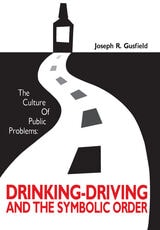
The Culture of Public Problems
Drinking-Driving and the Symbolic OrderJoseph R. Gusfield
University of Chicago Press, 1980
"A sophisticated and thoughtful critic. . . . Gusfield argues that the 'myth of the killer drunk' is a creation of the 'public culture of law.' . . . Through its dramatic development and condemnation of the anti-social character of the drinking-driver, the public law strengthens the illusion of moral consensus in American society and celebrates the virtues of a sober and orderly world."—James D. Orcutt, Sociology and Social Research
"Joseph Gusfield denies neither the role of alcohol in highway accidents nor the need to do something about it. His point is that the research we conduct on drinking-driving and the laws we make to inhibit it tells us more about our moral order than about the effects of drinking-driving itself. Many will object to this conclusion, but none can ignore it. Indeed, the book will put many scientific and legal experts on the defensive as they face Gusfield's massive erudition, pointed analysis and criticism, and powerful argumentation. In The Culture of Public Problems, Gusfield presents the experts, and us, with a masterpiece of sociological reasoning."—Barry Schwartz, American Journal of Sociology
This book is truly an outstanding achievement. . . . It is sociology of science, sociology of law, sociology of deviance, and sociology of knowledge. Sociologists generally should find the book of great theoretical interest, and it should stimulate personal reflection on their assumptions about science and the kind of consciousness it creates. They will also find that the book is a delight to read."—William B. Bankston, Social Forces
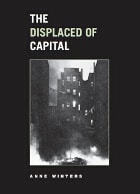
The Displaced of Capital
Anne Winters
University of Chicago Press, 2004
The long-awaited follow-up to The Key to the City—a finalist for the National Book Critics Circle Award in 1986—Anne Winters's The Displaced of Capital emanates a quiet and authoritative passion for social justice, embodying the voice of a subtle, sophisticated conscience.
The "displaced" in the book's title refers to the poor, the homeless, and the disenfranchised who populate New York, the city that serves at once as gritty backdrop, city of dreams, and urban nightmare. Winters also addresses the culturally, ethnically, and emotionally excluded and, in these politically sensitive poems, writes without sentimentality of a cityscape of tenements and immigrants, offering her poetry as a testament to the lives of have-nots. In the central poem, Winters witnesses the relationship between two women of disparate social classes whose friendship represents the poet's political convictions. With poems both powerful and musical, The Displaced of Capital marks Anne Winters's triumphant return and assures her standing as an essential New York poet.

The Fixed Stars
Thirty-Seven Emblems for the Perilous SeasonBrian Conn
University of Alabama Press, 2010
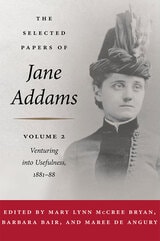
The Selected Papers of Jane Addams
Vol. 2: Venturing into UsefulnessEdited by Mary Lynn McCree Bryan, Barbara Bair, and Maree de Angury; with the assistance of Elizabeth Stevens, Stewart Burns, and Ellen Skerrett
University of Illinois Press, 2009
Artfully annotated, The Selected Papers of Jane Addams offers an evocative choice of correspondence, photographs, and other primary documents, presenting a multi-layered narrative of Addams's personal and emerging professional life. Themes inaugurated in the previous volume are expanded here, including dilemmas of family relations and gender roles; the history of education; the dynamics of female friendship; religious belief and ethical development; changes in opportunities for women; and the evolution of philanthropy, social welfare, and reform ideas.
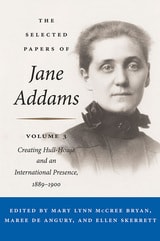
The Selected Papers of Jane Addams
Vol. 3: Creating Hull-House and an International Presence, 1889-1900Jane Addams Edited by Mary Lynn McCree Bryan, Maree de Angury, and Ellen Skerrett: with the assistance of Richard R. Seidel,
University of Illinois Press, 2019
The third volume in this acclaimed series documents Addams’s creation of Hull-House and her rise to worldwide fame as the acknowledged female leader of progressive reform. It also provides evidence of her growing commitment to pacifism. Here we see Addams, a force of thought, action, and commitment, forming lasting relationships with her Hull-House neighbors and the Chicago community of civic, political, and social leaders, even as she matured as an organizer, leader, and fund-raiser, and as a sought-after speaker, and writer. The papers reveal her positions on reform challenges while illuminating her strategies, successes, and responses to failures. At the same time, the collection brings to light Addams’s private life. Letters and other documents trace how many of her Hull-House and reform alliances evolved into deep, lasting friendships and also explore the challenges she faced as her role in her own family life became more complex.
Fully annotated and packed with illustrations, The Selected Papers of Jane Addams, Volume 3 is a portrait of a woman as she changed—and as she changed history.
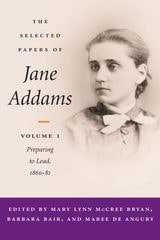
The Selected Papers of Jane Addams
vol. 1: Preparing to Lead, 1860-81Edited by Mary Lynn McCree Bryan, Barbara Bair, and Maree de Angury
University of Illinois Press, 2002
The Worker
Dominion and FormErnst Jünger, Edited by Laurence Paul Hemming, Translated from the German by Bogdan Costea and Laurence Paul Hemming
Northwestern University Press, 2018
Martin Heidegger considered Jünger “the only genuine follower of Nietzsche,” singularly providing “an interpretation which took shape in the domain of that metaphysics which already determines our epoch, even against our knowledge; this metaphysics is Nietzsche's doctrine of the ‘will to power.’” In The Worker, Jünger examines some of the defining questions of that epoch: the nature of individuality, society, and the state; morality, justice, and law; and the relationships between freedom and power and between technology and nature.
This work, appearing in its entirety in English translation for the first time, is an important contribution to debates on work, technology, and politics by one of the most controversial German intellectuals of the twentieth century. Not merely of historical interest, The Worker carries a vital message for contemporary debates about world economy, political stability, and equality in our own age, one marked by unsettling parallels to the 1930s.
Toward Better Problems
New Perspectives on Abortion, Animal Rights, the Environment, and JusticeAnthony Weston
Temple University Press, 1992
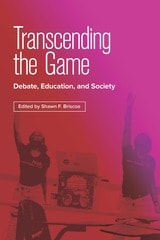
Transcending the Game
Debate, Education, and SocietyEdited by Shawn F. Briscoe
Southern Illinois University Press, 2024
A pathway to community, growth, and change
This collection of inclusive essays explores the role of debate in understanding and critiquing injustice and inequality. Edited by Shawn F. Briscoe, these essays closely examine multiple approaches to debate, considering their respective merits and controversies. This detailed compilation analyzes how debate methodologies are useful in everyday life and whether certain approaches have any value at all.
Briscoe provides an in-depth look into the varying styles of debate and contributes to a greater understanding of argument theory by discussing three stylistic approaches: audience-centered, technical/progressive, and nontraditional/performative. The book demonstrates that all three approaches offer students opportunity to engage in a socioemotional learning space, a discipline that prepares students for undergraduate and graduate work, a study that prepares participants for future careers, and a field that investigates current controversies and how to tackle them. Briscoe offers compelling narratives from BIPOC, LGBTQIA, and women authors that explore the personal impact of debate on social equality within this academic discipline, our educational system, and society.
The diversity in gender and race of the contributing authors allows for a multitude of perspectives on the complex styles, benefits, and issues discussed in Transcending the Game. Briscoe peels back the mystery that shrouds the benefits of academic, competitive debate from outsiders and insiders alike. A myriad of personal narratives tell stories about the role of debate in their lives; challenge the unproductive discourse in debate, education, and society; and offer diverse insight into why we debate.
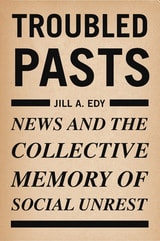
Troubled Pasts
News and the Collective Memory of Social UnrestJill A. Edy
Temple University Press, 2006