Results by title
107 books match the query 'Socialism' and 20 start with t

TV Socialism
Anikó Imre
Duke University Press, 2016

The Agrarian Question Volume 1
Karl Kautsky
Pluto Press, 1988
Lenin described The Agrarian Question as the first systematic Marxist study of capitalism and agriculture and the most important event in economic literature since the third volume of Capital. This great work is regarded as Kautsky's main achievement and is a classic work of analysis.
Kautsky's pariah status in the eyes of revolutionary Marxists resulted in many years of neglect, but his role and work are now commanding great attention. The analysis of the transformation of peasant economies by capital in The Agrarian Question is now seen as particularly relevant to contemporary Third World peasant economies.
This remarkable translation, which brings out the humanity - and the humour - in Kautksy's writing, is more than a work of economic analysis: in a manner ahead of his time, Kautsky integrates questions of political strategy, ecology, sexuality and the family.
The illuminating reassessment of The Agrarian Question in the introduction by Professor Teodor Shanin and Hamza Alavi examines in detail the political context, Kautsky's own life, the development of Kautsky's ideas within the work, and its contribution to our understanding of the world today. This timely re-evaluation of Kautsky's significance is long overdue.
The Agrarian Question Volume 2
Karl Kautsky
Pluto Press, 1988
Lenin described The Agrarian Question as the first systematic Marxist study of capitalism and agriculture and the most important event in economic literature since the third volume of Capital. This great work is regarded as Kautsky's main achievement and is a classic work of analysis.
Kautsky's pariah status in the eyes of revolutionary Marxists resulted in many years of neglect, but his role and work are now commanding great attention. The analysis of the transformation of peasant economies by capital in The Agrarian Question is now seen as particularly relevant to contemporary Third World peasant economies.
This remarkable translation, which brings out the humanity - and the humour - in Kautksy's writing, is more than a work of economic analysis: in a manner ahead of his time, Kautsky integrates questions of political strategy, ecology, sexuality and the family.
The illuminating reassessment of The Agrarian Question in the introduction by Professor Teodor Shanin and Hamza Alavi examines in detail the political context, Kautsky's own life, the development of Kautsky's ideas within the work, and its contribution to our understanding of the world today. This timely re-evaluation of Kautsky's significance is long overdue.
The Condition of Digitality
A Post-Modern Marxism for the Practice of Digital LifeRobert Hassan
University of Westminster Press, 2020
David Harvey’s The Condition of Postmodernity rationalised capitalism’s transformation during an extraordinary year: 1989. It gave theoretical expression to a material and cultural reality that was just then getting properly started – globalisation and postmodernity – whilst highlighting the geo-spatial limits to accumulation imposed by our planet.
However this landmark publication, author Robert Hassan argues, did not address the arrival of digital technology, the quantum leap represented by the move from an analogue world to a digital economy and the rapid creation of a global networked society. Considering first the contexts of 1989 and Harvey’s work, then the idea of humans as analogue beings he argues this arising new human condition of digitality leads to alienation not only from technology but also the environment. This condition he suggests, is not an ideology of time and space but a reality stressing that Harvey’s time-space compression takes on new features including those of ‘outward’ and ‘inward’ globalisation and the commodification of all spheres of existence.
Lastly the author considers culture’s role drawing on Rahel Jaeggi’s theories to make the case for a post-modern Marxism attuned to the most significant issue of our age. Stimulating and theoretically wide-ranging The Condition of Digitality recognises post-modernity’s radical new form as a reality and the urgent need to assert more democratic control over digitality.

The Crisis of Socialism in Europe
Christiane Lemke and Gary Marks, eds.
Duke University Press, 1991
The collection begins with an historical overview of socialism in Western Europe and moves toward the suggestion of a framework for a post-socialist discourse. Among the topics covered are: the birth and death of communism and a regime type in Eastern Europe; how different forms of national communism were smothered by Sovietization in the postwar period; the origins of revolutions in Eastern Europe; the potential for social democracy in Hungary; the role of the Left in a reunified German; and directions for the Left in general.
Contributors. Geoff Eley, Konrad Jarausch, Herbert Kitschelt, Christiane Lemke, Andrei Markovits, Gary Marks, Wolfgang Merkel, Norman Naimark, Iván and Szonja Szelénya, Sharon Wolchik
The Currency of Truth
Newsmaking and the Late-Socialist Imaginaries of China's Digital EraEmily H. C. Chua
University of Michigan Press, 2023
In The Currency of Truth, Emily H. C. Chua argues that news in China works less as a medium of mass communication than as a kind of currency as industry players make and use news articles to create agreements, build connections, and protect and advance their positions against one another. Looking at the ethical and professional principles that well-intentioned and civically minded journalists strive to uphold, and the challenges and doubts that they grapple with in the process, Chua brings her findings into conversation around “post-truth” news and the “crisis” of professional journalism in the West. The book encourages readers to rethink contemporary news, arguing that rather than setting out from the assumption that news works either to inform or deceive its publics, we should explore the “post-public” social and political imaginaries emerging among today’s newsmakers and remaking the terms of their practice.
The Education of a Radical
An American Revolutionary in Sandinista NicaraguaBy Michael Johns
University of Texas Press, 2012
“I went to Nicaragua with nothing but a tourist visa, $1,500 in cash, the name of someone at the Agrarian Reform Ministry, and the idea of being a revolutionary intellectual. . . . The idea took hold in a simple character flaw: wanting to believe that I knew better than everyone else.” —From the preface
When Michael Johns joined a Sandinista militia in 1983, a fellow revolutionary dubbed him a rábano, a radish: red on the outside but white on the inside. Now, more than twenty-five years later, Johns appreciates the wisdom of that label as he revisits the questions of identity he tried to resolve by working with the Sandinistas at that point in his life. In The Education of a Radical, Johns recounts his immersion in Marxism and the Nicaraguan sojourn it led to, with a painful maturation process along the way.
His conversion began in college, where he joined a student group called the Latin American Solidarity Association and traveled to Chiapas, Mexico, for research on his senior thesis. Overwhelmed by the poverty he witnessed (and fascinated by a new friend named Maricela who was trying to turn peasants into revolutionaries and who carried a heavily highlighted copy of Late Capitalism), he experienced an ideological transformation. When a Marxist professor later encouraged him to travel to Nicaragua, the real internal battle began for him, a battle that was intensified by the U.S. invasion of Grenada and its effect on the Sandinistas, who believed they were the next target for an imminent American invasion. Before he knew it, Johns was digging trenches and learning how to use an AK-47. His intellectual ideals came face-to-face with revolutionary facts, and the results would perplex him for years to come.
Bringing to life a vivid portrait of the sometimes painful process of reconciling reality with romanticized principles, The Education of a Radical encapsulates a trove of truths about humanity, economics, and politics in one man’s memorable journey.

The End of the Cold War
European Unity, Socialism, and the Shift in Global PowerBogdan Denitch
University of Minnesota Press, 1990
The End of the Cold War was first published in 1990. Minnesota Archive Editions uses digital technology to make long-unavailable books once again accessible, and are published unaltered from the original University of Minnesota Press editions.
Against the backdrop of unprecedented change in the world political and social order, Bogdan Denitch charts the unique opportunities and potential pitfalls that accompany the increased economic and political integration of the European Community. Historically, any move toward unification has had broad ramifications. This, coming as it does in the wake of recent democratic upheavals in Europe, will bring to a close an entire era -- an era of a world dominated by superpowers and the cold war that defined there confrontations.

The Fatal Conceit
The Errors of SocialismF. A. Hayek
University of Chicago Press, 1988
"The achievement of The Fatal Conceit is that it freshly shows why socialism must be refuted rather than merely dismissed—then refutes it again."—David R. Henderson, Fortune.
"Fascinating. . . . The energy and precision with which Mr. Hayek sweeps away his opposition is impressive."—Edward H. Crane, Wall Street Journal
F. A. Hayek is considered a pioneer in monetary theory, the preeminent proponent of the libertarian philosophy, and the ideological mentor of the Reagan and Thatcher "revolutions."
The Left Unraveled
Social Democracy & the New Left Challenge in Britain & West GermanyThomas A. Koelble
Duke University Press, 1991
By focusing on the established parties rather than on external developments, Koelble departs from conventional methodology regarding the fortunes of political parties. In examining the fundamental processes of decision making and coalition building within the SPD and the Labour Party, he argues that it is the organizational structures within parties that shape political results by setting limits, creating opportunities, and determining strategies.
The Left and Digital Politics
Political Parties from Platform Neoliberalism to Platform SocialismMarco Guglielmo
University of Westminster Press, 2025
The Problem with Work
Feminism, Marxism, Antiwork Politics, and Postwork ImaginariesKathi Weeks
Duke University Press, 2011
The Real Venezuela
Making Socialism in the 21st CenturyIain Bruce
Pluto Press, 2008
Venezuela has become a huge source of hope and inspiration for the Left throughout the world. Some see it as a shining example of how to begin building a successful socialist state, but Western leaders see it as a dangerous enemy and accuse Chávez of being a dictator. This book reveals the truth by examining the country from the ground up.
Iain Bruce explores the political changes underway in Venezuela at the level of the lives of ordinary people. Through grassroots investigations and extended interviews, he explores a series of key transformations in Venezuela: a new social economy around a network of co-operatives; workplace democracy; popular education; radical agrarian reform; participatory budgets and community planning. The result is a clear picture of everyday life in Venezuela.
No other book on the country has this level of detail; it will be a key text for students of Latin American politics and social movements and of interest to anyone following the fortunes of the Bolivarian Revolution.

The Red Coast
Radicalism and Anti-Radicalism in Southwest WashingtonAaron Goings
Oregon State University Press, 2019
With a focus on socialists, militant unionists, Wobblies, "Red" Finns, and Communists, The Red Coast covers the people, places, and events that made history-well-known events like the 1919 Armistice Day Tragedy in Centralia and the murders of labor activists William McKay and Laura Law in Aberdeen as well as lesser-known events that have been lost to posterity until now.
The Red Coast also delves deep into the lives and work of the region's anti-radical forces, examining the collective efforts of employers, news editors, and vigilantes to combat working-class organization. Topics include the Wobblies, the labor wars of the 1910s and 1930s, and the lumber and maritime industries. Labor historians, scholars, and general readers with interest in the working-class history of the Pacific Northwest will welcome this comprehensive and accessible account.

The Reification of Desire
Toward a Queer MarxismKevin Floyd
University of Minnesota Press, 2009
Kevin Floyd brings queer critique to bear on the Marxian categories of reification and totality and considers the dialectic that frames the work of Georg Lukács, Herbert Marcuse, and Fredric Jameson. Reading the work of these theorists together with influential queer work by such figures as Michel Foucault and Judith Butler, and alongside reconsiderations of such texts as The Sun Also Rises and Midnight Cowboy, Floyd reformulates these two central categories that have been inseparable from a key strand of Marxist thought and have marked both its explanatory power and its limitations. Floyd theorizes a dissociation of sexuality from gender at the beginning of the twentieth century in terms of reification to claim that this dissociation is one aspect of a larger dynamic of social reification enforced by capitalism.
Developing a queer examination of reification and totality, Kevin Floyd ultimately argues that the insights of queer theory require a fundamental rethinking of both.

The Socialist Way of Life in Siberia
Transformation in BuryatiaMelissa Chakars
Central European University Press, 2014
The Strange Death of Marxism
The European Left in the New MillenniumPaul Edward Gottrfied
University of Missouri Press, 2005
The Transformation of Chinese Socialism
Chun Lin
Duke University Press, 2006
Theories Of The New Class
Intellectuals And PowerLawrence Peter King
University of Minnesota Press, 2004
Demonstrates the centrality of thinking about intellectual class formation to social theory
Old as the notion of the “New Class” is (the term was coined by anarchist Mikhail Bakunin around 1870), the idea of the ascendancy of an intellectual elite continues to engage, and perplex, social theorists. In Theories of the New Class, Iván Szelényi, one of the most incisive and respected analysts of the intellectual class, and his colleague Lawrence King put New Class theories into a broad historical framework for the first time.
Addressing the intellectual history of Marxism and socialism, theories of the increasing role of the state and technocratic elites in capitalism, and theories of contemporary social change, King and Szelényi’s work clearly links the centrality of thinking about intellectual class formation to a variety of theoretical and political projects that have shaped social theory and influenced political realities over the past century.King and Szelényi show that the idea of the New Class has stubbornly entered and reentered the agenda of critical social theorizing throughout the last century. Indeed, they interpret that the last century as a history of projects by different groups of the highly educated—factions of intellectuals, bureaucrats, technocrats, managers, and the left-wing humanistic intelligentsia—to gain ultimate power. A rare empirical discussion of theory, Theories of the New Class invigorates class theories by grounding them in contemporary issues; at the same time, it uses modern polemics to revitalize historical debates on the origins of capitalism.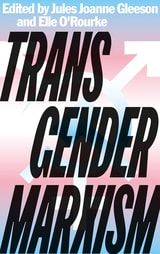
Transgender Marxism
Jules Joanne Gleeson
Pluto Press, 2021
Exploring trans lives and movements, the authors delve into the experience of surviving as transgender under capitalism. They explore the pressures, oppression and state persecution faced by trans people living in capitalist societies, their tenuous positions in the workplace and the home, and give a powerful response to right-wing scaremongering against 'gender ideology'.
Reflecting on the relations between gender and labour, these essays reveal the structure of antagonisms faced by gender non-conforming people within society. Looking at the history of transgender movements, Marxist interventions into developmental theory, psychoanalysis and workplace ethnography, the authors conclude that for trans liberation, capitalism must be abolished.