Results by title
247 books match the query 'South Africa' and 44 start with t
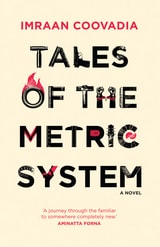
Tales of the Metric System
A NovelImraan Coovadia
Ohio University Press, 2016
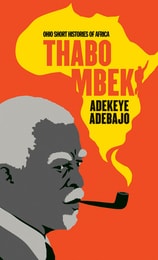
Thabo Mbeki
Adekeye Adebajo
Ohio University Press, 2017
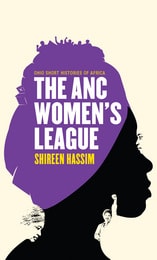
The ANC Women’s League
Sex, Gender and PoliticsShireen Hassim
Ohio University Press, 2015
First formed in the early twentieth century, the ANC Women’s League has grown into a leading organization in the women’s movement in South Africa. The league has been at the forefront of the nation’s century-long transition from an authoritarian state to a democracy that espouses gender equality as a core constitutional value. It has, indeed, always regarded itself as the women’s movement, frequently asserting its primacy as a vanguard organization and as the only legitimate voice of the women of South Africa. But, as this deeply insightful book shows, the history of the league is a more complicated affair—it was neither the only women’s organization in the political field nor an easy ally for South African feminism.
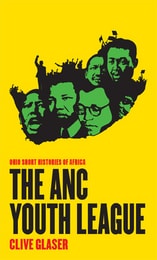
The ANC Youth League
Clive Glaser
Ohio University Press, 2012
This brilliant little book tells the story of the African National Congress (ANC) Youth League from its origins in the 1940s to the present and the controversies over Julius Malema and his influence in contemporary youth politics. Glaser analyzes the ideology and tactics of its founders, some of whom (notably Nelson Mandela and Oliver Tambo) later became iconic figures in South African history as well as inspirational figures such as A. P. Mda (father of author Zakes Mda) and Anton Lembede. It shows how the early Youth League gave birth not only to the modern ANC but also to its rival, the Pan Africanist Congress. Dormant for many years, the Youth League reemerged in the transition era under the leadership of Peter Mokaba—infused with the tradition of the militant youth politics of the 1980s. Throughout its history the Youth League has tried to “dynamize” and criticize the ANC from within, while remaining devoted to the mother body and struggling to find a balance between loyalty and rebellion.

The ANC and the Liberation Struggle
A Critical Political BiographyDale T. McKinley
Pluto Press, 1997
eloquent testimony of the continuing vitality of the South African left' Modern African Studies
The African National Congress, the ANC, negotiated a transition of government and power in South Africa in the early 1990s and gained widespread respect and legitimacy when Nelson Mandela was voted in as President in 1994.
In this controversial and radical critique of the ANC and the struggle for liberation in South Africa, Dale T. McKinley challenges conventional public perceptions of the organisation and its celebrated rise to power. McKinley offers the first detailed analysis of the ANC's leadership, tactics and strategies from the 1920s, through the years of exile, to the 1990s, focusing on its close alliance with the South African Communist Party. he reveals that the organisation, despite historical claims to the contrary, failed to stay in touch with the south African masses. The ANC made fundamental compromises to gain political power, and in so doing has ensured that the economic power-base of the ruling elites in South Africa remains essentially unaltered.
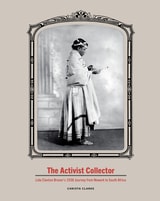
The Activist Collector
Lida Clanton Broner’s 1938 Journey from Newark to South AfricaChrista Clarke
Rutgers University Press, 2023
Published by the Newark Museum. Distributed worldwide by Rutgers University Press.
“After twenty-eight years of desire and determination, I have visited Africa, the land of my forefathers.” So wrote Lida Clanton Broner (1895–1982), an African American housekeeper and hairstylist from Newark, New Jersey, upon her return from an extraordinary nine-month journey to South Africa in 1938. This epic trip was motivated not only by Broner’s sense of ancestral heritage, but also a grassroots resolve to connect the socio-political concerns of African Americans with those of black South Africans under the segregationist policies of the time. During her travels, this woman of modest means circulated among South Africa’s Black intellectual elite, including many leaders of South Africa’s freedom struggle. Her lectures at Black schools on “race consciousness and race pride” had a decidedly political bent, even as she was presented as an “American beauty specialist.”
How did Broner—a working class mother—come to be a globally connected activist? What were her experiences as an African American woman in segregated South Africa and how did she further her work after her return? Broner’s remarkable story is the subject of this book, which draws upon a deep visual and documentary record now held in the collection of the Newark Museum of Art. This extraordinary archive includes more than one hundred and fifty objects, ranging from beadwork and pottery to mission school crafts, acquired by Broner in South Africa, along with her diary, correspondence, scrapbooks, and hundreds of photographs with handwritten notations.
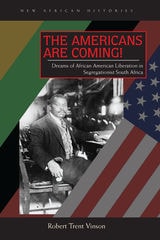
The Americans Are Coming!
Dreams of African American Liberation in Segregationist South AfricaRobert Trent Vinson
Ohio University Press, 2011
For more than half a century before World War II, black South Africans and “American Negroes”—a group that included African Americans and black West Indians—established close institutional and personal relationships that laid the necessary groundwork for the successful South African and American antiapartheid movements. Though African Americans suffered under Jim Crow racial discrimination, oppressed Africans saw African Americans as free people who had risen from slavery to success and were role models and potential liberators.
Many African Americans, regarded initially by the South African government as “honorary whites” exempt from segregation, also saw their activities in South Africa as a divinely ordained mission to establish “Africa for Africans,” liberated from European empires. The Jamaican-born Marcus Garvey’s Universal Negro Improvement Association, the largest black-led movement with two million members and supporters in forty-three countries at its height in the early 1920s, was the most anticipated source of liberation. Though these liberation prophecies went unfulfilled, black South Africans continued to view African Americans as inspirational models and as critical partners in the global antiapartheid struggle.
The Americans Are Coming! is a rare case study that places African history and American history in a global context and centers Africa in African Diaspora studies.
The Anatomy of a South African Genocide
The Extermination of the Cape San PeoplesMohamed Adhikari
Ohio University Press, 2011
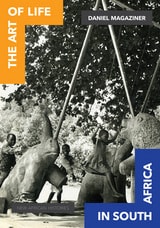
The Art of Life in South Africa
Daniel Magaziner
Ohio University Press, 2016
From 1952 to 1981, South Africa’s apartheid government ran an art school for the training of African art teachers at Indaleni, in what is today KwaZulu-Natal. The Art of Life in South Africa is the story of the students, teachers, art, and politics that circulated through a small school, housed in a remote former mission station. It is the story of a community that made its way through the travails of white supremacist South Africa and demonstrates how the art students and teachers made together became the art of their lives.
Daniel Magaziner radically reframes apartheid-era South African history. Against the dominant narrative of apartheid oppression and black resistance, as well as recent scholarship that explores violence, criminality, and the hopeless entanglements of the apartheid state, this book focuses instead on a small group’s efforts to fashion more fulfilling lives for its members and their community through the ironic medium of the apartheid-era school.
There is no book like this in South African historiography. Lushly illustrated and poetically written, it gives us fully formed lives that offer remarkable insights into the now clichéd experience of black life under segregation and apartheid.
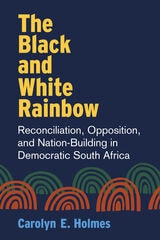
The Black and White Rainbow
Reconciliation, Opposition, and Nation-Building in Democratic South AfricaCarolyn E. Holmes
University of Michigan Press, 2020
Based on ethnographic and interview-based fieldwork conducted in 2012–13, The Black and White Rainbow: Reconciliation, Opposition, and Nation-Building in Democratic South Africa explores various themes of nation- and democracy-building, including the emotional and banal content of symbols of the post-apartheid state, the ways that gender and race condition nascent nationalism, the public performance of nationalism and other group-based identities, integration and sharing of space, language diversity, and the role of democratic functioning including party politics and modes of opposition. Each of these thematic chapters aims to explicate a feature of the multifaceted nature of identity-building, and link the South African case to broader literatures on both nationalism and democracy.

The Changing Past
Trends in South African Historical WritingKen Smith
Ohio University Press, 1989
E.H. Carr said: “Before you study the history, study the historian.” Written history often tells us more about the historian’s own times than it does of the times about which he is writing. The historians and the way in which each generation has rewritten history in the light of its own preoccupations is the subject of The Changing Past. This is the first book-length survey in English that covers all the main trends in South African historiography. Starting with the first documents and histories, it goes on to trace the 19th century. British and settler “schools,” Afrikaans historiography from its pre-academic 19th century phase to the present, and the liberal historians who struck out in a new direction from the 1920s. The book highlights the break with the past that historians of the “new radical school” have made in the last 15 years, and surveys the position of historical writing to the present.
The canvas is delineated in bold strokes that sketch in the main outlines rather than seek an exhaustive treatment of all existing literature. This, together with a conscious effort to minimize theoretical discussion, makes it a highly readable text.
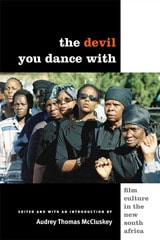
The Devil You Dance With
Film Culture in the New South AfricaEdited and with an Introduction by Audrey McCluskey
University of Illinois Press, 2008
This extraordinary volume presents twenty-five in-depth interviews with established and emerging South African filmmakers, collected and edited by Audrey Thomas McCluskey. The interviews capture the filmmakers’ spirit, energy, and ambition as they attempt to give birth to a film culture that reflects the heart and aspirations of their diverse and emergent nation. The collection includes a biographical profile of each filmmaker, as well an introductory essay by McCluskey, pointing to the themes, as well as creative differences and similarities, among the filmmakers.
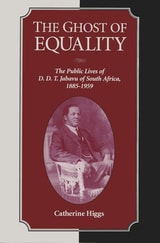
The Ghost of Equality
The Public Lives of D. D. T. Jabavu of South Africa, 1885–1959Catherine Higgs
Ohio University Press, 1996
Davidson Don Tengo Jabavu was born in the Cape Colony in British southern Africa on October 20, 1885, when a few African men could vote and the prospects for black equality with the ruling whites seemed promising. He died on August 3, 1959, in the Cape Province of the Union of South Africa, eleven years after the apartheid state had begun stripping blacks of their rights and exorcising the ‘ghost of equality’ with a completeness unparalleled in the country’s history. The ‘ghost of equality was the last vestige of the Cape liberal tradition — itself best summed up by the dictum ’equal rights for all civilized men‘ — finally erased in 1959 with the passage of legislation that would, the following year, remove from parliament the last elected white representatives of Africans.…
If D.D.T. Jabavu’s life reveals anything about South Africa’s political history, it is that this history was not monolithic. It was not simply a lengthly confrontation between a black elite represented by the African National Congress and the white segregationist state. Rather, there was a range of black political opinion and activity, of which Jabavu, an active participant in virtually every government-sponsored and every major extraparliamentary conference between 1920 and the late 1940s, represented one prominent historical strain.
This book, however, is about more than D.D.T. Javavu’s politics; it is about his public life, or perhaps more accurately, his public lives. The book is arranged thematically, divided according to the parts Jabavu played: student, teacher, Methodist, and politician.
— from the introduction by the author

The Global Debate over Constitutional Property
Lessons for American Takings JurisprudenceGregory S. Alexander
University of Chicago Press, 2006
A society’s traditions and culture, Alexander argues, have a much greater effect on property rights. Laws must aim, then, to change cultural ideas of property, rather than deem whether one has the right to own it. Ultimately, Alexander builds a strong case for improving American takings law by borrowing features from the laws of other countries—particularly those laws based on the idea that owning property not only confers rights, but also entails responsibilities to society as a whole.
The Global Economy and Democracy in South Africa
Koelble, Thomas A.
Rutgers University Press, 1998
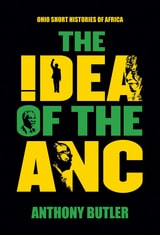
The Idea of the ANC
Anthony Butler
Ohio University Press, 2013
The African National Congress (ANC) is Africa’s most famous liberation movement. It has recently celebrated its centenary, a milestone that has prompted partisans to detail a century of unparalleled achievement in the struggle against colonialism and racial discrimination. Critics paint a less flattering portrait of the historical ANC as a communist puppet, a moribund dinosaur, or an elitist political parasite. For such skeptics, the ANC—now in government for two decades—has betrayed South Africans rather than liberating them.
South Africans endure deep inequality and unemployment, violent community protests, murders of foreign residents, major policy blunders, an AIDS crisis, and deepening corruption. Inside the ANC there are episodes of open rebellion against the leadership, conflicts over the character of a postliberation movement, and debilitating battles for succession to the movement’s presidency. The ANC is nevertheless likely to remain the party of government for the foreseeable future.
This remarkable book explores how ANC intellectuals and leaders interpret the historical project of their movement. It investigates three interlocking ideas: a conception of power, a responsibility for promoting unity, and a commitment to human liberation. Anthony Butler explores how these notions have shaped South African politics in the past and how they will inform ANC leaders’ responses to the challenges of the future.
The Impossible Machine
A Genealogy of South Africa's Truth and Reconciliation CommissionAdam Sitze
University of Michigan Press, 2016
Adam Sitze meticulously traces the origins of South Africa’s Truth and Reconciliation Commission back to two well-established instruments of colonial and imperial governance: the jurisprudence of indemnity and the commission of inquiry. This genealogy provides a fresh, though counterintuitive, understanding of the TRC’s legal, political, and cultural importance. The TRC’s genius, Sitze contends, is not the substitution of “forgiving” restorative justice for “strict” legal justice but rather the innovative adaptation of colonial law, sovereignty, and government. However, this approach also contains a potential liability: if the TRC’s origins are forgotten, the very enterprise intended to overturn the jurisprudence of colonial rule may perpetuate it. In sum, Sitze proposes a provocative new means by which South Africa’s Truth and Reconciliation Commission should be understood and evaluated.

The Infrastructures of Security
Technologies of Risk Management in JohannesburgMartin J. Murray
University of Michigan Press, 2022
In The Infrastructures of Security, author Martin J. Murray concentrates on not only the turn toward technological solutions to managing the risk of crime through digital (and software-based) surveillance and automated information systems, but also the introduction of somewhat bizarre and fly-by-night experimental “answers” to perceived risk and danger. Digitalized surveillance is significant for two reasons: first, it enables monitoring to take place across wide "geographical distances with little time delay"; and second, it allows for the active sorting, identification, and "tracking of bodies, behaviors, and characteristics of subject populations on a continuous, real-time basis." These new software-based surveillance technologies represent monitoring, tracking, and information gathering without walls, towers, or guards.
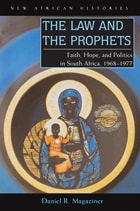
The Law and the Prophets
Black Consciousness in South Africa, 1968–1977Daniel Magaziner
Ohio University Press, 2010
“No nation can win a battle without faith,” Steve Biko wrote, and as Daniel R. Magaziner demonstrates in The Law and the Prophets, the combination of ideological and theological exploration proved a potent force.
The 1970s are a decade virtually lost to South African historiography. This span of years bridged the banning and exile of the country’s best-known antiapartheid leaders in the early 1960s and the furious protests that erupted after the Soweto uprisings of June 16, 1976. Scholars thus know that something happened—yet they have only recently begun to explore how and why.
The Law and the Prophets is an intellectual history of the resistance movement between 1968 and 1977; it follows the formation, early trials, and ultimate dissolution of the Black Consciousness movement. It differs from previous antiapartheid historiography, however, in that it focuses more on ideas than on people and organizations. Its singular contribution is an exploration of the theological turn that South African politics took during this time. Magaziner argues that only by understanding how ideas about race, faith, and selfhood developed and were transformed in this period might we begin to understand the dramatic changes that took place.
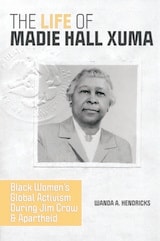
The Life of Madie Hall Xuma
Black Women's Global Activism during Jim Crow and ApartheidWanda A. Hendricks
University of Illinois Press, 2022
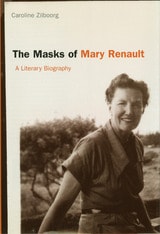
The Masks of Mary Renault
A Literary BiographyCaroline Zilboorg
University of Missouri Press, 2001
Born Eileen Mary Challans in London in 1905, Mary Renault wrote six successful contemporary novels before turning to the historical fiction about ancient Greece for which she is best known. While Renault's novels are still highly regarded, her life and work have never been completely examined. Caroline Zilboorg seeks to remedy this in The Masks of Mary Renault by exploring Renault's identity as a gifted writer and a sexual woman in a society in which neither of these identities was clear or easy.
Although Renault's life was anything but ordinary, this fact has often been obscured by her writing. The daughter of a doctor, she grew up comfortably and attended a boarding school in Bristol. She received a degree in English from St. Hugh's College in Oxford in 1928, but she chose not to pursue an academic career. Instead, she decided to attend the Radcliffe Infirmary in Oxford, where she trained to be a nurse. With the outbreak of the Second World War, she was assigned to the Winford Emergency Hospital in Bristol and briefly worked with Dunkirk evacuees. She went on to work in the Radcliffe Infirmary's brain surgery ward and was there until 1945.
It was during her nurse's training that Renault met Julie Mullard, who became her lifelong companion. This important lesbian relationship both resolved and posed many problems for Renault, not the least of which was how she was to write about issues at once intensely personal and socially challenging. In 1939, Renault published her first novel under a pseudonym in order to mask her identity. It was a time when she was struggling not only with her vocation (nursing and writing), but also with her sexual identity in the social and moral context of English life during the war.
In 1948, Renault left England with Mullard for South Africa and never returned. It was in South Africa that she made the shift from her early contemporary novels of manners to the mature historical novels of Hellenic life. The classical settings allowed Renault to mask material too explosive to deal with directly while simultaneously giving her an "academic" freedom to write about subjects vital to her—among them war, peace, career, women's roles, female and male homosexuality, and bisexuality.
Renault's reception complicates an understanding of her achievement, for she has a special status within the academic community, where she is both widely read and little written about. Her interest in sexuality and specifically in homosexuality and bisexuality, in fluid gender roles and identities, warrants a rereading and reevaluation of her work. Eloquently written and extensively researched, The Masks of Mary Renault will be of special value to anyone interested in women's studies or English literature.

The Mind is Not the Heart
Recollections of a Woman PhysicianEva J. Salber
Duke University Press, 1993
The Next Twenty-five Years
Affirmative Action in Higher Education in the United States and South AfricaDavid L. Featherman, Martin Hall, and Marvin Krislov, editors
University of Michigan Press, 2009
"Ambitious, provocative, and wide-ranging, this rich collection of essays from U.S. and South African perspectives reflects the thinking of thoughtful advocates of affirmative action."
---William G. Bowen, President Emeritus, The Andrew W. Mellon Foundation, and President Emeritus, Princeton University
"Thoughtful commentary from outstanding experts on affirmative action’s future in two countries struggling to overcome a legacy of racial injustice."
---Derek Bok, 300th Anniversary University Research Professor, and President Emeritus, Harvard University
"An enormously important comparative study and reflection on affirmative (U.S.) and corrective (South Africa) action with exhaustive and sensitive treatment of a vital topic."
---Kader Asmal, Professor of Law, University of the Western Cape, Cape Town, and former Minister of Education, South Africa
A penetrating exploration of affirmative action's continued place in 21st-century higher education, The Next Twenty-five Years assembles the viewpoints of some of the most influential scholars, educators, university leaders, and public officials. Its comparative essays span the political spectrum and dissect debates in two nations to elucidate the legal, political, social, economic, and moral dimensions of affirmative action in higher education and its role in contributing to a just, equitable, and vital society.
David L. Featherman is Professor of Sociology and Psychology and Founding Director of the Center for Advancing Research and Solutions for Society at the University of Michigan.
Martin Hall is Vice-Chancellor of the University of Salford, Greater Manchester, and previously was Deputy Vice-Chancellor at the University of Cape Town.
Marvin Krislov is President of Oberlin College and previously was Vice President and General Counsel at the University of Michigan.
The Novels of Nadine Gordimer
History from the InsideStephen Clingman
University of Massachusetts Press, 1986
In Nadine Gordimer's view, the novel can present history as historians cannot. Moreover, this presentation is not fictional in the sense of being “untrue.” Rather, fiction deals with an area of activity usually inaccessible to the sciences of greater externally: the area in which historical process is registered as the subjective experience of individuals in society; fiction give us “history from the inside.” Gordimer's novels give us an extraordinary and unique insight into historical experience in the period in which she writes.
The Old Testament and Christian Spirituality
Theoretical and Practical Essays from a South African PChristo Lombaard
SBL Press, 2012
An engaging anthology that deals with both theory and practice
The emerging discipline of biblical spirituality considers how faith finds expression within the biblical texts and how modern expressions of faith interact with those texts. This volume represents Christo Lombaard’s reflective, analytical, and exegetical contributions to the field in order to explore how biblical texts mediate faith, both ancient and contemporary. It reflects on aspects of the interaction of faith and Scripture, critically approaching both dimensions.
Features:
- Seven previously published papers drawn predominately from South African journals
- Explorations of how biblical texts mediate faith
- Close examination of the discipline of biblical spirituality as part of spirituality studies
The Perversity of Gratitude
An Apartheid EducationFarred, Grant
Temple University Press, 2024
Unsentimental about his education, Farred’s critique recognizes the impact of four exceptional teachers—all engaging pedagogical figures who cultivated a great sense of possibility in how thinking could be learned through a disenfranchised South African education.
The Perversity of Gratitude brings to bear the work of influential philosophers such as Martin Heidegger and Jacques Derrida. The book tackles broad philosophical concepts—transgression, withdrawal, and the dialectic. This leads to the creation of a new concept, “the diaspora-in-place,” which Farred explains, “is having left a place before one physically removes oneself from this place.”
Farred’s apartheid education in South Africa instilled in him a lifelong commitment to learning thinking. “And for that I am grateful,” Farred writes in The Perversity of Gratitude. His autopoiesis is sure to provoke and inspire readers.
The Poem in the Story
Music, Poetry, and NarrativeHarold Scheub
University of Wisconsin Press, 2002
Fact and fiction meet at the boundaries, the betwixt and between where transformations occur. This is the area of ambiguity where fiction and fact become endowed with meaning, and this is the area—where ambiguity, irony, and metaphor join forces—that Harold Scheub exposes in all its nuanced and evocative complexity in The Poem in the Story.
In a career devoted to exploring the art of the African storyteller, Scheub has conducted some of the most interesting and provocative investigations into nonverbal aspects of storytelling, the complex relationship between artist and audience, and, most dramatically, the role played by poetry in storytelling. This book is his most daring effort yet, an unconventional work that searches out what makes a story artistically engaging and emotionally evocative, the metaphorical center that Scheub calls "the poem in the story." Drawing on extensive fieldwork in southern Africa and decades of experience as a researcher and teacher, Scheub develops an original approach—a blend of field notes, diary entries, photographs, and texts of stories and poems—that guides readers into a new way of viewing, even experiencing, meaning in a story. Though this work is largely focused on African storytelling, its universal applications emerge when Scheub brings the work of storytellers as different as Shakespeare and Faulkner into the discussion.
The Politics of Necessity
Community Organizing and Democracy in South AfricaElke Zuern
University of Wisconsin Press, 2011
The end of apartheid in South Africa broke down political barriers, extending to all races the formal rights of citizenship, including the right to participate in free elections and parliamentary democracy. But South Africa remains one of the most economically polarized nations in the world. In The Politics of Necessity Elke Zuern forcefully argues that working toward greater socio-economic equality—access to food, housing, land, jobs—is crucial to achieving a successful and sustainable democracy.
Drawing on interviews with local residents and activists in South Africa’s impoverished townships during more than a decade of dramatic political change, Zuern tracks the development of community organizing and reveals the shifting challenges faced by poor citizens. Under apartheid, township residents began organizing to press the government to address the basic material necessities of the poor and expanded their demands to include full civil and political rights. While the movement succeeded in gaining formal political rights, democratization led to a new government that instituted neo-liberal economic reforms and sought to minimize protest. In discouraging dissent and failing to reduce economic inequality, South Africa’s new democracy has continued to disempower the poor.
By comparing movements in South Africa to those in other African and Latin American states, this book identifies profound challenges to democratization. Zuern asserts the fundamental indivisibility of all human rights, showing how protest movements that call attention to socio-economic demands, though often labeled a threat to democracy, offer significant opportunities for modern democracies to evolve into systems of rule that empower all citizens.
The Politics of Potential
Global Health and Gendered Futures in South AfricaMichelle Pentecost
Rutgers University Press, 2024
The Politics of Solidarity
Privatisation, Precarious Work and Labour in South AfricaCarmen Ludwig
Campus Verlag, 2019
The Price of Racial Reconciliation
Ronald W. Walters
University of Michigan Press, 2008
“In The Price of Racial Reconciliation, Ronald Walters offers an abundance of riches. This book provides an extraordinarily comprehensive and persuasive set of arguments for reparations, and will be the lens through which meaningful opportunities for reconciliation are viewed in the future. If this book does not lead to the success of the reparations movement, nothing will.”
—Charles J. Ogletree, Jesse Climenko Professor of Law, Harvard Law School
“The Price of Racial Reconciliation is a seminal study of comparative histories and race(ism) in the formation of state structures that prefigure(d) socioeconomic positions of Black peoples in South Africa and the United States. The scholarship is meticulous in brilliantly constructed analysis of the politics of memory, reparations as an immutable principle of justice, imperative for nonracial(ist) democracy, and a regime of racial reconciliation.”
—James Turner, Professor of African and African American Studies and Founder, Africana Studies and Research Center, Cornell University
“A fascinating and pathbreaking analysis of the attempt at racial reconciliation in South Africa which asks if that model is relevant to the contemporary American racial dilemma. An engaging multidisciplinary approach relevant to philosophy, sociology, history, and political science.”
—William Strickland, Associate Professor of Political Science, W.E.B. Du Bois Department of Afro-American Studies, University of Massachusetts Amherst
The issue of reparations in America provokes a lot of interest, but the public debate usually occurs at the level of historical accounting: “Who owes what for slavery?” This book attempts to get past that question to address racial restitution within the framework of larger societal interests. For example, the answer to the “why reparations?” question is more than the moral of payment for an injustice done in the past. Ronald Walters suggests that, insofar as the impact of slavery is still very much with us today and has been reinforced by forms of postslavery oppression, the objective of racial harmony will be disrupted unless it is recognized with the solemnity and amelioration it deserves. The author concludes that the grand narrative of black oppression in the United States—which contains the past and present summary of the black experience—prevents racial reconciliation as long as some substantial form of racial restitution is not seriously considered. This is “the price” of reconciliation.
The method for achieving this finding is grounded in comparative politics, where the analyses of institutions and political behaviors are standard approaches. The author presents the conceptual difficulties involved in the project of racial reconciliation by comparing South African Truth and Reconciliation and the demand for reparations in the United States.
Ronald Walters is Distinguished Leadership Scholar and Director, African American Leadership Program and Professor of Government and Politics, University of Maryland.
The Rainy Season
Three Lives in the New South AfricaMaggie Messitt
University of Iowa Press, 2015
The Rainy Season tells the stories of three generations in the Rainbow Nation one decade after its first democratic elections. This multi-threaded narrative follows Regina, a tapestry weaver in her sixties, standing at the crossroads where her Catholic faith and the AIDS pandemic crash; Thoko, a middle-aged sangoma (traditional healer) taking steps to turn her shebeen into a fully licensed tavern; and Dankie, a young man taking his matriculation exams, coming of age as one of Mandela’s Children, the first academic class educated entirely under democratic governance.
Home to Shangaan, Sotho, and Mozambican Tsonga families, Rooiboklaagte sits in a village where an outdoor butchery occupies an old petrol station and a funeral parlor sits in the attached garage. It’s a place where an AIDS education center sits across the street from a West African doctor selling cures for the pandemic. It’s where BMWs park outside of crumbling cement homes, and the availability of water changes with the day of the week. As the land shifts from dusty winter blond to lush summer green and back again, the duration of northeastern South Africa’s rainy season, Regina, Thoko, and Dankie all face the challenges and possibilities of the new South Africa.
The South Africa Reader
History, Culture, PoliticsClifton Crais and Thomas V. McClendon, eds.
Duke University Press, 2013
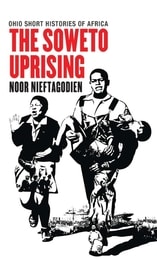
The Soweto Uprising
Noor Nieftagodien
Ohio University Press, 2015
The Soweto uprising was a true turning point in South Africa’s history. Even to contemporaries, it seemed to mark the beginning of the end of apartheid. This compelling book examines both the underlying causes and the immediate factors that led to this watershed event. It looks at the crucial roles of Black Consciousness ideology and nascent school-based organizations in shaping the character and form of the revolt. What began as a peaceful and coordinated demonstration rapidly turned into a violent protest when police opened fire on students. This short history explains the uprising and its aftermath from the perspective of its main participants, the youth, by drawing on a rich body of oral histories.
The Tongue Is Fire
South African Storytellers and ApartheidHarold E. Scheub
University of Wisconsin Press, 1996
With tape-recorder and camera in hand, Scheub registered the testaments of Swati, Xhosa, Ndebele, and Zulu storytellers, farming people who lived in the remote reaches of rural South Africa. While young people fought in the streets of Soweto and South African writers made the world aware of apartheid’s evils, the rural storytellers resisted apartheid in their own way, using myth and metaphor to preserve their traditions and confront their oppressors. For more than 20 years, Scheub kept the promise he made to the storytellers to publish his translations of their stories only when freedom came to South Africa. The Tongue Is Fire presents these voices of South African oral tradition—the historians, the poets, the epic-performers, the myth-makers—documenting their enduring faith in the power of the word to sustain tradition in the face of determined efforts to distort or eliminate it. These texts are a tribute to the storytellers who have always, in periods of crisis, exercised their art to inspire their own people.
The Trials of Richard Goldstone
Terris, Daniel
Rutgers University Press, 2019
The Trials of Richard Goldstone tells the story of this extraordinary individual and the price he paid for his convictions. It describes how Goldstone, working as a judge in apartheid South Africa, helped to undermine this unjust system and later, at Nelson Mandela’s request, led a commission that investigated cases of racial violence and intimidation. It also considers the international renown he received as the chief United Nations prosecutor for war crimes committed in Rwanda and the former Yugoslavia, the first tribunals to try political and military leaders on charges of genocide. Finally, it explores how Goldstone became a controversial figure in the wake of the Jewish jurist’s powerful, but flawed, investigation of Israel for alleged war crimes in Gaza.
Richard Goldstone’s dramatic life story reveals that even in a world rife with prejudice, nationalism, and contempt for human rights, one courageous man can advance the cause of justice.
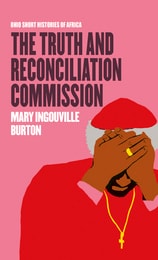
The Truth and Reconciliation Commission
Mary Ingouville Burton
Ohio University Press, 2017
In 1995, South Africa’s new government set up the Truth and Reconciliation Commission, a lynchpin of the country’s journey forward from apartheid. In contrast to the Nuremberg Trials and other retributive responses to atrocities, the TRC’s emphasis on reconciliation marked a restorative approach to addressing human rights violations and their legacies. The hearings, headed by Bishop Desmond Tutu, began in spring of 1996.
The commission was set up with three purposes: to investigate abuses, to assist victims with rehabilitation, and to consider perpetrators’ requests for amnesty. More than two decades after the first hearings, the TRC’s legacy remains mixed. Many families still do not know what became of their loved ones, and the commission came under legal challenges both from ex-president F. W. de Klerk and the African National Congress. Yet, the TRC fulfilled a vital role in the transition from apartheid to democracy, and has become a model for other countries.
This latest addition to the Ohio Short Histories of Africa series is a trenchant look at the TRC’s entire, stunningly ambitious project. And as a longtime activist for justice in South Africa and a former commissioner of the TRC, Mary Ingouville Burton is uniquely positioned to write this complex story.
The Uncoiling Python
South African Storytellers and ResistanceHarold Scheub
Ohio University Press, 2010
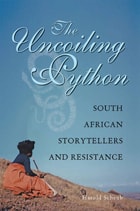
There are many collections of African oral traditions, but few as carefully organized as The Uncoiling Python. Harold Scheub, one of the world’s leading scholars of African oral traditions and folklore, explores the ways in which oral traditions have served to combat and subvert colonial domination in South Africa. From the time colonial forces first came to southern Africa in 1487, oral and written traditions have been a bulwark against what became 350 years of colonial rule, characterized by the racist policies of apartheid. The Uncoiling Python: South African Storytellers and Resistance is the first in-depth study of oral tradition as a means of survival.
In open insurrections and other subversive activities Africans resisted the daily humiliations of colonial rule, but perhaps the most effective and least apparent expression of subversion was through indigenous storytelling and poetic traditions. Harold Scheub has collected the stories and poetry of the Xhosa, Zulu, Swati, and Ndebele peoples to present a fascinating analysis of how the apparently harmless tellers of tales and creators of poetry acted as front-line soldiers.
Theatres of Struggle and the End of Apartheid
Belinda Bozzoli
Ohio University Press, 2004
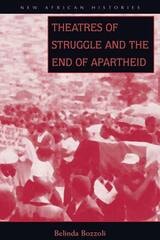
A compelling study of the origins and trajectory of one of the legendary black uprisings against apartheid, Theatres of Struggle and the End of Apartheid draws on insights gained from the literature on collective action and social movements. It delves into the Alexandra Rebellion of 1986 to reveal its inner workings.
Belinda Bozzoli’s aim is to examine how the residents of Alexandra, a poverty-stricken segregated township in Johannesburg, manipulated and overturned the meanings of space, time, and power in their sequestered world. She explains how they used political theater to convey, stage, and dramatize their struggle and how young and old residents generated differing ideologies and tactics, giving rise to a distinct form of generational politics.
Theatres of Struggle and the End of Apartheid asks the reader to enter into the world of the rebels and to confront the moral complexity and social duress they experienced as they invented new social forms and violently attacked old ones. It is an important study of collective action that will be of great interest to sociologists and to scholars of Africa, particularly to those interested in the antiapartheid struggle.
To Swim with Crocodiles
Land, Violence, and Belonging in South Africa, 1800-1996Jill E Kelly
Michigan State University Press, 2018
To the Fairest Cape
European Encounters in the Cape of Good HopeJack, Malcolm
Bucknell University Press, 2019
Published by Bucknell University Press. Distributed worldwide by Rutgers University Press.
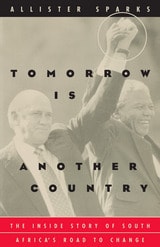
Tomorrow Is Another Country
The Inside Story of South Africa's Road to ChangeAllister Sparks
University of Chicago Press, 1996
"A gripping, fast-paced, authoritative account of the long and mostly secret negotiations that brought South Africa's bitter conflict to its near-miraculous end. Sparks's description of these talks sometimes brings a lump to one's throat. He shows how the participants' deep mutual suspicion was gradually replaced by excitement at the prospect of making a momentous agreement—and also by the dawning realization that the people on the other side were human beings, perhaps even decent human beings."—Adam Hochschild, New York Times Book Review
"A splendid and original history. . . . Sparks's skillful weaving of myriad strands—Mandela's secret sessions with the committee, the clandestine talks in England between the African National Congress and the government, the back-channel communications between Mandela and the A.N.C. in exile, the trepidation of Botha and the apparent transformation of his successor, De Klerk—possesses the drama and intrigue of a diplomatic whodunit."—Richard Stengel, Time
"Sparks offers many reasons for hope, but the most profound of them is the story this book tells."—Jacob Weisberg, Washington Post
"The most riveting of the many [accounts] that have been published about the end of apartheid."—The Economist
Transformation and Trouble
Crime, Justice and Participation in Democratic South AfricaDiana Gordon
University of Michigan Press, 2006
Crime is one of the major challenges to any new democracy. Violence often increases after the lifting of authoritarian control, or in the aftermath of regime change. But how can a fledgling democracy fight crime without violating the fragile rights of its citizens? In Transformation and Trouble, accomplished theorist and criminal justice scholar Diana Gordon critically examines South Africa's efforts to strike the perilous balance between democratic participation and social control.
South Africa has made great progress in pursuing the Western ideals of participatory justice and due process. Yet Gordon finds that popular concerns about crime have fostered the growth of a punitive criminal justice system that undermines the country's rights-oriented political culture. Transformation and Trouble calls for South Africa to reaffirm its commitment to public empowerment by reforming its criminal justice system-an approach, she argues, that would strengthen the country's new democracy.
"An eloquent, critical, but ultimately optimistic, analysis of the democratization of crime and justice in post-apartheid South Africa."
--Bill Dixon, School of Criminology, Education, Sociology and Social Work, Keele University
"A must read for understanding contemporary South Africa's agonizing dilemmas as it struggles to reconcile crime control with democratic values."
--Jerome H. Skolnick, New York University School of Law
"Gordon's vast experience with criminal justice illuminates her cautionary tale of the search for a new way in south Africa."
--Paul Chevigny, New York University
Diana Gordon is Professor Emerita of Political Science and Senior Research Scholar, City University of New York.