Results by title
418 books match the query 'Southern States' and 88 start with t
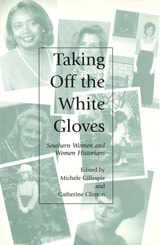
Taking Off the White Gloves
Southern Women and Women HistoriansEdited & Intro by Michele Gillespie & Catherine Clinton
University of Missouri Press, 1998
When southern women remove their gloves, they speak their minds. The ten timely and provocative essays in Taking Off the White Gloves represent the collective wisdom of some of the finest scholars on women's history in the American South. On the eve of the thirtieth anniversary of the Southern Association for Women Historians, this volume brings together some of the outstanding lectures delivered by distinguished members of the association over the past fifteen years.
Spanning four centuries of women's experiences in the South, the topics featured in Taking Off the White Gloves range from Native American sexuality and European conquest to woman suffrage in the South, from black women's protest history to the status of women in the historical profession at the end of the twentieth century.
Despite diverse subject matter, these rich essays share a number of important qualities. They take an integrative approach, combining literary analysis, social history, cultural interpretation, labor history, popular culture, and oral history. Embracing the distinctiveness of the southern past and women's experiences within that past, they also recognize the inextricability of critical categories such as sexuality and gender, race and gender, and women and work. Finally, these essays emphasize the authors' commitment to the belief that the personal is political; they reveal the subtle and not so subtle ways that women transform theory into practice.
Taking Off the White Gloves invites a new understanding of the complexities that surround the history of southern women across race, class, place, and time. A model of innovative and imaginative scholarly historical writing, this book provides fertile ground for young scholars and is sure to inspire new research. This thought- provoking volume has much to offer scholars and students, as well as the general reader.
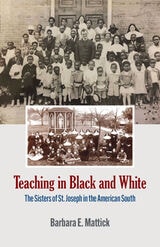
Teaching in Black and White
The Sisters of St. Joseph in the American SouthBarbara E. Mattick
Catholic University of America Press, 2022

Technology, Innovation, and Southern Industrialization
From the Antebellum Era to the Computer AgeEdited by Susanna Delfino & Michele Gillespie
University of Missouri Press, 2008
Because of its strong agrarian roots, the South has typically been viewed as a region not favorably disposed to innovation and technology. Yet innovation was never absent from industrialization in this part of the United States. From the early nineteenth century onward, southerners were as eager as other Americans to embrace technology as a path to modernity.
This volume features seven essays that range widely across the region and its history, from the antebellum era to the present, to assess the role of innovations presumed lacking by most historians. Offering a challenging interpretation of industrialization in the South, these writings show that the benefits of innovations had to be carefully weighed against the costs to both industry and society.
The essays consider a wide range of innovative technologies. Some examine specific industries in subregions: steamboats in the lower Mississippi valley, textile manufacturing in Georgia and Arkansas, coal mining in Virginia, and sugar planting and processing in Louisiana. Others consider the role of technology in South Carolina textile mills around the turn of the twentieth century, the electrification of the Tennessee valley, and telemedicine in contemporary Arizona—marking the expansion of the region into the southwestern Sunbelt.
Together, these articles show that southerners set significant limitations on what technological innovations they were willing to adopt, particularly in a milieu where slaveholding agriculture had shaped the allocation of resources. They also reveal how scarcity of capital and continued reliance on agriculture influenced that allocation into the twentieth century, relieved eventually by federal spending during the Depression and its aftermath that sparked the Sunbelt South’s economic boom.
Technology, Innovation, and Southern Industrialization clearly demonstrates that the South’s embrace of technological innovation in the modern era doesn’t mark a radical change from the past but rather signals that such pursuits were always part of the region’s economy. It deflates the myth of southern agrarianism while expanding the scope of antebellum American industrialization beyond the Northeast and offers new insights into the relationship of southern economic history to the region’s society and politics.

Tell the World You're a Wildflower
StoriesJennifer Horne
University of Alabama Press, 2014
In Tell the World You’re a Wildflower, each character must decide what to tell, whether to tell it, and to whom to tell it. Each struggles with questions of identity and truth, trying to understand who she is and what holds true for her. Some tell their stories plainly, directly, others more obliquely, nesting one within another. Anchored in the tradition of southern storytelling, these women contend with loss, change, and growth while going to church, school, and prison, navigating love and sex, and worrying too much about what people might think.
Yet these women generally refuse to behave, and they wander in and out of each other’s stories just like people do in small towns across the South. Small town lives are always interconnected: your third-grade teacher is your new neighbor’s aunt and the boy you dated your senior year falls from political grace after being caught in a hot tub with your second cousin. Though they may have had little say in where they were planted, Horne’s protagonists nevertheless do their best to bloom.
Rich, multifaceted, and unforgettable, Tell the World You’re a Wildflower is the work of a veteran explorer of the twentieth and twenty-first century South. Horne’s quest to understand her culture through decades of reading and observing has now yielded these narratives that imaginatively and insightfully enter the hearts and minds of southern women.

The American Southeast at the End of the Ice Age
Edited by D. Shane Miller, Ashley M. Smallwood, and Jesse W. Tune
University of Alabama Press, 2022
Synthesizes archaeological and environmental evidence to reinterpret how early human populations adapted to dynamic climatic changes during the Late Pleistocene, reshaping our understanding of Paleoindian lifeways and migration in the Southeastern United States.
The 1996 benchmark volume The Paleoindian and Early Archaic Southeast, edited by David G. Anderson and Kenneth E. Sassaman, was the first study to summarize what was known of the peoples who lived in the Southeast when ice sheets covered the northern part of the continent and mammals such as mammoths, saber-toothed cats, and ground sloths roamed the landscape.
The American Southeast at the End of the Ice Age provides an updated, definitive synthesis of current archaeological research gleaned from an array of experts in the region. It is organized in three parts: state records, the regional perspective, and reflections and future directions. Chapters survey a diversity of topics including the distribution of the earliest archaeological sites in the region, chipped-stone tool technology, the expanding role of submerged archaeology, hunter-gatherer lifeways, past climate changes and the extinction of megafauna on the transitional landscape, and evidence of demographic changes at the end of the Ice Age. Discussion of the ethical responsibilities regarding the use of private collections and the relationship of archaeologists and the avocational community, insight from outside the Southeast, and considerations for future research round out the volume.
The Archaeology of Events
Cultural Change and Continuity in the Pre-Columbian SoutheastZackary I. Gilmore and Jason M. O'Donoughue
University of Alabama Press, 2015
Across the social sciences, gradualist evolutionary models of historical dynamics are giving way to explanations focused on the punctuated and contingent “events” through which history is actually experienced. The Archaeology of Events is the first book-length work that systematically applies this new eventful approach to major developments in the pre-Columbian Southeast.
Traditional accounts of pre-Columbian societies often portray them as “cold” and unchanging for centuries or millennia. Events-based analyses have opened up archaeological discourse to the more nuanced and flexible idea of context-specific, rapidly transpiring, and broadly consequential historical “events” as catalysts of cultural change.
The Archaeology of Events, edited by Zackary I. Gilmore and Jason M. O’Donoughue, considers a variety of perspectives on the nature and scale of events and their role in historical change. These perspectives are applied to a broad range of archeological contexts stretching across the Southeast and spanning more than 7,000 years of the region’s pre-Columbian history. New data suggest that several of this region’s most pivotal historical developments, such as the founding of Cahokia, the transformation of Moundville from urban center to vacated necropolis, and the construction of Poverty Point’s Mound A, were not protracted incremental processes, but rather watershed moments that significantly altered the long-term trajectories of indigenous Southeastern societies.
In addition to exceptional occurrences that impacted entire communities or peoples, southeastern archaeologists are increasingly recognizing the historical importance of localized, everyday events, such as building a house, crafting a pot, or depositing shell. The essays collected by Gilmore and O’Donoughue show that small-scale events can make significant contributions to the unfolding of broad, regional-scale historical processes and to the reproduction or transformation of social structures.
The Archaeology of Events is the first volume to explore the archaeological record of events in the Southeastern United States, the methodologies that archaeologists bring to bear on this kind of research, and considerations of the event as an important theoretical concept.
The Archaeology of Houses and Households in the Native Southeast
Benjamin A. Steere
University of Alabama Press, 2017
The Archaeology of Houses and Households in the Native Southeast contributes enormously to the study of household archaeology and domestic architecture in the region. This significant volume combines both previously published and unpublished data on communities from the Southeast and is the first systematic attempt to understand the development of houses and households as interpreted through a theoretical framework developed from broad-ranging studies in cultural anthropology and archaeology.
Steere’s major achievement is the compilation of one of the largest and most detailed architectural datasets for the Southeast, including data for 1,258 domestic and public structures from 65 archaeological sites in North Carolina, Georgia, Alabama, Tennessee, Kentucky, and the southern parts of Missouri, Indiana, and Illinois. Rare data from hard-to-find cultural resource management reports is also incorporated, creating a broad temporal and geographic scope and serving as one of many remarkable features of the book, which is sure to be of considerable value to archaeologists and anthropologists interested in comparative studies of architecture.
Similar to other analyses, Steere’s research uses multiple theoretical angles and lines of evidence to answer archaeological questions about houses and the people who built them. However, unlike other examinations of household archaeology, this project spans multiple time periods (Woodland, Mississippian, and Historic); is focused squarely on the Southeast; features a more unified approach, using data from a single, uniform database; and privileges domestic architecture as a line of evidence for reconstructing daily life at major archaeological sites on a much broader scale than other investigations.
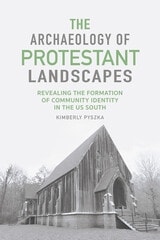
The Archaeology of Protestant Landscapes
Revealing the Formation of Community Identity in the US SouthKimberly Pyszka
University of Alabama Press, 2023
How religious institutions used landscapes and architecture to express their religious and social ideologies
The Archaeology of Protestant Landscapes focuses on three religious institutions in the US South in the eighteenth and nineteenth centuries: St. Paul’s Parish Church in coastal South Carolina, St. Luke’s Episcopal Church in central Alabama, and Cane Hill College in Northwest Arkansas. Drawing from archaeological surveys and excavations, artifact analysis, archival research, geophysical testing, and architectural information on religious structures, Kimberly Pyszka offers case studies of these institutions, which were located in developing communities that varied socially, politically, and economically.
Pyszka uses these case studies to demonstrate that select religious institutions used and modified natural landscape features to create cultural landscapes to express their ideology, identity, goals, and social, religious, and political power. She notes that where those structures were constructed, how they sat on the landscape, their architectural style, and their overall visual appearance were well-considered decisions made by religious leaders to benefit their organizations, communities, and, sometimes, themselves.
Pyszka also uses these case studies to highlight the social roles that religious organizations played in the development of communities. She points to landscape decisions—specifically to how the architectural design of religious structures was used, intentionally or not, to unite people, often those of differing religious backgrounds—as contributing to the creation of a common identity among people living in new and still-growing settlements, aiding in community development. This book contributes to the growing body of work within historical archaeology on churches, churchyards, and cemeteries and to the increasing awareness among archaeologists of how these sites contribute to questions of identity, consumerism, trade, and colonialism.

The Attention of a Traveller
Essays on William Bartram's "Travels" and LegacyEdited by Kathryn H. Braund
University of Alabama Press, 2022
An interdisciplinary reevaluation of William Bartram’s Travels, illuminating the natural, cultural, and intellectual landscapes of the eighteenth‑century Southeast through diverse scholarly lenses.
William Bartram, author of Travels through North and South Carolina, Georgia, East and West Florida, the Cherokee Country, the Extensive Territories of the Muscogulees, or Creek Confederacy, and the Country of the Chactaws, was colonial America’s first native born naturalist and artist, and the first author in the modern genre of writers who portrayed nature through personal experience as well as scientific observation. His book, first published in 1791, was based on his journeys through southern Indian nations and Britain’s southern colonies in the years just prior to the American Revolution and provides descriptions of the natural and cultural environments of what would soon become the American South. Scholars and general readers alike have long appreciated Bartram’s lush, vivid prose, his clarity of observation and evident wonder at the landscapes he traversed, and his engagement with the native nations whose lands he traveled through.
The Attention of a Traveller: Essays on William Bartram’s “Travels” and Legacy offers an interdisciplinary assessment of Bartram’s influence and evolving legacy, opening new avenues of research concerning the flora, fauna, and people connected to Bartram and his writings. Featuring 13 essays divided into five sections, contributors to the volume weave together scholarly perspectives from geology, art history, literary criticism, geography, and philosophy, alongside the more traditional Bartram-affiliated disciplines of biology and history. The collection concludes with a comprehensive treatment of the book as a material historical artifact.
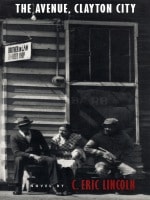
The Avenue, Clayton City
C. Eric Lincoln
Duke University Press, 1996
In this novel, originally published in 1988, Lincoln creates with deft skill the drama that rises from the lives of the people of Clayton City. In turn amusing, disgusting, enraging, wistful, and, as one hears the secrets hidden deep in their hearts, shocking, they exist in a place whose vibrant personality is itself a unique configuration of geography, relationships, patterns of behavior, and events. It is also a place whose unspoken and hidden power lies in its crushing compulsion to maintain itself as it already is—a power that forces everyone to succumb to an inflexible social order.

The Battle for the University of Alabama
The Perilous Path of Higher Education in the Reconstruction SouthWilliam Warren Rogers, Jr.
University of Alabama Press, 2025
Traces the little-known story of the bitter contest for the fate of the University of Alabama after the Civil War.
In The Battle for the University of Alabama, William Warren Rogers Jr. gives a fascinating account of the fierce struggle over the nature of the University of Alabama after the Civil War. Union forces reduced the campus to ruins as the war ended, and the university did not reopen until 1869. In the interregnum, powerful forces shifted the trajectory of the school. Alabama Republicans authored an egalitarian state constitution that delivered oversight of the university to the Republican Party. That set the stage for turmoil and confrontation. This book tells the story of that conflict.
In the next few years, Democrats charged Republicans with turning the university into a “radical” institution. They alleged that a handful of unqualified individuals had gained faculty positions because of their political allegiance, which resulted in the university’s academic desecration. Professors were bitterly denounced in the state newspaper press and quite personally in Tuscaloosa. Administration of the university became part of the fratricidal political debate in the state. Political violence and questions concerning race, specifically the possible integration of the university, illuminated the controversies of the Reconstruction years. Many of these questions resonate even today.
This authoritative account sets events at the University of Alabama against the backdrop of what occurred at other state universities in the Reconstruction South. The University of North Carolina experienced controversy similar to Alabama’s. At the University of Georgia, however, calm prevailed. This story of the incendiary events at Alabama’s flagship university charts new ground and provides a revelatory look into the extraordinary partisanship that characterized the South after the Civil War.

The Battle-Ground
Ellen Glasgow
University of Alabama Press, 2000
Captures the war's human toll and explores its social consequences
The Battle-Ground, Ellen Glasgow's fourth novel, was her first bestseller, with more than 21,000 copies sold in just two weeks. The novel committed her to a project almost unparalleled in American literary history: a novelistic meditation on the South from the decade before the Confederacy to the middle of the 20th century. The Battle-Ground speaks of a South before and during the Civil War in its struggles to become part of a nation still in the making. The overthrow of the aristocratic tradition, the transfer of hereditary power to a rural underclass, the continued disenfranchisement of African Americans, and the evolving status of women--these topics, which came to bind the more than a dozen volumes of Glasgow's self-styled "social history," initially coalesced in The Battle-Ground.
The Battle-Ground conspicuously departs from the tradition of Southern romances popularized by Thomas Nelson Page, and contemporary reviewers praised the book for its historical accuracy. Glasgow, an ardent Anglophile, bragged that military officers in Great Britain studied its descriptions of battle. With her, realism had not only crossed the Atlantic, it had "crossed the Potomac."
But Glasgow never sensationalizes the Civil War, whose bloodiest scenes she flanks with domestic officers, the sharing of rations, the warmth of camp, and reminders of home. Her vision of the war centers less on its corruption or barbarity than on its occasions for small decencies and their power of humanization. Glasgow cannot separate the war from its greater social implications--it is a place, as her title suggests, that tests the soul of a nation as well as individual men and women. The importance of The Battle-Ground in Southern literary history cannot be overemphasized, for Glasgow's reimagining of the Civil War had a profound impact on the next generation of Southern writers, including Allen Tate, Stark Young, and Margaret Mitchell.

The Big Jones Cookbook
Recipes for Savoring the Heritage of Regional Southern CookingPaul Fehribach
University of Chicago Press, 2015
You expect to hear about restaurant kitchens in Charleston, New Orleans, or Memphis perfecting plates of the finest southern cuisine—from hearty red beans and rice to stewed okra to crispy fried chicken. But who would guess that one of the most innovative chefs cooking heirloom regional southern food is based not in the heart of biscuit country, but in the grain-fed Midwest—in Chicago, no less? Since 2008, chef Paul Fehribach has been introducing Chicagoans to the delectable pleasures of Lowcountry cuisine, while his restaurant Big Jones has become a home away from home for the city’s southern diaspora. From its inception, Big Jones has focused on cooking with local and sustainably grown heirloom crops and heritage livestock, reinvigorating southern cooking through meticulous technique and the unique perspective of its Midwest location. And with The Big Jones Cookbook, Fehribach brings the rich stories and traditions of regional southern food to kitchens everywhere.
Fehribach interweaves personal experience, historical knowledge, and culinary creativity, all while offering tried-and-true takes on everything from Reezy-Peezy to Gumbo Ya-Ya, Chicken and Dumplings, and Crispy Catfish. Fehribach’s dishes reflect his careful attention to historical and culinary detail, and many recipes are accompanied by insights about their origins. In addition to the regional chapters, the cookbook features sections on breads, from sweet potato biscuits to spoonbread; pantry put-ups like bread and butter pickles and chow-chow; cocktails, such as the sazerac; desserts, including Sea Island benne cake; as well as an extensive section on snout-to-tail cooking, including homemade Andouille and pickled pigs’ feet.
Proof that you need not possess a thick southern drawl to appreciate the comfort of creamy grits and the skill of perfectly fried green tomatoes, The Big Jones Cookbook will be something to savor regardless of where you set your table.

The Bottom Rung
African American Family Life on Southern FarmsStewart E. Tolnay
University of Illinois Press, 1999
Tracing patterns of marriage and childbearing among both whites and blacks during the first decades of this century, Stewart Tolnay pursues questions about how black southern farm families were formed and dissolved, how they educated their children or put them to work in the fields, and how they migrated in search of opportunity. Further, he considers the possible legacy of these experiences for family life in contemporary urban environments.
Making revealing and innovative use of public records from the early part of the twentieth century, Tolnay challenges the widely held idea that southern migrants to northern cities carried with them a dysfunctional family culture. He demonstrates the powerful impact of economic conditions on family life and views patterns of marriage and childbearing as responsive to prevailing social, economic, and political conditions. In a provocative extension of this perspective, Tolnay argues that current high levels of single-parenthood among urban African American families likewise reflect rational responses to the socio-economic environment and government policies.
By placing post-World War II demographic developments in a wider historical perspective, The Bottom Rung sheds new light on recent discussions of the difficulties faced by the modern black urban family. The text is enhanced by Dorothea Lange's and Russell Lee's poignant photographs.
The Calusa
Linguistic and Cultural Origins and RelationshipsJulian Granberry
University of Alabama Press, 2012
Presents a full phonological and morphological analysis of the total corpus of surviving Calusa language data left by a literate Spanish captive held by the Calusa from his early youth to adulthood
The linguistic origins of Native American cultures and the connections between these cultures as traced through language in prehistory remain vexing questions for scholars across multiple disciplines and interests. Native American linguist Julian Granberry defines the Calusa language, formerly spoken in southwestern coastal Florida, and traces its connections to the Tunica language of northeast Louisiana.
Archaeologists, ethnologists, and linguists have long assumed that the Calusa language of southwest Florida was unrelated to any other Native American language. Linguistic data can offer a unique window into a culture’s organization over space and time; however, scholars believed the existing lexical data was insufficient and have not previously attempted to analyze or define Calusa from a linguistic perspective.
In The Calusa: Linguistic and Cultural Origins and Relationships, Granberry presents a full phonological and morphological analysis of the total corpus of surviving Calusa language data left by a literate Spanish captive held by the Calusa from his early youth to adulthood. In addition to further defining the Calusa language, this book presents the hypothesis of language-based cultural connections between the Calusa people and other southeastern Native American cultures, specifically the Tunica. Evidence of such intercultural connections at the linguistic level has important implications for the ongoing study of life among prehistoric people in North America. Consequently, this thoroughly original and meticulously researched volume breaks new ground and will add new perspectives to the broader scholarly knowledge of ancient North American cultures and to debates about their relationships with one another.

The Collected Works of Benjamin Hawkins, 1796–1810
Benjamin Hawkins, edited and with an introduction by H. Thomas Foster, II
University of Alabama Press, 2003
In 1795 Benjamin Hawkins, a former US senator and advisor to George Washington, was appointed US Indian agent and superintendent of all the tribes south of the Ohio River. Unlike most other agents, he lived among the Creek Indians for his entire tenure, from 1796 to 1816. Journeying forth from his home on the Flint River in Georgia, he served southeastern Indians as government intermediary during one of the longest eras of peace in the historic period.
Hawkins’s journals provide detailed information about European-Indian relations in the 18th-century frontier of the South. His descriptions of the natural and cultural environment are considered among the best sources for the ethnohistory of the Choctaw, Cherokee, Chickasaw, and, especially, the Creek Indians and the natural history of their territory.
Two previously published bodies of work by Benjamin Hawkins are included here—A Sketch of the Creek Country in the Years 1798 and 1799 and The Letters of Benjamin Hawkins 1796-1806. A third body of work that has never been published, “A Viatory or Journal of Distances” (describing routes and distances of a 3,578-mile journey through parts of Georgia, Alabama, and Mississippi), has been added. Together, these documents make up the known body of Hawkins’ work—his talks, treaties, correspondence, aboriginal vocabularies, travel journals, and records of the manners, customs, rites, and civil polity of the tribes. Hawkins' work provides an invaluable record of the time period.
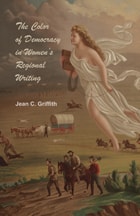
The Color of Democracy in Women's Regional Writing
Jean Carol Griffith
University of Alabama Press, 2009
Exploring how women writers used regional fiction to reimagine democracy, identity, and belonging in America.
American regionalism has become a contested subject in literary studies alongside the ubiquitous triad of race, class, and gender. The Color of Democracy in Women's Regional Writing enters into the heart of an ongoing debate in the field about the significance of regional fiction at the end of the 19th century. Jean Griffith presents the innovative view that regional writing provided Edith Wharton, Ellen Glasgow, and Willa Cather with the means to explore social transformation in a form of fiction already closely associated with women readers and writers.
Griffith provides new readings of texts by these authors; she places them alongside the works of their contemporaries, including William Faulkner and Langston Hughes, to show regionalism's responses to the debate over who was capable of democratic participation and reading regionalism's changing mediations between natives and strangers as reflections of the changing face of democracy.
This insightful work enriches the current debate about whether regionalism critiques hierarchies or participates in nationalist and racist agendas and will be of great interest to those invested in regional writing or the works of these significant authors.

The Confederate Belle
Giselle Roberts
University of Missouri Press, 2003
The Conjure Woman and Other Conjure Tales
Charles W. Chesnutt
Duke University Press, 1993
In the tradition of Uncle Remus, the conjure tale listens in on a poor black southerner, speaking strong dialect, as he recounts a local incident to a transplanted northerner for the northerner's enlightenment and edification. But in Chesnutt's hands the tradition is transformed. No longer a reactionary flight of nostalgia for the antebellum South, the stories in this book celebrate and at the same time question the folk culture they so pungently portray, and ultimately convey the pleasures and anxieties of a world in transition. Written in the late nineteenth century, a time of enormous growth and change for a country only recently reunited in peace, these stories act as the uneasy meeting ground for the culture of northern capitalism, professionalism, and Christianity and the underdeveloped southern economy, a kind of colonial Third World whose power is manifest in life charms, magic spells, and ha'nts, all embodied by the ruling figure of the conjure woman.
Humorous, heart-breaking, lyrical, and wise, these stories make clear why the fiction of Charles W. Chesnutt has continued to captivate audiences for a century.
The Development of Southeastern Archaeology
Edited by Jay K. Johnson
University of Alabama Press, 1993
Ten scholars whose specialties range from ethnohistory to remote sensing and lithic analysis to bioarchaeology chronicle changes in the way prehistory in the Southeast has been studied since the 19th century. Each brings to the task the particular perspective of his or her own subdiscipline in this multifaceted overview of the history of archaeology in a region that has had an important but variable role in the overall development of North American archaeology.
Some of the specialties discussed in this book were traditionally relegated to appendixes or ignored completely in site reports more than 20 years old. Today, most are integral parts of such reports, but this integration has been hard won. Other specialties have been and will continue to be of central concern to archaeologists. Each chapter details the way changes in method can be related to changes in theory by reviewing major landmarks in the literature. As a consequence, the reader can compare the development of each subdiscipline.
As the first book of this kind to deal specifically with the region, it be will valuable to archaeologists everywhere. The general reader will find the book of interest because the development of southeastern archaeology reflects trends in the development of social science as a whole.
Contributors include:
Jay K. Johnson, David S. Brose, Jon L. Gibson, Maria O. Smith, Patricia K. Galloway, Elizabeth J. Reitz, Kristen J. Gremillion, Ronald L. Bishop, Veletta Canouts, and W. Fredrick Limp
The Disappearing South?
Studies in Regional Change and ContinuityRobert P. Steed
University of Alabama Press, 1990
There is widespread agreement that the South has changed dramatically since the end of World War II—the essays in The Disappearing South address the ongoing debate
There is widespread agreement that the South has changed dramatically since the end of World War II. Social, demographic, economic, and political changes have altered significantly the region long considered the nation’s most distinctive. There is less agreement, however, about the extent to which the forces of nationalization have eroded the major elements of Southern distinctiveness. Although this volume does not purport to settle the debate on Southern political change, it does present a variety of recent evidence that helps put this important debate into perspective. In the process it helps clarify the contemporary politics of the South for readers ranging from the scholar to the more casual observer.
The essays in The Disappearing South address the ongoing debate. Contributors, in addition to the editors, include E. Lee Bernick, Earl Black, Merle Black, Lewis Bowman, Edward G. Carmines, Patrick Cotter, Thomas Eamon, Douglas G. Feig, John C. Green, James L. Guth, William E. Hulbary, Anne E. Kelley, Lyman A. Kellstedt, David M. Olson, John Shelton Reed, Harold Stanley, James G. Stovall, John Theilmann, Stephen H. Wainscott, and Allen Wilhite.
The Emancipation Circuit
Black Activism Forging a Culture of FreedomThulani Davis
Duke University Press, 2022

The Fire Ant Wars
Nature, Science, and Public Policy in Twentieth-Century AmericaJoshua Blu Buhs
University of Chicago Press, 2004
With political intrigue, environmental tragedy, and such figures as Rachel Carson and E. O. Wilson, The Fire Ant Wars is a grippingly perceptive tale of changing social attitudes and scientific practices. Tracing the political and scientific eradication campaigns, Joshua Buhs's bracing study uses the saga as a means to consider twentieth-century American concepts of nature and environmental stewardship. In telling the story, Buhs explores how human concepts of nature evolve and how these ideas affect the natural and social worlds.
Spotlighting a particular issue to discuss larger questions of science, public perceptions, and public policy—from pre-environmental awareness to the activist years of the early environmental movement—The Fire Ant Wars will appeal to historians of science, environmentalists, and biologists alike.

The Formative Period in Alabama, 1815-1828
Thomas Abernethy, with an introduction by David T. Morgan
University of Alabama Press, 1995
The Formative Period in Alabama, 1815-1828 is a beautifully crafted history of the evolution of the state written by Thomas Perkins Abernethy in 1922. The work shows how Alabama grew out of the Mississippi Territory and discusses the economic and political development during the years just before and just after Alabama became a state.

The Glory Road
A Gospel Gypsy LifeAnita Faye Garner
University of Alabama Press, 2021
“This is a story central to the origins of country music: the marriage of Saturday night and Sunday morning, and the literal marriage of two musicians, sometimes at odds with each other creatively and personally.” —Rosanne Cash
An essential memoir of music, memory, and the American South.
Anita Faye Garner grew up in the South—just about every corner of it. She and her musical family lived in Texarkana, Bossier City, Hot Springs, Jackson, Vicksburg, Hattiesburg, Pascagoula, Bogalusa, Biloxi, Gulfport, New Orleans, and points between, picking up sticks every time her father, a Pentecostal preacher known as “Brother Ray,” took over a new congregation.
In between jump-starting churches, Brother Ray took his wife and kids out on the gospel revival circuit as the Jones Family Singers. Ray could sing and play, and “Sister Fern” (Mama) was a celebrated singer and songwriter, possessed of both talent and beauty. Rounding out the band were the young Garner (known as Nita Faye then) and her big brother Leslie Ray. At all-day singings and tent revivals across the South, the Joneses made a joyful noise for the faithful and loaded into the car for the next stage of their tour.
But growing up gospel wasn’t always joyous. The kids practically raised and fended for themselves, bonding over a shared dislike of their rootless life and strict religious upbringing. Sister Fern dreamed of crossing over from gospel to popular music and recording a hit record. An unlikely combination of preacher’s wife and glamorous performer, she had the talent and presence to make a splash, and her remarkable voice brought Saturday night rock and roll to Sunday morning music. Always singing, performing, and recording at the margins of commercial success, Sister Fern shared a backing band with Elvis Presley and wrote songs recorded by Johnny Cash and many other artists.
In her touching memoir The Glory Road, Anita Faye Garner re-creates her remarkable upbringing. The story begins with Ray’s attempts to settle down and the family’s inevitable return to the gospel circuit and concludes with Sister Fern’s brushes with stardom and the family’s journey west to California where they finally landed—with some unexpected detours along the way. The Glory Road carries readers back to the 1950s South and the intersections of faith and family at the very roots of American popular music.
For more information about the book and Anita Garner, visit www.thegloryroad.com or www.anitagarner.com
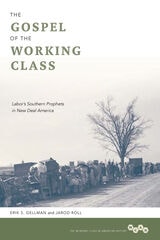
The Gospel of the Working Class
Labor's Southern Prophets in New Deal AmericaErik S. Gellman and Jarod Roll
University of Illinois Press, 2011
In this exceptional dual biography and cultural history, Erik S. Gellman and Jarod Roll trace the influence of two southern activist preachers, one black and one white, who used their ministry to organize the working class in the 1930s and 1940s across lines of gender, race, and geography. Owen Whitfield and Claude Williams, along with their wives Zella Whitfield and Joyce Williams, drew on their bedrock religious beliefs to stir ordinary men and women to demand social and economic justice in the eras of the Great Depression, New Deal, and Second World War.
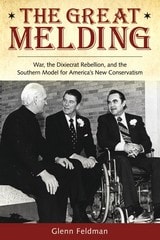
The Great Melding
War, the Dixiecrat Rebellion, and the Southern Model for America's New ConservatismGlenn Feldman
University of Alabama Press, 2015
CHOICE OUTSTANDING ACADEMIC TITLE
Tracing the Southern Origins of Modern American Conservatism.
Audacious in its scope, subtle in its analysis, and persuasive in its arguments, The Great Melding is the second book in Glenn Feldman’s magisterial recounting of the South’s transformation from a Reconstruction-era citadel of Democratic Party inertia to a cauldron of GOP agitation. In this pioneering study, Feldman shows how the transitional years after World War II, the Dixiecrat episode, and the early 1950s formed a pivotal sequence of events that altered America’s political landscape in profound, fundamental, and unexpected ways.
Feldman’s landmark work The Irony of the Solid South dismantled the myth of the New Deal consensus, proving it to be only a fleeting alliance of fissiparous factions; The Great Melding further examines how the South broke away from that consensus. Exploring issues of race and white supremacy, Feldman documents and explains the roles of economics, religion, and emotive appeals to patriotism in southern voting patterns. His probing and original analysis includes a discussion of the limits of southern liberalism and a fresh examination of the Dixiecrat Revolt of 1948.
Feldman convincingly argues that the Dixiecrats—often dismissed as a transitory footnote in American politics—served as a template for the modern conservative movement. Now a predictable Republican stronghold, Alabama at the time was viewed by national political strategists as a battleground and bellwether. Masterfully synthesizing a vast range of sources, Feldman shows that Alabama was then one of the few states where voters made unpredictable choices between the competing ideologies of the Democrats, Republicans, and Dixiecrats.
Writing in his lively and provocative style, Feldman demonstrates that the events he recounts in Alabama between 1942 and Dwight Eisenhower’s 1952 election encapsulate a rare moment of fluidity in American politics, one in which the New Deal consensus shattered and the Democratic and Republican parties fought off a third-party revolt only to find themselves irrevocably altered by their success. The Great Melding will fascinate historians, political scientists, political strategists, and readers of political nonfiction.
The Historian behind the History
Conversations with Southern HistoriansMegan L. Bever
University of Alabama Press, 2014
The historians and their main topics include:
Richard J. M. Blackett on antebellum and African American history
Dan T. Carter on Reconstruction, Civil Rights, and George Wallace
Pete Daniel on the New Deal and the Cold War South
Laura F. Edwards on the Early Republic, the Civil War, Reconstruction, and women’s history
William W. Freehling on the antebellum South
Gary W. Gallagher on the Civil War
Glenda Elizabeth Gilmore on Jim Crow
James M. McPherson on the Civil War
Theodore Rosengarten on the Depression
J. Mills Thornton III on the antebellum South
In his introduction, award-winning author and historian George C. Rable draws together the multifaceted themes of these interviews, offering a compelling overview of the nature of the field. Edited by Megan L. Bever and Scott A. Suarez, The Historian behind the History offers critical insights about the craft and professional life of the historian.
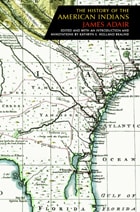
The History of the American Indians
A Critical EditionJames Adair; edited, introduced, and annotated by Kathryn E. Holland Braund
University of Alabama Press, 2009
A fully annotated edition of a classic work detailing the cultures of five southeastern American Indian tribes during the Contact Period
James Adair was an Englishman who lived and traded among the southeastern Indians for more than 30 years, from 1735 to 1768. During that time he covered the territory from the Appalachian Mountains to the Mississippi River. He encountered and lived among Indians, advised governors, spent time with settlers, and worked tirelessly for the expansion of British interests against the French and the Spanish. Adair’s acceptance by the Creeks, Choctaws, Cherokees, and Chickasaws provided him the opportunity to record, compare, and analyze their cultures and traditions.Adair’s written work, first published in England in 1775, is considered one of the finest histories of the Native Americans. His observations provide one of the earliest and what many modern scholars regard as the best account of southeastern Indian cultures. This edition adheres to current standards of literary editing, following the original closely, and provides fully annotated and indexed critical apparatus.

The Human Cost of Food
Farmworkers' Lives, Labor, and AdvocacyEdited by Charles D. Thompson, Jr., and Melinda F. Wiggins
University of Texas Press, 2002
Finding fresh fruits and vegetables is as easy as going to the grocery store for most Americans—which makes it all too easy to forget that our food is cultivated, harvested, and packaged by farmworkers who labor for less pay, fewer benefits, and under more dangerous conditions than workers in almost any other sector of the U.S. economy. Seeking to end the public's ignorance and improve workers' living and working conditions, this book addresses the major factors that affect farmworkers' lives while offering practical strategies for action on farmworker issues.
The contributors to this book are all farmworker advocates—student and community activists and farmworkers themselves. Focusing on workers in the Southeast United States, a previously understudied region, they cover a range of issues, from labor organizing, to the rise of agribusiness, to current health, educational, and legal challenges faced by farmworkers. The authors blend coverage of each issue with practical suggestions for working with farmworkers and other advocates to achieve justice in our food system both regionally and nationally.
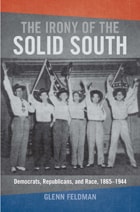
The Irony of the Solid South
Democrats, Republicans, and Race, 1865–1944Glenn Feldman
University of Alabama Press, 2013
Race, Politics, and the Making of the Modern South.
The Irony of the Solid South examines how the south became the “Solid South” for the Democratic Party and how that solidarity began to crack with the advent of American involvement in World War II. Relying on a sophisticated analysis of secondary research—as well as a wealth of deep research in primary sources such as letters, diaries, interviews, court cases, newspapers, and other archival materials—Glenn Feldman argues in The Irony of the Solid South that the history of the solid Democratic south is actually marked by several ironies that involve a concern with the fundamental nature of southern society and culture and the central place that race and allied types of cultural conservatism have played in ensuring regional distinctiveness and continuity across time and various partisan labels. Along the way, this account has much to say about the quality and nature of the New Deal in Dixie, southern liberalism, and its fatal shortcomings.
Feldman focuses primarily on Alabama and race but also considers at length circumstances in the other southern states as well as insights into the uses of emotional issues other than race that have been used time and again to distract whites from their economic and material interests. Feldman explains how conservative political forces (Bourbon Democrats, Dixiecrats, Wallace, independents, and eventually the modern GOP) ingeniously fused white supremacy with economic conservatism based on the common glue of animus to the federal government. A second great melding is exposed, one that joined economic fundamentalism to the religious kind along the shared axis of antidemocratic impulses.
Feldman’s study has much to say about southern and American conservatism, the enduring power of cultural and emotional issues, and the modern south’s path to becoming solidly Republican.
The Juan Pardo Expeditions
Exploration of the Carolinas and Tennessee, 1566-1568Charles Hudson. Afterword by David G. Moore, Robin A. Beck Jr., and Christopher B. Rodning
University of Alabama Press, 2005

The Life of Andrew Jackson
John Reid
University of Alabama Press, 2007
The frontier fighter who rose to the presidency and reshaped a nation.
Original copies of the first, 1817, edition of this work are so rare that even the Library of Congress does not have an undamaged copy. Consequently scholars and students of Jackson have had to rely on later, incomplete or bowdlerized editions. It is therefore all the more valuable to have Owsley’s critical restoration of the original edition, complete with its useful maps.
The work is a straightforward history of Jackson’s military career, begun by John Reid, Jackson’s military aide throughout the War of 1812 and the ensuing Creek War. Reid wrote the first four chapters, and after his death John Eaton completed the work from Reid’s outline, notes, and papers. Owsley, quondam professor of history at Auburn University, has carefully restored the original edition, noted variants between this and successor editions, and included helpful apparatus, including a memoir of John Reid by Helen Reid Roberts, and indexes to the whole.
This is the first paperback edition of this valuable record and includes the original four large-scale foldout maps on an accompanying CD.
The Made Thing
An Anthology of Contemporary Southern PoetryLeon Stokesbury
University of Arkansas Press, 2000
The Makers of the Sacred Harp
David Warren Steel with Richard H. Hulan
University of Illinois Press, 2010
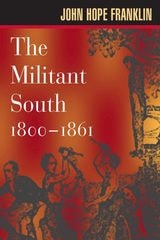
The Militant South, 1800-1861
John Hope Franklin
University of Illinois Press, 2002
Franklin asserts that the South was dominated by militant white men who resorted to violence in the face of social, personal, or political conflict. Fueled by their defense of slavery and a persistent desire to keep the North out of their affairs, Southerners adopted a vicious bellicosity that intensified as war drew nearer.
Drawing from Southern newspapers, government archives, memoirs, letters, and firsthand accounts, Franklin masterfully details the sources and consequences of antebellum aggression in the South. First published in 1956, this classic volume is an enduring and impeccably researched contribution to Southern history. This paperback edition features a new preface in which the author discusses controversial responses to the book.

The Mississippian Emergence
Bruce D. Smith
University of Alabama Press, 2007
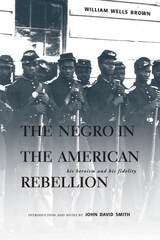
The Negro in the American Rebellion
His Heroism and His FidelityWilliam Wells Brown
Ohio University Press, 1997
In 1863, as the Civil War raged, the escaped slave, abolitionist, and novelist William Wells Brown identified two groups most harmful to his race. “The first and most relentless,” he explained, “are those who have done them the greatest injury, by being instrumental in their enslavement and consequent degradation. They delight to descant upon the ‘natural inferiority’ of the blacks, and claim that we were destined only for a servile condition, entitled neither to liberty nor the legitimate pursuit of happiness.”
“The second class,” Brown concluded, “are those who are ignorant of the characteristics of the race, and are the mere echoes of the first.” Four years later, Brown wrote the first military history of African Americans, The Negro in the American Rebellion. This text assailed those whose hatred and ignorance inclined them to keep blacks oppressed after Appomattox.
This critical edition of The Negro in the American Rebellion, one of Brown’s least-analyzed texts, is the first to appear in more than three decades. In his introduction, historian John David Smith identifies the text’s Anglo-American abolitionist roots, sets it in the context of Brown’s other writings, appraises it as military history, analyzes its interpretation of black masculinity and honor, and focuses closely on Brown’s assessment of contemporary racial tensions.
Largely ignored by scholars, The Negro in the American Rebellion, Smith argues, is a powerful transitional text, one that confronted squarely the neo-slavery of the Reconstruction era.
“Whites,” Brown wrote, “appear determined to reduce the blacks to a state of serfdom if they cannot have them as slaves.” His important text was a call to arms in the ongoing race struggle. Smith’s analysis, framed within recent scholarship on slavery, emancipation, and African American participation in the U.S. army, is long overdue.
The New South Faces the World
Foreign Affairs and the Southern Sense of Self,1877-1950Tennant S. McWilliams
University of Alabama Press, 2007
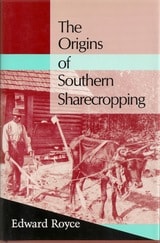
The Origins of Southern Sharecropping
Edward Royce
Temple University Press, 1993
Vivid primary accounts of post-Civil War life by planters and freed slaves complement this study of the rise of southern sharecropping. Edward Royce employs both historical and sociological methods to probe the question of why slavery was replaced by sharecropping rather than by some other labor arrangement. His detailed analysis illuminates conflicts between labor and capital as one group struggles to preserve the plantation system while the other pursues a quest for land and autonomy.
Royce contends that southern sharecropping occurred through a "constriction of possibilities," that it was shaped by default rather than orchestrated by economic reconstruction by white landowners and black laborers.
Highlighting the conflict-ridden nature of the process of social change, The Origins of Southern Sharecropping includes rich descriptions of the plantation system and gang labor, the freed slaves' dream of forty acres and a mule, the black colonization movement, the Freedman's Bureau, and racial relations after the war.
In the series Labor and Social Change, edited by Paula Rayman and Carmen Sirianni.
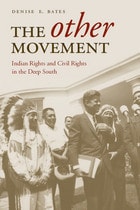
The Other Movement
Indian Rights and Civil Rights in the Deep SouthDenise E. Bates
University of Alabama Press, 2022
Examines the most visible outcome of the Southern Indian Rights Movement: state Indian affairs commissions
In recalling political activism in the post-World War II South, rarely does one consider the political activities of American Indians as they responded to desegregation, the passing of the Civil Rights Acts, and the restructuring of the American political party system. Native leaders and activists across the South created a social and political movement all their own, which drew public attention to the problems of discrimination, poverty, unemployment, low educational attainment, and poor living conditions in tribal communities.
While tribal-state relationships have historically been characterized as tense, most southern tribes—particularly non-federally recognized ones—found that Indian affairs commissions offered them a unique position in which to negotiate power. Although individual tribal leaders experienced isolated victories and generated some support through the 1950s and 1960s, the creation of the inter-tribal state commissions in the 1970s and 1980s elevated the movement to a more prominent political level. Through the formalization of tribal-state relationships, Indian communities forged strong networks with local, state, and national agencies while advocating for cultural preservation and revitalization, economic development, and the implementation of community services.
This book looks specifically at Alabama and Louisiana, places of intensive political activity during the civil rights era and increasing Indian visibility and tribal reorganization in the decades that followed. Between 1960 and 1990, U.S. census records show that Alabama’s Indian population swelled by a factor of twelve and Louisiana’s by a factor of five. Thus, in addition to serving as excellent examples of the national trend of a rising Indian population, the two states make interesting case studies because their Indian commissions brought formerly disconnected groups, each with different goals and needs, together for the first time, creating an assortment of alliances and divisions.

The Oxford American Book of Great Music Writing
Marc Smirnoff
University of Arkansas Press, 2010
To celebrate ten years of Southern music issues, most of which are sold-out or very hard to find, the fifty-five essays collected in this dynamic, wide-ranging, and vast anthology appeal to both music fans and fans of great writing.
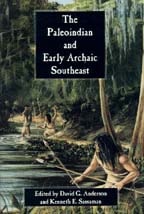
The Paleoindian and Early Archaic Southeast
Edited by David G. Anderson and Kenneth E. Sassaman
University of Alabama Press, 1996
The southeastern United States has one of the richest records of early human settlement of any area of North America. This book provides the first state-by-state summary of Paleoindian and Early Archaic research from the region, together with an appraisal of models developed to interpret the data. It summarizes what we know of the peoples who lived in the Southeast more than 8,000 years ago—when giant ice sheets covered the northern part of the continent, and such mammals as elephants, saber-toothed tigers, and ground sloths roamed the landscape. Extensively illustrated, this benchmark collection of essays on the state of Paleoindian and Early Archaic research in the Southeast will guide future studies on the subject of the region's first inhabitants for years to come.
Divided in three parts, the volume includes:
Part I: Modeling Paleoindian and Early Archaic Lifeways in the Southeast
Environmental and Chronological Considerations, David G. Anderson, Lisa D. O'Steen, and Kenneth E. Sassaman
Modeling Paleoindian and Early Archaic Settlement in the Southeast: A Historical Perspective, David G. Anderson and Kenneth E. Sassaman
Models of Paleoindian and Early Archaic Settlement in the Lower Southeast, David G. Anderson
Early Archaic Settlement in the South Carolina Coastal Plain, Kenneth E. Sassaman
Raw Material Availability and Early Archaic Settlement in the Southeast, I. Randolph Daniel Jr.
Paleoindian and Early Archaic Settlement along the Oconee Drainage, Lisa D. O'Steen
Haw River Revisited: Implications for Modeling Terminal Late Glacial and Early Holocene Hunter-Gatherer Settlement Systems in the Southeast, John S. Cable
Early Archiac Settlement and Technology: Lessons from Tellico, Larry R. Kimball
Paleoindians Near the Edge: A Virginia Perspective, Michael F. Johnson
Part II: The Regional Record
The Need for a Regional Perspective, Kenneth E. Sassaman and David G. Anderson
Paleoindian and Early Archaic Research in the South Carolina Area, David G. Anderson and Kenneth E. Sassaman
The Taylor Site: An Early Occupation in Central South Carolina, James L. Michie
Paleoindian and Early Archaic Research in Tennessee, John B. Boster and Mark R. Norton
A Synopsis of Paleoindian and Early Archaic Research in Alabama, Eugene M. Futato
Statified Late Pleistocene and Early Holocene Deposits at Dust Cave, Northwestern Alabama, Boyce N. Driskell
Bone and Ivory Tools from Submerged Paleoindian Sites in Florida, James S. Dunbar and S. David Webb
Paleoindian and Early Archaic Data from Mississippi, Samuel O. McGahey
Early and Middle Paleoindian Sites in the Northeastern Arkansas Region, J. Christopher Gillam
Part III: Commentary
A Framework for the Paleoindian/Early Archaic Transition, Joel Gunn
Modeling Communities and Other Thankless Tasks, Dena F. Dincauze
An Arkansas View, Dan F. Morse
Comments, Henry T. Wright

The Past in the Present
Women's Higher Education in the Twentieth-Century American SouthAmy T. McCandless
University of Alabama Press, 1999
The Perils and Prospects of Southern Black Leadership
Gordon Blaine Hancock, 1884–1970Raymond Gavins
Duke University Press, 1993

The Politics of Black Joy
Zora Neale Hurston and Neo-AbolitionismLindsey Stewart
Northwestern University Press, 2021
Stewart develops Hurston’s contributions to political theory and philosophy of race by introducing the politics of joy as a refusal of neo-abolitionism, a political tradition that reduces southern Black life to tragedy or social death. To develop the politics of joy, Stewart draws upon Zora Neale Hurston’s essays, Beyoncé’s Lemonade, and figures across several disciplines including Frederick Douglass, W. E. B. Du Bois, Toni Morrison, Angela Davis, Saidiya Hartman, Imani Perry, Eddie Glaude, and Audra Simpson. The politics of joy offers insights that are crucial for forming needed new paths in our current moment. For those interested in examining popular conceptions of Black political agency at the intersection of geography, gender, class, and Black spirituality, The Politics of Black Joy is essential reading.

The Quiet Voices
Southern Rabbis and Black Civil Rights, 1880s to 1990sMark K. Bauman
University of Alabama Press, 1997
These wide-ranging essays reveal the various roles played by southern rabbis in the struggle for black civil rights since Reconstruction
The study of black-Jewish relations has become a hotbed of controversy, especially with regard to the role played by Jewish leaders during the Civil Rights movement. Did these leaders play a pivotal role, or did many of them, especially in the South, succumb to societal pressure and strive to be accepted rather than risk being persecuted? If some of these leaders did choose a quieter path, were their reasons valid? And were their methods successful?
Individually, each essay offers a glimpse into both the private and public difficulties these rabbis faced in their struggle to achieve good. Collectively, the essays provide an unparalleled picture of Jewish leadership during the civil rights era.

The Rebel Yell
A Cultural HistoryCraig A. Warren
University of Alabama Press, 2014
The first comprehensive history of the fabled Confederate battle cry from its origins and myths through its use in American popular culture.
No aspect of Civil War military lore has received less scholarly attention than the battle cry of the Southern soldier. In The Rebel Yell, Craig A. Warren brings together soldiers' memoirs, little-known articles, and recordings to create a fascinating and exhaustive exploration of the facts and myths about the “Southern screech.”
Through close readings of numerous accounts, Warren demonstrates that the Rebel yell was not a single, unchanging call, but rather it varied from place to place, evolved over time, and expressed nuanced shades of emotion. A multifunctional act, the flexible Rebel yell was immediately recognizable to friends and foes but acquired new forms and purposes as the epic struggle wore on. A Confederate regiment might deliver the yell in harrowing unison to taunt Union troops across the empty spaces of a battlefield. At other times, individual soldiers would call out solo or in call-and-response fashion to communicate with or secure the perimeters of their camps.
The Rebel yell could embody unity and valor, but could also become the voice of racism and hatred. Perhaps most surprising, The Rebel Yell reveals that from Reconstruction through the first half of the twentieth century, the Rebel yell—even more than the Confederate battle flag—served as the most prominent and potent symbol of white Southern defiance of Federal authority. With regard to the late-twentieth and early twenty-first centuries, Warren shows that the yell has served the needs of people the world over: soldiers and civilians, politicians and musicians, re-enactors and humorists, artists and businessmen. Warren dismantles popular assumptions about the Rebel yell as well as the notion that the yell was ever “lost to history.”
Both scholarly and accessible, The Rebel Yell contributes to our knowledge of Civil War history and public memory. It shows the centrality of voice and sound to any reckoning of Southern culture.

The Reconstruction Desegregation Debate
The Policies of Equality and the Rhetoric of Place, 1870-1875Kirt H. Wilson
Michigan State University Press, 2002
In the decade that followed the Civil War, two questions dominated political debate: To what degree were African Americans now “equal” to white Americans, and how should this equality be implemented in law? Although Republicans entertained multiple, even contradictory, answers to these questions, the party committed itself to several civil rights initiatives. When Congress passed the Thirteenth Amendment, the 1866 Civil Rights Act, the Fourteenth Amendment, and the Fifteenth Amendment, it justified these decisions with a broad egalitarian rhetoric. This rhetoric altered congressional culture, instituting new norms that made equality not merely an ideal,but rather a pragmatic aim for political judgments.
Kirt Wilson examines Reconstruction’s desegregation debate to explain how it represented an important movement in the evolution of U.S. race relations. He outlines how Congress fought to control the scope of black civil rights by contesting the definition of black equality, and the expediency and constitutionality of desegregation. Wilson explores how the debate over desegregation altered public memory about slavery and the Civil War, while simultaneously shaping a political culture that established the trajectory of race relations into the next century.

The Red-cockaded Woodpecker
Surviving in a Fire-Maintained EcosystemBy Richard Conner, D. Craig Rudolph, and Jeffrey R. Walters
University of Texas Press, 2001
Though small among its woodpecker relatives, the Red-cockaded Woodpecker poses a huge dilemma for its human neighbors. Uniquely adapted to live in the old-growth pine forests of the southeastern United States, the Red-cockaded Woodpecker has nearly disappeared as the forests have been cleared for agricultural, commercial, and residential uses over the last two centuries. Today, it waits at a crossroads. Scientific management practices could restore the woodpecker's habitat and population, but the imperative to convert old-growth forests to other uses remains.
In this book, three of the leading experts on the Red-cockaded Woodpecker offer a comprehensive overview of all that is currently known about its biology and natural history and about the ecology of the fire-maintained forests it requires for survival. As the most visible endangered species in the Southeast, and the one whose conservation impacts the largest land area, the Red-cockaded Woodpecker holds a compelling interest not only for ornithologists, but also for wildlife managers, foresters, developers, environmentalists, and government officials. For all of these groups, this book will be the essential resource for learning more about the Red-cockaded Woodpecker and ensuring its survival.