Results by title
226 books match the query 'Southwest, New' and 39 start with t
The Archaeology of Meaningful Places
Brenda J Bowser
University of Utah Press, 2009
Diverse spatial and temporal contexts in two culture areas--Mesoamerica and the Greater Southwest--serve as backdrops for nine chapters in which fourteen contributors show how place is an ideal starting point to begin unraveling the human past. Several authors further address the enduring significance of places of the past for contemporary peoples. Among the many strengths of this volume is the careful way in which powerful concepts, diverse lines of thought, and empirical models are integrated to reveal the multiple facets of meaningful places, and to illustrate ways in which places may be approached archaeologically, theoretically, and culturally. Ultimately, the book’s contributors champion the notion that place is a valid and useful analytical unit for describing, reconstructing, interpreting, and explaining the form, structure, and temporality of the meanings humans ascribe to their environment.
The Archaic Southwest
Foragers in an Arid LandEdited by Bradley J. Vierra
University of Utah Press, 2018
The Army and the Navajo
The Bosque Redondo Reservation Experiment, 1863-1868Gerald Thompson
University of Arizona Press, 1976
The Casas Grandes World
Curtis Schaafsma
University of Utah Press, 1999
The Casas Grandes World focuses on a remarkable prehistoric culture that extended through parts of present-day Chihuahua, Sonora, New Mexico, Texas, and Arizona, centering on the large Mexican site of Casas Grandes. The thousands of prehistoric sites in this vast area have only recently been considered related to each other, yet it now appears that for more than 200 years, from about AD 1200 to 1425, the people of the region traded with each other, made coursed-adobe pueblos in the desert country, manufactured magnificent pottery, and produced some of the most extraordinary rock art in North America. Casas Grandes was recently designated a World Heritage Site by the United Nations.
During is florescence Casas Grandes served as a conduit or nexus between the Anasazi of the ancient American Southwest and the Mexican civilizations to the south. Using the seminal work of Charles Di Peso as a touchstone, and drawing on significant new archaeological work, this volume offers a reevaluation of the extent, history, and meaning of the great site and its far-reaching connections. It also considers influences on the Hohokam of Arizona and the peoples of west Mexico, positing the existence of a vast sphere of Casas Grandes cultural influence.
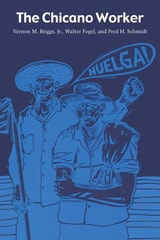
The Chicano Worker
By Vernon M. Briggs, Jr., Walter Fogel, and Fred H. Schmidt
University of Texas Press, 1977
The Chicano Worker is an incisive analysis of the labor-market experiences of Mexican American workers in the late twentieth century. The authors—each established in the fields of labor economics and research on Chicano workers—describe the major employment patterns of the Chicano labor force and discuss the historical and institutional factors determining these patterns. This work speaks to the continuing widespread public interest in Mexican immigration, migrant farm labor, unionization of farm workers, Chicano education and training needs, and the legacy of discriminatory treatment against Chicanos. The authors treat the convergence of these issues and their public policy implications.
Drawing from census data as well as other sources, The Chicano Worker reports on Chicano unemployment, labor-force participation, occupational and industrial distributions of employment, and various indices of earnings. It also deals with such issues as history, family size, health, and culture. The Chicano Worker is likely to open new areas of interest, discussion, and criticism concerning Chicanos in the United States.
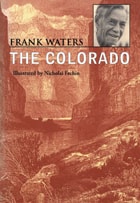
The Colorado
Frank Waters
Ohio University Press, 1985
The vast Colorado River collects water from the highest Rocky Mountain peaks and traverses the widest plateaus, the deepest canyons, and the lowest deserts before emptying into the delta of northern Mexico. This austere land and mighty river resist exploration, settlement, and description. But in the hands of one of the West’s great writers, Frank Waters, the history and lore of its past make irresistible reading and a resounding case for mankind’s respect for the environment.
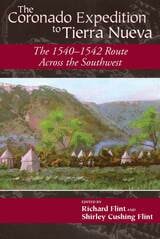
The Coronado Expedition to Tierra Nueva
The 1540-1542 Route across the SouthwestRichard Flint
University Press of Colorado, 1997
In search of where the expedition went and what peoples it encountered, this volume explores the fertile valleys of Sonora, the basins and ranges of southern Arizona, the Zuni pueblos and the Rio Grande Valley of New Mexico, and the Llano Estacado of the Texas panhandle.
The twenty-one contributors to the volume have pursued some of the most significant lines of research in the field in the last fifty years; their techniques range from documentary analysis and recording traditional stories to detailed examination of the landscape and excavation of campsites and Indian towns. With more confidence than ever before, researchers are closing in on the route of the conquistadors.

The Crusade for Justice
Chicano Militancy and the Government's War on DissentErnesto B. Vigil
University of Wisconsin Press, 1999
This definitive account of the Chicano movement in 1960s Denver reveals the intolerance and brutality that inspired and accompanied the urban Chicano organization known as the Crusade for Justice. Ernesto Vigil, an expert in the discourse of radical movements of this time, joined the Crusade as a young draft resistor where he met Rodolfo “Corky” Gonzales, the founder of the CFJ. Vigil follows the movement chronologically from Gonzales’s early attempts to fight discrimination as a participant in local democratic politics to his radical stance as an organizer outside mainstream politics.
Drawing extensively upon FBI documentation that became available under the Freedom of Information Act, Vigil exposes massive surveillance of the Crusade for Justice by federal agents and local police and the damaging effects of such methods on ethnic liberation movements. Vigil complements these documents and the story of Gonzales’s development as a radical with the story of his personal involvement in the movement. The Crusade for Justice describes one of the most important Chicano organizations against prejudice.
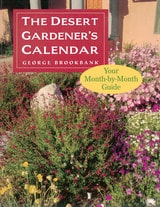
The Desert Gardener's Calendar
Your Month-by-Month GuideGeorge Brookbank
University of Arizona Press, 1999
Whether you're raising vegetables, nursing citrus trees, or just trying to keep your front yard looking its best, you'll find that this handy book gives you a valuable month-by-month perspective on the year. It helps you to focus on necessary activities and reminds you of simple tasks you might overlook.It's especially valuable for people who've moved to the desert regions from other parts of the country and follow old gardening dates that seldom apply to their new home.
The Desert Gardener's Calendar is a guide to the maintenance you need to do to keep your garden flourishing and your landscape attractive throughout the year. It combines the month-by-month gardening and landscaping activities from two separate books by George Brookbank—Desert Gardening, Fruits and Vegetables and Desert Landscaping—and was created in response to readers who have found the calendar sections of those books especially invaluable.
And because not all deserts are the same, Brookbank is careful to point out differences in scheduling encountered by gardeners in low- and middle-elevation regions in California and the Southwest. "I believe," says the author, "that if you use this calendar and let your judgment become more accurate with experience, you'll soon be doing everything right." Although that might suggest a day when you don't need this book, chances are good that, if you're a desert gardener, right now you do.
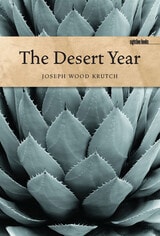
The Desert Year
Joseph Wood Krutch
University of Iowa Press, 1952
Now back in print, Joseph Wood Krutch’s Burroughs Award–winning The Desert Year is as beautiful as it is philosophically profound. Although Krutch—often called the Cactus Walden—came to the desert relatively late in his life, his curiosity and delight in his surroundings abound throughout The Desert Year, whether he is marveling at the majesty of the endless dry sea, at flowers carpeting the desert floor, or at the unexpected appearance of an army of frogs after a heavy rain.
Krutch’s trenchant observations about life prospering in the hostile environment of Arizona’s Sonoran Desert turn to weighty questions about humanity and the precariousness of our existence, putting lie to Western denials of mind in the “lower” forms of life: “Let us not say that this animal or even this plant has ‘become adapted’ to desert conditions. Let us say rather that they have all shown courage and ingenuity in making the best of the world as they found it. And let us remember that if to use such terms in connection with them is a fallacy then it can only be somewhat less a fallacy to use the same terms in connection with ourselves.”
This edition contains 33 exacting drawings by noted illustrator Rudolf Freund. Closely tied to Krutch’s uncluttered text, the drawings tell a story of ineffable beauty.
The Discovery of New Mexico by the Franciscan Monk Friar Marcos de Niza in 1539
Adolph F. Bandelier; Translated and Edited by Madeleine Turrell Rodack
University of Arizona Press, 1980
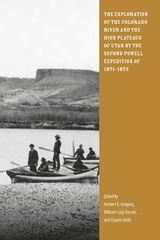
The Exploration of the Colorado River and the High Plateaus of Utah by the Second Powell Expedition of 1871-1872
Herbert E Gregory
University of Utah Press, 2009
Originally published from 1948 to 1949 as volumes sixteen and seventeen of the Utah Historical Quarterly, this volume looks to the larger significance and fruits of the second of Powell’s explorations, a more carefully constituted and better equipped scientific operation, yet one strangely neglected in historical records. Copublished with the Utah State Historical Society.
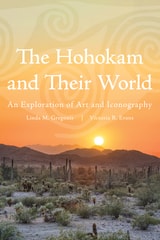
The Hohokam and Their World
An Exploration of Art and IconographyLinda M. Gregonis and Victoria R. Evans
University of Arizona Press, 2025
Southwest Books of the Year Pick
People traveling around the Sonoran Desert will see the traces of an ancient society, the Hohokam, through the material that they left behind—pottery, shell ornaments, carved stone, and rock imagery.
The Hohokam and Their World offers readers the opportunity to explore how these various images and objects may have been used by the Hohokam, and what the icons and objects may have meant, including how the Hohokam conveyed ideas about water, the Sonoran Desert, the ocean, travel, ancestors, and the cosmos.
Authors Linda M. Gregonis and Victoria R. Evans discuss how artists drew inspiration from their Sonoran Desert homeland and were also influenced by the cultures of western Mexico, the hunter-gatherers of the western desert, the Mogollon to the east, and the Pueblo cultures of the northern Southwest. Unlike traditional archaeological texts, this book takes a holistic approach by examining a diverse range of artistic expressions used by the Hohokam. From intricately crafted pottery to mesmerizing carvings in rock, each medium offers a unique glimpse into the Hohokam’s relationship with their environment and the wider world.
Whether you’re planning a visit to national parks or museums in the Southwest or simply intrigued by ancient civilizations, The Hohokam and Their World is a must-read. The work includes a glossary of key archaeological and anthropological terms, as well as endnotes and an extensive list of references for those who want to dig deeper.
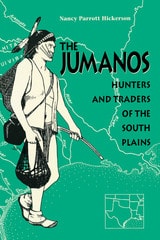
The Jumanos
Hunters and Traders of the South PlainsBy Nancy Parrott Hickerson
University of Texas Press, 1994
In the late sixteenth century, Spanish explorers described encounters with North American people they called "Jumanos." Although widespread contact with Jumanos is evident in accounts of exploration and colonization in New Mexico, Texas, and adjacent regions, their scattered distribution and scant documentation have led to long-standing disagreements: was "Jumano" simply a generic name loosely applied to a number of tribes, or were they an authentic, vanished people?
In the first full-length study of the Jumanos, anthropologist Nancy Hickerson proposes that they were indeed a distinctive tribe, their wide travel pattern linked over well-established itineraries. Drawing on extensive primary sources, Hickerson also explores their crucial role as traders in a network extending from the Rio Grande to the Caddoan tribes' confederacies of East Texas and Oklahoma.
Hickerson further concludes that the Jumanos eventually became agents for the Spanish colonies, drafted as mercenary fighters and intelligence-gatherers. Her findings reinterpret the cultural history of the South Plains region, bridging numerous gaps in the area's comprehensive history and in the chronicle of these elusive people.
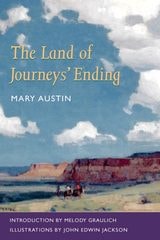
The Land of Journeys' Ending
Mary Austin
University of Illinois Press, 2003
When The Land of Journeys' Ending was first published in 1924, The Literary Reviewwarned, "This book is treacherous, waiting to overwhelm you with its abundant poetry." In it, successful New York author Mary Austin describes the epic journey she undertook in 1923, when left her East Coast home at the age of fifty-five to travel through the southwestern United States, the area where she lived as a child and where she would later retire.
The journey the book describes is a double one. Austin describes her transition from the cosmopolitan North East to the arid and largely unfamiliar land between the Colorado River and the Rio Grande. In telling her own story, Austin also tells the story of those who journeyed there before her-–Native American tribes, Spanish conquistadores, miners, adventurers, and California-bound migrants. The result is both an homage to the magnificence of the desert, mountains, rivers, canyons, plants, and animals of the Southwest and a history of the waves of people who inhabited the region.
Part memoir, part travel narrative, part historical investigation, and part ecological study, The Land of Journeys' Ending is a moving account of a woman coming full circle, finding solace in the broad landscape of her youth.
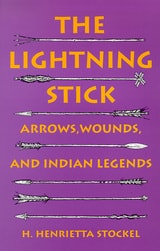
The Lightning Stick
Arrows, Wounds, And Indian LegendsH. Henrietta Stockel
University of Nevada Press, 1995
More than simply a history of the bow and arrow, The Lightening Stick brings together a broad range of significant people and events, spiritual usages, medicinal treatments, and an unusual array of subject matter related to the weapon itself. Henrietta Stockel conveys a host of information derived from primary documents and provides readers with a fascinating book. Her descriptive storytelling—serious, humorous, and even gory at times—takes the reader from modern uses of bows and arrows (including a previously little-known incident in the atomic city of Los Alamos, New Mexico) to an early era of western history, before guns changed the frontier forever.
The Mollusks of the Arid Southwest
With an Arizona Check ListJoseph C. Bequaert and Walter B. Miller
University of Arizona Press, 1973
Part I: Zoogeography of Southwestern Nearctic Mollusks
Integrates and evaluates information of interest to students of variation, evolution, zoogeography, and ecology of the fauna of the arid Southwest.
Part II: Annotated Check List of Recent Arizona Mollusks
Treatment of 173 valid species and 46 recognized subspecies gives nomenclature, type localities, distribution in Arizona, occurrence elsewhere in the Southwestern Molluscan Province, general Recent distribution, presence or absence in Late Cenozoic deposits, and synonymy.
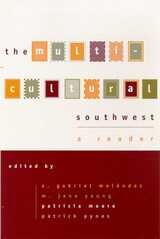
The Multicultural Southwest
A ReaderEdited by A. Gabriel Meléndez, M. Jane Young, Patricia Moore, and Patrick Pynes
University of Arizona Press, 2001
As Americans debate what it means to be a multicultural society, one need only turn for lessons to the Southwest, where distinct peoples have coexisted over centuries. Here difference has not only survived but thrived in a melting pot of races and customs.
This book presents a montage of differing perspectives demonstrating that there is no single, definitive description of the Southwest. It brings together a host of writers, from early travelers and historians to contemporary commentators, who explore a region diverse in its people and ecology and show it to be not just a segment of the nation, but rather a border contact zone.
The editors have assembled an interdisciplinary composite, drawing on history, sociology, anthropology, and geography. Fiction, essays, poetry, newspaper articles, and interviews with local inhabitants add a colorful dimension to the coverage. All of the contributions reveal the tremendous impact that everyday occurrences can have and show how life in the Southwest is affected by the interweaving of social, cultural, and ecological forces. Together they demonstrate the role played by personal and cultural memory in creating alternative views of environment, landscape, human social interaction, conquest, dispossession, technological change, and the survival of cultures.
The Multicultural Southwest is a multifaceted work that shows the many ways in which the past continues to affect the present. It will create in readers an awareness of the phenomena that fuel human imagination and creativity as it opens their eyes to the possibilities of the future.
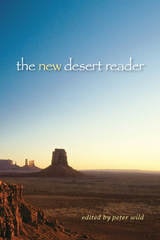
The New Desert Reader
Wild, Peter
University of Utah Press, 2006
A slow change in outlook dominates the book, as attitudes shift from viewing the desert as a place to be despised or exploited to an appreciation of it as a special place, an arena of highly complex natural communities, and a wild refuge for the human body and soul. Comprehensive and brightly informative, The New Desert Reader will be invaluable to anyone interested in the history, literature, and beauty of North America’s treasured desert places.
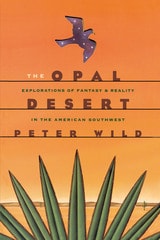
The Opal Desert
Explorations of Fantasy and Reality in the American SouthwestBy Peter Wild
University of Texas Press, 1999
The opalescent deserts of the American Southwest have become romantic icons in the public imagination through the words of writers, the images of artists and photographers, and the visual storytelling of filmmakers. In this spirited, personal, beautifully written book, Peter Wild explores the lives and works of sixteen writers whose words have shaped our visions of the opal desert.
Wild begins with Cabeza de Vaca, whose Relación of his desert wanderings sent treasure-hungry Spaniards searching for cities of gold. He goes on to discuss the works of both widely read and lesser-known nineteenth- and twentieth-century authors, including such luminaries as Mary Austin, Joseph Wood Krutch, Edward Abbey, Ann Zwinger, and Charles Bowden. He links all the writers as explorers of one kind or another, searching for tangible or intangible treasures, some finding and some losing their dreams in the opal desert.

The Origins of Southwestern Agriculture
R. G. Matson
University of Arizona Press, 1991
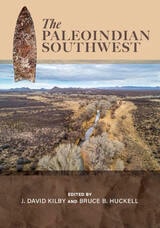
The Paleoindian Southwest
Edited by J. David Kilby and Bruce B. Huckell
University of Utah Press, 2025
The North American Southwest looms large in American archaeology, well known for the agricultural societies that dominated its austere landscape in later times. However, the traces of its earliest occupants, Native American ancestors who shared the ancient landscape with mammoth and giant bison toward the end of the last Ice Age, remain more obscure.
The Paleoindian Southwest provides the first comprehensive overview focused on the earliest human occupants of the Southwest, exploring past investigations, the current state of research, and directions for future discovery. Experts in the field examine individual archaeological sites—some classic and some newly discovered—as well as broader patterns of human behavior across varied regions of both the United States and Mexico. Chapter authors present new and unexpected discoveries, ranging from a gomphothere kill to fossil footprints, pushing the boundaries of the Paleoindian period and investigating nontraditional archaeological data. This collection is a critical resource and landmark volume for those interested in Southwest prehistory, Paleoindian archaeology, and Ice Age human ecology.
The Prehistoric Pueblo World, A.D. 1150-1350
Edited by Michael A. Adler
University of Arizona Press, 1996
1. "The Great Period": The Pueblo World During the Pueblo III Period, A.D. 1150 to 1350, Michael A. Adler
2. Pueblo II-Pueblo III Change in Southwestern Utah, the Arizona Strip, and Southern Nevada, Margaret M. Lyneis
3. Kayenta Anasazi Settlement Transformations in Northeastern Arizona: A.D. 1150 to 1350, Jeffrey S. Dean
4. The Pueblo III-Pueblo IV Transition in the Hopi Area, Arizona, E. Charles Adams
5. The Pueblo III Period along the Mogollon Rim: The Honanki, Elden, and Turkey Hill Phases of the Sinagua, Peter J. Pilles, Jr.
6. A Demographic Overview of the Late Pueblo III Period in the Mountains of East-central Arizona, J. Jefferson Reid, John R. Welch, Barbara K. Montgomery, and María Nieves Zedeño
7. Southwestern Colorado and Southeastern Utah Settlement Patterns: A.D. 1100 to 1300, Mark D. Varien, William D. Lipe, Michael A. Adler, Ian M. Thompson, and Bruce A. Bradley
8. Looking beyond Chaco: The San Juan Basin and Its Peripheries, John R. Stein and Andrew P. Fowler
9. The Cibola Region in the Post-Chacoan Era, Keith W. Kintigh
10. The Pueblo III Period in the Eastern San Juan Basin and Acoma-Laguna Areas, John R. Roney
11. Southwestern New Mexico and Southeastern Arizona, A.D. 900 to 1300, Stephen H. Lekson
12. Impressions of Pueblo III Settlement Trends among the Rio Abajo and Eastern Border Pueblos, Katherine A. Spielman
13. Pueblo Cultures in Transition: The Northern Rio Grande, Patricia L. Crown, Janet D. Orcutt, and Timothy A. Kohler
14. The Role of Warfare in the Pueblo III Period, Jonathan Haas and Winifred Creamer
15. Agricultural Potential and Carrying Capacity in Southwestern Colorado, A.D. 901 to 1300, Carla R. Van West
16. Big Sites, Big Questions: Pueblos in Transition, Linda S. Cordell
17. Pueblo III People and Polity in Relational Context, David R. Wilcox
Appendix: Mapping the Puebloa
The Presidio and Militia on the Northern Frontier of New Spain
A Documentary History, Volume I, 1570-1700Thomas H. Naylor and Charles W. Polzer
University of Arizona Press, 1986

The Protohistoric Pueblo World, A.D. 1275-1600
Edited by E. Charles Adams and Andrew I. Duff
University of Arizona Press, 2004
The Road to Mexico
Lawrence J. Taylor and Maeve Hickey
University of Arizona Press, 1997
Equipped with camera, pen, and a lively curiosity, photographer Maeve Hickey and writer Lawrence J. Taylor set out to capture whatever might come their way on the road to Mexico. They roamed and rambled, they stayed well off the beaten track, and they talked to nearly everyone they met, from wisecracking waitresses to landed gentry to street urchins dressed in rags. Their book brings to life the calf ropers and casinos, the saints and sinners, the mariachis and miracles in a no-man's-land that sometimes seems to belong neither to the United States nor to Mexico.
Following the footsteps of earlier travelers-traders, warriors, missionaries, and explorers-these modern pilgrims take a hands-on approach to their journey. Throughout, both writer and photographer convey the sizzle and spice of a land where Indian, Mexican, and Anglo worlds have collided, coexisted, and melted into each other for centuries. Their eye for the hidden telling detail carries the reader straight into the action, and their zest for excitement spurs any traveler to drop everything, grab a bag, and hit the road to Mexico.

The Secret Life Of John C. Van Dyke
Selected LettersDavid W. Teague
University of Nevada Press, 1997
The author of The Desert, the book that made the American landscape accessible to the mainstream mind, was much less like his fellow environmental prophets John Muir and Henry David Thoreau than he would have had us believe. Van Dyke claimed to have wandered "alone on horseback for thousands of miles through the American Southwest and northern Mexico," as readers of The Desert—now in the millions since the book was published in 1901—were told. He did not. In The Secret Life of John C. Van Dyke, Teague and Wild unmask the desert saint with Van Dyke’s own recently discovered letters. These letters depict a privileged, patrician, and pampered member of the upper-class. His incriminating correspondence reveals that he saw most of the desert from plush railroad cars and grand hotel rooms. In the introduction, the editors clear up many misconceptions scholars currently hold about Van Dyke’s ecological principles, about his outdoorsmanship, and about his trip through the desert itself. As the centennial of the publication of The Desert approaches, this lively collection of letters helps set the record straight. The John C. Van Dyke unveiled in The Secret Life is a more varied character than we had supposed—still worthy of much admiration for his remarkable accomplishments, but still mysterious, and not the man we thought him to be.
The Social Life of Pots
Glaze Wares and Cultural Dynamics in the Southwest, AD 1250-1680Edited by Judith A. Habicht-Mauche, Suzanne L. Eckert, and Deborah L. Huntley
University of Arizona Press, 2006
Through the study of glaze-painted pottery, archaeologists are beginning to understand that pots had “social lives” in this changing world and that careful reconstruction of the social lives of pots can help us understand the social lives of Puebloan peoples. In this book, fifteen contributors apply a wide range of technological and stylistic analysis techniques to pottery of the Rio Grande and Western Pueblo areas to show what it reveals about inter- and intra-community dynamics, work groups, migration, trade, and ideology in the precontact and early postcontact Puebloan world.
The contributors report on research conducted throughout the glaze producing areas of the Southwest and cover the full historical range of glaze ware production. Utilizing a variety of techniques—continued typological analyses, optical petrography, instrumental neutron activation analysis, X-ray microprobe analysis, and inductively coupled plasma mass spectroscopy—they develop broader frameworks for examining the changing role of these ceramics in social dynamics. By tracing the circulation and exchange of specialized knowledge, raw materials, and the pots themselves via social networks of varying size, they show how glaze ware technology, production, exchange, and reflected a variety of dynamic historical and social processes.
Through this material evidence, the contributors reveal that technological and aesthetic innovations were deliberately manipulated and disseminated to actively construct “communities of practice” that cut across language and settlement groups. The Social Life of Pots offers a wealth of new data from this crucial period of prehistory and is an important baseline for future work in this area.
Contributors
Patricia Capone
Linda S. Cordell
Suzanne L. Eckert
Thomas R. Fenn
Judith A. Habicht-Mauche
Cynthia L Herhahn
Maren Hopkins
Deborah L. Huntley
Toni S. Laumbach
Kathryn Leonard
Barbara J. Mills
Kit Nelson
Gregson Schachner
Miriam T. Stark
Scott Van Keuren
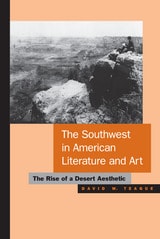
The Southwest in American Literature and Art
The Rise of a Desert AestheticDavid W. Teague
University of Arizona Press, 1997
By focusing on cultures that lived in the Southwest and by analyzing ways in which they described the land, David Teague persuasively argues against the destructive approach that Americans currently take to the region. Included are Native American legends and Spanish and Hispanic literature. However, the bulk of the study concentrates on Anglo American views of the Southwest, which have been generally at odds with the ecology of the deserts.
Ranging from oral traditions of the Navajo, Zuñi, and Hopi Indians to travel journals, fiction, and visual art, Teague examines the work of nearly thirty writers, artists, and explorers, including Alvar Núñez Cabeza de Vaca, Mary Austin, John Wesley Powell, and Frederic Remington. As he traces ideas about the desert over time, the author shows how American literature and art have come to represent the Southwest as a landscape to be sustained rather than transformed.
Bound to gain a prominent place in ecological criticism and in literature of the Southwest, this book offers important insights for scholars and students of literature, environmental studies, history, anthropology, and Native American studies. Its originality and vigor will also appeal to general readers with an interest in the landscape—and the future—of the American Southwest.
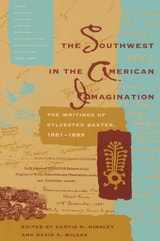
The Southwest in the American Imagination
The Writings of Sylvester Baxter, 1881-1889Curtis M. Hinsley
University of Arizona Press, 1996
Drawing on materials housed in half a dozen institutions and now brought together for the first time, this projected seven-volume work presents a cultural history of the Hemenway Expedition and early anthropology in the American Southwest, told in the voices of its participants and interpreted by contemporary scholars. Taken as a whole, the series comprises a thorough study and presentation of the cultural, historical, literary, and archaeological significance of the expedition, with each volume posing distinct themes and problems through a set of original writings such as letters, reports, and diaries. Accompanying essays guide readers to a coherent understanding of the history of the expedition and discuss the cultural and scientific significance of these data in modern debates.
This first volume, The Southwest in the American Imagination, presents the writings of Sylvester Baxter, a journalist who became Cushing's friend and publicist in the early 1880s and who traveled to the Southwest and wrote accounts of the expedition. Included are Baxter's early writings about Cushing and the Southwest, from 1881 to 1883, which reported enthusiastically on the anthropologist's work and lifestyle at Zuñi before the expedition. Also included are published accounts of the Hemenway Expedition and its scientific promise, from 1888 to 1889, drawing on Baxter's central role in expedition affairs as secretary-treasurer of the advisory board. Series co-editor Curtis Hinsley provides an introductory essay that reviews Baxter's relationship with Cushing and his career as a journalist and civic activist in Boston, and a closing essay that inquires further into the lasting implications of the "invention of the Southwest," arguing that this aesthetic was central to the emergence and development of southwestern archaeology.
Seen a century later, the Hemenway Expedition provides unusual insights into such themes as the formation of a Southwestern identity, the roots of museum anthropology, gender relations and social reform in the late nineteenth century, and the grounding of American nationhood in prehistoric cultures. It also conveys an intellectual struggle, ongoing today, to understand cultures that are different from the dominant culture and to come to grips with questions concerning America's meaning and destiny.

The Southwest
A Fire SurveyStephen J. Pyne
University of Arizona Press, 2016
Through a mixture of journalism, history, and literary imagination, fire expert Stephen J. Pyne provides a lively survey of what makes this region distinctive, moving us beyond the usual conversations of science and policy. Pyne explores the Southwest’s sacred mountains, including the Jemez, Mogollon, Huachucas, and Kaibab; its sky islands, among them the Chiricahuas, Mount Graham, and Tanque Verde; and its famous rims and borders. Together, the essays provide a cross-section of how landscape fire looks in the early years of the 21st century, what is being done to manage it, and how fire connects with other themes of southwestern life and culture.
The Southwest is part of the multivolume series describing the nation’s fire scene region by region. The volumes in To the Last Smoke also cover California, the Northern Rockies, the Great Plains, Florida, and several other critical fire regions. The series serves as an important punctuation point to Pyne’s 50-year career with wildland fire—both as a firefighter and a fire scholar. These unique surveys of regional pyrogeography are Pyne’s way of “keeping with it to the end,” encompassing the directive from his rookie season to stay with every fire “to the last smoke.”
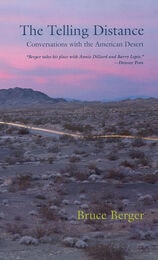
The Telling Distance
Conversations with the American DesertBruce Berger
University of Arizona Press, 1990
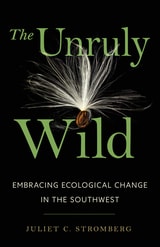
The Unruly Wild
Embracing Ecological Change in the SouthwestJuliet C. Stromberg
University of Arizona Press, 2026
Challenging the traditional invasion biology paradigm, Juliet C. Stromberg invites readers to reconsider the “alien invader” narrative and explore the beneficial roles that newly arrived plants can play in our ecosystems. Drawing from her extensive experience as a plant and restoration ecologist, Stromberg introduces a cast of plant characters that includes longtimers as well as newcomers.
Through compelling stories and scientific insights, Stromberg explains why some plants are thriving while others are in decline. Stromberg’s engaging narrative, enriched with personal anecdotes and detailed vignettes, encourages readers to pause, reflect, and deepen their relationship with the plant world. By promoting a more nuanced and respectful dialogue about our natural surroundings, this book offers valuable insights into biodiversity, climate resilience, and ecosystem restoration. This book is a call to embrace a more inclusive and adaptive approach to wild plants.
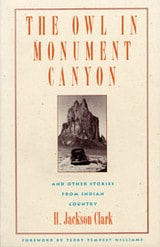
The owl in Monument Canyon, and other stories from Indian country
H. Jackson Clark
University of Utah Press, 1993
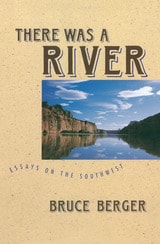
There Was a River
Bruce Berger
University of Arizona Press, 1994
The Southwest Berger sees is an unusual, even odd, place, with inhabitants that are just as strange. In this collection of essays he introduces us to people and places that define a region and a way of life. We meet eccentric desert dwellers like Cactus Pete, who claimed to have mapped the mountains of Venus long before NASA penetrated its clouds. We chart the canals of Phoenix, which have created a Martian landscape out of an irrigation system dating back to the ancient Hohokam; stay at a "wigwam" motel in Holbrook, whose kitsch appeals even to Hopis; and dim our lights for the International Dark-Sky Association's efforts to keep night skies safe for astronomy.
Focusing on the interaction of people with the environment, Berger reveals an original vision of the Southwest that encompasses both city and wilderness. In a concluding essay centering on the sale of his mother's estate in Phoenix, he concedes that "our intention to leave the desert alone has resulted, unwittingly, in loss after loss, simply by our being here." Sometimes there are losses—a canyon, a house—but Berger attunes us to the prodigies of change.
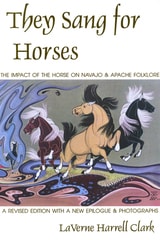
They Sang for Horses
The Impact of the Horse on Navajo and Apache FolkloreLaVerne Harrell Clark
University Press of Colorado, 2001
No Native American groups placed more emphasis on the horse in their lives than did the Navajo and Apache of the Southwest. They Sang for Horses, first published in 1966 and now considered a classic, remains the only comprehensive treatment of the profound mystical influence that the horse has exerted for more than 300 years.
In this completely redesigned and expanded edition, LaVerne Harrell Clark examines how storytellers, singers, medicine men, and painters created the animal's evolving symbolic significance by adapting existing folklore and cultural symbols. Exploring the horse's importance in ceremonies, songs, prayers, customs, and beliefs, she investigates the period of the horse's most pronounced cultural impact on the Navajo and the Apache, starting from the time of its acquisition from the Spanish in the seventeenth century and continuing to the mid-1960s, when the pickup truck began to replace it as the favored means of transportation. In addition, she presents a look at how Navajos and Apaches today continue to redefine the horse's important role in their spiritual as well as material lives.
This classic work is a must for historians, readers interested in Native American folklore and mythology, and anyone who has ever been captivated by the magic and romance of the horse.
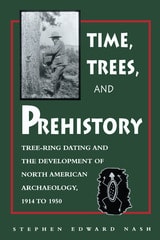
Time, Trees, and Prehistory
Tree Ring dating and the Development of NA Archaeology 1914 to 1950Stephen E Nash
University of Utah Press, 2006
Dendrochronology, the science of assigning precise calendar dates to annual growth rings in trees, provided accurate dates at a time when North American archaeologists had no absolute dating techniques available to guide their analyses. Time, Trees, and Prehistory examines the growth, development, application, and interpretive implications of North American archaeological tree-ring dating from 1914 to 1950.
The development of dendrochronology forced archaeologists to radically revise their understanding of the prehistoric past, compressing by nearly fifty percent the time scale of the archaeological record. Basketmaker sites, for instance, were once thought to be four thousand years old; tree-ring application demonstrated that these sites dated well into the present millennium. Classic sites in Chaco Canyon and Mesa Verde were believed occupied for nearly a thousand years, but tree-ring dates demonstrated that such sites were often built, occupied, and abandoned in just over a century. Other similar changes in temporal scale forced archaeologists to reconsider their interpretations of the rate of prehistoric cultural change, population growth, and the degree of social and political complexity in the Southwest.
Time, Trees, and Prehistory examines archaeological practices of the 1920s, 30s, and 40s and demonstrates that tree-ring dating set the stage that enabled revolutionary developments in archaeological method and theory in succeeding decades.
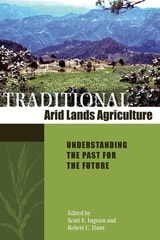
Traditional Arid Lands Agriculture
Understanding the Past for the FutureEdited by Scott E. Ingram and Robert C. Hunt
University of Arizona Press, 2015
Traditional agriculture, nonindustrial plant cultivation for human use, is practiced worldwide by millions of smallholder farmers in arid lands. Advancing an understanding of traditional agriculture can improve its practice and contribute to understanding the past. Traditional agriculture has been practiced in the U.S. Southwest and northwest Mexico for at least four thousand years and intensely studied for at least one hundred years. What is not known or well-understood about traditional arid lands agriculture in this region has broad application for research, policy, and agricultural practices in arid lands worldwide.
The authors represent the disciplines of archaeology, anthropology, agronomy, art, botany, geomorphology, paleoclimatology, and pedology. This multidisciplinary book will engage students, practitioners, scholars, and any interested in understanding and advancing traditional agriculture.
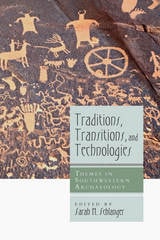
Traditions, Transitions, and Technologies
Themes in Southwestern ArchaeologySarah H. Schlanger
University Press of Colorado, 2016