Results by title
69 books match the query 'Suffrage' and 27 start with t
The Color of Representation
Congressional Behavior and Black InterestsKenny J. Whitby
University of Michigan Press, 2000
The Concise History of Woman Suffrage
Selections from History of Woman Suffrage, by Elizabeth Cady Stanton, Susan B. Anthony, Matilda Joslyn Gage, and the National American Woman Suffrage AssociationEdited and with an Introduction by Mari Jo Buhle and Paul Buhle
University of Illinois Press, 2005
In their Concise History of Woman Suffrage, Mari Jo Buhle and Paul Buhle have revitalized this classic text by carefully selecting from among its best material. The eighty-two chosen documents, now including interpretative introductory material by the editors, give researchers easy access to material that the original work's arrangement often caused readers to ignore or to overlook.
The volume contains the work of many reform agitators, among them Angelina Grimké, Lucy Stone, Carrie Chapman Catt, Charlotte Perkins Gilman, Anna Howard Shaw, Jane Addams, Sojourner Truth, and Victoria Woodhull, as well as Elizabeth Cady Stanton, Susan B. Anthony, Matilda Joslyn Gage, and Ida Husted Harper.
The Congressional Black Caucus, Minority Voting Rights, and the U.S. Supreme Court
Christina R. Rivers
University of Michigan Press, 2014
Both the U.S. Supreme Court and the Congressional Black Caucus (CBC) claim to advocate minority political interests, yet they disagree over the intent and scope of the Voting Rights Act (VRA), as well as the interpretation of the equal protection clause of the 14th Amendment. Whereas the Court promotes color-blind policies, the CBC advocates race-based remedies. Setting this debate in the context of the history of black political thought, Rivers examines a series of high-profile districting cases, from Rodgers v. Lodge (1982) through NAMUDNO v. Holder (2009). She evaluates the competing approaches to racial equality and concludes, surprisingly, that an originalist, race-conscious interpretation of the 14th Amendment, along with a revised states' rights position regarding electoral districting, may better serve minority political interests.
The Disenfranchisement of Ex-Felons
Elizabeth A. Hull, foreword by Representative John Conyers, Jr.
Temple University Press, 2006
The Disenfranchisement of Ex-Felons provides a comprehensive overview of the history, nature, and far-reaching sociological and political consequences of denying ex-felons the right to vote. Readers learn state practices in Florida and Ohio during the 2000 and 2004 presidential elections; arguments that have been used in court houses, legislatures, and the press to justify such practices; and attempts to reverse legislation through state and federal governments. In a timely appendix to the 2004 election, Elizabeth Hull makes her case that the battle for civil rights will not be won unless ex-felons, who have fulfilled their obligations to society, are restored the same rights afforded all other American citizens.
The Future of the Voting Rights Act
David Epstein
Russell Sage Foundation, 2006
The Making of the New Deal Democrats
Voting Behavior and Realignment in Boston, 1920-1940Gerald H. Gamm
University of Chicago Press, 1990
Almost all previous work on the subject has dealt with large-scale national patterns which make it difficult to pin down the precise processes by which the alignment took place. Gamm's work is most remarkable in that it is a close analysis of shifting voter alignments on the precinct and block level in the city of Boston. His extremely detailed and painstaking work of isolating homogeneous ethnic units over a twenty-year period allows one to trace the voting behavior of the particular ethnic groups that ultimately formed the core of the New Deal realignment."—Sidney Verba, Harvard University

The Masculine Woman in America, 1890-1935
Laura L. Behling
University of Illinois Press, 2001
Scrutinizing depictions of the masculine woman in literature and the popular press, Laura L. Behling explicates the literary, artistic, and rhetorical strategies used to eliminate the "sexually inverted" woman: punishing her by imprisonment or death; "rescuing" her into heterosexuality; subverting her through parody; or removing her from society to some remote or mystical place. Behling also shows how fictional same-sex relationships in the writings of Henry James, Charlotte Perkins Gilman, Gertrude Stein, and others conformed to and ultimately reaffirmed heterosexual models.
The Masculine Woman in America, 1890-1935 demonstrates that the women's suffrage movement did not so much suggest alternatives to women's gender and sexual behavior as it offered men and women afraid of perceived changes a tangible movement on which to blame their fears. A biting commentary on the insubstantial but powerful ghosts stirred up by the media, this study shows how, though legally enfranchised, the new woman was systematically disfranchised socially through scientific theory, popular press illustrations, and fictional predictions of impending sociobiological disaster.

The New Real
Media and Mimesis in Japan from Stereographs to EmojiJonathan E. Abel
University of Minnesota Press, 2022
Unlocking a vital understanding of how literary studies and media studies overlap and are bound together
A synthetic history of new media reception in modern and contemporary Japan, The New Real positions mimesis at the heart of the media concept. Considering both mimicry and representation as the core functions of mediation and remediation, Jonathan E. Abel offers a new model for media studies while explaining the deep and ongoing imbrication of Japan in the history of new media.
From stereoscopy in the late nineteenth century to emoji at the dawn of the twenty-first, Abel presents a pioneering history of new media reception in Japan across the analog and digital divide. He argues that there are two realities created by new media: one marketed to us through advertising that proclaims better, faster, and higher-resolution connections to the real; and the other experienced by users whose daily lives and behaviors are subtly transformed by the presence and penetration of the content carried through new media. Intervening in contemporary conversations about virtuality, copyright, copycat violence, and social media, each chapter unfolds with a focus on a single medium or technology, including 3D photographs, the phonograph, television, videogames, and emoji.
By highlighting the tendency of the mediated to copy the world and the world to copy the mediated, The New Real provides a new path for analysis of media, culture, and their function in the world.
The New Woman in Alabama
Social Reforms and Suffrage, 1890–1920Mary Martha Thomas
University of Alabama Press, 1992
How Alabama women reshaped public life during the Progressive Era.
Between 1890 and 1920, middle-class white and black Alabama women created many clubs and organizations that took them out of the home and provided them with roles in the public sphere. Beginning with the Alabama Woman’s Christian Temperance Union in the 1880s and followed by the Alabama Federation of Women’s Clubs and the Alabama Federation of Colored Women’s Clubs in the 1890s, women spearheaded the drive to eliminate child labor, worked to improve the educational system, upgraded the jails and prisons, and created reform schools for both boys and girls.
Suffrage was also an item on the Progressive agenda. After a brief surge of activity during the 1890s, the suffrage drive lay dormant until 1912, when women created the Alabama Equal Suffrage Association. During their campaigns in the 1915 and 1919 to persuade the legislature to enfranchise women, the leaders learned the art of politics—how to educate, organize, lobby, and count votes. Women seeking validation for their roles as homemakers and mother demanded a hearing in the political arena for issues that affected them and their families. In the process they began to erase the line between the public world of men and the private world of women. These were the New Women who tackled the problems created by the industrialization and urbanization of the New South. By 1920 Alabama women had created new public spaces for themselves in these voluntary associations. As a consequence of their involvement in reform crusades, the women’s club movement, and the campaign for woman suffrage, women were no longer passive and dependent. They were willing and able to be rightful participants.
Thomas’s book is the first of its kind to focus on the reform activities of women during the Progressive Era, and the first to consider the southern woman and all the organizations of middle-class black and white women in the South and particularly in Alabama. It is also the first to explore the drive of Alabama women to obtain the vote. The development of political power among southern women progressed slowly. Demolishing as it did the myth of the “Southern Lady.” Traditionally confined to the domestic sphere, southern women had no experience in public decision making and were discouraged from attaining the skills necessary for participation in public debate. The division of women by race and class further impeded their political education. But through their participation in so-called women’s issues—child labor laws, temperance, and educational reform—women gained experience in influencing political leaders. Black and white women’s clubs provided the framework for state-wide lobbying.
Only in the wake of their success with domestic issues tackled through club organizations and temperance unions did women dare seek the right to vote. They learned how to wield political power through acceptable “ladylike” avenues, and it was this experience that led to their long but eventually successful drive for woman suffrage. The New Woman eventually found a way to replace the Southern Lady.
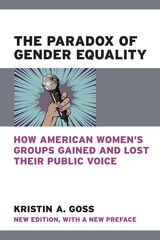
The Paradox of Gender Equality
How American Women's Groups Gained and Lost Their Public VoiceKristin A. Goss
University of Michigan Press, 2013
Drawing on original research, Kristin A. Goss examines how women's civic place has changed over the span of more than 120 years, how public policy has driven these changes, and why these changes matter for women and American democracy. Suffrage, which granted women the right to vote and invited their democratic participation, provided a dual platform for the expansion of women's policy agendas. As measured by women's groups' appearances before the U.S. Congress, women's collective political engagement continued to grow between 1920 and 1960—when many conventional accounts claim it declined—and declined after 1980, when it might have been expected to grow. This waxing and waning was accompanied by major shifts in issue agendas, from broad public interests to narrow feminist interests.
Goss suggests that ascriptive differences are not necessarily barriers to disadvantaged groups' capacity to be heard; that enhanced political inclusion does not necessarily lead to greater collective engagement; and that rights movements do not necessarily constitute the best way to understand the political participation of marginalized groups. She asks what women have gained — and perhaps lost — through expanded incorporation as well as whether single-sex organizations continue to matter in 21st-century America.
The Paradox of Gender Equality
How American Women's Groups Gained and Lost Their Public VoiceKristin A. Goss
University of Michigan Press, 2020
Goss asks what women have gained, and perhaps lost, through expanded incorporation, as well as whether single-sex organizations continue to matter in 21st-century America.
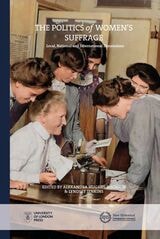
The Politics of Women's Suffrage
Local, National and International DimensionsEdited by Alexandra Hughes-Johnson and Lyndsey Jenkins
University of London Press, 2021
In the United Kingdom, the question of women’s suffrage represented the most substantial challenge to the constitution since 1832, seeking not only to expand but to redefine definitions of citizenship and power. At the same time, it was inseparable from other urgent contemporary political debates—the Irish question, the decline of the British Empire, the Great War, and the increasing demand for workers’ rights.
This collection positions women’s suffrage as central to, rather than separate from, these broader political discussions, demonstrating how they intersected and were mutually constitutive. In particular, this collection pays close attention to the issues of class and Empire which shaped this era. It demonstrates how campaigns for women’s rights were consciously and unconsciously played out, impacting attitudes to motherhood, spurring the radical “birth-strike” movement, and burgeoning communist sympathies in working-class communities around Britain and beyond.
The Precious Birthright
Black Leaders and the Fight to Vote in Antebellum Rhode IslandCJ Martin
University of Massachusetts Press, 2024
In 1842, Black Rhode Islanders secured a stunning victory, a success rarely seen in antebellum America: they won the right to vote. Amid heightened public discourse around shifting ideas of race, citizenship, and political rights, they methodically deconstructed the arguments against their enfranchisement, exposing the arbitrariness of the color line in delineating citizenship rights and choosing the perfect moments in which to act forcefully. At the head of this movement, a cohort of prominent business and community members formed an early example of a Black leadership class in the US.
CJ Martin draws upon a wealth of sources—including personal correspondences, government and organizational documents, tax records, and petitions—to argue that Black leaders employed a unique combination of agitation and accommodation to ensure the success of the movement. By investigating their tactics, Martin deepens the story of how race played a crucial role in American citizenship, and by focusing on Black leadership, he relates this history through the people who lived it—who thought, debated, petitioned, and enacted their own liberation. Telling the story of a fight that was as important to the pioneers of interracial democracy as it was for the civil rights activists of the twentieth century, The Precious Birthright provides new insight into the larger story of Black freedom.
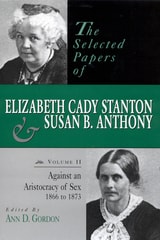
The Selected Papers of Elizabeth Cady Stanton and Susan B. Anthony
Against an Aristocracy of Sex, 1866 to 1873Gordon, Ann D
Rutgers University Press, 2000
The second volume picks up the story of Stanton and Anthony at the end of 1866, when they launched their drive to make universal suffrage the priority of Reconstruction. Through letters, speeches, articles, and diaries, this volume recounts their years as editor and publisher of the weekly paper the Revolution, their extensive travels, and their lobbying with Congress. It touches on the bitter division that occurred among suffragists over such controversial topics as marriage and divorce, and a national debate over the citizenship of women under the Fourteenth and Fifteenth Amendments. By the summer of 1873, when this volume ends, Anthony stood convicted of the federal crime of illegal citizenship of women under the Fourteenth and Fifteenth Amendments. By the summer of 1873, when this volume ends, Anthony stood convicted of the federal crime of illegal voting. An irate Stanton warned, "I felt afresh the mockery of this boasted chivalry of man towards woman."
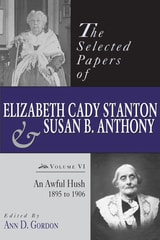
The Selected Papers of Elizabeth Cady Stanton and Susan B. Anthony
An Awful Hush, 1895 to 1906Gordon, Ann D
Rutgers University Press, 2012
The “hush” of the title comes suddenly, when first Elizabeth Cady Stanton dies on October 26, 1902, and three years later Susan B. Anthony dies on March 13, 1906. It is sudden because Stanton, despite near blindness and immobility, wrote so intently right to the end that editors had supplies of her articles on hand to publish several months after her death. It is sudden because Anthony, at the age of eighty-five, set off for one more transcontinental trip, telling a friend on the Pacific Coast, “it will be just as well if I come to the end on the cars, or anywhere, as to be at home.”
Volume VI of this extraordinary series of selected papers is inescapably about endings, death, and silence. But death happens here to women still in the fight. An Awful Hush is about reformers trained “in the school of anti-slavery” trying to practice their craft in the age of Jim Crow and a new American Empire. It recounts new challenges to “an aristocracy of sex,” whether among the bishops of the Episcopal church, the voters of California, or the trustees of the University of Rochester. And it sends last messages about woman suffrage. As Stanton wrote to Theodore Roosevelt on the day before she died, “Surely there is no greater monopoly than that of all men, in denying to all women a voice in the laws they are compelled to obey.”
With the publication of Volume VI, this series is now complete.
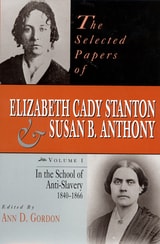
The Selected Papers of Elizabeth Cady Stanton and Susan B. Anthony
In the School of Anti-Slavery, 1840 to 1866Gordon, Ann D
Rutgers University Press, 1997
In the School of Anti-Slavery, 1840-1866 is the first of six volumes of The Selected Papers of Elizabeth Cady Stanton and Susan B. Anthony. The collection documents the lives and accomplishments of two of America's most important social and political reformers. Though neither Stanton nor Anthony lived to see the passage of the Nineteenth Amendment in 1920, each of them devoted fifty-five years to the cause. Their names were synonymous with woman suffrage in the United States and around the world as they mobilized thousands of women to fight for the right to a political voice.
Opening when Stanton was twenty-five and Anthony was twenty, and ending when Congress sent the Fourteenth Amendment to the states for ratification, this volume recounts a quarter of a century of staunch commitment to political change. Readers will enjoy an extraordinary collection of letters, speeches, articles, and diaries that tells a story-both personal and public-about abolition, temperance, and woman suffrage.
When all six volumes are complete, the Selected Papers of Stanton and Anthony will contain over 2,000 texts transcribed from their originals, the authenticity of each confirmed or explained, with notes to allow for intelligent reading. The papers will provide an invaluable resource for examining the formative years of women's political participation in the United States. No library or scholar of women's history should be without this original and important collection.
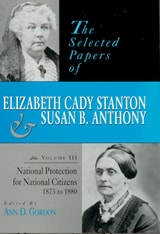
The Selected Papers of Elizabeth Cady Stanton and Susan B. Anthony
National Protection for National Citizens, 1873 to 1880Gordon, Ann D
Rutgers University Press, 2003
National Protection for National Citizens, 1873 to 1880 is the third of six planned volumes of TheSelected Papers of Elizabeth Cady Stanton and Susan B. Anthony. The entire collection documents the friendship and accomplishments of two of America's most important social and political reformers. Though neither Stanton nor Anthony lived to see passage of the Nineteenth Amendment in 1920, each of them devoted fifty-five years to the cause of woman suffrage.
The third volume of the Selected Papers of Elizabeth Cady Stanton and Susan B. Anthony opens while woman suffragists await the decision of the U.S. Supreme Court in cases testing whether the Constitution recognized women as voters within the terms of the Fourteenth and Fifteenth Amendments. At its close they are pursuing their own amendment to the Constitution and pressing the presidential candidates of 1880 to speak in its favor. Through their letters, speeches, articles, and diaries, the volume recounts the national careers of Elizabeth Cady Stanton and Susan B. Anthony as popular lecturers, their work with members of Congress to expand women's rights, their protests during the Centennial Year of 1876, and the launch that same year of their campaign for a Sixteenth Amendment.
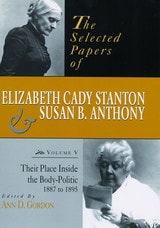
The Selected Papers of Elizabeth Cady Stanton and Susan B. Anthony
Their Place Inside the Body-Politic, 1887 to 1895Gordon, Ann D
Rutgers University Press, 2009
At the beginning, Stanton and Anthony focus their attention on organizing the International Council of Women in 1888. Late in 1887, Lucy Stone’s American Woman Suffrage Association announced its desire to merge with the national association led by Stanton and Anthony. Two years of fractious negotiations preceded the 1890 merger, and years of sharp disagreements followed. Stanton made her last trip to Washington in 1892 to deliver her famous speech “Solitude of Self.” Two states enfranchised women—Wyoming in 1890 and Colorado in 1893—but failures were numerous. Anthony returned to grueling fieldwork in South Dakota in 1890 and Kansas and New York in 1894. From the campaigns of 1894, Stanton emerged as an advocate of educated suffrage and staunchly defended her new position.
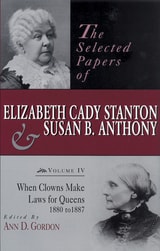
The Selected Papers of Elizabeth Cady Stanton and Susan B. Anthony
When Clowns Make Laws for Queens, 1880-1887Gordon, Ann D
Rutgers University Press, 2006
At the opening of the fourth volume, suffragists hoped to speed passage of a sixteenth amendment to the Constitution through the creation of Select Committees on Woman Suffrage in Congress. Congress did not vote on the amendment until January 1887. Then, in a matter of a week, suffragists were dealt two major blows: the Senate defeated the amendment and the Senate and House reached agreement on the Edmunds-Tucker Act, disenfranchising all women in the Territory of Utah.
As evidenced in this volume's selection of letters, articles, speeches, and diary entries, these were years of frustration. Suffragists not only lost federal and state campaigns for partial and full voting rights, but also endured an invigorated opposition. In spite of these challenges, Stanton and Anthony continued to pursue their life's work. In 1880 both women retired from lecturing to devote attention to their monumental History of Woman Suffrage. They also opened a new transatlantic dialogue about woman's rights during a trip to Europe in 1883.

The Spectacle of Women
Imagery of the Suffrage Campaign 1907-14Lisa Tickner
University of Chicago Press, 1988

The Sturdy Oak
A Composite Novel of American PoliticsElizabeth Jordan
Ohio University Press, 1998
In the spring of 1916, as the workers for woman suffrage were laying plans for another attack on the bastions of male supremacy, the idea for The Sturdy Oak was born. Based on the rules of an old parlor game, wherein one person begins a narrative, another continues it, and another follows, this collaborative effort by the leading writers of the day, such as Fannie Hurst, Dorothy Canfield, and Kathleen Norris, is a satiric look at the gender roles of the time.
There is much in The Sturdy Oak that reflects the New York campaign for suffrage of 1916–1917. The setting is the fictional city of Whitewater in upstate New York. Idealistic reformers are pitted against a ruthless political machine, and the traditional picture of man as “the sturdy oak” supporting woman, “the clinging vine,” is ridiculed in the portrayal of an engaging couple, George and Genevieve Remington. Nonetheless, the purpose of the book is not primarily ridicule but reform, and the reader is taken through the steps by which a confirmed anti-suffragist is gradually transformed into a supporter of the suffrage cause.
Beyond its historical interest, The Sturdy Oak is imbued with a political and social currency that makes it applicable even today. And because of the skill of the writers of this composite novel, even eight decades after its initial publication The Sturdy Oak is still, as the New York Times said in 1917, “irresistibly readable.”
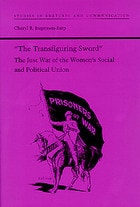
The Transfiguring Sword
The Just War of the Women's Social and Political UnionCheryl R. Jorgensen-Earp
University of Alabama Press, 1997
Provides a new understanding of the recurrent rhetorical need to employ conservative rhetoric in support of a radical cause
The Women’s Social and Political Union, the militant branch of the English women’s suffrage movement, turned to arson, bombing, and widespread property destruction as a strategy to achieve suffrage for women. Because of its comparative rarity, terrorist violence by reform (as opposed to revolutionary) movements is underexplored, as is the discursive rhetoric that accompanies this violence. Largely because of the moral stance that drives such movements, the need to justify violence is greater for the reformist than for the revolutionary terrorist. The burden of rhetorical justification falls even more heavily on women utilizing violence, an option generally perceived as open only to men.The militant suffragettes justified their turn to limited terrorism by arguing that their violence was part of a “just war.” Appropriating the rhetoric of a just war in defense of reformist violence allowed the suffragettes to exercise a traditional rhetorical vision for the sake of radical action. The concept of a just war allowed a spinning out of a fantasy of heroes, of a gallant band fighting against the odds. It challenged the imagination of the public to extend to women a heroic vision usually reserved for men and to accept the new expectations inherent in that vision. By incorporating the concept of a just war into their rhetoric, the WSPU leaders took the most conventional justification that Western tradition provides for the use of violence and adapted it to meet their unique circumstance as women using violence for political reform.
This study challenges the common view that the suffragettes’ use of military metaphors, their vilification of the government, and their violent attacks on property were signs of hysteria and self-destruction. Instead, what emerges is a picture of a deliberate, if controversial, strategy of violence supported by a rhetorical defense of unusual power and consistency.
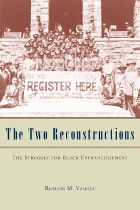
The Two Reconstructions
The Struggle for Black EnfranchisementRichard M. Valelly
University of Chicago Press, 2004
The Reconstruction era marked a huge political leap for African Americans, who rapidly went from the status of slaves to voters and officeholders. Yet this hard-won progress lasted only a few decades. Ultimately a "second reconstruction"—associated with the civil rights movement and the Voting Rights Act—became necessary.
How did the first reconstruction fail so utterly, setting the stage for the complete disenfranchisement of Southern black voters, and why did the second succeed? These are among the questions Richard M. Valelly answers in this fascinating history. The fate of black enfranchisement, he argues, has been closely intertwined with the strengths and constraints of our political institutions. Valelly shows how effective biracial coalitions have been the key to success and incisively traces how and why political parties and the national courts either rewarded or discouraged the formation of coalitions.
Revamping our understanding of American race relations, The Two Reconstructions brilliantly explains a puzzle that lies at the heart of America’s development as a political democracy.
The Way We Vote
The Local Dimension of American SuffrageAlec C. Ewald
Vanderbilt University Press, 2009
The book shows that local electoral variation has endured through dramatic changes in American political and constitutional structure, and that such variation is the product of a clear, repeated developmental pattern, not simple neglect or public ignorance. Legal materials, statutes and Congressional debates, state constitutional-convention proceedings, and the records of contested Congressional elections illuminate a long record of federal and state intervention in American electoral mechanics. Lawmakers have always understood that a certain level of disorder characterizes U.S. national elections, and have responded by exercising their authority over suffrage practices--but only in limited ways, effectively helping to construct our triply-governed electoral system.
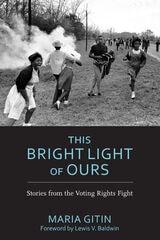
This Bright Light of Ours
Stories from the Voting Rights FightMaria Gitin
University of Alabama Press, 2014
Combining memoir with oral history, creates a vivid and searing portrait of the Freedom Summer of 1965.
This Bright Light of Ours offers a tightly focused insider’s view of the community-based activism that was the heart of the civil rights movement. A celebration of grassroots heroes, this book details through first-person accounts the contributions of ordinary people who formed the nonviolent army that won the fight for voting rights.
Combining memoir and oral history, Maria Gitin fills a vital gap in civil rights history by focusing on the neglected Freedom Summer of 1965 when hundreds of college students joined forces with local black leaders to register thousands of new black voters in the rural South. Gitin was an idealistic nineteen-year-old college freshman from a small farming community north of San Francisco who felt called to action when she saw televised images of brutal attacks on peaceful demonstrators during Bloody Sunday, in Selma, Alabama.
Atypical among white civil rights volunteers, Gitin came from a rural low-income family. She raised funds to attend an intensive orientation in Atlanta featuring now-legendary civil rights leaders. Her detailed letters include the first narrative account of this orientation and the only in-depth field report from a teenage Summer Community Organization and Political Education (SCOPE) project participant.
Gitin details the dangerous life of civil rights activists in Wilcox County, Alabama, where she was assigned. She tells of threats and arrests, but also of forming deep friendships and of falling in love. More than four decades later, Gitin returned to Wilcox County to revisit the people and places that she could never forget and to discover their views of the “outside agitators” who had come to their community. Through conversational interviews with more than fifty Wilcox County residents and former civil rights workers, she has created a channel for the voices of these unheralded heroes who formed the backbone of the civil rights movement.
Trading Democracy for Justice
Criminal Convictions and the Decline of Neighborhood Political ParticipationTraci Burch
University of Chicago Press, 2013
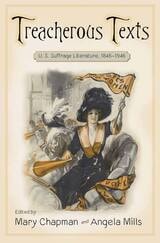
Treacherous Texts
An Anthology of U.S. Suffrage Literature, 1846-1946Chapman, Mary
Rutgers University Press, 2011
Uncovering startling affinities between popular literature and propaganda, Treacherous Texts samples a rich, decades-long tradition of suffrage literature created by writers from diverse racial, class, and regional backgrounds. Beginning with sentimental fiction and polemic, progressing through modernist and middlebrow experiments, and concluding with post-ratification memoirs and tributes, this anthology showcases lost and neglected fiction, poetry, drama, literary journalism, and autobiography; it also samples innovative print cultural forms devised for the campaign, such as valentines, banners, and cartoons. Featured writers include canonical figures as well as writers popular in their day but, until now, lost to ours.
Includes writings by:
• Sojourner Truth
• Elizabeth Cady Stanton
• Frederick Douglass
• Fanny Fern
• Harriet Beecher Stowe
• Djuna Barnes
• Charlotte Perkins Gilman
• Marianne Moore
• Sui Sin Far
• Edna St. Vincent Millay
• Gertrude Stein
And many others.