Results by title
91 books match the query 'Theater and society' and 23 start with t
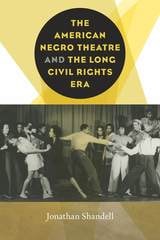
The American Negro Theatre and the Long Civil RIghts Era
Jonathan Shandell
University of Iowa Press, 2018
Jonathan Shandell provides the first in-depth study of the historic American Negro Theatre (ANT) and its lasting influence on American popular culture. Founded in 1940 in Harlem, the ANT successfully balanced expressions of African American consciousness with efforts to gain white support for the burgeoning civil rights movement. The theatre company featured innovative productions with emerging artists—Sidney Poitier, Harry Belafonte, Ruby Dee, and many others—who would become giants of stage, film, and television. In 1944, the ANT made theatrical history by creating the smash hit Anna Lucasta, the most popular play with an African American cast ever to perform on Broadway. Starting from a shoestring budget, the ANT grew into one of the most important companies in the history of African American theatre. Though the group folded in 1949, it continued to shape American popular culture through the creative work of its many talented artists.
Examining oral histories, playbills, scripts, production stills, and journalistic accounts, Shandell gives us the most complete picture to date of the theatre company by analyzing well-known productions alongside groundbreaking and now-forgotten efforts. Shedding light on this often-overlooked chapter of African American history, which fell between the New Negro Renaissance and the Black Arts Movement, Shandell reveals how the ANT became a valued community institution for Harlem—an important platform for African American artists to speak to racial issues—and a trailblazer in promoting integration and interracial artistic collaboration in the U.S. In doing so, Shandell also demonstrates how a small amateur ensemble of the 1940s succeeded in challenging, expanding, and transforming how African Americans were portrayed in the ensuing decades. The result is a fascinating and entertaining examination that will be of interest to scholars and students of African American and American studies and theatre history, as well as popular culture enthusiasts.

The American Pipe Dream
Performance of Drug Addiction, 1890-1940Max Shulman
University of Iowa Press, 2022
Chapters look at how theatre, film, and popular culture linked the Chinese immigrant and opium smoking; the early attacks on doctors for their part in the creation of addicts; the legislation of addiction as a criminal condition; the comic portrayals of addiction; the intersection of Black, jazz, and drug cultures through cabaret performance; and the linkage between narcotic inebriation and artistic inspiration. The American Pipe Dream creates active connections between these case studies, demonstrating how this history has influenced our contemporary understanding, treatment, and legislation of drug use and addiction.
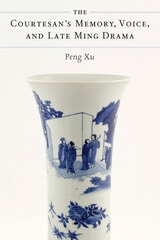
The Courtesan's Memory, Voice, and Late Ming Drama
Peng Xu
University of Michigan Press, 2025
This study profoundly remaps the textbook narratives of gender bias, challenges modern prejudices prevalent in the literary history of Chinese drama, and reveals how theatrical conditions and writing styles shifted to accommodate courtesan performances. Utilizing a wide range of sources such as scripts, city guides, biographies, diaries, letters, wood-block illustrations, and paintings, this study distinguishes itself from earlier studies of Chinese courtesans by not thematizing courtesans for their allegorical values, but rather pinpointing their agency in shaping the features of Chinese theater and recognizing courtesans as a source of creativity and development in the medium. Xu’s focus on courtesan performance culture allows for fresh readings of canonical Chinese plays, opening up new ways of understanding the history of Chinese drama written by women, thus deviating from standard historiography based solely on the writings of men.
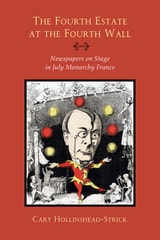
The Fourth Estate at the Fourth Wall
Newspapers on Stage in July Monarchy FranceCary Hollinshead-Strick
Northwestern University Press, 2019
July Monarchy plays, which provided affordable entertainment to a broad section of the public, constitute a large, nearly untapped reservoir of commentary on the arrival of the forty-franc press. Vaudevilles and comedies ask whether journalism that benefits from advertisement can be unbiased. Dramas explore whether threatening to spread false news is an acceptable way for journalists to exercise their influence. Hollinshead-Strick uses both plays and novels to show that despite their claims to enlighten their readers, newspapers were often accused of obscuring public access to information. Balzac’s interventions in this media sphere reveal his utopian views on print technology. Nerval’s and Pyat’s demonstrate the nefarious impact that corrupt theater critics could have on authors and on the public alike.
Scholars of press and media studies, French literature, theater, and nineteenth-century literature more generally will find this book a valuable introduction to a cross-genre debate about press publicity that remains surprisingly resonant today.
The Healing Stage
Black Women, Incarceration, and the Art of TransformationLisa Biggs
The Ohio State University Press, 2022
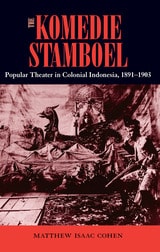
The Komedie Stamboel
Popular Theater in Colonial Indonesia, 1891–1903Matthew Isaac Cohen
Ohio University Press, 2006
Originating in 1891 in the port city of Surabaya, the Komedie Stamboel, or Istanbul-style theater, toured colonial Indonesia, Singapore, and Malaysia by rail and steamship. The company performed musical versions of the Arabian Nights, European fairy tales and operas such as Sleeping Beauty and Aida, as well as Indian and Persian romances, Southeast Asian chronicles, true crime stories, and political allegories. The actors were primarily Eurasians, the original backers were Chinese, and audiences were made up of all races and classes. The Komedie Stamboel explores how this new hybrid theater pointed toward possibilities for the transformation of self in a colonial society and sparked debates on moral behavior and mixed-race politics.
While audiences marveled at spectacles involving white-skinned actors, there were also racial frictions between actors and financiers, sexual scandals, fights among actors and patrons, bankruptcies, imprisonments, and a murder.
Matthew Isaac Cohen's evocative social history situates the Komedie Stamboel in the culture of empire and in late nineteenth-century itinerant entertainment. He shows how the theater was used as a symbol of cross-ethnic integration in postcolonial Indonesia and as an emblem of Eurasian cultural accomplishment by Indische Nederlanders. A pioneering study of nineteenth-century Southeast Asian popular culture, The Komedie Stamboel gives a new picture of the region's arts and culture and explores the interplay of currents in global culture, theatrical innovation, and movement in colonial Indonesia.ABOUT THE AUTHOR---Matthew Isaac Cohen is senior lecturer in Drama and Theatre Studies at Royal Holloway University of London. His articles on Southeast Asian performance have appeared in New Theatre Quarterly, Asian Theatre Journal, Journal of the Royal Asiatic Society, and Archipel. As a practicing shadow puppeteer, he has performed in the United States, Europe, and Asia.
The Media Players
Shakespeare, Middleton, Jonson, and the Idea of NewsStephen Wittek
University of Michigan Press, 2015

The National Stage
Theatre and Cultural Legitimation in England, France, and AmericaLoren Kruger
University of Chicago Press, 1992
The National Stage answers this question by tracing the relation between theatre institution and public sphere in the discourses of national identity in Britain, France, and the United States. Exploring the boundaries between history and theory, text and performance, this book speaks to theatre and social historians as well as those interested in the theoretical range of cultural studies.
The Purpose of Playing
Shakespeare and the Cultural Politics of the Elizabethan TheatreLouis Montrose
University of Chicago Press, 1996
Montrose first locates the public and professional theater within the ideological and material framework of Elizabethan culture. He considers the role of the professional theater and theatricality in the cultural transformation that was concurrent with religious and socio-political change, and then concentrates upon the formal means by which Shakespeare's Elizabethan plays called into question the absolutist assertions of the Elizabethan state. Drawing dramatic examples from the genres of tragedy and history, Montrose finally focuses his cultural-historical perspective on A Midsummer Night's Dream.
The Purpose of Playing elegantly demonstrates how language and literary imagination shape cultural value, belief, and understanding; social distinction and interaction; and political control and contestation.
The Recurrence of Fate
Theatre and Memory in Twentieth-Century RussiaSpencer Jay Golub
University of Iowa Press, 1994
How, why, and according to whose definitions and requirements does a culture self-consciously create memory and project its fate? In this remarkable book—the first in English to treat Russian history as theatre and cultural performance—Spencer Golub reveals the performative nature of Russian history in the twentieth century and the romantic imprisonment/self-imprisonment of the creative intelligentsia within this scenario.
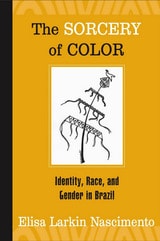
The Sorcery of Color
Identity, Race, and Gender in BrazilElisa Larkin Nascimento
Temple University Press, 2009
Originally published in 2003 in Portuguese, The Sorcery of Color argues that there are longstanding and deeply-rooted relationships between racial and gender inequalities in Brazil. In this pioneering book, Elisa Larkin Nascimento examines the social and cultural movements that have attempted, since the early twentieth century, to challenge and eradicate these conjoined inequalities.
The book's title describes the social sleight-of-hand that disguises the realities of Brazilian racial inequity. According to Nascimento, anyone who speaks of racism—or merely refers to another person as black—traditionally is seen as racist. The only acceptably non-racist attitude is silence. At the same time, Afro-Brazilian culture and history have been so overshadowed by the idea of a general "Brazilian identity" that to call attention to them is also to risk being labeled racist.
Incorporating leading international scholarship on Pan Africanism and Afrocentric philosophy with the writing of Brazilian scholars, Nascimento presents a compelling feminist argument against the prevailing policy that denies the importance of race in favor of a purposefully vague concept of ethnicity confused with color.

The Unfinished Art of Theater
Avant-Garde Intellectuals in Mexico and BrazilSarah J. Townsend
Northwestern University Press, 2018
A certain idea of the avant-garde posits the possibility of a total rupture with the past. The Unfinished Art of Theater pulls back on this futuristic impulse by showing how theater became a key site for artists on the semiperiphery of capitalism to reconfigure the role of the aesthetic between 1917 and 1934. The book argues that this “unfinished art”—precisely because of its historic weakness as a representative institution in Mexico and Brazil, where the bourgeois stage had not (yet) coalesced—was at the forefront of struggles to redefine the relationship between art and social change.
Drawing on extensive archival research, Sarah J. Townsend reveals the importance of projects and texts that belie the rhetoric of rupture and immediacy associated with the avant-garde: ethnographic operas with ties to the recording industry, populist puppet plays, children’s radio programs about the wonders of technology, a philosophical drama about the birth of a new race, and an antifascist spectacle written for (but never performed at) a theater shut down by the police. Ultimately, the book makes the case that the very category of avant-garde art is bound up in the experience of dependency, delay, and the uneven development of capitalism.
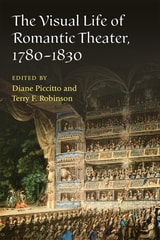
The Visual Life of Romantic Theater, 1780-1830
Edited by Diane Piccitto and Terry F. Robinson
University of Michigan Press, 2023
The Visual Life of Romantic Theater examines the dynamism and vibrancy of stage spectacle and its impact in an era of momentous social upheaval and aesthetic change. Situating theatrical production as key to understanding visuality ca. 1780-1830, this book places the stage front and center in Romantic scholarship—a field in a period long defined by its focus on poetry—by reenvisioning traditional approaches to artistic and social production. How, it asks, did dramaturgy and stagecraft influence aesthetic and sociopolitical concerns? How does a focus on visuality expand our understanding of the historical experience of theatergoing? In what ways did stage performance converge with visual culture beyond the theater? How did extra-theatrical genres engage with theatrical sight and spectacle? Finally, how does a focus on dramatic vision change the way we conceive of Romanticism itself? The volume’s essays by emerging and established scholars provide exciting and suggestive answers to these questions, along with a more capacious conception of Romantic theater as a locus of visual culture that reached well beyond playhouse walls.

Theater after Film
Martin Harries
University of Chicago Press, 2025
In Theater after Film, Martin Harries argues that after 1945, as cinema became omnipresent in popular culture, theater had to respond to cinema’s hegemony. Theater couldn’t break that hegemony, but it could provide a zone of contestation. Theater made film’s domination of the cultural field visible through hyperbole, refusal, and other strategies, thereby unsettling its power. Postwar theatrical experiment, Harries shows, often channeled and represented film’s mass cultural force, while knowing that it could never possess that force. Throughout the book, Harries brings critical theory into contact with theories of performance. Although Theater after Film treats the theatrical work of many figures, its central focus falls on Tennessee Williams, Samuel Beckett, and Adrienne Kennedy. Discussions of these dramatists consider their ways of addressing spectators, the politics of race between film and theater, and the place of the theatrical apparatus. Readings of these central figures in twentieth-century theater exemplify the book’s historical engagement with the media surround that drama confronted. This confrontation, Harries shows, was central to the development of some of the most continually compelling postwar drama.
Theater and Society in the Classical World
Ruth Scodel, Editor
University of Michigan Press, 1993
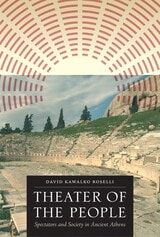
Theater of the People
Spectators and Society in Ancient AthensBy David Kawalko Roselli
University of Texas Press, 2011
Greek drama has been subject to ongoing textual and historical interpretation, but surprisingly little scholarship has examined the people who composed the theater audiences in Athens. Typically, scholars have presupposed an audience of Athenian male citizens viewing dramas created exclusively for themselves—a model that reduces theater to little more than a medium for propaganda. Women's theater attendance remains controversial, and little attention has been paid to the social class and ethnicity of the spectators. Whose theater was it?
Producing the first book-length work on the subject, David Kawalko Roselli draws on archaeological and epigraphic evidence, economic and social history, performance studies, and ancient stories about the theater to offer a wide-ranging study that addresses the contested authority of audiences and their historical constitution. Space, money, the rise of the theater industry, and broader social forces emerge as key factors in this analysis. In repopulating audiences with foreigners, slaves, women, and the poor, this book challenges the basis of orthodox interpretations of Greek drama and places the politically and socially marginal at the heart of the theater. Featuring an analysis of the audiences of Aeschylus, Sophocles, Euripides, Aristophanes, and Menander, Theater of the People brings to life perhaps the most powerful influence on the most prominent dramatic poets of their day.
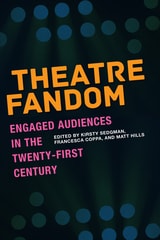
Theatre Fandom
Engaged Audiences in the Twenty-first CenturyKirsty Sedgman
University of Iowa Press, 2025
Contributors: Tom Cantrell, Francesca Coppa, Ruth Foulis, Helen Freshwater, Emily Garside, Caroline Heim, Matt Hills, Natalie Ibu, Laura MacDonald, Dominique Morisseau, Rachael Nicholas, Louie Lang Norman, Owen G. Parry, Stephanie E. Pitts, Sarah M. Price, Beth Emily Richards, Kirsty Sedgman, Megan Vaughan, Ben Walmsley, Sarah K. Whitfield
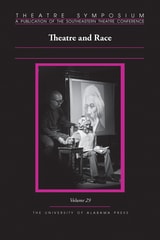
Theatre Symposium, Vol. 29
Theatre and RaceEdited by Andrew Gibb
University of Alabama Press, 2022
Essays whose composition and editing were undertaken almost entirely within the transformed cultural and professional landscape of 2020
A few weeks prior to the submission deadline for this volume of Theatre Symposium, the murder of George Floyd by officers of the Minneapolis Police Department sparked a movement for racial justice that reverberated at every level of US society. At predominantly and historically white academic institutions (including Theatre Symposium and its parent organization, the Southeastern Theatre Conference) leaders were compelled, as perhaps never before, to account for the role of systematic racism in the foundation and perpetuation of their organizations. While the present volume’s theme of “Theatre and Race” was announced in the waning days of 2019, the composition and editing of the issue’s essays were undertaken almost entirely within the transformed cultural and professional landscape of 2020. Throughout its twenty-nine years of publication, Theatre Symposium’s pages have included many excellent essays whose authors have deployed theories of race as an analytical framework, and (less often) treated BIPOC-centered art and artists as subject. The intent of the current editors in conceiving this issue was to center such subjects and theorizations, a goal that has since taken on a more widely recognized urgency.
Taken together, these twelve essays represent a wide range of scholarly responses to the theme of “theatre and race.” The fact that there is so much to say on the topic, from so many different perspectives, is a sign of how profoundly theatre practices have been—and continue to be—shaped by racial discourses and their material manifestations.
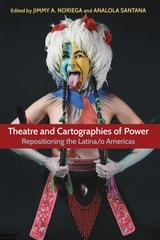
Theatre and Cartographies of Power
Repositioning the Latina/o AmericasEdited by Jimmy A. Noriega and Analola Santana
Southern Illinois University Press, 2018
Building on hemispheric and transnational models, this book demonstrates the capacity of theatre studies to challenge the up-down/North-South approach that dominates scholarship in the United States and presents a strong case for a repositioning of the Latina/o Americas in theatrical histories and practices.
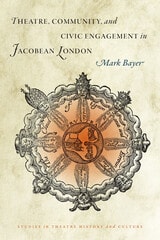
Theatre, Community, and Civic Engagement in Jacobean London
Mark Bayer
University of Iowa Press, 2011
Taking to heart Thomas Heywood’s claim that plays “persuade men to humanity and good life, instruct them in civility and good manners, showing them the fruits of honesty, and the end of villainy,” Mark Bayer’s captivating new study argues that the early modern London theatre was an important community institution whose influence extended far beyond its economic, religious, educational, and entertainment contributions. Bayer concentrates not on the theatres where Shakespeare’s plays were performed but on two important amphitheatres, the Fortune and the Red Bull, that offer a more nuanced picture of the Jacobean playgoing industry. By looking at these playhouses, the plays they staged, their audiences, and the communities they served, he explores the local dimensions of playgoing.
Theatres of Independence
Drama, Theory, and Urban Performance in India since 1947Aparna Bhargava Dharwadker
University of Iowa Press, 2005
The first part of Dharwadker’s study deals with the new dramatic canon that emerged after 1950 and the variety of ways in which plays are written, produced, translated, circulated, and received in a multilingual national culture. The second part traces the formation of significant postcolonial dramatic genres from their origins in myth, history, folk narrative, sociopolitical experience, and the intertextual connections between Indian, European, British, and American drama. The book’s ten appendixes collect extensive documentation of the work of leading playwrights and directors, as well as a record of the contemporary multilingual performance histories of major Indian, Western, and non-Western plays from all periods and genres. Treating drama and theatre as strategically interrelated activities, the study makes post-independence Indian theatre visible as a multifaceted critical subject to scholars of modern drama, comparative theatre, theatre history, and the new national and postcolonial literatures.

Toward a Theater of the Oppressed
The Dramaturgy of John ArdenJaved Malick
University of Michigan Press, 1995
Malick situates Arden's dramaturgy in the wider context of the radical alternative tradition in Western drama, drawing connections to Brecht, Piscator, the radical playwrights of the 1960s. He then explores the formal structure, ideological implications, and historical significance of Arden's work, treating his stage plays as one dramaturgically coherent opus- from the early Waters of Babylon to his and Margaretta D'Arcy's ambitious trilogy, The Island of the Mighty. Finally, he discusses the last phase of Arden and D'Arcy's political and artistic development, which led them to turn their backs on the professional theater circuit. He argues that Arden's rejection of the institutional stage was the logical outcome of his persistent search for alternative forms of political theater.
Toward a Theater of the Oppressed will be invaluable reading for those interested in modern drama, political theater, and popular performance, as well as students of contemporary British drama.
Javed Malick is Reader in English, Khalsa College, University of Delhi, India.

Tragic Muse
Rachel of the Comédie-FrançaiseRachel M. Brownstein
Duke University Press, 1995
Born to itinerant Jewish peddlers in 1821, Rachel arrived on the Paris stage at the age of fifteen. She became both a symbol of her culture’s highest art and a clue to its values and obsessions. Fascinated with all things Napoleonic, she was the mother of Napoleon’s grandson and the lover of many men connected to the emperor. Her story—the rise from humble beginnings to queen of the French state theater—echoes and parodies Napoleon’s own. She decisively controlled her career, her time, and finances despite the actions and claims of managers, suitors, and lovers. A woman of exceptional charisma, Rachel embodied contradiction and paradox. She captured the attention of her time and was memorialized in the works of Matthew Arnold, Charlotte Brontë, George Eliot, and Henry James.
Richly illustrated with portraits, photographs, and caricatures, Tragic Muse combines brilliant literary analysis and exceptional historical research. With great skill and acuity, Rachel M. Brownstein presents Rachel—her brief intense life and the image that was both self-fashioned and, outliving her, fashioned by others. First published by Knopf (1993), this book will attract a broad audience interested in matters as wide ranging as the construction of character, the cult of celebrity, women’s lives, and Jewish history. It will also be of enduring interest to readers concerned with nineteenth-century French culture, history, literature, theater, and Romanticism. Tragic Muse won the 1993 George Freedley Award presented by the Theater Library Association.