132 books match the query 'Thomas, Aquinas, Saint' and 42 start with t
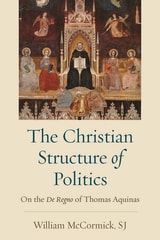
cover of The Christian Structure of Politics: The De Regno of Thomas Aquinas

The Christian Structure of Politics

The De Regno of Thomas Aquinas

William McCormick, SJ

Catholic University of America Press, 2022
The Christian Structure of Politics, the first full-length monograph on Thomas Aquinas's De Regno in decades, offers an authoritative interpretation of De Regno as a contribution to our understanding of Aquinas's politics, particularly on the relationship between Church and State. William McCormick argues that Aquinas takes up a via media between Augustine and Aristotle in De Regno, invoking human nature to ground politics as rational, but also Christian principles to limit politics because of both sin and the supernatural end of man beyond politics. Where others have seen disjoined sections on the best regime, tyranny, and the reward of the king, McCormick identifies a dialogical structure to the text - one not unlike the disputed question format - whereby Aquinas both tempers expectations for the best government and offers a spiritual diagnosis of tyranny, culminating in a sharp critique of civil religion and political theology. McCormick draws upon historical research on Aquinas' context, especially that of Anthony Black, Cary Nederman and Francis Oakley, from which he develops three themes: the medieval preponderance of kingship and royal ideology; the relationship between Church and State; and the intersection of Latin Christianity and Greco-Roman antiquity. While age-old concerns, recent research in these areas has allowed us to move beyond simplistic platitudes. For scholars of political theory and the history of political thought, De Regno will prove fascinating for the interplay of Aristotelian and Augustinian elements, undercutting the conventional wisdom that Aquinas was simply an Aristotelian. De Regno also includes an extended treatment of civil religion, one of Aquinas’ most historically-oriented discussions of politics.
[more]
cover of The Cleansing of the Heart

The Cleansing of the Heart

Reginald Lynch

Catholic University of America Press, 2017

Recalling the Biblical and Patristic roots of the Church's sacramental identity, the Second Vatican Council calls the Church the 'visible sacrament' of that unity offered through Christ (LG 9). 'Sacrament' in this sense not only describes who the Church is, but what she does. In this regard, the Council Fathers were careful to establish a strong connection between the symbolic nature of the Church's sacraments and their effect on those who received them.

Reginald Lynch is concerned with the cleansing of the heart—a phrase borrowed from St. Augustine and employed by Aquinas, which describes the effects that natural elements such as water or bread have on the human person when taken up by the Church as sacramental signs. Aquinas' approach to sacramental efficacy is unique for its integration of diverse theological topics such as Christology, merit, grace, creation and instrumentality. While all of these topics will be considered to some extent, the primary focus of The Cleansing of the Heart is the sacraments understood as instrumental causes of grace. This volume provides the historical context for understanding the development of sacramental causality as a theological topic in the scholastic period, emphasizing the unique features of Aquinas' response to this question. Following this, relevant texts from Aquinas' early and later work are examined, noting Aquinas' development and integration of the idea of sacramental causality in his later work. The Cleansing of the Heart concludes by contrasting alternatives to Aquinas' theory of sacramental causality that subsequently emerged. The rise of humanism introduced many changes within rhetoric and philosophy of language that had a profound effect on some theologians during the Modern period. This book provides historical context for understanding the most prominent of these theories in contrast to Aquinas, and examines some of their theological implications.
[more]
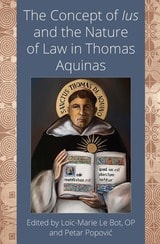
cover of The Concept of <i>Ius</i> and the Nature of Law in Thomas Aquinas

The Concept of <i>Ius</i> and the Nature of Law in Thomas Aquinas

Loic-Marie Le Bot, OP

Catholic University of America Press, 2025
This collection of essays constitutes the fruit of a scholarly conference held in Rome in April 2023, which was organized by the Pontifical University of Saint Thomas Aquinas, the Pontifical University of the Holy Cross, and the Angelicum Thomistic Institute. The essays offer a scholarly reflection on various historical and doctrinal aspects of Aquinas’s concept of ius, and on the extent to which this concept helps to illuminate his account of the nature of law, that is, of the juridical phenomenon. Each essay addresses, from the viewpoint of its specific topic, the implications of the Angelic Doctor’s description of ius as the object of justice, as presented in the Secunda secundae of his Summa theologiae (starting from question 57, article 1). Following Aquinas’s own insights, the focus on the virtue of justice is thus deemed crucial for understanding the essence or the ontological fabric of law. Justice is simultaneously analyzed as always remaining inherently connected to its moral and divine-salvific aspects. The volume is divided in three parts. The first part of the collection contains essays that are dedicated to the analysis of Aquinas’s concept of ius in a historical perspective. The second group of essays in this collection examine some further doctrinal and contextual issues pertinent to the essence of ius. Each attempt to elucidate the ontology of law should be supported by the aptitude of the resulting accounts of law’s nature to provide workable platforms for legal practices. This line of reasoning represents the rationale for the third part of this collection, which focuses on the matters of applying Aquinas’s concept of ius in systemic and practical legal settings of State law and canon law.
[more]
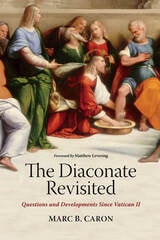
cover of The Diaconate Revisited: Questions and Developments Since Vatican II

The Diaconate Revisited

Questions and Developments Since Vatican II

Marc B. Caron

Catholic University of America Press, 2026
The sacrament of Holy Orders is the only one of the seven sacraments which exists in three ranks arranged hierarchically, that is, bishops, presbyters, and deacons. Deacons are distinct from both bishops and presbyters, yet united with them in one sacrament. Since the Second Vatican Council, various magisterial documents have limited the priestly dimension of holy orders to bishops and presbyters alone. If deacons do not share in the hierarchical priesthood at all, how are they then related to bishops and to presbyters? In the end, is the diaconate even part of the sacrament of holy orders? This book attempts to show how a ministerial dimension to the character received in ordination to each of the three ranks unites the episcopate, the presbyterate, and the diaconate in a single sacrament. According to the theology of the sacrament of holy orders found in Lumen gentium, the bishop receives the fullness of the sacrament, meaning both its sacerdotal and diaconal or ministerial dimensions. The presbyter then receives a lesser portion than the bishop of both sacerdotal and ministerial dimensions of the sacrament. Finally, the deacon receives an even lesser share than that of the presbyter of the ministerial dimension of holy orders alone. This approach makes clear that the bishop is the greatest servant of the Church as well as its high priest. It challenges presbyters to be of greater service to the Body of Christ than even deacons. The baptismal call to holiness of all the faithful can also be described as having both priestly and ministerial or diaconal dimensions as well. With this understanding, it now becomes clearer how the laity can perform certain functions by delegation which the Church normally entrusts to deacons by ordination. Finally, the unity of the diaconate with the two priestly ranks must inform the current discussions taking place about any possible ordination of women to the sacrament of holy orders in the diaconal rank.
[more]
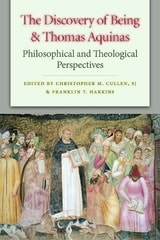
cover of The Discovery of Being and Thomas Aquinas

The Discovery of Being and Thomas Aquinas

Christopher M. Cullen, SJ

Catholic University of America Press, 2019

While there has been agreement among followers of Aquinas that being insofar as it is being (being qua being) is the subject of metaphysics, there is not agreement on how this being qua being is to be understood, nor on how we come to know the being that is the object of metaphysical investigation. The topic of what being is, as the object of the science of metaphysics, and how to account for the “discovery” of the being of metaphysics have emerged as central problems for the contemporary retrieval of Aquinas and for the larger project of post-Leonine Thomism in general. This lack of agreement has hampered the retrieval of Aquinas’s metaphysics.

The collection of essays within The Discovery of Being and Thomas Aquinas is divided into three major parts: the first set of essays concerns the foundation of metaphysics within Thomism; the second set exemplifies the use of metaphysics in fundamental philosophical issues within Thomism; and the third set employs metaphysics in central theological issues.

The Discovery of Being and Thomas Aquinas allows major scholars of the different types of Thomism to engage in a full-scale defense of their position, as well as expanding Thomistic metaphysics to the discipline of theology in important ways.
[more]
cover of The Ethics of St. Thomas Aquinas: Happiness, Natural Law, and the Virtues

The Ethics of St. Thomas Aquinas

Happiness, Natural Law, and the Virtues

Leo Elders

Catholic University of America Press, 2019
"Elders brings to his study an almost encyclopedic knowledge of the history of philosophy. Although he advises his readers not to look for any novel interpretations of Thomas, the book is full of surprises. Time and again, he offers a concise history of the moral issue under consideration...A more authoritative introduction to the moral philosophy of Aquinas is not likely to be found. In fact, it is a delight to read." - Philosophy in Review
[more]
cover of The Fittingness of the Incarnation: Essays in Analytic Thomistic Philosophy and Theology

The Fittingness of the Incarnation

Essays in Analytic Thomistic Philosophy and Theology

David Braine, David

Catholic University of America Press, 2025
The Fittingness of the Incarnation collects David Braine's best unpublished philosophical and theological essays. The essays contained herein are representative of Braine's careful, rich and distinctive work. As one of the more interesting philosophers of his generation, David Braine offered a realist account of the world - God's existence, the human person, and language - through his major works, and these essays help follow through on some of those thoughts, explain underlying metaphysical or epistemological principles, and we see many of these applied in his theological essays. Additionally, the book includes Braine's plans for books on the realism of St. Thomas Aquinas, which helps us see again his vision for a unified philosophical account, and the Incarnation, which shows how Braine's philosophical anthropology informs. Altogether, the book contributes the final papers of David Braine to the fields at large.
[more]
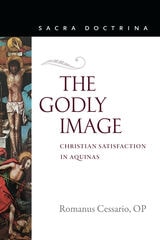
cover of The Godly Image: Christian Satisfaction in Aquinas

The Godly Image

Christian Satisfaction in Aquinas

Romanus Cessario

Catholic University of America Press, 2020
Christian satisfaction stands at the center of the Church’s teaching about salvation. Satisfaction pertains to studies about Christ, redemption, the Sacraments, and pastoral practice. The topic also enters into questions about God and the creature as well as about the divine mercy and providence. Somewhat neglected in the period after Vatican II, satisfaction now appears to scholars as the forgotten key to entering deeply into the mystery of Christ and his work. Seminarians especially will benefit from studying the place satisfaction holds in Catholic life. Further, ecumenical work requires a proper understanding of the place that satisfaction holds in Christian theology. Various factors operative since the sixteenth century have worked to displace satisfaction almost entirely from reformed practice and theology. To address such concerns, The Godly Image, has, over the past several decades and more, done a great deal to put satisfaction within its proper context of image-restoration. That is, to interpret satisfaction within the context of the divine mercy and not the divine justice. This unique contribution to satisfaction studies owes a great deal to the achievement of Saint Thomas Aquinas. In this sense, the book enacts a retrieval of the theology of the high classical period. Like much of Aquinas’s refined teaching, a proper understanding requires appeal to the commentatorial tradition that follows him. Interested students will find in this study the touchstones for further studies of these authors. The Godly Image aims also to distinguish the theology of Aquinas from that of the medieval author with whom the notion of satisfaction remains mostly identified, that is, Anselm of Canterbury. Although not a developed focus of the book’s contents, the attentive reader will recognize that Aquinas treats Saint Anselm with a reverential reading, even as the Common Doctor moves significantly away from interpretations of satisfaction that suggest that an angry God exacts from his innocent Son a painful substitutional penalty for a fallen human race.
[more]
cover of The Human Person

The Human Person

Steven J. Jensen

Catholic University of America Press, 2018
The Human Person presents a brief introduction to the human mind, the soul, immortality, and free will. While delving into the thought of Thomas Aquinas, it addresses contemporary topics, such as skepticism, mechanism, animal language research, and determinism. Steven J. Jensen probes the primal questions of human nature. Are human beings free or determined? Is the capacity to reason distinctive to human beings or do animals also have some share of reason? Have animals really been taught to use language?
[more]
cover of The Ideal Bishop

The Ideal Bishop

Michael G. Sirilla

Catholic University of America Press, 2017
St. Thomas Aquinas’s commentaries on the Pastoral Epistles are distinctive and overlooked theological resources, offering invaluable insights into the exercise of the episcopal office in bringing about the spiritual perfection of the faithful in Christ. The Ideal Bishop includes a review of the theology of the episcopacy found in St. Thomas’s principal contemporaries, including Peter Lombard, St. Albert the Great, and St. Bonaventure of Bagnoregio. The heart of this book is an examination of the theology and spirituality of the episcopacy found in the lectures on 1 Timothy, 2 Timothy, and Titus. Particular attention is devoted to Aquinas’s treatment of the nature, purpose, requisite virtues, disqualifying vice, special duties, and particular graces of the episcopal office.
[more]
cover of The Incarnate Lord

The Incarnate Lord

Thomas Josepth White, OP

Catholic University of America Press, 2015
The Incarnate Lord, then, considers central themes in Christology from a metaphysical perspective. Particular attention is given to the hypostatic union, the two natures of Christ, the knowledge and obedience of Jesus, the passion and death of Christ, his descent into hell, and resurrection. A central concern of the book is to argue for the perennial importance of ontological principles of Christology inherited from patristic and scholastic authors. However, the book also seeks to advance an interpretation of Thomistic Christology in a modern context. The teaching Aquinas, then, is central to the study, but it is placed in conversation with various modern theologians, such as Karl Barth, Karl Rahner and Hans Urs von Balthasar. Ultimately the goal of the work is to suggest how traditional Catholic theology might thrive under modern conditions, and also develop fruitfully from engaging in contemporary controversies.
[more]
cover of The Logic of Desire: Aquinas on Emotion

The Logic of Desire

Aquinas on Emotion

Nicholas E. Lombardo, O.P.

Catholic University of America Press, 2011
Focusing on the Summa theologiae, Nicholas Lombardo contributes to the recovery, reconstruction, and critique of Aquinas's account of emotion in dialogue with both the Thomist tradition and contemporary analytic philosophy
[more]
cover of The Metaphysical Foundations of Love: Aquinas on Participation, Unity, and Union

The Metaphysical Foundations of Love

Aquinas on Participation, Unity, and Union

Anthony T. Flood

Catholic University of America Press, 2018
The Metaphysical Foundations of Love: Aquinas on Participation, Unity, and Union offers a systematic treatment of St. Thomas Aquinas’s account of the metaphysical relations of unity-to-union and unity-to-participation in God as the key structuring elements to the nature of love and friendship. In general, Aquinas identifies love as the source and summit of the life of each human being. Everything in the created realm issues forth from God’s creative love, and the ultimate end of all human persons is the greatest possible union with God. Aquinas contends that the love of friendship allows for the greatest union between two persons; thus, the greatest union with God takes the form of friendship with him.
[more]
cover of The Metaphysics of Knowledge and Politics in Thomas Aquinas

The Metaphysics of Knowledge and Politics in Thomas Aquinas

Rocco Buttiglione

St. Augustine's Press, 2020

Metafisica della Conoscenza e Politica in S. Tommaso d’Aquino was originally published in Bologna in 1985 by the Centro Studi Europa Orientale. This English translation has been prepared with the explicit permission and encouragement of Buttiglione. The work grew from a series of lectures Buttiglione gave on the relationship between metaphysics, knowledge, and politics based on a critical reading of Thomas Aquinas’s Commentary on Aristotle’s Politics and other relevant texts. His aim was to advance Thomistic thinking by incorporating the insights of modern philosophy on subjectivity and relationality. 

In addition to its primary audience of philosophers, theologians, and political theorists, the book surprisingly enjoyed a wide general readership in Italy at the time of its publication. It represented an exciting attempt to harmonize medieval philosophy and the insights of personalism that had already had a deep impact on European intellectual life. Buttiglione was able to describe this attempt in a way accessible to a general readership, and in a way that confronted the political challenges Italy had been confronting for the last forty years.

Now, thirty-five years after the book’s initial publication, the conclusions Buttiglione draws from reading Thomas Aquinas’s commentary on Aristotle’s Politics––and the connections he makes between philosophy, theology, and political theory––are more relevant than ever. He argues that the traditional definition of “person” as rationalis naturae individua substantia––an individual substance or substrate (hypokeimenon) of a rational nature––“lacks that certain element that makes Augustine’s approach to personhood so appealing.” Hence Aquinas’s definition “is left wanting since it fails to elaborate on the crucial aspect of interpersonal relationship.”

The ingenuous way in which Buttiglione enlivens Thomistic political thinking with personalist philosophy helps to explain not only why free societies are more stable, tolerant, and respectful of human rights than totalitarian states, but theocratic ones as well. Only by raising the interpersonal aspects of political society to an ontological level—indeed, only by affirming and esteeming the self-transcendence of the human person as evidenced through ontological analysis—do the personal relationships that root and enliven the human person also lead to a realistic, dynamic, and convincing vision of the person’s real existence. 

Buttiglione was startlingly prescient of the problems we confront at the beginning of the third millennium. This book will spark new discussions as it explains the importance of both the medieval tradition and twentieth-century personalism. The book also draws on a wide range of secondary sources unavailable to English readers that I and will have the unique ability to introduce readers to the “Italian” way of relating speculative and political philosophy in a relatively slim volume. 
[more]
cover of The Mortara Case and St. Thomas Aquinas's Defense of Jewish Parental Authority: with Original Documents from the Mortara Case: <i>Pro-memoria, Syllabus, Brevi cenni</i>

The Mortara Case and St. Thomas Aquinas's Defense of Jewish Parental Authority

with Original Documents from the Mortara Case: <i>Pro-memoria, Syllabus, Brevi cenni</i>

Matthew Tapie

Catholic University of America Press, 2024
The Mortara case refers to Pope Pius IX’s 1858 removal of a six-year-old Jewish boy, Edgardo Mortara, from his parents in Bologna, Italy. Six years after Edgardo was born, it was reported that the family’s Christian housekeeper had baptized the boy after he had fallen ill as an infant and was allegedly in danger of death. Since canon law and civil law stipulated that a baptized child must be raised Catholic, Pius IX used his power as head of the papal states to remove the boy. In advocating for the return of the child, the Mortaras submitted to the Vatican a two-part document, which appealed to the teachings of Thomas Aquinas against baptism of Jewish children invitis parentibus (against the will of the parents). The papal counsel’s reply denied the request, citing Aquinas’s teaching to argue that Edgardo’s baptism was valid, and that he belonged to the Church. Today, some Catholic theologians defend or at least excuse the Pope’s decision with appeal to the works of Aquinas. Which side had the correct interpretation of Aquinas’s teaching? And how does this answer impact Catholic theology and Catholic Jewish-relations today? The Mortara Case and St. Thomas Aquinas's Defense of Jewish Parental Authority adjudicates the claims of both sides of the debate through an analysis of Aquinas’s teaching as it is interpreted in the Italian and Latin original documents from the 1858 case, which are housed in the Vatican Apostolic Archives, and reproduced here, with facing English translations, for the first time. Tapie demonstrates that, for Aquinas, Jewish parental rights are an order of the natural law, which Aquinas likened to a spiritualis uterus (spiritual womb). Through the metaphor of the spiritual womb, Aquinas merged the Roman institution of parental rights with the theological concept of the natural law. Tapie concludes by examining baptism invitis parentibus in the current Code of Canon Law with attention to the Second Vatican Council’s teaching on religious freedom and the Jewish people.
[more]
cover of The Mystery of Union with God

The Mystery of Union with God

Bernhard Blankenhorn

Catholic University of America Press, 2015
The Mystery of Union with God offers the most extensive, systematic analysis to date of how Albert and Thomas interpreted and transformed the Dionysian Moses "who knows God by unknowing." It shows Albert's and Thomas's philosophical and theological motives to place limits on Dionysian apophatism and to reintegrate mediated knowledge into mystical knowing. The author surfaces many similarities in the two Dominicans' mystical doctrines and exegesis of Dionysius. This work prepares the way for a new consideration of Albert the Great as the father of Rhineland Mysticism. The original presentation of Aquinas's theology of the Spirit's seven gifts breaks new ground in theological scholarship. Finally, the entire book lays out a model for the study of mystical theology from a historical, philosophical and doctrinal perspective.
[more]
cover of The Natural Law: A Beginner's Thomistic Guide

The Natural Law

A Beginner's Thomistic Guide

Steven J. Jensen

Catholic University of America Press, 2025
Drawing upon the timeless wisdom of Thomas Aquinas, The Natural Law offers clear insights into perplexing ethical dilemmas. The compelling conclusions of Aquinas emerge through a critical examination of contemporary ethical frameworks including moral relativism, utilitarianism, and Machiavellian politics. In part one, which elucidates the core principles of natural law ethics, the reader will discover fundamental truths underpinning the concepts of right and wrong, which are rooted in the very fabric of our humanity. Part two navigates the ethics of harm, grappling with contentious issues such as capital punishment, just war, and self-defense, while at the same time addressing moral quandaries like sacrificing one life in order to save another. This section also resolves thorny practical questions surrounding human actions. How can we tell the difference between an action and its consequences? How do we determine exactly what it means to kill another person? Part three ventures into the intricacies of human societies. The reader will explore the importance of authority and rules in guiding social interactions, from the nurturing bonds of the family to the shifting complexities of political society. The principles examined will shed light upon controversial topics within sexual ethics, such as transgenderism, faithful spousal intimacy, and cloning. The Natural Law invites readers on an engaging journey of critical inquiry. By challenging prevailing assumptions and provoking self-reflection, it will reshape your understanding of ethics and human nature, ultimately revealing your role and purpose within the universe.
[more]
cover of The One Creator God in Thomas Aquinas and Contemporary Theology

The One Creator God in Thomas Aquinas and Contemporary Theology

Michael J. Dodds, OP

Catholic University of America Press, 2020
This book provides a fundamental introduction to Aquinas's theology of the One Creator God. Aimed at making that thought accessible to contemporary audiences, it gives a basic explanation of his theology while showing its compatibility with contemporary science and its relevance to current theological issues. Opening with a brief account of Aquinas’s life, it then describes the purpose and nature of the Summa Theologica and gives a short review of current varieties of Thomism. Without neglecting other works, it then focuses primarily on the discussion of the One God in the first part of the Summa Theologica. God's transcendence and immanence is a recurrent theme in that discussion. Evidence of God's immanent causality in the natural world grounds Aquinas's five arguments for the existence of God (the Five Ways) which then open onto God's transcendence. The subsequent discussion of the divine attributes builds on the modes of God's causality established in the Five Ways. It also shows the need for a language of analogy to preserve God's transcendence and prevent us from reducing God to the level of creatures, even as qualities such as "goodness" and "love," which we first know from creatures, are applied to God. The discussion of God's providence and governance establishes that the transcendent Creator God is most intimately present in creation. God acts in all creatures in a way that does not diminish their proper causality, but is rather its source. As there is no contradiction between God's transcendence and immanence, so there is no competition between the primary causality of God and the secondary causality of creatures. Empirical science, which is limited by its method to the secondary causality of creatures, is shown to be compatible with the broader discipline of theology which also embraces the primary causality of the Creator.
[more]
cover of The Passion of Love in the <i>Summa Theologiae</i> of Thomas Aquinas

The Passion of Love in the <i>Summa Theologiae</i> of Thomas Aquinas

Daniel Joseph Gordon

Catholic University of America Press, 2023
This book is an introduction to three questions on love according to St. Thomas Aquinas (Summa Theologiae I–II, qq. 26–28). These three questions reflect on the nature of love (q. 26), the causes of love (q. 27), and the effects of love (q. 28). It is thus an introduction to the entire phenomenon of love, both as a bodily passion and an act of the will. The purpose is to present the Thomistic and broadly scholastic account of human and divine love from a philosophical and theological perspective. It aims to be a theological and philosophical study of the topic, useful both for a graduate/professional audience, as part of an undergraduate or graduate course, and perhaps for the educated reader. The thesis of the book is that, contrary to contemporary conceptions, not all loves are created equal. Some loves perfect us and some loves corrupt us. The worth of a love depends on its object and end. St. Thomas thus presents an objective and teleological account of human and divine love that is of philosophical and theological interest. The method is broadly exegetical, presenting a careful reading of the text and supplying the philosophical and theological background which the text of Aquinas assumes. The scope of the work is limited to three questions (ST I–II, qq. 26–28). References to interpretative disputes of Aquinas and references to further resources in the secondary literature will be mostly limited to the footnotes, making the body of the text accessible to more readers.
[more]
cover of The Perspective of Morality: Philosophical Foundations of Thomistic Virtue Ethics

The Perspective of Morality

Philosophical Foundations of Thomistic Virtue Ethics

Martin Rhonheimer

Catholic University of America Press, 2011
The Perspective of the Acting Person introduces readers to one of the most important and provocative thinkers in contemporary moral philosophy
[more]
cover of The Perspective of the Acting Person: Essays in the Renewal of Thomistic Moral Philosophy

The Perspective of the Acting Person

Essays in the Renewal of Thomistic Moral Philosophy

Martin Rhonheimer

Catholic University of America Press, 2008
The Perspective of the Acting Person introduces readers to one of the most important and provocative thinkers in contemporary moral philosophy
[more]
cover of The Root of Friendship

The Root of Friendship

Anthony T. Flood

Catholic University of America Press, 2014
The Root of Friendship addresses the connections between self-love and self-governance in the thought of St. Thomas Aquinas and defends three related theses. First, Aquinas's account of proper self-love is a description of the nature and importance of a person's subjective self- experience. Second, his notion of self-governance cannot be understood fully unless we grasp its basis in self-love. Finally, his account both satisfies contemporary conditions of relevance for self-governance and offers attractive solutions to issues raised in analytic discussions on such matters.
[more]
cover of The Saint and the Atheist: Thomas Aquinas and Jean-Paul Sartre

The Saint and the Atheist

Thomas Aquinas and Jean-Paul Sartre

Joseph S. Catalano

University of Chicago Press, 2021

It is hard to think of two philosophers less alike than St. Thomas Aquinas and Jean-Paul Sartre. Aquinas, a thirteenth-century Dominican friar, and Sartre, a twentieth-century philosopher and atheist, are separated by both time and religious beliefs. Yet, for philosopher Joseph S. Catalano, the two are worth bringing together for their shared concern with a fundamental issue: the uniqueness of each individual person and how this uniqueness relates to our mutual dependence on each other. When viewed in the context of one another, Sartre broadens and deepens Aquinas’s outlook, updating it for our present planetary and social needs. Both thinkers, as Catalano shows, bring us closer to the reality that surrounds us, and both are centrally concerned with the place of the human within a temporal realm and what stance we should take on our own freedom to act and live within that realm. Catalano shows how freedom, for Sartre, is embodied, and that this freedom further illuminates Aquinas’s notion of consciousness.
​
Compact and open to readers of varying backgrounds, this book represents Catalano’s efforts to bring a lifetime of work on Sartre into an accessible consideration of philosophical questions by placing him in conversation with Aquinas, and it serves as a primer on key ideas of both philosophers. By bringing together these two figures, Catalano offers a fruitful space for thinking through some of the central questions about faith, conscience, freedom, and the meaning of life.
[more]
cover of The Suffering Servant in Aquinas: Isaiah 53 and Thomas's Theology of Christ's Passion

The Suffering Servant in Aquinas

Isaiah 53 and Thomas's Theology of Christ's Passion

Daniel R. Waldow

Catholic University of America Press, 2024
The “Suffering Servant” text of Isaiah 53 is a perennial topic of debate within Jewish and Christian biblical theology. Is the Suffering Servant an individual, a group, or both? How and why did he suffer? What role did God play in his suffering? How is his suffering related to human salvation? The answers to these questions often divide Jewish and Christian readers of Scripture as well as Christians across different denominations. In particular, Isaiah 53 tends to inform different Christian accounts of the origin, nature, and saving value of Christ’s Passion. The Suffering Servant in Aquinas contributes to the debate on the meaning of Isaiah 53 and its bearing upon the Passion of Christ by examining how St. Thomas Aquinas engaged this biblical text. This book examines every explicit reference to Isaiah 53 that Aquinas makes in his biblical commentaries, Commentary on the Sentences, Summa Theologiae, and Opuscula. It analyzes how and why Aquinas interprets Isaiah 53 in the ways that he does. It focuses especially upon how Aquinas draws upon Isaiah 53 to shed light on the saving mystery of Christ’s Passion. Readers will see how Aquinas articulates the relationship between God’s will and Christ’s suffering, the diverse forms of Christ’s pain, the degree to which the Passion can be considered a “punishment,” and the saving functions of the Passion as example, merit, satisfaction, and sacrifice. This book makes an original contribution to the growing field of Biblical Thomism. It examines Aquinas’s exegetical methods as well as the role of Scripture within his speculative theology. And it properly contextualizes Aquinas’s exegesis by considering the differences between his Latin version of Isaiah 53 and contemporary renderings of Hebrew and Greek versions. Readers will see that Aquinas’s Christological interpretations of Isaiah 53 are both exegetically intriguing and theologically rich.
[more]
cover of The Thomistic Response to the Nouvelle Theologie: Concerning the Truth of Dogma and the Nature of Theology

The Thomistic Response to the Nouvelle Theologie

Concerning the Truth of Dogma and the Nature of Theology

Jon Kirwan

Catholic University of America Press, 2023
The Thomistic Response to the Nouvelle Théologie: Concerning the Truth of Dogma and the Nature of Theology retrieves the most important and largely forgotten exchanges in the mid-20th-century debate surrounding ressourcement thinkers. It makes available new translations of works by the leading Thomists in the exchange: Dominican Fathers Reginald Garrigou-Lagrange, Michel Labourdette, Marie-Joseph Nicolas, and Raymond Bruckberger. In addition to a lengthy historical and theological introduction, the volume contains sixteen articles, thirteen of which have never appeared in English. All the major critical responses of the Dominican Thomists to the nouvelle théologie are here presented chronologically according to the primary debates carried on, respectively, in the journals Revue Thomiste and Angelicum. A lengthy introduction describes the unfolding of the entire debate, article by article, and explains and references the ressourcement interventions. Unfortunately, the history of this important debate is largely surrounded by polemics, half-truths, caricatures, and journalistic soundbites. In the articles gathered in this volume, along with the accompanying introduction, the Toulouse and Roman Dominicans speak in their own voice. The central theses that define the two sides of the debate are sympathetically set forth. However, the texts gathered here show the immense lengths to which the Thomists went to initiate an authentic and fraternal theological dialogue with the nouveaux théologiens. Frs. Labourdette and Nicolas repeatedly argued for the importance of ressourcement work: they applauded its historical efforts, and they were generally sympathetic and complementary (although always pointed and persistent in gently expressing their concerns). Even Fr. Garrigou-Lagrange—whose infamous intervention is remembered as being a theological “atomic bomb”—is revealed as being no more guilty of escalation than the Dominicans’ interlocutors in their own responses to him and Fr. Labourdette. This volume will greatly aid in the task of theological and historical reconstruction and will, undoubtedly, assist in a certain rapprochement between the two sides, as the essential texts, concerns, and theological arguments are made available in their entirety to professional and lay anglophone readers.
[more]
cover of The Tribulations of Sophia

The Tribulations of Sophia

Etienne Gilson

St. Augustine's Press, 2021

The Tribulations of Sophia was the last of Étienne Gilson's books to appear during his lifetime (1967). French readers would have recognized the title's echo of a nineteenth century children's book by the Countess of Ségur, the Misfortunes of Sophia. Its disobedient protagonist, young Sophia (of whom the American Dennis the Menace was to be a very pale imitation) is the cause of a sequence of minor domestic catastrophes. One wonders if Gilson is proposing that the Catholic intellectual world of his day is fraught with her descendants. 

The heart of the book is entitled, “Three Lectures on Thomism and its Current Situation.” During the Second Vatican Council and its immediate aftermath, the status of Thomism in Catholic intellectual circles and institutions was vigorously challenged. Once again, the problem of Thomism emerges: What is Thomism and where does it belong? Gilson’s devotion to elaborating the nature of Christian philosophy compels him to confront this question head-on. Indeed, because Gilson approaches Thomism as the veritable model for Christian philosophy he cannot ignore the attempts to suppress or supplant it. 

And yet this section also contains a fourth lecture on Teilhard de Chardin, whom Gilson knew and held in high esteem. Was Teilhard's thought to become the new Christian philosophy and theology? Was it even appropriate to label his thought as proper philosophy and theology?

The second, somewhat shorter, portion of the book wrestles with the theme of dialogue that was very much in vogue in the 1960s. The central figure here is the French Marxist Roger Garaudy, internationally known for his call to dialogue with Christians. Gilson denies any possibility of such a dialogue, and certainly any usefulness in it. “I regret to say—not having myself any of the virtues of a skilled dialoguer, which are not to listen to what is being said and to take it in a sense that makes it easy to refute. It is a chimerical hope that there should be two people who proceed otherwise.” But specifically on the point of Christian and Marxist dialogue, from the massive ideological, bestial corpus of Marxism Gilson carves out its fundamental need for the world and serves it back to Garaudy, but without garnish, for among Marxists each has his own particular manner of impoverishing the concept of man.  

What might be called the postscript of the book, “Wandering Amid the Ruins,” shares some of Gilson's own experiences and unease in the unsettled situation of the Catholic Church at that time. “The Council was the work of truly supernatural courage. For more than three centuries the Church was harshly blamed for not having taken the initiative to make necessary reforms in the sixteenth century.” Yet Gilson laments that perhaps the manner of enacting reform is confused and not in all cases simply intent on reversing the trends of empty churches and the vocations drought. Perhaps we have not understood the Council at all. Gilson’s kind but clear description of the turmoil in Catholic teaching and thought is for the reader essential to any understanding of the tension and transitions of this period of history. 
[more]
cover of The Trinity: On the Nature and Mystery of the One God

The Trinity

On the Nature and Mystery of the One God

Thomas Joseph White, OP

Catholic University of America Press, 2021
The Trinity is the central mystery of the Christian faith. What can we say about the divine nature, and what does it mean to say that God is Father, Son, Holy Spirit, three persons who are one in being? In this book, best selling author Thomas Joseph White, OP, examines the development of early Christian reflection on the Trinity, arguing that essential contributions of Patristic theology are preserved and expanded in the thought of Thomas Aquinas. By focusing on Aquinas’ theology of the divine nature as well as his treatment of divine personhood, White explores in depth the mystery of Trinitarian monotheism. The Trinity: On the Nature and Mystery of the One God also engages with influential proposals of modern theologians on major topics such as Trinitarian creation, Incarnation and crucifixion, and presents creative engagements with these topics. Ultimately any theology of the cross is also a theology of the Trinity, and this book seeks to illustrate how the human life, death, and resurrection of Jesus reveal the inner life of God as Trinity.
[more]
cover of The Unchanging God of Love: Thomas Aquinas and Contemporary Theology on Divine Immutability (Second Edition)

The Unchanging God of Love

Thomas Aquinas and Contemporary Theology on Divine Immutability (Second Edition)

Michael J. Dodds, O.P.

Catholic University of America Press, 2008
The Unchanging God of Love provides a clear and comprehensive account of what Aquinas really says about divine immutability, presented in a way that allows his theology to address contemporary criticisms
[more]
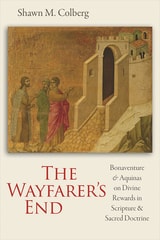
cover of The Wayfarer's End: Bonaventure and Aquinas on Divine Rewards in Scripture and Sacred Doctrine

The Wayfarer's End

Bonaventure and Aquinas on Divine Rewards in Scripture and Sacred Doctrine

Shawn M. Colberg

Catholic University of America Press, 2020
The Wayfarer’s End follows the human person’s journey to union with God in the theologies of Saint Bonaventure and Saint Thomas Aquinas. It argues that these seminal thinkers of the 13th Century emphasize scriptural notions of divine rewards as ordering principles for the graced movement of human viators to eternal life. Divine rewards emerge as a fundamental category through the study’s emphasis on Thomas and Bonaventure as scriptural commentators and preachers whose work in sacra pagina structures the content of their sacra doctrina. Shawn Colberg places Bonaventure’s and Aquinas’s scriptural, dogmatic, and polemical works into conversation and illumines their mutually edifying depictions of the way to eternal life. Looking to the journey itself, The Wayfarer’s End demonstrates a nuanced understanding of the roles played by God and human beings in the movement to full beatitude. To that end, it explores the relationships between grace and human nature, the effects of sin on the human person, the vital themes of predestination, conversion, perseverance, and the place of “reward-worthy” human action within the overall movement toward union with God. While St. Bonaventure and St. Thomas both stress the priority of grace and divine action for the journey, the study also illustrates their distinct frameworks for human action, unpacking Bonaventure’s preference for the language of acceptatio versus Thomas’s emphasis on ordinatio. This difference inflects their language of rewards, their exposition of scripture, and the scope of free human action in the movement to union with God. This study places the two most seminal theologians of the 13th Century into conversation on central and enduring topics of Christian life. Such a comparative study has been sorely lacking in the field of studies on Aquinas and Bonaventure. It offers insight to those interested in high scholastic thought, Franciscan and Dominican understandings of human salvation, and Thomist and Franciscan theology as it pertains to questions of the Reformation, including biblical exegesis on justification and sanctification. Above all, the study appreciates and foregrounds the richness of Bonaventure’s and Aquinas’s vocations: mendicant theologians concerned to share the fruits of contemplation with fellow friars and others seeking the goal of the wayfarer’s end.
[more]
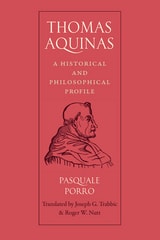
cover of Thomas Aquinas

Thomas Aquinas

Pasquale Porro

Catholic University of America Press, 2016
The development of ideas in Thomas Aquinas's philosophical thinking has been the subject of numerous smaller studies, but no contemporary work in the English-speaking world covers his every single work in chronological order in terms of philosophical development, influences, manuscript evidence, and historical setting. In Thomas Aquinas: A Historical and Philosophical Profile, Pasquale Porro has provided a complete landscape of Thomas's corpus that will give Thomistic scholars and students an invaluable reference point for research, discussion, and debate.
[more]
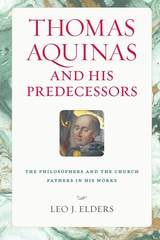
cover of Thomas Aquinas and His Predecessors: The Philosophers and the Church Fathers

Thomas Aquinas and His Predecessors

The Philosophers and the Church Fathers

Leo J. Elders

Catholic University of America Press, 2018
Thomas Aquinas and His Predecessors takes us on a voyage through the history of philosophical thought as present in the works of Thomas Aquinas. It is a synthetic presentation of the works and thought of the great predecessors of Aquinas, as he kne
[more]
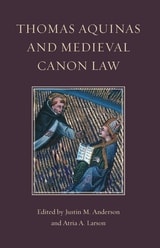
cover of Thomas Aquinas and Medieval Canon Law

Thomas Aquinas and Medieval Canon Law

Justin M. Anderson

Catholic University of America Press, 2025
Thomas Aquinas and Medieval Canon Law bridges, for the first time, two worlds of scholarship that have never been explored in book-length form and investigates an under-researched area in Thomistic studies, namely the question of how Thomas Aquinas engaged the ecclesiastical law and jurisprudence of his day. Neither historians of medieval canon law nor experts on Thomas's thought have previously paid much attention to the canon law tradition as a source for Thomas's work and an influence on his thought. But, as this volume shows, his consideration of mendicant life, law, justice, oaths, penance, clerical orders, the Eucharist, baptism, property, commerce, marriage and more reveal engagement with key canon law texts and concepts and with the jurisprudence of major canonists. The book uncovers how Aquinas encountered canonical regulations and jurisprudence as a Dominican, an educator in both theology and pastoral care, and a participant in the secular-mendicant controversy. In his life, education, community, and his way of thought, Thomas Aquinas could not avoid and necessarily encountered and dealt with the canonical tradition. He did so in a distinctive way, working as he did with his theological and philosophical source material to craft his own great synthesis. What this volume shows, if nothing else, is that the canon law tradition should be taken into consideration when assessing Thomas's synthetic thought. Following the editors' introduction, thirteen scholarly contributions and an epilogue explore Aquinas's interaction with medieval canon law through four major themes: Dominican Matters; Foundations Matters of Faith, Truth, and Law; Moral Matters; and Sacramental Matters. Approximately half the contributors are specialists from the field of medieval canon law, and half are grounded in Thomistic tradition. The result is a unique and scholarly contribution to two major research areas that may open avenues for similar studies of other key figures in the scholastic tradition.
[more]
cover of Thomas Aquinas and the Philosophy of Punishment

Thomas Aquinas and the Philosophy of Punishment

Peter Karl Koritansky

Catholic University of America Press, 2012

Thomas Aquinas and the Philosophy of Punishment explores how Aquinas's understandings of natural law and the common good apply to the contemporary philosophical discussion of punitive justice.
[more]
cover of Thomas Aquinas as Spiritual Teacher

Thomas Aquinas as Spiritual Teacher

Michael A. Dauphinais

Sapientia Press of Ave Maria University, 2023
St. Thomas Aquinas preaches in his sermon Puer Jesus "Just as your father begot you bodily, your teacher begets you spiritually." St. Thomas himself has been blessed with prodigious fecundity through the centuries for his teaching in the Holy Spirit. Always, he leads us to think of the Blessed Trinity and all things from God's own view. With new insights into St. Thomas's spiritual teaching in its sources, context, breadth, wisdom, and influences, Thomas Aquinas as Spiritual Teacher presents chapters inspired by an international conference co-sponsored by the Aquinas Center for Theological Renewal at Ave Maria University and the Thomistic Institute of the Dominican House of Studies. The volume, like its conference, honors Archbishop J. Augustine Di Noia, OP, adjunct secretary of the Dicastery for the Doctrine of the Faith, for his dedication to the spiritual teaching of St. Thomas in several decades of service to the Church and the academy. Luis F. Cardinal Ladaria, SJ, prefect of the Dicastery for the Doctrine of the Faith, contributed the volume's foreword.
[more]
cover of Thomas Aquinas on Faith, Hope, and Love: A Summa of the Summa on the Theological Virtues

Thomas Aquinas on Faith, Hope, and Love

A Summa of the Summa on the Theological Virtues

Christopher Kaczor

Catholic University of America Press, 2020
Thomas Aquinas on Faith, Hope, and Love is designed to make as easy as possible a first reading of key passages from the Summa theologiae. This book contains selections from the Summa that are most influential, most important, or likely to be most interesting to the contemporary reader. The text of the Summa itself is edited and arranged for beginners. Each article begins with Thomas’s answers to the question at hand and then goes to the first objection, followed by the reply to the first objection, the second objection and its reply, and so on. This arrangement provides a greater accessibility and ease in following the argument. Below the text, copious footnotes illuminate the text as a professor in the classroom might. Some notes provide historical background to figures that Thomas presupposes his reader will know such as Gratian, Dionysius, and Lombard. Other notes offer doctrinal summaries of other parts of the Summa that illuminate what Thomas says about faith, hope, or love. Thomas had an enormous influence on theologians, Church councils, and popes after his time, so some footnotes examine this influence. Thomas drew heavily on sources of wisdom before him, so other footnotes summarize the teachings of earlier authors, such as Aristotle and Augustine. This book also contains introductory essays on the Summa, on faith, on hope, and on love, which provide an overview to situate the reader and place treatment of the theological virtues in its larger context of the Summa. For those who have never read Thomas Aquinas on faith, hope, and love (and for those who teach them), this book provides ready access to the wisdom of the Angelic doctor.
[more]
cover of Thomas Aquinas on the Cardinal Virtues: A Summa of the Summa on Prudence, Justice, Temperance, and Courage

Thomas Aquinas on the Cardinal Virtues

A Summa of the Summa on Prudence, Justice, Temperance, and Courage

Christopher Kaczor

Catholic University of America Press, 2020
Thomas Aquinas on the Cardinal Virtues provides essential passages from Thomas's treatment of the cardinal virtues in the Summa theologiae, edited and explained for classroom use or the independent reader. Arranged for beginners, this book contains passages from the Summa theologiae of great historical import, contemporary relevance, or intrinsic interest combined with abundant footnotes aiding the modern reader. Each individual article is arranged so that the question, e.g. “Is capital punishment moral?” is followed directed by Thomas’s answer. Then the first objection is raised, followed immediately by Thomas’s response, the second objection is raised and then Thomas answers it, and so forth. The abundant footnotes help first time readers navigate key theological and philosophical terms which may be unfamiliar. In addition, the notes provide biographical information about key authors cited by Thomas, such as Tully, Vegetius, and Gregory the Great. The footnotes sometimes look back at the sources and philosophical roots of what Thomas teaches. Other notes note how authors after Aquinas including theologians, church councils, and popes developed, synthesized, and sometimes rejected what Thomas teaches. In sum, this book seeks to illuminate Thomas’s teaching on the cardinal virtues such as a teacher might do in the classroom.
[more]
cover of Thomas Aquinas on the Immateriality of the Human Intellect

Thomas Aquinas on the Immateriality of the Human Intellect

Adam Wood

Catholic University of America Press, 2020
The chief aims of Thomas Aquinas on the Immateriality of the Human Intellect are to provide a comprehensive interpretation of Aquinas's oft-repeated claim that the human intellect is immaterial, and to assess his arguments on behalf of this claim. Adam Wood argues that Aquinas's claim refers primarily to the mode in which the human intellect has its act of being. That the human intellect has an immaterial mode of being, however, crucially underwrites Aquinas's additional views that the human soul is subsistent and incorruptible. To show how it does so, Wood argues that the human intellect's immateriality can also be put in terms of the impossibility of explaining its operations in terms of coordination between bodily parts, states and processes. Aquinas's arguments for the human intellect's immateriality, therefore, can be understood as attempts to show why intellectual operations cannot be explained in bodily terms. The book argues that not all of them succeed in this aim and also proposes, however, a novel interpretation of Aquinas's argument based on human intellect's universal mode of cognition that may indeed be sound. Wood concludes by considering the ramifications of Aquinas's position on matters pertaining to the afterlife. Thomas Aquinas on the Immateriality of the Human Intellect represents the first book-length examination of Aquinas's claim that the human intellect is immaterial, and so — given the centrality of this claim to his thought — should interest any scholars interested in understanding Thomas. While it focuses throughout on careful attention to Aquinas's texts along with the relevant secondary literature, it also positions Thomas's thought alongside recent developments in metaphysics and philosophy of mind. Hence it should also interest historically-minded metaphysicians interested in understanding how Thomas's hylomorphism intersects with recent work in hylomorphic metaphysics, philosophers of mind interested in understanding how Thomas's philosophical psychology relates to contemporary forms of dualism, physicalism and emergentism, and philosophers of religion interested in the possibility of the resurrection.
[more]
cover of Thomas Aquinas' Trinitarian Theology: A Study in Theological Method

Thomas Aquinas' Trinitarian Theology

A Study in Theological Method

Timothy L Smith

Catholic University of America Press, 2003
Thomas' presentation of Trinitarian doctrine in his Summa Theologiae is an essential text for anyone interested in the great Dominican's theology. One finds here the meeting of a host of philosophical and theological issues.
[more]
cover of Thomism and Tolerance

Thomism and Tolerance

John F. X. Knasas

University of Scranton Press, 2010

In this incisive study, John F. X. Knasas grounds the ideal of tolerance in Aquinas’s natural law ethics and connects the virtue of civic tolerance to the concept of being. If God is the source of being, argues Knasas, then we are the articulation of being, and it is in this capacity that we recognize our bond with other people and thus acknowledge our duty to be tolerant of one another. An important contribution to practical metaphysics and the philosophical foundations of political theory, Thomism and Tolerance will appeal to philosophy scholars and students at the undergraduate and graduate level.
[more]
cover of Thomistic Considerations: Themes in Aquinas, Aristotle, Augustine, Dante and Eliot

Thomistic Considerations

Themes in Aquinas, Aristotle, Augustine, Dante and Eliot

Kevin White

Catholic University of America Press, 2026
This collection of essays considers a variety of themes in philosophy, theology, and poetry, three ways of thinking that share a certain openness and comprehensiveness. The essays show how philosophy, theology, and poetry are ways of thinking in the medium of words—in large part in the medium of written words—against the background of all things and from the point of view of all of human life. As the essays make clear, philosophy, theology, and poetry are special ways of thinking and speaking, but they are the contrary of specializations. Many of the themes are perennial preoccupations in philosophy: being, time, number, friendship, pleasure, purpose, choice, reason, and order. Others are particular concerns of theology and poetry, such as the divine presence and absence in the world, and poetic form. The volume is divided into two parts: a first part consisting of eight essays on themes in Aquinas’s work, and a second part consisting of five essays on other authors whose thought, in one way or another, has an affinity with the thought of Aquinas: Aristotle, Augustine, Anselm, Dante, T. S. Eliot, and Robert Sokolowski. The volume’s title pays homage to Aquinas’s use of the Latin word consideratio, a favorite term of the scholastics that could refer to any careful attending to what one knows. The essays illustrate ways in which considerations undertaken in philosophy, theology, and poetry provide points of survey from which to take in, to the extent we can, the great panorama of the whole of things.
[more]
cover of Thomistic Existentialism and Cosmological Reasoning

Thomistic Existentialism and Cosmological Reasoning

John F. X. Knasas

Catholic University of America Press, 2019
Cosmological reasoning is an important facet of classical arguments for the existence of God, but these arguments have been subject to many criticisms. The thesis of this book is that Thomas Aquinas can dodge many of the classic objections brought against cosmological reasoning. These objections criticize cosmological reasoning for its use of the Principle of Sufficient Reason; its notion of existence as a predicate; its use of ontological reasoning; its reliance on sense realism; its ignoring of the problem of evil; and its susceptibility to the critique of "ontotheology" as famously put forward by Heidegger. Secondly, the book proposes that the kind of reasoning found in Aquinas's De Ente can be formulated in a more robust version. Prompted by Aquinas’s admissions that philosophical knowledge of God is the prerogative of metaphysics, the second main portion of the book extensively illustrates how the more robust version of the De Ente is the interpretive key for Aquinas’s many arguments for God. Hence, the book should be of interest both to philosophers engaged in cosmological reasoning discussion and to Thomists interested in understanding Aquinas’s viae to God. Finally, the deep purpose of the book is to reawaken interest in Thomistic Existentialism, an interpretation of Aquinas that flourished in the 1950's in the works of Etienne Gilson, Jacques Maritain, and Joseph Owens. In this interpretation, a particular thing’s existence is the actuality of the thing in the sense of a distinctive actus not translatable into something else, for example, the fact of the thing or the thing having form. This book clearly explains how this interpretation looks at Thomas's metaphysics, and why it helps illuminate metaphysical realities.
[more]
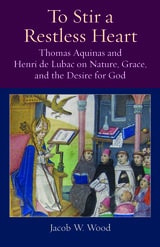
cover of To Stir a Restless Heart

To Stir a Restless Heart

Jacob W. Wood

Catholic University of America Press, 2019

To Stir a Restless Heart tells for the first time the story of how Thomas Aquinas conversed with his contemporaries about the dynamics of human nature’s longing for God, and documents how he deliberately utilized Greek, Arabic, Hebrew, and Latin sources to develop a version of Aristotelian natural desire that was uniquely Augustinian: natural desire seeks the complete fulfillment of human nature “insofar as is possible,” and so comes to rest in the highest end that God offers to it. Depending on whether God offers the free gift of grace to humanity, one and the same natural desire can come to rest in knowing God through creatures or seeing God directly.
[more]