Results by title
283 books match the query 'Transportation' and 58 start with t
Technologies for the Electrification of Land and Sea Transportation
Muhyaddin J.H. Rawa
The Institution of Engineering and Technology, 2025
The American Aviation Experience
A HistoryEdited by Tim Brady
Southern Illinois University Press, 2000
This book is designed to be a primary text for courses in aviation history and development and aviation in America.
The seventeen chapters in The American Aviation Experience: A History range chronologically from ancient times through the Wright brothers through both world wars, culminating with the development of the U.S. space program. Contributors also cover balloons and dirigibles, African American pioneers in aviation, and women in aviation. These essayists—leading scholars in the field—present the history of aviation mainly from an American perspective.
The American Aviation Experience includes 335 black-and-white photographs, two maps, and an appendix, “Leonardo da Vinci and the Science of Flight.”.

The Born in the Spring
A Collection of Spring WildflowersJune Carver Roberts
Ohio University Press, 2024
The Cedarville Conspiracy
Indicting U.S. SteelL. Stephen Cox
University of Michigan Press, 2005
The Cedarville Conspiracy is the story of that doomed ship and its crew. It is also the first Great Lakes history to expose the heroism, villainy, courage, and confusion surrounding the Cedarville disaster.
In atmospheric, cinematic style, L. Stephen Cox's gripping page-turner dramatizes the events surrounding the collision between the Norwegian and American freighters. As the mortally wounded Cedarville began to list and sink, U.S. Steel refused to allow the crew to escape to safety, while the captain secretly donned his life jacket and abandoned the sinking ship. Ten seamen died in the frigid waters that morning as the captain and survivors swam to safety.
Researching the story, author L. Stephen Cox interviewed the surviving crew and their rescuers and attorneys, examined more than 20,000 pages of Coast Guard reports, and discovered deposition transcripts and other documentary evidence that detailed the deterioration of the ship, the captain's disregard of Great Lakes navigational rules, the company's participation in the decision to confine the men aboard the sinking vessel, and the subsequent efforts by U.S. Steel to manipulate the evidence.
The Cultural Life of the Automobile
Roads to ModernityBy Guillermo Giucci
University of Texas Press, 2012
From its invention in Europe at the end of the nineteenth century, the automobile crisscrossed the world, completely took over the cities, and became a feature of daily life. Considered basic to the American lifestyle, the car reflected individualism, pragmatism, comfort, and above all modernity. In Latin America, it served as a symbol of distinction, similar to jewelry or fine clothing. In The Cultural Life of the Automobile, Guillermo Giucci focuses on the automobile as an instrument of social change through its “kinetic modernity” and as an embodiment of the tremendous social impact of technology on cultural life.
Material culture—how certain objects generate a wide array of cultural responses—has been the focus of much scholarly discussion in recent years. The automobile wrought major changes and inspired images in language, literature, and popular culture. Focusing primarily on Latin America but also covering the United States, Europe, Asia, and Africa, Giucci examines how the automobile was variously adapted by different cultures and how its use shaped and changed social and economic relationships within them. At the same time, he shows how the “automobilization” of society became an essential support for the development of modern individualism, and the automobile its clearest material manifestation.
The Divided Skies
Establishing Segregated Flight Training at Tuskegee, Alabama, 1934-1942Robert J. Jakeman
University of Alabama Press, 1996
In the Persian Gulf War, Americans of all races fought in integrated units under the leadership of the first African-American to serve as chairman of the Joint Chiefs of Staff. Indeed, the United States armed forces of the 1990s are arguably the most integrated institution in American society. But it was not always so.
The Echoes of L'Arbre Croche
Donald A. Johnston
University of Michigan Press, 2009
The year is 1915, and Benjamin Corvet, founder of the ship-owning firm Corvet, Sherrill and Spearman, suddenly disappears, sparking events and questions that baffle even those who are close to him.
Constance Sherrill, an attractive, sheltered young woman, feels strangely responsible for what may have happened to him---her father's best friend and coworker. Alan Conrad arrives in Chicago searching for his identity and an unknown benefactor and is swept into a maelstrom of mystery and intrigue that tests his intelligence and athleticism to the fullest. Henry Spearman, the firm's junior partner, is the most eligible bachelor along Chicago's Lake Shore Drive as a result of his catapult from ships' ranks to successful owner.
When a ship sinks off the coast of Beaver Island in Michigan, the intertwining lives of these characters unlock the mystery of the disappearance of another ship twenty years earlier, in a riveting whodunit set on the stormy waters of the Great Lakes.
Donald A. Johnston was born and raised in Detroit, served in World War II as a U.S. Navy Reserve officer, and was decorated for service in the Philippines and in the invasions of Iwo Jima and Okinawa. His career includes forty years in the insurance business. An ardent sailing enthusiast, he has cruised the Great Lakes extensively and has sailed winners in class boats and in offshore competition.
Jacket photograph © Yuriz / iStockphoto.com

The Electric Car
Development and future of battery, hybrid and fuel-cell carsMike H. Westbrook
The Institution of Engineering and Technology, 2001
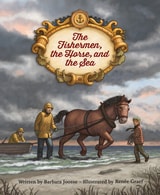
The Fishermen, the Horse, and the Sea
Barbara Joosse
Wisconsin Historical Society Press, 2021
This beautifully illustrated children’s book based on a true story recounts a dramatic rescue on Lake Michigan and introduces young readers to Lester Smith and his family, who founded Port Washington’s long-running and beloved Smith Bros. Fish Shanty. Educational materials including definitions, an illustrated map of Lake Michigan, and short biographies of the story’s featured characters supplement this engaging story for elementary-age readers.
The Fishing Line
A History of the Grand Rapids & Indiana RailroadGraydon M. Meints
Michigan State University Press, 2018
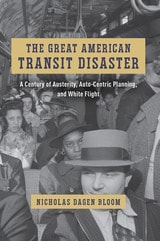
The Great American Transit Disaster
A Century of Austerity, Auto-Centric Planning, and White FlightNicholas Dagen Bloom
University of Chicago Press, 2023
Many a scholar and policy analyst has lamented American dependence on cars and the corresponding lack of federal investment in public transportation throughout the latter decades of the twentieth century. But as Nicholas Dagen Bloom shows in The Great American Transit Disaster, our transit networks are so bad for a very simple reason: we wanted it this way.
Focusing on Baltimore, Atlanta, Chicago, Detroit, Boston, and San Francisco, Bloom provides overwhelming evidence that transit disinvestment was a choice rather than destiny. He pinpoints three major factors that led to the decline of public transit in the United States: municipal austerity policies that denied most transit agencies the funding to sustain high-quality service; the encouragement of auto-centric planning; and white flight from dense city centers to far-flung suburbs. As Bloom makes clear, these local public policy decisions were not the product of a nefarious auto industry or any other grand conspiracy—all were widely supported by voters, who effectively shut out options for transit-friendly futures. With this book, Bloom seeks not only to dispel our accepted transit myths but hopefully to lay new tracks for today’s conversations about public transportation funding.
The Great American Transit Disaster
A Century of Austerity, Auto-Centric Planning, and White FlightNicholas Dagen Bloom
University of Chicago Press, 2023
A potent re-examination of America’s history of public disinvestment in mass transit.
Many a scholar and policy analyst has lamented American dependence on cars and the corresponding lack of federal investment in public transportation throughout the latter decades of the twentieth century. But as Nicholas Dagen Bloom shows in The Great American Transit Disaster, our transit networks are so bad for a very simple reason: we wanted it this way.
Focusing on Baltimore, Atlanta, Chicago, Detroit, Boston, and San Francisco, Bloom provides overwhelming evidence that transit disinvestment was a choice rather than destiny. He pinpoints three major factors that led to the decline of public transit in the United States: municipal austerity policies that denied most transit agencies the funding to sustain high-quality service; the encouragement of auto-centric planning; and white flight from dense city centers to far-flung suburbs. As Bloom makes clear, these local public policy decisions were not the product of a nefarious auto industry or any other grand conspiracy—all were widely supported by voters, who effectively shut out options for transit-friendly futures. With this book, Bloom seeks not only to dispel our accepted transit myths but hopefully to lay new tracks for today’s conversations about public transportation funding.
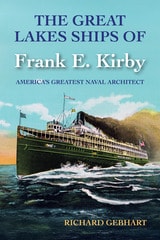
The Great Lakes Ships of Frank E. Kirby
America's Greatest Naval ArchitectRichard Gebhart
Michigan State University Press, 2026
This study of the legendary Michigan shipbuilder Frank E. Kirby examines his life and the accomplishments that earned him national esteem and international fame. Kirby was involved in the design and build of nearly one hundred vessels, many of which sailed the Great Lakes region. He is best known for designing the paddle steamer Tashmoo and two boats that ferried visitors to Boblo Island in the Detroit River for decades, Columbia and Ste. Claire. Though only three of his vessels remain, none of them operational, hundreds of thousands of Michiganders who are still alive today have been carried by Kirby vessels. Told through stories found in the Detroit Free Press, historical archives, family documents, an interview conducted by his daughter-in-law Dorothy Clement Kirby in 1926, and keepsakes, Richard Gebhart brings to life the story of one of the most prolific Great Lakes shipbuilders of the time.
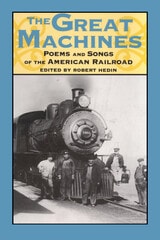
The Great Machines
Poems and Songs from the Age of the American RailroadRobert Hedin
University of Iowa Press, 1996
Here, for the first time, is a feast for anyone who has ever been beguiled by the trains that formerly thrummed through the landscapes of our lives. This entertaining and evocative anthology presents the amazing variety of poems and songs written about the American railroad in the last century and a half. Comprised of selections from both oral and written traditions, the volume celebrates the historical and cultural significance of this marvel of engineering skills. Hedin's anthology allows all readers, from the most avid railroad buff to anyone who has fond memories of train travel, to enjoy the romance of trains.
The Great Strikes of 1877
Edited by David O. Stowell
University of Illinois Press, 2007
A spectacular example of collective protest, the Great Strike of 1877--actually a sequence of related actions--was America's first national strike and the first major strike against the railroad industry. In some places, non-railroad workers also abandoned city businesses, creating one of the nation's first general strikes. Mobilizing hundreds of thousands of workers, the Great Strikes of 1877 transformed the nation's political landscape, shifting the primary political focus from Reconstruction to labor, capital, and the changing role of the state.
Probing essays by distinguished historians explore the social, political, regional, and ethnic landscape of the Great Strikes of 1877: long-term effects on state militias and national guard units; ethnic and class characterization of strikers; pictorial representations of poor laborers in the press; organizational strategies employed by railroad workers; participation by blacks; violence against Chinese immigrants; and the developing tension between capitalism and racial equality in the United States.
Contributors: Joshua Brown, Steven J. Hoffman, Michael Kazin, David Miller, Richard Schneirov, David O. Stowell, and Shelton Stromquist.
The Hocking Valley Railway
Edward H. Miller
Ohio University Press, 2024
The Jefferson Highway
Blazing the Way from Winnepeg to New OrleansLyell D. Henry Jr.
University of Iowa Press, 2016
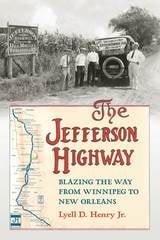
The plight of the rapidly rising numbers of early motorists soon spawned a “good roads” movement that included many efforts to build and pave long-distance, colorfully named auto trails across the length and breadth of the nation. Full of a can-do optimism, these early partisans of motoring sought to link together existing roads and then make them fit for automobile driving—blazing, marking, grading, draining, bridging, and paving them. The most famous of these named highways was the Lincoln Highway between New York City and San Francisco. By early 1916, a proposed counterpart coursing north and south from Winnipeg to New Orleans had also been laid out.
Called the Jefferson Highway, it eventually followed several routes through Minnesota, Iowa, Missouri, Kansas, Oklahoma, Texas, Arkansas, and Louisiana. The Jefferson Highway, the first book on this pioneering road, covers its origin, history, and significance, as well as its eventual fading from most memories following the replacement of names by numbers on long-distance highways after 1926. Saluting one of the most important of the early named highways on the occasion of its 100th anniversary, historian Lyell D. Henry Jr. contributes to the growing literature on the earliest days of road-building and long-distance motoring in the United States. For readers who might also want to drive the original route of the Jefferson Highway, three chapters trace that route through Iowa, pointing out many vintage features of the roadside along the way. The perfect book for a summer road trip!
The Jerrie Mock Story
The First Woman to Fly Solo around the WorldNancy Roe Pimm
Ohio University Press, 2016
A Junior Library Guild selection
Society of Children’s Book Writers and Illustrators Official 2016 Summer Reading List
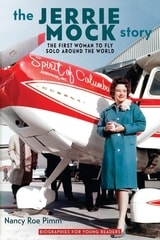
In this biography for middle-grade readers, Nancy Roe Pimm tells the story of Geraldine “Jerrie” Mock, the first woman to fly solo around the world. In her trusty Cessna, The Spirit of Columbus—also known as Charlie—she traveled from Columbus, Ohio, on an eastward route that totaled nearly twenty-three thousand miles and took almost a month. Overcoming wind, ice, mechanical problems, and maybe even sabotage, Mock persevered.
Mock caught the aviation bug at seven years old, when she rode in a Ford Trimotor plane with her parents. In high school, she displayed a talent for math and science, and she was the only woman in her aeronautical engineering classes at Ohio State University. Although she then settled into domestic life, she never lost her interest in flying. What began as a joking suggestion from her husband to fly around the world prompted her to pursue her childhood dream. But the dream became a race, as another woman, Joan Merriam Smith, also sought to be the first to circle the globe.
Even though Mock beat Smith and accomplished what her heroine Amelia Earhart had died trying to do, her feat was overshadowed by the Vietnam War and other world events. Now, Pimm introduces Mock to a new generation of adventurers.
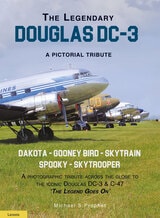
The Legendary Douglas DC-3
A Pictorial TributeMichael S. Prophet
Amsterdam University Press, 2023
Many of these revolutions related to safety; thanks to the DC-3’s reputation for reliability, air travel insurance finally became available to the general public in 1937. This is the airliner that not only made flying respectable but enabled the emerging aviation industry to end its reliance on mail subsidies and profit from passenger journeys.
DC-3 is still flying eight decades after their first debut - this book is a tribute to its brilliant design.

The Little Man with the Long Shadow
George S. Mills
University of Iowa Press, 1988
Frederick M. Hubbell, railroad financier and builder, real estate investor, public utilities magnate, leading lawyer, and founder of Iowa’s first life insurance company, the Equitable, was at one time the wealthiest Iowan in the state’s history. Based on his diaries from 1855 to 1927, The Little Man with the Long Shadow tells the story of this industrious and imaginative entrepreneur.
The Longest Voyage
Circumnavigators in the Age of DiscoveryRobert Silverberg
Ohio University Press, 1997
From the intense and brooding Magellan and the glamorous and dashing Sir Francis Drake; to Thomas Cavendish, who set off to plunder Spain’s American gold and the Dutch circumnavigators, whose numbers included pirates as well as explorers and merchants, Robert Silverberg captures the adventures and seafaring exploits of a bygone era.
Over the course of a century, European circumnavigators in small ships charted the coast of the New World and explored the Pacific Ocean. Characterized by fierce nationalism, competitiveness, and bloodshed, The Longest Voyage: Circumnavigators in the Age of Discovery captures the drama, danger, and personalities in the colorful story of the first voyages around the world. These accounts begin with Magellan’s unprecedented 1519–22 circumnavigation, providing an immediate, exciting, and intimate glimpse into that historic venture. The story includes frequent threats of mutiny; the nearly unendurable extremes of heat, cold, hunger, thirst, and fatigue; the fear, tedium, and moments of despair; the discoveries of exotic new peoples and strange new lands; and, finally, Magellan’s own dramatic death during a fanatical attempt to convert native Philippine islanders to Christianity.
Capturing the total context of political climate and historical change that made the Age of Discovery one of excitement and drama, Silverberg brings a motley crew of early ocean explorers vividly to life.
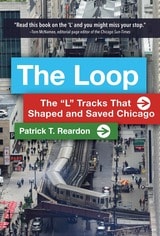
The Loop
The “L” Tracks That Shaped and Saved ChicagoPatrick T. Reardon
Southern Illinois University Press, 2021
Every day Chicagoans rely on the loop of elevated train tracks to get to their jobs, classrooms, or homes in the city’s downtown. But how much do they know about the single most important structure in the history of the Windy City? In engagingly brisk prose, Patrick T. Reardon unfolds the fascinating story about how Chicago’s elevated Loop was built, gave its name to the downtown, helped unify the city, saved the city’s economy, and was itself saved from destruction in the 1970s.
This unique volume combines urban history, biography, engineering, architecture, transportation, culture, and politics to explore the elevated Loop’s impact on the city’s development and economy and on the way Chicagoans see themselves. The Loop rooted Chicago’s downtown in a way unknown in other cities, and it protected that area—and the city itself—from the full effects of suburbanization during the second half of the twentieth century. Masses of data underlie new insights into what has made Chicago’s downtown, and the city as a whole, tick.
The Loop features a cast of colorful Chicagoans, such as legendary lawyer Clarence Darrow, poet Edgar Lee Masters, mayor Richard J. Daley, and the notorious Gray Wolves of the Chicago City Council. Charles T. Yerkes, an often-demonized figure, is shown as a visionary urban planner, and engineer John Alexander Low Waddell, a world-renowned bridge creator, is introduced to Chicagoans as the designer of their urban railway.
This fascinating exploration of how one human-built structure reshaped the social and economic landscape of Chicago is the definitive book on Chicago’s elevated Loop.
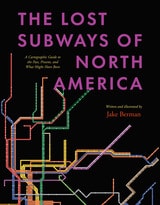
The Lost Subways of North America
A Cartographic Guide to the Past, Present, and What Might Have BeenJake Berman
University of Chicago Press, 2023
A visual exploration of the transit histories of twenty-three US and Canadian cities.
Every driver in North America shares one miserable, soul-sucking universal experience—being stuck in traffic. But things weren’t always like this. Why is it that the mass transit systems of most cities in the United States and Canada are now utterly inadequate?
The Lost Subways of North America offers a new way to consider this eternal question, with a strikingly visual—and fun—journey through past, present, and unbuilt urban transit. Using meticulous archival research, cartographer and artist Jake Berman has successfully plotted maps of old train networks covering twenty-three North American metropolises, ranging from New York City’s Civil War–era plan for a steam-powered subway under Fifth Avenue to the ultramodern automated Vancouver SkyTrain and the thousand-mile electric railway system of pre–World War II Los Angeles. He takes us through colorful maps of old, often forgotten streetcar lines, lost ideas for never-built transit, and modern rail systems—drawing us into the captivating transit histories of US and Canadian cities.
Berman combines vintage styling with modern printing technology to create a sweeping visual history of North American public transit and urban development. With more than one hundred original maps, accompanied by essays on each city’s urban development, this book presents a fascinating look at North American rapid transit systems.

The Many Lives of Eddie Rickenbacker
Andrew Speno
Ohio University Press, 2020
The life story of a daredevil who became a war hero will fascinate adventurous young readers with its tales of survival.
At age thirteen, following the death of his father, young Eddie dropped out of school and joined the workforce. Through a combination of smarts, hard work, and perseverance, Rickenbacker would grow up to become an automobile mechanic, a race car driver, a fighter pilot, an entrepreneur, a war hero, a business executive, and a staunch advocate for hard work and personal responsibility.
Along the way he lived on the line between recklessness and courage. He survived dozens of accidents, coming close to death more than once. During the earliest years of American automobile racing, Rickenbacker was “the most daring and withal the most cautious driver” on the circuit. How could he have been both daring and cautious? This book invites young readers to decide for themselves as they follow Rickenbacker on his many hair-raising adventures.
The Milwaukee Road
Its First Hundred YearsAugust Derleth
University of Iowa Press, 2002
From its incorporation in 1847 in Wisconsin Territory to its first run in 1851—twenty miles between Milwaukee and Waukesha—to its later position of far-flung power, the Chicago, Milwaukee, St. Paul &Pacific Railroad Company had a vivid history. By 1948, the Milwaukee Road had more than 40,000 employees and maintained more than 10,000 miles of line in twelve states from Indiana to Washington.
Also in 1948, August Derleth's popular and well-crafted corporate history celebrated the strength and status of this mighty carrier. On February 19, 1985, the railroad became a subsidiary of Soo Line Corporation and its identity vanished overnight. Nonetheless, it remains a romantic memory, and Derleth's book remains the only complete history of this innovative and dynamic railroad.
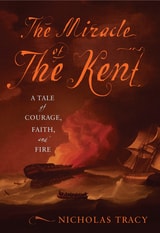
The Miracle of the Kent
A Tale of Courage, Faith, and FireNicholas Tracy
Westholme Publishing, 2008
“A naturally gripping adventure tale.”—Publishers Weekly
“Powerful and intensely focused.”—Booklist
“Tracy's satisfying narrative constitutes the first modern account. A finely detailed maritime history.”—Kirkus Reviews
In 1825, the Kent, an East Indiaman, set sail from England for India with a crew and nearly 600 men, women, and children on board. North of Spain, the ship was slammed by a ferocious gale, and while a sailor was inspecting the hold for damage, his lantern ignited a cask of spirits. A fire quickly erupted, and even with the desperate expedient of opening hatches and flooding the ship, the fire burned out of control. As night wore on, the ship became an inferno, with the flames moving toward stores of gunpowder. At this point, everyone on board knew that they would perish, and they began preparing for their ghastly deaths. Despite the raging tempest a sailor climbed one last time to the top of the Kent’s mainmast and—miraculously—a sail was sighted on the horizon. It was the Cambria, a small brig on its way to Mexico. The Cambriaspied the burning Kentand through determination and dogged seamanship in towering seas, the little brig closed the doomed vessel. Launching their boats, the Kent’s and Cambria’s crews were able to transfer nearly all of the children, women, and men to the brig and pull away before the Kent exploded. Dangerously overloaded, the Cambriamade the Cornish coast three days later.
In The Miracle of the Kent: A Tale of Courage, Faith, and Fire, award-winning historian Nicholas Tracy reconstructs this extraordinary tale through records left by the participants, revealing how those aboard the Kent faced their deaths, and their reactions to being offered a second chance. The story of the Kentis both a page-turning adventure and an inspirational homage to the capacity of the human spirit.
The Northeast Corridor
The Trains, the People, the History, the RegionDavid Alff
University of Chicago Press, 2024
Traversed by thousands of trains and millions of riders, the Northeast Corridor might be America’s most famous railway, but its influence goes far beyond the right-of-way. David Alff welcomes readers aboard to see how nineteenth-century train tracks did more than connect Boston to Washington, DC. They transformed hundreds of miles of Atlantic shoreline into a political capital, a global financial hub, and home to fifty million people. The Northeast Corridor reveals how freight trains, commuter rail, and Amtrak influenced—and in turn were shaped by—centuries of American industrial expansion, metropolitan growth, downtown decline, and revitalization.
Paying as much attention to Canton, Trenton, New Rochelle, and Providence as to New York City, Philadelphia, and Baltimore, Alff provides narrative thrills for history buffs, train enthusiasts, and adventurers alike. What’s more, he offers a glimpse into the future of the corridor. New infrastructural plans—supported by President Joe Biden, famously Amtrak’s biggest fan—envision ever-faster trains zipping along technologically advanced rails. Yet those tracks will literally sit atop a history that links the life of Frederick Douglass, who fled to freedom by boarding a train in Baltimore, to the Frederick Douglass Tunnel, which is expected to be the newest link in the corridor by 2032.
Trains have long made the places that make America, and they still do.
The Political Economy of Pipelines
A Century of Comparative Institutional DevelopmentJeff D. Makholm
University of Chicago Press, 2012
The Problem with Feeding Cities
The Social Transformation of Infrastructure, Abundance, and Inequality in AmericaAndrew Deener
University of Chicago Press, 2020
The Problem with Feeding Cities is a sociological and historical examination of how this remarkable network of abundance and convenience came into being over the last century. It looks at how the US food system transformed from feeding communities to feeding the entire nation, and it reveals how a process that was once about fulfilling basic needs became focused on satisfying profit margins. It is also a story of how this system fails to feed people, especially in the creation of food deserts. Andrew Deener shows that problems with food access are the result of infrastructural failings stemming from how markets and cities were developed, how distribution systems were built, and how organizations coordinate the quality and movement of food. He profiles hundreds of people connected through the food chain, from farmers, wholesalers, and supermarket executives, to global shippers, logistics experts, and cold-storage operators, to food bank employees and public health advocates. It is a book that will change the way we see our grocery store trips and will encourage us all to rethink the way we eat in this country.
The Steam and Diesel Era in Wheeling, West Virginia
Photographs by J. J. Young Jr.Nicholas Fry
West Virginia University Press, 2016
For nearly seventy years, John J. Young Jr. photographed railroads. With unparalleled scope and span, he documented the impact and beauty of railways in American life from 1936 to 2004.
As a child during the Great Depression, J. J. Young Jr. began to photograph railroads in Wheeling, West Virginia. This book collects over one hundred fifty of those images—some unpublished until now—documenting the railroads of Wheeling and the surrounding area from the 1930s until the 1960s.
The photographs within this book highlight the major railroads of Wheeling: the Baltimore & Ohio, the Pennsylvania, the Wheeling & Lake Erie, the Pittsburgh & West Virginia, the New York Central, and the industrial and interurban rail lines that crisscrossed the region. These images capture the routine activities of trains that carried passengers and freight to and from the city and its industries, as well as more unusual traffic, such as a circus-advertising car, the General Motors Train of Tomorrow, and the 1947 American Freedom Train.
The Thirty-Year War
A History of Detroit's Streetcars, 1892–1922Neil J. Lehto
Michigan State University Press, 2017
The UP Saga
Susan M. Martin
National University of Singapore Press, 2003
The Wardian Case
How a Simple Box Moved Plants and Changed the WorldLuke Keogh
University of Chicago Press, 2020
Roses, jasmine, fuchsia, chrysanthemums, and rhododendrons bloom in gardens across the world, and yet many of the most common varieties have roots in Asia. How is this global flowering possible? In 1829, surgeon and amateur naturalist Nathaniel Bagshaw Ward placed soil, dried leaves, and the pupa of a sphinx moth into a sealed glass bottle, intending to observe the moth hatch. But when a fern and meadow grass sprouted from the soil, he accidentally discovered that plants enclosed in glass containers could survive for long periods without watering. After four years of experimentation in his London home, Ward created traveling glazed cases that would be able to transport plants around the world. Following a test run from London to Sydney, Ward was proven correct: the Wardian case was born, and the botanical makeup of the world’s flora was forever changed.
In our technologically advanced and globalized contemporary world, it is easy to forget that not long ago it was extremely difficult to transfer plants from place to place, as they often died from mishandling, cold weather, and ocean salt spray. In this first book on the Wardian case, Luke Keogh leads us across centuries and seas to show that Ward’s invention spurred a revolution in the movement of plants—and that many of the repercussions of that revolution are still with us, from new industries to invasive plant species. From the early days of rubber, banana, tea, and cinchona cultivation—the last used in the production of the malaria drug quinine—to the collecting of beautiful and exotic flora like orchids in the first great greenhouses of the United States Botanic Garden in Washington, DC, and England’s Royal Botanic Gardens, Kew, the Wardian case transformed the world’s plant communities, fueled the commercial nursery trade and late nineteenth-century imperialism, and forever altered the global environment.
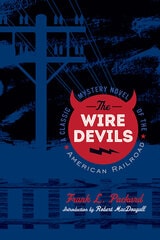
The Wire Devils
Frank L. Packard
University of Minnesota Press, 2013
Best known for his Jimmie Dale series of books, which have sold more than 3 million copies worldwide, Frank L. Packard first published The Wire Devils in 1918. A “wire thriller” that uses the booming railroads and telegraph lines of the old West as its backdrop for fast-paced adventure, The Wire Devils follows a criminal gang of the same name who hijack a railroad’s telegraph lines to glean information about profitable shipments. But foiling them again and again is the Hawk, the outlaw hero who robs from the robbers and is ultimately on the side of law and order.
Combining elements from dime-store novels and Packard’s own experience on the rails, The Wire Devils is at once a hybrid western and a thriller still worth reading nearly a century after it was written.
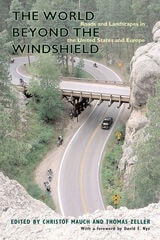
The World beyond the Windshield
Roads and Landscapes in the United States and EuropeChristof Mauch
Ohio University Press, 2008
For better or worse, the view through a car’s windshield has redefined how we see the world around us. In some cases, such as the American parkway, the view from the road was the be-all and end-all of the highway; in others, such as the Italian autostrada, the view of a fast, efficient transportation machine celebrating either Fascism or its absence was the goal. These varied environments are neither necessary nor accidental but the outcomes of historical negotiations, and whether we abhor them or take delight in them, they have become part of the fabric of human existence.
The World beyond the Windshield: Roads and Landscapes in the United States and Europe is the first systematic, comparative look at these landscapes. By looking at examples from the United States and Europe, the chapters in this volume explore the relationship between the road and the landscape thatit traverses, cuts through, defines, despoils, and enhances. The authors analyze the Washington Beltway and the Blue Ridge Parkway, as well as iconic roads in Italy, Nazi Germany, East Germany, and Great Britain. This is a story of the transatlantic exchange of ideas about environment and technology and of the national and nationalistic appropriations of such landscaping.
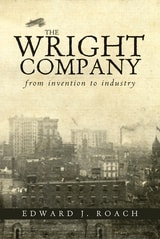
The Wright Company
From Invention to IndustryEdward J. Roach
Ohio University Press, 2014
Fresh from successful flights before royalty in Europe, and soon after thrilling hundreds of thousands of people by flying around the Statue of Liberty, in the fall of 1909 Wilbur and Orville Wright decided the time was right to begin manufacturing their airplanes for sale. Backed by Wall Street tycoons, including August Belmont, Cornelius Vanderbilt III, and Andrew Freedman, the brothers formed the Wright Company. The Wright Company trained hundreds of early aviators at its flight schools, including Roy Brown, the Canadian pilot credited with shooting down Manfred von Richtofen—the “Red Baron”—during the First World War; and Hap Arnold, the commander of the U.S. Army Air Forces during the Second World War. Pilots with the company’s exhibition department thrilled crowds at events from Winnipeg to Boston, Corpus Christi to Colorado Springs. Cal Rodgers flew a Wright Company airplane in pursuit of the $50,000 Hearst Aviation Prize in 1911.
But all was not well in Dayton, a city that hummed with industry, producing cash registers, railroad cars, and many other products. The brothers found it hard to transition from running their own bicycle business to being corporate executives responsible for other people’s money. Their dogged pursuit of enforcement of their 1906 patent—especially against Glenn Curtiss and his company—helped hold back the development of the U.S. aviation industry. When Orville Wright sold the company in 1915, more than three years after his brother’s death, he was a comfortable man—but his company had built only 120 airplanes at its Dayton factory and Wright Company products were not in the U.S. arsenal as war continued in Europe.
Edward Roach provides a fascinating window into the legendary Wright Company, its place in Dayton, its management struggles, and its effects on early U.S. aviation.

The Wright Company
From Invention to IndustryEdward J. Roach
Ohio University Press, 0
But all was not well in Dayton, a city that hummed with industry, producing cash registers, railroad cars, and many other products. The brothers found it hard to transition from running their own bicycle business to being corporate executives responsible for other people’s money. Their dogged pursuit of enforcement of their 1906 patent — especially against Glenn Curtiss and his company — helped hold back the development of the U.S. aviation industry. When Orville Wright sold the company in 1915, more than three years after his brother’s death, he was a comfortable man — but his company had built only 120 airplanes at its Dayton factory and Wright Company products were not in the U.S. arsenal as war continued in Europe.
Edward Roach provides a fascinating window into the legendary Wright Company, its place in Dayton, its management struggles, and its effects on early U.S. aviation.
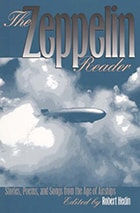
The Zeppelin Reader
Stories, Poems, and Songs from the Age Of AirshipsRobert Hedin
University of Iowa Press, 1998
Size is usually the first thing that comes to mind when we ponder the great airships. In war and peace, to most people they seem bigger than life itself, bright, wondrous, sometimes dangerous apparitions that engender a religious awe. They remain the largest crafts that have ever been launched into the sky. Tracing the history of the airship from its beginning in the nineteenth century to its fiery conclusion in 1937, Robert Hedin has gathered the finest stories, descriptions, poems, music, and illustrations about what the era was like in fact and in spirit.
Included are vivid accounts by such legendary figures as Count Ferdinand von Zeppelin, Hugo Eckener, and Alberto Santos-Dumont as well as memoirs, logs, journals, and diaries by Zeppelin commanders, crew, explorers, journalists, and survivors of ill-fated flights. The great airships inspired poets and writers old and new; here are works by such diverse writers as Robinson Jeffers, Kay Boyle, Bernard Shaw, D. H. Lawrence, Rita Dove, Richard Brautigan, and many others. There is a rich sampling of airship musical scores and lyrics; the music constitutes a kind of recovered history and helps recapture the emotional range of the era. Rounding out the gathering, The Zeppelin Reader is illustrated with stunning photographs, advertisements, drawings, and cartoons from the glorious age of airships.
Theory of Land Locomotion
The Mechanics of Vehicle MobilityM.G. Bekker
University of Michigan Press, 1956
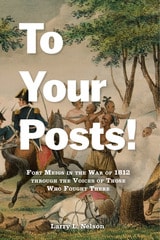
To Your Posts!
Fort Meigs in the War of 1812 through the Voices of Those Who Fought ThereLarry L. Nelson
Michigan State University Press, 2025
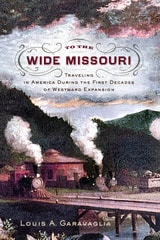
To the Wide Missouri
Traveling in America During the First Decades of Westward ExpansionLouis A. Garavaglia
Westholme Publishing, 2011
The Fascinating History of the Rapid Expansion of Roads, Canals, and Railways in the First Decades of the United States
While the great overland migration routes to America’s far west are well known and documented—the California, Oregon, Mormon, and Santa Fe Trails, the Central Overland and Pony Express—less attention has been given to how Americans in the first decades of the republic traveled across the western frontiers of the original colonies. Following the revolution, Americans began to seek their fortunes to the west in greater numbers. Land grants to veterans inspired others to move, including tradesmen, merchants, and tavern owners. With the Louisiana Purchase in 1803, the country doubled in size, and the rate of migration became extraordinary, with wider and more durable roads built, ferries installed at river crossings, canals cut to move goods, regular stage routes established, and ultimately the first railroad tracks laid down. Entire regions that supported few communities in the 1790s exploded in population, and as a result seven new states were admitted to the Union in the decade following the War of 1812. John Bradbury, who traveled through the United States between 1809 and 1811, wrote that “In passing through the upper parts of Virginia, I observed a great number of farms that had been abandoned, on many of which good houses had been erected, and fine apple and peach orchards had been planted. On enquiring the reason, I was always informed that the owners had gone to the western country.” In Maryland, a newspaper reporter wrote, “The time is close at hand when the region west of the Allegheny mountains will sway the destinies of the nation.” By 1839, the National Road extended more than 700 miles from Washington, DC, to central Illinois, New York’s Erie Canal operated from Albany to Buffalo, and the Baltimore and Ohio Railroad carried passengers briskly west, ultimately to the Ohio River.

Too Much Sea for Their Decks
Shipwrecks of Minnesota's North Shore and Isle RoyaleMichael Schumacher
University of Minnesota Press, 2023
Shipwreck stories from along Minnesota’s north shore of Lake Superior and Isle Royale
Against the backdrop of the extraordinary history of Great Lakes shipping, Too Much Sea for Their Decks chronicles shipwrecked schooners, wooden freighters, early steel-hulled steamers, whalebacks, and bulk carriers—some well-known, some unknown or forgotten—all lost in the frigid waters of Lake Superior.
Included are compelling accounts of vessels destined for infamy, such as that of the Stranger, a slender wooden schooner swallowed by the lake in 1875, the sailors’ bodies never recovered nor the wreckage ever found; an account of the whaleback Wilson, rammed by a large commercial freighter in broad daylight and in calm seas, sinking before many on board could escape; and the mysterious loss of the Kamloops, a package freighter that went down in a storm and whose sailors were found on the Isle Royale the following spring, having escaped the wreck only to die of exposure on the island. Then there is the ill-fated Steinbrenner, plagued by bad luck from the time of her construction, when she was nearly destroyed by fire, to her eventual (and tragic) sinking in 1953. These tales and more represent loss of life and property—and are haunting stories of brave and heroic crews.
Arranged chronologically and presented in three sections covering Minnesota's North Shore, Isle Royale, and the three biggest storms in Minnesota’s Great Lakes history (the 1905 Mataafa storm, the 1913 hurricane on the lakes, and the 1940 Armistice Day storm), each shipwreck documented within these pages provides a piece to the history of shipping on Lake Superior.
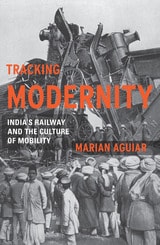
Tracking Modernity
India’s Railway and the Culture of MobilityMarian Aguiar
University of Minnesota Press, 2010
Since the colonial period in India, the railway has been idealized as a rational utopia—a moving box in which racial and class differences might be amalgamated under a civic, secular, and public order. Aguiar charts this powerful image into the postcolonial period, showing how the culture of mobility exposes this symbol of reason as surprisingly dynamic and productive. Looking in turn at the partition of India, labor relations, rituals of travel, works of literature and film, visual culture, and the Mumbai train bombings of 2006, Aguiar finds incongruities she terms “counternarratives of modernity” to signify how they work both with and against the dominant rhetoric. Revealing railways as a microcosm of tensions within Indian culture, Aguiar demonstrates how their representations have challenged prevailing ideas of modernity.
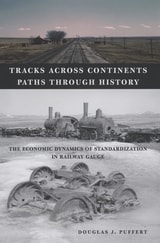
Tracks across Continents, Paths through History
The Economic Dynamics of Standardization in Railway GaugeDouglas J. Puffert
University of Chicago Press, 2009
A standard track gauge—the distance between the two rails—enables connecting railway lines to exchange traffic. But despite the benefits of standardization, early North American railways used six different gauges extensively, and even today breaks of gauge at national borders and within such countries as India and Australia are expensive burdens on commerce. In Tracks across Continents, Paths through History, Douglas J. Puffert offers a global history of railway track gauge, examining early choices and the dynamic process of diversity and standardization that resulted.
Drawing on the economic theory of path dependence, and grounded in economic, technical, and institutional realities, this innovative volume traces how early historical events, and even idiosyncratic personalities, have affected choices of gauge ever since, despite changing technology and understandings of what gauge is optimal. Puffert also uses this history to develop new insights in the theory of path dependence. Tracks across Continents, Paths through History will be essential reading for anyone interested in how history and economics inform each other.
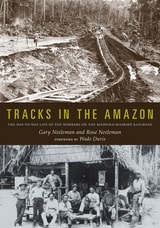
Tracks in the Amazon
The Day-to-Day Life of the Workers on the Madeira-Mamoré RailroadGary Neeleman
University of Utah Press, 2014
Although there have been many brief chronicles and writings about the Madeira-Mamoré Railroad over the years, most barely scratch the surface of this incredible story. Of particular import in Tracks in the Amazon are the photographs—which until now have rarely been seen—taken by Dana Merrill, a New York photographer hired to document the construction of the railroad. It also includes reproductions of the Porto Velho Marconigram, an English-language newspaper written for and by the American expatriates who lived in the construction headquarters at Porto Velho. Because this unique railroad traversed the densest tropical jungle on earth, more than 10,000 workers lost their lives laying the first five miles of track. The images and descriptions of the life of the workers on the railroad illustrate the challenges of working in the jungles—the unforgiving climate, malaria and yellow feverbearing mosquitoes, and the threat of wild animals—which made conditions for the workers next to impossible.
Finalist for the International Latino Book Awards: Best Book in Nonfiction in Portuguese.
Traffic Flow Prediction
Methods and applicationsQing-Jie Kong
The Institution of Engineering and Technology, 2017
Traffic Information and Control
Ruimin Li
The Institution of Engineering and Technology, 2021
Traffic Safety Data
Sources, analysis and applicationsAliaksei Laureshyn
The Institution of Engineering and Technology, 2025
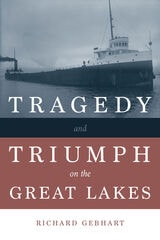
Tragedy and Triumph on the Great Lakes
Richard Gebhart
Michigan State University Press, 2024
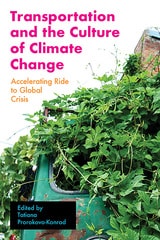
Transportation and the Culture of Climate Change
Accelerating Ride to Global CrisisTatiana Prorokova-Konrad
West Virginia University Press, 2020
The essays in Transportation and the Culture of Climate Change cover an eclectic range of subject matter, from the association of bicycles with childhood to the songs of Bruce Springsteen, but are united in a central conviction: “Transport is a considerable part of our culture that is as hard to transform as it is for us to stop using fossil fuels—but we do not have an alternative.”