Results by title
97 books match the query 'Urbanization' and 16 start with t
THE MYSTERIES OF THE GREAT CITY
THE POLITICS OF URBAN DESIGN, 1877-1937JOHN FAIRFIELD
The Ohio State University Press, 1997
The Mysteries of the Great City examines the physical, cultural, and political transformations of the American city between the Gilded Age and the New Deal. Focusing on New York, Chicago, and Cincinnati, John Fairfield demonstrates that these transformations before and after the advent of city planning were the result of political decisions influenced by corporate and private wealth.
The expansion and reorganization of the great city stood out as the most visible symbol of the transformation. The new metropolitan form, with its skyscraping business center, industrial satellites, crowded working-class neighborhoods, and exclusive suburbs, embodied an emerging corporate order. But the metropolis also disguised the new order and gave it an apparent physical implacability and inevitability that obscured the role of choice in its creation and therefore placed it beyond criticism. Fairfield unravels the mysteries of the new form to reveal the centrality of power and politics in urban design.
While acknowledging that a great many factors shaped urban development, Fairfield underscores the decisive role of human design. He argues that American cities, both before and after the advent of professional planning, have always been in some measure “planned.” Discussing such figures as Frederick Law Olmsted, Henry George, Daniel Burnham, Frederic Howe, Edward Bassett, Robert E. Park, and Louis Wirth, Fairfield illuminates the political and intellectual conflicts among advocates of alternative paths of urban development.
The Mysteries of the Great City will enlighten all readers interested in the development of cities, particularly urban historians and planners. In pointing to the Gilded Age as a period of great possibilities of progressive reform, this study will also reward readers interested in the historical foundations of our modern society.
Taifa
Making Nation and Race in Urban TanzaniaJames R. Brennan
Ohio University Press, 2012
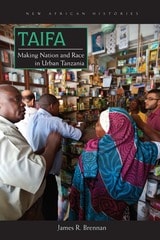
Taifa is a story of African intellectual agency, but it is also an account of how nation and race emerged out of the legal, social, and economic histories in one major city, Dar es Salaam. Nation and race—both translatable as taifa in Swahili—were not simply universal ideas brought to Africa by European colonizers, as previous studies assume. They were instead categories crafted by local African thinkers to make sense of deep inequalities, particularly those between local Africans and Indian immigrants. Taifa shows how nation and race became the key political categories to guide colonial and postcolonial life in this African city.
Using deeply researched archival and oral evidence, Taifa transforms our understanding of urban history and shows how concerns about access to credit and housing became intertwined with changing conceptions of nation and nationhood. Taifa gives equal attention to both Indians and Africans; in doing so, it demonstrates the significance of political and economic connections between coastal East Africa and India during the era of British colonialism, and illustrates how the project of racial nationalism largely severed these connections by the 1970s.
The Changing Face of Inequality
Urbanization, Industrial Development, and Immigrants in Detroit, 1880-1920Olivier Zunz
University of Chicago Press, 1983
The End of the Village
Planning the Urbanization of Rural ChinaNick R. Smith
University of Minnesota Press, 2021
How China’s expansive new era of urbanization threatens to undermine the foundations of rural life
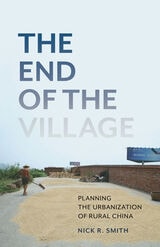
Since the beginning of the twenty-first century, China has vastly expanded its urbanization processes in an effort to reduce the inequalities between urban and rural areas. Centered on the mountainous region of Chongqing, which serves as an experimental site for the country’s new urban development policies, The End of the Village analyzes the radical expansion of urbanization and its consequences for China’s villagers. It reveals a fundamental rewriting of the nation’s social contract, as villages that once organized rural life and guaranteed rural livelihoods are replaced by an increasingly urbanized landscape dominated by state institutions.
Throughout this comprehensive study of China’s “urban–rural coordination” policy, Nick R. Smith traces the diminishing autonomy of the country’s rural populations and their subordination to larger urban networks and shared administrative structures. Outside Chongqing’s urban centers, competing forces are at work in reshaping the social, political, and spatial organization of its villages. While municipal planners and policy makers seek to extend state power structures beyond the boundaries of the city, village leaders and inhabitants try to maintain control over their communities’ uncertain futures through strategies such as collectivization, shareholding, real estate development, and migration.
As China seeks to rectify the development crises of previous decades through rapid urban growth, such drastic transformations threaten to displace existing ways of life for more than 600 million residents. Offering an unprecedented look at the country’s contentious shift in urban planning and policy, The End of the Village exposes the precarious future of rural life in China and suggests a critical reappraisal of how we think about urbanization.
The Ghosts of Berlin
Confronting German History in the Urban LandscapeBrian Ladd
University of Chicago Press, 1997
"Written in a clear and elegant style, The Ghosts of Berlin is not just another colorless architectural history of the German capital. . . . Mr. Ladd's book is a superb guide to this process of urban self-definition, both past and present."—Katharina Thote, Wall Street Journal
"If a book can have the power to change a public debate, then The Ghosts of Berlin is such a book. Among the many new books about Berlin that I have read, Brian Ladd's is certainly the most impressive. . . . Ladd's approach also owes its success to the fact that he is a good storyteller. His history of Berlin's architectural successes and failures reads entertainingly like a detective novel."—Peter Schneider, New Republic
"[Ladd's] well-written and well-illustrated book amounts to a brief history of the city as well as a guide to its landscape."—Anthony Grafton, New York Review of Books
The Ghosts of Berlin
Confronting German History in the Urban LandscapeBrian Ladd
University of Chicago Press, 2018
The History of Wisconsin, Volume III
Urbanization & Industrialization 1873-1893Robert C. Nesbit
Wisconsin Historical Society Press, 1985
Although the years from 1873-1893 lacked the well known, dramatic events of the periods before and after, this period presented a major transformation in Wisconsin's economy. The third volume in the History of Wisconsin series presents a balanced, comprehensive, and witty account of these two decades of dynamic growth and change in Wisconsin society, business, and industry. Concentrating on three major areas: the economy, communities, and politics and government, this volume in the History of Wisconsin series adds substantially to our knowledge and understanding of this crucial, but generally little-understood, period.
The Metropolis in Latin America, 1830-1930
Cityscapes, Photographs, DebatesIdurre Alonso
J. Paul Getty Trust, The, 2021
In the century between 1830 and 1930, following independence from Spain and Portugal, major cities in Latin America experienced large-scale growth, with the development of a new urban bourgeois elite interested in projects of modernization and rapid industrialization. At the same time, the lower classes were eradicated from old city districts and deported to the outskirts. The Metropolis in Latin America, 1830–1930 surveys this expansion, focusing on six capital cities—Havana, Mexico City, Rio de Janeiro, Buenos Aires, Santiago de Chile, and Lima—as it examines sociopolitical histories, town planning, art and architecture, photography, and film in relation to the metropolis.
Drawing from the Getty Research Institute’s vast collection of books, prints, and photographs from this period, largely unpublished until now, this volume reveals the cities’ changes through urban panoramas, plans depicting new neighborhoods, and photographs of novel transportation systems, public amenities, civic spaces, and more. It illustrates the transformation of colonial cities into the monumental modern metropolises that, by the end of the 1920s, provided fertile ground for the emergence of today’s Latin American megalopolis.
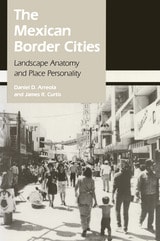
The Mexican Border Cities
Landscape Anatomy and Place PersonalityDaniel D. Arreola and James R. Curtis
University of Arizona Press, 1993
The Mexican Border Cities draws on extensive field research to examine eighteen settlements along the 2,000-mile border, ranging from towns of less than 10,000 people to dynamic metropolises of nearly a million. The authors chronicle the cities' growth and compare their urban structure, analyzing them in terms of tourist districts, commercial landscapes, residential areas, and industrial and transportation quarters.
Arreola and Curtis contend that, despite their proximity to the United States, the border cities are fundamentally Mexican places, as distinguished by their cultural landscapes, including town plan, land-use pattern, and building fabric. Their study, richly illustrated with over 75 maps and photographs, offers a provocative and insightful interpretation of the geographic anatomy and personality of these fascinating—and rapidly changing—communities.
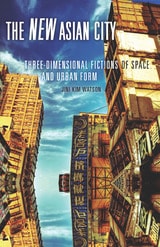
The New Asian City
Three-Dimensional Fictions of Space and Urban FormJini Kim Watson
University of Minnesota Press, 2011
Under Jini Kim Watson’s scrutiny, the Asian Tiger metropolises of Seoul, Taipei, and Singapore reveal a surprising residue of the colonial environment. Drawing on a wide array of literary, filmic, and political works, and juxtaposing close readings of the built environment, Watson demonstrates how processes of migration and construction in the hypergrowth urbanscapes of the Pacific Rim crystallize the psychic and political dramas of their colonized past and globalized present.
Examining how newly constructed spaces—including expressways, high-rises, factory zones, department stores, and government buildings—become figured within fictional and political texts uncovers how massive transformations of citizenries and cities were rationalized, perceived, and fictionalized. Watson shows how literature, film, and poetry have described and challenged contemporary Asian metropolises, especially around the formation of gendered and laboring subjects in these new spaces. She suggests that by embracing the postwar growth-at-any-cost imperative, they have buttressed the nationalist enterprise along neocolonial lines.
The New Asian City provides an innovative approach to how we might better understand the gleaming metropolises of the Pacific Rim. In doing so, it demonstrates how reading cultural production in conjunction with built environments can enrich our knowledge of the lived consequences of rapid economic and urban development.
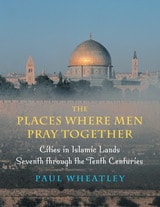
The Places Where Men Pray Together
Cities in Islamic Lands, Seventh through the Tenth CenturiesPaul Wheatley
University of Chicago Press, 2001
Building on the tenth-century geographer al-Maqdisi's writings on urban centers of the Islamic world, buttressed by extensive comparative material from roadbooks, topographies, histories, adab literatures, and gazetteers of the time, Wheatley identifies the main functions of different Islamic urban centers. Chapters on each of the thirteen centers that al-Maqdisi identified, ranging from the Atlantic to the Indus and from the Caspian to the Sudan, form the heart of this book. In each case Wheatley shows how specific agglomeration and accessibility factors combined to make every city functionally distinct as a creator of effective space. He also demonstrates that, far from revolutionizing every aspect of life in these cities, the adoption of Islam often affected the development of these cities less than previously existing local traditions.
The Places Where Men Pray Together is a monumental work that will speak to scholars and readers across a broad variety of disciplines, from historians, anthropologists, and sociologists to religious historians, archaeologists, and geographers.
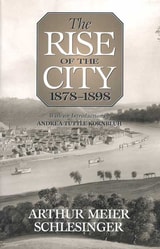
The Rise of the City, 1878–1898
Arthur Meier Schlesinger
The Ohio State University Press, 1999
The Social Production of Urban Space
By M. Gottdiener
University of Texas Press, 1994
From reviews of the first edition:
"This is perhaps the best theoretically oriented book by a United States urban sociologist since the work of Firey, Hawley, and Sjoberg in the 1940s and 1950s.... Gottdiener is on the cutting edge of urban theoretical work today." —Joe R. Feagin, Contemporary Sociology
Since its first publication in 1985, The Social Production of Urban Space has become a landmark work in urban studies. In this second edition, M. Gottdiener assesses important new theoretical models of urban space—and their shortcomings—including the global perspective, the flexible accumulation school, postmodernism, the new international division of labor, and the "growth machine" perspective.
Going beyond the limitations of these and older theories, Gottdiener proposes a model of urban growth that accounts for the deconcentration away from the central city that began in the United States in the 1920s and continues today. Sociologists, political scientists, economists, geographers, and urban planners will find his interdisciplinary approach to urban science invaluable, as it is currently the most comprehensive treatment of European and American work in these related fields.
The Surrounds
Urban Life within and beyond CaptureAbdouMaliq Simone
Duke University Press, 2022
The Urbanization of Opera
Music Theater in Paris in the Nineteenth CenturyAnselm Gerhard
University of Chicago Press, 1998
"An invaluable look at this fascinating genre."—George W. Loomis, Opera News
Toward One Oregon
Rural-Urban Interdependence and the Evolution of a StateMichael Hibbard
Oregon State University Press, 2011