Results by title
195 books match the query 'Utah' and 33 start with t
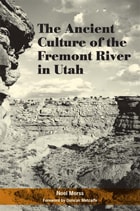
The Ancient Culture of the Fremont River in Utah
Report on the Explorations under the Claflin-Emerson Fund, 1928-1929Noel Morss
University of Utah Press, 2009
One such survey was conducted by author Noel Morss during the summer of 1928, resulting in an unexpected revelation: the Fremont (Dirty Devil) River drainage area being surveyed proved to be host to a prehistoric culture different from all other established Southwestern cultures. Excavations completed the following field season confirmed Morss’s findings. This distinct culture was defined by unique unpainted black or gray pottery, sole use of a primitive moccasin type, elaborate clay figurines, and abundant distinctive pictographs. Though too definite and well developed to be confined to a single drainage, Morss concluded that the Fremont were nonetheless a periphery culture and not an integral part of the mainstream of Southwestern development.
Originally published in 1931 and now featuring a new foreword by Duncan Metcalfe, The Ancient Culture of the Fremont River in Utah has become a classic in Southwestern archaeology, furthering a conversation about the early peoples of southern Utah that continues even today.

The Avenues of Salt Lake City
Cevan J. LeSieur
University of Utah Press, 2012
Salt Lake City’s oldest residential historic district is a neighborhood known as the Avenues. During the late nineteenth century this area was home to many of the most influential citizens of Salt Lake City. Built from 1860 until 1930, it contains a mix of middle and upper middle class homes of varying architectural styles. This architectural diversity makes the Avenues unique among Utah's historic districts. For the past thirty years, as citizens have rediscovered the value of living in historic properties near downtown and the University of Utah, preservation efforts have soared in the area.
In 1980, the Avenues was established as a historic district and the Utah Historical Society published The Avenues of Salt Lake City. That book’s authors, Karl T. Haglund and Philip F. Notarianni, gleaned much about the area’s history by using information found on the historic district applications. This newly revised edition of The Avenues of Salt Lake City by Cevan J. LeSieur updates the original with a greatly expanded section on the historic homes in the neighborhood, including more than 600 new photos, and additional material covering the history of the Avenues since 1980.
The book is designed so that readers can take it along as a guide when exploring the neighborhoods. All the pictures of Avenues homes are accompanied with architectural information and brief histories of the properties. This volume makes a valuable resource for those interested in the history of the Avenues and its diverse architecture, and for anyone interested in Utah history, Utah architecture, and historic preservation.
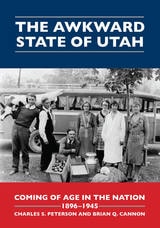
The Awkward State of Utah
Coming of Age in the Nation, 1896-1945Charles Peterson and Brian Cannon
University of Utah Press, 2015
The half century between statehood in 1896 and the end of World War II in 1945 was a period of transformation and transition for Utah. This book interprets those profound changes, revealing sweeping impacts on both institutions and ordinary people. Drawing upon expertise honed over decades of teaching, researching, and writing about Utah’s history, the authors incorporate fresh archival sources, new oral histories, and hundreds of scholarly articles and books as they narrate the little-known story of the crucial formative years when Utah came of age.
During its sometimes awkward years of adolescence and maturation, Utah was gradually incorporated into the American political, social, and economic mainstream. Urban and industrial influences supplanted agrarian traditions, displacing people socially, draining the countryside of population, and galvanizing a critical crisis in values and self-identification. National corporations and mass labor movements took root in the state as commerce expanded. Involvement in world events such as the Spanish-American War, two world wars, and the Great Depression further set the stage for entry into the modern, globalized world as Utahns immersed themselves in national politics and became part of the democratic, corporate culture of twentieth-century America.

The Backslider
Peterson, Levi
Signature Books, 2013
Frank comes into contact with a host of rural and urban characters. Of central importance is his Lutheran girlfriend, Marianne, whom Frank seduces, begrudgingly marries, and eventually loves. Frank’s extended family is just a generation removed from polygamy and still energized by old-time grudges and deprivations. Along the way Frank encounters a closeted secular humanist, a polygamist prophet, a psychiatrist, a Mason, government employees, college professors, lawyers, and entrepreneurs—all drawn with heightened realism reminiscent of Charles Dickens or the grotesque forms of William Faulkner and Flannery O’Connor.
The story engages readers as it alternates almost imperceptibly between Frank’s naïve consciousness and the more informed awareness of its narrator. It can be read as a love story, a satiric comedy, or a dark and sobering study of self-mutilation. Shifting from one to another, it builds suspense and elicits
complex emotions, among them a profound sense of compassion. More joyous than cynical, it sympathizes deeply with the plight of all of God’s backsliders.

The Book of Bauer
Stories from a Forgotten TownStephen S. Lottridge
University of Utah Press, 2023
Graffiti-covered industrial concrete ruins are all that remain today to remind us of the lives, adventures, and human relationships that once animated Bauer, Utah. Located just south of Tooele, across the Oquirrh Mountains west of the Salt Lake Valley, Bauer was abandoned in 1979 and declared a toxic waste site. The Book of Bauer: Stories from a Forgotten Town brings it back to life, evoking mid-twentieth century family and community in that company town as seen through the eyes of an observant adolescent boy.
Presenting a dramatic snapshot of life in Bauer in narrative autobiographical form, the book recalls the fate of hundreds of derelict mining towns throughout the mountain and sagebrush West. With vivid prose and intimate observation, The Book of Bauer offers an unparalleled memoir of small-town life in Utah and the Great Basin.
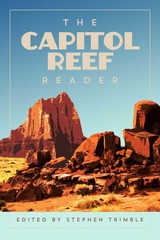
The Capitol Reef Reader
Stephen Trimble
University of Utah Press, 2019
The volume features nearly fifty writers who have anchored their attention and imagination in Utah’s least-known national park. The bedrock elders of Colorado Plateau literature are here (Clarence Dutton, Wallace Stegner, Edward Abbey), as are generations of writers who love this land (including Ellen Meloy, Craig Childs, Charles Bowden, Renny Russell, Ann Zwinger, Gary Ferguson, and Rose Houk). Their pieces are a pleasure to read and each reveals a facet of Capitol Reef’s story, creating a gem of a volume. Editor Stephen Trimble guides and orients with commentary and context.
A visual survey of the park in almost 100 photographs adds another layer to our understanding of this place. Historic photos, pictures from Trimble’s forty-five years of hiking the park, as well as images from master visual artists who have worked in Capitol Reef are included. No other book captures the essence of Capitol Reef like this one.
Part of the National Park Reader series, edited by Lance Newman and David Stanley
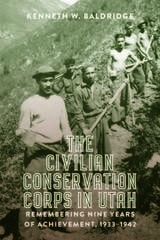
The Civilian Conservation Corps in Utah
Remembering Nine Years of Achievement, 1933-1942Kenneth W. Baldridge
University of Utah Press, 2018
Copublished with the Utah State Historical Society. Affiliated with the Utah Division of State History, Utah Department of Heritage & Arts
“There was a certain magic about sending young men into the woods. It was not so much man against nature as it was man in league with nature against the economic troubles that were then stalking the land.”—from the book
In 1932, unemployment in Utah was about 34 percent. Nearly every state west of the Mississippi River was struggling not only with unemployment but also with drought, erosion, and overgrazing. To solve these serious difficulties, President Franklin D. Roosevelt launched what would become arguably the most popular of his New Deal programs—the Civilian Conservation Corps (CCC). From 1933 to 1942, the CCC employed three million young men on land-improvement projects that are still used today.
In this book, Kenneth Baldridge chronicles the work of the 10,000 men who served at Utah’s 116 CCC camps. With facts and anecdotes drawn from camp newspapers, government files, interviews, letters written by enrollees, and other sources, he situates the CCC within the political climate and details not only the projects but also the day-to-day aspects of camp life. For thirty dollars a month—of which twenty-five was sent home to their folks—these young recruits planted trees; built roads, bridges, dams, and trails; fought fires; battled pests and noxious weeds; and erected cabins, campgrounds, amphitheaters, and reservoirs, and more.
Today the CCC is credited with creating greater public awareness and appreciation of the outdoors. It has also served as a model for the Student Conservation Corps and other youth programs. This volume documents the public good created by the CCC, provides an extensive bibliography, and is illustrated with numerous historic and modern photos.
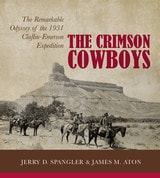
The Crimson Cowboys
The Remarkable Odyssey of the 1931 Claflin-Emerson ExpeditionJerry D. Spangler and James M. Aton
University of Utah Press, 2018
In 1931 a group from Harvard University’s Peabody Museum accomplished something that had never been attempted in the history of American archaeology: a six-week, four-hundred-mile horseback survey of Fremont prehistoric sites through some of the West’s most rugged terrain. The expedition was successful, but a report on the findings was never completed. What should have been one of the great archaeological stories in American history was relegated to boxes and files in the basement of the Peabody Museum at Harvard.
Now, based on over a thousand pages of documents (field journals, correspondence, and receipts) and over four hundred photographs, this book recounts the remarkable day-to-day adventures of this crew of one professor, five students, and three Utah guides who braved heat, fatigue, and the dangerous canyon wilderness to reveal vestiges of the Fremont culture in the Tavaputs Plateau and Uinta Basin areas. To better tell this story, authors Spangler and Aton undertook extensive fieldwork to confirm the sites; their recent photographs and those of the original expedition are shared on these pages. This engaging narrative situates the 1931 survey and its discoveries within the history of American archaeology.
Click here for a podcast with the APEX hour and Jim Aton about The Crimson Cowboys.
The Disappearances
A Story of Exploration, Murder, and Mystery in the American WestScott Thybony
University of Utah Press, 2016
Intrigued by this unusual string of coincidental disappearances, Scott Thybony set out to learn what happened. His investigations took him from Island in the Sky to Skeleton Mesa, from Texas to Tucson, and from the Green River to the Red. He traced the journey of Lucy Garrett from the murder of her father to her dramatic courtroom testimony. Using the pages of an old journal he followed the route of Dan Thrapp as he crossed an expanse of wildly rugged country with a pair of outlaws. Thrapp’s story of survival in an unforgiving land is a poignant counterpoint to the fate of the artist Everett Ruess, which the New York Times has called “one of the most enduring mysteries of the modern West.” Thybony draws on extensive research and a lifetime of exploration to create a riveting story of these three lives.
The Earth Will Appear as the Garden of Eden
Essays on Mormon Environmental HistoryJedediah S. Rogers and Matthew C. Godfrey
University of Utah Press, 2018
Since Joseph Smith’s revelations, Mormons have interacted with nature in significant ways—whether perceiving it as a place to find God, uncorrupted spaces in which to build communities to usher in the Second Coming, wildness needing domestication and control, or a world brimming with natural resources to ensure economic well-being. The essays in this volume—written by leading scholars in both environmental history and Mormon history—explore how nature has influenced Mormon beliefs and how these beliefs inform Mormons’ encounters with nature. Introducing overarching environmental ideas, contributors examine specific aspects of nature and Mormon theology to glean new insights into the Mormon experience.
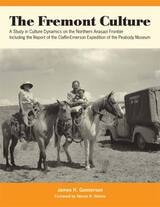
The Fremont Culture
A Study in Culture Dynamics on the Northern Anasazi Frontier, including the Report of the Claflin-Emerson Expedition of the Peabody MuseumJames H Gunnerson
University of Utah Press, 2009
Early expedition surveys and excavations conducted by Noel Morss would lead to a definition of the Fremont culture; later research would augment existing data on the Fremont by adding entirely new traits, disclosing new variations in architecture and basketry, and providing new information on the distribution of previously known traits.
In The Fremont Culture: A Study in Culture Dynamics on the Northern Anasazi Frontier, archaeologist James H. Gunnerson provides the results of his 1950s survey and excavation in the Utah area. He presents a functional synthesis of the Fremont culture and discusses the dynamics of its growth and decline.
Gunnerson’s report also uses the original field notes, maps, plans, photographs, sketches, and unpublished preliminary reports of the Claflin-Emerson expedition. Together, the reports of Morss and Gunnerson offer the most important and complete overview of the expedition available. They are fitting tributes to the men of that expedition, scientists who recognized the importance of an ancient people who once wrested a meager living from the rugged canyon country of the Green and Colorado Rivers.

The Full Gospel in Zion
A History of Pentecostalism in UtahAlan J. Clark
University of Utah Press, 2022
In The Full Gospel in Zion, Alan J. Clark explores the dynamic history of Pentecostalism in Utah. Although the story of Pentecostalism now spans the globe, there is no previous study of its growth and development among the mountains and valleys of the Beehive State. This book recovers and reveals the identities of the earliest Pentecostal pioneers across the state and places the founding churches within the historical narrative of Utah religion in the twentieth and early twenty-first centuries.
Utah Pentecostals faced difficulties establishing churches and congregations in a region dominated by a Latter-day Saint majority. Pentecostals found that they shared surprising similarities in belief but faced unexpected obstacles in evangelism, as Latter-day Saints did not respond as other Christians did to the Pentecostal message. Clark draws from interviews conducted with church leaders and congregants and from the rich documentary record to show Utah Pentecostals’ perseverance in creating a strong foothold in Utah. His work offers a new look at the diversity and richness of Utah’s religious history.

The Great Salt Lake Food Chains
Fragility and ResiliencyBonnie K. Baxter
University of Utah Press, 2024
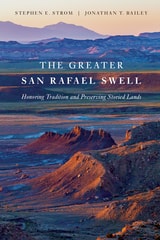
The Greater San Rafael Swell
Honoring Tradition and Preserving Storied LandsStephen E. Strom and Jonathan T. Bailey
University of Arizona Press, 2022
Natural and human history come together in The Greater San Rafael Swell, which spans much of Emery County in Utah. Authors Stephen Strom and Jonathan Bailey paint a multi-faceted picture of a singular place through photographs, along with descriptions of geology, paleontology, archaeology, history, and dozens of interviews with individuals who devoted more than two decades to developing a shared vision of the future of both the Swell and the County. At its core, the book relates the important story of how a coalition of ranchers, miners, off-road enthusiasts, conservationists, recreationists, and Native American tribal nations worked together for nearly 25 years to forge and pass the Emery County Public Lands Management Act in 2019.
This book chronicles hopeful stories for our times: how citizens of Emery and three other counties in the rural West worked to resolve perhaps the most volatile issue in the region – the future of public lands. Both their successes and the processes by which they found common ground serve as beacons in today’s uncertain landscape – beacons that can illuminate paths toward rebuilding our shared democracy from the ground up.
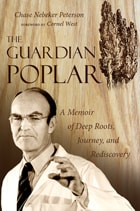
The Guardian Poplar
A Memoir of Deep Roots, Journey, and RediscoveryChase Nebeker Peterson
University of Utah Press, 2012
When Barney Clark received the Jarvik-7 artificial heart in 1983 and Cold Fusion came under fire in 1989, Chase Peterson, as the University of Utah president, was inevitably pulled into these campus events. While these episodes may be the best known in Peterson’s professional history, they are certainly not the only stories that make his autobiography worth reading.
The Guardian Poplar tells of a man who grew up in small-town Utah and carried his pioneer and Mormon heritage to a New England prep school and later to Harvard. He then returned to Utah as a doctor, but unexpectedly found himself back at Harvard as its dean of admissions, handling issues such as the Vietnam War and racial and gender reform. The book explains how Peterson’s home state recruited him back to become an administrator at the University of Utah and how he would eventually become the university president, taking on new issues and challenges. Peterson recounts these years by drawing on anecdotes that recall the people he served and the moments that brought his life meaning.
This autobiography is a compelling account of how Peterson has managed to balance family and career, handle the tensions that have arisen between his faith and his scientific training, and remain solid in the face of his newest challenge—cancer. The book’s engaging prose and honest reflections are sure to intrigue and inspire readers who know the man well, as well as those readers who simply want to know a man who can be described as dedicated, faithful, hardworking, and hopeful about the future.
“When I first met Chase Peterson as a Harvard freshman—along with our joint friend and brother David Evans—something deeply touched me. It was not only his sincere smile and open embrace but also a sense that here was a kind and courageous man comfortable in his own skin, secure in who he was yet eager to encounter new persons, new experiences, and new challenges. . . . He was from Utah but in New England, a Mormon in old Harvard, and a medical doctor in the deanship of admissions. Little did I know that his journey would enhance and enrich my own—owing to his critical allegiance to his family, his faith, his friends, and to his citizenship of country and world. His prophetic witness at Harvard in the turbulent ‘60s and ‘70s, his promotion of black priesthood in the Mormon church, his support of antiapartheid protests in the ‘80s, and his steadfast defense of academic freedom in the Cold Fusion controversy in the early ‘90s all express his quiet and humble effort to be true to himself—a self grounded in, but
not limited by, a rich Mormon tradition.”—from the foreword by Cornel West

The Interior West
A Fire SurveyStephen J. Pyne
University of Arizona Press, 2018
In this collection of essays, fire historian Stephen J. Pyne explains the relevance of the Interior West to the national fire scene. This region offered the first scientific inquiry into landscape fire in the United States, including a map of Utah burns published in 1878 as part of John Wesley Powell’s Arid Lands report. Then its significance faded, and for most of the 20th century, the Interior West was the hole in the national donut of fire management. Recently the region has returned to prominence due to fires along its front ranges; invasive species, both exotics like cheatgrass and unleashed natives like mountain pine beetle; and fatality fires, notably at South Canyon in 1994.
The Interior West has long been passed over in national fire narratives. Here it reclaims its rightful place.
Included in this volume:
- A summary of 19th- and 20th-century fire history in the Interior West
- How this important region inspired U.S. studies of landscape fire
- Why the region disappeared from national fire management discussions
- How the expansion of invasive species and loss of native species has affected the region’s fire ecology
- The national significance of fire in the Interior West
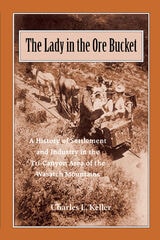
The Lady In The Ore Bucket
A History of Settlement and Industry in the Tri-Canyon Area of the Wasatch MountainsCharles L Keller
University of Utah Press, 2001
These place names, as well as the physcial traces and artifacts that persist in three Wasatch canyons—Mill Creek, Big Cottonwood, and Little Cottonwood—tantalize with what they suggest, but do not tell, about the history of settlement and development in the canyons. Charles Keller has extracted a wealth of information to create The Lady in the Ore Bucket, a faxcinating history of the lumber, mining, and hydropower industries built from the rich natural resources of the canyons. With more than six dozen photographs and maps, the book is alive with details concerning the personalities, politics, pacts, and peregrinations of local leaders from white settlement in 1847 through the early 1900s. It will delight any reader with an interest in the magnificent canyones that open onto the modern Wasatch Front.
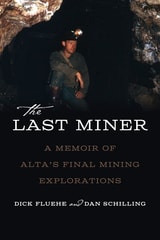
The Last Miner
A Memoir of Alta's Final Mining ExpeditionsDick Fluehe with Dan Schilling
University of Utah Press, 2025
The Last Miner is a captivating memoir chronicling the final days of mining exploration in Utah’s legendary Little Cottonwood Canyon during the 1950s. Through the eyes of Dick Fluehe, the last living miner to traverse these haunted, silver-laden tunnels, readers are immersed in a forgotten world beneath the internationally renowned Alta and Snowbird ski areas. With a knowledge as deep as the mines themselves, Dick recounts tales of collapsed shafts, gloriously jeweled stopes, and colorful personalities, such as “Swingin’ Door,” “Slick,” and “The Bull,” who lived and died pursuing ore.
Edited by New York Times bestselling author Dan Schilling, The Last Miner offers a unique, firsthand account of the treacherous, adventurous, and humorous lives of mid-century miners. Both thrilling and insightful, this memoir is the mining equivalent of a float down the Mississippi with Mark Twain and an unprecedented insight into the history of American West mining.
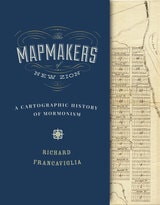
The Mapmakers of New Zion
A Cartographic History of MormonismRichard Francaviglia
University of Utah Press, 2015
From their earliest days on the American frontier through their growth into a worldwide church, the spatially expansive Mormons made maps to help them create idealized communities, migrate to and colonize large parts of the American West, visualize the stories in their sacred texts, and spread their message internationally through a well-organized missionary system. This book identifies many Mormon mapmakers who played an important but heretofore unsung role in charting the course of Latter-day Saint history. For Mormons, maps had and continue to have both practical and spiritual significance. In addition to using maps to help build their new Zion and to explore the Intermountain West, Latter-day Saint mapmakers used them to depict locations and events described in the Book of Mormon.
Featuring over one hundred historical maps reproduced in full color—many never before published—The Mapmakers of New Zion sheds new light on Mormonism and takes readers on a fascinating journey through maps as both historical documents and touchstones of faith.
Winner of the Southwest Book Design and Production Award from the New Mexico Book Association.
Selected as one of the American Library Association's Best of the Best from University Presses.
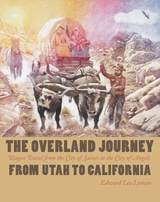
The Overland Journey From Utah To California
Wagon Travel From The City Of Saints To The City Of AngelsEdward Leo Lyman
University of Nevada Press, 2008
The wagon trail between Salt Lake City and Los Angeles is one of the most important and least-known elements of nineteenth-century Western migration. Known as the Southern Route, it included the western half of the Old Spanish Trail and was favored because it could be used for travel and freighting year-round. It was, however, likely the most difficult route that pioneers traveled with any consistency, following not rivers but leading from one--sometimes dubious--desert watering place to the next and offering few havens for the sick, weary, or unfortunate. Historian Edward Leo Lyman has provided the first history of the complete Southern Route and of the people who developed and used it. Based on extensive research in primary sources--including many early travelers’ accounts--and on Lyman’s own investigation of the route and its branches, the book discusses the exploration and development of the Old Spanish Trail, its horse thieves and traders, including Jed Smith and Kit Carson, along with government explorere John C. Frémont. Developing the old pack mule trail as a wagon road between Salt Lake City and Los Angeles, miners heading for the California gold fields first used the route extensively. Mormon missionaries and the colonizers of San Bernardino and other communities also traveled that way, as did a wide array of mail carriers, soldiers and world travelers. Later, a steady stream of Anglo-American emigrants seeking new homes or fortunes in California shared the road with a surprising number of freight wagon operators. The trail passed through the territories of numerous Native American peoples, and contacts with them--both friendly and hostile--played a significant role in the experiences of travelers and in the fates of Native American cultures in this region. Lyman’s discussions of Mormon-Indian relations and of the infamous Mountain Meadows Massacre offer fresh and important analyses of these vital aspects of the westward movement.
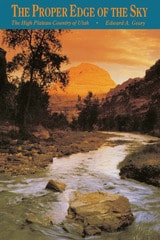
The Proper Edge of the Sky
High Plateau Country of UtahEdward A Geary
University of Utah Press, 1992
Edward Geary’s collection of writings on the High Plateau country of central and southern Utah, a combination guidebook, travel narrative, personal essays, and natural, social, and literary history, encompasses each of those forms with a sweep as broad as the landscape it describes.
It traces the progress of travelers to the region, including the historic Dominguez-Escalante party in 1776, and trappers and explorers such as Jedediah Smith, John C. Freemont, and Kit Carson. Scandinavian and English descendants of the early Mormon pioneers, sent to settle Manti and surrounding areas by Brigham Young in 1849, populate many of the pages and dominate the agrarian villages described by the author. The book also describes the multiethnic society of French Basque, Greeks, Slavs, Italians, Chinese, Welsh, and Finnish laborers and coal miners that developed in the region.
Geary writes of all these people with affection and a deep sense of place, of belonging to a distinctive landscape and its history. It is a book that will bring a rush of understanding to those who have lived in the High Plateaus and greater depth of appreciation to visitors.
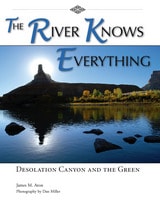
The River Knows Everything
Desolation Canyon and the GreenJames M Aton
Utah State University Press, 2009

The Salt Lake Papers
From the Years in the Earthscapes of UtahEd Lueders
University of Utah Press, 2018
The Salt Lake Papers is divided into two sections by location and time. Book One reflects the central geophysical presence of the Great Salt Lake, in view from Leuders’s home and the University of Utah campus where he studied and taught. Researched and composed during the 1980s, it is published here for the first time. Book Two begins with his retirement to the “earthscapes” of the Torrey–Capitol Reef area of southern Utah and contemplates the Colorado River system. Hydrology thus provides both the physical and the metaphysical basis for the author’s reflective insights and for the natural flow of his advancing thought.
Beautifully written, The Salt Lake Papers, in varied ways, speaks to the necessity of the humanities in the modern age. At its heart, Lueders’s small book of intellectual musings explores place and the ways landscape shapes what is observant in each of us.
Hear Ed Lueders talk about his book on Utah Conversations with Ted Capener on KUED

The Selected Letters of Juanita Brooks
Edited by Craig S. Smith
University of Utah Press, 2019
The letters in this volume, written from 1941 to 1978, trace Brooks’s development from fledgling historian to recognized authority. Serving almost as an autobiography of her interactions with her contemporaries, this selection provides a new perspective on Brooks’s personality and growth as a scholar. Richly detailed, chatty, and covering a wide array of subjects, the letters afford an important glimpse into Brooks’s struggles, concerns, and interests.
The Spiral Jetty Encyclo
Exploring Robert Smithson's Earthwork through Time and PlaceHikmet Sidney Loe
University of Utah Press, 2017
Copublished with the Tanner Trust Fund, J. Willard Marriott Library.
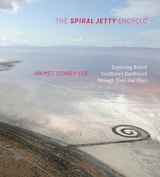
Robert Smithson’s earthwork, Spiral Jetty (1970), an icon of the Land Art movement of the 1960s and 1970s, is located on the northern shores of Utah’s Great Salt Lake. Smithson built a masterpiece from local materials, one that spirals counterclockwise into the lake and appears or is submerged with fluctuations in the lake’s locally red, saline water.
The Spiral Jetty Encyclo draws on Smithson’s writings for encyclopedic entries that bring to light the context of the earthwork and Smithson’s many points of reference in creating it. Visitors and armchair travelers, too, will discover how much significance Smithson placed on regional considerations, his immersion in natural history, his passion for travel, and his ability to use diverse mediums to create a cohesive and lasting work of art. Containing some 220 images, most of them in color, with some historical black and whites, The Spiral Jetty Encyclo lets readers explore the construction, connections, and significance of Smithson’s 1,500-foot-long curl into Great Salt Lake, created, in Smithson’s words, of “mud, salt crystals, rocks, water.”
Winner of 15 Bytes Book Award for Art Book.
Finalist for the Utah State Historical Society Best Book Award.
The Thieves of Summer
Linda Sillitoe
Signature Books, 2014
Prin-cess Al-ice in Liberty Park
Munch-es ba-nan-as ’til way after dark.
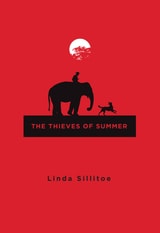
Princess Alice is an elephant the children of Utah purchased by donating nickels and dimes to a circus. The girls don’t know this, but her handler takes the mammoth princess out on late-night strolls around the park when the moon is out. What they do know is that the elephant sometimes escapes and goes on a rampage, crashing through front-yard fences and collecting collars of clothesline laundry around her neck, a persistent train of barking dogs following behind. The girls’ father is a police officer who is investigating a boy’s disappearance. As the case unfolds, the perception of the park, with its eighty acres of trees and grass, will change from the epitome of freedom to a place to be avoided, even as Princess Alice moves to a secure confinement at a new zoo at the mouth of Emigration Canyon. The story is loosely based on the exploits of a real live elephant that lived in Liberty Park a decade before Sillitoe’s childhood in the neighborhood.

The Women
A Family StoryKerry William Bate
University of Utah Press, 2016
Kerry Bate proceeds on the premise that a story centering on the women of the clan could provide fresh perspective and insight. He portrays real people with well-rounded, flawed characters; builds from deep research; writes with a bit of style; and includes the rich context and detail of these lives. His main subjects are four generations of impressive women: the pioneer Catherine Campbell Steele; her daughter Young Elizabeth, the first Mormon child born in Utah; Kate, an accomplished community leader; and Sarah, a gifted seamstress trapped in an unhappy marriage. To enter their hardscrabble lives in small southern Utah communities is to meet women who pioneered in their own modest but determined ways.
Winner of the Mormon History Association's Best Personal History/Memoir Award.
Interview with Tom Williams on Access Utah

This Is the Plate
Utah Food TraditionsEdited by Carol Edison, Eric A Eliason, and Lynne S McNeill
University of Utah Press, 2019
Thunder Over Zion
The Life and Times of Chief Judge Willis W RitterCowley & Nielson
University of Utah Press, 2006
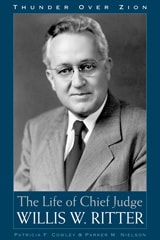
Ritter was clearly ahead of his time, for his opinions on criminal justice, police interrogation, and the rights to counsel have now become accepted standards in jurisprudence. They are, indeed, so universally accepted that few if any viewers of televised police court dramas would even question them. In his personal life he was a man flawed on a grand scale and he lived a life fraught with contradictions. This is his compelling story, compellingly recounted.
Traces of Fremont
Society and Rock Art in Ancient UtahSteven R. Simms, Photography by François Gohier
University of Utah Press, 2010
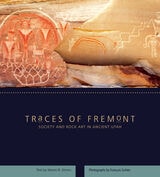
Fremont is a culture (ca. 300–1300 A.D.) first defined by archaeologist Noel Morss in 1928 based on characteristics unique to the area. Initially thought to be a simple socio-political system, recent reassessments of the Fremont assume a more complex society. This volume places Fremont rock art studies in this contemporary context. Author Steven Simms offers an innovative model of Fremont society, politics, and worldview using the principles of analogy and current archaeological evidence. Simms takes readers on a trip back in time by describing what a typical Fremont hamlet or residential area might have looked like a thousand years ago, including the inhabitants' daily activities. François Gohier's captivating photographs of Fremont art and artifacts offer an engaging complement to Simms's text, aiding us in our understanding of the lives of these ancient people.
Winner of the Utah Book Award in Nonfiction.
Winner of the Society for American Archaeology Book Award for Public Audience.
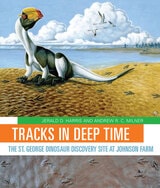
Tracks in Deep Time
The St. George Dinosaur Discovery Site at Johnson FarmJerald D. Harris and Andrew R. Milner
University of Utah Press, 2015
Tracks in Deep Time presents, for the first time, an engaging, thoroughly readable account of the history, geology, and paleontology of this important site. Two hundred million years ago, Lake Dixie covered the site. Within its waters and along its shores, a diverse ecosystem of dinosaurs, early crocodylians, fishes, plants, and other organisms thrived, leaving behind thousands of footprints and other fossils preserved in layers of rock. Unusual fossils found here include the world’s largest collection of tracks left by swimming dinosaurs and one of only six traces known to have been made by a sitting, meat-eating dinosaur. With approachable text and lavish, full-color photographs and illustrations, Jerald Harris and Andrew Milner describe how geologists and paleontologists have painstakingly reconstructed a vivid “snapshot” of life from the Early Jurassic epoch.
Transformation of the Mormon Culture Region
Ethan R. Yorgason
University of Illinois Press, 2010
Twelve Mormon Homes Revisited
Touring Polygamous Utah with Elizabeth Kane, 1872-1873Lowell C. Bennion
University of Utah Press, 2024