103 books match the query 'Violence against' and 22 start with t
cover of Teaching against Violence: The Reassessing Toolbox

Teaching against Violence

The Reassessing Toolbox

Inez Testoni

Central European University Press, 2014
Teaching Against Violence deals with gender based violence, paying particular attention to domestic violence, as in this field feminism has tenaciously sought to change the condition of women and, as a result, many international policies have promoted a significant social transformation. The chapters present active techniques that were adopted during the interventions to promote women's empowerment. The contributions face these issues from various perspectives, present the state of the art research in multiple fields of study and suggest educational best practices that can be used where this problem is particularly severe.
[more]
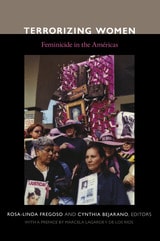
cover of Terrorizing Women: Feminicide in the Americas

Terrorizing Women

Feminicide in the Americas

Rosa-Linda Fregoso and Cynthia L. Bejarano, eds.

Duke University Press, 2010

More than 600 women and girls have been murdered and more than 1,000 have disappeared in the Mexican state of Chihuahua since 1993. Violence against women has increased throughout Mexico and in other countries, including Argentina, Costa Rica, Guatemala, and Peru. Law enforcement officials have often failed or refused to undertake investigations and prosecutions, creating a climate of impunity for perpetrators and denying truth and justice to survivors of violence and victims’ relatives. Terrorizing Women is an impassioned yet rigorously analytical response to the escalation in violence against women in Latin America during the past two decades. It is part of a feminist effort to categorize violence rooted in gendered power structures as a violation of human rights. The analytical framework of feminicide is crucial to that effort, as the editors explain in their introduction. They define feminicide as gender-based violence that implicates both the state (directly or indirectly) and individual perpetrators. It is structural violence rooted in social, political, economic, and cultural inequalities.

Terrorizing Women brings together essays by feminist and human rights activists, attorneys, and scholars from Latin America and the United States, as well as testimonios by relatives of women who were disappeared or murdered. In addition to investigating egregious violations of women’s human rights, the contributors consider feminicide in relation to neoliberal economic policies, the violent legacies of military regimes, and the sexual fetishization of women’s bodies. They suggest strategies for confronting feminicide; propose legal, political, and social routes for redressing injustices; and track alternative remedies generated by the communities affected by gender-based violence. In a photo essay portraying the justice movement in Chihuahua, relatives of disappeared and murdered women bear witness to feminicide and demand accountability.

Contributors: Pascha Bueno-Hansen, Adriana Carmona López, Ana Carcedo Cabañas, Jennifer Casey, Lucha Castro Rodríguez , Angélica Cházaro, Rebecca Coplan, Héctor Domínguez-Ruvalcaba, Marta Fontenla, Alma Gomez Caballero, Christina Iturralde, Marcela Lagarde y de los Ríos, Julia Estela Monárrez Fragoso, Hilda Morales Trujillo, Mercedes Olivera, Patricia Ravelo Blancas, Katherine Ruhl, Montserrat Sagot, Rita Laura Segato, Alicia Schmidt Camacho, William Paul Simmons, Deborah M. Weissman, Melissa W. Wright
[more]
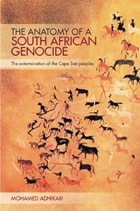
cover of The Anatomy of a South African Genocide: The Extermination of the Cape San Peoples

The Anatomy of a South African Genocide

The Extermination of the Cape San Peoples

Mohamed Adhikari

Ohio University Press, 2011

In 1998 David Kruiper, the leader of the ‡Khomani San who today live in the Kalahari Desert in South Africa, lamented, “We have been made into nothing.” His comment applies equally to the fate of all the hunter-gatherer societies of the Cape Colony who were destroyed by the impact of European colonialism. Until relatively recently, the extermination of the Cape San peoples has been treated as little more than a footnote to South African narratives of colonial conquest. During the eighteenth and nineteenth centuries, Dutch-speaking pastoralists who infiltrated the Cape interior dispossessed its aboriginal inhabitants. In response to indigenous resistance, colonists formed mounted militia units known as commandos with the express purpose of destroying San bands. This ensured the virtual extinction of the Cape San peoples. In The Anatomy of a South African Genocide, Mohamed Adhikari examines the history of the San and persuasively presents the annihilation of Cape San society as genocide.
[more]
cover of The Anti-Black City: Police Terror and Black Urban Life in Brazil

The Anti-Black City

Police Terror and Black Urban Life in Brazil

Jaime Amparo Alves

University of Minnesota Press, 2018

An important new ethnographic study of São Paulo’s favelas revealing the widespread use of race-based police repression in Brazil

While Black Lives Matter still resonates in the United States, the movement has also become a potent rallying call worldwide, with harsh police tactics and repressive state policies often breaking racial lines. In The Anti-Black City, Jaime Amparo Alves delves into the dynamics of racial violence in Brazil, where poverty, unemployment, residential segregation, and a biased criminal justice system create urban conditions of racial precarity. 

The Anti-Black City provocatively offers race as a vital new lens through which to view violence and marginalization in the supposedly “raceless” São Paulo. Ironically, in a context in which racial ambiguity makes it difficult to identify who is black and who is white, racialized access to opportunities and violent police tactics establish hard racial boundaries through subjugation and death. Drawing on two years of ethnographic research in prisons and neighborhoods on the periphery of this mega-city, Alves documents the brutality of police tactics and the complexity of responses deployed by black residents, including self-help initiatives, public campaigns against police violence, ruthless gangs, and self-policing of communities.

The Anti-Black City reveals the violent and racist ideologies that underlie state fantasies of order and urban peace in modern Brazil. Illustrating how “governing through death” has become the dominant means for managing and controlling ethnic populations in the neoliberal state, Alves shows that these tactics only lead to more marginalization, criminality, and violence. Ultimately, Alves’s work points to a need for a new approach to an intractable problem: how to govern populations and territories historically seen as “ungovernable.”
[more]
cover of The Cunning of Gender Violence: Geopolitics and Feminism

The Cunning of Gender Violence

Geopolitics and Feminism

Lila Abu-Lughod, Rema Hammami, and Nadera Shalhoub-Kevorkian, editors

Duke University Press, 2023

The Cunning of Gender Violence focuses on how a once visionary feminist project has folded itself into contemporary world affairs. Combating violence against women and gender-based violence constitutes a highly visible and powerful agenda enshrined in international governance and law and embedded in state violence and global securitization. Case studies on Palestine, Bangladesh, Iran, India, Pakistan, Israel, and Turkey as well as on UN and US policies trace the silences and omissions, along with the experiences of those subjected to violence, to question the rhetoric that claims the agenda as a “feminist success story.” Because religion and racialized ethnicity, particularly “the Muslim question,” run so deeply through the institutional structures of the agenda, the contributions explore ways it may be affirming or enabling rationales and systems of power, including civilizational hierarchies, that harm the very people it seeks to protect.

Contributors. Lila Abu-Lughod, Nina Berman, Inderpal Grewal, Rema Hammami, Janet R. Jakobsen, Shenila Khoja-Moolji, Vasuki Nesiah, Samira Shackle, Sima Shakhsari, Nadera Shalhoub-Kevorkian, Dina M Siddiqi, Shahla Talebi, Leti Volpp, Rafia Zakaria
[more]
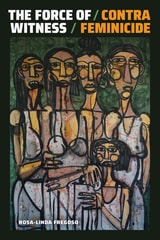
cover of The Force of Witness: Contra Feminicide

The Force of Witness

Contra Feminicide

Rosa-Linda Fregoso

Duke University Press, 2023

In The Force of Witness Rosa-Linda Fregoso examines the contra feminicide movement in Mexico and other feminist efforts to eradicate gender violence. Drawing on interviews, art, documentaries, and her years of activism, Fregoso traces the micro and macro scales of misogyny and the patterns of state complicity with gender violence. She shows how different forms of witnessing—from activist-mothers’ bearing witness to the memories of their daughters and expert witnesses in court cases to communal witnessing and a scholar-activist-citizen witnessing her own actions—are key to resisting feminicidal violence. Fregoso situates these forms of witness in the histories, contexts, structures, bodies, and intersectional struggles they emerge from. By outlining the complexities of feminicidal violence in relation to witnessing processes, Fregoso challenges the notion of witness as an individual or autonomous subject inscribed solely in the legal or religious arenas. Rather, she theorizes witness as a force of collectivity and a constellation of multiple social locations and intersectional practices that work together to abolish feminicidal violence.
[more]
cover of The Hirschfeld Archives: Violence, Death, and Modern Queer Culture

The Hirschfeld Archives

Violence, Death, and Modern Queer Culture

Heike Bauer

Temple University Press, 2017

Influential sexologist and activist Magnus Hirschfeld founded Berlin’s Institute of Sexual Sciences in 1919 as a home and workplace to study homosexual rights activism and support transgender people. It was destroyed by the Nazis in 1933. This episode in history prompted Heike Bauer to ask, Is violence an intrinsic part of modern queer culture? The Hirschfeld Archives answers this critical question by examining the violence that shaped queer existence in the first part of the twentieth century. 

Hirschfeld himself escaped the Nazis, and many of his papers and publications survived. Bauer examines his accounts of same-sex life from published and unpublished writings, as well as books, articles, diaries, films, photographs and other visual materials, to scrutinize how violence—including persecution, death and suicide—shaped the development of homosexual rights and political activism. 

The Hirschfeld Archives brings these fragments of queer experience together to reveal many unknown and interesting accounts of LGBTQ life in the early twentieth century, but also to illuminate the fact that homosexual rights politics were haunted from the beginning by racism, colonial brutality, and gender violence.
[more]
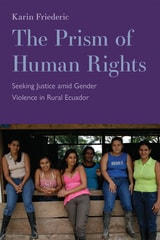
cover of The Prism of Human Rights: Seeking Justice amid Gender Violence in Rural Ecuador

The Prism of Human Rights

Seeking Justice amid Gender Violence in Rural Ecuador

Karin Friederic

Rutgers University Press, 2023

Gender violence has been at the forefront of women’s human rights struggles for decades, shaping political movements and NGO and government programs related to women’s empowerment, community development, and public health. Drawing on over twenty years of research and activism in rural Ecuador, Karin Friederic provides a remarkably intimate view of what these rights-based programs actually achieve over the long term. The Prism of Human Rights brings us into the lives of women, men, and children who find themselves entangled in intimate partner violence, structural violence, political economic change, and a global cultural project in which “rights” are associated with modernity, development, and democratic states. She details the multiple forms of violence that rural women experience; shows the diverse ways they make sense of, endure, and combat this violence; and helps us understand how people are grappling with new ideas of gender, rights, and even of violence itself. Ultimately, Friederic demonstrates that rights-based interventions provide important openings for women seeking a life free of violence, but they also unwittingly expose “liberated” women to more extreme dynamics of structural violence. Thus, these interventions often reduce women’s room to maneuver and encourage communities to hide violence in order to appear “modern” and “developed.” This analysis of human rights in practice is essential for anyone seeking to promote justice in a culturally responsible manner, and for anyone who hopes to understand how the globalization of rights, legal institutions, and moral visions is transforming distant locales and often perpetuating violence in the process.
[more]
cover of The Seductions of Quantification: Measuring Human Rights, Gender Violence, and Sex Trafficking

The Seductions of Quantification

Measuring Human Rights, Gender Violence, and Sex Trafficking

Sally Engle Merry

University of Chicago Press, 2016

We live in a world where seemingly everything can be measured. We rely on indicators to translate social phenomena into simple, quantified terms, which in turn can be used to guide individuals, organizations, and governments in establishing policy. Yet counting things requires finding a way to make them comparable. And in the process of translating the confusion of social life into neat categories, we inevitably strip it of context and meaning—and risk hiding or distorting as much as we reveal.

With The Seductions of Quantification, leading legal anthropologist Sally Engle Merry investigates the techniques by which information is gathered and analyzed in the production of global indicators on human rights, gender violence, and sex trafficking. Although such numbers convey an aura of objective truth and scientific validity, Merry argues persuasively that measurement systems constitute a form of power by incorporating theories about social change in their design but rarely explicitly acknowledging them. For instance, the US State Department’s Trafficking in Persons Report, which ranks countries in terms of their compliance with antitrafficking activities, assumes that prosecuting traffickers as criminals is an effective corrective strategy—overlooking cultures where women and children are frequently sold by their own families. As Merry shows, indicators are indeed seductive in their promise of providing concrete knowledge about how the world works, but they are implemented most successfully when paired with context-rich qualitative accounts grounded in local knowledge.

[more]
cover of The Specter and the Speculative: Afterlives and Archives in the African Diaspora

The Specter and the Speculative

Afterlives and Archives in the African Diaspora

Mae G. Henderson

Rutgers University Press, 2024

The Specter and the Speculative: Afterlives and Archives in the African Diaspora engages in a critical conversation about how historical subjects and historical texts within the African Diaspora are re-fashioned, re-animated, and re-articulated, as well as parodied, nostalgized, and defamiliarized, to establish an “afterlife” for African Atlantic identities and narratives. These essays focus on transnational, transdisciplinary, and transhistorical sites of memory and haunting—textual, visual, and embodied performances—in order to examine how these “living” archives circulate and imagine anew the meanings of prior narratives liberated from their original context. Individual essays examine how historical and literary performances—in addition to film, drama, music, dance, and material culture—thus revitalized, transcend and speak across temporal and spatial boundaries not only to reinstate traditional meanings, but also to motivate fresh commentary and critique. Emergent and established scholars representing diverse disciplines and fields of interest specifically engage under explored themes related to afterlives, archives, and haunting.
[more]
cover of The Torture Letters: Reckoning with Police Violence

The Torture Letters

Reckoning with Police Violence

Laurence Ralph

University of Chicago Press, 2019

Torture is an open secret in Chicago. Nobody in power wants to acknowledge this grim reality, but everyone knows it happens—and that the torturers are the police. Three to five new claims are submitted to the Torture Inquiry and Relief Commission of Illinois each week. Four hundred cases are currently pending investigation. Between 1972 and 1991, at least 125 black suspects were tortured by Chicago police officers working under former Police Commander Jon Burge. As the more recent revelations from the Homan Square “black site” show, that brutal period is far from a historical anomaly. For more than fifty years, police officers who took an oath to protect and serve have instead beaten, electrocuted, suffocated, and raped hundreds—perhaps thousands—of Chicago residents.
 
In The Torture Letters, Laurence Ralph chronicles the history of torture in Chicago, the burgeoning activist movement against police violence, and the American public’s complicity in perpetuating torture at home and abroad. Engaging with a long tradition of epistolary meditations on racism in the United States, from James Baldwin’s The Fire Next Time to Ta-Nehisi Coates’s Between the World and Me, Ralph offers in this book a collection of open letters written to protesters, victims, students, and others. Through these moving, questing, enraged letters, Ralph bears witness to police violence that began in Burge’s Area Two and follows the city’s networks of torture to the global War on Terror. From Vietnam to Geneva to Guantanamo Bay—Ralph’s story extends as far as the legacy of American imperialism. Combining insights from fourteen years of research on torture with testimonies of victims of police violence, retired officers, lawyers, and protesters, this is a powerful indictment of police violence and a fierce challenge to all Americans to demand an end to the systems that support it.
 
With compassion and careful skill, Ralph uncovers the tangled connections among law enforcement, the political machine, and the courts in Chicago, amplifying the voices of torture victims who are still with us—and lending a voice to those long deceased.

 
[more]
cover of The Torture Letters: Reckoning with Police Violence

The Torture Letters

Reckoning with Police Violence

Laurence Ralph

University of Chicago Press, 2020

Torture is an open secret in Chicago. Nobody in power wants to acknowledge this grim reality, but everyone knows it happens—and that the torturers are the police. Three to five new claims are submitted to the Torture Inquiry and Relief Commission of Illinois each week. Four hundred cases are currently pending investigation. Between 1972 and 1991, at least 125 black suspects were tortured by Chicago police officers working under former Police Commander Jon Burge. As the more recent revelations from the Homan Square “black site” show, that brutal period is far from a historical anomaly. For more than fifty years, police officers who took an oath to protect and serve have instead beaten, electrocuted, suffocated, and raped hundreds—perhaps thousands—of Chicago residents.
 
In The Torture Letters, Laurence Ralph chronicles the history of torture in Chicago, the burgeoning activist movement against police violence, and the American public’s complicity in perpetuating torture at home and abroad. Engaging with a long tradition of epistolary meditations on racism in the United States, from James Baldwin’s The Fire Next Time to Ta-Nehisi Coates’s Between the World and Me, Ralph offers in this book a collection of open letters written to protesters, victims, students, and others. Through these moving, questing, enraged letters, Ralph bears witness to police violence that began in Burge’s Area Two and follows the city’s networks of torture to the global War on Terror. From Vietnam to Geneva to Guantanamo Bay—Ralph’s story extends as far as the legacy of American imperialism. Combining insights from fourteen years of research on torture with testimonies of victims of police violence, retired officers, lawyers, and protesters, this is a powerful indictment of police violence and a fierce challenge to all Americans to demand an end to the systems that support it.
 
With compassion and careful skill, Ralph uncovers the tangled connections among law enforcement, the political machine, and the courts in Chicago, amplifying the voices of torture victims who are still with us—and lending a voice to those long deceased.

 
[more]
cover of The Violence of Protection: Policing, Immigration Law, and Asian American Women

The Violence of Protection

Policing, Immigration Law, and Asian American Women

Lee Ann S. Wang

Duke University Press, 2026

Celebrated as a feminist victory upon its passage as part of the Clinton Crime Bill, the Violence Against Women Act (VAWA) is a landmark piece of legislation that provides protections for survivors of gender and sexual violence. However, as Lee Ann S. Wang shows in The Violence of Protection, VAWA primarily funds law enforcement efforts to rescue women, and in doing so, creates conditions of racial violence against survivors from communities who are already policed, surveilled, and face immigration enforcement. Through ethnographic fieldwork with legal and social advocates serving Asian American survivors of gender and sexual violence in the San Francisco Bay Area, Wang shows how these advocates grapple with laws which require survivors to cooperate with policing in order to receive protection. Engaging in methodologies of feminist refusal, theories of racial assemblage, and abolition feminisms, The Violence of Protection theorizes the victim as a legal subject and exposes the racial violence enacted when State-provided legal safeguards are leveraged to expand punishment against survivors, their communities, and others.
[more]
cover of The Wendys

The Wendys

Allison Benis White

Four Way Books, 2020

“Because it is easier to miss a stranger / with your mother’s name,” Allison Benis White instead writes about five women named Wendy as a way into the complex grief that still lingers after the death of a sixth Wendy, the author’s long-absent mother. A series of epistolary poems addressed to Wendy O. Williams becomes an occasion for the speaker to eulogize as well as reflect on the singer’s life and eventual suicide: “What kind of love is death, I’m asking?” In the section devoted to Wendy Torrance, the fictional wife from The Shining who was bludgeoned by her husband, the speaker muses on the inadequacy of language to resolve or even contain grief in the wake of trauma: “A book is a coffin. Hoarsely. A white sheet draped over the cage of being.” Ultimately, The Wendys is a book of silences and space in which tenderness and violence exist in exquisite tension. “If to speak is to die,” White writes in “Ignis Fatuus,” “I will whisper.”
[more]
cover of The Wolf at the End of the Block: A Play

The Wolf at the End of the Block

A Play

Ike Holter

Northwestern University Press, 2020

Taut and fast-paced, The Wolf at the End of the Block tells the story of Abe, a resident of the Rightlynd neighborhood of Chicago, who seeks justice after a mysterious, late-night interatction at a boarded-up bar. The intrigue envelops Abe, his sister, his boss, and a morally complicated reporter in pursuit of the truth. But as the clock ticks down, the play discloses the hidden motives of each character, leading to a finale of unpredictable twists, turns, and reveals.
 
A modern-day neo-noir, The Wolf at the End of the Block remixes several different genres to present a new kind of thriller that is socially conscious, relentlessy suspenseful, and bitingly funny. Praised for its power and grace, the play is one of Holter’s most unforgettable.
 
The Wolf at the End of the Block is one of seven plays in Holter’s Rightlynd Saga, set in Chicago’s fictional fifty-first ward. The other plays in the cycle are Rightlynd, Exit Strategy, Sender, Prowess, Red Rex, and Lottery Day.
 
[more]
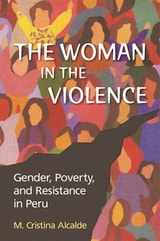
cover of The Woman in the Violence: Gender, Poverty, and Resistance in Peru

The Woman in the Violence

Gender, Poverty, and Resistance in Peru

M. Cristina Alcalde

Vanderbilt University Press, 2010

The Woman in the Violence draws on fieldwork conducted in Lima, Peru, one of the largest cities in Latin America, and the life stories of dozens of women to examine multiple forms of violence and how it interrelates in their lives. Gender-based violence continues to blight the landscape of South American urban centers, and this book unravels the personal experiences of those impacted. Alcalde explores the everyday lives of these women before, during, and after an abusive relationship to explore the impact of, and response to, structural, institutional, and interpersonal violence.


Focusing on the experiences of women who are predominantly poor, nonwhite, rural-to-urban migrants with little or no formal education, The Woman in the Violence addresses a range of serious concerns. What types of violence do women experience at different stages in their lives? Which identities and roles are manifested throughout their lives, and do some of these increase their vulnerability to different forms of violence? What strategies do women employ to gain some power and control in these situations, and how can we conceptualize these strategies?


In examining these questions, The Woman in the Violence contributes to our understanding of violence, gender, race, resistance, and urbanism as it exposes and analyzes systemic violence against women. The everyday forms of resistance these women employ provide significant insight for students, scholars, and health professionals.
[more]
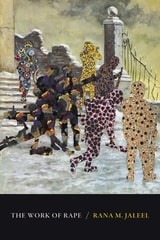
cover of The Work of Rape

The Work of Rape

Rana M. Jaleel

Duke University Press, 2021

In The Work of Rape Rana M. Jaleel argues that the redefinition of sexual violence within international law as a war crime, crime against humanity, and genocide owes a disturbing and unacknowledged debt to power and knowledge achieved from racial, imperial, and settler colonial domination. Prioritizing critiques of racial capitalism from women of color, Indigenous, queer, trans, and Global South perspectives, Jaleel reorients how violence is socially defined and distributed through legal definitions of rape. From Cold War conflicts in Latin America, the 1990s ethnic wars in Rwanda and Yugoslavia, and the War on Terror to ongoing debates about sexual assault on college campuses, Jaleel considers how legal and social iterations of rape and the terms that define it—consent, force, coercion—are unstable indexes and abstractions of social difference that mediate racial and colonial positionalities. Jaleel traces how post-Cold War orders of global security and governance simultaneously transform the meaning of sexualized violence, extend US empire, and disavow legacies of enslavement, Indigenous dispossession, and racialized violence within the United States.

Duke University Press Scholars of Color First Book Award recipient

[more]
cover of This Far and No Further: Photographs Inspired by the Voting Rights Movement

This Far and No Further

Photographs Inspired by the Voting Rights Movement

By William Abranowicz; foreword by Nikole Hannah-Jones

University of Texas Press, 2021

Standing on the Edmund Pettus Bridge in Selma, Alabama, in 2017, photographer William Abranowicz was struck by the weight of historical memory at this hallowed site of one of the civil rights movement's defining episodes: 1965's “Bloody Sunday,” when Alabama police officers attacked peaceful marchers. To Abranowicz’s eye, Selma seemed relatively unchanged from its apperance in the photographs Walker Evans made there in the 1930s. That, coupled with an awareness of renewed voter suppression efforts at state and federal levels, inspired Abranowicz to explore the living legacy of the civil and voting rights movement through photographing locations, landscapes, and individuals associated with the struggle, from Rosa Parks and Harry Belafonte to the barn where Emmett Till was murdered.

The result is This Far and No Further, a collection of photographs from Abranowicz's journey through the American South. Through symbolism, metaphor, and history, he unearths extraordinary stories of brutality, heroism, sacrifice, and redemption hidden within ordinary American landscapes, underscoring the crucial necessity of defending—and exercising—our right to vote at this tenuous moment for American democracy.

[more]
cover of This Is Not Dixie: Racist Violence in Kansas, 1861-1927

This Is Not Dixie

Racist Violence in Kansas, 1861-1927

Brent M.S. Campney

University of Illinois Press, 2018
Often defined as a mostly southern phenomenon, racist violence existed everywhere. Brent M. S. Campney explodes the notion of the Midwest as a so-called land of freedom with an in-depth study of assaults both active and threatened faced by African Americans in post–Civil War Kansas. Campney's capacious definition of white-on-black violence encompasses not only sensational demonstrations of white power like lynchings and race riots, but acts of threatened violence and the varied forms of pervasive routine violence--property damage, rape, forcible ejection from towns--used to intimidate African Americans. As he shows, such methods were a cornerstone of efforts to impose and maintain white supremacy. Yet Campney's broad consideration of racist violence also lends new insights into the ways people resisted threats. African Americans spontaneously hid fugitives and defused lynch mobs while also using newspapers and civil rights groups to lay the groundwork for forms of institutionalized opposition that could fight racist violence through the courts and via public opinion. Ambitious and provocative, This Is Not Dixie rewrites fundamental narratives on mob action, race relations, African American resistance, and racism's grim past in the heartland.
[more]
cover of Traffic in Asian Women

Traffic in Asian Women

Laura Hyan Yi Kang

Duke University Press, 2020
In Traffic in Asian Women Laura Hyun Yi Kang demonstrates that the figure of "Asian women" functions as an analytic with which to understand the emergence, decline, and permutation of U.S. power/knowledge at the nexus of capitalism, state power, global governance, and knowledge production throughout the twentieth century. Kang analyzes the establishment, suppression, forgetting, and illegibility of the Japanese military "comfort system" (1932–1945) within that broader geohistorical arc. Although many have upheld the "comfort women" case as exemplary of both the past violation and the contemporary empowerment of Asian women, Kang argues that it has profoundly destabilized the imaginary unity and conceptual demarcation of the category. Kang traces how "Asian women" have been alternately distinguished and effaced as subjects of the traffic in women, sexual slavery, and violence against women. She also explores how specific modes of redress and justice were determined by several overlapping geopolitical and economic changes ranging from U.S.-guided movements of capital across Asia and the end of the Cold War to the emergence of new media technologies that facilitated the global circulation of "comfort women" stories.
[more]
cover of Traumatic States: Gendered Violence, Suffering, and Care in Chile

Traumatic States

Gendered Violence, Suffering, and Care in Chile

Nia Parson

Vanderbilt University Press, 2013

The end of the Pinochet regime in Chile saw the emergence of an organized feminist movement that influenced legal and social responses to gender-based violence, and with it new laws and avenues for reporting violence that never before existed. What emerged were grassroots women's rights organizations, challenging and engaging the government and NGOs to confront long-ignored problems in responding to marginalized victims.


In Traumatic States, anthropologist Nia Parson explores the development of methods of care and recovery from domestic violence. She interviews and contextualizes the lives of numerous individuals who have confronted these acts, as victims, authorities, and activists. Ultimately, Traumatic States argues that facing the challenges of healing both body and mind, and addressing the fundamental inequalities that make those challenges even more formidable, are part of the same battle.
[more]
cover of Troubled Ground: A Tale of Murder, Lynching, and Reckoning in the New South

Troubled Ground

A Tale of Murder, Lynching, and Reckoning in the New South

Claude A. Clegg III

University of Illinois Press, 2010

In Troubled Ground, Claude A. Clegg III revisits a violent episode in his hometown's history that made national headlines in the early twentieth century but disappeared from public consciousness over the decades. Moving swiftly between memory and history, between the personal and the political, Clegg offers insights into southern history, mob violence, and the formation of American race ideology while coming to terms on a personal level with the violence of the past. Three black men were killed in front of a crowd of thousands in Salisbury, North Carolina, in 1906, following the ax murder of a local white family for whom the men had worked. One of the lynchers was prosecuted for his role in the execution, the first conviction of its kind in North Carolina and one of the earliest in the country. Yet Clegg, an academic historian who grew up in Salisbury, had never heard of the case until 2002 and could not find anyone else familiar with the case. In this book, Clegg mines newspaper accounts and government records and links the victims of the 1906 case to a double-lynching in 1902, suggesting a complex history of lynching in the area while revealing the determination of the city to rid its history of a shameful and shocking chapter. The result is a multi-layered, deeply personal exploration of lynching and lynching prosecutions in the United States.
[more]