Results by title
101 books match the query 'White people' and 17 start with t
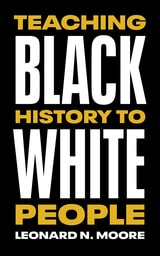
Teaching Black History to White People
By Leonard N. Moore
University of Texas Press, 2021
Leonard Moore has been teaching Black history for twenty-five years, mostly to white people. Drawing on decades of experience in the classroom and on college campuses throughout the South, as well as on his own personal history, Moore illustrates how an understanding of Black history is necessary for everyone.
With Teaching Black History to White People, which is “part memoir, part Black history, part pedagogy, and part how-to guide,” Moore delivers an accessible and engaging primer on the Black experience in America. He poses provocative questions, such as “Why is the teaching of Black history so controversial?” and “What came first: slavery or racism?” These questions don’t have easy answers, and Moore insists that embracing discomfort is necessary for engaging in open and honest conversations about race. Moore includes a syllabus and other tools for actionable steps that white people can take to move beyond performative justice and toward racial reparations, healing, and reconciliation.

Texan Crucible
How the Irish, Germans, and Czechs Became AngloMarian J. Barber
University of Texas Press, 2026
A history of European immigrants in Texas and how they redefined racial identity.
While the creation of a Black-White racial binary was foundational to most of the United States, nineteenth-century Texas developed a unique tripartite system that acknowledged the role of individuals of Mexican ancestry in a region that was Spanish, Mexican, and an independent nation before becoming a US (and briefly Confederate) state. Yet this framework was fraught, struggling to accommodate new arrivals from beyond North America, in particular the Irish, Germans, and Czechs. Texan Crucible tells the story of these immigrants and how they became Anglo.
Marian Barber reveals the ways language, religion, alcohol use, and attitudes toward slavery distinguished these newcomers to Texas from those arriving from the eastern United States and how they nevertheless created thriving, influential communities. Their status was shaped by events inside and far beyond Texas, including an 1887 prohibition fight, the Civil War, and two world wars that encouraged them to erase their distinctiveness. As segregation was formally outlawed and civil rights activism grew, understandings of race shifted, cementing these groups’ status as Anglo. Texan Crucible recovers the histories of German, Irish, and Czech immigrants and unveils the social construction of racial difference underpinning Texan identity.

That Guy Wolf Dancing
Elizabeth Cook-Lynn
Michigan State University Press, 2014
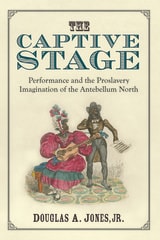
The Captive Stage
Performance and the Proslavery Imagination of the Antebellum NorthDouglas A. Jones, Jr.
University of Michigan Press, 2014
The Cultural Territories of Race
Black and White BoundariesEdited by Michèle Lamont
University of Chicago Press, 1999
These essays examine the cultural territories of race through topics such as blacks' strategies for dealing with racism, public categories for definition of race, and definitions of rules for cultural memberships. Empirically grounded, these studies analyze divisions among blacks according to their relationships with whites or with alternative black culture; differences among whites regarding their attitudes toward blacks; and differences both among blacks and between blacks and whites, in their cultural understandings of various aspects of social life ranging from material success to marital life and to ideas about feminism. The essays teach us about the largely underexamined cultural universes of black executives, upwardly mobile college students, fast-food industry workers, so-called deadbeat dads, and proponents of Afrocentric curricula.
The Cultural Territories of Race makes an important contribution to current policy debates by amplifying muted voices that have too often been ignored by other social scientists.
Contributors are: Elijah Anderson, Amy Binder, Bethany Bryson, Michael C. Dawson, Catherine Ellis, Herbert J. Gans, Jennifer L. Hochschild, Michèle Lamont, Jane J. Mansbridge, Katherine S. Newman, Maureen R. Waller, Pamela Barnhouse Walters, Mary C. Waters, Julia Wrigley, Alford A. Young Jr.

The Feeling of Forgetting
Christianity, Race, and Violence in AmericaJohn Corrigan
University of Chicago Press, 2023
The dual traumas of colonialism and slavery are still felt by Native Americans and African Americans as victims of ongoing violence toward people of color today. In The Feeling of Forgetting, John Corrigan calls attention to the trauma experienced by white Americans as perpetrators of this violence. By tracing memory’s role in American Christianity, Corrigan shows how contemporary white Christian nationalism is motivated by a widespread effort to forget the role race plays in American society. White trauma, Corrigan argues, courses through American culture like an underground river that sometimes bursts forth into brutality, terrorism, and insurrection. Tracing the river to its source is a necessary first step toward healing.

The Geography of Hate
The Great Migration through Small-Town AmericaJennifer Sdunzik
University of Illinois Press, 2023
During the Great Migration, Black Americans sought new lives in midwestern small towns only to confront the pervasive efforts of white residents determined to maintain their area’s preferred cultural and racial identity. Jennifer Sdunzik explores this widespread phenomenon by examining how it played out in one midwestern community. Sdunzik merges state and communal histories, interviews and analyses of population data, and spatial and ethnographic materials to create a rich public history that reclaims Black contributions and history. She also explores the conscious and unconscious white actions that all but erased Black Americans--and the terror and exclusion used against them--from the history of many midwestern communities.
An innovative challenge to myth and perceived wisdom, The Geography of Hate reveals the socioeconomic, political, and cultural forces that prevailed in midwestern towns and helps explain the systemic racism and endemic nativism that remain entrenched in American life.
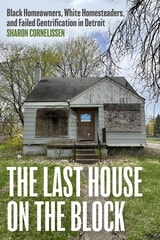
The Last House on the Block
Black Homeowners, White Homesteaders, and Failed Gentrification in DetroitSharon Cornelissen
University of Chicago Press, 2025
In the minds of many, Detroit is undergoing a renaissance thanks to gentrifying urbanites who’ve been drawn to the city with the promise of cheap housing and thriving culture. But what happens when gentrification attempts to come to one of the most depopulated neighborhoods in the country—a place where every other property in the neighborhood was a vacant lot and every third house stood empty? To find out, Sharon Cornelissen moved to the Brightmoor neighborhood of Detroit for three years and became the owner of a $7,000 house.
The Last House on the Block takes us to Brightmoor to meet Cornelissen’s fellow residents. She introduces us to the long-time residents of the neighborhood who reveal their struggles to keep a home while keeping violence, tall grass, and yes—gentrification—at bay. We also meet the eclectic white newcomers of Brightmoor and learn about their real estate bargains, urban farms, and how they became the unlikely defenders of urban desolation. Where oldtimers take pride in neatly mowed lawns and hope for a return to residential density, newcomers love the open space and aim to buy more empty lots to raise chickens and goats. It is a story of gentrification, but not at all in the usual sense: it is a case of failed gentrification. We often think about gentrification as an unstoppable force—once the first white newcomers with yoga mats enter an often brown or Black community, the coffee shops and restaurants follow. But in Brightmoor, the dreams of white newcomers met the harsh reality of decade-long decline. Nearly a decade after Cornelissen’s fieldwork began, Brightmoor is even emptier than it was when she started.
Today, depopulation remains more common than gentrification in poor communities. Cornelissen’s story offers deep insights into what it is like to live in a declining neighborhood, and through the example of Brightmoor, Cornelissen reveals why depopulation continues and helps us imagine a more inclusive and equitable city turnaround.

The Machinery of Whiteness
Studies in the Structure of RacializationAuthored by Steve Martinot
Temple University Press, 2010
In this follow up to his book, The Rule of Racialization—which considered the way class structure is formed in the U.S.—Steve Martinot now examines how the structures of racialization reside at the core of all social, cultural, and political institutions in the U.S. In The Machinery of Whiteness, Martinot examines how race and racism are produced in the United States, analyzing the politics of racialization, and the preponderance of racial segregation and racial deprivation that have kept the U.S. a white dominated society throughout its history. Martinot dedicates this work to expunging white supremacy from the earth.
The Machinery of Whiteness investigates how “whiteness” came to be as foundational to the process that then produced the modern concept of race. Martinot addresses the instrumentalization of women as a necessary step in its formation, furthering the debates regarding the relationships of race and gender. And he addresses U.S. international interventionism, the anti-immigrant movements, and white racist populism to describe the political forms that white supremacy takes.
Martinot puts these together to analyze the underlying cultural structures of racialization that have driven and conditioned the resurgence of white supremacy and white entitlement in the wake of the Civil Rights movements. This book is a call to transform the cultural structures of the U.S. to make justice and democracy, which depend on inclusion and not segregation, possible.

The Obama Effect
How the 2008 Campaign Changed White Racial AttitudesSeth K. Goldman
Russell Sage Foundation, 2014
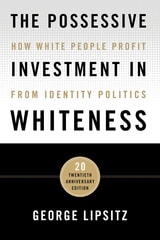
The Possessive Investment in Whiteness
How White People Profit from Identity PoliticsGeorge Lipsitz
Temple University Press, 2018
George Lipsitz’s classic book The Possessive Investment in Whiteness argues that public policy and private prejudice work together to create a possessive investment in whiteness that is responsible for the racialized hierarchies of our society. Whiteness has a cash value: it accounts for advantages that come to individuals through profits made from housing secured in discriminatory markets, through the unequal educational opportunities available to children of different races, through insider networks that channel employment opportunities to the friends and relatives of those who have profited most from past and present discrimination, and especially through intergenerational transfers of inherited wealth that pass on the spoils of discrimination to succeeding generations. White Americans are encouraged to invest in whiteness, to remain true to an identity that provides them with structured advantages.
In this twentieth anniversary edition, Lipsitz provides a new introduction and updated statistics; as well as analyses of the enduring importance of Hurricane Katrina; the nature of anti-immigrant mobilizations; police assaults on Black women, the killings of Trayvon Martin, Michael Brown, and Freddie Gray; the legacy of Obama and the emergence of Trump; the Charleston Massacre and other hate crimes; and the ways in which white fear, white fragility, and white failure have become drivers of a new ethno-nationalism.
As vital as it was upon its original publication, the twentieth anniversary edition of The Possessive Investment in Whiteness is an unflinching but necessary look at white supremacy.
The Possessive Investment in Whiteness
How White People Profit from Identity Politics, Revised and Expanded EditionGeorge Lipsitz
Temple University Press, 2006
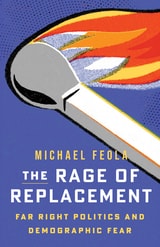
The Rage of Replacement
Far Right Politics and Demographic FearMichael Feola
University of Minnesota Press, 2024
Tracing how the “Great Replacement” narrative has shaped far-right extremism and propelled its dangerous political projects and acts of violence
The “Great Replacement” narrative, which imagines that historic white majorities are being intentionally replaced through immigration policies crafted by global elites, has effectively mobilized racist, nationalist, and nativist movements in the United States and Europe. The Rage of Replacement tracks how this narrative has shaped the politics and worldview of the far right, binding its various camps into a community of rage obsessed with nostalgia for a white-supremacist past.
Showing how the replacement narrative has found significant purchase in recent mainstream discourse through the rise of Trumpism, right-wing media figures like Tucker Carlson, and events such as 2017’s “Unite the Right” rally in Charlottesville, Virginia, Michael Feola diagnoses the dangers this racist theory poses as it shapes the far-right imagination, expands through civil society, and deforms political culture. In particular, he tracks how the replacement narrative has given rise to malignant political strategies designed to “take back” the nation from its perceived enemies—by force if deemed necessary.
Identifying the Great Replacement narrative as a central force behind the rise and expansion of far-right extremism, Feola shows how it has motivated a variety of dangerous political projects in pursuit of illiberal, antidemocratic futures. From calls for the creation of segregated white ethnostates to extremist violence such as the mass shootings in Christchurch, El Paso, and Buffalo, The Rage of Replacement makes clear that replacement theory poses a dire threat to democracy and safety.
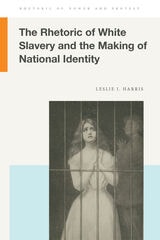
The Rhetoric of White Slavery and the Making of National Identity
Leslie J Harris
Michigan State University Press, 2023
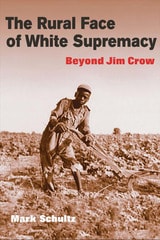
The Rural Face of White Supremacy
BEYOND JIM CROWMark Schultz
University of Illinois Press, 2007
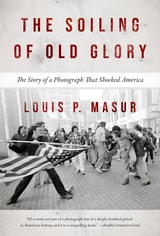
The Soiling of Old Glory
The Story of a Photograph That Shocked AmericaLouis P. Masur
Brandeis University Press, 2024
In 1976, Boston was bitterly divided over a court order to desegregate its public schools. Plans to bus students between predominantly white and Black neighborhoods stoked backlash and heated protests. Photojournalist Stanley Forman was covering one such demonstration at City Hall when he captured an indelible image: a white protester attacking a Black attorney with the American flag. A second white man grabs at the victim, appearing to assist the assailant.
The photo appeared in newspapers across the nation and went on to win the Pulitzer Prize. In The Soiling of Old Glory, esteemed historian Louis P. Masur reveals what happened the day of the assault and the ways these events reverberated long afterward. He interviews the men involved: Forman, who took the photo; Ted Landsmark, a Black, Yale-educated attorney and an activist; Joseph Rakes, the white protester lunging with the flag, a disaffected student; and Jim Kelly, a local politician who opposed busing, but who helped Landsmark to his feet after protesters knocked him to the ground. The photo, Masur discovers, holds more complexities than initially meet the eye. The flag never made contact with the victim, for example, and Kelly was attempting to protect Landsmark, not hurt him.
Masur delves into the history behind Boston’s efforts to desegregate the schools and the anti-busing protests that shook the city. He examines photography’s power to move, inform, and persuade us, as well as the assumptions we each bring to an image as viewers. And he delves into the flag, to explore how other artists and photographers have shaped, bolstered, or challenged its patriotic significance.
Gripping and deeply researched, The Soiling of Old Glory shows how a disturbing event, frozen on a film, impacted Boston and the nation. In an age of renewed calls for visual literacy and disagreements about the flag’s meaning, Masur’s history, now updated with a new foreword by Ted Landsmark and a new preface by the author, is as relevant as ever.

The Stories Whiteness Tells Itself
Racial Myths and Our American NarrativesDavid Mura
University of Minnesota Press, 2022
Uncovering the pernicious narratives white people create to justify white supremacy and sustain racist oppression
The police murders of two Black men, Philando Castile and George Floyd, frame this searing exploration of the historical and fictional narratives that white America tells itself to justify and maintain white supremacy. From the country’s founding through the summer of Black Lives Matter in 2020, David Mura unmasks how white stories about race attempt to erase the brutality of the past and underpin systemic racism in the present.
Intertwining history, literature, ethics, and the deeply personal, Mura looks back to foundational narratives of white supremacy (Jefferson’s defense of slavery, Lincoln’s frequently minimized racism, and the establishment of Jim Crow) to show how white identity is based on shared belief in the pernicious myths, false histories, and racially segregated fictions that allow whites to deny their culpability in past atrocities and current inequities. White supremacy always insists white knowledge is superior to Black knowledge, Mura argues, and this belief dismisses the truths embodied in Black narratives.
Mura turns to literature, comparing the white savior portrayal of the film Amistad to the novelization of its script by the Black novelist Alexs Pate, which focuses on its African protagonists; depictions of slavery in Faulkner and Morrison; and race’s absence in the fiction of Jonathan Franzen and its inescapable presence in works by ZZ Packer, tracing the construction of Whiteness to willfully distorted portraits of race in America. In James Baldwin’s essays, Mura finds a response to this racial distortion and a way for Blacks and other BIPOC people to heal from the wounds of racism.
Taking readers beyond apology, contrition, or sadness, Mura attends to the persistent trauma racism has exacted and lays bare how deeply we need to change our racial narratives—what white people must do—to dissolve the myth of Whiteness and fully acknowledge the stories and experiences of Black Americans.