Results by title
75 books match the query 'House' and 10 start with a
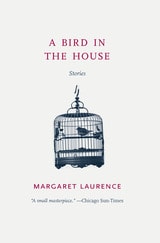
A Bird in the House
StoriesMargaret Laurence
University of Chicago Press, 1974
"Vanessa rebels against the dominance of age; she watches [her grandfather] imitate her aunt Edna; and her rage at times is such that she would gladly kick him. It takes great skill to keep this story within the expanding horizon of this young girl and yet make it so revealing of the adult world."—Atlantic
"A Bird in the House achieves the breadth of scope which we usually associate with the novel (and thereby is as psychologically valid as a good novel), and at the same time uses the techniques of the short story form to reveal the different aspects of the young Vanessa." —Kent Thompson, The Fiddlehead
"I am haunted by the women in Laurence's novels as if they really were alive—and not as women I've known, but as women I've been."—Joan Larkin, Ms. Magazine
"Not since . . . To Kill a Mockingbird has there been a novel like this. It should not be missed by anyone who has a child or was a child."—Pittsburgh Post-Gazette
One of Canada's most accomplished writers, Margaret Laurence (1926-87) was the recipient of many awards including Canada's prestigious Governor General's Literary Award on two separate occasions, once for The Diviners.

A God in the House
Poets Talk About FaithEdited by Ilya Kaminsky and Katherine Towler
Tupelo Press, 2012
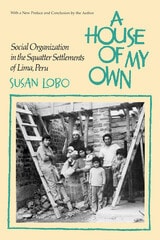
A House of My Own
Social Organization in the Squatter Settlements of Lima, PeruSusan Lobo
University of Arizona Press, 1982
"Whether or not one accepts Susan Lobo's optimistic analysis, her ability to translate the apparent chaos of shanty-town lives into such neat patterns and to help outsiders view life as the inhabitants do are important contributions." —Inter-American Review of Bibliography
"An extremely competent ethnography, simple and straightforward." —Anthropos
"A pleasure to read, a mine of information which will be useful in teaching students to formulate their own hypotheses." —International Journal of Urban & Regional Research
"Very well written and provides a great wealth of the liveliest sort of ethnographic detail." —Latin American Research Review
"Lobo's study of two squatter settlements in Lima provides a solid, well-written, detailed, traditional ethnography of poor families in a Third World urban setting." —Hispanic American Historical Review
"This well-written account . . . has a lot of heart and feeling for the human face of the urban poor." —International Migration Review
A House of Prayer for All People
Contesting Citizenship in a Queer ChurchDavid K. Seitz
University of Minnesota Press, 2017
Perhaps an unlikely subject for an ethnographic case study, the Metropolitan Community Church of Toronto in Canada is a large predominantly LGBT church with a robust, and at times fraught, history of advocacy. While the church is often riddled with fault lines and contradictions, its queer and faith-based emphasis on shared vulnerability leads it to engage in radical solidarity with asylum-seekers, pointing to the work of affect in radical, coalition politics.
A House of Prayer for All People maps the affective dimensions of the politics of citizenship at this church. For nearly three years, David K. Seitz regularly attended services at MCCT. He paid special attention to how community and citizenship are formed in a primarily queer Christian organization, focusing on four contemporary struggles: debates on race and gender in religious leadership, activism around police–minority relations, outreach to LGBT Christians transnationally, and advocacy for asylum seekers. Engaging in debates in cultural geography, queer of color critique, psychoanalysis, and affect theory, A House of Prayer for All People stages innovative, reparative encounters with citizenship and religion.
Building on queer theory’s rich history of “subjectless” critique, Seitz calls for an “improper” queer citizenship—one that refuses liberal identity politics or national territory as the ethical horizon for sympathy, solidarity, rights, redistribution, or intimacy. Improper queer citizenship, he suggests, depends not only on “good politics” but also on people’s capacity for empathy, integration, and repair.
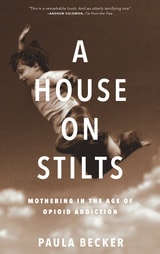
A House on Stilts
Mothering in the Age of Opioid AddictionPaula Becker
University of Iowa Press, 2019
More than 2.5 million Americans are addicted to opioids, some half-million of these to heroin. For many of them, their drug addiction leads to lives of demoralization, homelessness, and constant peril. For parents, a child’s addiction upends family life, catapulting them onto a path no longer prescribed by Dr. Spock, but by Dante’s Inferno. Within this ten-year crucible, Paula is transformed by an excruciating, inescapable truth: the difference between what she can do and what she cannot do.
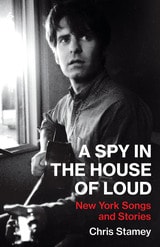
A Spy in the House of Loud
New York Songs and StoriesBy Chris Stamey
University of Texas Press, 2018
Popular music was in a creative upheaval in the late 1970s. As the singer-songwriter and producer Chris Stamey remembers, “the old guard had become bloated, cartoonish, and widely co-opted by a search for maximum corporate profits, and we wanted none of it.” In A Spy in the House of Loud, he takes us back to the auteur explosion happening in New York clubs such as the Bowery’s CBGB as Television, Talking Heads, R.E.M., and other innovative bands were rewriting the rules. Just twenty-two years old and newly arrived from North Carolina, Stamey immersed himself in the action, playing a year with Alex Chilton before forming the dB’s and recording the albums Stands for deciBels and Repercussion, which still have an enthusiastic following.
A Spy in the House of Loud vividly captures the energy that drove the music scene as arena rock gave way to punk and other new streams of electric music. Stamey tells engrossing backstories about creating in the recording studio, describing both the inspiration and the harmonic decisions behind many of his compositions, as well as providing insights into other people’s music and the process of songwriting. Photos, mixer-channel and track assignment notes, and other inside-the-studio materials illustrate the stories. Revealing another side of the CBGB era, which has been stereotyped as punk rock, safety pins, and provocation, A Spy in the House of Loud portrays a southern artist’s coming-of-age in New York’s frontier abandon as he searches for new ways to break the rules and make some noise.

A Spy in the House of Love
Anaïs Nin
Ohio University Press, 2014
Although Anaïs Nin found in her diaries a profound mode of self-creation and confession, she could not reveal this intimate record of her experiences during her lifetime. Instead, she turned to literary fiction, transforming her private writings into artfully crafted novels that explore female desire, identity, and emotional complexity.
A Spy in the House of Love is a classic of psychological and women’s fiction, centered on Sabina, a woman torn between her longing for artistic freedom, romantic adventure, and sensual fulfillment, and the social expectations that constrain her. Moving through a bohemian, Parisian-inspired world, Sabina navigates multiple relationships in her search for passion, meaning, and self-understanding.
Written at a time when Nin’s own life was shaped by conflicting loyalties and intense relationships, the novel offers a deeply introspective exploration of love, infidelity, erotic longing, and self-discovery. As Sabina confronts her inner divisions, she asks a timeless question: can one indulge the fantasies and restless pursuit of desire without facing profound emotional consequences?
A landmark of modernist literature and feminist writing, A Spy in the House of Love remains a powerful, evocative portrait of a woman’s inner life—ideal for readers of classic literary fiction, experimental narrative, and character-driven novels about relationships and desire.
A Woman's Place Is in the House
Campaigning for Congress in the Feminist EraBarbara Burrell
University of Michigan Press, 1994
Alone in the House of My Heart
PoemsKari Gunter-Seymour
Ohio University Press, 2022
Another Life and The House on the Embankment
Yuri Trifonov
Northwestern University Press, 1999
Widely regarded as a major writer of his generation, Yuri Trifonov tolerated attack and admiration in the Soviet Union. His novellas are celebrated as being in the tradition of great nineteenth-century Russian writing. In "Another Life," a woman suddenly widowed attempts to grasp the memory of her brilliant, erratic husband, and to understand their life together. "The House on the Embankment" is the story of an academic opportunist who rises to apparatchik but suffers the oppression of society, friends, and most of all his inability to make decisions.