Results by title
139 books match the query 'World War, 1914-1918' and 39 start with t
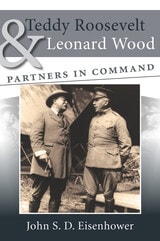
Teddy Roosevelt and Leonard Wood
Partners in CommandJohn S. D. Eisenhower
University of Missouri Press, 2013
Theodore Roosevelt was a man of wide interests, strong opinions, and intense ambition for both himself and his country. When he met Leonard Wood in 1897, he recognized a kindred spirit. Moreover, the two men shared a zeal for making the United States an imperial power that would challenge Great Britain as world leader. For the remainder of their lives, their careers would intertwine in ways that shaped the American nation.
When the Spanish American War came, both men seized the opportunity to promote the goals of American empire. Roosevelt resigned as assistant secretary of the navy in William McKinley’s administration to serve as a lieutenant colonel of the Rough Riders, a newly organized volunteer cavalry. Wood, then a captain in the medical corps and physician to McKinley, was promoted to colonel and given charge of the unit.
Roosevelt later took over command of the Rough Riders. In the Battle of San Juan Hill, he led it in a charge up Kettle Hill that would end in victory for the American troops and make their daring commander a household name, a war hero, and, eventually, president of the United States.
At the Treaty of Paris in 1898, Spain ceded Cuba, Puerto Rico, Guam, and the Philippines to the United States. The next year, Wood became military governor of Cuba. He remained in the post until 1902. By that time Roosevelt was president. One of the major accomplishments of his administration was reorganization of the War Department, which the war with Spain had proved disastrously outdated. In 1909, when William Howard Taft needed a strong army chief of staff to enforce the new rules, he appointed Leonard Wood.
Both Wood and Roosevelt were strong proponents of preparedness, and when war broke out in Europe in August 1914, Wood, retired as chief of staff and backed by Roosevelt, established the “Plattsburg camps,” a system of basic training camps. When America entered the Great War, the two men’s foresight was justified, but their earlier push for mobilization had angered Woodrow Wilson, and both were denied the command positions they sought in Europe.
Roosevelt died in 1919 while preparing for another presidential campaign. Wood made a run in his place but was never taken seriously as a candidate. He retired from the army and spent the last seven years of his life as civilian governor of the Philippines.
It was a quiet end for two men who had been giants of their time. While their modernization of the army is widely admired, they were not without their critics. Roosevelt and Wood saw themselves as bold leaders but were regarded by some as ruthless strivers. And while their shared ambitions for the United States were tempered by a strong sense of duty, they could, in their certainty and determination, trample those who stood in their path. Teddy Roosevelt and Leonard Wood: Partners in Command is a revealing and long overdue look at the dynamic partnership of this fascinating pair and will be welcomed by scholars and military history enthusiasts alike.

The AEF in Print
An Anthology of American Journalism in World War IChris Dubbs
University of North Texas Press, 2018
The Ace of Lightning
Stephen-Paul Martin
University of Alabama Press, 2017
Stephen-Paul Martin’s The Ace of Lightning is a series of interconnected stories focused on a turning point in Western history: the assassination in Sarajevo of Archduke Franz Ferdinand of Austria which triggered World War I, and the mysterious circumstances that led Gavrilo Princip to shoot and kill the heir apparent to one of Europe’s most powerful empires.
Far from being a conventional work of historical fiction, Martin’s collection asks readers to think about what truly constitutes history. What would the past look like if history was written under the influence of Mad Magazine and The Twilight Zone? What happens when the assassination in Sarajevo becomes “the assassination in Sarajevo,” when Gavrilo Princip becomes “Gavrilo Princip,” when the past and the present shape a textual future that looks suspiciously like a past that never was and a present that never is?
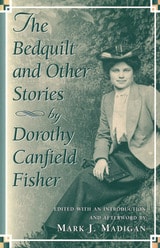
The Bedquilt and Other Stories
By Dorothy Canfield FisherEdited, Intro, & Afterword by Mark J. Madigan
University of Missouri Press, 1997
Dorothy Canfield Fisher, the prolific author of more than forty books, including translations, juveniles, and nonfiction, as well as novels and short-story collections, was one of the most popular and engaging American writers of the first half of the twentieth century. Although her work has been unduly neglected for several decades, it is currently enjoying a revival of critical attention. This colorful collection ranges in subject from New Englanders to the Basques of France to the struggles of African Americans to gain equal rights. Through her stories, many of which received literary awards, Fisher examined the complexities of modern life in the United States and abroad.
In addition to her writing, Fisher had a lifelong involvement in charitable work and social causes--so much so that Eleanor Roosevelt called her one of the most influential women of her time. As one of the earliest and most assertive members of the Book-of-the-Month Club selection committee, Fisher helped define literary taste in America for more than two decades. Mark J. Madigan discusses Fisher's extraordinary life and work in an Introduction and Afterword.
Because of Fisher's rare ability to distinguish enduring concerns from merely topical issues, her work will provide lasting pleasure for generations of readers to come.
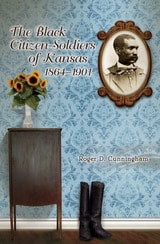
The Black Citizen-Soldiers of Kansas, 1864-1901
Roger D. Cunningham
University of Missouri Press, 2008
Roger Cunningham examines a lost history to show that, in addition to black regulars, hundreds of other black militiamen and volunteers from the Sunflower State provided military service from the Civil War until the dawn of the twentieth century. He tells how African Americans initially filled segregated companies hurriedly organized to defend the state from the threat of Confederate invasion, with some units ordered into battle around Kansas City. Then after the state constitution was amended to admit blacks into the Kansas National Guard, but its generals still refused to integrate, blacks served in reserve militia and independent companies and in all-black regiments that were raised for the Spanish-American and Philippine wars.
Cunningham has researched service records, African American newspapers, and official correspondence to give voice to these citizen-soldiers. He shares stories of real people like William D. Matthews, a captain in the First Kansas Colored Infantry who was refused a commission when his regiment was mustered into the Union army; Charles Grinsted, who commanded the first black militia company after the Civil War; and other unsung heroes.
More than a military history, Cunningham’s account records the quest of black men, many of them former slaves, for inclusion in American society. Many came from the bottom of the socioeconomic order and found that as militiamen they could gain respect within their communities. And by marching in public ceremonies and organizing fund-raising activities to compensate for lack of financial support from the state, they also strengthened the ties that bound African American communities together.
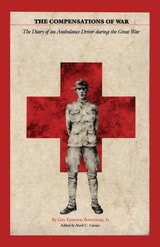
The Compensations of War
The Diary of an Ambulance Driver during the Great WarBy Guy Emerson Bowerman
University of Texas Press, 1983
In 1917, shortly after the United States’ declaration of war on Germany, Guy Emerson Bowerman, Jr., enlisted in the American army’s ambulance service. Like other young ambulance drivers—Hemingway, Dos Passos, Cummings, Cowley—Bowerman longed to “see the show.” He was glad to learn that the ambulance units were leaving for France right away.
For seventeen months, until the armistice of November 1918, Bowerman kept an almost daily diary of the war. To read his words today is to live the war with an immediacy and vividness of detail that is astonishing.
Only twenty when he enlisted, Bowerman was an idealistic, if snobbish, young man who exulted that his section was made up mostly of young “Yalies” like himself. But he expected the war to change him, and it did. In the end he writes that he and his compatriots scarcely remember a world at peace. "The old life was gone forever. . ."
Guy Bowerman’s unit was attached to a French infantry division stationed near Verdun. Sent to halt the German drive to Paris in 1918, the division participated in the decisive counterattack of July and tracked the routed Germans through Belgium. Then, “unwarned,” Bowerman and his comrades were “plunged into … a life of peace.” Into this life, he writes, they walked “bewildered,” like “men fearing ambush.”
This remarkable chronicle of one young man’s rite of passage is destined to become a classic in the literature of the Great War.
The Construction of Memory in Interwar France
Daniel J. Sherman
University of Chicago Press, 2000
Sherman shows how a wartime visual culture saturated with images of ordinary foot soldiers, together with contemporary novels, memoirs, and tourist literature, promoted a distinctive notion of combat experience. The contrast between battlefield and home front, soldier and civilian was the basis for memory and collective gratitude. Postwar commemoration, however, also grew directly out of the long and agonized search for the remains of hundreds of thousands of missing soldiers, and the sometimes contentious debates over where to bury them. For this reason, the local monument, with its inscribed list of names and its functional resemblance to tombstones, emerged as the focal point of commemorative practice. Sherman traces every step in the process of monument building as he analyzes commemoration's competing goals—to pay tribute to the dead, to console the bereaved, and to incorporate mourners' individual memories into a larger political discourse.
Extensively illustrated, Sherman's study offers a visual record of a remarkable moment in the history of public art. It is at once a moving account of a culture haunted by war and a sophisticated analysis of the political stakes of memory in the twentieth century.
Winner of the 2000 J. Russell Major Prize of the American Historical Association
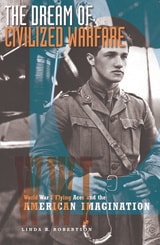
The Dream of Civilized Warfare
World War I Flying Aces and the American ImaginationLinda R. Robertson
University of Minnesota Press, 2005
Analyzes the link between “civilized warfare” and the American self-image
Linda R. Robertson argues that the development of the United States as a global military power arose from the influence of an image of air combat carefully constructed during World War I to mask the sordid realities of modern ground warfare. The Dream of Civilized Warfare carries this trajectory to its logical end, tracing the long history of the American desire to exert the nation’s will throughout the world without having to risk the lives of ground soldiers—a theme that continues to reverberate in public discussions, media portrayals, and policy decisions today.
Histories of American air power usually focus on World War II, when the air force became the foundation for the military strength of the United States. The equally fascinating story of World War I air combat is often relegated to a footnote, but it was the earlier war that first inspired the vision of the United States attaining dominance in world affairs through a massive air force. In The Dream of Civilized Warfare, Robertson presents the compelling story of the creation of the first American air force—and how, through the propaganda of the flying ace, a vision of “clean” or civilized combat was sold to politicians and the public. During World War I, air combat came to epitomize American ingenuity, technological superiority, adventure, leadership, and teamwork. Robertson reveals how the romantic and chivalric imagery associated with flying aces was a product of intentional propaganda and popular culture. Examining aviation history, military battles, films, literature, and political events, she looks at how the American public’s imagination was shaped—how flying aces offered not only a symbol of warfare in stark contrast to the muddy, brutal world of the trenches, but also a distraction to an American public resistant to both intervention in a European conflict and the new practice of conscription.
The Early Poetry of Robert Graves
The Goddess BeckonsBy Frank L. Kersnowski
University of Texas Press, 2002
Like many men of his generation, poet Robert Graves was indelibly marked by his experience of trench warfare in World War I. The horrific battles in which he fought and his guilt over surviving when so many perished left Graves shell-shocked and disoriented, desperately seeking a way to bridge the rupture between his conventional upbringing and the uncertainties of postwar British society.
In this study of Graves's early poetry, Frank Kersnowski explores how his war neurosis opened a door into the unconscious for Graves and led him to reject the essential components of the Western idea of reality—reason and predictability. In particular, Kersnowski traces the emergence in Graves's early poems of a figure he later called "The White Goddess," a being at once terrifying and glorious, who sustains life and inspires poetry. Drawing on interviews with Graves's family, as well as unpublished correspondence and drafts of poems, Kersnowski argues that Graves actually experienced the White Goddess as a real being and that his life as a poet was driven by the purpose of celebrating and explaining this deity and her matriarchy.
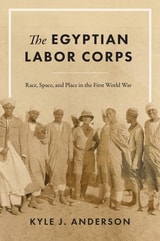
The Egyptian Labor Corps
Race, Space, and Place in the First World WarKyle J. Anderson
University of Texas Press, 2021
During World War I, the British Empire enlisted half a million young men, predominantly from the countryside of Egypt, in the Egyptian Labor Corps (ELC) and put them to work handling military logistics in Europe and the Middle East. British authorities reneged on their promise not to draw Egyptians into the war, and, as Kyle Anderson shows, the ELC was seen by many in Egypt as a form of slavery. The Egyptian Labor Corps tells the forgotten story of these young men, culminating in the essential part they came to play in the 1919 Egyptian Revolution.
Combining sources from archives in four countries, Anderson explores Britain’s role in Egypt during this period and how the ELC came to be, as well as the experiences and hardships these men endured. As he examines the ways they coped—through music, theater, drugs, religion, strikes, and mutiny—he illustrates how Egyptian nationalists, seeing their countrymen in a state akin to slavery, began to grasp that they had been racialized as “people of color.” Documenting the history of the ELC and its work during the First World War, The Egyptian Labor Corps also provides a fascinating reinterpretation of the 1919 revolution through the lens of critical race theory.
The First World War and Popular Cinema
1914 to the PresentParis, Michael
Rutgers University Press, 2000
The Great War played an instrumental role in the development of cinema, so necessary was it to the mobilization efforts of the combatant nations. In turn, after the war, as memory began to fade, cinema continued to shape the war's legacy and eventually to determine the ways in which all warfare is imagined.
The First World War and Popular Cinema provides fresh insight into the role of film as an historical and cultural tool. Through a comparative approach, essays by contributors from Europe, Australia, Canada, and the United States enrich our understanding of cinematic depictions of the Great War in particular and combat in general. New historical research on both the uses of propaganda and the development of national cinemas make this collection one of the first to show the ways in which film history can contribute to our study of national histories. The contributors to the volume monitor popular perceptions of the war, the reshaping of the war's legacy, and the evolution of cinematic clichés that are perpetuated in filmmaking through the century. Some of the films they discuss are All Quiet on the Western Front, Gallipoli, The Grand Illusion, The Big Parade, Battle of the Somme, J'Accuse, Regeneration, and many more. The First World War and Popular Cinema is a vital addition to film studies and history, two fields only recently united in a productive way.
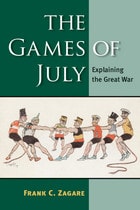
The Games of July
Explaining the Great WarFrank C. Zagare
University of Michigan Press, 2011
"Frank C. Zagare combines a deep command of historical scholarship and the sophisticated skills of an applied game theorist to develop and test a theory of why deterrence failed, catastrophically, in July 1914. . . . Zagare concludes with sage advice on how to avoid even more cataclysmic breakdowns in a nuclear world."
---Steven J. Brams, New York University
"Zagare's deft study of the origins of the First World War using his perfect deterrence theory uncovers new insights into that signal event and shows the value of formal theory applied to historical events. A must-read for those interested in security studies."
---James D. Morrow, University of Michigan
"Through an exemplary combination of formal theory, careful qualitative analysis, and lucid prose, The Games of July delivers important and interesting answers to key questions concerning the international political causes of World War I. Its well-formed narratives and its sustained engagement with leading works in IR and diplomatic history . . . make it a rewarding read for security scholars in general and a useful teaching tool for international security courses."
---Timothy W. Crawford, Boston College
Taking advantage of recent advances in game theory and the latest historiography, Frank C. Zagare offers a new, provocative interpretation of the events that led to the outbreak of World War I. He analyzes key events from Bismarck's surprising decision in 1879 to enter into a strategic alliance with Austria-Hungary to the escalation that culminated in a full-scale global war. Zagare concludes that, while the war was most certainly unintended, it was in no sense accidental or inevitable.
The Games of July serves not only as an analytical narrative but also as a work of theoretical assessment. Standard realist and liberal explanations of the Great War are evaluated along with a collection of game-theoretic models known as perfect deterrence theory.
Frank C. Zagare is UB Distinguished Professor of Political Science at the State University of New York at Buffalo.
Cover illustration: Satirical Italian postcard from World War I. Used with permission from The University of North Carolina at Chapel Hill Libraries.
The Great War Comes to Wisconsin
Sacrifice, Patriotism, and Free Speech in a Time of CrisisRichard L. Pifer
Wisconsin Historical Society Press, 2017
Instead of a comprehensive history of the battlefield, this book captures the homefront experience: the political debates over war policy, the worry over loved ones fighting overseas, the countless everyday sacrifices, and the impact of a wartime hysteria that drove dissent underground. It also includes the voices of soldiers from Wisconsin’s famed 32nd Division, through extensively quoted letters and newspaper accounts. Immerse yourself in the Wisconsin experience during World War I—a conflict that demonstrated America’s great capacity for sacrifice and generosity, but also for prejudice, intolerance, and injustice.
The Great War in the Air
Military Aviation from 1909 to 1921John H. Morrow, Jr.
University of Alabama Press, 2009
"For the general reader as well as the specialist, Morrow's history of the development and significance of airpower during WWI will be considered definitive. He compares the military, technological, and industrial aspects of the air services of the major powers--France, Germany, England, Italy, Austria-Hungary, and the United States--and reveals how, by means of superior production (particularly French engine manufacture), the Allies prevailed in the air war."--Publishers Weekly
"Morrow's encyclopedic examination of aviation's part in World War I concentrates on aircraft engine and airframe production, but the emotional content of contemporary accounts rises to the surface to put a human face on the brutal use of an infant technology. . . . a serious yet readable history of this vital part of the conflict, meant for any reader."--Library Journal
"A comprehensive study of the totality of the air war in its military, political, industrial, and cultural aspects distinguish this book from other treatments of military aviation during this period. . . . Morrow's efforts have yielded new insights into the evolution of military aviation and corrected previous oversights. The author's attention to developments in production and logistics, as well as events at the front, provide the most complete understanding of the development of air power and its role in the Great War."--American Historical Review
The Great War in the Heart of Dixie
Alabama During World War IMartin T. Olliff
University of Alabama Press, 2008
The Human Body in the Age of Catastrophe
Brittleness, Integration, Science, and the Great WarStefanos Geroulanos and Todd Meyers
University of Chicago Press, 2018
In The Human Body in the Age of Catastrophe, Stefanos Geroulanos and Todd Meyers uncover a fascinating story of how medical scientists came to conceptualize the body as an integrated yet brittle whole. Responding to the harrowing experience of the Great War, the medical community sought conceptual frameworks to understand bodily shock, brain injury, and the vast differences in patient responses they occasioned. Geroulanos and Meyers carefully trace how this emerging constellation of ideas became essential for thinking about integration, individuality, fragility, and collapse far beyond medicine: in fields as diverse as anthropology, political economy, psychoanalysis, and cybernetics.
Moving effortlessly between the history of medicine and intellectual history, The Human Body in the Age of Catastrophe is an intriguing look into the conceptual underpinnings of the world the Great War ushered in.
The Last Ottoman Wars
The Human Cost, 1877–1923Jeremy Salt
University of Utah Press, 2019
Jeremy Salt brings to the surface previously ignored facts that disrupt the conventional narrative of an ethno-religious division between Muslim perpetrators and Christian victims of violence. Salt shows instead that all major ethno-religious groups—including Armenians, Turks, Kurds, and Greeks—were guilty of violent acts. The result is a more balanced picture of European involvement in the Ottoman Empire and the Balkans, one that highlights the destructive role of British Prime Minister David Lloyd George and other European leaders grabbing for Ottoman resources up to the end of World War I. The effects of these events are felt to the present day.
This extraordinary story centers not on military campaigns but on ordinary civilians whose lives were disrupted and in many cases destroyed by events over which they had no control. Disease, malnutrition, massacre and inter-communal fighting killed millions of people during the First World War alone. Until now this epic saga of human suffering has remained a story largely untold.
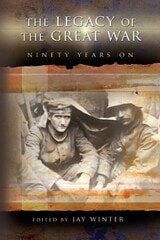
The Legacy of the Great War
Ninety Years OnEdited by Jay Winter
University of Missouri Press, 2009
In late 2007 and early 2008, world-renowned historians gathered in Kansas City for a series of public forums on World War I. Each of the five events focused on a particular topic and featured spirited dialogue between its prominent participants.
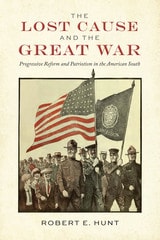
The Lost Cause and the Great War
Progressive Reform and Patriotism in the American SouthRobert E. Hunt
University of Alabama Press, 2025
How Tennessee reformers reconciled Southern heritage with rising nationalism, weaving the Lost Cause into the fabric of American progress and identity.
The Lost Cause and the Great War tells the stories of central Tennessee Progressive-era reformers to illustrate the fascinating broader issue of how Southerners steeped in Lost Cause Civil War mythologies simultaneously developed patriotic American fervor. Focusing on Luke Lea, a prominent politician and American army officer who attempted to capture Kaiser Wilhelm II during World War I, the book reveals the intricate interplay between three competing ideas: attachment to the memory of the Confederacy, intense American nationalism, and advocacy for progressive reforms.
Hunt shows that Lea and his contemporaries sought either to harmonize these competing loyalties or to compartmentalize them to use when needed. Through insightful accounts of Tennessee’s 1928 presidential campaign, the American Legion’s response to cuts to veteran benefits in 1933, and the redefinition of America’s global role post–World War II, Hunt shows how these reformers achieved a balance that held until the Civil Rights movement disrupted this delicate consensus.
Hunt’s rich account reveals how Lea and others like him wove national patriotism and Southern collective memory into a cohesive narrative that supported their broader Progressive goals. The book offers much to readers interested in Southern history, the Gilded Age, Prohibition, World War I, World War II, and the beginnings of the Civil Rights movement. It provides vivid examples of how collective memory and narratives shape social and political movements. General readers will discover how white Southerners who remained devoted to vindicating the Confederacy nonetheless became fervent supporters of America's growing nationalism in the early twentieth century.
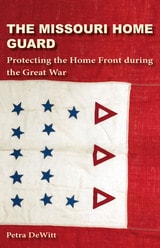
The Missouri Home Guard
Protecting the Home Front during the Great WarPetra DeWitt
University of Missouri Press, 2022
The Home Guard also functioned to preserve patriotism and reduce opposition to the war. Service in the Guard was a way to show loyalty to one’s country, particularly for German Americans, who were frequently under suspicion as untrustworthy. Many German Americans in Missouri enthusiastically signed up to dispel any whispers of treason, while others found themselves torn between the motherland and their new homeland. Men too old or exempt from the draft for other reasons found meaning in helping with the war effort through the Home Guard while also garnering respect from the community. For similar reasons, women attempted to join the organization as did African Americans, some of whom formed units of a “Negro Home Guard.” Informed by the dynamics of race, gender, and ethnicity, DeWitt’s consideration of this understudied but important organization examines the fluctuating definition of patriotism and the very real question of who did and who did not have the privilege of citizenship and acceptance in society.
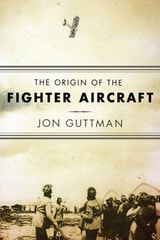
The Origin of the Fighter Aircraft
Jon Guttman
Westholme Publishing, 2009
From Scouts to Balloon-busters, the Emergence of Air-to-Air Combat in World War I
When World War I began in August 1914, the airplane had already proven its worth as an intelligence gathering “eye-in-the-sky.” These scouting aircraft soon became indispensable to armies on both sides, and the attempt to drive enemy planes away began in earnest. Local air superiority was incorporated into battlefield strategy, and the use of aircraft to conduct offensive operations would change warfare as dramatically as the first firearms 300 years before. By the end of 1915, the basic formula of the armed scout settled on a single-seater with a machine gun synchronized to fire through its propeller blades. This heavily armed aircraft became the first true fighter plane whose primary function was to destroy enemy aircraft, whether scouts, balloons, bombers, or other fighters. A new glamorized “knight of the air” was born: the ace, a fighter pilot who brought down five or more opponents. From 1916 on, as the combatants relied on airplanes more, flying tactics and strategy—including mass formations—were developed for what would become a deadly struggle for complete air superiority. By 1918, the final year of the war, air battles could be as sprawling as those on the ground.
In The Origin of the Fighter Aircraft, historian Jon Guttman tells the engrossing story of how one of the most amazing inventions became a integral component of warfare. Balancing technical description, personalities, and battle accounts, the author demonstrates that by the end of World War I most of the fundamentals for modern aerial combat had been established.
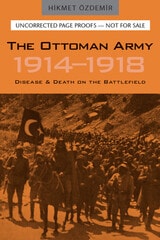
The Ottoman Army 1914 - 1918
Disease and Death on the BattlefieldHikmet Ozdemir
University of Utah Press, 2008
What kind of relationship exists between wars and epidemics? It is widely held that epidemics affected the outcomes of many wars and, until World War II, more victims of war died of disease than of battle wounds. Many disease vectors are present in times of conflict, including mass movements of people across borders and increased contact between persons of different geographic regions, yet disease is rarely treated in depth in histories of war.
Hikmet Özdemir’s The Ottoman Army, 1914–1918 provides extensive documentation of disease and death across the Ottoman Empire during World War I, when epidemic diseases annihilated armies and caused civilians to perish en masse. Drawing on hospital records and information on regional disease prevalence, Özdemir examines the effects that disease and epidemic had on the outcome of the war.
The information on disease mortality explains much that has never been properly understood about wartime events and government actions, events that only begin to make sense when the disease factor is considered. Rich in detail, this is an extremely valuable book that illuminates a facet of the war that has not been adequately considered until now.
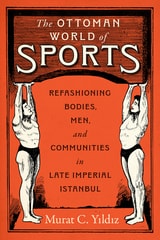
The Ottoman World of Sports
Refashioning Bodies, Men, and Communities in Late Imperial IstanbulMurat C. Yildiz
University of Texas Press, 2025
2026 co-winner of the Ottoman and Turkish Studies Association Book Prize
A revision of the history of modern sports in late Ottoman Istanbul, showing how Muslims, Christians, and Jews created a shared sports culture that was simultaneously global, imperial, and local.
The history of sports in Turkey is deeply contested. Over the decades, journalists, pundits, non-professional historians, sports scholars, and everyday people have offered competing narratives about the origins of modern sports in the late Ottoman Empire.
The Ottoman World of Sports tells the story of how Istanbul’s Muslims, Christians, and Jews—gymnastics teachers, football coaches, weightlifters, journalists, athletes, and fans—created a gendered and class-stratified civic project that promoted athletics as a source of fun, beauty, and moral education. Influenced by the emerging global vogue for organized sports, all boys from the expanding middle class of the late nineteenth- and early twentieth-century imperial capital were expected to exercise and compete on the playing field in order to develop into moral men. Yet even as the embrace of modern athletics transcended ethnoreligious divisions, it did not erase them. Drawing on a wide range of archival research in multiple languages, historian Murat Cihan Yıldız shows that sportsmen created new communal boundaries in team affiliations, fandom, and sports media. Adeptly reconstructing Istanbul’s imperial culture as it was experienced more than a century ago, The Ottoman World of Sports recovers a lived imperial culture whose defining features were shaped by its multiethnic, multireligious, and multilingual sportsmen.
The Perils of Prosperity, 1914-1932
William E. Leuchtenburg
University of Chicago Press, 1993
William E. Leuchtenburg's lively yet balanced account of this hotly debated era in American history has been a standard text for many years. This substantial revision gives greater weight to the roles of women and minorities in the great changes of the era and adds new insights into literature, the arts, and technology in daily life. He has also updated the lists of important dates and resources for further reading.
“This book gives us a rare opportunity to enjoy the matured interpretation of an American Historian who has returned to the story and seen how recent decades have added meaning and vividness to this epoch of our history.”—Daniel J. Boorstin, from the Preface
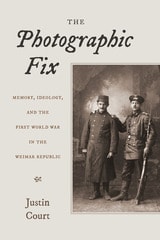
The Photographic Fix
Memory, Ideology, and the First World War in the Weimar RepublicJustin Court
University of Michigan Press, 2026
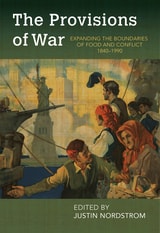
The Provisions of War
Expanding the Boundaries of Food and Conflict, 1840-1990Justin Nordstrom
University of Arkansas Press, 2021
The Provisions of War examines how soldiers, civilians, communities, and institutions have used food and its absence as both a destructive weapon and a unifying force in establishing governmental control and cultural cohesion during times of conflict. Historians as well as scholars of literature, regional studies, and religious studies problematize traditional geographic boundaries and periodization in this essay collection, analyzing various conflicts of the nineteenth and twentieth centuries through a foodways lens to reveal new insights about the parameters of armed interactions.
The subjects covered are as varied and inclusive as the perspectives offered—ranging from topics like military logistics and animal disease in colonial Africa, Indian vegetarian identity, and food in the counterinsurgency of the Malayan Emergency, to investigations of hunger in Egypt after World War I and American soldiers’ role in the making of US–Mexico borderlands. Taken together, the essays here demonstrate the role of food in shaping prewar political debates and postwar realities, revealing how dietary adjustments brought on by military campaigns reshape national and individual foodways and identities long after the cessation of hostilities
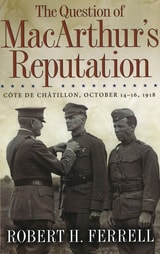
The Question of MacArthur's Reputation
Côte De Châtillon, October 14-16, 1918Robert H. Ferrell
University of Missouri Press, 2008
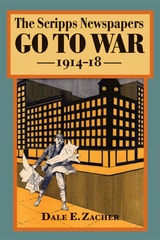
The Scripps Newspapers Go to War, 1914-18
Dale Zacher
University of Illinois Press, 2007
Zacher's account delves into details inside a major newspaper operation during World War I and provides fascinating accounts of its struggles with competition, attending to patriotic duties, and internal editorial dissent. Zacher also looks at war-related issues, considering the newspapers' relationship with President Woodrow Wilson, American neutrality, the move to join the war, and fallout from disillusionment over the actuality of war. As Zacher shows, the progressive spirit and political independence at the Scripps newspapers came under attack and was changed forever during the era.
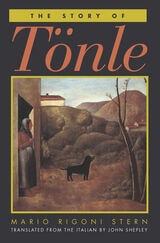
The Story of Tonle
Mario Rigoni Stern
Northwestern University Press, 1998
The Summer the Archduke Died
On Wars and WarriorsLouis D. Rubin, Jr.
University of Missouri Press, 2008
The Tree Stump
An Arabic Historical NovelSamiha Khrais
Michigan State University Press, 2017

The Vatican and the Emergence of the Modern Middle East
Agnes de Dreuzy
Catholic University of America Press, 2016

The Walnut Trees of Altenburg
André Malraux
University of Chicago Press, 1992
"The description of the gas attack on the Russian front in 1915 will never be forgotten by anyone who has read it. . . . [Malraux] writes with the precision, the certitude and the authority of an obsessed person who knows that he has found the essence of what he has been looking for."—Conor Cruise O'Brien, from the Foreword
Malraux's greatest novel, Man's Fate, gave a grim, lurid picture of human suffering. [The Walnut Trees of Altenburg], written by a life-long observer of violent upheaval and within the shadows of World War II, gives a calm, thoughtful vision of humanistic endeavor that can transcend the absurdity of existence. Mature readers will find this a rewarding visit to one of the most accomplished writers of our time."—Choice
The War at Home
Perspectives on the Arkansas Experience during World War IMark K. Christ
University of Arkansas Press, 2020
The Weekly War
How the Saturday Evening Post Reported World War IChris Dubbs
University of North Texas Press, 2023
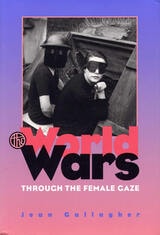
The World Wars Through the Female Gaze
Jean Gallagher
Southern Illinois University Press, 1998
For some women writers and photographers during the two world wars—Edith Wharton, Mildred Aldrich, Martha Gellhorn, Lee Miller, H.D., and Gertrude Stein—the construction of the female subject as an observer of combat became a vital concern. Their explorations of vision took place against the backdrop of a larger shift in Western culture's understanding of what "seeing" meant in common practice and philosophical discourse alike. The role of visuality in their lives was massively transformed not only by the rigid gender roles of war but by the introduction of new combat practices and technologies such as aerial surveillance, trench warfare, and civilian bombardment.
In The World Wars Through the Female Gaze, Jean Gallagher maps one portion of the historicized, gendered territory of what Nancy K. Miller calls the "gaze in representation." Expanding the notion of the gaze in critical discourse, Gallagher situates a number of visual acts within specific historic contexts to reconstruct the wartime female subject. She looks at both the female observer's physical act of seeing—and the refusal to see—for example, a battlefield, a wounded soldier, a torture victim, a national flag, a fashion model, a bombed city, or a wartime hallucination.
The book begins with two instances of wartime propaganda written by American women in France in 1915. Both Edith Wharton's Fighting France and Mildred Aldrich's A Hilltop on the Marne offer a complex and often contradictory sense of a woman writer's struggles with authority, resistance, and killing. In the process, Gallagher teases out the role of specular vision and the impossibility of "directly" seeing the war.
Gallagher then turns to literary and visual texts produced by two female journalists between 1940 and 1945. Martha Gellhorn's 1940 novel A Stricken Field exhibits a range of gendered seeing positions within and in opposition to the visual ideologies of fascism during the Nazi occupation of Czechoslovakia. Lee Miller's war correspondence and photography for Vogue show how Miller constructed herself and her predominantly female American audience as antifascist observers of war by working with and against some of the conventions of surrealist fashion photography.
Gallagher concludes by focusing on the experimental autobiographical prose of H.D. and Gertrude Stein to explore the functions of vision on two World War II "homefronts"—London during the Blitz and Vichy France.
They Called Them Soldier Boys
A Texas Infantry Regiment in World War IGregory W. Ball
University of North Texas Press, 2013
To Can the Kaiser
Arkansas and the Great WarMichael D. Polston
Butler Center for Arkansas Studies, 2015
Traveler, Scholar, Political Adventurer
A Transylvanian Baron at the Birth of Albanian Independence: The memoirs of Franz NopcsaFranz Nopcsa
Central European University Press, 2014