Results by title
127 books match the query 'World politics' and 24 start with t

Telling Young Lives
Portraits of Global Youthedited by Craig Jeffrey and Jane Dyson
Temple University Press, 2008
Telling Young Lives presents more than a dozen fascinating, ethnograph-ically informed portraits of young people facing rapid changes in society and politics from different parts of the world. From a young woman engaged in agricultural labor in the High Himalayas to a youth activist based in Tanzania, the distinctive voices from the U.K., India, Germany, Sierra Leone, South Africa and Bosnia Herzegovina, provide insights into the active and creative ways these youths are addressing social and political challenges such as war, hunger and homelessness.
Telling Young Lives has great appeal for classroom use in geography courses and makes a welcome contribution to the growing field of “young geographies,” as well as to politics and political geography. Its focus on individual portraits gives readers a fuller, more vivid picture of the ways in which global changes are reshaping the actual experiences and strategies of young people around the world.
Temple of Peace
International Cooperation and Stability since 1945Ingo Trauschweizer
Ohio University Press, 2021
This collection raises timely questions about peace and stability as it interrogates the past and present status of international relations.
The post–World War II liberal international order, upheld by organizations such as the United Nations, the North Atlantic Treaty Organization, and similar alliances, aspired to ensure decades of collective security, economic stability, and the rule of law. All of this was a negotiated process that required compromise—and yet it did not make for a peaceful world.
When Winston Churchill referred to the UN framework as “the temple of peace” in his famous 1946 Iron Curtain speech, he maintained that international alliances could help provide necessary stability so free people could prosper, both economically and politically. Though the pillars of international order remain in place today, in a world defined as much by populism as protest, leaders in the United States no longer seem inclined to serve as the indispensable power in an alliance framework that is built on shared values, human rights, and an admixture of hard and soft power.
In this book, nine scholars and practitioners of diplomacy explore both the successes and the flaws of international cooperation over the past seventy years. Collectively, the authors seek to address questions about how the liberal international order was built and what challenges it has faced, as well as to offer perspectives on what could be lost in a post-American world.

Terms of Disorder
Keywords for an InterregnumAlberto Toscano
Seagull Books, 2023
There is widespread agreement, across a voluble political spectrum and around the planet, that we live in times of intensifying insecurity and turmoil. If ours is an age of transition, its direction is anything but certain. Momentous transformations in ecology, geopolitics, and everyday life are shadowed by a suffocating sense of stasis. The limits to capital and the limits of nature are entangled in frightful ways, while the profoundly obsolete form of leadership, domination, and conflict exacerbate an already baleful situation. And yet struggles for liberation have not been quelled. Terms of Disorder confronts this moment by probing some of the defining terms in the modern vocabulary of emancipation, with the aim of testing their capacity to name and orient collective action set on abolishing the present state of things. Ranging from communism to leadership, the eleven keywords addressed in this book provide a set of interlocking points of entry into the common task of forging a political language capable of navigating our disorientation. If, as Gramsci famously noted, the interregnum is a time when the new struggles to be born while the old order is moribund, we may wish to heed Cedric Robinson’s call to “choose wisely among the dying.”

The Absolute Weapon Revisited
Nuclear Arms and the Emerging International OrderT. V. Paul, Richard J. Harknett, and James J. Wirtz, Editors
University of Michigan Press, 2000
The Culture of Disaster
Marie-Hélène Huet
University of Chicago Press, 2012
The Diffusion of War
A Study of Opportunity and WillingnessRandolph M. Siverson and Harvey Starr
University of Michigan Press, 1991

The Dynamics of Nuclear Proliferation
Stephen M. Meyer
University of Chicago Press, 1984

The Economics of Killing
How the West Fuels War and Poverty in the Developing WorldVijay Mehta
Pluto Press, 2012
Globalisation has created an interconnected world, but has not diminished violence, militarism and inequality. The Economics of Killing describes how the power of global elites, entrenched under globalisation, has created a deadly cycle of violence.
In this groundbreaking work, Vijay Mehta shows how attempts at peaceful national development are routinely blocked by Western powers. He locates the 2008 financial crisis in US attempts to block China's model of development. He shows how Europe and the US conspire with regional dictators to prevent countries from developing advanced industries, and how this system has fed terrorism.
Mehta argues that a different world is possible, based on policies of disarmament, demilitarisation and sustainable development. This original and thought-provoking book will be of great interest to anyone concerned about the consequences of endless war fuelled by the West.

The Fear of Barbarians
Beyond the Clash of CivilizationsTzvetan Todorov
University of Chicago Press, 2010
The relationship between Western democracies and Islam, rarely entirely comfortable, has in recent years become increasingly tense. A growing immigrant population and worries about cultural and political assimilation—exacerbated by terrorist attacks in the United States, Europe, and around the world—have provoked reams of commentary from all parts of the political spectrum, a frustrating majority of it hyperbolic or even hysterical.
In The Fear of Barbarians, the celebrated intellectual Tzvetan Todorov offers a corrective: a reasoned and often highly personal analysis of the problem, rooted in Enlightenment values yet open to the claims of cultural difference. Drawing on history, anthropology, and politics, and bringing to bear examples ranging from the murder of Theo van Gogh to the French ban on headscarves, Todorov argues that the West must overcome its fear of Islam if it is to avoid betraying the values it claims to protect. True freedom, Todorov explains, requires us to strike a delicate balance between protecting and imposing cultural values, acknowledging the primacy of the law, and yet strenuously protecting minority views that do not interfere with its aims. Adding force to Todorov's arguments is his own experience as a native of communist Bulgaria: his admiration of French civic identity—and Western freedom—is vigorous but non-nativist, an inclusive vision whose very flexibility is its core strength.
The record of a penetrating mind grappling with a complicated, multifaceted problem, The Fear of Barbarians is a powerful, important book—a call, not to arms, but to thought.

The Future of Fallout, and Other Episodes in Radioactive World-Making
Joseph Masco
Duke University Press, 2020

The Games of July
Explaining the Great WarFrank C. Zagare
University of Michigan Press, 2011
"Frank C. Zagare combines a deep command of historical scholarship and the sophisticated skills of an applied game theorist to develop and test a theory of why deterrence failed, catastrophically, in July 1914. . . . Zagare concludes with sage advice on how to avoid even more cataclysmic breakdowns in a nuclear world."
---Steven J. Brams, New York University
"Zagare's deft study of the origins of the First World War using his perfect deterrence theory uncovers new insights into that signal event and shows the value of formal theory applied to historical events. A must-read for those interested in security studies."
---James D. Morrow, University of Michigan
"Through an exemplary combination of formal theory, careful qualitative analysis, and lucid prose, The Games of July delivers important and interesting answers to key questions concerning the international political causes of World War I. Its well-formed narratives and its sustained engagement with leading works in IR and diplomatic history . . . make it a rewarding read for security scholars in general and a useful teaching tool for international security courses."
---Timothy W. Crawford, Boston College
Taking advantage of recent advances in game theory and the latest historiography, Frank C. Zagare offers a new, provocative interpretation of the events that led to the outbreak of World War I. He analyzes key events from Bismarck's surprising decision in 1879 to enter into a strategic alliance with Austria-Hungary to the escalation that culminated in a full-scale global war. Zagare concludes that, while the war was most certainly unintended, it was in no sense accidental or inevitable.
The Games of July serves not only as an analytical narrative but also as a work of theoretical assessment. Standard realist and liberal explanations of the Great War are evaluated along with a collection of game-theoretic models known as perfect deterrence theory.
Frank C. Zagare is UB Distinguished Professor of Political Science at the State University of New York at Buffalo.
Cover illustration: Satirical Italian postcard from World War I. Used with permission from The University of North Carolina at Chapel Hill Libraries.
The Internal Colony
Race and the American Politics of Global DecolonizationSam Klug
University of Chicago Press, 2025
In The Internal Colony, Sam Klug reveals the central but underappreciated importance of global decolonization to the divergence between mainstream liberalism and the Black freedom movement in postwar America. Klug reconsiders what has long been seen as a matter of primarily domestic policy in light of a series of debates concerning self-determination, postcolonial economic development, and the meanings of colonialism and decolonization. These debates deeply influenced the discord between Black activists and state policymakers and formed a crucial dividing line in national politics in the 1960s and 1970s.
The result is a history that broadens our understanding of ideological formation—particularly how Americans conceptualized racial power and political economy—by revealing a much wider and more dynamic network of influences. Linking intellectual, political, and social movement history, The Internal Colony illuminates how global decolonization transformed the terms of debate over race and social class in the twentieth-century United States.
The Long 1989
Decades of Global RevolutionKyrill Kunakhovich
Central European University Press, 2019

The Narrow Path of Freedom and Other Essays
Eugene Davidson
University of Missouri Press, 2002
The Politics of Expertise
Competing for Authority in Global GovernanceOle Jacob Sending
University of Michigan Press, 2015
Drawing on insights from sociology, political science, and institutional theory, Sending challenges theories centered on particular actors’ authority, whether it is the authority of so-called epistemic communities, the moral authority of advocacy groups, or the rational-legal authority of international organizations. Using in-depth and historically oriented case studies of population and peacebuilding, he demonstrates that authority is not given nor located in any set of particular actors. Rather, continuous competition for recognition as an authority to determine what is to be governed, by whom, and for what purpose shapes global governance in fundamental ways.
Advancing a field-based approach, Sending highlights the political stakes disguised by the technical language of professionals and thus opens a broader public debate over the key issues of our time.
The Politics of Subjectivity in American Foreign Policy Discourses
Ty Solomon
University of Michigan Press, 2015
The Pursuit of Power
Technology, Armed Force, and Society since A.D. 1000William H. McNeill
University of Chicago Press, 1982
The Superpowers and Africa
The Constraints of a Rivalry, 1960-1990Zaki Laidi
University of Chicago Press, 1990
The lapse of European influence in the 1960s left a diplomatic void, which the superpowers rushed to fill. Just as Dien Bien Phû and the Suez crisis thrust Asia and the Near East, respectively, into the diplomatic spotlight, so the Angolan crisis lent a multifaceted cast to Africa's international relations. The ebb and flow of African crises is now linked to the rhythm of superpower relations, but Laidï is quick to warn that Africa's internal political circumstances shape the boundaries for external influence and constrain any efforts of the superpowers to exert total control.
Laidï's provocative study, here in its first English translation, addresses diplomatic strategy, often neglected economic considerations, the growing influence of the Bretton Woods institutions, and the decline of French influence in Africa.
The Will of the Many
How the Alterglobalisation Movement is Changing the Face of DemocracyMarianne Maeckelbergh
Pluto Press, 2009
Never before has the idea of democracy enjoyed the global dominance it holds today, but neoliberalism has left the practice of democracy in deep crisis.
Marianne Maeckelbergh argues that the most promising model for global democracy is not coming from traditional political parties or international institutions, but from the global networks of resistance to neoliberal economics, known collectively as the Alter-globalisation movement. Through extensive ethnography of decision-making practices within these movements, Maeckelbergh describes an alternative form of global democracy in the making.
Perfect for activists and students of political anthropology, this powerful and enlightening book offers radical changes.

Three-Way Street
Strategic Reciprocity in World PoliticsJoshua S. Goldstein and John R. Freeman
University of Chicago Press, 1990
The authors demonstrate that three major schools of international relations theory—all game-theoretic, psychological, and quantitative-empirical approaches—have all advocated a strategy that employs cooperative initiatives and reciprocal responses in order to elicit cooperation from other countries. Critics have questioned whether such approaches can model how countries actually behave, but Goldstein and Freeman provide a wealth of detailed empirical evidence showing the existence and effectiveness of strategic reciprocity among the three countries between 1948 and 1989. Specifically, they establish that relations among the three countries have improved in recent decades through a "two steps forward, one step back" pattern. Their innovative and remarkably accessible synthesis of leading theoretical perspectives brilliantly illuminates the nature and workings of international cooperation.
Thucydides’s Trap?
Historical Interpretation, Logic of Inquiry, and the Future of Sino-American RelationsSteve Chan
University of Michigan Press, 2020
The Peloponnesian War (431–404 BCE) ostensibly arose because of the fear that a rising Athens would threaten Sparta’s power in the Mediterranean. The idea of Thucydides’ Trap warns that all rising powers threaten established powers. As China increases its power relative to the United States, the theory argues, the two nations are inevitably set on a collision course toward war. How enlightening is an analogy based on the ancient Greek world of 2,500 years ago for understanding contemporary international relations? How accurate is the depiction of the history of other large armed conflicts, such as the two world wars, as a challenge mounted by a rising power to displace an incumbent hegemon?Thucydides’s Trap?: Historical Interpretation, Logic of Inquiry, and the Future of Sino-American Relations offers a critique of the claims of Thucydides’s Trap and power-transition theory. It examines past instances of peaceful accommodation to uncover lessons that can ease the frictions in ongoing Sino-American relations.
To Agree or Not to Agree
Leadership, Bargaining, and Arms ControlLisa A. Baglione
University of Michigan Press, 1999
Toward a Just World
The Critical Years in the Search for International JusticeDorothy V. Jones
University of Chicago Press, 2002
A century ago, there was no such thing as international justice, and until recently, the idea of permanent international courts and formal war crimes tribunals would have been almost unthinkable. Yet now we depend on institutions such as these to air and punish crimes against humanity, as we have seen in the International Criminal Tribunal for Rwanda and the appearance of Serbian leader Slobodan Milosevic before the Tribunal for the Former Yugoslavia.
Toward a Just World tells the remarkable story of the long struggle to craft the concept of international justice that we have today. Dorothy V. Jones focuses on the first half of the twentieth century, the pivotal years in which justice took on expanded meaning in conjunction with ideas like world peace, human rights, and international law. Fashioning both political and legal history into a compelling narrative, Jones recovers little-known events from undeserved obscurity and helps us see with new eyes the pivotal ones that we think we know. Jones also covers many of the milestones in the history of diplomacy, from the Treaty of Versailles and the creation of the League of Nations to the Nuremberg war crimes tribunal and the making of the United Nations.
As newspapers continue to fill their front pages with stories about how to administer justice to al Qaeda and Saddam Hussein, Toward a Just World will serve as a timely reminder of how the twentieth century achieved one of its most enduring triumphs: giving justice an international meaning.
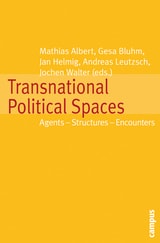
Transnational Political Spaces
Agents - Structures - EncountersEdited by Mathias Albert, Gesa Bluhm, Jan Helmig, Andreas Leutzsch, and Jochen W
Campus Verlag, 2009
From a decidedly multidisciplinary perspective, the articles in Transnational Political Spaces address the notion that political space is no longer fully congruent with national borders. Instead there are areas called transnational political spaces—caused by factors such as migration and social transformation—where policy occurs oblivious to national pressure. Organized into three sections—transnational actors, transnational spaces, and critical encounters—this volume explains how these spaces are formed and defined and how they can be traced and conceptualized.