4743 books match the query 'Religion' and 1168 start with t
cover of The Inspiration and Truth of Scripture: Testing the Ratzinger Paradigm

The Inspiration and Truth of Scripture

Testing the Ratzinger Paradigm

Aaron Pidel, SJ

Catholic University of America Press, 2023
What does it mean to say that Scripture is God’s Word? And just how true is the Bible? Though sometimes dismissed as “fundamentalist” concerns, these questions also sent twentieth-century Catholic theology searching for a new paradigm of biblical inspiration. Theologians repeatedly attempted to reconcile the traditional conviction that the Bible shares in the omniscience of its divine author with scholarly findings that suggested otherwise. Joseph Ratzinger contributed both negatively and positively to this project, deconstructing the regnant manualist models of inspiration and constructing an alternative inspired by St. Bonaventure. The result is an ecclesial model of surprising comprehensiveness and balance. Indeed, The Inspiration and Truth of Scripture concludes that Ratzinger’s alternative provides the least inadequate paradigm currently on offer today. The Inspiration and Truth of Scripture breaks new ground in several ways. First, it situates Ratzinger within a broader Catholic quest for a theology of inspiration, showing his model offers advantages even relative to those proposed by modern theology’s most eminent minds: John Henry Newman, Pierre Benoit, Karl Rahner, and David Tracy. Secondly, this book shows how Ratzinger’s paradigm generates “tests” for identifying the perennially valid affirmations of Scripture, and thus an approach to resolving disputed biblical questions. Must one who accepts the authority of Scripture believe in the Devil? Are the Marian dogmas really “in” Scripture? To what extent does Jesus’s prohibition of divorce still apply in today’s changed social circumstances? Just how historical are Gospel narratives, like the Last Supper, intended to be? The result is a book that bridges the gap between normative theology and historical exegesis. Overall, The Inspiration and Truth of Scripture presents Ratzinger not as an unimaginative enforcer of doctrinal conclusions but as a creatively faithful theologian, whose reconfiguration of inspiration should serve as the point of departure for all future reflection on the subject.
[more]
cover of The Institutionalization of Islam in Southern Senegal: Intermarriage, Qur'anic Education, and Jihad

The Institutionalization of Islam in Southern Senegal

Intermarriage, Qur'anic Education, and Jihad

Aly Dramé

University of Michigan Press, 2025

Weaving together oral and written sources, The Institutionalization of Islam in Southern Senegal investigates previously overlooked dimensions of Islamization in Senegambia through the processes of intermarriage, Qur’anic education, and jihãd. Due to its geographic location at the point where Senegal, The Gambia, and Guinea-Bissau meet, the Middle Casamance has historically been a melting pot where centralized and decentralized societies have coexisted for generations. In the past, historians have failed to consider the contributions of the Middle Casamance region and Mandinka Muslim settlements to the development of Islam, despite centers for Islamic education having existed in the region centuries before the emergence of the Sufi and jihãd movements of the eighteenth and nineteenth centuries. Aly Dramé seeks to close this gap by conceptualizing the leading role played by these Mandinka settlements and how religious spaces are negotiated, acquired, and transformed through intermarriage, Qur’anic education, and jihãd when peoples from distinct backgrounds encounter one another. 

Drawing on archival documents, oral history and traditions, travelers’ accounts, the Arabic text Pakao al-Qurano (Holy Book of Pakao), and original ethnography, The Institutionalization of Islam in Southern Senegal demonstrates how these communities reframe the debates about the institutionalization of Islam in Senegambia geographically, chronologically, and thematically.
[more]
cover of The Intellectual Adventure of Ancient Man: An Essay of Speculative Thought in the Ancient Near East

The Intellectual Adventure of Ancient Man

An Essay of Speculative Thought in the Ancient Near East

Henri Frankfort, H. A. Frankfort, John A. Wilson, Thorkild Jacobsen, and William A. Irwin

University of Chicago Press, 1946

The people in ancient times the phenomenal world was teeming with life; the thunderclap, the sudden shadow, the unknown and eerie clearing in the wood, all were living things. This unabridged edition traces the fascinating history of thought from the pre-scientific, personal concept of a "humanized" world to the achievement of detached intellectual reasoning.

The authors describe and analyze the spiritual life of three ancient civilizations: the Egyptians, whose thinking was profoundly influenced by the daily rebirth of the sun and the annual rebirth of the Nile; the Mesopotamians, who believed the stars, moon, and stones were all citizens of a cosmic state; and the Hebrews, who transcended prevailing mythopoeic thought with their cosmogony of the will of God. In the concluding chapter the Frankforts show that the Greeks, with their intellectual courage, were the first culture to discover a realm of speculative thought in which myth was overcome.
[more]
cover of The Intercourse of Knowledge:On Gendering Desire and 'Sexuality' in the Hebrew Bible

The Intercourse of Knowledge

On Gendering Desire and 'Sexuality' in the Hebrew Bible

Athalya Brenner

SBL Press, 2016

Now in paperback!

This groundbreaking book, which builds on the author's earlier work in On Gendering Texts, studies how, by what means, and to what extent human love, desire and sex, and possibly even "sexuality"; are gendered in the Hebrew Bible. The investigation looks into the construction of male and female bodies in language and ideologies; the praxis and ideology of sex, procreation, and contraception; deviation from socio-sexual boundaries (e.g. incest, rape, adultery, homosexuality, prostitution); eroticism and "pornoprophetics."

Features:

  • Paperback format of an essential Brill monograph
  • A classification and gendering of the linguistic and semantic data
  • Discussion of wider sociological and theological implications
[more]
cover of The Internet and the Madonna: Religious Visionary Experience on the Web

The Internet and the Madonna

Religious Visionary Experience on the Web

Paolo Apolito

University of Chicago Press, 2005

In 1994, a devout Catholic woman from Vermont began having religious visions and hearing the voice of the Virgin Mary. To spread word about her mystical experiences, she turned to the Internet. As Paolo Apolito records here, she is only one of many people who use the Web as a tool of religious devotion. Every day, thousands of Catholics—from Italy and Latin America to the United States and Bosnia—use the Internet to describe and celebrate apparitions of Mary, to exchange relics and advice in chat rooms, to make pilgrimages to religious Web sites, and to practice the rites of their faith online.

But how has this potent new mix of technology and religiosity changed the way Catholics view their faith? And what challenges do the autonomous qualities of the Internet pose to the broader authority of Catholicism? Does the democratic nature of access to digital technologies constitute a return to a more archaic and mystical form of Catholicism that predates the modernizing reforms of the Second Vatican Council?

In working through these questions, Apolito considers visions of Mary on the Web over the past two decades, revealing a great deal about religion as it is now experienced through new information technologies. The Internet, he explains, has made possible a decentralized community of the devoted, even as it has absorbed God into the shifts and complexities of electronic circuitry. And this profound development in religious life will only accelerate as use of the Internet spreads around the world.

An indispensable guide to the future of Catholicism, The Internet and the Madonna offers a compelling glimpse into the spiritual life of the connected soul.
[more]
cover of The Invention of Early Christian Discourse, Volume 1: Rhetography, Rhetology, and Storyline in Wisdom, Prophetic, and Apocalyptic Rhetorolect

The Invention of Early Christian Discourse, Volume 1

Rhetography, Rhetology, and Storyline in Wisdom, Prophetic, and Apocalyptic Rhetorolect

Vernon K. Robbins

SBL Press, 2026

In The Invention of Christian Discourse, Volume 1, Vernon K. Robbins dives into the rushing stream of religious thoughts, beliefs, and practices of the Greco-Roman Mediterranean world from which the New Testament emerged. Robbins explores wisdom, prophetic, and apocalyptic rhetorolects as well as examples of themes, topics, argumentation, and picturing drawn from the Hebrew Scriptures, Second Temple and later Jewish literature, and Greco-Roman literature. He demonstrates how first-century Christ believers blended these rhetorolects to create the New Testament and other early Christian literature. Robbins includes a glossary of essential terms used in sociorhetorical studies. This second edition of Robbins’s foundational volume provides rich insights into the development of sociorhetorical interpretation and its ongoing application as an interpretive analytic in sociorhetorical commentary.
[more]
cover of The Invention of Hebrew

The Invention of Hebrew

Seth L. Sanders

University of Illinois Press, 2011

The Invention of Hebrew is the first book to approach the Bible in light of recent epigraphic discoveries on the extreme antiquity of the alphabet and its use as a deliberate and meaningful choice. Hebrew was more than just a way of transmitting information; it was a vehicle of political symbolism and self-representation.

Seth L. Sanders connects the Bible's distinctive linguistic form--writing down a local spoken language--to a cultural desire to speak directly to people, summoning them to join a new community that the text itself helped call into being. Addressing the people of Israel through a vernacular literature, Hebrew texts reimagined their audience as a public. By comparing Biblical documents with related ancient texts in Hebrew, Ugaritic, and Babylonian, this book shows Hebrew's distinctiveness as a self-conscious political language. Illuminating the enduring stakes of Biblical writing, Sanders demonstrates how Hebrew assumed and promoted a source of power previously unknown in written literature: "the people" as the protagonist of religion and politics.

[more]
cover of The Invention of Religion in Japan

The Invention of Religion in Japan

Jason Ananda Josephson Storm

University of Chicago Press, 2012
Throughout its long history, Japan had no concept of what we call “religion.” There was no corresponding Japanese word, nor anything close to its meaning. But when American warships appeared off the coast of Japan in 1853 and forced the Japanese government to sign treaties demanding, among other things, freedom of religion, the country had to contend with this Western idea. In this book, Jason Ananda Josephson reveals how Japanese officials invented religion in Japan and traces the sweeping intellectual, legal, and cultural changes that followed.
 
More than a tale of oppression or hegemony, Josephson’s account demonstrates that the process of articulating religion offered the Japanese state a valuable opportunity. In addition to carving out space for belief in Christianity and certain forms of Buddhism, Japanese officials excluded Shinto from the category. Instead, they enshrined it as a national ideology while relegating the popular practices of indigenous shamans and female mediums to the category of “superstitions”—and thus beyond the sphere of tolerance. Josephson argues that the invention of religion in Japan was a politically charged, boundary-drawing exercise that not only extensively reclassified the inherited materials of Buddhism, Confucianism, and Shinto to lasting effect, but also reshaped, in subtle but significant ways, our own formulation of the concept of religion today. This ambitious and wide-ranging book contributes an important perspective to broader debates on the nature of religion, the secular, science, and superstition.
[more]
cover of The Invention of Sodomy in Christian Theology

The Invention of Sodomy in Christian Theology

Mark D. Jordan

University of Chicago Press, 1997

In this startling original work of historical detection, Mark D. Jordan explores the invention of Sodomy by medieval Christendom, examining its conceptual foundations in theology and gauging its impact on Christian sexual ethics both then and now. This book is for everyone involved in the ongoing debate within organized religions and society in general over moral judgments of same-sex eroticism.

"A crucial contribution to our understanding of the tortured and tortuous relationship between men who love men, and the Christian religion—indeed, between our kind and Western society as a whole. . . . The true power of Jordan's study is that it gives back to gay and lesbian people our place in history and that it places before modern theologians and church leaders a detailed history of fear, inconsistency, hatred and oppression that must be faced both intellectually and pastorally."—Michael B. Kelly, Screaming Hyena

"[A] detailed and disturbing tour through the back roads of medieval Christian thought."—Dennis O'Brien, Commonweal

"Being gay and being Catholic are not necessarily incompatible modes of life, Jordan argues. . . . Compelling and deeply learned."—Virginia Quarterly Review
[more]
cover of The Invention of World Religions: Or, How European Universalism Was Preserved in the Language of Pluralism

The Invention of World Religions

Or, How European Universalism Was Preserved in the Language of Pluralism

Tomoko Masuzawa

University of Chicago Press, 2005

The idea of "world religions" expresses a vague commitment to multiculturalism. Not merely a descriptive concept, "world religions" is actually a particular ethos, a pluralist ideology, a logic of classification, and a form of knowledge that has shaped the study of religion and infiltrated ordinary language.

In this ambitious study, Tomoko Masuzawa examines the emergence of "world religions" in modern European thought. Devoting particular attention to the relation between the comparative study of language and the nascent science of religion, she demonstrates how new classifications of language and race caused Buddhism and Islam to gain special significance, as these religions came to be seen in opposing terms-Aryan on one hand and Semitic on the other. Masuzawa also explores the complex relation of "world religions" to Protestant theology, from the hierarchical ordering of religions typical of the Christian supremacists of the nineteenth century to the aspirations of early twentieth-century theologian Ernst Troeltsch, who embraced the pluralist logic of "world religions" and by so doing sought to reclaim the universalist destiny of European modernity.
[more]
cover of The Iraqi Invasion of Kuwait: Religion, Identity and Otherness in the Analysis of War and Conflict

The Iraqi Invasion of Kuwait

Religion, Identity and Otherness in the Analysis of War and Conflict

Hamdi A. Hassan

Pluto Press, 2005

Focusing on the 1990 Iraqi invasion of Kuwait, Hamdi Hassan offers a balanced examination of the motivation of the Iraqi polity and the conditions which accelerated and facilitated the decision to invade. Critical of the traditional approach of most Middle East studies, The Iraqi Invasion of Kuwait offers a counterpoint to Western interpretations of this key event in the contemporary history of the Middle East.

Hassan examines how Saddam Hussein assessed and responded to American and Israeli intentions after the invasion, the reaction of other Arab states, and the unprecedented grassroots support for the Iraqi leadership. In this context, the author examines the social structure of Iraqi society – families, clans and regional alliances – and the importance of Ba’athism. Hassan also examines the political structure of the country, relating the identity of Arabism – the religion and language which is associated closely with the Pan Arabist ideals – to Iraqi foreign policy.
[more]
cover of The Irony of American History

The Irony of American History

Reinhold Niebuhr

University of Chicago Press, 2008

A powerful indictment of American moral complacency from a writer Barack Obama called “one of my favorite philosophers”
 
“[Niebuhr] is one of my favorite philosophers. I take away [from his works] the compelling idea that there’s serious evil in the world, and hardship and pain. And we should be humble and modest in our belief we can eliminate those things. But we shouldn’t use that as an excuse for cynicism and inaction. I take away . . . the sense we have to make these efforts knowing they are hard.”—President Barack Obama
 
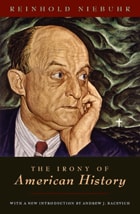
Forged during the tumultuous but triumphant postwar years when America came of age as a world power, The Irony of American History is more relevant now than ever before. Cited by politicians as diverse as Hillary Clinton and John McCain, Niebuhr’s masterpiece on the incongruity between personal ideals and political reality is both an indictment of American moral complacency and a warning against the arrogance of virtue. Impassioned, eloquent, and deeply perceptive, Niebuhr’s wisdom will cause readers to rethink their assumptions about right and wrong, war and peace.

 “The supreme American theologian of the twentieth century.”—Arthur Schlesinger Jr., New York Times

“Niebuhr is important for the left today precisely because he warned about America’s tendency—including the left’s tendency—to do bad things in the name of idealism. His thought offers a much better understanding of where the Bush administration went wrong in Iraq.”—Kevin Mattson, The Good Society
 
“Irony provides the master key to understanding the myths and delusions that underpin American statecraft. . . . The most important book ever written on US foreign policy.”—Andrew J. Bacevich, from the Introduction
[more]
cover of The Irreducibility of the Human Person: A Catholic Synthesis

The Irreducibility of the Human Person

A Catholic Synthesis

Mark K. Spencer

Catholic University of America Press, 2022
Catholic philosophical anthropologists have defended views of the human person on which we are irreducible to anything non-personal. For example, it is not the case that we are nothing but matter, souls, or parts of society. But many Catholic anthropologies have overlooked ways in which we are irreducible and so have not given an adequate account of the uniqueness of each human person. This book presents a philosophical portrait of human persons that depicts each way in which we are irreducible, with the goal of guiding the reader to perceive, wonder at, and love all the unique features of human persons. It builds this portrait by showing how claims from many strands of the Catholic tradition can be synthesized. These strands include Thomism, Scotism, phenomenology, personalism, nouvelle théologie, analytic philosophy, and Greek and Russian thought. The book focuses on how these traditions’ claims are grounded in experience and on how they help us to perceive irreducible features of persons. While many metaphysical claims about persons are defended, the picture of persons that ultimately emerges is one on which persons are best grasped not through abstract concepts but through aesthetic perception and love, as unique kinds of beauty. This book also explores irreducible features of our subjectivity, senses, intellect, freedom, and affections, and of our souls, bodies, and activities. It includes discussions of divine simplicity and causality, and of the nature of angels, matter, organisms, and artifacts, all of which must be understood to fully grasp our irreducibility. In showing how to synthesize various traditions’ claims, the book also offers new solutions to a number of debates in Catholic philosophy. These include debates over natural law, the natural desire to see God, the separated soul, integralism and personalism, idealist and realist phenomenology, and scholastic accounts of the act of existence.
[more]
cover of The Islamic Movement in Israel

The Islamic Movement in Israel

Tilde Rosmer

University of Texas Press, 2022

Since its establishment in the late 1970s, Israel’s Islamic Movement has grown from a small religious revivalist organization focused on strengthening the faith of Muslim Palestinian citizens of Israel to a countrywide sociopolitical movement with representation in the Israeli legislature. But how did it get here? How does it differ from other Islamic movements in the region? And why does its membership continue to grow?

Tilde Rosmer examines these issues in The Islamic Movement in Israel as she tells the story of the movement, its identity, and its activities. Using interviews with movement leaders and activists, their documents, and media reports from Israel and beyond, she traces the movement’s history from its early days to its 1996 split over the issue of its relationship to the state. She then explores how the two factions have functioned since, revealing that while leaders of the two branches have pursued different approaches to the state, until the outlawing of the Northern Branch in 2015, both remained connected and dedicated to providing needed social, education, and health services in Israel’s Palestinian towns and villages. The first book in English on this group, The Islamic Movement in Israel is a timely study about how an Islamist movement operates within the unique circumstances of the Jewish state.
[more]
cover of The Islamic World

The Islamic World

Edited by William H. McNeill and Marilyn Robinson Waldman

University of Chicago Press, 1984
The Islamic World is a collection of important and representative documents from all periods of Islamic history. From the formative years in Arabia to the confrontations with and responses to modernity, these translations indicate the continuity and development of the youngest of the world's greatest civilizations. Included are historical, theological, philosophical, and political writings, as well as poetry and narratives, from Muslim writers in the Arab lands, Turkey, Persia, and other parts of the Islamic world. The editors have provided informative introductions to each historical period and to the individual texts, making this an enlightening and intriguing first look at Islamic civilization and tradition.
[more]
cover of The J. Golden Kimball Stories

The J. Golden Kimball Stories

Eric A. Eliason

University of Illinois Press, 2007

The sharp wit of a free-thinking Mormon folk hero

In The J. Golden Kimball Stories, beloved and iconoclastic Mormon humorist J. Golden Kimball (1853-1938) speaks on death, marriage, love, hell, God, and everything in between. Compiled by Eric A. Eliason from previously unpublished archival resources, this collection of stories, anecdotes, and jokes captures the irreverent comedy and independent thinking that made Kimball so beloved both in and out of his Mormon community.

Arranged thematically and framed by short contextual introductions, each chapter presents a colorful portrait of Kimball on topics including tricks, cussing, ministering, chastising, and repentance. A comprehensive introductory essay places Kimball in the context of Mormon history and folklore scholarship.

[more]
cover of The Jaguar and the Priest: An Ethnography of Tzeltal Souls

The Jaguar and the Priest

An Ethnography of Tzeltal Souls

By Pedro Pitarch

University of Texas Press, 2010

In contrast to western notions of the soul as the essence or most native part of a human being, the Tzeltal-speaking Indians of Chiapas, Mexico, regard the soul first and foremost as an Other. Made up of beings that personify the antithesis of their native selves—animals such as hummingbirds or jaguars, atmospheric phenomena like lightning bolts or rainbows, or spirits of European appearance such as Catholic priests or evangelical musicians—Tzeltal souls represent the maximum expression of that which is alien. And because their souls enfold that which is outside and Other, the Tzeltal contain within themselves the history of their relationship with Europeans from the beginning of the Spanish conquest to the present time. Thus, to understand the Indian self opens a window into the Tzeltal conception of culture and community, their notions of identity and alterity, and their interpretation of interethnic relations and types of historical memory.

In this pathfinding ethnography, which was originally published in Spanish in 1996 as Ch'ulel: una etnografía de las almas tzeltales and is now extensively rewritten and amplified in English, Pedro Pitarch offers a new understanding of indigenous concepts of the soul, personhood, and historical memory in highland Chiapas. Exploring numerous aspects of indigenous culture and history—medicine and shamanism, geography and cosmology, and politics and kinship among them—he engages in a radical rethinking of classic issues in Mesoamerican anthropology, such as ethnicity and alterity, community and tradition, and change and permanence.
[more]
cover of The Jewish Middle Ages

The Jewish Middle Ages

Carol Bakhos

SBL Press, 2023

For many, the Middle Ages in general evokes a sense of the sinister and brings to mind a world of fear, superstition, and religious fanaticism. For Jews it was a period marked by persecutions, pogroms, and expulsions. Yet at the same time, the Middle Ages was also a time of lively cultural exchange and heightened creativity for Jews. In The Jewish Middle Ages, contributors explore the ways in which the stories of biblical women, including, Eve, Sarah, Hagar, Rebekah, Zipporah, Ruth, Esther, and Judith, make their way into the rich tapestry of medieval Jewish literature, mystical texts, and art, particularly in works emanating from Ashkenazic circles. Contributors include Carol Bakhos, Judith R. Baskin, Elisheva Baumgarten, Dagmar Börner-Klein, Constanza Cordoni, Rachel Elior, Meret Gutmann-Grün, Robert A. Harris, Yuval Katz-Wilfing, Sheila Tuller Keiter, Katrin Kogman-Appel, Gerhard Langer, Aurora Salvatierra Ossorio, and Felicia Waldman. These essays give us a glimpse into the role women played and the authority they assumed in medieval Jewish culture beyond the rabbinic centers of Palestine and Babylonia.
[more]
cover of The Jewish Question Again

The Jewish Question Again

Edited by Joyce Dalsheim and Gregory Starrett

Prickly Paradigm Press, 2020

Anti-Semitism is on the rise. How is this still possible? Once again, we are witness to a surge in right-wing authoritarianism, ethnonationalism, and white supremacism, and the racist, xenophobic, and misogynist violence they spread. Like historic newsreels brought back to life, renewed waves of refugees are turned away at borders, placed in cages, or washed up lifeless on the shore.

Such striking similarities between present and past suggest that we are not done with the issues raised by the historical Jewish Question: that is, what is the place of “the Jew”—the minority, the relic, the rootless stranger, the racialized other, the exiled, the displaced, the immigrant, the diasporic? In The Jewish Question Again, leading scholars grapple with our inability to keep these struggles in the past and why we continue to repeat these atrocities. This book explores the haunting recurrence of the Jewish Question today and begs why we find ourselves here yet again.

 
[more]
cover of The Jewish Radical Right: Revisionist Zionism and Its Ideological Legacy

The Jewish Radical Right

Revisionist Zionism and Its Ideological Legacy

Eran Kaplan

University of Wisconsin Press, 2005

The Jewish Radical Right is the first comprehensive analysis of Zionist Revisionist thought in the 1920s and 1930s, and of its ideological legacy in modern-day Israel. The Revisionists, under the leadership of Ze'ev Jabotinsky, offered a radical view of Jewish history and a revolutionary vision for its future. Using new archival material, Eran Kaplan examines the intellectual and cultural origins of the Zionist and Israeli Right, when Revisionism evolved into one of the most important movements in the Zionist camp. He presents revisionism as a form of integral nationalism, rooted in an ontological monism and intellectually related to the radical right-wing ideologies that flourished in the early twentieth century. Kaplan provocatively suggests that revisionism's legacies can be found both in the right-wing policies of Likud and in the heart of Post Zionism and its critique of mainstream (Labor) Zionism.

Published with support from the Koret Jewish Studies Program
[more]
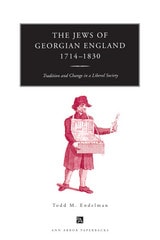
cover of The Jews of Georgian England, 1714-1830: Tradition and Change in a Liberal Society

The Jews of Georgian England, 1714-1830

Tradition and Change in a Liberal Society

Todd M. Endelman

University of Michigan Press, 1999
The movement from tradition to modernity engulfed all of the Jewish communities in the West, but hitherto historians have concentrated on the intellectual revolution in Germany by Moses Mendelssohn in the second half of the eighteenth century as the decisive event in the origins of Jewish modernity. In The Jews of Georgian England, Todd M. Endelman challenges the Germanocentric orientation of the bulk of modern Jewish historiography and argues that the modernization of European Jewry encompassed far more than an intellectual revolution.
His study recounts the rise of the Anglo-Jewish elite--great commercial and financial magnates such as the Goldsmids, the Franks, Samson Gideon, and Joseph Salvador--who rapidly adopted the gentlemanly style of life of the landed class and adjusted their religious practices to harmonize with the standards of upper-class Englishmen. Similarly, the Jewish poor--peddlers, hawkers, and old-clothes men--took easily to many patterns of lower-class life, including crime, street violence, sexual promiscuity, and coarse entertainment.
An impressive marshaling of fact and analysis, The Jews of Georgian England serves to illuminate a significant aspect of the Jewish passage to modernity.
"Contributes to English as well as Jewish history. . . . Every reader will learn something new about the statistics, setting or mores of Jewish life in the eighteenth century. . . ." --American Historical Review
Todd M. Endelman is William Haber Professor of Modern Jewish History, University of Michigan. He is also the author of Comparing Jewish Societies, Jewish Apostasy in the Modern World, and Radical Assimilation in English Jewish History, 1656-1945.
[more]
cover of The Journal of Religion, volume 101 number 1 (January 2021)

The Journal of Religion, volume 101 number 1 (January 2021)

The University of Chicago Press

University of Chicago Press Journals, 2021

[more]
cover of The Journal of Religion, volume 101 number 2 (April 2021)

The Journal of Religion, volume 101 number 2 (April 2021)

The University of Chicago Press

University of Chicago Press Journals, 2021
[more]
cover of The Journal of Religion, volume 101 number 3 (July 2021)

The Journal of Religion, volume 101 number 3 (July 2021)

The University of Chicago Press

University of Chicago Press Journals, 2021
This is volume 101 issue 3 of The Journal of Religion. The Journal of Religion promotes critical, hermeneutical, historical, and constructive inquiry into religion. The journal publishes articles in theology, religious ethics, and philosophy of religion, as well as articles that approach the role of religion in culture and society from a historical, sociological, psychological, linguistic, or artistic standpoint. It also publishes highly specialized research in limited areas of inquiry that has significance for a wider readership.
[more]
cover of The Journal of Religion, volume 101 number 4 (October 2021)

The Journal of Religion, volume 101 number 4 (October 2021)

The University of Chicago Press

University of Chicago Press Journals, 2021
This is volume 101 issue 4 of The Journal of Religion. The Journal of Religion promotes critical, hermeneutical, historical, and constructive inquiry into religion. The journal publishes articles in theology, religious ethics, and philosophy of religion, as well as articles that approach the role of religion in culture and society from a historical, sociological, psychological, linguistic, or artistic standpoint. It also publishes highly specialized research in limited areas of inquiry that has significance for a wider readership.
[more]
cover of The Journal of Religion, volume 102 number 1 (January 2022)

The Journal of Religion, volume 102 number 1 (January 2022)

The University of Chicago Press

University of Chicago Press Journals, 2022
This is volume 102 issue 1 of The Journal of Religion. The Journal of Religion promotes critical, hermeneutical, historical, and constructive inquiry into religion. The journal publishes articles in theology, religious ethics, and philosophy of religion, as well as articles that approach the role of religion in culture and society from a historical, sociological, psychological, linguistic, or artistic standpoint. It also publishes highly specialized research in limited areas of inquiry that has significance for a wider readership.
[more]
cover of The Journal of Religion, volume 102 number 2 (April 2022)

The Journal of Religion, volume 102 number 2 (April 2022)

The University of Chicago Press

University of Chicago Press Journals, 2022
This is volume 102 issue 2 of The Journal of Religion. The Journal of Religion promotes critical, hermeneutical, historical, and constructive inquiry into religion. The journal publishes articles in theology, religious ethics, and philosophy of religion, as well as articles that approach the role of religion in culture and society from a historical, sociological, psychological, linguistic, or artistic standpoint. It also publishes highly specialized research in limited areas of inquiry that has significance for a wider readership.
[more]
cover of The Journal of Religion, volume 102 number 3 (July 2022)

The Journal of Religion, volume 102 number 3 (July 2022)

The University of Chicago Press

University of Chicago Press Journals, 2022
This is volume 102 issue 3 of The Journal of Religion. The Journal of Religion promotes critical, hermeneutical, historical, and constructive inquiry into religion. The journal publishes articles in theology, religious ethics, and philosophy of religion, as well as articles that approach the role of religion in culture and society from a historical, sociological, psychological, linguistic, or artistic standpoint. It also publishes highly specialized research in limited areas of inquiry that has significance for a wider readership.
[more]
cover of The Journal of Religion, volume 102 number 4 (October 2022)

The Journal of Religion, volume 102 number 4 (October 2022)

The University of Chicago Press

University of Chicago Press Journals, 2022
This is volume 102 issue 4 of The Journal of Religion. The Journal of Religion promotes critical, hermeneutical, historical, and constructive inquiry into religion. The journal publishes articles in theology, religious ethics, and philosophy of religion, as well as articles that approach the role of religion in culture and society from a historical, sociological, psychological, linguistic, or artistic standpoint. It also publishes highly specialized research in limited areas of inquiry that has significance for a wider readership.
[more]
cover of The Journal of Religion, volume 103 number 1 (January 2023)

The Journal of Religion, volume 103 number 1 (January 2023)

The University of Chicago Press

University of Chicago Press Journals, 2023
This is volume 103 issue 1 of The Journal of Religion. The Journal of Religion promotes critical, hermeneutical, historical, and constructive inquiry into religion. The journal publishes articles in theology, religious ethics, and philosophy of religion, as well as articles that approach the role of religion in culture and society from a historical, sociological, psychological, linguistic, or artistic standpoint. It also publishes highly specialized research in limited areas of inquiry that has significance for a wider readership.
[more]
cover of The Journal of Religion, volume 103 number 2 (April 2023)

The Journal of Religion, volume 103 number 2 (April 2023)

The University of Chicago Press

University of Chicago Press Journals, 2023
This is volume 103 issue 2 of The Journal of Religion. The Journal of Religion promotes critical, hermeneutical, historical, and constructive inquiry into religion. The journal publishes articles in theology, religious ethics, and philosophy of religion, as well as articles that approach the role of religion in culture and society from a historical, sociological, psychological, linguistic, or artistic standpoint. It also publishes highly specialized research in limited areas of inquiry that has significance for a wider readership.
[more]
cover of The Journal of Religion, volume 103 number 3 (July 2023)

The Journal of Religion, volume 103 number 3 (July 2023)

The University of Chicago Press

University of Chicago Press Journals, 2023
This is volume 103 issue 3 of The Journal of Religion. The Journal of Religion promotes critical, hermeneutical, historical, and constructive inquiry into religion. The journal publishes articles in theology, religious ethics, and philosophy of religion, as well as articles that approach the role of religion in culture and society from a historical, sociological, psychological, linguistic, or artistic standpoint. It also publishes highly specialized research in limited areas of inquiry that has significance for a wider readership.
[more]
cover of The Journal of Religion, volume 103 number 4 (October 2023)

The Journal of Religion, volume 103 number 4 (October 2023)

The University of Chicago Press

University of Chicago Press Journals, 2023
This is volume 103 issue 4 of The Journal of Religion. The Journal of Religion promotes critical, hermeneutical, historical, and constructive inquiry into religion. The journal publishes articles in theology, religious ethics, and philosophy of religion, as well as articles that approach the role of religion in culture and society from a historical, sociological, psychological, linguistic, or artistic standpoint. It also publishes highly specialized research in limited areas of inquiry that has significance for a wider readership.
[more]
cover of The Journal of Religion, volume 104 number 1 (January 2024)

The Journal of Religion, volume 104 number 1 (January 2024)

The University of Chicago Press

University of Chicago Press Journals, 2024
This is volume 104 issue 1 of The Journal of Religion. The Journal of Religion promotes critical, hermeneutical, historical, and constructive inquiry into religion. The journal publishes articles in theology, religious ethics, and philosophy of religion, as well as articles that approach the role of religion in culture and society from a historical, sociological, psychological, linguistic, or artistic standpoint. It also publishes highly specialized research in limited areas of inquiry that has significance for a wider readership.
[more]
cover of The Journal of Religion, volume 104 number 2 (April 2024)

The Journal of Religion, volume 104 number 2 (April 2024)

The University of Chicago Press

University of Chicago Press Journals, 2024
This is volume 104 issue 2 of The Journal of Religion. The Journal of Religion promotes critical, hermeneutical, historical, and constructive inquiry into religion. The journal publishes articles in theology, religious ethics, and philosophy of religion, as well as articles that approach the role of religion in culture and society from a historical, sociological, psychological, linguistic, or artistic standpoint. It also publishes highly specialized research in limited areas of inquiry that has significance for a wider readership.
[more]
cover of The Journal of Religion, volume 104 number 3 (July 2024)

The Journal of Religion, volume 104 number 3 (July 2024)

The University of Chicago Press

University of Chicago Press Journals, 2024
This is volume 104 issue 3 of The Journal of Religion. The Journal of Religion promotes critical, hermeneutical, historical, and constructive inquiry into religion. The journal publishes articles in theology, religious ethics, and philosophy of religion, as well as articles that approach the role of religion in culture and society from a historical, sociological, psychological, linguistic, or artistic standpoint. It also publishes highly specialized research in limited areas of inquiry that has significance for a wider readership.
[more]
cover of The Journal of Religion, volume 104 number 4 (October 2024)

The Journal of Religion, volume 104 number 4 (October 2024)

The University of Chicago Press

University of Chicago Press Journals, 2024
This is volume 104 issue 4 of The Journal of Religion. The Journal of Religion promotes critical, hermeneutical, historical, and constructive inquiry into religion. The journal publishes articles in theology, religious ethics, and philosophy of religion, as well as articles that approach the role of religion in culture and society from a historical, sociological, psychological, linguistic, or artistic standpoint. It also publishes highly specialized research in limited areas of inquiry that has significance for a wider readership.
[more]
cover of The Journal of Religion, volume 105 number 1 (January 2025)

The Journal of Religion, volume 105 number 1 (January 2025)

The University of Chicago Press

University of Chicago Press Journals, 2025
This is volume 105 issue 1 of The Journal of Religion. The Journal of Religion promotes critical, hermeneutical, historical, and constructive inquiry into religion. The journal publishes articles in theology, religious ethics, and philosophy of religion, as well as articles that approach the role of religion in culture and society from a historical, sociological, psychological, linguistic, or artistic standpoint. It also publishes highly specialized research in limited areas of inquiry that has significance for a wider readership.
[more]
cover of The Journal of Religion, volume 105 number 2 (April 2025)

The Journal of Religion, volume 105 number 2 (April 2025)

The University of Chicago Press

University of Chicago Press Journals, 2025
This is volume 105 issue 2 of The Journal of Religion. The Journal of Religion promotes critical, hermeneutical, historical, and constructive inquiry into religion. The journal publishes articles in theology, religious ethics, and philosophy of religion, as well as articles that approach the role of religion in culture and society from a historical, sociological, psychological, linguistic, or artistic standpoint. It also publishes highly specialized research in limited areas of inquiry that has significance for a wider readership.
[more]
cover of The Journal of Religion, volume 105 number 3 (July 2025)

The Journal of Religion, volume 105 number 3 (July 2025)

The University of Chicago Press

University of Chicago Press Journals, 2025
This is volume 105 issue 3 of The Journal of Religion. The Journal of Religion promotes critical, hermeneutical, historical, and constructive inquiry into religion. The journal publishes articles in theology, religious ethics, and philosophy of religion, as well as articles that approach the role of religion in culture and society from a historical, sociological, psychological, linguistic, or artistic standpoint. It also publishes highly specialized research in limited areas of inquiry that has significance for a wider readership.
[more]
cover of The Journal of Religion, volume 105 number 4 (October 2025)

The Journal of Religion, volume 105 number 4 (October 2025)

The University of Chicago Press

University of Chicago Press Journals, 2025
This is volume 105 issue 4 of The Journal of Religion. The Journal of Religion promotes critical, hermeneutical, historical, and constructive inquiry into religion. The journal publishes articles in theology, religious ethics, and philosophy of religion, as well as articles that approach the role of religion in culture and society from a historical, sociological, psychological, linguistic, or artistic standpoint. It also publishes highly specialized research in limited areas of inquiry that has significance for a wider readership.
[more]
cover of The Journal of Religion, volume 106 number 1 (January 2026)

The Journal of Religion, volume 106 number 1 (January 2026)

The University of Chicago Press

University of Chicago Press Journals, 2026
This is volume 106 issue 1 of The Journal of Religion. The Journal of Religion promotes critical, hermeneutical, historical, and constructive inquiry into religion. The journal publishes articles in theology, religious ethics, and philosophy of religion, as well as articles that approach the role of religion in culture and society from a historical, sociological, psychological, linguistic, or artistic standpoint. It also publishes highly specialized research in limited areas of inquiry that has significance for a wider readership.
[more]
cover of The Journal of Religion, volume 106 number 2 (April 2026)

The Journal of Religion, volume 106 number 2 (April 2026)

The University of Chicago Press

University of Chicago Press Journals, 2026
This is volume 106 issue 2 of The Journal of Religion. The Journal of Religion promotes critical, hermeneutical, historical, and constructive inquiry into religion. The journal publishes articles in theology, religious ethics, and philosophy of religion, as well as articles that approach the role of religion in culture and society from a historical, sociological, psychological, linguistic, or artistic standpoint. It also publishes highly specialized research in limited areas of inquiry that has significance for a wider readership.
[more]
cover of The Journal of Religion, volume 106 number 3 (July 2026)

The Journal of Religion, volume 106 number 3 (July 2026)

The University of Chicago Press

University of Chicago Press Journals, 2026
This is volume 106 issue 3 of The Journal of Religion. The Journal of Religion promotes critical, hermeneutical, historical, and constructive inquiry into religion. The journal publishes articles in theology, religious ethics, and philosophy of religion, as well as articles that approach the role of religion in culture and society from a historical, sociological, psychological, linguistic, or artistic standpoint. It also publishes highly specialized research in limited areas of inquiry that has significance for a wider readership.
[more]
cover of The KGB and the Vatican: Secrets of the Mitrokhin Files

The KGB and the Vatican

Secrets of the Mitrokhin Files

Sean Brennan

Catholic University of America Press, 2022
One of the greatest ironies of the history of Soviet rule is that, for an officially atheistic state, those in the political police and in the Politburo devoted an enormous amount of time and attention to the question of religion. The Soviet government’s policies toward religious institutions in the USSR, and toward religious institutions in the non-Communist world, reflected this, especially when it came to the Vatican and Catholic Churches, both the Latin and Byzantine Rite, in Soviet territory. The KGB and the Vatican consists of the transcripts of KGB records concerning the policies of the Soviet secret police towards the Vatican and the Catholic Church in the Communist world, transcripts provided by KGB archivist and defector Vasili Mitrokhin, from the Second Vatican Council to the election of John Paul II. Among the topics covered include how the Soviet regime viewed the efforts of John XXIII and Paul VI of reaching out to eastern side of the Iron Curtain, the experience of the Roman Catholic Church in Lithuanian Soviet Socialist Republic and the underground Greek Catholic Church in the Ukrainian Soviet Socialist Republic, the religious underground in the key cities of Leningrad and Moscow, and finally the election of John Paul II and its effect on the tumultuous events in Poland in the late 1970s and early 1980s. This valuable primary source collection also contains a historical introduction written by the translator, Sean Brennan, a professor of History at the University of Scranton.
[more]
cover of The Key to Natural Philosophy

The Key to Natural Philosophy

Barbara Honorius Augustodunensis

Catholic University of America Press, 2026
Honorius Augustodunensis (“of Regensburg”), born perhaps in the 1070s, was a native son of southern Germany or Austria who pursued his studies in England with St. Anselm of Canterbury. Under Anselm’s influence he became a Benedictine monk before returning to Germany in the opening years of the twelfth century. During his life-long monastic career he blossomed as a prolific writer. He died around 1140. The epithet “of Autun,” as a translation of “Augustodunensis,” was applied to him by scholars a century ago and earlier, but it has long been discredited, and the meaning of “Augustodunensis” remains a mystery. Although Honorius has been appropriately described as an enigmatic figure, his strong influence on Western theologians is widely recognized. Despite his large corpus, now known to consist of approximately thirty texts (but almost certainly more) Honorius Augustodunensis is the most unjustly neglected writer of the twelfth- century renaissance. Although he is best known as a popularizer, he also composed a major philosophical text, The Key to Natural Philosophy (Clavis physicae), ca. 1125-30. Taking the form of a dialogue between master and disciple, the Clavis is an abridged paraphrase of Eriugena’s Periphyseon, the most radical work of Neoplatonic thought in the time frame between pseudo-Dionysius and Meister Eckhart. Honorius treats such topics as the unknowability of God, apophatic and cataphatic theology, the primordial causes, the cosmological process of creation and return, human and angelic nature, the Fall, the four elements, and the findings of ancient astronomers. Although Eriugena was condemned for heresy in the thirteenth century, Honorius managed to escape that censure. The Key to Natural Philosophy thus became the chief conduit of the Carolingian philosopher’s thought in the later Middle Ages, influencing readers from Eckhart through Nicholas of Cusa.
[more]
cover of The Key to The Name of the Rose: Including Translations of All Non-English Passages

The Key to The Name of the Rose

Including Translations of All Non-English Passages

Adele J. Haft, Jane G. White, and Robert J. White

University of Michigan Press, 1999
Umberto Eco's The Name of the Rose is a brilliant mystery set in a fictitious medieval monastery. The text is rich with literary, historical, and theoretical references that make it eminently re-readable. The Key makes each reading fuller and more meaningful by helping the interested reader not merely to read but also to understand Eco's masterful work. Inspired by pleas from friends and strangers, the authors, each trained in Classics, undertook to translate and explain the Latin phrases that pepper the story. They have produced an approachable, informative guide to the book and its setting--the middle ages. The Key includes an introduction to the book, the middle ages, Umberto Eco, and philosophical and literary theories; a useful chronology; and reference notes to historical people and events.
The clear explanations of the historical setting and players will be useful to anyone interested in a general introduction to medieval history.
Adele J. Haft is Associate Professor of Classics, Hunter College, City University of New York. Jane G. White is chair of the Department of Languages, Dwight Englewood School. Robert J. White is Professor of Classics and Oriental Studies, Hunter College, City University of New York.
[more]
cover of The Key to Unlocking the Door to the Truth: Father Ignacio Gordon, SJ, and His Contribution to the Discipline of Canonical Procedural Law

The Key to Unlocking the Door to the Truth

Father Ignacio Gordon, SJ, and His Contribution to the Discipline of Canonical Procedural Law

William L. Daniel

Catholic University of America Press, 2022
Father Ignacio Gordon, SJ, taught canon law (the Catholic Church’s law) from 1960 until 1985 at the Pontifical Gregorian University in Rome, with a concentration on procedural law, or the laws on trials. By all testimonies, he was outstanding for the clarity of his teaching, his humble affection for his students, his indefatigable and hidden service to the Apostolic See, and his priestly zeal. Notable among his endeavors was an educational initiative for the ongoing formation of judges and other ministers of justice in ecclesiastical tribunals. In his teaching, he stressed the ecclesial importance and supernatural implications of procedural law in general, and the indispensability of the judicial protection of marriage in particular. Special efforts were made to make procedural law understandable to his students and to canonists in general, at a time when the Church was celebrating and implementing the teachings of the Second Vatican Ecumenical Council, as a result of which her law was undergoing a major revision. Father Gordon taught from the consistent canonical tradition, while also laying bare the latest developments in law and jurisprudence. He taught the entirety of the law on trials, producing numerous scholarly works on questions both timeless and new, giving marked emphasis to the problem of the excessive length of trials and the causes of delayed justice. An area of his particular attention and dedication was the Supreme Tribunal of the Apostolic Signatura—of which he was a consultor (referendary and later votans)—including both its proper law and its history. This history displayed, in part, why that Tribunal was the natural one to function as the supreme administrative tribunal of the Church. Father Gordon’s contribution to the question of ecclesiastical administrative justice was among those leading the novel and dynamic discussion about it in the 1960s and 1970s.
[more]
cover of The King James Version at 400: Assessing Its Genius as Bible Translation and Its Literary Influence

The King James Version at 400

Assessing Its Genius as Bible Translation and Its Literary Influence

David G. Burke

SBL Press, 2013

In this collection of essays, thirty scholars from diverse disciplines offer their unique perspectives on the genius of the King James Version, a translation whose 400th anniversary was recently celebrated throughout the English-speaking world. While avoiding nostalgia and hagiography, each author clearly appreciates the monumental, formative role the KJV has had on religious and civil life on both sides of the Atlantic (and beyond) as well as on the English language itself. In part 1 the essayists look at the KJV in its historical contexts—the politics and rapid language growth of the era, the emerging printing and travel industries, and the way women are depicted in the text (and later feminist responses to such depictions). Part 2 takes a closer look at the KJV as a translation and the powerful precedents it set for all translations to follow, with the essayists exploring the translators’ principles and processes (with close examinations of “Bancroft’s Rules” and the Prefaces), assessing later revisions of the text, and reviewing the translation’s influence on the English language, textual criticism, and the practice of translation in Jewish and Chinese contexts. Part 3 looks at the various ways the KJV has impacted the English language and literature, the practice of religion (including within the African American and Eastern Orthodox churches), and the broader culture. The contributors are Robert Alter, C. Clifton Black, David G. Burke, Richard A. Burridge, David J. A. Clines, Simon Crisp, David J. Davis, James D. G. Dunn, Lori Anne Ferrell, Leonard J. Greenspoon, Robin Griffith-Jones, Malcolm Guite, Andrew E. Hill, John F. Kutsko, Seth Lerer, Barbara K. Lewalski, Jacobus A. Naudé, David Norton, Jon Pahl, Kuo-Wei Peng, Deborah W. Rooke, Rodney Sadler Jr., Katharine Doob Sakenfeld, Harold Scanlin, Naomi Seidman, Christopher Southgate, R. S. Sugirtharajah, Joan Taylor, Graham Tomlin, Philip H. Towner, David Trobisch, and N. T. Wright.
[more]
cover of The Kingdom and the Garden

The Kingdom and the Garden

Giorgio Agamben

Seagull Books, 2020

In a tour-de-force reinterpretation of the Christian tradition, Agamben shows that the Garden of Eden has always served as a symbol for humanity’s true nature.

What happened to paradise after Adam and Eve were expelled? The question may sound like a theological quibble, or even a joke, but in The Kingdom and the Garden, Giorgio Agamben uses it as a starting point for an investigation of human nature and the prospects for political transformation. In a tour-de-force reinterpretation of the Christian tradition, Agamben shows that the Garden of Eden has always served as a symbol of humanity’s true nature. Where earlier theologians viewed the expulsion as temporary, Augustine’s doctrine of original sin makes it permanent, reimagining humanity as the paradoxical creature that has been completely alienated from its own nature. From this perspective, there can be no return to paradise, only the hope for the messianic kingdom. Yet there have always been thinkers who rebelled against this idea, and Agamben highlights two major examples. The first is the early medieval philosopher John Scotus Eriugena, who argued for a radical unity of humanity with all living things. The second is Dante, whose vision of the earthly paradise points towards the possibility of genuine human happiness in this world. In place of the messianic kingdom, which has provided the model for modern revolutionary movements, Agamben contends that we should place our hopes for political change in a return to our origins, by reclaiming the earthly paradise.
 
[more]