Results by title
4030 books match the query 'Language Arts & Disciplines' and 760 start with t
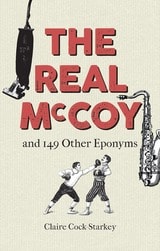
The Real McCoy
And 149 Other EponymsClaire Cock-Starkey
Bodleian Library Publishing, 2018
Deriving from numerous sources, eponyms are full of intrigue. This book features one hundred and fifty of the most interesting and enlightening specimens, delving into the origins of the words and describing the fascinating people after whom they were named. Some honor a style icon, inventor, or explorer, such as pompadour, Kalashnikov, and Cadillac. Others have roots in Greek or Roman mythology, such as panic and tantalize. Still others are far from celebratory and were created to brand the negative association of their origins—into this category can be filed boycott, Molotov cocktail, and sadist.
Encompassing words from medicine, botany, invention, science, fashion, food, and literature, this book uncovers the curious tales of discovery, mythology, innovation, and infamy behind the eponyms we use every day. The Real McCoy is the perfect addition to any wordsmith’s bookshelf.
The Recognition of Nathaniel Hawthorne
Selected Criticism Since 1828Edited by B. Bernard Cohen
University of Michigan Press, 1969
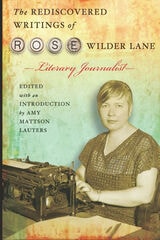
The Rediscovered Writings of Rose Wilder Lane, Literary Journalist
Edited by Amy Mattson Lauters
University of Missouri Press, 2007
This book recovers journalistic work by an American icon for whom scholarly recognition is long overdue. Amy Mattson Lauters introduces readers to Lane’s life through examples of her journalism and argues that her work and career help establish her not only as an author and political rhetorician but also as a literary journalist. Lauters has assembled a collection of rarely seen nonfiction articles that illustrate Lane’s talent as a writer of literary nonfiction, provide on-the-spot views of key moments in American cultural history, and offer sharp commentary on historical events.
Through this collection of Lane’s journalism, dating from early work for Sunset magazine in 1918 to her final piece for Woman’s Day set in 1965 Saigon, Lauters shows how Lane infused her writing with her particular ideology of Americanism and individualism, self-reliance, and freedom from government interference, thereby offering stark commentary on her times. Lane shares her experiences as an extra in a Douglas Fairbanks movie and interviews D.W. Griffith. She reports on average American women struggling to raise a family in wartime and hikes over the Albanian mountains between the world wars. Her own maturing conservative political views provide a lens through which readers can view debates over the draft, war, and women’s citizenship during World War II, and her capstone piece brings us again into a culture torn by war, this time in Southeast Asia.
These writings have not been available to the reading public since they first appeared. They encapsulate important moments for Lane and her times, revealing the woman behind the text, the development of her signature literary style, and her progression as a writer. Lauters’s introduction reveals the flow of Lane’s life and career, offering key insights into women’s history, the literary journalism genre, and American culture in the first half of the twentieth century.
Through these works, readers will discover a writer whose cultural identity was quintessentially American, middle class, midwestern, and simplistic—and who assumed the mantle of custodian to Americanism through women’s arts. The Rediscovered Writings of Rose Wilder Lane traces the extraordinary relationship between one woman and American society over fifty pivotal years and offers readers a treasury of writings to enjoy and discuss.

The Reference Guide to Data Sources
Julia Bauder
American Library Association, 2014

The Regional Dynamics of Language Differentiation in Belgium
A Study in Cultural-Political GeographyAlexander B. Murphy
University of Chicago Press, 1988
The Religious Thought of Samuel Johnson
Chester F. Chapin
University of Michigan Press, 1968

The Reporter's Environmental Handbook
Third EditionBernadette M West, M. Jane Lewis, Michael R Greenberg, David B. Sachsman, and Renee M. Rogers
Rutgers University Press, 2003

The Reporter's Handbook on Nuclear Materials, Energy & Waste Management
Michael R. Greenberg
Vanderbilt University Press, 2009
Each "brief" is based on interviews with named scientists, engineers, or administrators in a nuclear specialty, and each has been reviewed by a team of independent experts. The objective is not to make a case for or against nuclear-related technologies, but rather to provide definitive background information. (The approach is based on that of The Reporter's Environmental Handbook, published in 1988, which won a special award for journalism from the Sigma Delta Chi Society of professional journalists.)
Other features of the book include: a glossary of hundreds of terms, an introduction to risk assessment, environmental and economic impacts, and public perceptions, an article by an experienced reporter with recommendations about how to cover nuclear issues, quick guides to the history of nuclear power in the United States, important federal legislation and regulations, nuclear position statements, and key organizations, print and electronic resources.
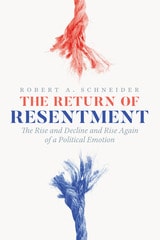
The Return of Resentment
The Rise and Decline and Rise Again of a Political EmotionRobert A. Schneider
University of Chicago Press, 2023
The term “resentment,” often casually paired with words like “hatred,” “rage,” and “fear,” has dominated US news analysis since November 2016. Despite its increased use, this word seems to defy easy categorization. Does “resentment” describe many interlocking sentiments, or is it just another way of saying “anger”? Does it suggest an irrational grievance, as opposed to a legitimate callout of injustice? Does it imply political leanings, or is it nonpartisan by nature?
In The Return of Resentment, Robert A. Schneider explores these questions and more, moving from eighteenth-century Britain to the aftermath of the French Revolution to social movements throughout the twentieth century. Drawing on a wide range of writers, thinkers, and historical experiences, Schneider illustrates how resentment has morphed across time, coming to express a collective sentiment felt by people and movements across the political spectrum. In this history, we discover resentment’s modernity and its ambiguity—how it can be used to dismiss legitimate critique and explain away violence, but also convey a moral stance that demands recognition. Schneider anatomizes the many ways resentment has been used to label present-day movements, from followers of Trump and supporters of Brexit to radical Islamicists and proponents of identity politics. Addressing our contemporary political situation in a novel way, The Return of Resentment challenges us to think critically about the roles different emotions play in politics.
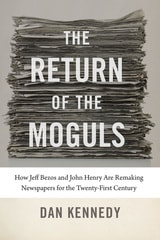
The Return of the Moguls
How Jeff Bezos and John Henry Are Remaking Newspapers for the Twenty-First CenturyDan Kennedy
University Press of New England, 2018
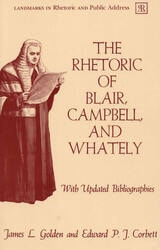
The Rhetoric of Blair, Campbell, and Whately, Revised Edition
James L. Golden and Edward P. J. Corbett
Southern Illinois University Press, 1990
Hugh Blair, George Campbell, and Richard Whately, whose works were first published in the late 18th and early 19th centuries, constituted the great triumvirate of British Rhetoricians. For 20 years, earlier printings of this book, which contains substantial excerpts comprising the most significant portions of their writings, have been widely used as textbooks in history-of-rhetoric courses. An increasing interest in rhetoric at the college level has created a renewed demand for reprints of such classic primary texts.
The Preface places the three rhetoricians within the context of the rhetorical tradition, which began in 5th-century BCE Greece. The bibliographies have been updated to include 20th-century scholarly work on Blair, Campbell, and Whately, and on the 18th- and 19th-century rhetorical movement. Biographical sketches of Blair, Campbell, and Whately are also provided.
The Rhetoric of Cool
Composition Studies and New MediaJeff Rice
Southern Illinois University Press, 2007
The Rhetoric of Cool addresses the disciplinary claim that composition studies underwent a rebirth in 1963. At that time, three writers reviewed technology, cultural studies, and visual writing outside composition studies and independently used the word cool to describe each position. Starting from these three positions, Rice focuses on chora, appropriation, commutation, juxtaposition, nonlinearity, and imagery—rhetorical gestures conducive to new media work-- to construct the rhetoric of cool.
An innovative work that approaches computers and writing issues from historical, critical, theoretical, and practical perspectives, The Rhetoric of Cool challenges current understandings of writing and new media and proposes a rhetorical rather than an instrumental response for teaching writing in new media contexts.
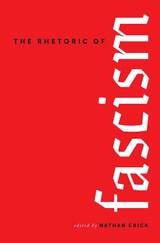
The Rhetoric of Fascism
Edited by Nathan Crick
University of Alabama Press, 2022
Decoding the discourse: Rhetorical foundations of authoritarian power.
Fascism has resurfaced as one of the most pressing problems of our time. The rise of extremist parties and candidates in Europe, the United States, and around the globe has led even mainstream political commentators to begin using the term “fascism” to describe dangerous movements that have revived and repackaged many of the strategies long thought to have been relegated to the margins of political rhetoric. No longer just confined to the state regimes of the past, fascism thrives today as a globally self-augmenting, self-propagating rhetorical phenomenon with a variety of faces and expressions.
The Rhetoric of Fascism defines and interprets the common persuasive devices that characterize fascist discourse to understand the nature of its enduring appeal. By approaching fascism from a rhetorical perspective, this volume complements established political and sociological understandings of fascism as a movement or regime. A rhetorical approach studies fascism less as a party one joins than as a set of persuasive strategies one adopts. Fascism spreads precisely because it is not a coherent entity. Instead, it exists as a loosely bound and often contradictory collection of persuasive trajectories that have attained enough coherence to mobilize and channel the passions of a self-constituted mass of individuals.
Introductory chapters focus on general theories of fascism drawn from twentieth-century history and theory. Contributors investigate specific historical figures and their relationship to contemporary rhetorics, focusing on a specific rhetorical device that is characteristic of fascist rhetoric. A common thread throughout every chapter is that fascist devices are appealing because they speak to us in the familiar language of our culture. As we are seduced by one device at a time, we soon find ourselves part of a movement, a group, or a campaign that makes us act in ways we might never have imagined. This volume reveals that fascism may be closer to home than we think.
CONTRIBUTORS
Patrick D. Anderson / Rya Butterfield / Nathan Crick / Elizabeth R. Earle / Zac Gershberg / Stephen J. Hartnett / Marie-Odile N. Hobeika / Sean Illing / Jacob A. Miller / Fernando Ismael Quiñones Valdivia / Patricia Roberts-Miller / Raquel M. Robvais / Bradley A. Serber / Ryan Skinnell
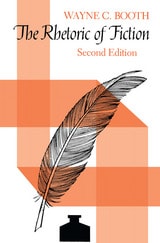
The Rhetoric of Fiction
Wayne C. Booth
University of Chicago Press, 1983
For this new edition, Wayne C. Booth has written an extensive Afterword in which he clarifies misunderstandings, corrects what he now views as errors, and sets forth his own recent thinking about the rhetoric of fiction. The other new feature is a Supplementary Bibliography, prepared by James Phelan in consultation with the author, which lists the important critical works of the past twenty years—two decades that Booth describes as "the richest in the history of the subject."
The Rhetoric of Law
Austin Sarat and Thomas R. Kearns, Editors
University of Michigan Press, 1996
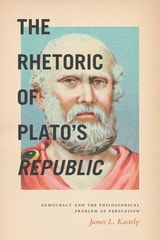
The Rhetoric of Plato's Republic
Democracy and the Philosophical Problem of PersuasionJames L. Kastely
University of Chicago Press, 2015
As Kastely shows, the Republic begins with two interrelated crises: one rhetorical, one philosophical. In the first, democracy is defended by a discourse of justice, but no one can take this discourse seriously because no one can see—in a world where the powerful dominate the weak—how justice is a value in itself. That value must be found philosophically, but philosophy, as Plato and Socrates understand it, can reach only the very few. In order to reach its larger political audience, it must become rhetoric; it must become a persuasive part of the larger culture—which, at that time, meant epic poetry. Tracing how Plato and Socrates formulate this transformation in the Republic, Kastely isolates a crucial theory of persuasion that is central to how we talk together about justice and organize ourselves according to democratic principles.

The Rhetoric of Pregnancy
Marika Seigel
University of Chicago Press, 2013
Using a sophisticated rhetorical analysis, Marika Seigel works to deconstruct pregnancy manuals while also identifying ways to improve communication about pregnancy and healthcare. She traces the manuals’ evolution from early twentieth-century tomes that instructed readers to unquestioningly turn their pregnancy management over to doctors, to those of the women’s health movement that encouraged readers to engage more critically with their care, to modern online sources that sometimes serve commercial interests as much as the mother’s.
The first book-length study of its kind, The Rhetoric of Pregnancy is a must-read for both users and designers of our prenatal systems—doctors and doulas, scholars and activists, and anyone interested in encouraging active, effective engagement.
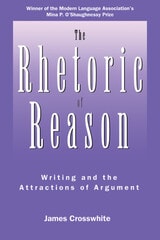
The Rhetoric of Reason
Writing and the Attractions of ArgumentJames Crosswhite
University of Wisconsin Press, 1996
To those who have lost faith in the abilities of people to reach reasoned mutual agreements, and to others who have attacked the right-or-wrong model of formal logic, this book offers the reminder that the rhetorical tradition has always viewed argumentation as a dialogue, a response to changing situations, an exchange of persuading, listening, and understanding. Crosswhite’s aim is to give new purpose to writing instruction and to students’ writing, to reinvest both with the deep ethical interests of the rhetorical tradition. In laying out the elements of argumentation, for example, he shows that claiming, questioning, and giving reasons are not simple elements of formal logic, but communicative acts with complicated ethical features. Students must learn not only how to construct an argument, but the purposes, responsibilities, and consequences of engaging in one.
Crosswhite supports his aims through a rhetorical reconstruction of reason, offering new interpretations of Plato and Aristotle and of the concepts of reflection and dialogue from early modernity through Hegel to Gadamer. And, in his conclusion, he ties these theoretical and historical underpinnings to current problems of higher education, the definition of the liberal arts, and, especially, the teaching of written communication.
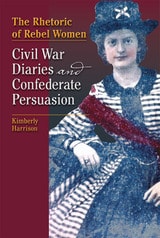
The Rhetoric of Rebel Women
Civil War Diaries and Confederate PersuasionKimberly Harrison
Southern Illinois University Press, 2013
Informed by more than one hundred diaries, this study provides insight into how women cultivated rhetorical agency, challenging traditional gender expectations while also upholding a cultural status quo. Author Kimberly Harrison analyzes the rhetorical choices these women made and valued in wartime and postwar interactions with Union officers and soldiers, slaves and former slaves, local community members, and even their God. In their intimate accounts of everyday war, these diarists discussed rhetorical strategies that could impact their safety, their livelihoods, and those of their families. As they faced Union soldiers in attempts to protect their homes and property, diarists saw their actions as not only having local, immediate impact on their well-being but also as reflecting upon their cause and the character of the southern people as a whole. They instructed themselves through their personal writing, allowing insight into how southern women prepared themselves to speak and act in new and contested contexts.
The Rhetoric of Rebel Women highlights the contributions of privileged white southern women in the development of the Confederate national identity, presenting them not as passive observers but as active participants in the war effort.
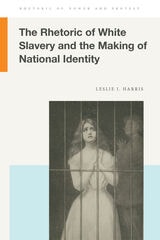
The Rhetoric of White Slavery and the Making of National Identity
Leslie J Harris
Michigan State University Press, 2023

The Rhetoric of the "Other" Literature
W. Ross Winterowd
Southern Illinois University Press, 1990
Using traditional and contemporary rhetorical theory, Winterowd argues that the fiction-nonfiction division of literature is unjustified and destructive.
He would bridge the gap between literary scholars and rhetoricians by including both fiction (imaginative literature) and nonfiction (literature of fact) in the canon. The actual difference in literary texts, he notes, lies not in their factuality but in their potential for eliciting an aesthetic response.
With speech act and rhetorical theory as a basis, Winterowd argues that presentational literature gains its power on the basis of its ethical and pathetic appeal, not because of its assertions or arguments.
The Rhetoric of the New Political Documentary
Edited by Thomas W. Benson and Brian J. Snee
Southern Illinois University Press, 2008
The Rhetoric of the New Political Documentary explores the most visible and volatile element in the 2004 presidential campaign—the partisan documentary film. This collection of original critical essays by leading scholars and critics—including Shawn J. and Trevor Parry-Giles, Jennifer L. Borda, and Martin J. Medhurst—analyzes a selection of political documentaries that appeared during the 2004 election season. The editors examine the new political documentary with the tools of rhetorical criticism, combining close textual analysis with a consideration of the historical context and the production and reception of the films.
The essays address the distinctive rhetoric of the new political documentary, with the films typically having been shot with relatively low budgets, in video, and using interviews and stock footage rather than observation of uncontrolled behavior. The quality was often good enough and interest was sufficiently intense that the films were shown in theaters and on television, which provided legitimacy and visibility before they were released soon afterwards on DVD and VHS and marketed on the Internet.
The volume reviews such films as Michael Moore’s Fahrenheit 9/11; two refutations of Moore’s film, Fahrenhype 9/11 and Celsius 41.11;Unprecedented: The 2000 Presidential Election; and George W. Bush: Faith in the White House—films that experimented with a variety of angles and rhetorics, from a mix of comic disparagement and earnest confrontation to various emulations of traditional news and documentary voices.
The Rhetoric of the New Political Documentary represents the continued transformation of American political discourse in a partisan and contentious time and showcases the independent voices and the political power brokers that struggled to find new ways to debate the status quo and employ surrogate “independents” to create a counterrhetoric.
The Rhetorical Invention of Diversity
Supreme Court Opinions, Public Arguments, and Affirmative ActionM. Kelly Carr
Michigan State University Press, 2018
The Rhetorical Turn
Invention and Persuasion in the Conduct of InquiryEdited by Herbert W. Simons
University of Chicago Press, 1990
The Rhetorical Turn moves from biology to politics via excursions into the rhetorics of psychoanalysis, decision science, and conversational analysis. Topics explored include how rhetorical invention guides scientific invention, how rhetoric assists political judgment, and how it integrates varying approaches to meta-theory. Concluding with four philosophical essays, this volume of case studies demonstrates how the inventive and persuasive dimensions of scholarly discourse point the way to forms of argument appropriate to our postmodern age.
The Rhetorics of Thomas Hobbes and Bernard Lamy
John T. Harwood
Southern Illinois University Press, 1986
Makes accessible to modern readers the 17th-century rhetorics of Thomas Hobbes (1588–1677) and Bernard Lamy (1640–1715)
Hobbes’ A Briefe of the Art of Rhetorique, the first English translation of Aristotle’s rhetoric, reflects Hobbes’ sense of rhetoric as a central instrument of self-defense in an increasingly fractious Commonwealth. In its approach to rhetoric, which Hobbes defines as “that Faculty by which wee understand what will serve our turne, concerning any subject, to winne beliefe in the hearer,” the Briefe looks forward to Hobbes’ great political works De Cive and Leviathan.
Published anonymously in France as De l’art de parler, Lamy’s rhetoric was translated immediately into English as The Art of Speaking. Lamy’s long association with the Port Royalists made his works especially attractive to English readers because Port Royalists were engaged in a vicious quarrel with the Jesuits during the last half of the 17th century.
The Riddle of Literary Quality
A Computational ApproachKarina van Dalen-Oskam
Amsterdam University Press, 2023
Using evidence from almost 14,000 readers and building on more textual data than ever before, Van Dalen-Oskam and her team uncovered unconscious biases that shed new light on prejudices many people assumed no longer existed. This monograph explains in an accessible way how the project unfolded, which methods were used, and how the results may change the future of Literary Studies.
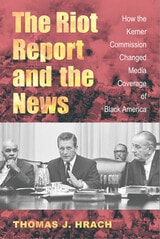
The Riot Report and the News
How the Kerner Commission Changed Media Coverage of Black AmericaThomas J. Hrach
University of Massachusetts Press, 2016
On July 28, 1967, President Lyndon B. Johnson established the National Advisory Commission on Civil Disorders to investigate the causes of unrest in urban black communities during the 1960s. Chaired by Illinois governor Otto Kerner Jr., the commission ominously warned, “Our nation is moving toward two societies, one black, one white—separate and unequal.” And it aimed its sharpest criticism at the mainstream media, concluding: “The press has too long basked in a white world, looking out of it, if at all, with white men's eyes and a white perspective.” Major news media responded by expanding and diversifying their coverage of black communities and increasing the number of African Americans in their newsrooms.
Although much has been written about the Kerner Commission, the analysis has focused primarily on its affect on the American press. In The Riot Report and the News, Thomas J. Hrach instead explores how the commission came to its conclusions, in order to understand why and how its report served as a catalyst for change. Hrach finds that such government criticism of the media can have a long-term and positive influence on the nation, an insight that remains important as the news continues to struggle with how to cover issues of race.
The Rise and Fall of Early American Magazine Culture
Jared Gardner
University of Illinois Press, 2014
The Rise and Fall of the Associated Negro Press
Claude Barnett's Pan-African News and the Jim Crow ParadoxGerald Horne
University of Illinois Press, 2017
Gerald Horne weaves Barnett's fascinating life story through a groundbreaking history of the ANP, including its deep dedication to Pan-Africanism. An activist force in journalism, Barnett also helped send doctors and teachers to Africa, advised African governments, gave priority to foreign newsgathering, and saw the African American struggle in global terms. Yet Horne also confronts Barnett's contradictions. A member of the African American elite, Barnett's sympathies with black aspirations often clashed with his ethics and a powerful desire to join the upper echelons of business and government. In the end, Barnett's activist success undid his work. Horne traces the dramatic story of the ANP's collapse as the mainstream press, retreating from Jim Crow, finally covered black issues and hired African American journalists.
Revelatory and entertaining, The Rise and Fall of the Associated Negro Press tells the story of a forgotten pioneer and the ambitious black institution he created.
The Rise of AI
Implications and Applications of Artificial Intelligence in Academic LibrariesSandy Hervieux
Assoc of College & Research Libraries, 2022
The Rise of AI collects projects, collaborations, and future uses from academic librarians who have begun to embrace AI in their work. In three parts—User Services, Collections and Discovery, and Toward Future Applications—it explores:
- machine translation
- creating incubation spaces
- robotics
- combining information literacy initiatives with AI literacy
- fostering partnerships with other on-campus groups
- integrating AI technology into collections to enhance discoverability
- using AI to refine metadata for images, articles, and theses
- machine learning
The Rise of AI introduces implications and applications of artificial intelligence in academic libraries and hopes to provoke conversations and inspire new ways of engaging with the technology. As the discussion surrounding ethics, bias, and privacy in AI continues to grow, librarians will be called to make informed decisions and position themselves as leaders in this discourse.
The Rising of Lotus Flowers
Self-Education by Deaf Children in Thai Boarding SchoolsCharles B. Reilly
Gallaudet University Press, 2005
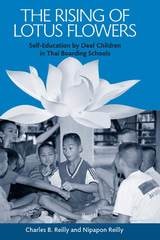
In developed nations around the world, residential schools for deaf students are giving way to the trend of inclusion in regular classrooms. Nonetheless, deaf education continues to lag as the students struggle to communicate. In the Bua School in Thailand, however, 400 residential deaf students ranging in age from 6 to 19 have met with great success in teaching each other Thai Sign Language (TSL) and a world of knowledge once thought to be lost to them. The Rising of Lotus Flowers: Self-Education by Deaf Children in Thai Boarding Schools reveals how their institutionalization allowed them to foster a unique incubator of communication and education.
Charles B. Reilly, a teacher and community organizer in Thailand for eight years, and Nipapon Reilly, a Deaf Thai citizen, studied the students in the Bua School for 14 years, with periodic follow-ups thereafter. They found that the students learned little from their formal instructors, but that they were able to educate each other in time spent away from the classroom. Older students who had learned TSL in the dorms and on the playground successfully passed it on to six-year-olds who had virtually no language at all. The Reillys’ study uncovers an elaborate hierarchy of education among these students, with each group using games and other activities to teach and bring other classmates up to their level. Named for the much admired aquatic plant that blooms in Thailand’s bogs, the Bua School epitomizes the ideal of The Rising of Lotus Flowers, which also offers analytical evidence of the continuing value of residential schools in deaf education.
The Road Story and the Rebel
Moving Through Film, Fiction, and TelevisionKatie Mills
Southern Illinois University Press, 2006
In The Road Story and the Rebel: Moving Through Film, Fiction, and Television, Beat studies scholar Katie Mills examines how road stories, which have offered declarations of independence to generations of rebellious Americans, have been transformed by media, technology, and social movements. The genre, which includes literature, films, television shows, and several types of digital media, has evolved, says Mills, as each new generation questions its own identity and embraces the thrill of “automobility” (autonomy and mobility) thus providing audiences a means to consider radically altered notions of independence, even as the genre cycles between innovation and commodification.
This cultural history reveals the unique qualities of road stories and follows the evolution from the Beats’ postwar literary adventures to today’s postmodern reality television shows. Tracing the road story as it moves to both LeRoi Jones’s critique of the Beats’ romanticization of blacks as well as to the mainstream in the 1960s with CBS’s Route 66, Mills also documents the rebel subcultures of novelist Ken Kesey and the Merry Pranksters, who used film and LSD as inspiration on a cross-country bus trip, and she examines the sexualization of male mobility and biker mythology in the films Scorpio Rising,The Wild Angels, and Easy Rider. Mills addresses how the filmmakers of the 1970s—Coppola, Scorsese, and Bogdanovich—flourished in New Hollywood with road films that reflected mainstream audiences and how feminists Joan Didion and Betty Friedan subsequently critiqued them. A new generation of women and minority storytellers gain clout and bring genre remapping to the national consciousness, Mills explains, as the road story evolves from such novels as Song of Solomon to films like Thelma and Louise and television’s Road Rules 2.
The Road Story and the Rebel, which includes twenty illustrations, effectively explores the cultural significance of sixty years of rebellion in film, literature, television, and digital media. Spanning media platforms and marginalized communities, the text offers new interpretations of canonical works and reintroduces forgotten works, revealing the genre to be more political and philosophical than previously understood.
The Role of the Educational Interpreter
Perceptions of Administrators and TeachersStephen B. Fitzmaurice
Gallaudet University Press, 2021
Through a series of qualitative interviews and quantitative questionnaires with district administrators, school administrators, general education teachers, and teachers of the deaf, Fitzmaurice documents their perceptions of educational interpreters. Findings from the data reveal the perceptions of administrators and teachers set the stage for role ambiguity, role conflicts, and subsequent role overload for educational interpreters. Fitzmaurice elaborates on the implications of the research, and also provides concrete recommendations for researchers and practitioners, including an emphasis on the importance of involving the Deaf community in this work. This volume aims to offer clarity on the role of the educational interpreter, and dispel the confusion and conflicts created by divergent perspectives. A shared understanding of the role of the educational interpreter will allow administrators, teachers, and interpreters to work collaboratively to improve educational outcomes for deaf students.
The SBL Handbook of Style
SBL Press, 2014
The definitive source for how to write and publish in the field of biblical studies
The long-awaited second edition of the essential style manual for writing and publishing in biblical studies and related fields includes key style changes, updated and expanded abbreviation and spelling-sample lists, a list of archaeological site names, material on qur’anic sources, detailed information on citing electronic sources, and expanded guidelines for the transliteration and transcription of seventeen ancient languages.
Features:
- Expanded lists of abbreviations for use in ancient Near Eastern, biblical, and early Christian studies
- Information for transliterating seventeen ancient languages
- Exhaustive examples for citing print and electronic sources
The Scholarly Communications Cookbook
Brianna Buljung
Assoc of College & Research Libraries, 2021
The Scholarly Communications Cookbook features 84 recipes that can help you establish programs, teach concepts, conduct outreach, and use scholarly communications technologies in your library. The book is divided into 4 thorough sections:
- Taking Your Program to the Next Level
- Open Educational Resources
- Publishing Models and Open Access
- Tools, Trends, and Best Practices for Modern Researchers

The Scholarly Workflow in the Digital Age
Steven Weiland
Against the Grain, LLC, 2021
As this Briefing explains, the workflow features planning and structure, and a recognizable sequence of activities. But so too is there room for imagination, improvisation, and serendipity. Science and scholarship are human activities and the workflow in all disciplines reflects both convention and innovation as scholars discover the extent and meanings of their professional interactions with technology. In the digital age the workflow is in a new stage of representing what scholars do to advance knowledge and their careers, at the same time it displays the durability of traditional research practices.
The Science of Reading
Information, Media, and Mind in Modern AmericaAdrian Johns
University of Chicago Press, 2023
Reading is perhaps the essential practice of modern civilization. For centuries, it has been seen as key to both personal fulfillment and social progress, and millions today depend on it to participate fully in our society. Yet, at its heart, reading is a surprisingly elusive practice. This book tells for the first time the story of how American scientists and others have sought to understand reading, and, by understanding it, to improve how people do it.
Starting around 1900, researchers—convinced of the urgent need to comprehend a practice central to industrial democracy—began to devise instruments and experiments to investigate what happened to people when they read. They traced how a good reader’s eyes moved across a page of printed characters, and they asked how their mind apprehended meanings as they did so. In schools across the country, millions of Americans learned to read through the application of this science of reading. At the same time, workers fanned out across the land to extend the science of reading into the social realm, mapping the very geography of information for the first time. Their pioneering efforts revealed that the nation’s most pressing problems were rooted in drastic informational inequities, between North and South, city and country, and white and Black—and they suggested ways to tackle those problems.
Today, much of how we experience our information society reflects the influence of these enterprises. This book explains both how the science of reading shaped our age and why, with so-called reading wars still plaguing schools across the nation, it remains bitterly contested.
The Science of Reading
Information, Media, and Mind in Modern AmericaAdrian Johns
University of Chicago Press, 2023
For the first time, the story of how and why we have plumbed the mysteries of reading, and why it matters today.
Reading is perhaps the essential practice of modern civilization. For centuries, it has been seen as key to both personal fulfillment and social progress, and millions today depend on it to participate fully in our society. Yet, at its heart, reading is a surprisingly elusive practice. This book tells for the first time the story of how American scientists and others have sought to understand reading, and, by understanding it, to improve how people do it.
Starting around 1900, researchers—convinced of the urgent need to comprehend a practice central to industrial democracy—began to devise instruments and experiments to investigate what happened to people when they read. They traced how a good reader’s eyes moved across a page of printed characters, and they asked how their mind apprehended meanings as they did so. In schools across the country, millions of Americans learned to read through the application of this science of reading. At the same time, workers fanned out across the land to extend the science of reading into the social realm, mapping the very geography of information for the first time. Their pioneering efforts revealed that the nation’s most pressing problems were rooted in drastic informational inequities, between North and South, city and country, and white and Black—and they suggested ways to tackle those problems.
Today, much of how we experience our information society reflects the influence of these enterprises. This book explains both how the science of reading shaped our age and why, with so-called reading wars still plaguing schools across the nation, it remains bitterly contested.

The Scientific Journal
Authorship and the Politics of Knowledge in the Nineteenth CenturyAlex Csiszar
University of Chicago Press, 2018
The Scientific Journal tells the story of how that changed. Alex Csiszar takes readers deep into nineteenth-century London and Paris, where savants struggled to reshape scientific life in the light of rapidly changing political mores and the growing importance of the press in public life. The scientific journal did not arise as a natural solution to the problem of communicating scientific discoveries. Rather, as Csiszar shows, its dominance was a hard-won compromise born of political exigencies, shifting epistemic values, intellectual property debates, and the demands of commerce. Many of the tensions and problems that plague scholarly publishing today are rooted in these tangled beginnings. As we seek to make sense of our own moment of intense experimentation in publishing platforms, peer review, and information curation, Csiszar argues powerfully that a better understanding of the journal’s past will be crucial to imagining future forms for the expression and organization of knowledge.
The Scientific Literature
A Guided TourEdited by Joseph E. Harmon and Alan G. Gross
University of Chicago Press, 2007
The scientific article has been a hallmark of the career of every important western scientist since the seventeenth century. Yet its role in the history of science has not been fully explored. Joseph E. Harmon and Alan G. Gross remedy this oversight with The Scientific Literature, a collection of writings—excerpts from scientific articles, letters, memoirs, proceedings, transactions, and magazines—that illustrates the origin of the scientific article in 1665 and its evolution over the next three and a half centuries.
Featuring articles—as well as sixty tables and illustrations, tools vital to scientific communication—that represent the broad sweep of modern science, The Scientific Literature is a historical tour through both the rhetorical strategies that scientists employ to share their discoveries and the methods that scientists use to argue claims of new knowledge. Commentaries that explain each excerpt’s scientific and historical context and analyze its communication strategy accompany each entry.
A unique anthology, The Scientific Literature will allow both the scholar and the general reader to experience first hand the development of modern science.
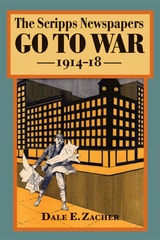
The Scripps Newspapers Go to War, 1914-18
Dale Zacher
University of Illinois Press, 2007
Zacher's account delves into details inside a major newspaper operation during World War I and provides fascinating accounts of its struggles with competition, attending to patriotic duties, and internal editorial dissent. Zacher also looks at war-related issues, considering the newspapers' relationship with President Woodrow Wilson, American neutrality, the move to join the war, and fallout from disillusionment over the actuality of war. As Zacher shows, the progressive spirit and political independence at the Scripps newspapers came under attack and was changed forever during the era.
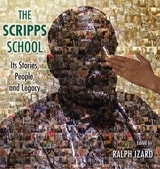
The Scripps School
Its Stories, People, and LegacyRalph Izard
Ohio University Press, 2018
An anecdotal history published on the occasion of the one hundredth anniversary of Ohio University’s renowned E. W. Scripps School of Journalism.
After its founding in 1924, what is now the E. W. Scripps School of Journalism at Ohio University quickly became one of the premier programs in the country. For decades, it has produced leaders who have reached the highest levels of journalism and communication in their careers, and their success is a direct product not only of the education they get in Athens but of the community the school fosters.
In this book, nearly one hundred alumni, faculty, friends, and students offer their stories of life at and after Scripps. The result is a multilayered, inspiring portrait of the school and how it shapes those who pass through its doors. At the same time, The Scripps School gives a nuanced history of journalism education at Ohio University. From covering assassinations and presidential elections to major moments in sports, alumni have documented the unprecedented and the historic, and here they show just how Scripps prepared them to be there.
The Scripps School, edited by former director Ralph Izard, is a love letter to the people and the institution. At a time when journalism is more important than ever, this book humanizes and contextualizes the profession in ways that will resonate in the Scripps community and beyond.
The Second International Symposium on Signed Language Interpretation and Translation Research
Selected PapersDanielle I. J. Hunt
Gallaudet University Press, 2020
Signed chapter summaries will be available on the Gallaudet University Press YouTube channel upon publication.
The Secret History of Emotion
From Aristotle's Rhetoric to Modern Brain ScienceDaniel M. Gross
University of Chicago Press, 2006
Through a radical rereading of Aristotle, Seneca, Thomas Hobbes, Sarah Fielding, and Judith Butler, among others, Daniel M. Gross reveals a persistent intellectual current that considers emotions as psychosocial phenomena. In Gross’s historical analysis of emotion, Aristotle and Hobbes’s rhetoric show that our passions do not stem from some inherent, universal nature of men and women, but rather are conditioned by power relations and social hierarchies. He follows up with consideration of how political passions are distributed to some people but not to others using the Roman Stoics as a guide. Hume and contemporary theorists like Judith Butler, meanwhile, explain to us how psyches are shaped by power. To supplement his argument, Gross also provides a history and critique of the dominant modern view of emotions, expressed in Darwinism and neurobiology, in which they are considered organic, personal feelings independent of social circumstances.
The result is a convincing work that rescues the study of the passions from science and returns it to the humanities and the art of rhetoric.

The Secret of the Hardy Boys
Leslie McFarlane and the Stratemeyer SyndicateMarilyn S. Greenwald
Ohio University Press, 2004
For generations of readers, the Hardy Boys were the creations of the legendary Franklin W. Dixon—except Dixon never existed. Behind the iconic series stood the Stratemeyer Syndicate, a powerhouse of children’s publishing, and one gifted but largely unrecognized writer: Leslie McFarlane.
In The Secret of the Hardy Boys, acclaimed biographer Marilyn S. Greenwald uncovers the remarkable story of the man who first brought Frank and Joe Hardy to life. A young Canadian journalist with ambitions beyond formula fiction, McFarlane infused the Syndicate’s rigid plots with wit, atmosphere, and narrative vitality—helping to shape one of the most enduring franchises in children’s literature.
Bound by contract and reluctant to claim authorship, McFarlane kept his role a secret for decades, receiving little financial reward for books that sold in the millions. Yet his story is far from one of regret. Drawing on extensive research, Greenwald paints a vivid portrait of a versatile writer who navigated the shifting landscape of twentieth-century media, from pulp magazines to radio and film.
Rich in literary history and human insight, The Secret of the Hardy Boys is both a revealing behind-the-scenes account of a cultural phenomenon and an inspiring testament to creativity, resilience, and the quiet architects of beloved stories.
The Selected Writings of John Witherspoon
Edited by Thomas P. Miller
Southern Illinois University Press, 1990

The Self As Subject
Autoethnographic Research IntoAnneMarie Deitering
Assoc of College & Research Libraries, 2017
The Semantic Basis of Argument Structure
Stephen Wechsler
CSLI, 1995

The Semantics of Incorporation
From Argument Structure to Discourse TransparencyDonka F. Farkas and Henriëtte de Swart
CSLI, 2003
The analysis presented in this book has important consequences for a cross-linguistic theory of anaphora. Linguists and logicians interested in discourse structure, cross-linguistic semantics, and the relationship between morpho-syntax and meaning will find this an engaging and innovative work.
The Semantics of Syntax
A Minimalist Approach to GrammarDenis Bouchard
University of Chicago Press, 1995
The Semantics of Syntax is an elegant and powerful analysis of the relationship between syntax and semantics. Noting that meaning is underdetermined by form even in simple cases, Denis Bouchard argues that it is impossible to build knowledge of the world into grammar and still have a describable grammar. He thus proposes simple semantic representations and simple rules to relate linguistic levels. Focusing on a class of French verbs, Bouchard shows how multiple senses can be accounted for by the assumption of a single abstract core meaning along with background information about how objects behave in the world. He demonstrates that this move simplifies the syntax at no cost to the descriptive power of the semantics. In two important final chapters, he examines the consequences of his approach for standard syntactic theories.