Results by title
4531 books match the query 'Cultural & Ethnic Studies' and 804 start with t

The Right to Remain Violets
poemasAntonio De Jesús López
University of Arizona Press, 2027
The Right to Remain Violets is an electrifying poetry collection that reimagines the language of policing, public education, and state surveillance to illuminate the lived realities of Black and Brown youth in East Palo Alto—a city shaped by redlining, freeway expansion, and decades of over-policing. Blending documentary poetics with hip-hop cadence and Catholic liturgy, Antonio De Jesús López transforms transcripts, municipal documents, and legal language into a powerful form of witness. These poems trace how children are drafted into systems of surveillance and criminalization, even as they search for joy and solidarity amid Silicon Valley’s contrasts of wealth and dispossession.
Inventive and emotionally resonant, the collection spans sonnets, sestinas, hip-hop, and prayer, insisting that language can both indict and heal. López brings his experiences as an award-winning poet, scholar, and former mayor of East Palo Alto to each poem. At once elegy and refusal, The Right to Remain Violets speaks to readers of documentary poetics, social justice literature, and those who believe in the radical importance of protecting childhood in an America reckoning with itself.

The Rise and Fall of America's Concentration Camp Law
Civil Liberties Debates from the Internment to McCarthyism and the Radical 1960sMasumi Izumi
Temple University Press, 2019
The Emergency Detention Act, Title II of the Internal Security Act of 1950, is the only law in American history to legalize preventive detention. It restricted the freedom of a certain individual or a group of individuals based on actions that may be taken that would threaten the security of a nation or of a particular area. Yet the Act was never enforced before it was repealed in 1971.
Masumi Izumi links the Emergency Detention Act with Japanese American wartime incarceration in her cogent study, The Rise and Fall of America’s Concentration Camp Law. She dissects the entangled discourses of race, national security, and civil liberties between 1941 and 1971 by examining how this historical precedent generated “the concentration camp law” and expanded a ubiquitous regime of surveillance in McCarthyist America.
Izumi also shows how political radicalism grew as a result of these laws. Japanese Americas were instrumental in forming grassroots social movements that worked to repeal Title II. The Rise and Fall of America’s Concentration Camp Law is a timely study in this age of insecurity where issues of immigration, race, and exclusion persist.
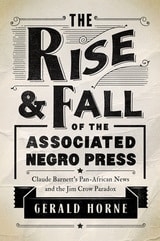
The Rise and Fall of the Associated Negro Press
Claude Barnett's Pan-African News and the Jim Crow ParadoxGerald Horne
University of Illinois Press, 2017
Gerald Horne weaves Barnett's fascinating life story through a groundbreaking history of the ANP, including its deep dedication to Pan-Africanism. An activist force in journalism, Barnett also helped send doctors and teachers to Africa, advised African governments, gave priority to foreign newsgathering, and saw the African American struggle in global terms. Yet Horne also confronts Barnett's contradictions. A member of the African American elite, Barnett's sympathies with black aspirations often clashed with his ethics and a powerful desire to join the upper echelons of business and government. In the end, Barnett's activist success undid his work. Horne traces the dramatic story of the ANP's collapse as the mainstream press, retreating from Jim Crow, finally covered black issues and hired African American journalists.
Revelatory and entertaining, The Rise and Fall of the Associated Negro Press tells the story of a forgotten pioneer and the ambitious black institution he created.

The Rise of Chicago's Black Metropolis, 1920-1929
Christopher Robert Reed
University of Illinois Press, 2014

The Rise of the American Conservation Movement
Power, Privilege, and Environmental ProtectionDorceta E. Taylor
Duke University Press, 2016
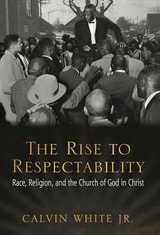
The Rise to Respectability
Race, Religion, and the Church of God in ChristCalvin White
University of Arkansas Press, 2015
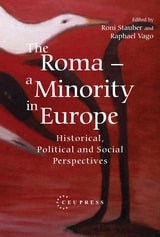
The Roma - A Minority in Europe
Historical, Political and Social PerspectivesYehuda Bauer
Central European University Press, 2007
The main issues arising from the encounter between Roma people and surrounding European society since the time of their arrival in Medieval Europe until today are discussed in this work. The history of their persecution and genocide during the Nazi era, in particular, is central to the present volume. Significantly, some authors sought to emphasize the continuing history of prejudice and persecution, which reached a peak during the Nazi era and persisted after the war. Current questions of social integration in Europe, as well as that of ethnic definition and the construction of ethnic-national identity constitute another principal pillar of the book. The complexity of issues involved, such as collective memory, myth-making and social constructionism, trigger intense debate among researchers dealing with Romani studies.
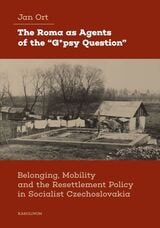
The Roma as Agents of the “G*psy Question”
Belonging, Mobility, and Resettlement Policy in Socialist Czechoslovakia in the 1960sJan Ort
Karolinum Press, 2024
The story of Romani people in communist Czechoslovakia has long been framed by a discriminatory policy of assimilation, and thus by fatal interventions into Romani family ties and their broader socio-cultural systems. Paradoxically, such a narrative failed to integrate the perspective of the Roma themselves, who often associated the same period with an unprecedented experience of social inclusion and material security. In this book, Jan Ort examines the state policy that in the mid-1960s aimed at the definitive elimination of "G*psy backwardness" through the placement of thousands of Roma families in non-Roma society, thus becoming a symbol of the social engineering interventions of the Communist regime in the lives of Czechoslovak Roma. In contrast to the predominant focus on the perspective of state authorities, Ort seeks to map the practice of this policy in specific places with an emphasis on the experiences and agency of the Roma themselves, especially those who had their homes in eastern Slovakia. In the empirical richness of a micro-historical approach, Roma as Agents of the “G*psy Question” uncovers the diverse stories of ordinary Roma who were able to incorporate various aspects of state policy into their own lives without necessarily giving up their distinctive cultural identity.
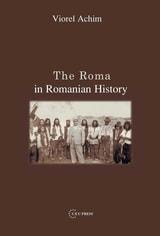
The Roma in Romanian History
Viorel Achim
Central European University Press, 2004
The Rope of God
James T. Siegel
University of Michigan Press, 2000
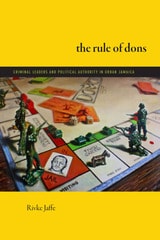
The Rule of Dons
Criminal Leaders and Political Authority in Urban JamaicaRivke Jaffe
Duke University Press, 2024
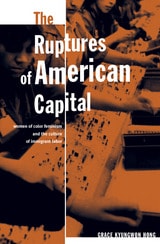
The Ruptures Of American Capital
Women Of Color Feminism And The Culture Of Immigrant LaborGrace Kyungwon Hong
University of Minnesota Press, 2006
The Rural Face of White Supremacy
BEYOND JIM CROWMark Schultz
University of Illinois Press, 2007

The Ryukyu Islands
A New History from the Stone Age to the PresentGregory Smits
University of Chicago Press, 2025
The Ryukyu Islands between Japan and Taiwan consist of around 160 islands and are home to about 1.5 million inhabitants. Across the islands’ history, sea-lanes and trade patterns have connected them to the East China Sea region, giving them a unique vantage point on the region’s changes and making them a useful lens through which to view and understand those transformations. In this book, Gregory Smits marshals his expertise to canvass the environmental, political, and social history of this fascinating area, emphasizing the diversity of influences from China, Japan, and Korea that have shaped it. Smits begins by tracing the islands’ early history from the time of the oldest extant human remains, through massive inflows of settlers from Japan, until the emergence of a centralized state in the sixteenth century. He then traces the development of the Ryukyu Kingdom from the fifteenth to the nineteenth century, examining its major cultural formations and the interplay of local and external influences driving its evolution. Finally, Smits ushers readers to the modern era, from the end of the Ryukyu Kingdom in 1879 through World War II, the era of American military control, and on to the present. He concludes with their present-day status as a tourist destination affected by ongoing geopolitical, economic, and environmental challenges. Synthesizing decades of research, this book is an indispensable, comprehensive guide to the islands’ history for scholars and nonspecialists alike.

The Sacred Door and Other Stories
Cameroon Folktales of the BebaMakuchi
Ohio University Press, 2007
The Scandal of the State
Women, Law, and Citizenship in Postcolonial IndiaRajeswari Sunder Rajan
Duke University Press, 2003
The Scandal of the State develops through a series of compelling case studies, each of which centers around an incident exposing the contradictory position of the Indian state vis-à-vis its female citizens and, ultimately, the inadequacy of its commitment to women’s rights. Sunder Rajan focuses on the custody battle over a Muslim child bride, the compulsory sterilization of mentally retarded women in state institutional care, female infanticide in Tamilnadu, prostitution as labor rather than crime, and the surrender of the female outlaw Phoolan Devi. She also looks at the ways the Uniform Civil Code presented many women with a stark choice between allegiance to their religion and community or the secular assertion of individual rights. Rich with theoretical acumen and activist passion, The Scandal of the State is a powerful critique of the mutual dependence of women and the state on one another in the specific context of a postcolonial modernity.

The Scattered Court
Hindustani Music in Colonial BengalRichard David Williams
University of Chicago Press, 2023
How far did colonialism transform north Indian music? In the period between the Mughal empire and the British Raj, how did the political landscape bleed into aesthetics, music, dance, and poetry? Examining musical culture through a diverse and multilingual archive, primarily using sources in Urdu, Bengali, and Hindi that have not been translated or critically examined before, The Scattered Court challenges our assumptions about the period. Richard David Williams presents a long history of interactions between northern India and Bengal, with a core focus on the two courts of Wajid Ali Shah (1822–1887), the last ruler of the kingdom of Awadh. He charts the movement of musicians and dancers between the two courts in Lucknow and Matiyaburj, as well as the transregional circulation of intellectual traditions and musical genres, and demonstrates the importance of the exile period for the rise of Calcutta as a celebrated center of Hindustani classical music. Since Lucknow is associated with late Mughal or Nawabi society and Calcutta with colonial modernity, examining the relationship between the two cities sheds light on forms of continuity and transition over the nineteenth century, as artists and their patrons navigated political ruptures and social transformations. The Scattered Court challenges the existing historiography of Hindustani music and Indian culture under colonialism by arguing that our focus on Anglophone sources and modernizing impulses has directed us away from the aesthetic subtleties, historical continuities, and emotional dimensions of nineteenth-century music.
The Scene of Harlem Cabaret
Race, Sexuality, PerformanceShane Vogel
University of Chicago Press, 2009
Harlem’s nightclubs in the 1920s and ’30s were a crucible for testing society’s racial and sexual limits. Normally tacit divisions were there made spectacularly public in the vibrant, but often fraught, relationship between performer and audience. The cabaret scene, Shane Vogel contends, also played a key role in the Harlem Renaissance by offering an alternative to the politics of sexual respectability and racial uplift that sought to dictate the proper subject matter for black arts and letters. Individually and collectively, luminaries such as Duke Ellington, Lena Horne, Langston Hughes, Claude McKay, Wallace Thurman, and Ethel Waters expanded the possibilities of blackness and sexuality in America, resulting in a queer nightlife that flourished in music, in print, and on stage.
Deftly combining performance theory, literary criticism, historical research, and biographical study, The Scene of Harlem Cabaret brings this rich moment in history to life, while exploring the role of nightlife performance as a definitive touchstone for understanding the racial and sexual politics of the early twentieth century.

The Science and Politics of Racial Research
William H. Tucker
University of Illinois Press, 1994
The Search for a Socialist El Dorado
Finnish Immigration to Soviet Karelia from the United States and Canada in the 1930sAlexey Golubev and Irina Takala
Michigan State University Press, 2014
The Second Battle for Africa
Garveyism, the US Heartland, and Global Black FreedomErik S. McDuffie
Duke University Press, 2024
The Selfie Machine
Selfies, Platforms, and Digital Image Culture in IndiaAnirban K. Baishya
Rutgers University Press, 2027
The Selfie Machine offers novel insight into personalized communication practices in the digital age through the medium of the selfie. While the selfie has achieved notoriety due to pop-psychology accounts of Narcissism-related selfie "disorders," this book examines the selfie as a mode of meaning making and self-presentation that includes not just still images, but also short videos, hashtag practices and economies of liking and following. In taking India as the starting point of its investigation, The Selfie Machine inverts the "West-then-the-rest" model of understanding global digital media practices. The book considers selfie culture’s impact on personal and public digital practices and trends—ranging from cellphone markets, to influencer entrepreneurship and microcelebrity, to the conduct of politics and protest. In doing so, it not only offers an expanded definition of selfies in digital media culture, but also demonstrates how “global” digital media (including selfies) cannot be understood as a monolith.
The Selling Sound
The Rise of the Country Music IndustryDiane Pecknold
Duke University Press, 2007
Pecknold draws on sources as diverse as radio advertising journals, fan magazines, Hollywood films, and interviews with industry insiders. Her sweeping social history encompasses the genre’s early days as an adjunct of radio advertising in the 1920s, the friction between Billboard and more genre-oriented trade papers over generating the rankings that shaped radio play lists, the establishment of the Country Music Association, and the influence of rock ‘n’ roll on the trend toward single-genre radio stations. Tracing the rise of a large and influential network of country fan clubs, Pecknold highlights the significant promotional responsibilities assumed by club organizers until the early 1970s, when many of their tasks were taken over by professional publicists.
The Sense of Brown
José Esteban Muñoz. Edited and with an Introduction by Joshua Chambers-Letson and Tavia Nyong'o
Duke University Press, 2020

The Sexual Life of English
Languages of Caste and Desire in Colonial IndiaShefali Chandra
Duke University Press, 2012
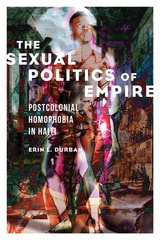
The Sexual Politics of Empire
Postcolonial Homophobia in HaitiErin L. Durban
University of Illinois Press, 2023
Evangelical Christians and members of the global LGBTQI human rights movement have vied for influence in Haiti since the 2010 earthquake. Each side accuses the other of serving foreign interests. Yet each proposes future foreign interventions on behalf of their respective causes despite the country’s traumatic past with European colonialism and American imperialism. As Erin L. Durban shows, two discourses dominate discussions of intervention. One maintains imperialist notions of a backward Haiti so riddled with cultural deficiencies that foreign supervision is necessary to overcome Haitians’ resistance to progress. The other sees Haiti as a modern but failed state that exists only through its capacity for violence, including homophobia. In the context of these competing claims, Durban explores the creative ways that same-sex desiring and gender creative Haitians contend with anti-LGBTQI violence and ongoing foreign intervention.
Compelling and thought-provoking, The Sexual Politics of Empire examines LGBTQI life in contemporary Haiti against the backdrop of American imperialism and intervention.
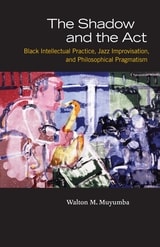
The Shadow and the Act
Black Intellectual Practice, Jazz Improvisation, and Philosophical PragmatismWalton M. Muyumba
University of Chicago Press, 2009
Though often thought of as rivals, Ralph Ellison, James Baldwin, and Amiri Baraka shared a range of interests, especially a passion for music. Jazz, in particular, was a decisive influence on their thinking, and, as The Shadow and the Act reveals, they drew on their insights into the creative process of improvisation to analyze race and politics in the civil rights era. In this inspired study, Walton M. Muyumba situates them as a jazz trio, demonstrating how Ellison, Baraka, and Baldwin’s individual works form a series of calls and responses with each other.
Muyumba connects their writings on jazz to the philosophical tradition of pragmatism, particularly its support for more freedom for individuals and more democratic societies. He examines the way they responded to and elaborated on that lineage, showing how they significantly broadened it by addressing the African American experience, especially its aesthetics. Ultimately, Muyumba contends, the trio enacted pragmatist principles by effectively communicating the social and political benefits of African Americans fully entering society, thereby compelling America to move closer to its democratic ideals.
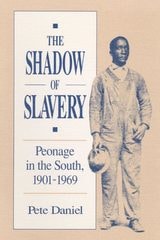
The Shadow of Slavery
Peonage in the South, 1901-1969Pete Daniel
University of Illinois Press, 1972
Pete Daniel's book is about this largely ignored form of twentieth-century slavery. It is in part "the record of an American failure, the inability of federal, state, and local law-enforcement officers to end peonage." In a series of case studies and histories, Daniel re-creates the neglected and frightening world of peonage, demanding, "If a form of slavery yet exists in the United States, as so much evidence suggests, then the relevant questions are why, and by whose irresponsibility?"
Peonage grew out of labor settlements following emancipation, when employers forbade croppers to leave plantations because of debt (often less than $30). At the turn of the century the federal government acknowledged that the "labyrinth of local customs and laws" binding men in debt was peonage. They outlawed debt servitude and slowly moved against it, but with no large success. Disappearing witnesses and acquitted employers characterized the cases that did go to court.
Daniel holds that peonage persists for many reasons: the corruption and apathy of law-enforcement, racist traditions in the South, and the impotence of the Justice Department in prosecuting this violation of federal law. He draws extensively on complaints and trial transcripts from the peonage records of the Justice Department.

The Shadow of the Wall
Violence and Migration on the U.S.-Mexico BorderEdited by Jeremy Slack, Daniel E. Martínez, and Scott Whiteford; Foreword by Josiah Heyman; Photographs by Murphy Woodhouse
University of Arizona Press, 2018
The authors analyze data from the Migrant Border Crossing Study (MBCS), a mixed-methods, binational research project that offers socially relevant, rigorous social science about migration, immigration enforcement, and violence on the border. Using information gathered from more than 1,600 post-deportation surveys, this volume examines the different faces of violence and migration along the Arizona-Sonora border and shows that deportees are highly connected to the United States and will stop at nothing to return to their families. The Shadow of the Wall underscores the unintended social consequences of increased border enforcement, immigrant criminalization, and deportation along the U.S.-Mexico border.
Contributors
Howard Campbell
Josiah Heyman
Alison Elizabeth Lee
Daniel E. Martínez
Ricardo Martínez-Schuldt
Emily Peiffer
Jeremy Slack
Prescott L. Vandervoet
Matthew Ward
Scott Whiteford
Murphy Woodhouse
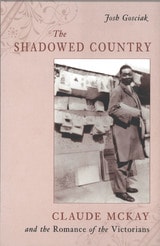
The Shadowed Country
Claude McKay and the Romance of the VictoriansGosciak, Josh
Rutgers University Press, 2006
One of the most important voices of the Harlem Renaissance, Claude McKay is largely recognized for his work during the 1920s, which includes a major collection of poems, Harlem Shadows, as well as a critically acclaimed novel, Home to Harlem. But McKay was never completely comfortable with his literary reputation during this period. Throughout his world travels, he saw himself as an English lyricist.
In this compelling examination of the life and works of this complex poet, novelist, journalist, and short story writer, Josh Gosciak sheds light on McKay’s literary contributions beyond his interactions with Harlem Renaissance artists and writers. Working within English literary traditions, McKay crafted a verse out of hybridity and diaspora. Gosciak shows how he reinvigorated a modern pastoral through his encounters with some of the major aesthetic and political movements of the late Victorian and early modern periods.
Exploring new archival material as well as many of McKay’s lesser known poetic works, TheShadowed Country provides a unique interpretation of the writings of this major author.
The Sian Incident
A Pivotal Point in Modern Chinese HistoryTien-wei Wu
University of Michigan Press, 1976

The Silver Cradle
Las Posadas, Los Pastores, and Other Mexican American TraditionsBy Julia Nott Waugh
University of Texas Press, 1955
Originally published in 1955, The Silver Cradle is the story of a year in the life of the Mexican American people of San Antonio, Texas. During the 1950s, Julia Nott Waugh recorded the performances of such seasonal and religious traditions as Las Posadas, Los Pastores, Las Calaveras, the Blessing of the Animals, the liturgical observances of Holy Week, and festivities of el diez y seis de septiembre (Mexican Independence Day), among others.
Although years have passed and many of the details of observances have changed, the festival calendar and the joy and sincerity of the Mexican American people in honoring its customs and obligations have not disappeared. Now, in fact, a much wider population shares and appreciates the pageantry preserved for us by people like Graciana Reyes, in whose prized silver cradle the Christ Child slept every year at Christmas, and like Doroteo Domínguez, whose annual devotion to presenting a thousand-year-old pastoral epic in his back yard was legendary.
Waugh has done much more than just open a window onto a charming past. She has captured for us one of the true gifts of our Mexican American heritage—the willingness to ritually celebrate the passage of time and to embellish the occasions with sensitivity and fervor. This book will appeal to the general reader as well as to those interested in folk traditions and Mexican American culture.
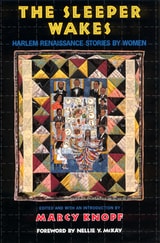
The Sleeper Wakes
Harlem Renaissance Stories by WomenKnopf-Newman, Marcy
Rutgers University Press, 1993
In recent years there has been an explosion of interest in the art and culture of the Harlem Renaissance. Yet this significant collection is the first definitive edition of Harlem Renaissance stories by women. The writers include Gwendolyn Bennett, Jessie Redmon Fauset, Angelina Weld Grimké, Zora Neale Hurston, Nella Larsen, Alice Dunbar-Nelson, and Dorothy West.
Published originally in periodicals such as The Crisis, Fire!!, and Opportunity, these twenty-seven stories have until now been virtually unavailable to readers. These stories are as compelling today as they were in the 1920s and 1930s. In them, we find the themes of black and white racial tension and misunderstanding, economic deprivation, passing, love across and within racial lines, and the attempt to maintain community and uplift the race.
Marcy Knopf's introduction surveys the history of the Harlem Renaissance, the periodicals and books it generated, and describes the rise to prominence of these women writers and their later fall from fame. She also includes a brief biography of each of the writers. Nellie Y. McKay's foreword analyzes the themes and concerns of the stories.

The Slumbering Volcano
American Slave Ship Revolts and the Production of Rebellious MasculinityMaggie Montesinos Sale
Duke University Press, 1997
This comparison of narrative response with written public reaction to the actual revolts allows Sale to investigate the precise manner in which public opinion regarding definitions of liberty evolved over this crucial period of time between the Revolutionary and Civil Wars. Mapping the ways in which unequally empowered groups claimed and transformed statements associated with the discourse of national identity, Sale succeeds in recovering a historically informed sense of the discursive and activist options available to people of another era.
In its demonstration of how the United States has been uniquely shaped by its dual status as both an imperial and a postcolonial power, this study on the discourse of natural rights and national identity in the pre-Civil War United States will interest students and scholars of American studies, African American studies, gender studies, and American history and literature.

The Social Politics of Medieval Diplomacy
Anglo-German Relations (1066-1307)Joseph P. Huffman
University of Michigan Press, 2000
The Social Roots Of Basque Nationalism
Alfonso Pérez-Agote
University of Nevada Press, 2006
Translated by Cameron Watson and William A. Douglass. Foreword by William A. Douglass. The Basque people have preserved their ethnic identity and sense of themselves as a separate community despite centuries of repression, diaspora, and economic and social upheaval—one of the most remarkable achievements in the history of the phenomenon we call nationalism. In The Social Roots of Basque Nationalism, sociologist Alfonso Pérez-Agote addresses the social mechanisms that Basques employed to sustain their ethnic identity under the Franco Regime and demonstrates how persecution actually encouraged the extension of Basque nationalist consciousness. He also reveals how state political pressure radicalized one element of the Basque-nationalist movement, resulting in the formation of ETA, an armed terrorist wing that itself became a mechanism for extending nationalist consciousness. Finally, he examines the subsequent changes in Basque nationalism following Franco’s death and the extension of democracy in Spain, which resulted in the institutionalization of the movement into an autonomous political power. This work is based in part on interviews and polls with informants in the Basque Country and abroad, eliciting such data as the role that family, education, social contacts, and religious environment play in the evolution of political attitudes; the place of violence in the Basque world view and contemporary political culture; regional variations in Basque nationalism; and the factors that contributed to the resilience of Basque nationalism in adapting to new historical conditions. The result is a sophisticated discussion of the various ways in which Basque social reality is constituted and how this reality helps to create political culture. Because Pérez-Agote situates his discussion within the broader frameworks of ethnic identity, group dynamics, and the nature of nationalism, the book makes a significant contribution not only to our understanding of the Basques but to the broader study of the evolution of nationalism and the nation-state, political violence, and the complicated transition of any society from dictatorship to democracy.

The Song of the Hawk
The Life and Recordings of Coleman HawkinsJohn Chilton
University of Michigan Press, 1993
The Songs of Blind Folk
African American Musicians and the Cultures of BlindnessTerry Rowden
University of Michigan Press, 2009
"Rowden has wedded ethnomusicology and disability studies to offer a fresh approach to the study of African American popular music. The Songs of Blind Folk undermines many of the defining mythologies and tropes of blind musicians, including the perception that they are successful because they compensate for the loss of vision."
---Mark Anthony Neal, Duke University
"Illuminates how the enduring phenomenon of blind African American musicians emerged from brutal conditions, how these musicians were deployed in the burgeoning American iconography of race and 'freakdom,' and how they negotiated this hazardous cultural terrain . . . the book is timely, well-historicized, and rich in insight."
---Kari Winter, University at Buffalo
The Songs of Blind Folk explores the ways that the lives and careers of blind and visually impaired African American musicians and singers have mirrored the changes in America's image of African Americans and the social positioning and possibilities of the entire black community. The book offers a historically grounded consideration of African American performers and their audiences, and the ways that blindness, like blackness, has affected the way the music has been produced and received. Author Terry Rowden considers the controversial nineteenth-century prodigy Blind Tom Bethune; blues singers and songwriters such as Blind Lemon Jefferson, who achieved an unprecedented degree of visibility and acceptance in the 1920s and '30s; spiritual and gospel musicians such as the Blind Boys of Alabama; celebrated jazz and rhythm and blues artists Art Tatum, Rahsaan Roland Kirk, and Ray Charles; and finally, perhaps the best known of all blind performers, Stevie Wonder.
Terry Rowden is Assistant Professor of English at the City University of New York, Staten Island. He is coeditor of Transnational Cinema: The Film Reader.
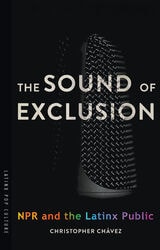
The Sound of Exclusion
NPR and the Latinx PublicChristopher Chávez
University of Arizona Press, 2021
Chávez analyzes NPR as a historical product that has evolved alongside significant changes in technology, industry practice, and demography. In The Sound of Exclusion, Chávez asks these pressing questions: What kind of news organization was NPR intended to be? What has it become over time? In what ways is it evolving to meet the needs of a nation, in which U.S. Latinxs are becoming an increasingly larger portion of the American public that NPR serves? Informed by more than fifty in-depth interviews conducted with public radio practitioners from all aspects of the business, Chávez addresses how power is enacted in everyday broadcast practices. By interrogating industry practices, we might begin to reimagine NPR as a public good that serves the broad and diverse spectrum of the American public.

The Sound of Thinking
A Listener's Companion to Conceptual MusicCraig Dworkin
University of Chicago Press, 2026
An artist draws two octaves of pitches randomly from a hat, just enough to set each syllable of the dictionary definition of imprimer (to score, to print). Trawling the internet for cute videos of cats “playing” piano, an artist splices together a complete, note-perfect performance of Arnold Schoenberg’s Opus 11. Half a century after the release of Miles Davis’s album Kind of Blue, a jazz quintet spends months of focused practice to reproduce the original exactly. These performances share a common denominator: absolute fidelity to the outcome of a system. From Marcel Duchamp to Yoko Ono, Steve Reich to Sun Ra, The Sound of Thinking brings together a diverse array of musical or sonic works that are algorithmic, automatic, permutational, procedural, or otherwise structured in contrast to the creative expressivity typically associated with artistic production.
In twenty-six short essays, each keyed to a term that begins with a different letter of the alphabet, Dworkin discusses work composed or performed according to a predetermined rule, transforming artistic creation into a system running its course. The pieces detailed here, drawn from more than a century of musical experimentation, offer a fresh perspective on the history of innovative music by decoupling music from expression and by shunting creativity from the level of organizing sounds to the level of devising a system that can do the organizing. Not only does this book spotlight the critical role of music in twentieth-century conceptual art, but it also identifies previously overlooked links among diverse artists and movements.
The Southern Debate over Slavery
Volume 2: Petitions to Southern County Courts, 1775-1867Edited by Loren Schweninger
University of Illinois Press, 2007
An incomparably rich source of period information, the second volume of The Southern Debate over Slavery offers a representative and extraordinary sampling of the thousands of petitions about issues of race and slavery that southerners submitted to county courts between the American Revolution and Civil War. These petitions, filed by slaveholders and nonslaveholders, slaves and free blacks, women and men, abolitionists and staunch defenders of slavery, constitute a uniquely important primary source. The collection records with great immediacy and minute detail the dynamics and legal restrictions that shaped southern society.
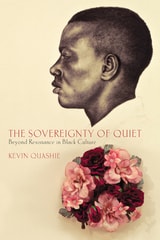
The Sovereignty of Quiet
Beyond Resistance in Black CultureQuashie, Kevin
Rutgers University Press, 2012
The book revisits such iconic moments as Tommie Smith and John Carlos’s protest at the 1968 Mexico City Olympics and Elizabeth Alexander’s reading at the 2009 inauguration of Barack Obama. Quashie also examines such landmark texts as Gwendolyn Brooks’s Maud Martha, James Baldwin’s The Fire Next Time, and Toni Morrison’s Sula to move beyond the emphasis on resistance, and to suggest that concepts like surrender, dreaming, and waiting can remind us of the wealth of black humanity.
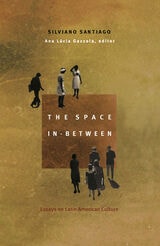
The Space In-Between
Essays on Latin American CultureSilviano Santiago
Duke University Press, 2001
Santiago’s work creates a theoretical field that transcends both the study of a specific national literature and the traditional perspectives of comparative literature. He examines the pedagogical and modernizing mission of Western voyagers from the conquistadors to the present. He deconstructs the ideas of “original” and “copy,” unpacking their implications for the notions of so-called dominant and dominated cultures. Santiago also confronts questions of cultural dependency and analyzes the problems involved in the imposition of an alien European history, the cultural displacements experienced by the Indians through their religious conversion, and the hierarchical suppression of native and Afro-Brazilian values.
Elegantly written and translated, The Space In-Between will provide insights and perspectives that will interest cultural and literary theorists, postcolonial scholars, and other students of contemporary culture.
The Specter and the Speculative
Afterlives and Archives in the African DiasporaMae G. Henderson
Rutgers University Press, 2024
The Spike Lee Reader
Paula Massood
Temple University Press, 2007
Gathered in this anthology are critical writings on Spike Lee's films by leading scholars in the fields of cinema studies and African American studies. In sixteen new and reprinted essays, the contributors to The Spike Lee Reader consider the nexus of race, gender, and sexuality in Lee's work, and in so doing encourage readers to further explore the cultural, social, and political implications of Lee's films as well as his entire body of work.
Contributors include: Christine Acham, Toni Cade Bambara, Mark D. Cunningham, Anna Everett, Daniel Flory, Krin Gabbard, David A. Gerstner, Ed Guerrero, Keith M. Harris, bell hooks, Wahneema Lubiano, James C. McKelly, Tavia Nyong'o, Beretta E. Smith-Shomade, Michele Wallace, S. Craig Watkins, and the editor.
The Spirit of Soul Food
Race, Faith, and Food JusticeChristopher Carter
University of Illinois Press, 2021
Soul food has played a critical role in preserving Black history, community, and culinary genius. It is also a response to--and marker of--centuries of food injustice. Given the harm that our food production system inflicts upon Black people, what should soul food look like today?
Christopher Carter's answer to that question merges a history of Black American foodways with a Christian ethical response to food injustice. Carter reveals how racism and colonialism have long steered the development of US food policy. The very food we grow, distribute, and eat disproportionately harms Black people specifically and people of color among the global poor in general. Carter reflects on how people of color can eat in a way that reflects their cultural identities while remaining true to the principles of compassion, love, justice, and solidarity with the marginalized.
Both a timely mediation and a call to action, The Spirit of Soul Food places today's Black foodways at the crossroads of food justice and Christian practice.

The Splendid Drunken Twenties
Selections from the Daybooks, 1922 - 30Carl Van Vechten
University of Illinois Press, 2002
Between 1922 and 1930, Carl Van Vechten--one of the most significant figures of the Harlem Renaissance--kept a daily record of his activities. The records recount his day-to-day life, as well as the alliances, drinking habits, feuds, and affairs of a wide number of the period's luminaries, providing a rich resource for reconstructing the culture of 1920s New York and the social milieu during Prohibition. Bruce Kellner has provided copious informative notes identifying central figures and clarifying details.
The St. Louis African American Community and the Exodusters
Bryan M. Jack
University of Missouri Press, 2021
In the aftermath of the Civil War, thousands of former slaves made their way from the South to the Kansas plains. Called “Exodusters,” they were searching for their own promised land. Bryan Jack now tells the story of this American exodus as it played out in St. Louis, a key stop in the journey west.
Many of the Exodusters landed on the St. Louis levee destitute, appearing more as refugees than as homesteaders, and city officials refused aid for fear of encouraging more migrants. To the stranded Exodusters, St. Louis became a barrier as formidable as the Red Sea, and Jack tells how the city’s African American community organized relief in response to this crisis and provided the migrants with funds to continue their journey.
The St. Louis African American Community and the Exodusters tells of former slaves such as George Rogers and Jacob Stevens, who fled violence and intimidation in Louisiana and Mississippi. It documents the efforts of individuals in St. Louis, such as Charlton Tandy, Moses Dickson, and Rev. John Turner, who reached out to help them. But it also shows that black aid to the Exodusters was more than charity. Jack argues that community support was a form of collective resistance to white supremacy and segregation as well as a statement for freedom and self-direction—reflecting an understanding that if the Exodusters’ right to freedom of movement was limited, so would be the rights of all African Americans. He also discusses divisions within the African American community and among its leaders regarding the nature of aid and even whether it should be provided.
In telling of the community’s efforts—a commitment to civil rights that had started well before the Civil War—Jack provides a more complete picture of St. Louis as a city, of Missouri as a state, and of African American life in an era of dramatic change. Blending African American, southern, western, and labor history, The St. Louis African American Community and the Exodusters offers an important new lens for exploring the complex racial relationships that existed within post-Reconstruction America.
The Star-Entangled Banner
One Hundred Years of America in the PhilippinesDelmendo, Sharon
Rutgers University Press, 2004
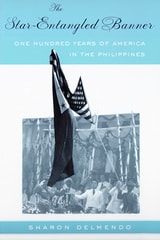
During a ceremony held in 1996 to commemorate the fiftieth anniversary of formal Philippine independence, the U.S. flag was being lowered while the Philippine flag was being raised, and the two became entangled. In The Star-Entangled Banner, Sharon Delmendo demonstrates that this incident is indicative of the longstanding problematic relationship between the two countries. When faced with a national crisis or a compelling need to reestablish its autonomy, each nation paradoxically turns to its history with the other to define its place in the world.
Each chapter of the book deals with a separate issue in this linked history: the influence of Buffalo Bill’s show on the proto-nationalism of José Rizal, who is often described as the “First Filipino”; the portrayal of the Philippines in American children’s books; Back to Bataan, a World War II movie starring John Wayne; the post-independence fiction of F. Sionil José; and the refusal of the U..S military to return the Balangiga Bells, which were taken as war booty during the Philippine-American War. Ultimately, Delmendo demonstrates how the effects of U.S. imperialism in the Philippines continue to resonate in U.S. foreign policy in the post cold war era and the war on terrorism.
The Starting Line
Latina/o Children, Texas Schools, and National Debates on Early EducationBy Robert Crosnoe
University of Texas Press, 2020
How can we create high-quality learning environments for children from socially, politically, and economically marginalized groups? How do early childhood programs help to overcome the challenges created by poverty? Seeking to answer these questions, The Starting Line delves into the ups and downs of early education programs serving Latinas/os in Texas, using the state as a window into broader debates about academic opportunity and the changing demographics of the United States.
Immersing readers in the day-to-day activities of Texas's early childhood education programs, Robert Crosnoe illuminates how significant obstacles can stymie the best intentions. Crosnoe pays particular attention to the complex connections among classrooms, schools, families, and communities, as well as the frequently unfolding interplay of educational philosophies. The result is a story highlighting the promises of early childhood education, the perils faced in attempting to fulfill them, and the degree to which Texas stands at the forefront of some larger movements and lags behind in others.
Giving voice to bilingual educators and low-income Latina/o families, this book is a timely exploration of the strengths and needs of what will soon be the largest share of the US child population.