Results by title
28164 books match the query 'History' and 6372 start with t
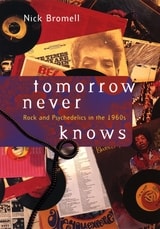
Tomorrow Never Knows
Rock and Psychedelics in the 1960sNick Bromell
University of Chicago Press, 2000

Tomorrow Will Be Better
Surviving Nazi GermanyWalter Meyer with the assistance of Matt Valentine
University of Missouri Press, 1999
How does a young German who has been a member of the Hitler Youth and has competed in Nazi-organized athletic competitions become, over the span of two years, an eighty-pound, tuberculosis-stricken concentration camp escapee?
In this larger-than-life memoir, Walter Meyer leads readers from one harrowing moment to the next as he recounts his experiences during and after Hitler's reign. As a teenager, Meyer refused to conform to institutional rules. While serving in the Hitler Youth, he rebelled by joining a subversive group that focused its efforts on pranks against the youth organization. During World War II, Meyer was arrested, interrogated, and beaten for stealing shoes, but he received a sentence of one to four years, as opposed to the standard penalty for looting—death.
The sixteen-year-old Meyer's refusal to conform to prison regulations and his foiled escape attempts resulted in solitary confinement on several occasions. His fiery spirit eventually landed him in a Nazi work camp. Unbeknownst to his family, Meyer became a concentration camp prisoner. Transported to Ravensbrueck, he was forced to work under grueling conditions in a quarry. He struggled to reach his daily work quota so he could dine on watery broth and bits of bread. In these subhuman conditions, Meyer developed tuberculosis. Knowing he would soon die in the camp, he again plotted his escape. This time he succeeded.
Upon returning home to Duesseldorf, Meyer despaired at the destruction of his hometown. He lamented the pallor that had spread throughout the town and the country itself. After recovering his health, he regained his youthful lust for adventure. His postwar travels began with his infiltration of the Russian-occupied zone of Germany to retrieve his family's possessions. Meyer then began a whirlwind odyssey, ducking into train cars and stowing away on ships, occasionally landing in jail for traveling without a passport—from France to Spain, Belgium to Holland, and finally to South America--in pursuit of something other than the aftermath of war.
Meyer's memoir gives insight into the climate in Germany during World War II and in the defeated nation after the war. His experience as a non-Jewish survivor of the Nazi concentration camps provides an enlightening and varied perspective to the Holocaust dialogue.
Tondi Songway Kiini
Reference Grammar and TSK-English-French DictionaryJeffrey Heath
CSLI, 2005

Tongass Odyssey
Seeing the Forest Ecosystem through the Politics of TreesJohn Schoen
University of Alaska Press, 2020
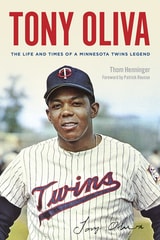
Tony Oliva
The Life and Times of a Minnesota Twins LegendThom Henninger
University of Minnesota Press, 2019
If not for the botched Bay of Pigs invasion, Minnesota might never have known one of its most popular baseball players, Twins three-time batting champion and eight-time All-Star Tony Oliva. In April 1961, the twenty-two-year-old Cuban prospect failed to impress the Twins in a tryout, but the sudden rupture in U.S.–Cuba relations made a return visa all but impossible. The story of how Oliva’s unexpected stay led to a second chance and success with the Twins—as well as decades of personal and cultural isolation—is told for the first time in this full-scale biography of the man the fans affectionately call “Tony O.”
With unprecedented access to the very private Oliva, baseball writer Thom Henninger captures what life was like for the Cuban newcomer as he adjusted to major league play and American culture—and at the same time managed to earn Rookie of the Year honors and win the American League batting title in his first two seasons, all while playing with a knuckle injury. Packed with never-before-published photographs, the book follows Oliva through the 1965 season, all the way to the World Series, and then, with repaired knuckle and knee, into one of the most dramatic pennant races in baseball history in 1967. Through the voices of Oliva, his family, and his teammates—including the Cuban players who shared his cultural challenges and the future Hall of Famers he mentored, Rod Carew and Kirby Puckett—the personal and professional highs and lows of the years come alive: the Gold Glove Award in 1966, a third batting title in 1971, the devastating injury that curtailed his career, and, through it all, the struggle to build a family and recover the large and close-knit one he had left behind in Cuba.
Nearly forty years after Oliva’s retirement, the debate continues over whether his injury-shortened career was Hall of Fame caliber—a question that gets a measured and resounding answer here.

Too Far on a Whim
The Limits of High-Steam Propulsion in the US NavyTyler A. Pitrof
University of Alabama Press, 2024
WINNER OF THE LYMAN BOOK AWARD FOR MARITIME AND NAVAL SCIENCE, TECHNOLOGY, AND ENVIRONMENT
Argues that the US Navy’s commitment to high-steam propulsion for its World War II fleet was a tactical, technological, and bureaucratic failure
In Too Far on a Whim, Tyler A. Pitrof presents a high-spirited revision of the US Navy’s commitment to high-steam propulsion systems, the mainstay of its World War II fleets. Pitrof’s research persuasively demonstrates that in its war against the Imperial Japanese Navy, the US Navy succeeded despite its high-steam propulsion systems rather than because of them.
War with an aggressive Japan and a resurgent Germany loomed in the dark days of the late 1930s. Rear Admiral Harold G. Bowen Sr., head of the US Navy’s Bureau of Engineering, advanced a radical vision: a new fleet based on high-steam propulsion, a novel technology that promised high speeds with smaller engines and better fuel efficiency. High-steam engines had drawbacks—smaller operational ranges and maintenance issues. Nevertheless, trusting its engineers to resolve these issues, the US Navy put high-steam propulsion at the heart of its warship design from 1938 to 1945.
The official record of high-steam technology’s subsequent performance has relied heavily on Bowen’s own memoir, in which he painted high-steam innovation in heroic colors. Pitrof’s empirical review of primary sources such as ship’s maintenance records, however, illuminates the opposite—that the heroism lay in the ability of American seamen to improvise solutions to keep these difficult engines running.
Pitrof artfully explains engineering concepts in layman’s terms and provides an account that extends far beyond technology and into matters of naval hierarchies and bureaucracy, strategic theory, and ego. He offers a cautionary tale—as relevant to any endeavor as it is to military undertakings—about how failures arise when technical experts lack managers who understand their work. Admiral Bowen wielded excessive power because no one else in the US Navy knew enough to countermand him.
Compulsively readable, Too Far on a Whim is a landmark for those interested in naval history and technology but also for readers interested in the interplay between innovation, decision-making, and engineering.
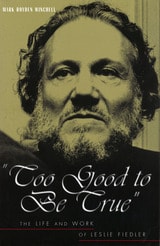
Too Good to Be True
The Life and Work of Leslie FiedlerMark Royden Winchell
University of Missouri Press, 2002

Too Much Sea for Their Decks
Shipwrecks of Minnesota's North Shore and Isle RoyaleMichael Schumacher
University of Minnesota Press, 2023
Shipwreck stories from along Minnesota’s north shore of Lake Superior and Isle Royale
Against the backdrop of the extraordinary history of Great Lakes shipping, Too Much Sea for Their Decks chronicles shipwrecked schooners, wooden freighters, early steel-hulled steamers, whalebacks, and bulk carriers—some well-known, some unknown or forgotten—all lost in the frigid waters of Lake Superior.
Included are compelling accounts of vessels destined for infamy, such as that of the Stranger, a slender wooden schooner swallowed by the lake in 1875, the sailors’ bodies never recovered nor the wreckage ever found; an account of the whaleback Wilson, rammed by a large commercial freighter in broad daylight and in calm seas, sinking before many on board could escape; and the mysterious loss of the Kamloops, a package freighter that went down in a storm and whose sailors were found on the Isle Royale the following spring, having escaped the wreck only to die of exposure on the island. Then there is the ill-fated Steinbrenner, plagued by bad luck from the time of her construction, when she was nearly destroyed by fire, to her eventual (and tragic) sinking in 1953. These tales and more represent loss of life and property—and are haunting stories of brave and heroic crews.
Arranged chronologically and presented in three sections covering Minnesota's North Shore, Isle Royale, and the three biggest storms in Minnesota’s Great Lakes history (the 1905 Mataafa storm, the 1913 hurricane on the lakes, and the 1940 Armistice Day storm), each shipwreck documented within these pages provides a piece to the history of shipping on Lake Superior.
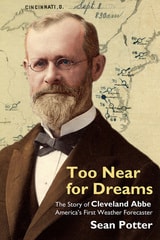
Too Near for Dreams
The Story of Cleveland Abbe, America's First Weather ForecasterSean Potter
American Meteorological Society, 2020
As director of the Cincinnati Observatory and, later, a civilian in the newly established forecast and storm warning division of the U.S. Army Signal Service, Cleveland Abbe was the first person to issue official, regularly scheduled weather forecasts, or “probabilities,” in the United States. Abbe began his work in forecasting in 1869, earning the nickname “Old Probabilities” and gaining recognition for the reliability of his reports. He would go on to become a leader of the US Weather Bureau—which we know today as the National Weather Service. In establishing a system for creating daily weather forecasts and more, this humble pioneer helped lay the foundation for modern meteorology in the United States.
Set against the backdrop of nineteenth and early twentieth-century international events and scientific advancements, this biography of Abbe explores both his personal life and his scientific career. It illuminates his time spent in Russia in the mid-1860s—as the Civil War was waged and a president was assassinated back home—in part through letters with his mother. Decades of diaries and correspondence from the Cleveland Abbe Papers at the Library of Congress, as well as first-person accounts, illuminate this biography of a mild-mannered family man whose thirst for knowledge drove him to become a giant in an emerging scientific field.
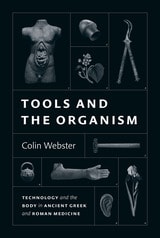
Tools and the Organism
Technology and the Body in Ancient Greek and Roman MedicineColin Webster
University of Chicago Press, 2023
Medicine is itself a type of technology, involving therapeutic tools and substances, and so one can write the history of medicine as the application of different technologies to the human body. In Tools and the Organism, Colin Webster argues that, throughout antiquity, these tools were crucial to broader theoretical shifts. Notions changed about what type of object a body is, what substances constitute its essential nature, and how its parts interact. By following these changes and taking the question of technology into the heart of Greek and Roman medicine, Webster reveals how the body was first conceptualized as an “organism”—a functional object whose inner parts were tools, or organa, that each completed certain vital tasks. He also shows how different medical tools created different bodies.
Webster’s approach provides both an overarching survey of the ways that technologies impacted notions of corporeality and corporeal behaviors and, at the same time, stays attentive to the specific material details of ancient tools and how they informed assumptions about somatic structures, substances, and inner processes. For example, by turning to developments in water-delivery technologies and pneumatic tools, we see how these changing material realities altered theories of the vascular system and respiration across Classical antiquity. Tools and the Organism makes the compelling case for why telling the history of ancient Greco-Roman medical theories, from the Hippocratics to Galen, should pay close attention to the question of technology.
Tools for Teaching the History of Civil Rights in Milwaukee and the Nation
Michael Edmonds
Wisconsin Historical Society Press, 2015
This powerful, user-friendly curriculum is designed to help teach middle and high school students the history of the Civil Rights Movement in Milwaukee and the South. Each of its twenty lessons includes background information, facsimiles of historical documents, classroom activities and thoughtful questions designed to spark critical thinking. Students will learn to connect their lives today with the people who worked 50 years ago to make the United States honor the promises of the Founding Fathers.
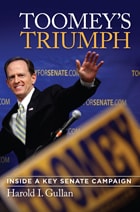
Toomey's Triumph
Inside a Key Senate CampaignHarold Gullan
Temple University Press, 2012
The 2010 Pennsylvania Senate election provided high drama from the earliest days of its primary campaigns right through Election Day. After long-time incumbent Arlen Specter was eliminated, the race boiled down to two fresh faces—Pat Toomey and Joe Sestak. Their battle constitutes a microcosm of the political divide that characterizes contemporary American politics.
Veteran writer Hal Gullan obtained special access to the Toomey campaign early on. Toomey's Triumph offers both that inside look and a Philadelphian's reflections of a riveting election. Gullan's astute month-by-month narrative distills the events of the year-long battles through the high drama and the day-to-day of grassroots organizing and campaigning. He describes how the candidates appear, what they say, and how the media pundits respond to their various gambits. He provides wry observations on the efficacy of each candidate's campaign ads and strategies, and he analyzes the up-and-down polls.
Toomey's Triumph provides an engaging chronicle of a critical campaign.
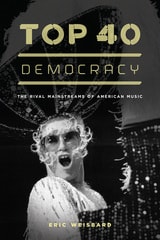
Top 40 Democracy
The Rival Mainstreams of American MusicEric Weisbard
University of Chicago Press, 2014
In Top 40 Democracy, Eric Weisbard studies the evolution of this multicentered pop landscape, along the way telling the stories of the Isley Brothers, Dolly Parton, A&M Records, and Elton John, among others. He sheds new light on the upheavals in the music industry over the past fifteen years and their implications for the audiences the industry has shaped. Weisbard focuses in particular on formats—constructed mainstreams designed to appeal to distinct populations—showing how taste became intertwined with class, race, gender, and region. While many historians and music critics have criticized the segmentation of pop radio, Weisbard finds that the creation of multiple formats allowed different subgroups to attain a kind of separate majority status—for example, even in its most mainstream form, the R&B of the Isley Brothers helped to create a sphere where black identity was nourished. Music formats became the one reliable place where different groups of Americans could listen to modern life unfold from their distinct perspectives. The centers of pop, it turns out, were as complicated, diverse, and surprising as the cultural margins. Weisbard’s stimulating book is a tour de force, shaking up our ideas about the mainstream music industry in order to tease out the cultural importance of all performers and songs.
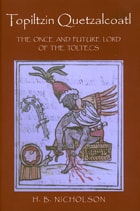
Topiltzin Quetzalcoatl
The Once and Future Lord of the ToltecsH. B. Nicholson
University Press of Colorado, 2001
Professor Nicholson sorts through this wealth of material, classifying, summarizing, and analyzing all known primary accounts of the career of Topiltzin Quetzalcoatl, in the Spanish, Nahuatl, and Mayan languages, which Spanish missionaries and Spanish-educated natives recorded after the Conquest. In a new introduction, he updates the original source material presently available to scholars interested in this figure. After careful consideration of the evidence, he concludes that, in spite of the obvious myth surrounding this renowned Toltec priest-ruler, at least some of Topiltzin Quetzalcoatl's recorded life and deeds are drawn from historical fact. Nicholson also contends that the tradition of his expected return probably played a role in the peaceable reception of Cortés by Moctezuma II in Mexico's Tenochtitlan in the fall of 1519.
Including new illustrations and an index, Topiltzin Quetzalcoatl: The Once and Future Lord of the Toltecs constitutes a major contribution to Mesoamerican ethnohistory and archaeology.
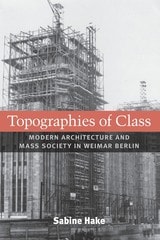
Topographies of Class
Modern Architecture and Mass Society in Weimar BerlinSabine Hake
University of Michigan Press, 2010
In Topographies of Class, Sabine Hake explores why Weimar Berlin has had such a powerful hold on the urban imagination. Approaching Weimar architectural culture from the perspective of mass discourse and class analysis, Hake examines the way in which architectural projects; debates; and representations in literature, photography, and film played a key role in establishing the terms under which contemporaries made sense of the rise of white-collar society.
Focusing on the so-called stabilization period, Topographies of Class maps out complex relationships between modern architecture and mass society, from Martin Wagner's planning initiatives and Erich Mendelsohn's functionalist buildings, to the most famous Berlin texts of the period, Alfred Döblin's city novel Berlin Alexanderplatz (1929) and Walter Ruttmann's city film Berlin, Symphony of the Big City (1927). Hake draws on critical, philosophical, literary, photographic, and filmic texts to reconstruct the urban imagination at a key point in the history of German modernity, making this the first study---in English or German---to take an interdisciplinary approach to the rich architectural culture of Weimar Berlin.
Sabine Hake is Professor and Texas Chair of German Literature and Culture at the University of Texas at Austin. She is the author of numerous books, including German National Cinema and Popular Cinema of the Third Reich.
Cover art: Construction of the Karstadt Department Store at Hermannplatz, Berlin-Neukölln. Courtesy Bildarchiv Preeussischer Kulturbesitz / Art Resource, NY
Tormented Master
A Life of Rabbi Nahman of BratslavWritten by Arthur E. Green
University of Alabama Press, 1979
“If Hasidism begins in the life-enhancing spirituality of the Baal Shem Tov, it concludes in the tortuous, elitist and utterly fascinating career of Nahman of Bratslav (1722–1810) whose biography and teaching Arthur Green has set forth in his comprehensive, moving, and subtle study, Tormented Master.
“Arthur Green has managed to lead us through the thickets of the Bratslaver discourse with a grace and facility thus far unequaled in the English language literature on Hasidism. Tormented Master is a model of clarity and percipience, balancing awed respect and honor for its subject with a ruthless pursuit of documented truth. . . . Tormented Master is sufficiently open to the agonies of religion in general and the issues of modern religion in particular to make Nahman a thinker utterly relevant to our time.
“Nahman of Bratslav is unique in the history of Judaism, Green emphasizes, for having made the individual’s quest for intimacy with God the center of the religious way. He was a Kierkegaard before his time, believing in the utter abandon of the life of faith and the risk of paradoxicality. . . . He was, more than all others, the predecessor of Kafka, whose tales, like Nahman’s, have no explicit key and rankle, flush and irritate the spirit, compelling us—even in our failure to understand—to acknowledge their potency and challenge.”
—New York Times
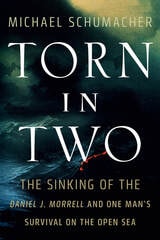
Torn in Two
The Sinking of the Daniel J. Morrell and One Man's Survival on the Open SeaMichael Schumacher
University of Minnesota Press, 2018
Dennis Hale reached the dock just in time to see the Daniel J. Morrell heading out to open waters, a 600-foot freighter that had plied the waters for sixty years, carrying ore from Minnesota’s Iron Range to steel firms around the Great Lakes. The twenty-six-year-old watchman had, quite literally, missed the boat—which meant scrambling to rejoin the Morrell at its next stop or forfeiting a good chunk of his pay package. Seventy-two hours later, Hale would find himself clinging to a life raft alongside the frozen bodies of his crewmates in the violent waves of Lake Huron. The boat would not be reported missing for another twenty-seven hours and by the time the life raft was found, Dennis Hale would remain as the sole survivor of the wreck of the Daniel J. Morrell.
This is life-and-death drama on the inland sea as only Michael Schumacher can tell it. In Torn in Two the great Lakes historian recreates the circumstances surrounding the terrible storm of November 29, 1966, that broke the mighty freighter in half, sending twenty-five of the Morrell’s twenty-nine-man crew to their deaths and consigning the surviving four to the freezing raft where all but Hale would perish. At the heart of Torn in Two are the terrible hours spent by Hale on the life raft with his crewmen, clinging to life for thirty-eight hours in freezing temperatures and wearing only a peacoat, life jacket, and boxer shorts. The fight to save Hale and find the others, the Coast Guard hearings into what happened, the discovery of the wreckage—Schumacher’s vivid narrative captures every harrowing detail and curious fact of the Morrell’s demise, finally doing justice to this epic shipwreck fifty years past.

Tortilleras Negotiating Intimacy
Love, Friendship, and Sex in Queer Mexico CityAnahi Russo Garrido
Rutgers University Press, 2020
Torture Porn in the Wake of 9/11
Horror, Exploitation, and the Cinema of SensationAaron Michael Kerner
Rutgers University Press, 2015
Torture and Impunity
The U.S. Doctrine of Coercive InterrogationAlfred W. McCoy
University of Wisconsin Press, 2012
During the Cold War, McCoy argues, the U.S. Central Intelligence Agency covertly funded psychological experiments designed to weaken a subject’s resistance to interrogation. After the 9/11 terrorist attacks, the CIA revived these harsh methods, while U.S. media was flooded with seductive images that normalized torture for many Americans. Ten years later, the U.S. had failed to punish the perpetrators or the powerful who commanded them, and continued to exploit intelligence extracted under torture by surrogates from Somalia to Afghanistan. Although Washington has publicly distanced itself from torture, disturbing images from the prisons at Abu Ghraib and Guantanamo are seared into human memory, doing lasting damage to America’s moral authority as a world leader.
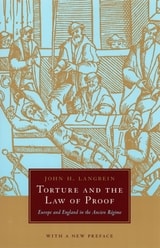
Torture and the Law of Proof
Europe and England in the Ancien RégimeJohn H. Langbein
University of Chicago Press, 2006
The book has recently taken on an eerie relevance as a consequence of controversial American and British interrogation practices in the Iraq and Afghanistan wars. In a new introduction, Langbein contrasts the "new" law of torture with the older European law and offers some pointed lessons about the difficulty of reconciling coercion with accurate investigation. Embellished with fascinating illustrations of torture devices taken from an eighteenth-century criminal code, this crisply written account will engage all those interested in torture's remarkable grip on European legal history.
Torture in the National Security Imagination
Stephanie Athey
University of Minnesota Press, 2023
Reassessing the role of torture in the context of police violence, mass incarceration, and racial capitalism
At the midpoint of a century of imperial expansion, marked on one end by the Philippine–American War of 1899–1902 and on the other by post–9/11 debates over waterboarding, the United States embraced a vision of “national security torture,” one contrived to cut ties with domestic torture and mass racial terror and to promote torture instead as a minimalist interrogation tool. Torture in the National Security Imagination argues that dispelling this vision requires a new set of questions about the everyday work that torture does for U.S. society.
Stephanie Athey describes the role of torture in the proliferation of a U.S. national security stance and imagination: as U.S. domestic tortures were refined in the Philippines at the turn of the twentieth century, then in mid-century counterinsurgency theory and the networks that brought it home in the form of law-and-order policing and mass incarceration.
Drawing on examples from news to military reports, legal writing, and activist media, Athey shows that torture must be seen as a colonial legacy with a corporate future, highlighting the centrality of torture to the American empire—including its role in colonial settlement, American Indian boarding schools, and police violence. She brings to the fore the spectators and commentators, the communal energy of violence, and the teams and target groups necessary to a mass undertaking (equipment suppliers, contractors, bureaucrats, university researchers, and profiteers) to demonstrate that, at base, torture is propelled by local social functions, conducted by networked professional collaborations, and publicly supported by a durable social imaginary.
Torture, Humiliate, Kill
Inside the Bosnian Serb Camp SystemHikmet Karcic
University of Michigan Press, 2022
Half a century after the Holocaust, on European soil, Bosnian Serbs orchestrated a system of concentration camps where they subjected their Bosniak Muslim and Bosnian Croat neighbors to torture, abuse, and killing. Foreign journalists exposed the horrors of the camps in the summer of 1992, sparking worldwide outrage. This exposure, however, did not stop the mass atrocities. Hikmet Karčić shows that the use of camps and detention facilities has been a ubiquitous practice in countless wars and genocides in order to achieve the wartime objectives of perpetrators. Although camps have been used for different strategic purposes, their essential functions are always the same: to inflict torture and lasting trauma on the victims.
Torture, Humiliate, Kill develops the author’s collective traumatization theory, which contends that the concentration camps set up by the Bosnian Serb authorities had the primary purpose of inflicting collective trauma on the non-Serb population of Bosnia and Herzegovina. This collective traumatization consisted of excessive use of torture, sexual abuse, humiliation, and killing. The physical and psychological suffering imposed by these methods were seen as a quick and efficient means to establish the Serb “living space.” Karčić argues that this trauma was deliberately intended to deter non-Serbs from ever returning to their pre-war homes. The book centers on multiple examples of experiences at concentration camps in four towns operated by Bosnian Serbs during the war: Prijedor, Bijeljina, Višegrad, and Bileća. Chosen according to their political and geographical position, Karčić demonstrates that these camps were used as tools for the ethno-religious genocidal campaign against non-Serbs. Torture, Humiliate, Kill is a thorough and definitive resource for understanding the function and operation of camps during the Bosnian genocide.
Tortured Subjects
Pain, Truth, and the Body in Early Modern FranceLisa Silverman
University of Chicago Press, 2001
Looking closely at the theory and practice of judicial torture in France from 1600 to 1788, the year in which it was formally abolished, Silverman revisits dossiers compiled in criminal cases, including transcripts of interrogations conducted under torture, as well as the writings of physicians and surgeons concerned with the problem of pain, records of religious confraternities, diaries and letters of witnesses to public executions, and the writings of torture's abolitionists and apologists. She contends that torture was at the center of an epistemological crisis that forced French jurists and intellectuals to reconsider the relationship between coercion and sincerity, or between free will and evidence. As the philosophical consensus on which torture rested broke down, and definitions of truth and pain shifted, so too did the foundation of torture, until by the eighteenth century, it became an indefensible practice.
Tosca's Rome
The Play and the Opera in Historical PerspectiveSusan Vandiver Nicassio
University of Chicago Press, 1999
By far the most "historical" opera in the active repertoire, Tosca is set in a very specific time and place: Rome, from June 17 to 18, 1800. But as Nicassio demonstrates, history in Tosca is distorted by nationalism and by the vehement anticlerical perceptions of papal Rome shared by Sardou, Puccini, and the librettists. To provide the historical background necessary for understanding Tosca, Nicassio takes a detailed look at Rome in 1800 as each of Tosca's main characters would have seen it—the painter Cavaradossi, the singer Tosca, and the policeman Scarpia. Finally, she provides a scene-by-scene musical and dramatic analysis of the opera.
"[Nicassio] must be the only living historian who can boast that she once sang the role of Tosca. Her deep knowledge of Puccini's score is only to be expected, but her understanding of daily and political life in Rome at the close of the 18th century is an unanticipated pleasure. She has steeped herself in the period and its prevailing culture-literary, artistic, and musical-and has come up with an unusual, and unusually entertaining, history."—Paul Bailey, Daily Telegraph
"In Tosca's Rome, Susan Vandiver Nicassio . . . orchestrates a wealth of detail without losing view of the opera and its pleasures. . . . Nicassio aims for opera fans and for historians: she may well enthrall both."—Publishers Weekly
"This is the book that ranks highest in my estimation as the most in-depth, and yet highly entertaining, journey into the story of the making of Tosca."—Catherine Malfitano
"Nicassio's prose . . . is lively and approachable. There is plenty here to intrigue everyone-seasoned opera lovers, musical novices, history buffs, and Italophiles."—Library Journal

Total Market American
Race, Data, and AdvertisingMarcel Rosa-Salas
Duke University Press, 2025
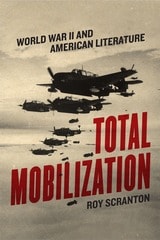
Total Mobilization
World War II and American LiteratureRoy Scranton
University of Chicago Press, 2019
Since World War II, the story of the trauma hero—the noble white man psychologically wounded by his encounter with violence—has become omnipresent in America’s narratives of war, an imaginary solution to the contradictions of American political hegemony. In Total Mobilization, Roy Scranton cuts through the fog of trauma that obscures World War II, uncovering a lost history and reframing the way we talk about war today.
Considering often overlooked works by James Jones, Wallace Stevens, Martha Gellhorn, and others, alongside cartoons and films, Scranton investigates the role of the hero in industrial wartime, showing how such writers struggled to make sense of problems that continue to plague us today: the limits of American power, the dangers of political polarization, and the conflicts between nationalism and liberalism. By turning our attention to the ways we make war meaningful—and by excavating the politics implicit within the myth of the traumatized hero—Total Mobilization revises the way we understand not only World War II, but all of postwar American culture.
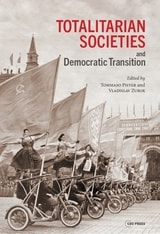
Totalitarian Societies and Democratic Transition
Essays in Memory of Victor ZaslavskyRiccardo James Vargiu
Central European University Press, 2017
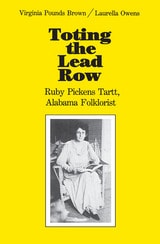
Toting the Lead Row
Ruby Pickens Tartt, Alabama FolkloristVirginia Pounds Brown
University of Alabama Press, 1981
Preserving voices from the back roads—Ruby Pickens Tartt and the folklore of Alabama’s Black Belt.
“You recall the expression ‘toting the lead row’, don’t you? In chopping cotton or corn there is always a leader, one who can chop the fastest of them all. When he finishes his row, he goes back and helps the other choppers finish theirs. The one who totes the lead row takes the lead place in the next row.”—Ruby Pickens Tartt
Toting the Lead Row is a powerful biographical and cultural tribute to Ruby Pickens Tartt, a white woman from Alabama’s Black Belt who devoted her life to preserving the oral traditions of rural Black communities. Born in 1880 in Livingston, Alabama, Tartt witnessed nearly a century of social transformation and made it her mission to document the songs, stories, and life histories of her African American neighbors. She believed that the soul of Sumter County resided not in its institutions, but in its cabins, fields, and voices.
During the Great Depression, Tartt worked with the Federal Writers’ Project, collaborating with renowned folklorists such as Carl Carmer and John Lomax. Her home became a hub for cultural preservation, attracting scholars and artists who recognized the depth of her fieldwork. The book’s title refers to a Southern agricultural phrase—“toting the lead row”—symbolizing leadership and support, a role Tartt embodied in her efforts to elevate the voices of those often overlooked.
This volume is divided into two parts: the first offers a detailed biography of Tartt and her work with the WPA, while the second presents a curated selection of her collected writings, including 18 life histories and 12 slave narratives. Through these stories, Tartt preserved a vital piece of Southern history and gave voice to generations whose experiences might otherwise have been lost.
Toting the Lead Row is both a celebration of a remarkable woman and a vital contribution to the study of folklore, race, and Southern identity.
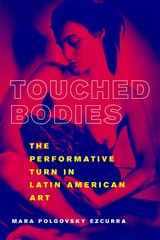
Touched Bodies
The Performative Turn in Latin American ArtMara Polgovsky Ezcurra
Rutgers University Press, 2019
Winner of the 2019 Art Journal Prize from the College Art Association
What is the role of pleasure and pain in the politics of art? In Touched Bodies, Mara Polgovsky Ezcurra approaches this question as she examines the flourishing of live and intermedial performance in Latin America during times of authoritarianism and its significance during transitions to democracy. Based on original documents and innovative readings, her book brings politics and ethics to the discussion of artistic developments during the “long 1980s”. She describes the rise of performance art in the context of feminism, HIV-activism, and human right movements, taking a close look at the work of Diamela Eltit and Raúl Zurita from Chile, León Ferrari and Liliana Maresca from Argentina, and Marcos Kurtycz, the No Grupo art collective, and Proceso Pentágono from Mexico. The comparative study of the work of these artists attests to a performative turn in Latin American art during the 1980s that, like photography and film before, recast the artistic field as a whole, changing the ways in which we perceive art and understand its role in society.
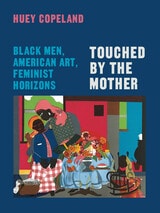
Touched by the Mother
Black Men, American Art, Feminist HorizonsHuey Copeland
University of Chicago Press, 2026
Collecting twenty years of incisive essays, articles, and interviews—including four published here for the first time—by art historian Huey Copeland, this book affirms the extraordinary depth of black men’s cultural production and the diversity of artistic practices that explore visual black masculinity in the United States. Part history, part memoir, part critical manifesto, Touched by the Mother offers a multi-faceted look at American art and discourse of the past fifty years, a personal meditation on navigating the world as a black gay man, and a feminist perspective on the ways transatlantic slavery continues to mark African and African diasporic men. Focusing on how the black maternal shapes black masculinity, Copeland confronts the dynamics that position African-American men—after their mothers—as sites of violence, creativity, and contestation in the cultural imagination.
Richly illustrated throughout, Touched by the Mother considers an exciting range of assemblage, painting, performance, photography, sculpture, and video works by more than twenty renowned practitioners, along with interviews featuring Hilton Als, Thelma Golden, Frank B. Wilderson, III, and other influential figures in contemporary art, culture, and criticism. Works by artists including Mark Bradford, Theaster Gates, David Hammons, Barkley L. Hendricks, Arthur Jafa, Glenn Ligon, Kerry James Marshall, Howardena Pindell, Sun Ra, and Lorna Simpson represent modes of making and thinking that are uniquely “touched by the mother,” Copeland argues, moving us toward the promise of black feminist futures.
Touching Base
Professional Baseball and American Culture in the Progressive EraSteven A. Riess
University of Illinois Press, 1999
Touching Home
Baseball and the Liberal-Republican Tradition in AmericaMary Craig
University of Missouri Press, 2025
2026 Society for American Baseball Research Seymour Medal finalist
Baseball’s relationship to American ideals has long been an object of study across disciplines. In Touching Home, Mary Craig contributes to this ongoing study by relating issues of class, race, and gender to America’s theoretical tradition of liberalism and republicanism established during the nation’s founding era. Specifically, Touching Home traces theories of individualism and civic virtue from the founding era through baseball’s place in American society at the end of the twentieth century.
The work also examines the mythologizing of baseball’s pastoralism, racial equality, and inculcation of manliness as a civic virtue. These myths became ingrained in baseball in significant ways, including, for example, the Supreme Court’s granting of an antitrust exemption to Major League Baseball; MLB’s promotion of Jackie Robinson’s career as proof of its leadership in and commitment to desegregation; and the short-lived All-American Girls Professional Baseball League (1943-1954) and subsequent relegation of women to softball.
Through the exploration of these and other societal issues, Craig’s work highlights baseball’s development from accessible hobby to multi-billion-dollar corporation, exploring the ways in which the sport has helped shape how individual Americans engage with politics. Indeed, in the pages of Touching Home readers will find a demythologizing of baseball that helps them better understand the results of their efforts to form community through engaging with teams at both the local and national levels. Scholars of American politics, particularly American political thought, will be intrigued to find baseball used as a case study of the effectiveness of the founders’ project of crafting a jointly liberal-republican framework capable of directing Americans toward responsible citizenship.
In all of these ways, Touching Home upholds the value of studying popular culture, presenting baseball as a unique and highly interesting lens through which to help us appreciate how individual Americans relate to politics and parties in their respective communities and nationally.
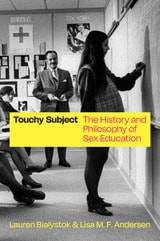
Touchy Subject
The History and Philosophy of Sex EducationLauren Bialystok and Lisa M. F. Andersen
University of Chicago Press, 2022
In the United States, sex education is more than just an uncomfortable rite of passage: it's a political hobby horse that is increasingly out of touch with young people’s needs. In Touchy Subject, philosopher Lauren Bialystok and historian Lisa M. F. Andersen unpack debates over sex education, explaining why it’s worth fighting for, what points of consensus we can build upon, and what sort of sex education schools should pursue in the future.
Andersen surveys the history of school-based sex education in the United States, describing the key question driving reform in each era. In turn, Bialystok analyzes the controversies over sex education to make sense of the arguments and offer advice about how to make educational choices today. Together, Bialystok and Andersen argue for a novel framework, Democratic Humanistic Sexuality Education, which exceeds the current conception of “comprehensive sex education” while making room for contextual variation. More than giving an honest run-down of the birds and the bees, sex education should respond to the features of young people’s evolving worlds, especially the digital world, and the inequities that put some students at much higher risk of sexual harm than others. Throughout the book, the authors show how sex education has progressed and how the very concept of “progress” remains contestable.
Touchy Subject
The History and Philosophy of Sex EducationLauren Bialystok and Lisa M. F. Andersen
University of Chicago Press, 2022
A case for sex education that puts it in historical and philosophical context.
In the United States, sex education is more than just an uncomfortable rite of passage: it's a political hobby horse that is increasingly out of touch with young people’s needs. In Touchy Subject, philosopher Lauren Bialystok and historian Lisa M. F. Andersen unpack debates over sex education, explaining why it’s worth fighting for, what points of consensus we can build upon, and what sort of sex education schools should pursue in the future.
Andersen surveys the history of school-based sex education in the United States, describing the key question driving reform in each era. In turn, Bialystok analyzes the controversies over sex education to make sense of the arguments and offer advice about how to make educational choices today. Together, Bialystok and Andersen argue for a novel framework, Democratic Humanistic Sexuality Education, which exceeds the current conception of “comprehensive sex education” while making room for contextual variation. More than giving an honest run-down of the birds and the bees, sex education should respond to the features of young people’s evolving worlds, especially the digital world, and the inequities that put some students at much higher risk of sexual harm than others. Throughout the book, the authors show how sex education has progressed and how the very concept of “progress” remains contestable.

Tough Love
Amazon Encounters in the English RenaissanceKathryn Schwarz
Duke University Press, 2000
Despite seeming to function as signs for what is outside the social—the alien, the exotic, the other—Amazons in sixteenth- and seventeenth-century texts were often represented in conventionally domestic roles, as mothers and lovers, wives and queens, Schwarz demonstrates. She traces this pattern in works by Shakespeare, Spenser, Sidney, Raleigh, and Jonson, as well as in such materials as conduct manuals, explorers’ accounts, court spectacles, and political tracts. Through readings of these texts, Schwarz shows that the Amazon myth provided a language both for setting forth and for challenging the terms of social logic. In representations of Amazon encounters, she argues, homosocial bonds became indistinguishable from heterosexual desires, masculine agency attached itself as logically to women as it did to men, and sexual difference was made nearly impossible to sustain or define. Schwarz’s analysis unveils the Amazon as a theoretical term, one that illuminates the tensions and paradoxes through which ideologies of the domestic take shape.
Tough Love contributes to the ongoing discussion of gendered identity and sexual desire in the early modern period. It will interest students of queer theory, cultural studies, early modern history, feminism, and literature.
Touring The Sierra Nevada
Cheryl Angelina Koehler
University of Nevada Press, 2007
The complete guide to the entire Sierra Nevada
The Sierra Nevada is one of the most scenic, biologically diverse, and historically rich mountain ranges in North America. Touring the Sierra Nevada covers the entire range and its adjacent regions, exploring the Sierra Nevada from such world-famous sites as Lake Tahoe and Yosemite to picturesque mining towns, scenic alpine lakes, lush vineyards, and colorful hidden byways. Koehler offers suggestions for long tours and exciting daytrips, as well as detailed information about the history, geology, flora and fauna, economy, and unique features of places along the way. The book is illustrated with photographs and maps of the regions she describes. Koehler includes excursions for automobile travelers as well as backcountry adventures for hikers. She provides information about attractions in the Sierra’s two “jumping-off” cities, Sacramento and Reno, as well as in some of the major towns within the range. There is practical advice about contacting parks, museums, historical sites, visitors’ bureaus, U.S. Forest Service offices, and other agencies; finding lodging, campgrounds, and restaurants along the way; preparing for weather and altitude changes; and identifying further sources of information about the region in published guides and other books, as well as on websites. Koehler offers her readers the literary companionship of an experienced, charming, and vivacious guide through one of America’s most fascinating regions.

Touring the Screen
Tourism and New Zealand Film GeographiesAlfio Leotta
Intellect Books, 2011
Following the success of prominent feature films shot on location, including Tolkien’s wildly popular The Lord of the Rings, New Zealand boasts an impressive film tourism industry. This book examines the relationship between New Zealand’s cinematic representation—as both a vast expanse of natural beauty and a magical world of fantasy on screen—and its tourism imagery, including the ways in which savvy local tourism boards have in recent decades used the country’s film representations to sell New Zealand as a premiere travel destination. Focusing on the films that have had a strong impact on marketing strategies by local tourist boards, Touring the Screen will be of interest to all those working and studying in the fields of cinema, postcolonial history, and tourism studies.

Tourism, Landscape, and the Irish Character
British Travel Writers in Pre-Famine IrelandWilliam H. A. Williams
University of Wisconsin Press, 2007
Picturesque but poor, abject yet sublime in its Gothic melancholy, the Ireland perceived by British visitors during the eighteenth and nineteenth centuries did not fit their ideas of progress, propriety, and Protestantism. The rituals of Irish Catholicism, the lamentations of funeral wakes, the Irish language they could not comprehend, even the landscapes were all strange to tourists from England, Wales, and Scotland. Overlooking the acute despair in England’s own industrial cities, these travelers opined in their writings that the poverty, bog lands, and ill-thatched houses of rural Ireland indicated moral failures of the Irish character.
Tourist Distractions
Traveling and Feeling in Transnational Hallyu CinemaYoungmin Choe
Duke University Press, 2016
Tourists of History
Memory, Kitsch, and Consumerism from Oklahoma City to Ground ZeroMarita Sturken
Duke University Press, 2007
Sturken contends that a consumer culture of comfort objects such as World Trade Center snow globes, FDNY teddy bears, and Oklahoma City Memorial t-shirts and branded water, as well as reenactments of traumatic events in memorial and architectural designs, enables a national tendency to see U.S. culture as distant from both history and world politics. A kitsch comfort culture contributes to a “tourist” relationship to history: Americans can feel good about visiting and buying souvenirs at sites of national mourning without having to engage with the economic, social, and political causes of the violent events. While arguing for the importance of remembering tragic losses of life, Sturken is urging attention to a dangerous confluence—of memory, tourism, consumerism, paranoia, security, and kitsch—that promulgates fear to sell safety, offers prepackaged emotion at the expense of critical thought, contains alternative politics, and facilitates public acquiescence in the federal government’s repressive measures at home and its aggressive political and military policies abroad.
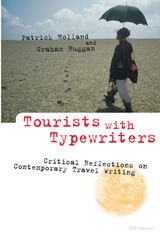
Tourists with Typewriters
Critical Reflections on Contemporary Travel WritingPatrick Holland and Graham Huggan
University of Michigan Press, 2000
The book maps new terrain in a growing area of critical study. Although critical of travel writing's complacency and its often unacknowledged ethnocentrism, the book recognizes its importance as both a literary and cultural form. While travel writing at its worst emerges as a crude expression of economic advantage, at its best it becomes a subtle instrument of cultural self-perception, a barometer for changing views of "other" (i.e., foreign, non-Western) cultures, and a trigger for the information circuits that tap us into the wider world.
Tourists with Typewriters gauges both the best and worst in contemporary travel writing, capturing the excitement of this most volatile--and at times infuriating--of literary genres. The book will appeal to general readers interested in a closer examination of travel writing and to academic readers in disciplines such as literary/cultural studies, geography, history, anthropology, and tourism studies.
"An eminently readable and informative study. It breathes tolerance and intelligence. It is critically perceptive and very au courant. It raises issues (coloniality, postmodernity, gender. . . ) and discusses books that readers of many different stripes will want to find out about." --Ross Chambers, University of Michigan
Patrick Holland, Associate Professor of English, University of Guelph, was born in New Zealand and educated in England, Australia, and Canada. Graham Huggan, Professor of English, University of Munich, was born in Hong Kong and educated in England and in British Columbia.
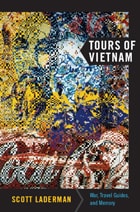
Tours of Vietnam
War, Travel Guides, and MemoryScott Laderman
Duke University Press, 2009
Tracing a history of ideological assertions embedded in travel discourse, Laderman analyzes the use of tourism in the Republic of Vietnam as a form of Cold War cultural diplomacy by a fledgling state that, according to one pamphlet published by the Vietnamese tourism authorities, was joining the “family of free nations.” He chronicles the evolution of the Defense Department pocket guides to Vietnam, the first of which, published in 1963, promoted military service in Southeast Asia by touting the exciting opportunities offered by Vietnam to sightsee, swim, hunt, and water-ski. Laderman points out that, despite historians’ ongoing and well-documented uncertainty about the facts of the 1968 “Hue Massacre” during the National Liberation Front’s occupation of the former imperial capital, the incident often appears in English-language guidebooks as a settled narrative of revolutionary Vietnamese atrocity. And turning to the War Remnants Museum in Ho Chi Minh City, he notes that, while most contemporary accounts concede that the United States perpetrated gruesome acts of violence in Vietnam, many tourists and travel writers still dismiss the museum’s display of that record as little more than “propaganda.”
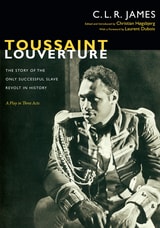
Toussaint Louverture
The Story of the Only Successful Slave Revolt in History; A Play in Three ActsC. L. R. James Edited and Introduced by Christian Høgsbjerg
Duke University Press, 2013
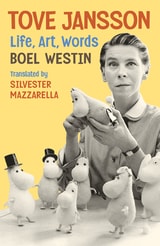
Tove Jansson
Life, Art, WordsBoel Westin
University of Minnesota Press, 2024
An in-depth, perceptive account of the unconventional life of the Moomins’ beloved creator, now available in the United States
Tove Jansson achieved fame as the creator of the Moomins, beloved by generations of readers around the world. Remarkably, the Moomins were only part of the prodigious creative output of this Finnish-Swedish writer and artist. Jansson’s work also includes short stories and five novels for adults, as well as paintings, murals, and book illustrations. In this acclaimed biography, Boel Westin relies on numerous conversations with Jansson and unprecedented access to her journals, letters, and personal archives to present an engrossing and comprehensive review of the life and world of Scandinavia’s best-loved author.
As Westin’s meticulous research makes clear, Jansson’s artistic and literary works reflected what was most important to her: the love of family and nature and the desire to pursue her art. Guided by her personal motto, “Love and work,” Jansson seized both with uncompromising joy. And while her romantic relationships with men proved unfulfilling, she found those with women—especially with her longtime partner, the artist Tuulikki Pietilä—both grounding and inspiring.
Westin weaves together the many threads of Jansson’s rich, complex life: an education interrupted to help her family; the bleak war years and her emergence as a painter; the decades of Moominmania across books, newspaper comic strips, merchandise, and adaptations; her later fictions, including her popular The Summer Book; and her time with Pietilä on the solitary island of Klovharu. Tove Jansson: Life, Art, Words offers fans and admirers around the world the most complete portrait of the writer Philip Pullman described as “a genius, a woman of profound wisdom and great artistry.”
Toward "Natural Right and History"
Lectures and Essays by Leo Strauss, 1937–1946Leo Strauss
University of Chicago Press, 2018
Previously unpublished in book form, Strauss’s lectures are presented here in a thematic order that mirrors Natural Right and History and with interpretive essays by J. A. Colen, Christopher Lynch, Svetozar Minkov, Daniel Tanguay, Nathan Tarcov, and Michael Zuckert that establish their relation to the work. Rounding out the book are copious annotations and notes to facilitate further study.
Toward Nationalism's End
An Intellectual Biography of Hans KohnAdi Gordon
Brandeis University Press, 2017

Toward Wiser Public Judgment
Daniel Yankelovich
Vanderbilt University Press, 2011
In his lead chapter, Dan Yankelovich urges us to move away from a "misleading model of public opinion" that "dominates the expert culture of our society, including journalists, scientists, business leaders, scholars, professional experts, and political leaders." He and the other contributors (Will Friedman, Keith Melville, Robert Kingston, Alison Kadlec, Steven A. Rosell, and Heidi Gantwerk) describe methods used by organizations like Public Agenda, National Issues Forums, and Viewpoint Learning, Inc., to advance the public's learning curve through various forms of civic engagement, education, dialogue and deliberation.
They provide case studies of education reform in Bridgeport, Connecticut, and math and science initiatives in the Kansas City area, and examples of programs that have focused on issues ranging from energy and health care to US-Muslim relations. One chapter is a dialogue between Yankelovich and Friedman.
While our political culture resonates to the public's desire for a stronger voice, it fails to ensure that this voice reflects anything more than the spin, spectacle, and excessive partisanship that dominate today's public discourse. Toward Wiser Public Judgment offers insights and strategies to counteract these troubling trends.
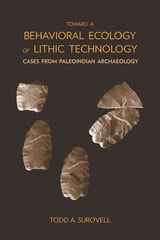
Toward a Behavioral Ecology of Lithic Technology
Cases from Paleoindian ArchaeologyTodd A. Surovell
University of Arizona Press, 2009
Because the fundamental processes of making, using, and discarding stone tools are, at root, exercises in problem solving, Todd Surovell asks what conditions favor certain technological solutions. Whether asking if a biface should be made thick or thin or if a flake should be saved or discarded, Surovell seeks answers that extend beyond a case-by-case analysis. One avenue for addressing these questions theoretically is formal mathematical modeling.
Here Surovell constructs a series of models designed to link environmental variability to human decision making as it pertains to lithic technology. To test the models, Surovell uses data from the analysis of more than 40,000 artifacts from five Rocky Mountain and Northern Plains Folsom and Goshen complex archaeological sites dating to the Younger Dryas stadial (ca. 12,600-11,500 years BP). The primary result is the production of powerful new analytical tools useful to the interpretation of archaeological assemblages.
Surovell's goal is to promote modeling and explore the general issues governing technological decisions. In this light, his models can be applied to any context in which stone tools are made and used.