Results by title
3576 books match the query 'American' and 770 start with t
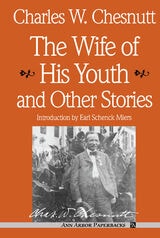
The Wife of His Youth and Other Stories
Charles W. Chesnutt
University of Michigan Press, 1968
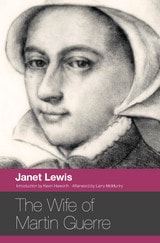
The Wife of Martin Guerre
Janet Lewis
Ohio University Press, 2013
In this new edition of Janet Lewis’s classic short novel, The Wife of Martin Guerre, Swallow Press executive editor Kevin Haworth writes that Lewis’s story is “a short novel of astonishing depth and resonance, a sharply drawn historical tale that asks contemporary questions about identity and belonging, about men and women, and about an individual’s capacity to act within an inflexible system.” Originally published in 1941, The Wife of Martin Guerre has earned the respect and admiration of critics and readers for over sixty years.
Based on a notorious trial in sixteenth-century France, this story of Bertrande de Rols is the first of three novels making up Lewis’s Cases of Circumstantial Evidence suite (the other two are The Trial of Sören Qvist and The Ghost of Monsieur Scarron).
Swallow Press is delighted and honored to offer readers beautiful new editions of all three Cases of Circumstantial Evidence novels, each featuring a new introduction by Kevin Haworth.

The Wild Earth’s Nobility
A NovelFrank Waters
Ohio University Press, 2002
The Wild Earth’s Nobility is the first of Frank Waters’s semiautobiographical novels in the Pikes Peak saga. Here, in a frontier town in the shadow of the commanding mountain, the Rogier family settles near an age-old route of migrating Native Americans. In an era of prospecting, silver strikes, and frenzied mining, Joseph Rogier becomes a successful building contractor, rears a large family, and is gradually overwhelmed by the power of the great peak.
In Waters’s visionary prose, the story becomes a mythic journey to reconcile instinct and reason, consciousness and intuition, and the powerful emotions of a family struggling with its own dreams and human limitations.
Frank Waters (1902-1995), one of the finest chroniclers of the American Southwest, wrote twenty-eight works of fiction and nonfiction. Of Pike’s Peak (1971), the Chicago Daily News wrote, “It is a product of maturity, written with a sustained strength and beauty of style rarely found in fiction today.”
Pike’s Peak is composed of three condensed novels: The Wild Earth’s Nobility, Below Grass Roots, and The Dust within the Rock.
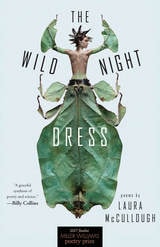
The Wild Night Dress
PoemsLaura McCullough
University of Arkansas Press, 2017
Finalist, 2017 Miller Williams Poetry Prize, edited by Billy Collins
“A graceful synthesis of poetry and science.”
—Billy Collins
Laura McCullough finds passage through the darkest times as she loses, in short order, her mother and her marriage. Through her near unbearable grief, she creates poems that slip between science and nature as she grasps at coordinates in a world spun out of its orbit. From the God Particle to toroidal vortexes, from the slippery linguistics of translation to the translation of the body, McCullough brings readers to the mystery of surrender, and the paradox that what we bear can make us more beautiful, that there is a gift in grief.
The Wilderness and Other Poems
Louis Coxe
University of Minnesota Press, 1958
The Wished For Country
Wayne Karlin
Northwestern University Press, 2002
The stories of these three men, the women who love them, and the community they form, bring to vivid life the experiences of those who came to America pulled by a dream of what could be shaped from an emptiness that embodied promise, of those who were unwillingly brought to be the instruments of that dream, and of those who saw the shape of their world forever changed by the coming of the Europeans.
The Wizard of Oz and Who He Was
Martin Gardner
Michigan State University Press, 1994
When Russel B. Nye and Martin Gardner teamed up to bring out a new edition of The Wonderful Wizard of Oz, theirs was the first critical analysis of L. Frank Baum American classic. The book opens with an essay by Nye, entitled "An Appreciation," which is an overview of Baum's creative and imaginative genius. Nye explores the reasons why earlier critics virtually ignored the Oz stories. Gardner, in his essay, "The Royal Historian of Oz," presents a brief biographical sketch, revealing little-known facts about this prolific writer. The volume also contains the complete, original text of the Wonderful Wizard of Oz, along with many original illustrations by artist W. W. Denslow.
The Wolf at the End of the Block
A PlayIke Holter
Northwestern University Press, 2020
A modern-day neo-noir, The Wolf at the End of the Block remixes several different genres to present a new kind of thriller that is socially conscious, relentlessy suspenseful, and bitingly funny. Praised for its power and grace, the play is one of Holter’s most unforgettable.
The Wolf at the End of the Block is one of seven plays in Holter’s Rightlynd Saga, set in Chicago’s fictional fifty-first ward. The other plays in the cycle are Rightlynd, Exit Strategy, Sender, Prowess, Red Rex, and Lottery Day.
The Woman At Otowi Crossing
Frank Waters
Ohio University Press, 1987
Based on the real life of Edith Warner, who ran a tearoom at Otowi Crossing, just below Los Alamos, The Woman at Otowi Crossing is the story of Helen Chalmer, a person in tune with her adopted environment and her neighbors in the nearby Indian pueblo and also a friend of the first atomic scientists. The secret evolution of atomic research is a counterpoint to her psychic development.
In keeping with its tradition of allowing the best of its list to thrive, Ohio University Press/Swallow Press is particularly proud to reissue The Woman at Otowi Crossing by best-selling author Frank Waters. This new edition features an introduction by Professor Thomas J. Lyon and a foreword by the author’s widow, Barbara Waters.
The story is quintessential Waters: a parable for the potentially destructive materialism of the mid-twentieth century. The antidote is Helen Chalmer’s ability to understand a deeper truth of her being; beyond the Western notion of selfhood, beyond the sense of a personality distinct from the rest, she experiences a new and wider awareness.
The basis for an opera of the same name, The Woman at Otowi Crossing is the powerful story of the crossing of cultures and lives: a fable for our times.
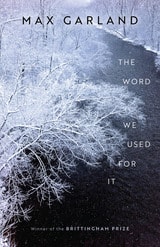
The Word We Used For It
Max Garland
University of Wisconsin Press, 2017
In these poems Max Garland confesses, even revels in, the fabricated nature of memory. He links personal and localized patterns (fingerprints, plowed fields) to the motions animating the insides of atoms and the unfurling of remote galaxies. Back on earth, the poems honor the decidedly homespun quality of grit—how creatures both animal and human bear up in the face of mounting odds against them. Garland suggests that imagination itself requires grit, to be called upon when the more spectacular angels are otherwise occupied.
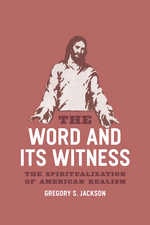
The Word and Its Witness
The Spiritualization of American RealismGregory S. Jackson
University of Chicago Press, 2009
Jackson shows how the homiletic tradition in Protestant sermons provided a foundation for the development of visual and literary realism. Evangelical preachers and writers used vivid language grounded in everyday life to translate abstract concepts like hell into concrete reality—a key influence on realist authors that brought about the more secular forms of the movement we know today. This emphasis on the sensuous also paved the way for Protestantism’s embrace of new media, evident in the photographs of Jacob Riis as well as the video game Left Behind: Eternal Forces.
With its remarkable scope and timely insights into the interplay between religion, secularism, and politics, The Word and Its Witness will transform the way we understand American realism and American religion.
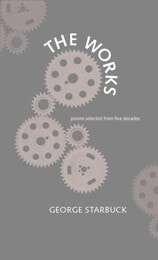
The Works
Poems Selected from Five DecadesGeorge Starbuck
University of Alabama Press, 2003
Eighty-one poems spanning the career of the late George Starbuck, widely praised luminary of modern American verse.
Starbuck was known in his lifetime and is remembered today as a practitioner of verse remarkable for its pathos, intelligence, and wit. A master of American vernacular, sensitive to the rhythms of everyday speech, Starbuck was also a brilliant lyricist, at once erudite and irreverent. He addressed some of the most profound issues of his day with a playful ingenuity and a virtuosity of talent that Glyn Maxwell, poetry editor of the New Republic, writing in The Oxford Companion to Twentieth Century Poetry, calls a “veritable arsenal of strategies against the darkness.”
Starbuck came to wide critical notice in 1960 with the publication of his first book, Bone Thoughts, which won the Yale Series of Younger Poets prize. He published work regularly in the New Yorker and other major literary journals in the United States. His work was consistently recognized with awards, among them the Prix de Rome, an Ingram-Merrill Fellowship, a Rockefeller Foundation Fellowship, the Beth Hokin Prize, a Notable Book of the Year designation from the New York Times, the Lenore Marshall poetry prize, and an Aiken-Taylor Lifetime Achievement Award.
Grouped together by decades, the poems reveal Starbuck's developing genius. His technical agility and his singular voice are evident. As Anthony Hecht declares in his foreword, "I come to this posthumous collection with serene and justified confidence in finding enormous pleasure, astonishment, admiration, and genuine satisfaction. [This book] is a generous sampling of a profound poetic legacy, one for which readers ought to be deeply grateful."
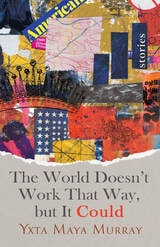
The World Doesn't Work That Way, but It Could
StoriesYxta Maya Murray
University of Nevada Press, 2025
The Millions' Most Anticipated: The Great Second-Half of 2020 Book Preview
The gripping, thought-provoking stories in Yxta Maya Murray’s latest collection find their inspiration in the headlines. Here, ordinary people negotiate tentative paths through wildfire, mass shootings, bureaucratic incompetence, and heedless government policies with vicious impacts on the innocent and helpless. A nurse volunteers to serve in catastrophe-stricken Puerto Rico after Hurricane Maria and discovers that her skill and compassion are useless in the face of stubborn governmental inertia. An Environmental Protection Agency employee, whose agricultural-worker parents died after long exposure to a deadly pesticide, finds herself forced to find justifications for reversing regulations that had earlier banned the chemical. A Department of Education employee in a dystopic future America visits a highly praised charter school and discovers the horrific consequences of academic failure. A transgender trainer of beauty pageant contestants takes on a beautiful Latina for the Miss USA pageant and brings her to perfection and the brink of victory, only to discover that she has a fatal secret.
The characters in these stories grapple with the consequences of frightening attitudes and policies pervasive in the United States today. The stories explore not only our distressing human capacity for moral numbness in the face of evil, but also reveal our surprising stores of compassion and forgiveness. These brilliantly conceived and beautifully written stories are troubling yet irresistible mirrors of our time.
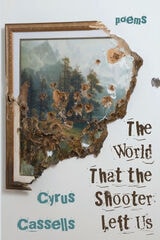
The World That the Shooter Left Us
Cyrus Cassells
Four Way Books, 2022
In the aftermath of the Stand Your Ground killing of his close friend’s father, poet Cassells explores, in his most fearless book to date, the brutality, bigotry, and betrayal at the heart of current America. Taking his cue from the Civil Rights and Vietnam War era poets and songwriters who inspired him in his youth, Cassells presents The World That the Shooter Left Us, a frank, bulletin-fierce indictment of unraveling democracy in an embattled America, in a world still haunted by slavery, by Guernica, Hiroshima, and the Holocaust, by climate catastrophe, by countless battles, borders, and broken promises—adding new grit, fire, and luster to his forty-year career as a dedicated and vital American poet.
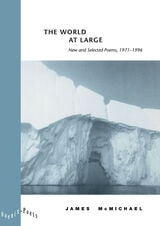
The World at Large
New and Selected Poems, 1971-1996James McMichael
University of Chicago Press, 1996
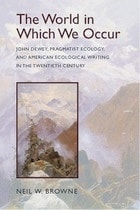
The World in Which We Occur
John Dewey, Pragmatist Ecology, and American Ecological Writing in the Twentieth CenturyNeil W. Browne
University of Alabama Press, 2007
Where nature meets democracy—John Dewey’s vision for a more connected world.
American philosopher John Dewey considered all human endeavors to be one with the natural world. In his writings, particularly Art as Experience (1934), Dewey insists on the primacy of the environment in aesthetic experience. Dewey’s conception of environment includes both the natural and the man-made. The World in Which We Occur highlights this notion in order to define “pragmatist ecology,” a practice rooted in the interface of the cultural and the natural. Neil Browne finds this to be a significant feature of some of the most important ecological writing of the last century.
To fully understand human involvement in the natural world, Browne argues that disciplinary boundaries must be opened, with profound implications for the practice of democracy. The degradation of the physical environment and democratic decay, for Browne, are rooted in the same problem: our persistent belief that humans are somehow separate from their physical environment.
Browne probes the work of a number of major American writers through the lens of Dewey’s philosophy. Among other texts examined are John Muir’s My First Summer in the Sierra (1911); Sea of Cortez (1941) by John Steinbeck and Edward Ricketts; Rachel Carson’s three books about the sea, Under the Sea-Wind (1941), The Sea Around Us (1951), and The Edge of the Sea (1955); John Haines’s The Stars, the Snow, the Fire (1989); Barry Lopez’s Arctic Dreams (1986); and Terry Tempest Williams’s Refuge (1991). Together, these texts—with their combinations of scientific observation and personal meditation—challenge the dichotomies that we have become accustomed and affirm the principles of a pragmatist ecology, one in which ecological and democratic values go hand in hand.
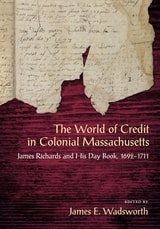
The World of Credit in Colonial Massachusetts
James Richards and His Daybook, 1692-1711James E. Wadsworth
University of Massachusetts Press, 2017
For years, James Richards, a prosperous and typical colonial farmer, tracked nearly five thousand transactions, involving more than six hundred individuals and stretching from Charlestown to Barnstable. Richards and his neighbors were bound together in a heterogeneous economy, reliant on networks of credit, barter, and sometimes cash. Richards practiced mixed husbandry farming, shipped goods by cart and by sloop, and produced and sold malt, salt, wool, and timber. The day book also reveals significant social details of Richards and his household, including his diverse trading partners, his extensive family connections, an Indian slave girl, and a well-dressed female servant. Available in both print and electronic editions, fully transcribed, annotated, and introduced by the editor, this record of economic life reinforces and challenges our understanding of colonial America.
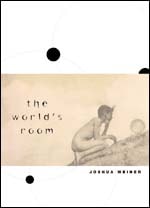
The World's Room
Joshua Weiner
University of Chicago Press, 2001
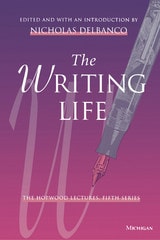
The Writing Life
The Hopwood Lectures, Fifth SeriesNicholas Delbanco
University of Michigan Press, 2000
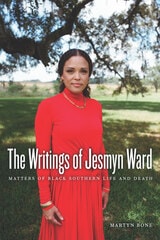
The Writings of Jesmyn Ward
Matters of Black Southern Life and DeathMartyn Bone
University of Iowa Press, 2025
Martyn Bone thoughtfully examines key themes running throughout Ward’s writing: Black life in the U.S. South; the legacies of slavery and segregation; neoliberalism as the contemporary form of capitalism; environmental crisis in the Anthropocene; and human-animal relations. Bone also connects Ward’s work to major figures in the U.S. literary canon, with particular focus on William Faulkner, Zora Neale Hurston, and Toni Morrison.
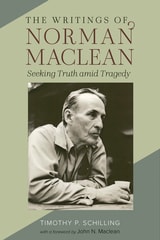
The Writings of Norman Maclean
Seeking Truth amid TragedyTimothy P. Schilling
University of Nevada Press, 2024
The Writings of Norman Maclean: Seeking Truth amid Tragedy provides the first critical reassessment of this celebrated author’s work in more than a decade. In his study, Timothy P. Schilling focuses on Maclean’s attempt, in A River Runs through It and Other Stories and Young Men and Fire, to come to grips with the tragic side of human existence. From the 1938 death of his brother Paul to the 1949 deaths of thirteen firefighters in Montana’s Mann Gulch wildfire, Maclean is driven by a desire to discover ultimate meaning—the truth—in the face of haunting tragedy. Through careful analysis of all of Maclean’s published works, Schilling highlights the audaciousness of Maclean’s quest to wrest free an answer from “the universe.”
Ever open to scientific, literary, philosophical, and theological ways of viewing reality, Maclean found ambiguity, paradoxically, to be an essential tool for probing the truth. Beyond exploring Maclean’s use of this tool, Schilling breaks new ground by considering Maclean’s invocation of the Transcendentals in “A River Runs through It,” noting the sly homage Maclean pays to Izaak Walton, examining Maclean’s often-neglected “Other Stories,” assessing Robert Redford’s film adaptation of “A River Runs through It,” and providing the most thorough exploration of Young Men and Fire yet available.
With this book, Schilling offers a current and complete analysis of Maclean—one of the most iconic figures in Western American literature.

The Yale Critics
Deconstruction in AmericaJonathan Arac, Wlad Godzich, and Wallace Martin, Editors
University of Minnesota Press, 1983
The Yale Critics was first published in 1983. Minnesota Archive Editions uses digital technology to make long-unavailable books once again accessible, and are published unaltered from the original University of Minnesota Press editions.
A heated debate has been raging in North America in recent years over the form and function of literature. At the center of the fray is a group of critics teaching at Yale University—Harold Bloom, Geoffrey Hartman, Paul de Man, and J. Hillis Miller—whose work can be described in relation to the deconstructive philosophy practiced by French philosopher Jacques Derrida. For over a decade the Yale Critics have aroused controversy; most often they are considered as a group, to be applauded or attacked, rather than as individuals whose ideas merit critical scrutiny. Here a new generation of scholars attempts for the first time a serious, broad assessment of the Yale group. These essays appraise the Yale Critics by exploring their roots, their individual careers, and the issues they introduce.
Wallace Martin's introduction offers a brilliant, compact account of the Yale Critics and of their relation to deconstruction and the deconstruction to two characteristically Anglo-American enterprises; Paul Bove explores the new criticism and Wlad Godzich the reception of Derrida in America. Next come essays giving individual attention to each of the critics: Michael Sprinker on Hartman, Donald Pease on Miller, Stanley Corngold on de Man, and Daniel O'Hara on Bloom. Two essays then illuminate "deconstruction in America" through a return to modern continental philosophy: Donald Marshall on Maurice Blanchot, and Rodolphe Gasche on Martin Heidegger. Finally, Jonathan Arac's afterword brings the volume together and projects a future beyond the Yale Critics.
Throughout, the contributors aim to provide a balanced view of a subject that has most often been treated polemically. While useful as an introduction, The Yale Critics also engages in a serious critical reflection on the uses of the humanities in American today.
The Year of the Femme
Cassie Donish
University of Iowa Press, 2019
The Yellow Wall-Paper by Charlotte Perkins Gilman
A Dual-Text Critical EditionCharlotte Perkins Gilman
Ohio University Press, 2006
Most editions have been based on the 1892 New England Magazine publication rather than the handwritten manuscript at Radcliffe College. Publication of the unedited manuscript in 1994 sparked controversy over which of the two was definitive. Since then, scholars have discovered half a dozen parent texts for later twentieth-century printings, including William Dean Howells’s version from 1920 and the 1933 Golden Book version.
While traditional critical editions gather evidence and make an argument for adopting one text as preferable to others,“The Yellow Wall-Paper” by Charlotte Perkins Gilman: A Dual-Text Critical Edition, edited by Shawn St. Jean, offers both manuscript and magazine versions, critically edited and printed in parallel for the first time. New significance appears in such facets as the magazine’s accompanying illustrations, its lineation and paragraphing, Gilman’s choice of pronouns, and her original handwritten ending.
This critical edition of “The Yellow Wall-Paper” includes a full and nontraditional apparatus, making it easy for students and scholars to study the more than four hundred variants between the two texts. Four new essays, written especially for this volume, explore the implications of this multitext model.
Theater Enough
American Culture and the Metaphor of the World Stage, 1607–1789Jeffrey H. Richards
Duke University Press, 1991
The rhetoric, or discourse, of early American theater emerged out of the figures of speech that permeated the colonists’ lives and literary productions. Jeffrey H. Richards examines a variety of texts—histories, diaries, letters, journals, poems, sermons, political tracts, trial transcripts, orations, and plays—and looks at the writings of such authors as John Winthrop and Mercy Otis Warren. Richards places the American usage of theatrum mundi—the world depicted as a stage—in the context of classical and Renaissance traditions, but shows how the trope functions in American rhetoric as a register for religious, political, and historical attitudes.
Theaters of Madness
Insane Asylums and Nineteenth-Century American CultureBenjamin Reiss
University of Chicago Press, 2008
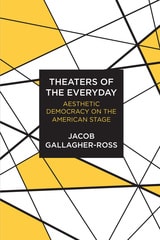
Theaters of the Everyday
Aesthetic Democracy on the American StageJacob Gallagher-Ross
Northwestern University Press, 2018
Offering both fresh reappraisals of canonical figures and movements and new examinations of theatrical innovators, Theaters of the Everyday reveals surprising affinities between artists often considered poles apart, such as John Cage and Lee Strasberg, and Thornton Wilder and the New York experimentalist Nature Theater of Oklahoma. Gallagher-Ross persuasively shows how these creators eschew conventional definitions of dramatic action and focus attention on smaller but no less profound dramas of perception, consciousness, and day-to-day life.
Gallagher-Ross traces some of the intellectual roots of the theater of the everyday to American transcendentalism, with its pragmatic process philosophy as well as its sense of ordinary experience as the wellspring of aesthetic awareness.
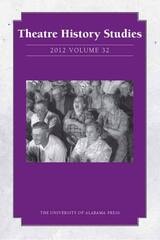
Theatre History Studies 2012, Vol. 32
Edited by Rhona Justice-Malloy
University of Alabama Press, 2012
Penny Farfan / Victor Holtcamp / Lisa Jackson-Schebetta / Richard
L. Poole / Bill Rauch / Thomas Robson / Marlis Schweitzer / Virginia
Scott / Christine Woodworth
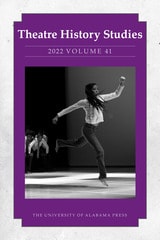
Theatre History Studies 2022, Vol 41
edited by Lisa Jackson-Schebetta
University of Alabama Press, 2023
New perspectives and rigorous scholarship shaping the histories of theatre and performance.
Theatre History Studies 2022, Vol. 41 presents a dynamic collection of peer‑reviewed essays that exemplify current directions in theatre and performance historiography. Edited by Lisa Jackson‑Schebetta, this volume brings together scholars whose work spans diverse periods, geographies, and performance traditions, demonstrating the field’s continued expansion in scope and methodology. As the official journal of the Mid‑America Theatre Conference, Theatre History Studies remains a vital venue for rigorous historical inquiry grounded in archival research, critical theory, and historiographic reflection.
Volume 41 engages pressing questions about how theatre histories are constructed, narrated, and mobilized in relation to social, political, and cultural contexts. Contributors explore performance as a site of embodied knowledge, identity formation, resistance, and memory, with essays that address race, gender, sexuality, labor, migration, and transnational exchange. The volume reflects a historiographic turn toward interdisciplinary approaches, drawing from dance studies, performance studies, critical race theory, and cultural history to reconsider established narratives and recover overlooked voices.
Together, the essays in this volume demonstrate the continued relevance of theatre history as both a scholarly practice and a critical framework for understanding performance’s role in shaping—and being shaped by—broader historical forces. Theatre History Studies 2022, Vol. 41 will be of particular value to scholars, educators, and graduate students in theatre and performance studies, as well as researchers in related fields who are interested in innovative historical methods and the evolving contours of performance scholarship.
CONTRIBUTORS
Angela K. Ahlgren / Samer Al-Saber / Kelly I. Aliano / Gordon Alley-Young / Melissa Blanco Borelli / Trevor Boffone / Jay Buchanan / Matthieu Chapman / Joanna Dee Das / Ryan J. Douglas / Victoria Fortuna / Christiana Molldrem Harkulich / Alani Hicks-Bartlett / Jeanmarie Higgins / Lisa Jackson-Schebetta / Erin Rachel Kaplan / Heather Kelley / Patrick Maley / Karin Maresh / Lisa Milner / Courtney Elkin Mohler / Heather S. Nathans / Heidi L. Nees / Sebastian Samur / Michael Schweikardt / Teresa Simone / Dennis Sloan / Guilia Taddeo / Kyle A. Thomas / Alex Vermillion / Bethany Wood
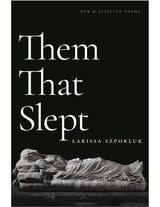
Them That Slept
New & Selected PoemsLarissa Szporluk
Tupelo Press, 2026
A selection of poems that form a narrative about psychological and spiritual somnambulance in our current age and the ever-urgent need to wake up.
In Them That Slept, Larissa Szporluk gathers three decades of work into a single incandescent arc—poems that braid feminist theology, eros, and myth into a lyric of fierce awakening. Borrowing its title from First Corinthians—“the firstfruits of them that slept”—this collection asks what it means to rise, not into certainty, but into desire, voice, and embodiment. Here, virgins become saints and saints become women of appetite. Daughters speak back to fathers. The sea mothers and devours. Joan of Arc lingers in her cell. Venus tweets. The body is never merely symbolic—it is radiant, wounded, knowing. Szporluk’s women are not passive figures in inherited narratives; they are theologians of touch, architects of longing, midwives of their own transformations.
Across selections from six previous books and a powerful suite of new poems, Szporluk reimagines sacred language as intimate speech. Biblical cadences shimmer against domestic interiors, fields, bedrooms, and storm skies. Eros is not an ornament but a form of knowledge; faith is not obedience but risk. These are poems that refuse to sleep through history. They burn toward revelation— sensual, subversive, and alive.
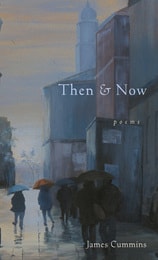
Then and Now
PoemsJames Cummins
Ohio University Press, 2004
James Cummins’s first book of poems, The Whole Truth, became known throughout much of the poetry world as the “Perry Mason sestinas.” His second book, Portrait in a Spoon, was chosen by Richard Howard for the James Dickey Prize Contemporary Poetry Series.
His latest and most accomplished work is collected in Then and Now, which reflects the same inventiveness and wit evident in his earlier books, with a deepening of tone and spirit. The result is a collection of poems filled with feeling and with Cummins’s signature anguished humor.
If the language of poetry is a way into a hall of mirrors of the self, it can be a way out, too. The voice that emerges in Then and Now is sane, imaginative, bemused, and sly, not only taking responsibility for the character of the writer put fully on display, but ironically and affectionately exploring how this process occurs.
Doing Lunch
You have lunch with a friend.
You put on a false face for him,
because he is your friend.
You want to spare him your
maunderings,
your lies and malfeasance.
But this is just what your friend desires,
because he is your friend.
He wants your face to fall open
in front of him and twitch
like a rabbit hit on the fly.
He says he wants the latest word
from the border region between
narcissism and an inner life.
And laughs.
Shamelessly, you tell him everything,
because he is your friend.
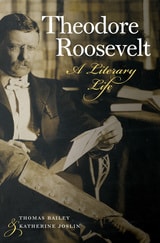
Theodore Roosevelt
A Literary LifeThomas Bailey and Katherine Joslin
University Press of New England, 2018
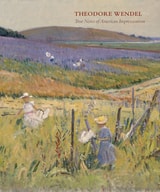
Theodore Wendel
True Notes of American ImpressionismTheodore Wendel
The Artist Book Foundation, 2019
One of the original "Duveneck boys" who studied in Munich at the Royal Academy, Theodore Wendel followed his mentor to Florence and Venice; he later went on to Paris and ultimately joined a colony of young artists at Giverny. The scenes and subject matter in the works he completed there are among the earliest by an American artist to adopt and evolve Impressionist strategies. Upon his return to America, he spent the next decades rendering scenes of the farmland and coast north of Boston that contemporary critics acclaimed as some of the best they had seen. Yet despite his talent and the significant accolades earned during his career, in the near-century following his death the recognition of his achievements has faded. The Artist Book Foundation is delighted to have the opportunity to remedy this siutation with its forthcoming monograph on the artist, Theodore Wendel: True Notes of American Impressionism.
Laurene Buckley's years of exhaustive research inform an engaging and detailed narrative of Wendel's time in Europe and his many years capturing the essence of the farms and fishing villages along the rural coast of Massachusetts. Thanks to her efforts, the book will feature many of his best works, a number of which are in private collections. An informative introduction by William H. Gerdts provides significant artistic context for Wendel and explains the artist's deft ability to draw the viewer into a scene. Concluding the monograph, an extensive chronology, exhibition history, and bibliography complete the scholarship on this long overdue tribute to a master of American Impressionism.
Theory and Practice of American Literary Naturalism
Selected Essay and ReviewsDonald Pizer
Southern Illinois University Press, 1993
In his first book devoted exclusively to naturalism, Donald Pizer brings together thirteen essays and four reviews written over a thirty-year period that in their entirety constitute a full-scale interpretation of the basic character and historical shape of naturalism in America.
The essays fall into three groups. Some deal with the full range of American naturalism, from the 1590s to the late twentieth century, and some are confined either to the 1890s or to the twentieth century. In addition to the essays, an introduction in which Pizer recounts the development of his interest in American naturalism, reviews of recent studies of naturalism, and a selected bibliography contribute to an understanding of Pizer’s interpretation of the movement.
One of the recurrent themes in the essays is that the interpretation of American naturalism has been hindered by the common view that the movement is characterized by a commitment to Emile Zola’s deterministic beliefs and that naturalistic novels are thus inevitably crude and simplistic both in theme and method. Rather than accept this notion, Pizer insists that naturalistic novels be read closely not for their success or failure in rendering obvious deterministic beliefs but rather for what actually does occur within the dynamic play of theme and form within the work.
Adopting this method, Pizer finds that naturalistic fiction often reveals a complex and suggestive mix of older humanistic faiths and more recent doubts about human volition, and that it renders this vital thematic ambivalence in increasingly sophisticated forms as the movement matures. In addition, Pizer demonstrates that American naturalism cannot be viewed monolithically as a school with a common body of belief and value. Rather, each generation of American naturalists, as well as major figures within each generation, has responded to threads within the naturalistic impulse in strikingly distinctive ways. And it is indeed this absence of a rigid doctrinal core and the openness of the movement to individual variation that are responsible for the remarkable vitality and longevity of the movement.
Because the essays have their origin in efforts to describe the general characteristics of American naturalism rather than in a desire to cover the field fully, some authors and works are discussed several times (though from different angles) and some referred to only briefly or notat all. But the essays as a collection are "complete" in the sense that they comprise an interpretation of American naturalism both in its various phases and as a whole. Those authors whose works receive substantial discussion include Stephen Crane, Frank Norris, Theodore Dreiser, Edith Wharton, James T. Farrell, Norman Mailer, Joyce Carol Oates, and William Kennedy. Of special interest is Pizer’s essay on Ironweed, which appears here for the first time.

Therapon
Bruce Bond and Dan Beacy-Quick
Tupelo Press, 2023
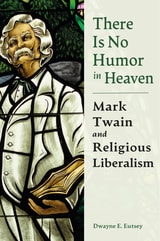
There is No Humor in Heaven
Mark Twain and Religious LiberalismDwayne E. Eutsey
University of Missouri Press, 2025
In There is No Humor in Heaven, Dwayne Eutsey challenges the persistent view of Twain as a hostile critic of religion by placing him within the prevailing liberal religious ethos of his time. From Hannibal to the western frontier and from Hartford to the wider world, Eutsey contends Twain’s vocation as a humorist was rooted in his frustrated youthful ambition to become a preacher of the Gospel. Throughout his life, his friendships with several influential liberal ministers, each of them espousing various forms of the era’s diverse progressive theology, informed not only Twain’s evolving religious worldview but his lecture performances and literary output.
There is No Humor in Heaven traces unconventional theological influences on Twain ranging from African-American spirituality, Freemasonry, and frontier Unitarianism to devout Liberal Christianity, radical Free Religion, and esoteric Hinduism. Drawing from Twain’s writings, documents, personal notes, and more, There is No Humor in Heaven offers readers a radical re-examination of the spiritually creative vitality of a controversial literary giant.
These Many Rooms
Laure-Anne Bosselaar
Four Way Books, 2019
They Can't Take That Away from Me
Gail Mazur
University of Chicago Press, 2001
Thieves' Latin
Peter Jay Shippy
University of Iowa Press, 2003
“Ah, writ happens.” Like the con men who rely on thieves' Latin to ply their trade, the poems in Peter Jay Shippy's award-winning collection don't play well with other poems. They are difficult. They rave. They are unsettling and blunt. They crash cars and ride tsunamis and hitch rides on tugs. They also provide a contemporary, ironic, and tender view of America, all the while layering wordplay, cleverness, and sentiment.
Things That Burn
Jacqueline Berger
University of Utah Press, 2005
Thinking Outside the Book
Augusta Rohrbach
University of Massachusetts Press, 2014
In Thinking Outside the Book, Augusta Rohrbach works through the increasing convergences between digital humanities and literary studies to explore the meaning and primacy of the book as a literary, material, and cultural artifact. Rohrbach assembles a rather unlikely cohort of nineteenth-century women writers—Jane Johnston Schoolcraft, Sojourner Truth, Hannah Crafts, Augusta Evans, and Mary Chesnut—to consider the publishing culture of their period from the perspective of our current digital age, bringing together scholarly concepts from both print culture and new media studies.
In nineteenth-century America, women from a variety of racial and class affiliations were bombarding the print market with their literary productions, taking advantage of burgeoning rates of literacy and advances in publishing technology. Their work challenged prevailing modes of authorship and continues to do so today. Each chapter of Thinking Outside the Book positions a focal figure as both paradigmatic and problematic within the context of key terms that define the study of the book. In lieu of terms such as literacy, authorship, publication, edition, and editor, Rohrbach develops an alternate typology that includes mediation, memory, history, testimony, and loss. Recognizing that the field spans radio, cinema, television, and the Internet, she draws comparisons to the present day, when Web 2.0 allows writers from varying backgrounds and positions to seek out readers without “gatekeepers” limiting their exposure.
More than a literary history, this book takes up theories of recovery, literacy, authorship, narrative, the book, and new media in connection with race, gender, class, and region.
Thinking in Henry James
Sharon Cameron
University of Chicago Press, 1989
Thirsty
A NovelKristin Bair O’Keeffe
Ohio University Press, 2009
It is 1883, and all of Klara Bozic’s girlish dreams have come crashing down as she arrives in Thirsty, a gritty steel town carved into the slopes above the Monongahela River just outside of Pittsburgh. She has made a heartbreaking discovery. Her new husband Drago is as abusive as the father she left behind in Croatia.
In Kristin Bair O’Keeffe’s debut novel, Klara’s life unfolds over forty years as she struggles to find her place in a new country where her survival depends on the friends who nurture her: gutsy, funny Katherine Zupanovic, who isn‘t afraid of Drago’s fist; BenJo, the only black man in Thirsty to have his own shop; and strangely enough, Old Man Rupert, the town drunk.
Thirsty follows a chain of unlikely events that keep Klara’s spirit aloft: a flock of angelic butterflies descends on Thirsty; Klara gives birth to her first child in Old Man Rupert’s pumpkin patch; and BenJo gives her a talking bird. When Klara’s daughter marries a man even more brutal than Drago, Klara is forced to act. If she doesn’t finally break the cycle of violence in her family, her granddaughters will one day walk the same road, broken and bruised. As the threads that hold her family together fray and come undone, Klara has to decide if she has the courage to carve out a peaceful spot in the world for herself and her girls.
This Alaska
Carlie Hoffman
Four Way Books, 2021
To live in an Alaska of the mind is to map the imagined cartography of winter on all that is physical. To dwell perpetually in a symbolic cold, and to emerge, with grace, unscathed. This book questions what it means to live and love in such a buried season. This Alaska interrogates all that emotional and physical intimacy cannot salvage or keep warm. Death and dreams are at the very center of this book. But life — and all it entails and circles and loses and loves — is at its heart.
This Country of Mothers
Julianna Baggott
Southern Illinois University Press, 2001
A mosaic of memories, the poems of This Country of Mothers recollect Julianna Baggott’s experiences as both mother and daughter. With wit, compassion, aggression, and anxiety, Baggott examines her maternal history. She recalls moments of creation and destruction in her life, times of elation and of desperation that mold her as both a woman and a poet. This affecting study of motherhood is framed in issues of Catholicism and of poetry itself, challenging and espousing the roles of both. Throughout her poems, Baggott’s personal experiences embrace universal themes to birth poems in a language and style that is both powerfully feminine and accessibly human.
This Is Called Moving
A Critical Poetics of FilmAbigail Child, with a foreword by Tom Gunning
University of Alabama Press, 2005
A pioneering exploration of how poetry and experimental cinema intersect to reconstruct meaning across visual and linguistic forms.
As the writer, director, producer, and cinematographer of almost all her 30 films, videos, and shorts, Abigail Child has been recognized as a major and influential practitioner of experimental cinema since the early 1970s. Hallmarks of her style are the appropriation and reassembly of found footage and fragments from disparate visual sources, ranging from industrial films and documentaries to home movies, vacation photography, and snippets of old B movies.
The resulting collages and montages are cinematic narratives that have been consistently praised for their beauty and sense of wonder and delight in the purely visual. At the same time, Child's films are noted for their incisive political commentary on issues such as gender and sexuality, class, voyeurism, poverty, and the subversive nature of propaganda.
In the essays of This Is Called Moving, Child draws on her long career as a practicing poet as well as a filmmaker to explore how these two language systems inform and cross-fertilize her work. For Child, poetry and film are both potent means of representation, and by examining the parallels between them—words and frames, lines and shots, stanzas and scenes—she discovers how the two art forms re-construct and re-present social meaning, both private and collective.
This Is My Body
PoemsJonathan Fletcher
Northwestern University Press, 2025
Winner of the 2023 Drinking Gourd Chapbook Poetry Prize
This Is My Body readily and unapologetically examines issues of race and ethnicity, ancestry and community, mental illness and recovery, queer sexuality and identity, and the body and disability. Traditionally religious language and hopeful imagery abound; so, too, do their spiritual antagonists: doubt, loss, isolation, and despair. But even in the darkest moments of a troubled inner life, insight and triumph intervene and sometimes even linger. An intimate exploration of the human experience, this debut collection proves itself more than the sum of its interior encounters—however revelatory or transformative any one given experience might be. It is a timely and necessary exercise in faith.
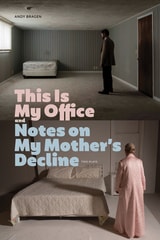
This Is My Office and Notes on My Mother’s Decline
Two PlaysAndy Bragen; foreword by Sarah Ruhl
Northwestern University Press, 2022
These plays by Andy Bragen examine the intimacies and shadows that exist between parents and children. In This Is My Office, a guided tour through an empty office becomes the unexpected portal to a forgotten New York and a father’s legacy. This play brings you face-to-face with a narrator who finds his way through doubt, soul-sickness, and doughnut cravings by telling you a story. Not the one he meant to tell, but a richer one about family, redemption, and love.
The autobiographical Notes on My Mother’s Decline evokes the final days of a woman’s life. Late at night, while his baby daughter sleeps, a son takes notes on his mother’s daily life and scenes from their complicated relationship. He is shaping a play, as well as a perspective. Two blocks away, his mother naps, smokes, reads, and drinks coffee. She is shaping her existence within encroaching confines. Bragen plumbs silences and one-sided conversations to ask how we come to know one another as parents and as children. How do we care for those we love, and what does it take to live with—and without—them?
This One Will Hurt You
Paul Crenshaw
The Ohio State University Press, 2019
With eloquence, subtle humor, and an urgent poignancy, Crenshaw delivers a powerful and moving collection of nonfiction essays, tied together by place and the violence of the world in which we live.
Thomas Kinkade
The Artist in the MallAlexis L. Boylan, ed.
Duke University Press, 2011
Contributors. Julia Alderson, Alexis L. Boylan , Anna Brzyski, Seth Feman, Monica Kjellman-Chapin, Micki McElya, Karal Ann Marling, David Morgan, Christopher Pearson, Andrea Wolk Rager, Jeffrey Vallance