Results by title
3785 books match the query 'Poetry' and 833 start with t
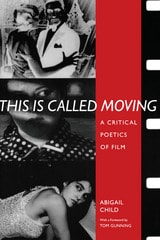
This Is Called Moving
A Critical Poetics of FilmAbigail Child, with a foreword by Tom Gunning
University of Alabama Press, 2005
A pioneering exploration of how poetry and experimental cinema intersect to reconstruct meaning across visual and linguistic forms.
As the writer, director, producer, and cinematographer of almost all her 30 films, videos, and shorts, Abigail Child has been recognized as a major and influential practitioner of experimental cinema since the early 1970s. Hallmarks of her style are the appropriation and reassembly of found footage and fragments from disparate visual sources, ranging from industrial films and documentaries to home movies, vacation photography, and snippets of old B movies.
The resulting collages and montages are cinematic narratives that have been consistently praised for their beauty and sense of wonder and delight in the purely visual. At the same time, Child's films are noted for their incisive political commentary on issues such as gender and sexuality, class, voyeurism, poverty, and the subversive nature of propaganda.
In the essays of This Is Called Moving, Child draws on her long career as a practicing poet as well as a filmmaker to explore how these two language systems inform and cross-fertilize her work. For Child, poetry and film are both potent means of representation, and by examining the parallels between them—words and frames, lines and shots, stanzas and scenes—she discovers how the two art forms re-construct and re-present social meaning, both private and collective.
This Is My Body
PoemsJonathan Fletcher
Northwestern University Press, 2025
Winner of the 2023 Drinking Gourd Chapbook Poetry Prize
This Is My Body readily and unapologetically examines issues of race and ethnicity, ancestry and community, mental illness and recovery, queer sexuality and identity, and the body and disability. Traditionally religious language and hopeful imagery abound; so, too, do their spiritual antagonists: doubt, loss, isolation, and despair. But even in the darkest moments of a troubled inner life, insight and triumph intervene and sometimes even linger. An intimate exploration of the human experience, this debut collection proves itself more than the sum of its interior encounters—however revelatory or transformative any one given experience might be. It is a timely and necessary exercise in faith.
This Joyous Soul
A New Voice for Ancient YearningsAlden Solovy
Central Conference of American Rabbis, 2019
Like its predecessor, This Grateful Heart, this volume of creative liturgy opens a door into the transformative power of prayer. Structured to reflect the morning service found within Mishkan T'filah, this collection invites a deeply personal prayer experience that will strengthen our connection to Judaism and to the Reform siddur.
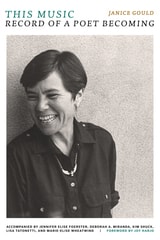
This Music
Record of a Poet BecomingJanice Gould; Edited by Jennifer Elise Foerster, Deborah A. Miranda, Kim Shuck, Lisa Tatonetti, and Marie-Elise Wheatwind; Foreword by Joy Harjo
University of Arizona Press, 2026
This Music is the final, intimate work of celebrated Koyoonk’auwi (Concow) poet and essayist Janice Gould, completed posthumously by a collective of close friends and literary scholars.
Told through lyrical prose poems and personal photographs, this memoir traces Gould’s life as a queer/Two-Spirit California Native coming of age in the late 1960s, navigating family, identity, activism, and art. With reflections on her mixed-blood heritage, her experiences in lesbian feminist circles, and her journey as a poet and musician, Gould’s voice resonates with clarity, tenderness, and fierce honesty.
The book opens with a foreword by Joy Harjo and an introduction from the editorial collective, including an essay by Gould’s spouse, Marie-Elise Wheatwind, framing the memoir as both a literary achievement and a loving tribute.
This Music is a vital contribution to Indigenous and LGBTQ+ literatures, offering readers a rare and powerful account of gender, sexuality, and Native identity in mid-century and contemporary America. As the one hundredth volume in the Sun Tracks series, this work honors Gould’s legacy while expanding the canon of poetic memoir. Ideal for readers of poetry, memoir, and Indigenous literature, this book will resonate deeply with scholars, students, and anyone drawn to stories of resilience, creativity, and the enduring power of memory.

This Nest, Swift Passerine
Dan Beachy-Quick
Tupelo Press, 2009
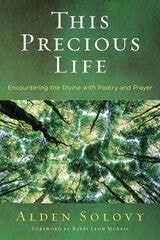
This Precious Life
Encountering the Divine with Poetry and PrayerAlden Solovy
Central Conference of American Rabbis, 2021
In This Precious Life, liturgist Alden Solovy presents prayers, poetry, and meditations inspired by encounters with God. The first part draws from divine moments in our sacred texts, mostly the Torah but also the Prophets and the Writings. Using a contemporary voice, Solovy imagines these holy moments as experienced by our biblical ancestors so we can reclaim them as our own. The second part focuses on sacred moments in our daily lives, connections with the Divine that occur simply because we are human beings created in God's image. Equally suited to individual reflection and group prayer, the book completes a trilogy with This Grateful Heart and This Joyous Soul.
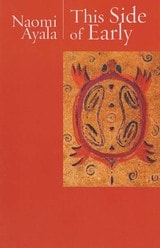
This Side of Early
Naomi Ayala
Northwestern University Press, 2008
“HOLE”
One morning
they dig up the sidewalk and leave.
No sign of the truck—only the large,
dark shadow digging and digging,
piling up sludge with a hand shovel
beside the only tree.
Two o’clock I come by
and he’s slumbering in the grass beside rat holes.
Three and he’s stretched across a jagged stonewall,
folded hands tucked beneath one ear—
a beautiful young boy smiling,
not the heavy, large shadow who can’t breathe.
Four-thirty and the August heat
takes one down here.
He’s pulled up an elbow joint
some three feet round.
At seven I head home for the night,
pass the fresh gravel mound,
a soft footprint near the manhole
like the “x” abuelo would place beside his name
all the years he couldn’t write.
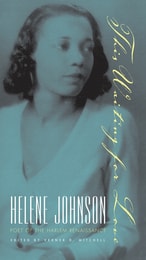
This Waiting for Love
Helene Johnson, Poet of the Harlem RenaissanceVerner D. Mitchell
University of Massachusetts Press, 2000
This volume brings together all of the known poetry and a selection of correspondence by an enormously talented but underappreciated poet of the Harlem Renaissance. Cousin of novelist Dorothy West and friend of Zora Neale Hurston, Helene Johnson (1905–1995) first gained literary prominence when James Weldon Johnson and Robert Frost selected three of her poems for prizes in a 1926 competition. During the late 1920s and early 1930s her poetry appeared in various small magazines, such as the Saturday Evening Quill, Palms, Opportunity, and Harlem. In 1933 Johnson married, and two years later her last published poem, “Let Me Sing My Song,” appeared in Challenge, the journal West had founded to revive the spirit of the Harlem Renaissance.
In his well-researched introduction, Verner D. Mitchell reconstructs Johnson's life, the details of which have long been veiled from public view, and places her in the context of a vital literary tradition. In addition to discussing her relationship with West, Hurston, and other black women writers, he explores the distinctive, at times radical, qualities of her work. Ever willing to defy the genteel conventions that governed women's writing, Johnson wrote poems on erotic themes and engaged the aesthetic, gender, and racial politics of her time.
Cheryl A. Wall's foreword also celebrates Johnson's talent, particularly the ease with which she moved among various verse forms—from the rigor of the sonnet to the improvisational creativity of free black vernacular. “An unexpected and most welcome gift,” This Waiting for Love, Wall writes, is “an enduring tribute” to “the vibrant poetry of Helene Johnson.”
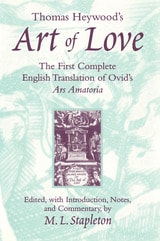
Thomas Heywood's Art of Love
The First Complete English Translation of Ovid's Ars AmatoriaEdited, with Introduction, Notes, and Commentary by M. L. Stapleton
University of Michigan Press, 2000
The present edition represents the first instance in which the translation has been edited in a scholarly manner. Besides a full Introduction that accounts for the history of Loues Schoole, Ovid in the English Renaissance, and the editorial method, each of the three books of the poem includes a Commentary that provides cross-references within the text; glosses for unusual, archaic, or regional forms peculiar to Heywood's English; annotations from sourcebooks that Heywood used to identify or understand characters from classical history, literature, and mythology; and explanations for any emendations the editor deemed necessary. In his efforts to make the Ars a seventeenth-century poem, Heywood contemporizes Ovid's references to dress, behavior, courtship, marriage, games, theater, agriculture, horsemanship, war, literature --all of which the Commentary explains at great length.
Loues Schoole will find readership in these areas: early modern history, literature, and culture; classical studies; Renaissance drama; the history of sexuality; and translation theory.
M. L. Stapleton is Associate Professor of English and Philosophy, Stephen F. Austin State University.
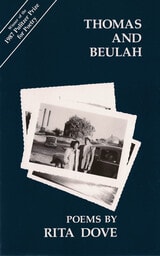
Thomas and Beulah
Rita Dove
Carnegie Mellon University Press, 1986
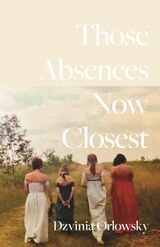
Those Absences Now Closest
Dzvinia Orlowsky
Carnegie Mellon University Press, 2024
In her newest collection, Ukrainian American poet Dzvinia Orlowsky is a witness, never a bystander, ready to stare down the demons, to “cut yourself with a dull razor.” She sets up house among the nightmares of intergenerational trauma and, as far as anyone can, humanizes them. Through her work, Orlowsky prompts us to enter our own histories instead of just watching.
Threat Come Close
Aaron Coleman
Four Way Books, 2018
Three Modern Italian Poets
Saba, Ungaretti, MontaleJoseph Cary
University of Chicago Press, 1993
Three Poems
Concerning His Own Affairs, Concerning Himself and the Bishops, and Concerning His Own LifeSaint Gregory of Nazianzus
Catholic University of America Press, 1987
Three Trios
PoemsJ II
Northwestern University Press, 2007
Three-Toed Gull
Selected PoemsJesper Svenbro
Northwestern University Press, 2003
Thresherphobe
Mark Halliday
University of Chicago Press, 2013
Threshold
James Longenbach
University of Chicago Press, 1998
Threshold
Jennifer Richter
Southern Illinois University Press, 2010
Jennifer Richter presents a series of poems that explore the many facets of the term "threshold." Throughout the collection, the narrator experiences several acts of threshing, or separating—from birth and the small yet profound distances that part a mother and child, to the separation caused by illness and its toll on relationships. At the same time, she is progressively gathering, piecing together the remnants of her life, collecting her children into her arms, and welcoming a future without pain. Pain is often present in these poems, as the narrator frequently confronts her own threshold for enduring a ravaging illness. Her harrowing struggle through recovery is chronicled by a poem at the end of each section, tracing her powerful journey from deep suffering to a fragile yet steadfast sense of hope.
These gripping lyric and prose poems explore duality in its many forms: the private, contemplative world versus a world of action; the mirror sides of health and sickness; the warmth of a June sun and the deep, long nights of winter; mother and child; collecting and letting go. From the comfort of a morning bed at home to the desperate streets of Hanoi, Threshold is a searing portrait of healing, the courage it takes to bridge the gulfs that divide, and the wonder of the ties that bind.
What Is My Body Without You?
My son’s pajamas unsnapped
on the floor: small husk
of his body relaxing on its back,
legs and sleeves still filled
with his rush. This part of him
hasn’t outgrown my arms
and sometimes lets me lift
him up our steep stairs,
carry him to bed and pull
his shade against the gray
thin winter sky like milk
my daughter wakes up wanting.
In the last days of lifting her
to my breast, I fill her less
than the air already gone
from my son’s flat shape.
Twice like that I have lain back,
the doctor opening me
along the same clean seam.
Each time I was watching:
with a few tugs the child
was out, naked and heading
toward other hands, each child
cut loose before I knew it.
Threshold
Joseph O. Legaspi
CavanKerry Press, 2017
Through the Stonecutter's Window
PoemsIndigo Moor
Northwestern University Press, 2010
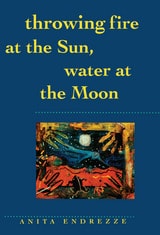
Throwing Fire at the Sun, Water at the Moon
Anita Endrezze
University of Arizona Press, 2000
Throwing Fire at the Sun, Water at the Moon is a blend of ancient myths, poetry, journal extracts, short stories, and essays that tell her people's story from the early 1500s to the present, and her family's story over the past five generations. Reproductions of Endrezze's paintings add an additional dimension to her story and illuminate it with striking visual imagery. Endrezze has combed history and legend to gather stories of her immediate family and her mythical ancient family, the two converging in the spirit of storytelling. She tells Aztec and Yaqui creation stories, tales of witches and seductresses, with recurring motifs from both Yaqui and Chicano culture. She shows how Christianity has deeply infused Yaqui beliefs, sharing poems about the Flood and stories of a Yaqui Jesus. She re-creates the coming of the Spaniards through the works of such historical personages as Andrés Pérez de Ribas. And finally she tells of those individuals who carry the Yaqui spirit into the present day. People like the Esperanza sisters, her grandmothers, and others balance characters like Coyote Woman and the Virgin of Guadalupe to show that Yaqui women are especially important as carriers of their culture.
Greater than the sum of its parts, Endrezze's work is a new kind of family history that features a startling use of language to invoke a people and their past--a time capsule with a female soul. Written to enable her to understand more about her ancestors and to pass this understanding on to her own children, Throwing Fire at the Sun, Water at the Moon helps us gain insight not only into Yaqui culture but into ourselves as well.
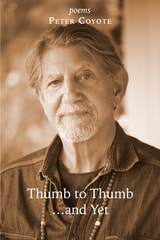
Thumb to Thumb… and Yet
Peter Coyote
Four Way Books, 2026
If Emmy Award-winner Peter Coyote’s debut collection represents the culmination of a half-century’s devotion to writing poetry, his second functions as a true encore: triumphant and raw. Thumb to Thumb… and Yet presents eighty-plus years of living — the countercultural adventures, the journey from Zen Buddhist discipleship to priesthood, marriage and divorce, a public career in entertainment, and the private work and rewards of parenthood — not as a retrospective but as a perpetual process of becoming. Coyote captures often-elusive wisdom and infuses these pages with the fullness of human experience: weariness that labor never ceases, that we cannot outgrow suffering, that we’re like “Manteaux ducks, immobilized so the fat / of everything can be forced down our gullets,” the glut of gavage neverending and “no option to stop swallowing”; frustration that ambition and ego persist despite the “pre-dawn Zendo chill” and over five decades spent “thumb-to-thumb sitting” in devoted practice; the satisfaction of pleasure, “smiling in the ruined sheets”; gratitude for life consummated and life ongoing and life that will continue long after us, for the opportunity of existence, for the work itself, for the “single nuthatch [that] bows / upside down on the grand oak” and its reminder during meditation that “everything presents itself as a partner.” The titular qualification of that “and yet” is an argument against and a celebration of conclusion; in a masterful encapsulation of the lyrical moment itself, these poems find Coyote returning to the stage only to perform another finale, every end recycled toward beginning. One song cedes to another, and yet the music flows on.
Thunderclouds in the Forecast
A NovelClarence Major
Northwestern University Press, 2021
When Ray’s train is delayed in Lorena, a Gold Rush outpost turned college town, he meets Alice. Together they embark on a romance that tempts him to stay. By the time Ray arrives in San Francisco, Scotty has abandoned his bartending job, his rented room, and his scant belongings and skipped town with a married woman from Lorena. Now Ray has more than one reason to return.
A preeminent American writer who thrives on reinvention, Major returns with an unforgettable exploration of life on the brink of sweeping change. With spare prose and subtle poignancy, Thunderclouds in the Forecast probes love, loyalty, and belonging. As Toni Morrison wrote, “Clarence Major has a remarkable mind and the talent to match.”
Thunderhead
Emily Rose Cole
University of Wisconsin Press, 2022
In this striking and nostalgic collection, Emily Rose Cole unearths the fragility and resilience of daughterhood through indelible imagery that evokes new senses of the body: swallowing keys, rain lashing eyelids, unzipping of flesh. Grieving self-portraits of historical and mythological women are woven with stirring recollections of struggling bodies and evocative spells to overcome them. Undulating with memories and magic, illness and death, these poems reveal how a single chance at life and loving can be both too much and not enough.
The wolf will live with the lamb, what did you mean?
Some days, cancer is the wolf. Some days, the wolf is Mama.
—excerpt from “Still Life with Lines from Isaiah”
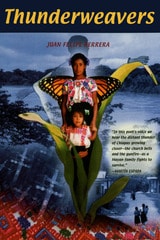
Thunderweavers/ Tejedoras de rayos
Juan Felipe Herrera
University of Arizona Press, 2000
In the winter of 1997, paramilitary agents ambushed and killed many Mayan villagers in Acteal, Chiapas. Gifted writer Juan Felipe Herrera has composed a stirring poem sequence—published in a bilingual format—written in response and homage to those who died, as well as to all those who call for peace and justice in the Mexican highlands and throughout the Americas.
The sections are written in the voices of four women from a family in Chiapas: Xunka, a lost twelve-year-old girl; Pascuala, the mother; grandmother Maruch; and Makal, an older daughter who is pregnant. Each voice weaves into the others and speaks for still other members of the larger Mayan and Native American family.
Thunderweavers is a story of violent displacements in the lives of the most impoverished residents of southern Mexico.Through these words, readers will learn the meaning of transcendence and continuity in the midst of chaos, suffering, and war.
Tidal
Josh Kalscheur
Four Way Books, 2015
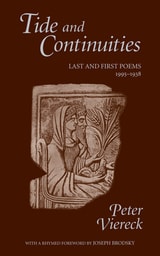
Tide and Continuities
Last and First Poems, 1995-1938Peter Viereck
University of Arkansas Press, 1995
Peter Viereck’s career in poetry is an ongoing experiment in the symbiosis of poetry and history. In Tide and Continuities that experiment has yielded its finest results. Included are many new poems, never before published, and stunning revisions from work as recent as his 1987 epic, Archer in the Marrow: The Applewood Cycles, and as early as his 1948 Pulitzer Prize-winning collection, Terror and Decorum.
This collection is the revelation of a great American poet. The Nobel laureate Joseph Brodsky calls Viereck “possibly the greatest rhymer of / the modern period.” This is Viereck’s most lyrical, most passionate book; hence Brodsky rhymes “lyric” with “Viereck.”
Tide and Continuities marks Viereck’s complete evolution as a poet, and brilliantly describes the arc of more than a half century’s work.
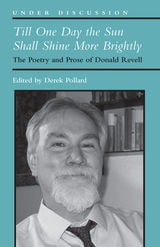
Till One Day the Sun Shall Shine More Brightly
The Poetry and Prose of Donald RevellDerek Pollard, Editor
University of Michigan Press, 2020
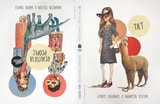
Tilt / Beautiful People
Denise Duhamel, Maureen Seaton, and Aaron Smith
Bridwell Press, 2024
In Tilt, Denise Duhamel and Maureen Seaton (1947-2023) write through climate change, Maureen’s illness, and the pandemic with their signature wit and poignancy. Their feminist curiosity leads them to poems about gender identity, marriage equality, and the complexities of national politics. Assembled shortly before Maureen’s death, the poems in Tilt tell the story of a friendship rooted in collaborative artistic play. The title of the book gives a nod to the earth’s tilt, which gives us seasons, but also hints that the poems were written at full tilt, these poets hyperaware they only had so much time left to write with one another.
Beautiful People was written back and forth over the course of several months by poets Maureen Seaton and Aaron Smith. Bold and inventive, it moves from sonnets and sestinas to prose poems and so much more. While its center is a love for poetry and art and laughter, the poets also grapple with mortality, sadness, and what it means to be alive on a broken but beautiful planet. Through their literary friendship, they put a mirror to all our lovely faces.
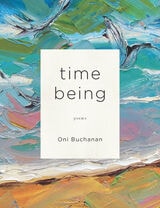
Time Being
Oni Buchanan
University of Iowa Press, 2020
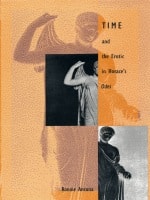
Time and the Erotic in Horace's Odes
Ronnie Ancona
Duke University Press, 1994
Drawing on contemporary theory, including recent work in feminist criticism, Ancona provides close readings of fourteen odes, which are presented in English translation as well as in Latin. Through a discussion of the poet’s use of various temporal devices—the temporal adverb, seasonal imagery, and the lover or beloved’s own temporality—she shows how Horace makes time dominate the erotic context and, further, how the version of love that appears in his poems is characterized by the lover’s desire to control the beloved. The romantic ideal of a timeless love, apparently rejected by the poet, emerges here instead as an underlying element of the poet’s portrayal of the erotic. In a critique of the predominant modes of recent Horatian scholarship on the love odes, Ancona offers an alternative view that takes into account the male gender of the lover and its effect on the structure of desire in the poems. By doing so, she advances a broader project in recent classical studies that aims to include discussion of features of classical literature, such as sexuality and gender, which have previously escaped critical attention.
Addressing aspects of Horace as a love poet—especially the dynamics of gender relations—that critics have tended to ignore, this book articulates his version of love as something not to be championed or condemned but rather to be seen as challengingly problematic. Of primary interest to classicists, it will also engage the attention of scholars and teachers in the humanities with specializations in gender, sexuality, lyric poetry, or feminist theory.
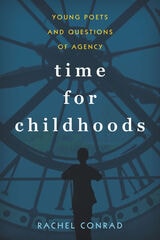
Time for Childhoods
Young Poets and Questions of AgencyRachel Conrad
University of Massachusetts Press, 2020
Time for Childhoods presents a selection of striking twentieth-and twenty-first-century American poetry written by young people, and highlights how young poets imagined and shaped time for their own poetic purposes. Through close engagement with archival materials, as well as select interviews and correspondence with adult mentors, Conrad discerns how young writers figured social realities and political and racial injustices, and discusses what important advocates such as Gwendolyn Brooks and June Jordan can teach us about supporting the agency of young poets. This essential study demonstrates that young poets have much to contribute to ongoing conversations about time and power.
Time-Spirit of Matthew Arnold
R. H. Super
University of Michigan Press, 2025
Tips to Help You Do Your Best
Mike Carlson
Tupelo Press, 2025
Written over a fifteen-year period, a period in which events and politics seemed to defy reason, the poems collected in Tips to Help You Do Your Best seek an imaginative wisdom on the outskirts of conventional thinking. By writing obsessively about the landscape, the objects that litter it, and the people he finds loitering there, Mike Carlson arrives at the emotional truth of his experience, mapping the distance between irreverence and irony, cowardice, and courage, condolences and pure clear words.
In doing so, he also lays out a theory of poetry, a philosophical, aesthetic, and spiritual treatise that values object matter over subject matter. These poems approach understanding by image and rhythm, by light and shadow, and by means of encountering motorcycles and mushrooms and silos. While these poems often assume the authoritative and axiomatic tone of a guide book or set of instructions, they are at odds with easy explanation and drudgery.
To Be At Music
Essays & TalksNorma Cole
Omnidawn, 2010
To Be Named Something Else
Shaina Phenix
University of Arkansas Press, 2023
Named one of New York Public Library's Best Books, 2023
Winner, 2023 Miller Williams Poetry Prize
To Be Named Something Else is a high-spirited celebration of Black matriarchy and lineage—both familial and literary. Centering the coming-of-age of Black femmes in Harlem, Shaina Phenix’s debut collection, in the words of series judge Patricia Smith: “enlivens the everyday—the everyday miraculous, the everyday hallelujah, the numbing everyday love, the everyday risk of just being Black and living. There is absolutely nowhere these poems aren’t—we’re dancing and sweating through our clothes, terminating a pregnancy in a chilled room of white and silver, finally gettin’ those brows threaded and nails did, practicing gettin’ the Holy Ghost, sending folks to their rest, having babies, listening carefully to the lessons of elders, and sometimes even talking back. . . . To Be Named Something Else is a book of reason and reckoning, substance and shadow. It’s tender and wide-aloud and just about everything we need right now, when both reason and reckoning are in such woefully short supply.” Phenix’s full-throated poetry, with its “superlative combination of formalism and funk,” is assuredly something else.
To Be in This Number
Alane Rollings
Northwestern University Press, 2005
To Forget Venice
Peg Boyers
University of Chicago Press, 2014
To Go Into the Words
Norman Finkelstein
University of Michigan Press, 2023
To Go Into the Words is the latest book of critical prose from renowned poet and scholar of Jewish literature Norman Finkelstein. Through a rigorous examination of poets such as William Bronk, Helen Adam, and Nathaniel Mackey, the book engages the contemporary poetic fascination with transcendence through the radical delight with language. By opening up a given poem, Finkelstein seeks the “gnosis” or insight of what it contains so that other readers can understand and appreciate the works even more.
Pulling from Finkelstein’s experience of writing thirteen books of poetry and six books of literary criticism, To Go Into the Words consistently rewards the reader with insights as transformative as they are well-considered and deftly mapped out. This volume opens the world of poetry to poets, scholars, and readers by showcasing “the gnosis that is to be found in modern poetry.”
To Let the Sun
John Allen Taylor
University of Arkansas Press, 2025
Finalist, 2025 Miller Williams Poetry Prize
John Allen Taylor’s debut poetry collection To Let the Sun opens with an invitation both generous and resolute: “take a walk with me . . . I hope you’ll come / though I am going anyway.” These poems peel back the layers of recovery as an adult from childhood sexual abuse, the myriad ways a body can change to protect itself from memory, and the difficulty of looking at abuse head-on. Taylor uses a poetics of reclamation to write the child-self from a perspective beyond trauma, to document the messiness of survival, the child’s flight from himself, and the uncertain path home—to a life filled with small and perfect things. Through hermit crabs and golden pothos, fungal gnats and beet seed, the speaker reclaims himself: “I am not lost . . . I know memory / is not healed by time, but / by the oddities / with which we adorn our lives, / the fragilities we need to know / we’re needed by.
To Make a Prairie
Essays on Poets, Poetry, and Country LivingMaxine Kumin
University of Michigan Press, 1980
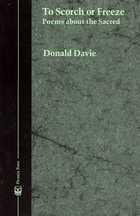
To Scorch or Freeze
Poems about the SacredDonald Davie
University of Chicago Press, 1988
"Few modern poets have managed to achieve Donald Davie's sense of human worth."—Times Higher Educational Supplement

To Think of a Match
PoemsHalee Kirkwood
Northwestern University Press, 2027
A gripping oscillation between the manufactured and the natural, between capitalism and truth
To Think of a Match is a collection of daydreams from behind the eyes of retail clerks, corporate mascots, ghosts of 49ers, and sundry others. Situated in Minnesota’s Twin Cities, home of the Mall of America and the glistening Bde Maka Ska, these poems explore the intimate collisions of class and labor, spiraling out from the recent history of the Gold Rush and into the near future of asteroid mineral mining and beyond. Halee Kirkwood searches for possibilities of a postcapitalist future in our most squirmy, slimy, and wriggly forms of earthly life. What can invertebrates teach us about the ways humanity organizes labor, creativity, and community? What does it mean to have a body caught between economies and ecologies? Contending with subjects ranging from Sappho to Petco and envisioning a new pastoral that is honest about the human and nonhuman domains we are building today, To Think of a Match yearns for a poetics that thrives between shifts.
To Us, All Flowers Are Roses
POEMSLorna Goodison
University of Illinois Press, 1995
David Mason has characterized Lorna Goodison's work as a "revelation
to me, much of it beautiful for its simple negotiation of the line between
life and art."
One of the most distinguished
contemporary poets of the Caribbean, Goodison draws on both African and
European inheritances in her finely crafted poems, which often carry a
sense of language's healing power in the face of the pain of the past.
She deals thematically with the struggle of Caribbean women and writes
in a fashion that has developed from conversational to more ritualistic.
From reviews of Goodison's
earlier works:
"The evocative power
of Lorna Goodison's poetry derives its urgency and appeal from the heart-and-mind
concerns she has for language, history, racial identity, and gender."
Andrew Salkey -- World Literature Today
"A marvelous poet, one
to savor and to chant aloud."
-- Pat Monaghan, Booklist

To the Bone
NEW AND SELECTED POEMSSydney Lea
University of Illinois Press, 1996
The writings of Didymus were censored and destroyed due to his posthumous condemnation for heresy. This study recovers the uncensored voice of Didymus through the commentaries among the Tura papyri, a massive set of documents discovered in an Egyptian quarry in 1941.
This neglected corpus offers an unprecedented glimpse into the internal workings of a Christian philosophical academy in the most vibrant and tumultuous cultural center of late antiquity. By exploring the social context of Christian instruction in the competitive environment of fourth-century Alexandria, Richard A. Layton elucidates the political implications of biblical interpretation.
Through detailed analysis of the commentaries on Psalms, Job, and Genesis, the author charts a profound tectonic shift in moral imagination as classical ethical vocabulary becomes indissolubly bound to biblical narrative. Attending to the complex interactions of political competition and intellectual inquiry, this study makes a unique contribution to the cultural history of late antiquity.
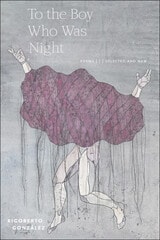
To the Boy Who Was Night
Poems: Selected and NewRigoberto González
Four Way Books, 2023
The capstone of a quarter-century career in poetry, To the Boy Who Was Night collects the poetry published by Rigoberto González since 1999, including selections from five previous books as well as new work. Mirroring González’s personal trajectory, the arc of this work articulates the course of a life: these poems recall leaving a beloved homeland, confront masculinity and sexuality in new adulthood, imagine the earth devoid of human inhabitants, descend into the realm of ghosts, and return to arrive at Dispatches from the Broken World. This latest section ventures into foreign terrain — an autobiographical confrontation with isolation and the aging body. His lyrical exploration, like the weather reports scrawled on ancient temple walls, will preserve this age-old message: “likely a poem, surely an epitaph.” To the Boy Who Was Night bears the fruit of 25 years of poetry, González’s boldest and most comprehensive volume yet.
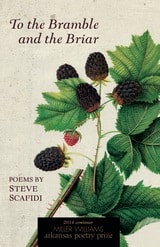
To the Bramble and the Briar
PoemsSteve Scafidi
University of Arkansas Press, 2014
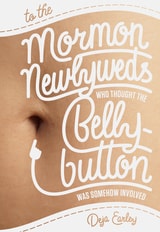
To the Mormon Newlyweds Who Thought the Bellybutton Was Somehow Involved
Deja Earley
Signature Books, 2018
In navigating her life as a free-spirited Mormon, each of Earley’s poems expresses the tension she feels in adhering to and expanding the confines of her faith. From awkward first kisses shared on a church couch to refusing to talk to men who are not Mormon “lest I fall from grace, on my ass,” her poems remain funny, wry, thoughtful. Despite the promise not to talk to non-Mormon men, her final poems detail her marriage to a Catholic husband who offers Hail Mary prayers after a lost pregnancy while she struggles to find comfort from an elusive Mother in Heaven. Despite their differences and moments of heartache, they thrive, allowing themselves to “imagine we’re floating in bright bubbles of light.” It is an emotional roadmap for anyone else facing such tensions, joys, and accommodations.