Results by title
3785 books match the query 'Poetry' and 833 start with t
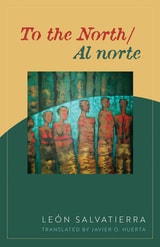
To the North/Al norte
PoemsLeon Salvatierra
University of Nevada Press, 2022
Salvatierra mixes lyrical and prose poems to explore the experience of exile in a new country. His powerful metaphors and fresh images inhabit spaces fraught with the violence, anxiety, and vulnerability that undocumented Central American migrants commonly face in their transnational journeys. His vivid memories of Nicaragua tie the personal experiences of his poetic subjects to the geopolitical history between the Central American region and the United States.

Today in the Taxi
Sean Singer
Tupelo Press, 2022
—Laurie Sheck
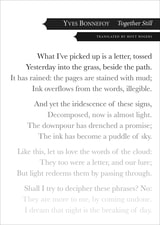
Together Still
Yves Bonnefoy
Seagull Books, 2017
The international community of letters mourned the recent death of Yves Bonnefoy, universally acclaimed as one of France’s greatest poets of the last half-century. A prolific author, he was often considered a candidate for the Nobel Prize and published a dozen major collections of poetry in verse and prose, several books of dream-like tales, and numerous studies of literature and art. His oeuvre has been translated into scores of languages, and he himself was a celebrated translator of Shakespeare, Yeats, Keats, and Leopardi.
Together Still is his final poetic work, composed just months before his death. The book is nothing short of a literary testament, addressed to his wife, his daughter, his friends, and his readers throughout the world. In these pages, he ruminates on his legacy to future generations, his insistence on living in the present, his belief in the triumphant lessons of beauty, and, above all, his courageous identification of poetry with hope.
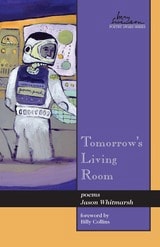
Tomorrow's Living Room
Jason Whitmarsh
Utah State University Press, 2009
Volume 13 in the Swenson Award Series, Tomorrow's Living Room offers a pleasantly disorienting verbal territory. The collection is alternately wry and dark, hopeful and bleak, full of unexpected light and laugh-out-loud incongruities. We begin to see that the shape and the furniture of Jason Whitmarsh's world reflect our own (they may in fact be universal), but we're considering them through completely new terms of engagement.
Selected by, and with a foreword by, Billy Collins.
The annual Swenson competition, named for May Swenson, honors her as one of America’s most provocative and vital writers. In John Hollander’s words, she was "one of our few unquestionably major poets."
Tongue & Groove
Stephen Cramer
University of Illinois Press, 2007
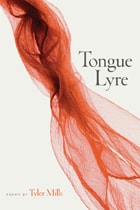
Tongue Lyre
Tyler Mills
Southern Illinois University Press, 2013
In Tongue Lyre, Tyler Mills weaves together fragments of myth and memory, summoning the works of Ovid, Homer, and James Joyce to spin a story of violence and the female body. Introducing the recurring lyre figure in the collection—a voice to counter the violence—is Ovid’s Philomena, who, while cruelly rendered speechless, nonetheless sets the reader on an eloquent voyage to discover the body through music, art, and language. Other legendary figures making appearances within—Telemachos, Nestor, Cyclops, Circe, and others—are held up as mirrors to reflect the human form as home. In this dynamic collection, the female body and its relationship to the psyche traverse mythic yet hauntingly familiar contemporary settings as each presents not a single narrative but a progressive exploration of our universal emotional experience.
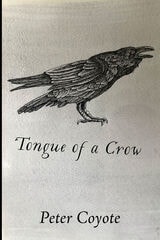
Tongue of a Crow
Peter Coyote
Four Way Books, 2021
Peter Coyote’s first collection of poetry takes us on a whirlwind tour of an eclectic and exciting life as an actor and Zen Buddhist priest, meandering from love affairs to marriage to divorce to the Sixties to psychedelic spirituality and beyond. Written over several decades, these poems read as a collage, each piece distinct and contributing to a cohesive lyric narrative.
Tongue of a Crow
Peter Coyote
Four Way Books, 2021
Peter Coyote’s first collection of poetry takes us on a whirlwind tour of an eclectic and exciting life as an actor and Zen Buddhist priest, meandering from love affairs to marriage to divorce to the Sixties to psychedelic spirituality and beyond. Written over several decades, these poems read as a collage, each piece distinct and contributing to a cohesive lyric narrative.
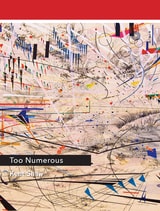
Too Numerous
Kent Shaw
University of Massachusetts Press, 2019
What does it really mean when people are viewed as bytes of data? And is there beauty or an imaginative potential to information culture and the databases cataloging it? As Too Numerous reveals, the raw material of bytes and data points can be reshaped and repurposed for ridiculous, melancholic, and even aesthetic purposes.
Grappling with an information culture that is both intimidating and daunting, Kent Shaw considers the impersonality represented by the continuing accumulation of personal information and the felicities—and barriers—that result: “The us that was inside us was magnificent structures. And they weren't going to grow any larger.”
Took House
Lauren Camp
Tupelo Press, 2020

Topaz
Brian Komei Dempster
Four Way Books, 2013
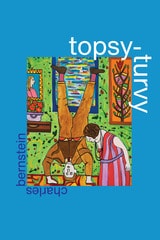
Topsy-Turvy
Charles Bernstein
University of Chicago Press, 2021
Though Bernstein’s poems play with form, they incorporate a melancholy, even tragic, sensibility. This “cognitive dissidence,” as Bernstein calls it, is reflected in a lyrically explosive mix of pathos, comedy, and wit, though the reader is kept guessing which is which at almost every turn. Topsy-Turvy includes an ode to the New York City subway and a memorial for Harpers Ferry hero Shields Green, along with collaborations with artists Amy Sillman and Richard Tuttle. This collection is also full of other voices: Pessoa, Geeshie Wiley, Friedrich Rückert, and Rimbaud; Carlos Drummond, Virgil, and Brian Ferneyhough; and even Caudio Amberian, an imaginary first-century aphorist.
Bernstein didn’t set out to write a book about the pandemic, but these poems, performances, and translations are oddly prescient, marking a path through dark times with a politically engaged form of aesthetic resistance: We must “Continue / on, as / before, as / after.”
The audio version of Topsy-Turvy is performed by the author.
Topsy-Turvy
Charles Bernstein
University of Chicago Press, 2021
Though Bernstein’s poems play with form, they incorporate a melancholy, even tragic, sensibility. This “cognitive dissidence,” as Bernstein calls it, is reflected in a lyrically explosive mix of pathos, comedy, and wit, though the reader is kept guessing which is which at almost every turn. Topsy-Turvy includes an ode to the New York City subway and a memorial for Harpers Ferry hero Shields Green, along with collaborations with artists Amy Sillman and Richard Tuttle. This collection is also full of other voices: Pessoa, Geeshie Wiley, Friedrich Rückert, and Rimbaud; Carlos Drummond, Virgil, and Brian Ferneyhough; and even Caudio Amberian, an imaginary first-century aphorist.
Bernstein didn’t set out to write a book about the pandemic, but these poems, performances, and translations are oddly prescient, marking a path through dark times with a politically engaged form of aesthetic resistance: We must “Continue / on, as / before, as / after.”
The audio version of Topsy-Turvy is performed by the author.
Torn
C. Dale Young
Four Way Books, 2011
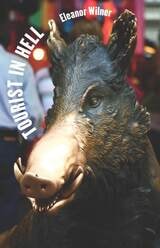
Tourist in Hell
Eleanor Wilner
University of Chicago Press, 2010
Eleanor Wilner’s poems attempt to absorb the shock of the wars and atrocities of the twentieth and early twenty-first centuries. In their litany of loss, in their outrage and sorrow, they retain the joy in life, mercy for the mortal condition, and praise for the plenitude of nature and the gifts of human artistry.
As with her six earlier collections, these poems are drawn from the transpersonal realm of history and cultural memory, but they display an increasing horror at the bloody repetitions of history, its service of death, and the destructive savagery of power separated from intelligence and restraint. The poems describe “a sordid drama” in which the players wear “eyeless masks,” and the only thing time changes is the name of the enemy. Underneath it all, driving “the art that” in both senses “keeps nothing at bay,” swim the enormous formal energies of life, the transitive figure that moves on in the depths, something glimpsed in the first light, something stronger than hope.
“It is a relief to come across work in which a moral intelligence is matched by aesthetic refinement, in which the craft of the poems is equal to their concerns.”--Christian Wiman, Poetry

Toward the End of the Century
Essays into PoetryWayne Dodd
University of Iowa Press, 1992
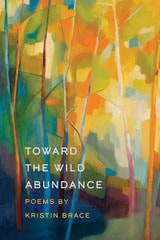
Toward the Wild Abundance
Kristin Brace
Michigan State University Press, 2019
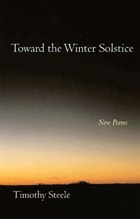
Toward the Winter Solstice
New PoemsTimothy Steele
Ohio University Press, 2006
Toward the Winter Solstice, Steele’s first collection of new poems in twelve years, features his characteristic grace, wit, and power, while extending his range. In addition to the relatively short lyrical, descriptive, and contemplative poems he has always written so well, this collection offers several middle-length pieces that read almost like compressed novels.
Addressing a variety of topics and themes, Toward the Winter Solstice explores the relationship between the world of nature and the world of ideas. In one way or another, the poems attempt to link the external material universe with that sense of inward self-awareness central to our experience of life. Throughout, Steele writes with a clarity that not only illuminates his subjects but also acknowledges and preserves their ultimate mystery and complexity.
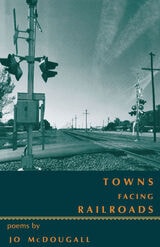
Towns Facing Railroads
PoemsJo McDougall
University of Arkansas Press, 1991
In her second book of poetry, Jo McDougall takes her readers to the dusty prairie towns of the central states, places where the flat terrain belies a complex human landscape. In short, dceptively simple lines, McDougall can so keenly trace the lineaments of place and era that her subject stands before us, its essence displayed and made timeless.
Quietly, with an almost aphoristic bit, McDougall writes about ordinary lives and small towns in a way that her readers may never forget.
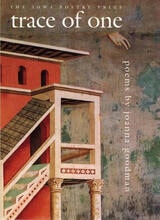
Trace of One
Joanna Goodman
University of Iowa Press, 2002
In Trace of One,real geographies merge with spiritual ones, just as details of the speaker’s physical and emotional worlds intertwine with the transcendent realms of science, religion, and myth. Joanna Goodman’s poems share a sense of spatial and temporal displacement—they are love poems to a place, whether it be a field, a room, or a paradise—they celebrate their subjects, but they are also poems of grief and solitude. The poems resonate with ethereal echoes paradoxically emitted by an increasingly demystified world in which mechanical explanations for the workings of the human mind and body bump up against the mystery and obliqueness of the soul.
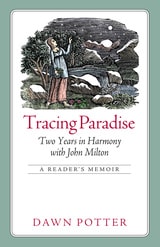
Tracing Paradise
Two Years in Harmony with John MiltonDawn Potter
University of Massachusetts Press, 2009
One winter morning, poet Dawn Potter sat down at her desk in Harmony, Maine, and began copying out the opening lines of John Milton's Paradise Lost. Her intent was to spend half an hour with a poem she had never liked, her goal to transcribe a page or two. Maybe she would begin to appreciate the poet's art, though she had no real expectations that the exercise would change her mind about the poem. Yet what began as a whim turned rapidly into an obsession, and soon Potter was immersed in a strange and unexpected project: she found herself copying out every single word of Milton's immense, convoluted epic.
Tracing Paradise: Two Years in Harmony with John Milton is her memoir of that long task. Over the course of twelve chapters, Potter explores her very personal response to Milton and Paradise Lost, tracing the surprising intersections between a seventeenth-century biblical epic and the routine joys and tragedies of domestic life in contemporary rural Maine. Curious, opinionated, and eager, she engages with the canon on mutable, individual terms. Though she writes perceptively about the details and techniques of Milton's art, always her reactions are linked to her present-tense experiences as a poet, small-time farmer, family member, and citizen of a poor and beleaguered north-country town.
A skilled and entertaining writer, Potter is also a wide-ranging and sophisticated reader. Yet her memoir is not a scholarly treatise: her enthusiasms and misgivings about both Milton and Paradise Lost ebb and flow with the days. Tracing Paradise reminds us that close engagement with another artist's task may itself be a form of creation. Above all, Potter's memoir celebrates one reader's difficult yet transformative love affair with Milton's glorious, irritating, inscrutable masterpiece.
Traffic with Macbeth
Larissa Szporluk
Tupelo Press, 2011
Train Dance
Jonathan Wells
Four Way Books, 2011
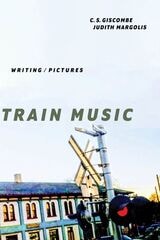
Train Music
Writing / PicturesC.S. Giscombe and Judith Margolis
Omnidawn, 2021
Late in the fall of 2017, poet C. S. Giscombe and book artist Judith Margolis boarded an Amtrak train in New York City and, four days later, stepped off another train at the edge of San Francisco Bay. Giscombe was returning home to California to address an all-white audience on the problem of white supremacy, and expatriate Margolis, accustomed to a somewhat solitary existence, was visiting the United States and making collages. Traveling together, they each turned their train quarters into writing and drawing “studios” where they engaged in conversations and arguments and shared experiences of the discomforts and failures of recent times.
Their original intention had been to travel west and document, in journals and sketchpads, the complex, charged American landscape, but as the trip progressed—and in the months afterwards—the project took on a new shape. Train Music, the book that resulted, recollects and explores the century’s racial and gendered conflicts—sometimes sensually, sometimes in stark images, sometimes in a “mixed economy” of poetry and prose.
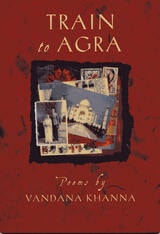
Train to Agra
Vandana Khanna
Southern Illinois University Press, 2001
Calling upon two cultures, Vandana Khanna’s Train to Agra meditates on the effects of displacement and expatriation on the construction of a young Indian American woman’s identity. The physical journeys undertaken by the speaker reflect her inner journey from immigrant child to Indian American woman, struggling to find her place between India and America, Krishna and Jesus, samosas and hamburgers. The speaker constantly tries to recapture visions, smells, and sounds of her childhood and her travels, but cannot do so without imagination. Her memory fails her, so through metaphor she invents her past as it should have been. Traveling through her reflections on childhood, fate, faith, death, and belonging, she comes to accept her reality as a construct of lived memories and wished-for fantasies.

Trajectories
Crossing the Map of PoetryCarolyne Wright
University of Michigan Press, 2027
In Trajectories, poet, translator, human rights advocate, and world traveler Carolyne Wright maps her poetic path in the crossing of cultural, linguistic, and national boundaries. From her origins in Seattle and the Pacific Northwest through Latin America (Chile, Brazil) and South Asia (India, Bangladesh) through languages spoken in these regions (Spanish, Portuguese, and Bengali), Wright recalls and relives the poetic trajectory as well as the seeming tangents that one poet’s relatively uncommon life has taken. She pays tribute to poetic mentors of the “Northwest School,” to Bengali and Chilean women poets, to the poetry and music of Brazil, and to poets such as Elizabeth Bishop, Ted Hughes, and Sylvia Plath.
Throughout her essays and interviews and across a wide range of literary interests, Wright explores connections between family and national history, intersections of personal and public spheres, and the poetics of the era in which she moves. She connects lyricism to social engagement, witnessing contemporary and historical issues while remaining committed to the heightened, musical language of lyric poetry. Both personal and political, a compelling story and a work of criticism, Trajectories seeks essential insights into poetry as a path of discovery across the cartography of the human heart. Wright offers these experiences and insights as a map for readers who wish to share the journey.
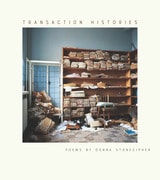
Transaction Histories
Donna Stonecipher
University of Iowa Press, 2018
Reveling in the paradox of the formal prose poem, Donna Stonecipher’s Transaction Histories gathers together six series of poems that explore the disobedient incongruities of aesthetics and emotions. Stonecipher’s carefully sculpted forms and exacting language are held in tension with an unruly imagination to provoke a vision of experience densely layered with bodies impinging upon and altering each other, engaging in transactions that unfold in poetically complex and emotionally startling ways. By turns wry and melancholic, playful and acerbic, erotically charged and politically skeptical, Stonecipher’s poems marry a deeply felt lyricism to a fascination with the mechanisms of narrative. The result is akin to Roland Barthes’s notion of “the novelistic”: writing that flirts with the gestures and spaces of the novel without the trappings of plot, character, or action. Narrative fragments dart in and out of sight, spectral figures and motifs recur in fugal patterns, and habits of ruthless observation are brought to bear on the details of both intimate life and social organization.
Stonecipher lays claim to a stylistic achievement and vision that are entirely her own, transparent and elusive, casual in address and rigorous in design. Whether training its eye on fetishized polar bears, illegal garbage dumping, or ideological debates around rose chintz wallpaper, Transaction Histories tracks the fitful and tragicomic relationships that exist among objects, landscapes, texts, and people, and lays bare the ways in which our transactions keep our lives going.
Transistor Rodeo
Jon Wilkins
University of Utah Press, 2010
Translating the Unspeakable
Poetry and the Innovative NecessityKathleen Fraser
University of Alabama Press, 1999
A prominent avant-garde poet charts both her personal artistic development and the difficulties faced by women writers pursuing innovative paths.
An accomplished and influential poet, Kathleen Fraser has been instrumental in drawing attention to other women poets working outside the mainstream. Translating the Unspeakable gathers eighteen of her essays written over nearly twenty years, combining autobiography and criticism to examine what it means for any artist to innovate instead of following an already traveled path.
In autobiographical passages Fraser tells how her generation was influenced by revolutions in art and philosophy during the early 1960s and how she spent years pursuing idiosyncratic means of rediscovering the poem's terms. By the 1970s her evolving poetics were challenged by questions of gender, until immersion in feminist/modernist scholarship led her to initiate greater dialogue among experimentalist poets.
Other essays examine modernist women writers, their contemporary successors, and the visual poetics they have practiced. By exploring the work of such poets as H. D., Mina Loy, Lorine Niedecker, and Barbara Guest, Fraser conveys their struggle to establish a presence within accepted poetic conventions and describes the role experimentation plays in helping women overcome self-imposed silence.
All of Fraser's writings explore how the search to find one's own way of speaking into a very private yet historic space—of translating the unspeakable—drives poetic experimentation for women and men alike. This provocative book provides a glimpse into the thought processes of
the poetic mind, enhancing our understanding of innovative writing.
Translation as Muse
Poetic Translation in Catullus's RomeElizabeth Marie Young
University of Chicago Press, 2015
Catullus has long been admired as a poet, but his efforts as a translator have been largely ignored. Young reveals how essential translation is to his work: many poems by Catullus that we tend to label as lyric originals were in fact shaped by Roman translation practices entirely different from our own. By rereading Catullus through the lens of translation, Young exposes new layers of ingenuity in Latin poetry even as she illuminates the idiosyncrasies of Roman translation practice, reconfigures our understanding of translation history, and questions basic assumptions about lyric poetry itself.
Translingual Poetics
Writing Personhood Under Settler ColonialismSarah Dowling
University of Iowa Press, 2018
Since the 1980s, poets in Canada and the U.S. have increasingly turned away from the use of English, bringing multiple languages into dialogue—and into conflict—in their work. This growing but under-studied body of writing differs from previous forms of multilingual poetry. While modernist poets offered multilingual displays of literary refinement, contemporary translingual poetries speak to and are informed by feminist, anti-racist, immigrant rights, and Indigenous sovereignty movements. Although some translingual poems have entered Chicanx, Latinx, Asian American, and Indigenous literary canons, translingual poetry has not yet been studied as a cohesive body of writing.
The first book-length study on the subject, Translingual Poetics argues for an urgent rethinking of Canada and the U.S.’s multiculturalist myths. Dowling demonstrates that rising multilingualism in both countries is understood as new and as an effect of cultural shifts toward multiculturalism and globalization. This view conceals the continent’s original Indigenous multilingualism and the ongoing violence of its dismantling. It also naturalizes English as traditional, proper, and, ironically, native.
Reading a range of poets whose work contests this “settler monolingualism”—Jordan Abel, Layli Long Soldier, Myung Mi Kim, Guillermo Gómez-Peña, M. NourbeSe Philip, Rachel Zolf, Cecilia Vicuña, and others—Dowling argues that translingual poetry documents the flexible forms of racialization innovated by North American settler colonialisms. Combining deft close readings of poetry with innovative analyses of media, film, and government documents, Dowling shows that translingual poetry’s avoidance of authentic, personal speech reveals the differential forms of personhood and non-personhood imposed upon the settler, the native, and the alien.
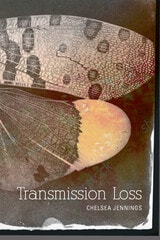
Transmission Loss
Chelsea Jennings
University of Massachusetts Press, 2018
In the study of sound waves and optics, the term transmission loss refers to how a signal grows weaker as it travels across distance and between objects. In this book, Chelsea Jennings reimagines the term in poems that register attenuated signals, mark presence and loss, and treat the body as an instrument sensitive to the weather of immediate experience. Threading together landscapes, abstract paintings, family heirlooms, maps, manuscripts, and photographs, these poems follow the seasons and traverse the spectrum of visible light. Vivid and precise, Transmission Loss brings us to the boundary between inside and outside, “As if what the hand knows / could be held in the hand.”
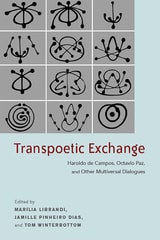
Transpoetic Exchange
Haroldo de Campos, Octavio Paz, and Other Multiversal DialoguesMarília Librandi
Bucknell University Press, 2020
The volume is divided into three parts. “Essays” unites seven texts by renowned scholars who focus on the relationship between the two authors, their impact and influence, and their cultural resonance by exploring explore the historical background and the different stylistic and cultural influences on the authors, ranging from Latin America and Europe to India and the U.S. The second section, “Remembrances,” collects four experiences of interaction with Haroldo de Campos in the process of transcreating Paz’s poem and working on Transblanco and Galáxias. In the last section, “Poems,” five poets of international standing--Jerome Rothenberg, Antonio Cicero, Keijiro Suga, André Vallias, and Charles Bernstein.
Paz and Campos, one from Mexico and the other from Brazil, were central figures in the literary history of the second half of the 20th century, in Latin America and beyond. Both poets signal the direction of poetry as that of translation, understood as the embodiment of otherness and of a poetic tradition that every new poem brings back as a Babel re-enacted.
This volume is a print corollary to and expansion of an international colloquium and poetic performance held at Stanford University in January 2010 and it offers a discussion of the role of poetry and translation from a global perspective. The collection holds great value for those interested in all aspects of literary translation and it enriches the ongoing debates on language, modernity, translation and the nature of the poetic object.
Published by Bucknell University Press. Distributed worldwide by Rutgers University Press.
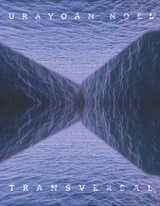
Transversal
PoemsUrayoán Noel
University of Arizona Press, 2021
Featuring Noel’s bilingual playfulness, intellect, and irreverent political imagination, Transversal contains personal reflections on love, desire, and loss filtered through a queer approach to form, expanding upon Noel’s experiments with self-translation in his celebrated collection Buzzing Hemisphere/Rumor Hemisférico. This collection explores walking poems improvised on a smartphone, as well as remixed classical and experimental forms. Poems are presented in interlocking bilingual versions that complicate the relationship between translation and original, and between English and Spanish as languages of empire and popular struggle. The book creatively examines translation and its simultaneous urgency and impossibility in a time of global crisis.
Transversal seeks to disrupt standard English and Spanish, and it celebrates the nonequivalence between languages. Inspired by Caribbean poet and philosopher Édouard Glissant, the collection celebrates Caribbean practices of creolization as maximalist, people-centered, affect-loaded responses to the top-down violence of austerity politics. This groundbreaking, modular approach to poetic translation opens up alternative ways of reading in any language.

Traveling Light
COLLECTED AND NEW POEMSDavid Wagoner
University of Illinois Press, 1999
Witty, eloquent, and insightful, Traveling Light offers new and familiar treasures from a master observer of both the natural and the human worlds. In a style by turns direct and intricate, Wagoner distills the essential emotions from people's encounters with each other, with nature, and with themselves. Through his compassionate but unblinking eyes, we see ourselves and the world that surrounds us more sharply delineated.
Travels of Marco
Mark Levine
Four Way Books, 2016
Tree of Heaven
James Mckean
University of Iowa Press, 1995
Trees Became Torches
SELECTED POEMSEdwin Rolfe. Edited by Cary Nelson and Jefferson Hendricks
University of Illinois Press, 1995
. . . He stands in the forefront of an entire 'lost generation' of left-wing
writers who fused artistic craft with irrepressible political commitment."
-- Alan Wald, author of The Responsibility of Intellectuals: Selected
Essays on Marxist Traditions in Cultural Commitment
"[Rolfe's] Spanish Civil War poems may be the best written by an
American writer, and his McCarthy era poems brilliantly counteract the
often apolitical, rather socially aseptic poetry of their time."
-- Reginald Gibbons, editor of TriQuarterly
The radical journalist and poet Edwin Rolfe wrote eloquently of the hardships
of the Great Depression, the experience of war, and McCarthy era witch-hunts.
More than fifty of his best poems--some beautifully lyrical and some devastatingly
satiric--are included in Trees Became Torches. Rolfe was widely
known as the poet laureate of the Abraham Lincoln Battalion, the Americans
who volunteered to help defend the elected Spanish government during the
1936-39 civil war.
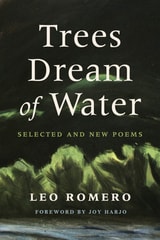
Trees Dream of Water
Selected and New PoemsLeo Romero; Foreword by Joy Harjo
University of Arizona Press, 2025
Leo Romero stands as a foundational figure in Latino letters. With six books of poetry and a book of short fiction to his name, Romero’s contribution to the literary canon is profound and enduring.
Bringing together for the first time his new and selected poems, Trees Dream of Water reflects Romero’s journey from youth to maturity as a person and a poet, and his deep connection to New Mexico and its culture. Traversed by memory, myth, and observation of the natural world, these poems explore family, community belonging and conflict, life as an artist, and the cycles of life and death. This lyrical anthology includes accompanying essays to illuminate Romero’s life and work for longtime admirers and new readers alike.
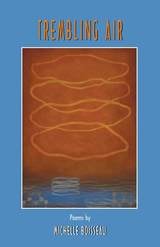
Trembling Air
PoemsMichelle Boisseau
University of Arkansas Press, 2003
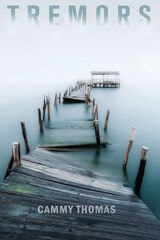
Tremors
Cammy Thomas
Four Way Books, 2021
Thomas’s short, musical poems make stops in the terrains of childhood, difficult and somewhat violent; middle life, with parents breaking down and children moving away into their own lives; and later life when memory falters but passion does not.
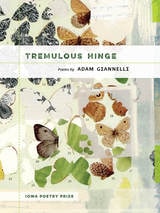
Tremulous Hinge
Adam Giannelli
University of Iowa Press, 2017
From the difficulties of stuttering to teetering attempts at love, from struggling to order a hamburger to tracing the deckled edge of a hydrangea, these poems tumble and hum, revealing a hinge between word and world. Ultimately, among lofting waves, collapsing hands, and darkening skies, words themselves—a stutterer's maneuvers through speech, a deceased grandfather’s use of punctuation—become forms of consolation. From its initial turbulence to its final surprising solace, this debut collection mesmerizes.
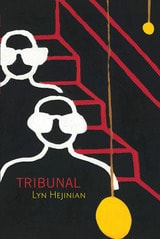
Tribunal
Lyn Hejinian
Omnidawn, 2019
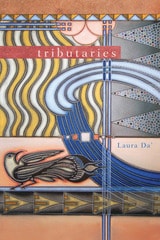
Tributaries
Laura Da'
University of Arizona Press, 2015
Precise images open to piercing meditations of Shawnee history. In the present, a woman watches the approximation of a scalping at a theatrical presentation. Da’ writes, “Soak a toupee with cherry Kool-Aid and mineral oil. / Crack the egg onto the actor’s head. / Red matter will slide down the crown / and egg shell will mimic shards of skull.” This vivid image is paired with a description of the traditional removal path of her own Shawnee ancestors through small towns in Ohio.
These poems range from the Midwestern landscapes of Ohio and Oklahoma to the Pacific Northwest, and the importance of place is apparent. Tributaries simultaneously offers us an extended narrative rumination on the impact of Indian policy and speaks to the contemporary experiences of parenthood and the role of education in passing knowledge from one generation to the next. This collection is composed of four sections that come together to create an important new telling of Shawnee past and present.
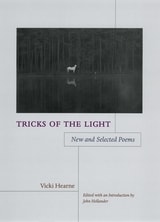
Tricks of the Light
New and Selected PoemsVicki Hearne
University of Chicago Press, 2007
The horse that, trotting with open heart
Against the wind, achieves bend and flow
Will live forever. So far, so good,
But they never do, until too late,
Bend properly and time spreads from
The momentary hesitations
Of their spines, circles their tossing necks,
Falls from their teeth like rejected oats,
Litters the ground like penitence.
This is where we come in, where the drop
Of time congeals the air and someone
Speaks to the discouraged grass . . .
Tricks of the Light explores the often fraught relationships between domestic animals and humans through mythological figurations, vibrant thought, and late-modern lyrics that seem to test their own boundaries. Vicki Hearne (1946–2001), best known and celebrated today as a writer of strikingly original poetry and prose, was a capable dog and horse trainer, and sometimes controversial animal advocate.
This definitive collection of Hearne’s poetry spans the entirety of her illustrious career, from her first book, Nervous Horses (1980), to never-before-published poems composed on her deathbed. But no matter the source, each of her meditative, metaphysical lyrics possesses that rare combination of philosophical speculation, practical knowledge of animals, and an unusually elegant style unlike that of any other poet writing today. Before her untimely death, Hearne entrusted the manuscript to distinguished poet, scholar, and long-time friend John Hollander, whose introduction provides both critical and personal insight into the poet’s magnum opus. Tricks of the Light—acute, vibrant, and deeply informed—is a sensuous reckoning of the connection between humans and the natural world.
Praise for The Parts of Light
“Hearne . . . strives to capture exactly what she knows she can't—the intense immediacy of animal consciousness, a consciousness free of the moral vagaries and intellectual preoccupations that pockmark human experience. Her style, smooth in some places, choppy in others, reflects both the wholeness of animal presence and the jarring, fragmentary nature of human reason and reflection. Hearne's poems demand participation, refuse passive enjoyment; she dares the reader to stay in the saddle.”—Publishers Weekly
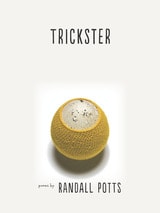
Trickster
Randall Potts
University of Iowa Press, 2014
Trickster veers quickly from meditation and narrative to song, plunging the reader into a liminal world of dreams, archaic lyrics, and fables, populated with figures ranging from the Hawk and Worm, the Cat and Dove, to Cold and Death. It is a wilderness in which all things are alive: “a blade of grass / equal to the suffering / of a lifetime.” Yet it is also a place of menace, “where a fly with one wing, keeps / tipping over in the grass, where / the ants will have him.” Whether or not the Trickster reaches utopia, he reckons with the world that is achievable on earth and in words, “those dreams of woods / relayed to you.”
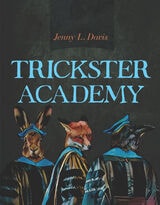
Trickster Academy
Jenny L. Davis
University of Arizona Press, 2022
Trickster Academy is a collection of poems that explore being Native in Academia—from land acknowledgement statements, to mascots, to the histories of using Native American remains in anthropology. Jenny L. Davis’ collection brings humor and uncomfortable realities together in order to challenge the academy and discuss the experience of being Indigenous in university classrooms and campuses. Organized around the premise of the Trickster Academy— a university space run by, and meant for training, Tricksters— this collection moves between the personal dynamics of a Two-Spirit/queer Indigenous woman in spaces where there are few, if any, others and a Trickster’s critique of those same spaces.
Trickster Academy is playful at times, yet more complicated and salient issues are at the heart of these poems. Davis’ Trickster Academy deeply challenges the institutions that still hold Indigenous remains in their archives and storage rooms, and the insincerities of the academy when it comes to acknowledging Indigenous peoples. The realities that the poems in Trickster Academy address are not only relevant to people in academic positions. From leaving home, to being the only Indian in the room, to having to deal with the constant pressures to being a ‘real Indian’, these poems illuminate the shared experiences of Indians across many regions, and all of us who live amongst Tricksters.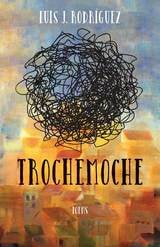
Trochemoche
PoemsLuis J. Rodriguez
Northwestern University Press, 1998
Tropical Depressions
Elton Glaser
University of Iowa Press, 1988
Robert Frost's ovenbird question was, "What to make of a diminished thing?" This new volume of poetry by Elton Glaser answers that question on a personal level, by broadening the sense of loss and exile until it envelops our common concerns of the twentieth century: the loss of love, faith, civility—all the old verities diminished and distorted.
While the first two sections of the book raise exuberant laments for the domestic, artistic, amatory, and religious life, the third section of poems moves beyond complaint to celebration. The complainer, purged of his grievances, leaves behind a northern exile and moves somewhere closer to home. In these final poems, Glaser returns to the South and his native city of New Orleans. Without nostalgia for the romance of moonlit magnolias, without denial of the region's dark past, he voices a more measured, more settled view of the world, one of balance and hard-won acceptance.
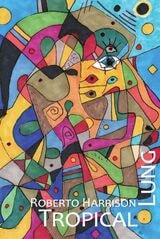
Tropical Lung
exi(s)t(s)Roberto Harrison
Omnidawn, 2021
Tropical Lung shows how apocalypses can give us the keys to new futures and how aloneness and silence can lead us to live multidimensionally, beyond the boundaries of time and space. The screen makes itself known and offers a means of kinship, but it is also removed by song and born in the red of encounter and the dark of seven pupils. These wild visions coalesce into a fantastic vision of a future both technological and communal.