Results by title
8812 books match the query 'Political Science' and 1911 start with t
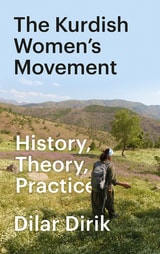
The Kurdish Women’s Movement
History, Theory, PracticeDilar Dirik
Pluto Press, 2021
'One the foremost writers and participants in the Kurdish women's movement' - Harsha Walia
The Kurdish women's movement is at the heart of the most exciting revolutionary experiment in the world today: Rojava. Forged over decades of struggle, most recently in the fight against ISIS, Rojava embodies a radical commitment to ecology, democracy and gender equality. But while striking images of Kurdish women in desert fatigues proliferate, a true understanding of the women's movement remains elusive.
Taking apart the superficial and Orientalist frameworks that dominate, Dilar Dirik offers instead an empirically rich account of the women's movement in Kurdistan. Drawing on original research and ethnographic fieldwork, she surveys the movement's historical origins, ideological evolution, and political practice over the past forty years. Going beyond abstract ideas, Dirik locates the movement's culture and ideology in its concrete work for women's liberation and radical democracy.
Taking the reader from the guerrilla camps in the mountains to radical women's academies and self-organized refugee camps, the book invites readers around the world to engage with the revolution in Kurdistan, both theoretically and practically, as a vital touchstone in the wider struggle for a militant anti-fascist, anti-capitalist feminist internationalism.
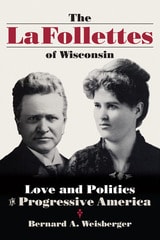
The La Follettes of Wisconsin
Love and Politics in Progressive AmericaBernard A. Weisberger
University of Wisconsin Press, 2013
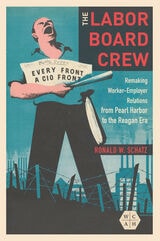
The Labor Board Crew
Remaking Worker-Employer Relations from Pearl Harbor to the Reagan EraRonald W. Schatz
University of Illinois Press, 2021
Schatz argues that the Labor Board vets, who saw themselves as disinterested technocrats, were in truth utopian reformers aiming to transform the world. Beginning in the 1970s stagflation era, they faced unforeseen opposition, and the cooperative relationships they had fostered withered. Yet their protégé George Shultz used mediation techniques learned from his mentors to assist in the integration of Southern public schools, institute affirmative action in industry, and conduct Cold War negotiations with Mikhail Gorbachev.
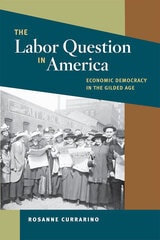
The Labor Question in America
Economic Democracy in the Gilded AgeRoseanne Currarino
University of Illinois Press, 2011
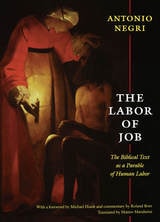
The Labor of Job
The Biblical Text as a Parable of Human LaborAntonio Negri
Duke University Press, 2009
The Labor of Job was first published in Italy in 1990. Negri began writing it in the early 1980s, while he was a political prisoner in Italy, and it was the first book he completed during his exile in France (1983–97). As he writes in the preface, understanding suffering was for him in the early 1980s “an essential element of resistance. . . . It was the problem of liberation, in prison and in exile, from within the absoluteness of Power.” Negri presents a Marxist interpretation of Job’s story. He describes it as a parable of human labor, one that illustrates the impossibility of systems of measure, whether of divine justice (in Job’s case) or the value of labor (in the case of late-twentieth-century Marxism). In the foreword, Michael Hardt elaborates on this interpretation. In his commentary, Roland Boer considers Negri’s reading of the book of Job in relation to the Bible and biblical exegesis. The Labor of Job provides an intriguing and accessible entry into the thought of one of today’s most important political philosophers.
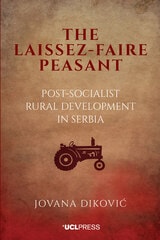
The Laissez-Faire Peasant
Post-Socialist Rural Development in SerbiaJovana Dikovic
University College London, 2025
The Laissez-Faire Peasant: Post-Socialist Rural Development in Serbia subverts conventional wisdom on rural development by shifting the focus from state-led planning to the agency of peasants themselves. Rejecting the notion that rural populations are passive victims of top-down policies, Jovana Dikovic presents a compelling ethnographic study of three Serbian villages, where autonomy and local cooperation drive economic and social resilience. She introduces the concept of the “laissez-faire peasant”—a figure who thrives outside rigid government schemes, shaping rural development on their own terms. By examining the friction between state policies and the everyday strategies of rural communities, Dikovic uncovers how peasant autonomy not only resists external intervention but fosters sustainable and self-sufficient growth.
The first in-depth study of contemporary Serbian peasantry, this book reframes rural life as a site of innovation rather than stagnation. An area of interest for scholars of post-socialist transitions, rural development, and economic anthropology, The Laissez-Faire Peasant provides a new lens on how rural communities survive and adapt in a rapidly changing world.

The Land Was Theirs
Jewish Farmers in the Garden StateGertrude W. Dubrovsky
University of Alabama Press, 1992
A historical account of Jewish agricultural colonies in New Jersey that examines how immigrants built farming communities in early America.
The Land Was Theirs is about Farmingdale, New Jersey, a community of Jewish farming communities in the United States established with the help of the Jewish Agricultural Society. The 50 year history of Farmingdale provides a perspective on the pressures, problems, and satisfactions of rural Jewish life as experienced in one community.
Beginning in 1919, the community grew around the small town of Farmingdale, when two Jewish families pooled their resources to establish a farm. The community evolved gradually as unrelated individuals with no previous farm experience settled and then created the institutions and organizations they needed to sustain their Jewish life. By 1945 Farmingdale was one of the leading egg-producing communities in the United States, and contributed in large measure to New Jersey’s reputation as the “egg basket of America.”
The Land Was Theirs draws from life-history interviews with 120 farmers, from the author’s personal experiences, and from a variety of private and community papers and documents. They are the pieces from which a full picture of a single Jewish farm community emerges.
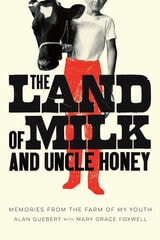
The Land of Milk and Uncle Honey
Memories from the Farm of My YouthAlan Guebert with Mary Grace Foxwell
University of Illinois Press, 2015
Here are Guebert's tireless parents, measuring the year not in months but in seasons for sewing, haying, and doing the books; Jackie the farmhand, needing ninety minutes to do sixty minutes' work and cussing the entire time; Hoard the dairyman, sore fingers wrapped in electrician's tape, sharing wine and the prettiest Christmas tree ever; and the unflappable Uncle Honey, spreading mayhem via mistreated machinery, flipped wagons, and the careless union of diesel fuel and fire.
Guebert's heartfelt and humorous reminiscences depict the hard labor and simple pleasures to be found in ennobling work, and show that in life, as in farming, Uncle Honey had it right with his succinct philosophy for overcoming adversity: "the secret's not to stop."
https://www.youtube.com/watch?v=DooGQqUlXI4&index=1&list=FLPxtuez-lmHxi5zpooYEnBg

The Language of Political Incorporation
Chinese Migrants in EuropeAmy Liu
Temple University Press, 2021
In this groundbreaking study, The Language of Political Incorporation, Amy Liu focuses on Chinese migrants in Central-Eastern Europe and their varying levels of political incorporation in the local community. She examines the linguistic diversity of migrant networks, finding institutional trust and civic engagement depend not on national identity, but on the network’s linguistic diversity—namely, whether the operating language is a migrant’s mother tongue or a lingua franca.
The Language of Political Incorporation uses original survey data to assess when the Chinese engage positively with the authorities and when they become civic minded. The results are surprising. In Hungary, the Chinese community has experienced high levels of political incorporation in part because they have not been targeted by anti-immigrant rhetoric and policies. In contrast, migrants in Romania sought the assistance of the Chinese embassy to fight an effort to collect back taxes.
Liu also compares the Chinese experiences in Central-Eastern Europe with those of Muslims in the region, as well as how the Chinese are treated in Western Europe. Additionally, she considers how the local communities perceive the Chinese. The Language of Political Incorporation concludes by offering best practices for how governments can help migrants become more trusting of—and have greater involvement with—locals in their host countries. Ultimately, Liu demonstrates the importance of linguistic networks for the incorporation of immigrants.
The Language of Public Administration
Bureaucracy, Modernity, and PostmodernityDavid John Farmer
University of Alabama Press, 1995
Rethinking bureaucracy through the lenses of modernity, postmodernity, and administrative imagination.
Coping with the practical problems of bureaucracy is hampered by the limited self-conception and the constricted mindsets of mainstream public administration thinking. Modernist public administration theory, although valuable and capable of producing ever more remarkable results, is limiting as an explanatory and catalytic force in resolving fundamental problems about the nature, size, scope, and functioning of public bureaucracy and in transforming public bureaucracy into a more positive force.
This original study specifies a reflexive language paradigm for public administration thinking and shows how a postmodern perspective permits a revolution in the character of thinking about public bureaucracy. The author considers imagination, deconstruction, deterritorialization, and alterity. Farmer's work emphasizes the need for an expansion in the character and scope of public administration's disciplinary concerns and shows clearly how the study and practice of public administration can be reinvigorated.
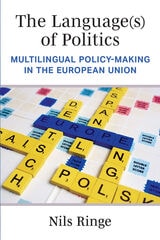
The Language(s) of Politics
Multilingual Policy-Making in the European UnionNils Ringe
University of Michigan Press, 2022
Multilingualism is an ever-present feature in political contexts around the world, including multilingual states and international organizations. Increasingly, consequential political decisions are negotiated between politicians who do not share a common native language. Nils Ringe uses the European Union to investigate how politicians’ reliance on shared foreign languages and translation services affects politics and policy-making. Ringe's research illustrates how multilingualism is an inherent and consequential feature of EU politics—that it depoliticizes policy-making by reducing its political nature and potential for conflict. An atmosphere with both foreign language use and a reliance on translation leads to communication that is simple, utilitarian, neutralized, and involves commonly shared phrases and expressions. Policymakers tend to disregard politically charged language and they are constrained in their ability to use vague or ambiguous language to gloss over disagreements by the need for consistency across languages.
The Last Colonial Massacre
Latin America in the Cold War, Updated EditionGreg Grandin
University of Chicago Press, 2011
After decades of bloodshed and political terror, many lament the rise of the left in Latin America. Since the triumph of Castro, politicians and historians have accused the left there of rejecting democracy, embracing communist totalitarianism, and prompting both revolutionary violence and a right-wing backlash. Through unprecedented archival research and gripping personal testimonies, Greg Grandin powerfully challenges these views in this classic work. In doing so, he uncovers the hidden history of the Latin American Cold War: of hidebound reactionaries holding on to their power and privilege; of Mayan Marxists blending indigenous notions of justice with universal ideas of equality; and of a United States supporting new styles of state terror throughout the region.
With Guatemala as his case study, Grandin argues that the Latin American Cold War was a struggle not between political liberalism and Soviet communism but two visions of democracy—one vibrant and egalitarian, the other tepid and unequal—and that the conflict’s main effect was to eliminate homegrown notions of social democracy. Updated with a new preface by the author and an interview with Naomi Klein, The Last Colonial Massacre is history of the highest order—a work that will dramatically recast our understanding of Latin American politics and the role of the United States in the Cold War and beyond.
“This work admirably explains the process in which hopes of democracy were brutally repressed in Guatemala and its people experienced a civil war lasting for half a century.”—International History Review
“A richly detailed, humane, and passionately subversive portrait of inspiring reformers tragically redefined by the Cold War as enemies of the state.”—Journal of American History
The Last Drop
The Politics of WaterMike Gonzalez and Marianella Yanes
Pluto Press, 2015
This book looks at how we got here and what we can and should do next. Laying out the complex arguments surrounding water, its ownership and access to it, Mike Gonzalez and Marianella Yanes make the technical and scientific aspects of the discussion clear and accessible—and thereby enable themselves to make the political questions more urgent. Pushing back against the market fundamentalists, the authors argue that it is both possible and necessary that considerations of equity and social justice prevail in the debates about water. Powerful and polemical, The Last Drop will be a vital resource for water activists worldwide.
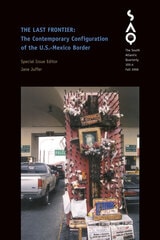
The Last Frontier
The Contemporary Configuration of the U.S.-Mexico Border, Volume 105Jane Juffer, ed.
Duke University Press, 0
Covering a range of disciplinary perspectives—geography, political science, anthropology, American studies, literary studies, and environmental studies—these essays contend that U.S. policies to curtail immigration and drug trafficking along the Mexican border are ineffective. George W. Bush’s call for a volunteer security force has legitimized a vigilante presence through the formation of Minutemen civilian border patrols, in addition to larger numbers of Border Patrol agents and expanded detention centers. One contributor argues that, due to the increasingly dangerous border-crossing conditions, more undocumented immigrants are remaining in the United States year-round rather than following the traditional seasonal pattern of work and returning to Mexico. Another contributor interviews drug smugglers and government officials, revealing the gap between reality and the claims of success by the U.S. government in the “war on drugs.” Focusing on the social justice movement Ni Una Mas (Not One More), one essay delves into the controversy over the unsolved murders of hundreds of young women in the border town of Ciudad Juárez and the refusal of the government to investigate these murders properly. Other essays consider instances of resistance and activism—ranging from political movements and protests by NGOs to artistic expression through alternative narratives, poetry, and photography—against the consequences of neoliberalism on the border and its populations.
Contributors. Ana M. Manzanas Calvo, Alicia Schmidt Camacho, Arturo Dávila, Sarah Hill, Jane Juffer, Laura Lewis, Alejandro Lugo, Tony Payan, Claudia Sadowski-Smith, Santiago Vaquera, Melissa Wright

The Last Generation
Work and Life in the Textile Mills of Lowell, Massachusetts, 1910-1960Mary H. Blewett
University of Massachusetts Press, 1990
Oral histories of many of the last generation of Lowell, MA, textile mill workers preceded by two introductory sections. The first presents the historic setting of economic development and subsequent decline of the textile industry in Lowell. The second is a brief explanation of the production process wherein the last generation of mill workers expended so many of their skills and so much of their energy.
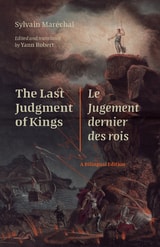
The Last Judgment of Kings / Le Jugement dernier des rois
A Bilingual EditionYann Robert
Bucknell University Press, 2025
Joué pour la première fois le lendemain de l’exécution de Marie-Antoinette, Le Jugement dernier des rois met en scène le procès burlesque des autres rois et reines d’Europe : exhibés et enchaînés tels des animaux, contraints de se battre pour un tonneau de biscuits, et finalement anéantis par l’éruption spectaculaire d’un volcan. Tel est le contexte scandaleux—tragédie et farce à la fois—de la pièce la plus célèbre de la Révolution française, bien connue de tous les spécialistes de cette période. Jusqu’à maintenant, pourtant, il n’existait ni édition critique ni traduction anglaise de cet ouvrage historique. Notre édition bilingue fait revivre la pièce de Maréchal et la replace au centre des plus grands débats chez les historiens de la Révolution, traitant de justice, religion, commémoration, comédie, et propagande. Provocateur, facile à lire, et concis—parfaitement adapté aux étudiants d’un cours de français ou d’histoire—Le Jugement dernier des rois propose ainsi une introduction idéale à la période révolutionnaire et à ses principales controverses.
Published by Bucknell University Press. Distributed worldwide by Rutgers University Press.
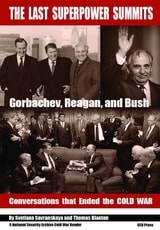
The Last Superpower Summits
Reagan, Gorbachev and Bush. Conversations that Ended the Cold War.The National Security Archive Savranskaya
Central European University Press, 2017
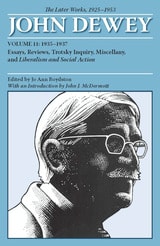
The Later Works of John Dewey, Volume 11, 1925 - 1953
Essays, Reviews, Trotsky Inquiry, Miscellany, and Liberalism and Social ActionJohn Dewey. Edited by Jo Ann Boydston
Southern Illinois University Press, 2008
This volume includes ninety-two items from 1935, 1936, and 1937, including Dewey’s 1935 Page-Barbour Lectures at the University of Virginia, published as Liberalism and Social Action.
In essay after essay Dewey analyzed, criticized, and reevaluated liberalism. When his controversial Liberalism and Social Action appeared, asking whether it was still possible to be a liberal, Horace M. Kallen wrote that Dewey “restates in the language and under the conditions of his times what Jefferson’s Declaration of Independence affirmed in the language and under the conditions of his.”
The diverse nature of the writings belies their underlying unity: some are technical philosophy; other philosophical articles shade into social and political themes; social and political issues permeate the educational articles, which in turn involve Dewey’s philosophical ideas.
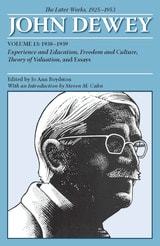
The Later Works of John Dewey, Volume 13, 1925 - 1953
1938-1939, Experience and Education, Freedom and Culture, Theory of Valuation, and EssaysJohn Dewey. Edited by Jo Ann Boydston
Southern Illinois University Press, 2008
This volume includes all Dewey’s writings for 1938 except for Logic: The Theory of Inquiry (Volume 12 of The Later Works), as well as his 1939 Freedom and Culture, Theory of Valuation, and two items from Intelligence in the Modern World.
Freedom and Culture presents, as Steven M. Cahn points out, “the essence of his philosophical position: a commitment to a free society, critical intelligence, and the education required for their advance.”
The Later Works of John Dewey, Volume 17, 1925 - 1953
1885 - 1953, Miscellaneous WritingsJohn Dewey. Edited by Jo Ann Boydston
Southern Illinois University Press, 2008
This is the final textual volume in The Collected Works of John Dewey, 1882–1953, published in 3 series comprising 37 volumes: The Early Works, 1882–1898 (5 vols.); The Middle Works, 1899–1924 (15 vols.); The Later Works, 1925–1953 (17 vols.).
Volume 17 contains Dewey’s writings discovered after publication of the appropriate volume of The Collected Works and spans most of Dewey’s publishing life. There are 83 items in this volume, 24 of which have not been previously published.
Among works highlighted in this volume are 10 “Educational Lectures before Brigham Young Academy,” early essays “War’s Social Results” and “The Problem of Secondary Education after the War,” and the previously unpublished “The Russian School System.”
The Later Works of John Dewey, Volume 3, 1925 - 1953
1927-1928, Essays, Reviews, Miscellany, and "Impressions of Soviet Russia"John Dewey. Edited by Jo Ann Boydston
Southern Illinois University Press, 2008
All of Dewey’s writings for 1927 and 1928 with the exception of The Public and Its Problems, which appears in Volume 2, A Modern Language Association’s Committee on Scholarly Editions textual edition.
These essays are, as Sidorsky says in his Introduction, “framed, in great measure, by those two poles of his philosophical interest: looking backward, in a sense, to the defense of naturalistic metaphysics and moving forward to the justification and to the implications for practice of an empirical theory.”
Dewey’s five essays on education are evidence of his continued interest in that field. Among them is the frequently quoted “Why I Am a Member of the Teachers Union,” which is still used by the American Federation of Teachers in its recruiting efforts. Other highlights of this volume include the famous exchange between George Santayana and Dewey on Experience and Nature; an impassioned condemnation of the miscarriage of justice Dewey saw in the Sacco-Vanzetti trial; and a series of six articles on the Soviet Union based on Dewey’s trip to that country in 1928.
The Later Works of John Dewey, Volume 5, 1925 - 1953
1929-1930, Essays, The Sources of a Science of Education, Individualism, Old and New, and Construction and CriticismJohn Dewey. Edited by Jo Ann Boydston
Southern Illinois University Press, 2008
With the exception of The Quest for Certainty (Volume 4) this fifth volume brings together Dewey’s writings for the 1929–1930 period.
During this time Dewey published 4 books and 50 articles on philosophical, educational, political, and social issues. His philosophical essays include “What Humanism Means to Me” and “What I Believe,” both of which express Dewey’s faith in man’s potentialities and intelligence, and a lively Journal of Philosophy exchange with Ernest Nagel, William Ernest Hocking, C. I. Lewis, and F. J. E. Woodbridge. Educational writings include The Sources of a Science of Education. The contents of this volume reflect Dewey’s increasing involvement in social and political problems.
The Later Works of John Dewey, Volume 6, 1925 - 1953
1931-1932, Essays, Reviews, and MiscellanyJohn Dewey. Edited by Jo Ann Boydston
Southern Illinois University Press, 2008
Except for Dewey’s and James H. Tufts’ 1932 Ethics (Volume 7 of The Later Works), this volume brings together Dewey’s writings for 1931–1932.
The Great Depression presented John Dewey and the American people with a series of economic, political, and social crises in 1931 and 1932 that are reflected in most of the 86 items in this volume, even in philosophical essays such as “Human Nature.” As Sidney Ratner points out in his Introduction, Dewey’s interest in international peace is featured in the writings in this volume.
The Latin American Voter
Pursuing Representation and Accountability in Challenging ContextsRyan E. Carlin, Matthew M. Singer, and Elizabeth J. Zechmeister
University of Michigan Press, 2015
The Latina Advantage
Gender, Race, and Political SuccessBy Christina E. Bejarano
University of Texas Press, 2013
Challenging common assumptions and offering new alternatives in the debate over the current political status of women, this data-driven study indicates that minority female political candidates often have a strong advantage over male opponents when seeking political office.
During the first decade of the 21st century, racial/ethnic minority women have made significant strides in U.S. politics, comprising large portions of their respective minority delegations both in Congress and in state legislatures. This trend has been particularly evident in the growing political presence of Latinas, yet scholars have offered no clear explanations for this electoral phenomenon—until now.
In The Latina Advantage, Christina E. Bejarano draws on national public opinion datasets and a close examination of state legislative candidates in Texas and California to demonstrate the new power of the political intersection between race and gender. Underscoring the fact that racial/ethnic minority women form a greater share of minority representatives than do white women among white elected officials, Bejarano provides empirical evidence to substantiate previous theoretical predictions of the strategic advantage in the intersectionality of gender and ethnicity in Latinas. Her evidence indicates that two factors provide the basis for the advantage: increasingly qualified candidates and the softening of perceived racial threat, leading minority female candidates to encounter fewer disadvantages than their male counterparts.
Overturning the findings of classic literature that reinforce stereotypes and describe minority female political candidates as being at a compounded electoral disadvantage, Bejarano brings a crucial new perspective to dialogues about the rapidly shifting face of America’s electorate.
The Latino Question
Politics, Laboring Classes and the Next LeftRodolfo D. Torres
Pluto Press, 2018
In a radical alternative to the dominant orthodoxy in Latino political studies, Rodolfo D. Torres, Armando Ibarra, and Alfredo Carlos emphasize the importance of political economy for understanding Latino politics, culture, and social issues. Written in an accessible style, the authors draw from extensive original research and several critical traditions—including Karl Marx, Antonio Gramsci, and Michel Foucault—to make crucial links between socio-economic and culture-based approaches for understanding the politics of race and ethnicity in capitalist society. Notably, they present front-line evidence of how some Mexican communities across America are not only resisting, but also reinventing and transforming the predominant economic ideas. The Latino Question will be essential for anyone hoping to understand the changes in Latino communities in America today.

The Lausanne Moment
Reckoning with the 1923 Treaty of Peace and Its LegaciesEdited by Ozan Ozavci, Julia Secklehner, and Georgios Giannakopoulos
Gingko, 2027
The 1923 Treaty of Lausanne remains one of the few interwar peace settlements that has endured into the twenty-first century. Yet, the memory of Lausanne has proved deeply contested. Celebrated by some as a triumph of state sovereignty and peacemaking, it has also come to symbolize forced displacement, the erasure of minority rights, and the codification of population transfers as instruments of international order.
Just over one hundred years after the signing of the Treaty of Lausanne, The Lausanne Moment revisits this diplomatic, legal, economic, and financial juncture that helped reshape the world and defined new norms of sovereignty, displacement, and identity. Building on a growing body of interdisciplinary scholarship and serving as a sequel to They All Made Peace—What is Peace?, also published by Gingko, this edited volume foregrounds the lived realities and long-term legacies of the treaty, critically re-examining the political, cultural, and social consequences of its provisions and aftershocks.
Rather than focusing solely on high diplomacy or legal text, The Lausanne Moment brings into view the human dimension of the Lausanne moment. Through case studies ranging from the refugee experience in Nikaia and Asia Minor orphans in Greece, to the enduring memory of loss in Pontic singing, the symbolic ethnicity of Cretan descendants, and the Kurdish experience in Turkey, the book documents the deeply personal and community-level consequences of forced migration and political rupture. These experiences are not confined to the immediate postwar period; they linger across time, informing the present-day politics of memory, migration, and identity.
This volume also interrogates the geopolitics of Lausanne through new thematic lenses. Essays explore how the treaty facilitated the continuation of imperial practices under new nationalist forms, shaped debates over public debt and cultural heritage, and affected actors and regions often overlooked in Lausanne historiography, such as Albania, Cyprus, and the Kurdish nationalist movements. Lausanne’s cultural afterlives, from its role in shaping archaeology, music, and education policy, are also covered in the book. Through its interdisciplinary and transregional approach, The Lausanne Moment breaks new ground in Lausanne studies, bringing together historians, anthropologists, archaeologists, political scientists, and cultural theorists, and introduces voices and perspectives—Kurdish, Cypriot, Pontic, Albanian, and Cretan—that have been marginal to mainstream narratives. By weaving together policy analysis, oral history, cultural production, and historical research, the volume offers an expansive and textured account of one of the twentieth century’s most consequential, yet paradoxical, peace settlements.
The Lausanne Moment situates the treaty within broader histories of state-led population engineering, colonial eugenic practices, and the moral politics of international humanitarianism. The “peace” of Lausanne, the volume suggests, was neither absolute nor apolitical—it was crafted, contested, and constantly renegotiated. The book’s contributors collectively ask not only what peace meant in 1923, but also what it means today for those still living with its consequences.
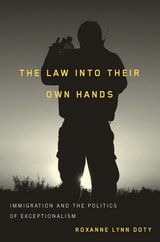
The Law Into Their Own Hands
Immigration and the Politics of ExceptionalismRoxanne Lynn Doty
University of Arizona Press, 2009
Doty examines the social and political contexts that have enabled these civilian groups to flourish and gain legitimacy amongst policy makers and the public. The sentiments underlying the vigilante movement both draw upon and are channeled through a diverse range of organizations whose messages are often reinforced by the media. Taking action when they believe official policy is lacking, groups ranging from elements of the religious right to anti-immigrant groups to white supremacists have created a social movement.
Doty seeks to alert us to the consequences related to this growing movement and to the restructuring of our society. She maintains that with immigrants being considered as enemies and denied basic human rights, it is irresponsible of both citizens and policy makers to treat this complicated issue as a simple black or white reality.
In this solid and theoretically grounded look at contemporary, post-9/11 border vigilantism, the author observes the dangerous and unproductive manner in which private citizens seek to draw firm and uncompromising lines between who is worthy of inclusion in our society and who is not.
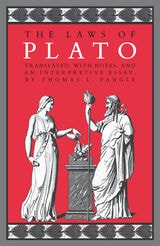
The Laws of Plato
Plato
University of Chicago Press, 1988
"Because it succeeds in being both literal and comprehensive, it is by far superior to any translation available. By reproducing dramatic detail often omitted, such as oaths, hesitations, repetitions, and forms of address, Pangle allows the reader to follow the dialogue's interplay between argument and dramatic context. . . . Pangle's translation captures the excitement and the drama of Plato's text."—Mary P. Nichols, Ancient Philosophy
"Pangle's achievement is remarkable. . . . The accompanying interpretive essay is an excellent distillation of a dialogue three times its size. The commentary is thoughtful, even profound; and it amply demonstrates the importance of reading Plato carefully and from a translation that is true to his language."—Patrick Coby, American Political Science Review
The Laws of the Roman People
Public Law in the Expansion and Decline of the Roman RepublicCallie Williamson
University of Michigan Press, 2015
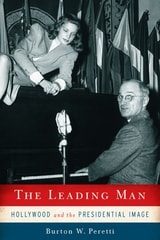
The Leading Man
Hollywood and the Presidential ImagePeretti, Burton W
Rutgers University Press, 2012
American presidents and Hollywood have interacted since the 1920s. This relationship has made our entertainment more political and our political leadership more aligned with the world of movies and movie stars.
In The Leading Man, Burton W. Peretti explores the development of the cinematic presidential image. He sets the scene in chapter 1 to show us how the chief executive, beginning with George Washington, was positioned to assume the mantle of cultural leading man. As an early star figure in the young republic, the president served as a symbol of national survival and wish fulfillment. The president, as head of government and head of state, had the potential to portray a powerful and charismatic role.
At the center of the story are the fourteen presidents of the cinematic era, from Herbert Hoover to Barack Obama. Since the 1920s, the president, like the lead actor in a movie, has been given the central place on the political stage under the intense glare of the spotlight. Like other American men, future presidents were taught by lead movie actors how to look and behave, what to say, and how to say it. Some, like John F. Kennedy and Richard M. Nixon, took particular care to learn from the grooming, gestures, movements, and vocal inflections of film actors and applied these lessons to their political careers. Ronald Reagan was a professional actor. Bill Clinton, a child of the post–World War II Baby Boom, may have been the biggest movie fan of all presidents. Others, including Lyndon Johnson, showed little interest in movies and their lessons for politicians.
Presidents and other politicians have been criticized for cheapening their offices by hiring image and advertising consultants and staging their public events. Peretti analyzes the evolution and the significance of this interaction to trace the convoluted history of the presidential cinematic image. He demonstrates how movies have been the main force in promoting appearance and drama over the substance of governing, and how Americans’ lives today may be dominated by entertainment at the expense of their engagement as citizens.
The Left Behind
Reimagining Britain's Socially ExcludedJames
Pluto Press, 2022
Examines the ways in which the 'Left Behind' have been used to symbolize and foment social divisions in contemporary Britain.
'The Left Behind' is a defining motif of contemporary British political discourse. It is the thread that knits together the 2016 Brexit referendum, the crumbling of the fabled 'Red Wall' in the North, and the pernicious culture war being waged today. But who are the Left Behind?
James Morrison goes in search of the reality behind the rhetoric, offering the first comprehensive, historical analysis of the origins, uses and meanings of the term. He interrogates the popular archetype of the Left Behind - as a working-class, Leave-voting white male from a former industrial heartland - and situates the concept in the context of longstanding, demonizing discourses aimed at communities seen as backward and 'undeserving'.
Analyzing national newspaper coverage and parliamentary discussions, and drawing on interviews with MPs, community leaders, charities, and people with direct lived experiences of poverty and precarity, The Left Behind grapples with the real human cost of austerity for neglected post-industrial communities and other marginalized groups across the world, and the stigmatizing discourse that does little to serve them.
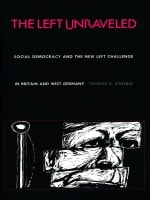
The Left Unraveled
Social Democracy & the New Left Challenge in Britain & West GermanyThomas A. Koelble
Duke University Press, 1991
By focusing on the established parties rather than on external developments, Koelble departs from conventional methodology regarding the fortunes of political parties. In examining the fundamental processes of decision making and coalition building within the SPD and the Labour Party, he argues that it is the organizational structures within parties that shape political results by setting limits, creating opportunities, and determining strategies.
The Left and Digital Politics
Political Parties from Platform Neoliberalism to Platform SocialismMarco Guglielmo
University of Westminster Press, 2025
The Legacy of Division
East and West after 1989Ferenc Laczó
Central European University Press, 2020
This volume examines the legacy of the East–West divide since the implosion of the communist regimes in Europe. The ideals of 1989 have largely been frustrated by the crises and turmoil of the past decade. The liberal consensus was first challenged as early as the mid-2000s. In Eastern Europe, grievances were directed against the prevailing narratives of transition and ever sharper ethnic-racial antipathies surfaced in opposition to a supposedly postnational and multicultural West. In Western Europe, voices regretting the European Union's supposedly careless and premature expansion eastward began to appear on both sides of the left–right and liberal–conservative divides. The possibility of convergence between Europe's two halves has been reconceived as a threat to the European project.
In a series of original essays and conversations, thirty-three contributors from the fields of European and global history, politics and culture address questions fundamental to our understanding of Europe today: How have perceptions and misperceptions between the two halves of the continent changed over the last three decades? Can one speak of a new East–West split? If so, what characterizes it and why has it reemerged? The contributions demonstrate a great variety of approaches, perspectives, emphases, and arguments in addressing the daunting dilemma of Europe's assumed East–West divide.
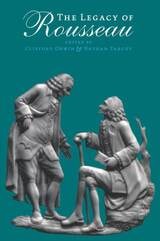
The Legacy of Rousseau
Edited by Clifford Orwin and Nathan Tarcov
University of Chicago Press, 1996
The volume begins by taking up a central theme noted by the late Allan Bloom—Rousseau's critique of the bourgeois as the dominant modern human type and as a being fundamentally in contradiction, caught between the sentiments of nature and the demands of society. It then turns to Rousseau's crucial polarity of nature and society and to the later conceptions of history and culture it gave rise to. The third part surveys Rousseau's legacy in both domestic and international politics. Finally, the book examines Rousseau's contributions to the virtues that have become central to the current sensibility: community, sincerity, and compassion.
Contributors include Allan Bloom, François Furet, Pierre Hassner, Christopher Kelly, Roger Masters, and Arthur Melzer.

The Legal Status of Church-State Relationships in the United States
With Special Reference to the Public SchoolsAlvin Johnson
University of Minnesota Press, 1934
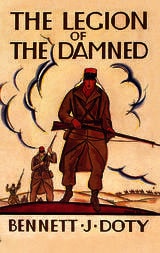
The Legion of the Damned
The Adventures of Bennett J. Doty in the French Foreign Legion as Told by HimselfBennett J. Doty
Westholme Publishing, 2020
“You see there was down South a girl I liked. And she is now married . . . not to me.” So Bennett J. Doty confessed when he sailed for France and enlisted in the French Foreign Legion in 1924. A World War I veteran and University of Virginia student, Doty first trained in Morocco and Algeria before being shipped off to the French-controlled State of Syria. There, he and his fellow “bleus,” who hailed from Belgium, Poland, Italy, Senegal, Spain, Germany, Russia, and other countries, found themselves at the spearhead of the attempt to quell the revolt against French rule in the area. The fighting, mostly against the Druze, was fierce, merciless, and unrelenting. Fought in villages and at isolated outposts, there was no quarter. Entire villages were razed, fields destroyed, and prisoners were not taken by either side. In the engagement where Doty and several other of his “copains”—“buddies”—earned the Croix de Guerre, his unit became isolated and withstood days of attacks which claimed more than half of the Legionnaires until they were finally relieved by a French colonial column. With the immediate fighting over, the Legion was put to heavy manual labor under the hot desert sun. Doty became disillusioned, and with four other soldiers, fled in an attempt to reach British-controlled Jordan. They were caught, tried, and Doty was sentenced to eight years in a French prison. When word reached the United States, diplomatic efforts ultimately gained Doty a pardon and honorable discharge from service.
Originally published in 1928, Legion of the Damned, Doty’s acclaimed account of his time in the Legion, is a remarkable memoir that requires no additional drama to allow the reader to experience the desperation, exhilaration, fear, and disgust of a colonial war. Here, Doty shows how drunken, unruly, vicious veterans would transform into capable, cool, and orderly soldiers as soon as a battle began—the élan that earned the French Foreign Legion its reputation as a legendary fighting unit.

The Less Responsive Chamber?
Politics and Development in the Early US SenateJoel Sievert
University of Michigan Press, 2027
Who did members of the early US Senate represent? Many scholarly and popular political accounts of the Antebellum era assume that senators were exclusively representatives of the state governments because pre-reform senators were chosen by state legislatures. However, The Less Responsive Chamber? examines senators’ relationships with three potential targets of representation—the state governments, the state legislature, and the electorate of the state.
Through both empirical analyses and detailed case studies, the book demonstrates that senators cared about the public and did not strictly view their representational role as one of being faithful agents to state governments. While senators’ floor speeches, circulars, and correspondences frequently referenced the state electorate as their primary constituency, they were often directed to represent a variety of interests. Further, senators were aware of and responded to public opinion as well as intrastate political dynamics. By documenting how the interests of political parties, states, and the public influenced the Senate’s behavior during the early years of the United States, this book offers insight into a period whose fraught politics continue to impact our lives today.
The Lesson of Carl Schmitt
Four Chapters on the Distinction between Political Theology and Political PhilosophyHeinrich Meier
University of Chicago Press, 1998
Relating this religious dimension to Schmitt's support for National Socialism and his continuing anti-Semitism, Meier compels the reader to come to terms with the irreconcilable differences between political theology and political philosophy. His book will give pause to those who have tended to gloss over the troubling aspects of some of Schmitt's ideas.
With editions in German, French, Italian, and now English, Meier's two books on Schmitt have dramatically reoriented the international debate about Carl Schmitt and his significance for twentieth-century political thought.
"Standing far above the rest . . . is Heinrich Meier's new study, Die Lehre Carl Schmitts, which covers all of Schmitt's writings. . . . Meier's work has forced everyone to take a second look at the assumptions underlying Schmitt's better-known writings and reconsider some that have been ignored."—Mark Lilla, reviewing the German edition in The New York Review of Books
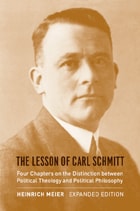
The Lesson of Carl Schmitt
Four Chapters on the Distinction between Political Theology and Political Philosophy, Expanded EditionHeinrich Meier
University of Chicago Press, 2011
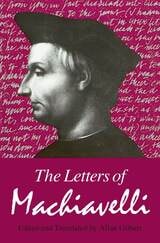
The Letters of Machiavelli
Niccolò Machiavelli
University of Chicago Press, 1988

The Leverage of Labor
Managing the Cortés Haciendas in Tehuantepec, 1588–1688Lolita Gutiérrez Brockington
Duke University Press, 1989
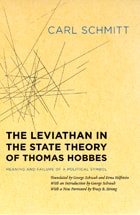
The Leviathan in the State Theory of Thomas Hobbes
Meaning and Failure of a Political SymbolCarl Schmitt
University of Chicago Press, 2008
“Carl Schmitt is surely the most controversial German political and legal philosopher of this century. . . . We deal with Schmitt, against all odds, because history stubbornly persists in proving many of his tenets right.”—Perspectives on Political Science
“[A] significant contribution. . . . The relation between Hobbes and Schmitt is one of the most important questions surrounding Schmitt: it includes a distinct, though occasionally vacillating, personal identification as well as an association of ideas.”—Telos

The Lex Rex Effect
Stories of a Conservative Pursuing JusticeAsa Hutchinson
University of Arkansas Press, 2027
Lex rex—Latin for “the law is king”—expresses a foundational principle of human liberty: that the law, rather than the will of any individual ruler, is the ultimate governmental authority. This principle was at the heart of the American Revolution and remains essential to the functioning and endurance of America today. For 250 years, the United States has been tested by political conflict, social change, and institutional challenges, yet the rule of law has remained central to the nation’s constitutional order.
Asa Hutchinson’s distinguished career—as a former US attorney, member of the US House of Representatives, administrator of the Drug Enforcement Administration, under secretary of Homeland Security, and governor of Arkansas—offers a unique perspective from which to examine the lasting significance of lex rex in contemporary America.
Drawing on Hutchinson’s work at the intersection of law, politics, and public service, The Lex Rex Effect explores how the principles of law, justice, and constitutional government underpin democracy. Through personal stories and thoughtful analysis, Hutchinson considers the forces that sustain our democracy and argues for the perennial importance of a system in which the law—not an autocrat’s whim—reigns supreme in the land.
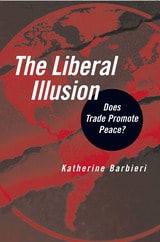
The Liberal Illusion
Does Trade Promote Peace?Katherine Barbieri
University of Michigan Press, 2005
--Nils Petter Gleditsch, Journal of Peace Research
"Barbieri builds on a solid foundation of work on trade and conflict and specifies the conditions under which trade reduces and increases conflict. . . . The bottom line is that this is an important book in the study of trade and conflict because of its comprehensive approach."
--Kathy L. Powers, Perspectives on Politics
"Barbieri's analysis reveals the fundamental and intellectual weaknesses of the various arguments on this topic. [A] solid and timely contribution to the literature"
--Choice
The Liberal Illusion sheds light on an increasingly important question in international relations scholarship and the domain of policy making-whether international trade promotes peace. By examining a broad range of theories about trade's impact on interstate relations and undertaking a set of empirical analyses of the trade-conflict puzzle, Katherine Barbieri provides a comprehensive assessment of the liberal view that trade promotes peace. Barbieri's stunning conclusions depart from conventional wisdom in international relations. Consequently, The Liberal Illusion serves as an important counterargument and a warning call to policymakers who rely upon trade-based strategies to promote peace, strategies that appear to offer little hope of achieving their goals.
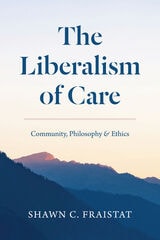
The Liberalism of Care
Community, Philosophy, and EthicsShawn C. Fraistat
University of Chicago Press, 2021
To recover that language, Fraistat turns to three prominent philosophers—Plato, Jean-Jacques Rousseau, and William Godwin—who illuminate the varied ways caring language and caring values have structured core debates in the history of Western political thought about the proper role of government, as well as the rights and responsibilities of citizens. The Liberalism of Care presents a distinctive vision for our liberal politics where political communities and citizens can utilize the ethic and practices of care to face practical challenges.
The Life Cycles of Global Governance
How Institutions Emerge, Evolve, and EndureJulia Gray
University of Michigan Press, 2027
International organizations influence nearly every aspect of global life—from aid and finance to law, security, and development. At a moment when the liberal international order is widely described as being in decline, this volume offers a corrective. International organizations do not simply rise and fall; they are always in motion—adapting, fragmenting, or being repurposed in response to shifting conditions. A life-cycle perspective reveals that what appears as decline may instead reflect transformation. Although they are often treated as fixed landmarks of global politics, institutions rarely follow a linear path from creation to maturity. This interdisciplinary edited volume brings together scholars from law, political science, sociology, and international relations to reveal the life cycles of these institutions: their false starts, early challenges, periods of drift, moments of revitalization, and even their afterlives.
Spanning cases from the 19th century to the present and covering diverse issue areas, the book offers a fresh perspective on why some organizations adapt while others stagnate or disappear. The volume shows how shifting political pressures, bureaucratic agency, and global shocks shape the fortunes of organizations from the UN, WTO, and World Bank to regional bodies and informal networks. By tracing these trajectories across disciplines and domains, The Life Cycles of Global Governance provides an accessible, richly textured account of how global cooperation actually unfolds—and why understanding institutional change is essential in today’s shifting international order.
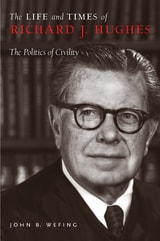
The Life and Times of Richard J. Hughes
The Politics of CivilityWefing, John B
Rutgers University Press, 2009
This biography illuminates the governor's accomplishments between 1962 and 1970, including the creation of the Hackensack Meadowlands Commission, formation of the county college system, establishment of stringent antipollution laws, design of the public defender system, and the adoption of a New Jersey sales tax, as well as his pivotal role during the Newark riots. As chief justice, Hughes faced difficult issuesùschool funding, low and moderate income housing needs, freedom of speech, and his decision in the rightto-die case involving Karen Ann Quinlan. With a career characterized by liberal activism, Hughes also contributed nationally and internationally, from serving as host of the 1964 Democratic National Convention to monitoring elections in South Vietnam.
John B. Wefing's research includes interviews with prominent politicians and leaders who worked with Hughes at various points in his career. The result is a rich story of a public servant who possessed a true ability to work with members of both political parties and played a significant role in shaping modern New Jersey.
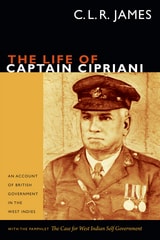
The Life of Captain Cipriani
An Account of British Government in the West Indies, with the pamphlet The Case for West-Indian Self GovernmentC. L. R. James
Duke University Press, 2014