Results by title
5448 books match the query 'History and criticism' and 1116 start with t
The Twelve Best Books by African Women
Critical ReadingsChikwenye Okonjo Ogunyemi
Ohio University Press, 2009
The Twelve Best Books by African Women is a collection of critical essays on eleven works of fiction and one play. The titles by African women that were included in the list of “Africa’s 100 Best Books of the Twentieth Century” are: Anowa, Ama Ata Aidoo (1970); A Question of Power, Bessie Head (1974); Woman at Point Zero, Nawal El Saadawi (1975); The Beggars’ Strike, Aminata Sow Fall (1979); Burger’s Daughter, Nadine Gordimer (1979); The Joys of Motherhood, Buchi Emesheta (1979); So Long a Letter, Mariama Bâ (1980); Fantasia: An Algerian Cavalcade, Assia Djebar (1983); Nervous Conditions, Tsitsi Dangarembga (1988); Living, Loving and Lying Awake at Night, Sindiwe Magona (1991); Butterfly Burning, Yvonne Vera (1998); Riwan ou le chemin de sable, Ken Bugul (1999).
This collection of original essays recognizes the gesture of inclusion as an important shift in consciousness and creates a fresh awareness of the literary works by African women writers. Each essay offers a penetrating analysis of individual texts and opens up a fresh perspective that allows scholars and students alike to explore new dimensions of these writers’ work.
The Twentieth-Century Spanish American Novel
By Raymond Leslie Williams
University of Texas Press, 2003
A Choice Magazine Outstanding Academic Book
Spanish American novels of the Boom period (1962-1967) attracted a world readership to Latin American literature, but Latin American writers had already been engaging in the modernist experiments of their North American and European counterparts since the turn of the twentieth century. Indeed, the desire to be "modern" is a constant preoccupation in twentieth-century Spanish American literature and thus a very useful lens through which to view the century's novels.
In this pathfinding study, Raymond L. Williams offers the first complete analytical and critical overview of the Spanish American novel throughout the entire twentieth century. Using the desire to be modern as his organizing principle, he divides the century's novels into five periods and discusses the differing forms that "the modern" took in each era. For each period, Williams begins with a broad overview of many novels, literary contexts, and some cultural debates, followed by new readings of both canonical and significant non-canonical novels. A special feature of this book is its emphasis on women writers and other previously ignored and/or marginalized authors, including experimental and gay writers. Williams also clarifies the legacy of the Boom, the Postboom, and the Postmodern as he introduces new writers and new novelistic trends of the 1990s.
The Twisted Mind
Madness In Melville'S FictionPaul Mccarthy
University of Iowa Press, 1990
Paul McCarthy
"Though madness has been a consistent topic in considerations of Melville's work, this is the first full-scale treatment of the subject. It is in a sense, then, a pioneering work that will no doubt receive widespread attention."
—William B. Dillingham
The Two-Soul'd Animal
Early Modern Literatures of the Classical and Christian SoulsJames Jaehoon Lee
Northwestern University Press, 2019
The English writers studied in The Two-Soul’d Animal place two prevailing interpretations of the soul’s faculties—one rhetorical on the plane of aesthetics, the other theological on the plane of ethics—into contact as a way to construct a new mode of Christian agency.
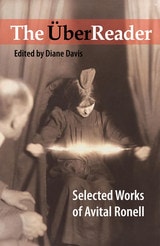
The UberReader
SELECTED WORKS OF AVITAL RONELLEdited by Diane Davis
University of Illinois Press, 2007
For twenty years Avital Ronell has stood at the forefront of the confrontation between literary study and European philosophy. She has tirelessly investigated the impact of technology on thinking and writing, with groundbreaking work on Heidegger, dependency and drug rhetoric, intelligence and artificial intelligence, and the obsession with testing. Admired for her insights and breadth of field, she has attracted a wide readership by writing with guts, candor, and wit.
Coyly alluding to Nietzsche’s “gay science,” The ÜberReader presents a solid introduction to Avital Ronell’s later oeuvre. It includes at least one selection from each of her books, two classic selections from a collection of her early essays (Finitude’s Score), previously uncollected interviews and essays, and some of her most powerful published and unpublished talks. An introduction by Diane Davis surveys Ronell’s career and the critical response to it thus far.
With its combination of brevity and power, this Ronell “primer” will be immensely useful to scholars, students, and teachers throughout the humanities, but particularly to graduate and undergraduate courses in contemporary theory.
The Underground Poetry Metro Transportation System for Souls
Essays on the Cultural Life of PoetryTony Hoagland
University of Michigan Press, 2019
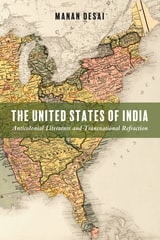
The United States of India
Anticolonial Literature and Transnational RefractionManan Desai
Temple University Press, 2020
The United States of India shows how Indian and American writers in the United States played a key role in the development of anticolonial thought in the years during and immediately following the First World War. For Indians Lajpat Rai and Dhan Gopal Mukerji, and Americans Agnes Smedley, W.E.B. Du Bois, and Katherine Mayo, the social and historical landscape of America and India acted as a reflective surface. Manan Desai considers how their interactions provided a “transnational refraction”—a political optic and discursive strategy that offered ways to imagine how American history could shed light on an anticolonial Indian future.
Desai traces how various expatriate and immigrant Indians formed political movements that rallied for American support for the cause of Indian independence. These intellectuals also developed new forms of writing about subjugation in the U.S. and India. Providing an examination of race, caste, nationhood, and empire, Desai astutely examines this network of Indian and American writers and the genres and social questions that fomented solidarity across borders.
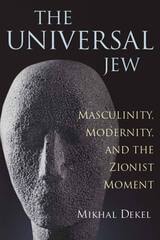
The Universal Jew
Masculinity, Modernity, and the Zionist MomentMikhal Dekel
Northwestern University Press, 2010
Such prototypical characters transform the symbol of the Jew from a racially or religiously defined minority subject to a "post-Jewish," particularuniversal, and fundamentally liberal majority subject. The Universal Jew situates the "Zionist moment" horizontally, within the various intellectual currents that make up the turn of the twentieth century: the discourse on modernity, the crisis in liberalism, Nietzsche’s critique of the Enlightenment, psychoanalysis, early feminism, and fin de siècle interrogation of sexual identities. The book examines the symbolic roles that Jews are assigned within these discourses and traces the ways in which Jewish literary citizens are shaped, both out of and in response to them. Beginning with an analysis of George Eliot’s construction of the character Deronda and its reception in Zionist circles, the Universal Jew ends with the self-fashioning of male citizens in fin de siècle and post-statehood Hebrew works, through the aesthetics oftragedy. Throughout her readings, Dekel analyzes the political meaning of these nascent images of citizens, uncovering in particular the gendered arrangements out of which they are born.
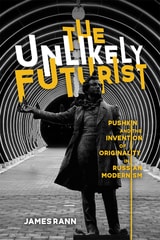
The Unlikely Futurist
Pushkin and the Invention of Originality in Russian ModernismJames Rann
University of Wisconsin Press, 2020
Through systematic and detailed readings of Futurist texts, James Rann offers the first book-length study of the tensions between the outspoken literary group and the great national poet. He observes how those in the movement engaged with and invented a new Pushkin, who by turns became a founding father to rebel against, a source of inspiration to draw from, a prophet foreseeing the future, and a monument to revive.
Rann's analysis contributes to the understanding of both the Futurists and Pushkin's complex legacy. The Unlikely Futurist will appeal broadly to scholars of Slavic studies, especially those interested in literature and modernism.
The Unrepentant Renaissance
From Petrarch to Shakespeare to MiltonRichard Strier
University of Chicago Press, 2011
Who during the Renaissance could have dissented from the values of reason and restraint, patience and humility, rejection of the worldly and the physical? These widely articulated values were part of the inherited Christian tradition and were reinforced by key elements in the Renaissance, especially the revival of Stoicism and Platonism. This book is devoted to those who did dissent from them. Richard Strier reveals that many long-recognized major texts did question the most traditional values and belong to a Renaissance far more unconstrained and affirmative than much recent scholarship has allowed.
The Unrepentant Renaissance counters the prevalent view of the period as dominated by the regulation of bodies and passions; the book aims to reclaim the Renaissance as an era happily churning with surprising, worldly, and self-assertive energies. Reviving the perspective of Burckhardt and Nietzsche, Strier provides fresh and uninhibited readings of texts by Petrarch, Shakespeare (sonnets and plays), Loyola, Montaigne, Descartes, and Milton. Strier’s lively argument, expressed in lucid prose, is meant to stir debate throughout the field of Renaissance studies.
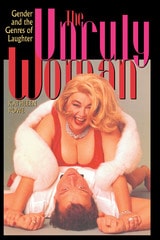
The Unruly Woman
Gender and the Genres of LaughterBy Kathleen Rowe
University of Texas Press, 1995
Unruly women have been making a spectacle of themselves in film and on television from Mae West to Roseanne Arnold. In this groundbreaking work, Kathleen Rowe explores how the unruly woman—often a voluptuous, noisy, joke-making rebel or "woman on top"—uses humor and excess to undermine patriarchal norms and authority.
At the heart of the book are detailed analyses of two highly successful unruly women—the comedian Roseanne Arnold and the Muppet Miss Piggy. Putting these two figures in a deeper cultural perspective, Rowe also examines the evolution of romantic film comedy from the classical Hollywood period to the present, showing how the comedic roles of actresses such as Katharine Hepburn, Barbara Stanwyck, and Marilyn Monroe offered an alternative, empowered image of women that differed sharply from the "suffering heroine" portrayed in classical melodramas.
The Untimely Present
Postdictatorial Latin American Fiction and the Task of MourningIdelber Avelar
Duke University Press, 1999
Avelar starts by offering new readings of works produced before the dictatorship era, in what is often considered the boom of Latin American fiction. Distancing himself from previous celebratory interpretations, he understands the boom as a manifestation of mourning for literature’s declining aura. Against this background, Avelar offers a reassessment of testimonial forms, social scientific theories of authoritarianism, current transformations undergone by the university, and an analysis of a number of novels by some of today’s foremost Latin American writers—such as Ricardo Piglia, Silviano Santiago, Diamela Eltit, João Gilberto Noll, and Tununa Mercado. Avelar shows how the ‘untimely’ quality of these narratives is related to the position of literature itself, a mode of expression threatened with obsolescence.
This book will appeal to scholars and students of Latin American literature and politics, cultural studies, and comparative literature, as well as to all those interested in the role of literature in postmodernity.
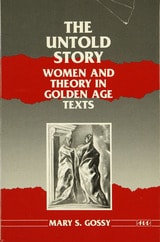
The Untold Story
Women and Theory in Golden Age TextsMary S. Gossy
University of Michigan Press, 1990
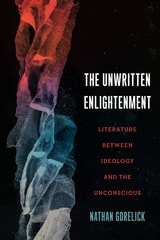
The Unwritten Enlightenment
Literature between Ideology and the UnconsciousNathan Gorelick
Northwestern University Press, 2024
Nathan Gorelick’s The Unwritten Enlightenment: Literature between Ideology and the Unconscious traces the relations between literary criticism and psychoanalysis to their shared origins in the Enlightenment era’s novels and novelistic discourse, where the period’s efforts to invent new notions of subjectivity and individualism are most apparent. Gorelick shows how modern concepts of literature and the unconscious were generated in response to these efforts and by an ethical concern for what the language of the Enlightenment excludes, represses, or struggles to erase. Troubling the idea of the Enlightenment on its own terms, subverting its supposed authority from within, Gorelick thus reveals the workings of unconscious fantasy at the foundations of our contemporary political realities. The Unwritten Enlightenment makes clear that to criticize the Enlightenment’s deficiencies, ambiguities, and legacies of violence without regard for the unconscious fantasies that drive them risks reproducing the very patterns of thought, action, and imagination that the Enlightenment novel already unsettles.
The Unwritten War
American Writers and the Civil WarDaniel Aaron
University of Alabama Press, 2003
In The Unwritten War, Daniel Aaron examines the literary output of American writers—major and minor—who treated the Civil War in their works. He seeks to understand why this devastating and defining military conflict has failed to produce more literature of a notably high and lasting order, why there is still no "masterpiece" of Civil War fiction.
In his portraits and analyses of 19th- and some 20th-century writers, Aaron distinguishes between those who dealt with the war only marginally—Henry Adams, Henry James, William Dean Howells, Mark Twain-and those few who sounded the war's tragic import—Herman Melville, Walt Whitman, and William Faulkner. He explores the extent to which the war changed the direction of American literature and how deeply it entered the consciousness of American writers. Aaron also considers how writers, especially those from the South, discerned the war's moral and historical implications.
The Unwritten War was originally published by Alfred A. Knopf in 1973. The New Republic declared, [This book's] major contribution will no doubt be to American literary history. In this respect it resembles Edmund Wilson's Patriotic Gore and is certain to become an indispensable guide for anyone who wants to explore the letters, diaries, journals, essays, novels, short stories, poems-but apparently no plays-which constitute Civil War literature. The mass of material is presented in a systematic, luminous, and useful way.
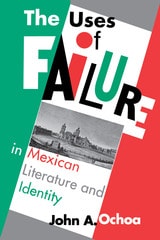
The Uses of Failure in Mexican Literature and Identity
By John A. Ochoa
University of Texas Press, 2005
While the concept of defeat in the Mexican literary canon is frequently acknowledged, it has rarely been explored in the fullness of the psychological and religious contexts that define this aspect of "mexicanidad." Going beyond the simple narrative of self-defeat, The Uses of Failure in Mexican Literature and Identity presents a model of failure as a source of knowledge and renewed self-awareness.
Studying the relationship between national identity and failure, John Ochoa revisits the foundational texts of Mexican intellectual and literary history, the "national monuments," and offers a new vision of the pivotal events that echo throughout Mexican aesthetics and politics. The Uses of Failure in Mexican Literature and Identity encompasses five centuries of thought, including the works of the Conquistador Bernal Díaz del Castillo, whose sixteenth-century True History of the Conquest of New Spain formed Spanish-speaking Mexico's early self-perceptions; José Vasconcelos, the essayist and politician who helped rebuild the nation after the Revolution of 1910; and the contemporary novelist Carlos Fuentes.
A fascinating study of a nation's volatile journey towards a sense of self, The Uses of Failure elegantly weaves ethical issues, the philosophical implications of language, and a sociocritical examination of Latin American writing for a sparkling addition to the dialogue on global literature.
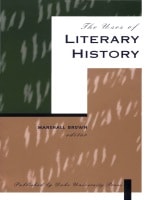
The Uses of Literary History
Marshall Brown, ed.
Duke University Press, 1995
Concerned with both the theory and practice of literary history, these provocative and sometimes combative pieces examine the writing of literary history, the nature of our interest in tradition, and the ways that literary works act in history. Among the numerous issues discussed are the uses of evidence, anachronism, the dialectic of texts and contexts, particularism and the resistance to reductive understanding, the construction of identities, memory, and the endurance of the past. New historicism, nationalism, and gender studies appear in relation to more traditional issues such as textual editing, taste, and literary pedagogy. Combining new and old perspectives, The Uses of Literary History provides a broad view of the field.
Contributors. Charles Altieri, Jonathan Arac, R. Howard Bloch, Richard Dellamora, Paul H. Fry, Geoffrey Hartman, Denis Hollier, Donna Landry, Lawrence Lipking, Jerome J. McGann, Walter Benn Michaels, Rukmini Bhaya Nair, Virgil Nemoianu, Annabel Patterson, David Perkins, Marjorie Perloff, Meredith Anne Skura, Doris Sommer, Peter Stallybrass, Susan Stewart
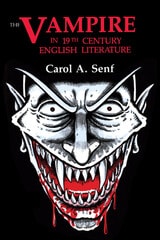
The Vampire in Nineteenth Century English Literature
Carol A. Senf
University of Wisconsin Press, 1988
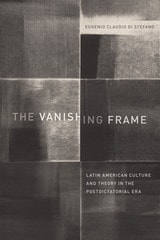
The Vanishing Frame
Latin American Culture and Theory in the Postdictatorial EraBy Eugenio Claudio Di Stefano
University of Texas Press, 2018
In the postdictatorial era, Latin American cultural production and criticism have been defined by a series of assumptions about politics and art—especially the claim that political freedom can be achieved by promoting a more direct experience between the textual subject (often a victim) and the reader by eliminating the division between art and life. The Vanishing Frame argues against this conception of freedom, demonstrating how it is based on a politics of human rights complicit with economic injustices. Presenting a provocative counternarrative, Eugenio Claudio Di Stefano examines literary, visual, and interdisciplinary artists who insist on the autonomy of the work of art in order to think beyond the politics of human rights and neoliberalism in Latin American theory and culture.
Di Stefano demonstrates that while artists such as Diamela Eltit, Ariel Dorfman, and Albertina Carri develop a concept of justice premised on recognizing victims’ experiences of torture or disappearance, they also ignore the injustice of economic inequality and exploitation. By examining how artists such as Roberto Bolaño, Alejandro Zambra, and Fernando Botero not only reject an aesthetics of experience (and the politics it entails) but also insist on the work of art as a point of departure for an anticapitalist politics, this new reading of Latin American cultural production offers an alternative understanding of recent developments in Latin American aesthetics and politics that puts art at its center and the postdictatorship at its end.
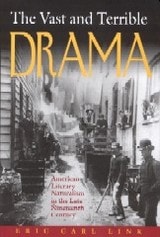
The Vast and Terrible Drama
American Literary Naturalism in the Late Nineteenth CenturyEric Carl Link
University of Alabama Press, 2004
A broad treatment of the cultural, social, political, and literary under-pinnings of an entire period and movement in American letters
The Vast and Terrible Drama is a critical study of the context in which authors such as Oliver Wendell Holmes, Stephen Crane, Frank Norris, Theodore Dreiser, and Jack London created their most significant work. In 1896 Frank Norris wrote: "Terrible things must happen to the characters of the naturalistic tale. They must be twisted from the ordinary . . . and flung into the throes of a vast and terrible drama." There could be "no teacup tragedies here." This volume broadens our understanding of literary naturalism as a response to these and other aesthetic concerns of the 19th century.
Themes addressed include the traditionally close connection between French naturalism and American literary naturalism; relationships between the movement and the romance tradition in American literature, as well as with utopian fictions of the 19th century; narrative strategies employed by the key writers; the dominant naturalist theme of determinism; and textual readings that provide broad examples of the role of the reader. By examining these and other aspects of American literary naturalism, Link counters a century of criticism that has perhaps viewed literary naturalism too narrowly, as a subset of realism, bound by the conventions of realistic narration.
The Victorian Novel of Adulthood
Plot and Purgatory in Fictions of MaturityRebecca Rainof
Ohio University Press, 2015
In The Victorian Novel of Adulthood, Rebecca Rainof confronts the conventional deference accorded the bildungsroman as the ultimate plot model and quintessential expression of Victorian nation building. The novel of maturity, she contends, is no less important to our understanding of narrative, Victorian culture, and the possibilities of fiction.
Reading works by Charles Dickens, George Eliot, Henry James, John Henry Newman, and Virginia Woolf, Rainof exposes the little-discussed theological underpinnings of plot and situates the novel of maturity in intellectual and religious history, notably the Oxford Movement. Purgatory, a subject hotly debated in the period, becomes a guiding metaphor for midlife adventure in secular fiction. Rainof discusses theological models of gradual maturation, thus directing readers’ attention away from evolutionary theory and geology, and offers a new historical framework for understanding Victorian interest in slow and deliberate change.
The Victorians in the Rearview Mirror
Simon Joyce
Ohio University Press, 2007
When Margaret Thatcher called in 1979 for a return to Victorian values such as hard work, self-reliance, thrift, and national pride, Labour Party leader Neil Kinnock responded that “Victorian values” also included “cruelty, misery, drudgery, squalor, and ignorance.”
The Victorians in the Rearview Mirror is an in-depth look at the ways that the twentieth century reacted to and reimagined its predecessor. It considers how the Victorian inheritance has been represented in literature, politics, film, and visual culture; the ways in which modernists and progressives have sought to differentiate themselves from an image of the Victorian; and how conservatives (and some liberals) have sought to revive elements of nineteenth-century life. Nostalgic and critical impulses combine to fix an understanding of the Victorians in the popular imagination.
Simon Joyce examines heritage culture, contemporary politics, and the “neo-Dickensian” novel to offer a more affirmative assessment of the Victorian legacy, one that lets us imagine a model of social interconnection and interdependence that has come under threat in today’s politics and culture.
Although more than one hundred years have passed since the death of Queen Victoria, the impact of her time is still fresh. The Victorians in the Rearview Mirror speaks to diverse audiences in literary and cultural studies, in addition to those interested in visual culture and contemporary politics, and situates detailed close readings of literary and cinematic texts in the context of a larger argument about the legacies of an era not as distant as we might like to think.
The Viet Nam War/The American War
Images and Representations in Euro-American and Vietnamese Exile NarrativesRenny Christopher
University of Massachusetts Press, 1995
This book seeks to reformulate the canon of writings on what is called “the Viet Nam War” in America and “the American War” in Viet Nam. Until recently, the accepted canon has consisted almost exclusively of American white male combat narratives, which often reflect and perpetuate Asian stereotypes. Renny Christopher introduces material that displays a bicultural perspective, including works by Vietnamese exile writers and by lesser-known Euro-Americans who attempt to bridge the cultural gap.
Christopher traces the history of American stereotyping of Asians and shows how Euro-American ethnocentricity has limited most American authors' ability to represent fairly the Vietnamese in their stories. By giving us access to Vietnamese representations of the war, she creates a context for understanding the way the war was experienced from the “other” side, and she offers perceptive, well-documented analyses of how and why Americans have so emphatically excised the Vietnamese from narratives about a war fought in their own country.
The Virginal Mother in German Culture
From Sophie von La Roche and Goethe to MetropolisLauren Nossett
Northwestern University Press, 2019
Examining the virginal mother in the first novel by a German woman (Sophie von La Roche), canonical texts by Goethe, nineteenth-century popular fiction, autobiographical works, and Thea von Harbou’s novel Metropolis and Fritz Lang’s film by the same name, this book highlights the virginal mother at pivotal moments in German history and cultural development: the entrance of women into the literary market, the Goethezeit, the foundation of the German Empire, and the volatile Weimar Republic. The Virginal Mother in German Culture will be of interest to students and scholars of German literature, history, cultural and social studies, and women’s studies.
The Visceral Logics of Decolonization
Neetu Khanna
Duke University Press, 2020
The Visionary Queen
Justice, Reform, and the Labyrinth in Marguerite de NavarreTheresa Brock
University of Delaware Press, 2024
The Visions of Sor María de Agreda
Writing Knowledge and PowerClark Colahan
University of Arizona Press, 1994
The Visual Life of Romantic Theater, 1780-1830
Edited by Diane Piccitto and Terry F. Robinson
University of Michigan Press, 2023
The Visual Life of Romantic Theater examines the dynamism and vibrancy of stage spectacle and its impact in an era of momentous social upheaval and aesthetic change. Situating theatrical production as key to understanding visuality ca. 1780-1830, this book places the stage front and center in Romantic scholarship—a field in a period long defined by its focus on poetry—by reenvisioning traditional approaches to artistic and social production. How, it asks, did dramaturgy and stagecraft influence aesthetic and sociopolitical concerns? How does a focus on visuality expand our understanding of the historical experience of theatergoing? In what ways did stage performance converge with visual culture beyond the theater? How did extra-theatrical genres engage with theatrical sight and spectacle? Finally, how does a focus on dramatic vision change the way we conceive of Romanticism itself? The volume’s essays by emerging and established scholars provide exciting and suggestive answers to these questions, along with a more capacious conception of Romantic theater as a locus of visual culture that reached well beyond playhouse walls.
The Visual World of the Hungarian Angevin Legendary
Béla Zsolt Szakács
Central European University Press, 2016
The Vital Lie
Reality and Illusion in Modern DramaAnthony S. Abbott
University of Alabama Press, 1988
The Vital Lie: Reality and Illusion in Modern Drama is a sweeping inquiry into the stories people tell themselves in order to endure, survive, and belong. Moving from Ibsen and Strindberg to Beckett, Pinter, and beyond, Anthony S. Abbott traces the uneasy traffic between actuality and self-invention that animates modern theater. Rather than offering a simple survey, he uncovers a recurring dramatic predicament: the cognitive dissonance that afflict people when the beliefs they hold about themselves collide with reality.
Anthony S. Abbott writes with the erudite observation of a critic and the curiosity of a participant. His book explores illusion, meaning, and human resilience, a perspective that lends unusual urgency to its readings of canonical playwrights. Abbott's scholarship is expansive without becoming academic in the pejorative sense; his arguments remain animated by large questions about purpose, dignity, and the imaginative structures that sustain ordinary lives.
Ideal for theater devotees, literary historians, students of modernism, philosophy-minded readers, directors, dramaturgs, and anyone fascinated by self-deception, mythmaking, and identity. Admirers of intellectual biography, cultural criticism, existential inquiry, and ambitious cross-author interpretation will find this volume especially rewarding. Those who relish fresh angles on familiar classics will discover a study that is probing, elegant, and unexpectedly memorable.
The Voice in the Drum
Music, Language, and Emotion in Islamicate South AsiaRichard K. Wolf
University of Illinois Press, 2014

The Voice in the Garden
Andrei Bolotov and the Anxieties of Russian Pastoral 1738-1833Thomas Newlin
Northwestern University Press, 2001
The Voice of the Mother
Embedded Maternal Narratives in Twentieth-Century Women's AutobiographiesJo Malin
Southern Illinois University Press, 2000
Every woman autobiographer is a daughter who writes and establishes her identity through her autobiographical narrative. In The Voice of the Mother, Jo Malin argues that many twentieth-century autobiographies by women contain an intertext, an embedded narrative, which is a biography of the writer/daughter’s mother.
Analyzing this narrative practice, Malin examines ten texts by women who seem particularly compelled to tell their mothers’ stories: Virginia Woolf, Sara Suleri, Kim Chernin, Drusilla Modjeska, Joan Nestle, Carolyn Steedman, Dorothy Allison, Adrienne Rich, Cherríe Moraga, and Audre Lorde. Each author is, in fact, able to write her own autobiography only by using a narrative form that contains her mother’s story at its core. These texts raise interesting questions about autobiography as a genre and about a feminist writing practice that resists and subverts the dominant literary tradition.
Malin theorizes a hybrid form of autobiographical narrative containing an embedded narrative of the mother. The textual relationship between the two narratives is unique among texts in the auto/biographical canon. This alternative narrative practice—in which the daughter attempts to talk both to her mother and about her—is equally an autobiography and a biography rather than one or the other. The technique is marked by a breakdown of subject/object categories as well as auto/biographical dichotomies of genre. Each text contains a “self” that is more plural than singular, yet neither.
In addition to being a theoretical and textual analysis, Malin’s book is also a mother-daughter autobiography and biography itself. She shares her own story and her mother’s story as a way to connect directly with readers and as a way to bridge the gap between theory and practice.
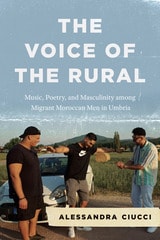
The Voice of the Rural
Music, Poetry, and Masculinity among Migrant Moroccan Men in UmbriaAlessandra Ciucci
University of Chicago Press, 2022
Umbria is known to most Americans for its picturesque rolling hills and medieval villages, but to the many migrant Moroccan men who travel there, Umbria is better known for the tobacco fields, construction sites, small industries, and the outdoor weekly markets where they work. Marginalized and far from their homes, these men turn to Moroccan traditions of music and poetry that evoke the countryside they have left— l-‘arubiya, or the rural. In this book, Alessandra Ciucci takes us inside the lives of Moroccan workers, unpacking the way they share a particular musical style of the rural to create a sense of home and belonging in a foreign and inhospitable nation. Along the way, she uncovers how this culture of belonging is not just the product of the struggles of migration, but also tied to the reclamation of a noble and virtuous masculine identity that is inaccessible to Moroccan migrants in Italy.
The Voice of the Rural allows us to understand the contemporary experiences of migrant Moroccan men by examining their imagined relationship to the rural through sound, shedding new light on the urgent issues of migration and belonging.

The Voyage In
Fictions of Female DevelopmentEdited by Elizabeth Abel, Marianne Hirsch, and Elizabeth Langland
Dartmouth College Press, 1983
The Wandering Scholars
Helen Waddell
University of Michigan Press, 1990
The Wandering Signifier
Rhetoric of Jewishness in the Latin American ImaginaryErin Graff Zivin
Duke University Press, 2008
In her readings of Spanish American and Brazilian fiction, Graff Zivin highlights inventions of Jewishness in which the concept is constructed as a rhetorical device. She argues that Jewishness functions as a wandering signifier that while not wholly empty, can be infused with meaning based on the demands of the textual project in question. Just as Jews in Latin America possess distinct histories relative to their European and North American counterparts, they also occupy different symbolic spaces in the cultural landscape. Graff Zivin suggests that in Latin American fiction, anxiety, desire, paranoia, attraction, and repulsion toward Jewishness are always either in tension with or representative of larger attitudes toward otherness, whether racial, sexual, religious, national, economic, or metaphysical. She concludes The Wandering Signifier with an inquiry into whether it is possible to ethically represent the other within the literary text, or whether the act of representation necessarily involves the objectification of the other.

The War Against The Intellect
Episodes Decline Of DiscoursePeter Shaw
University of Iowa Press, 1989
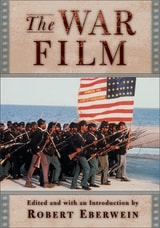
The War Film
Eberwein, Robert
Rutgers University Press, 2004
War has had a powerful impact on the film industry. But it is not only wars that affect films; films influence war-time behavior and incisively shape the way we think about the battles that have been waged.
In The War Film, Robert Eberwein brings together essays by scholars using a variety of critical approaches to explore this enduringly popular film genre. Contributors examine the narrative and aesthetic elements of war films from four perspectives: consideration of generic conventions in works such as All Quiet on the Western Front, Bataan, and The Thin Red Line; treatment of race in various war films, including Glory, Home of the Brave, Platoon,and Hamburger Hill; aspects of gender, masculinity and feminism in The Red Badge of Courage, Rambo, Dogfight, and Courage under Fire; and analysis of the impact of contemporary history on the production and reception of films such as The Life and Times of Rosie the Riveter, Saving Private Ryan, and We Were Soldiers.
Drawing attention to the dynamic interrelationships among politics, nationalism, history, gender, and film, this comprehensive anthology is bound to become a classroom favorite.
The War on Words
Slavery, Race, and Free Speech in American LiteratureMichael T. Gilmore
University of Chicago Press, 2010
How did slavery and race impact American literature in the nineteenth century? In this ambitious book, Michael T. Gilmore argues that they were the carriers of linguistic restriction, and writers from Frederick Douglass to Stephen Crane wrestled with the demands for silence and circumspection that accompanied the antebellum fear of disunion and the postwar reconciliation between the North and South.
Proposing a radical new interpretation of nineteenth-century American literature, The War on Words examines struggles over permissible and impermissible utterance in works ranging from Thoreau’s “Civil Disobedience” to Henry James’s The Bostonians. Combining historical knowledge with groundbreaking readings of some of the classic texts of the American past, The War on Words places Lincoln’s Cooper Union address in the same constellation as Margaret Fuller’s feminism and Thomas Dixon’s defense of lynching. Arguing that slavery and race exerted coercive pressure on freedom of expression, Gilmore offers here a transformative study that alters our understanding of nineteenth-century literary culture and its fraught engagement with the right to speak.
The Weather for Poetry
Essays, Reviews, and Notes on Poetry, 1977-81Donald Hall
University of Michigan Press, 1982
The Web of Iniquity
Early Detective Fiction by American WomenCatherine Ross Nickerson
Duke University Press, 1998
This subgenre allowed women writers to participate in postbellum culture and to critique other aspects of a rapidly changing society. Domestic detective fiction combined elements of sensationalist papers, popular nonfiction crime stories, and the domestic novel. Nickerson shows how it also incorporated the gothic tropes found in the work of Harriet Beecher Stowe, Louisa May Alcott, and Charlotte Brontë and influenced the work of Pauline Hopkins. Mid-nineteenth-century writer Metta Fuller Victor, who represented such important areas of cultural conflict as the role of professions in the formation of class identity and the possibility of women's independence and self-determination, paved the way for the appearance of women detectives in the late-nineteenth-century fiction of Anna Katharine Green. Nickerson credits Mary Roberts Rinehart, in particular, for bringing sophistication to the subgenre by amplifying the humorous, terrifying, and feminist elements inherent in earlier detective novels by women. Throughout the volume, Nickerson focuses on the narrative qualities of the domestic novel tradition and the ways in which it reflected ideologies of domesticity and gender. Also included are a discussion of various rewritings of the Lizzie Borden scandal in this tradition and an afterword on the relation of domestic detective fiction to the hard-boiled style.
The Web of Iniquity places the detective fiction written by women between 1850 and 1940 into ongoing discussions regarding women, culture, and literature and will appeal to scholars and students of women's studies, American studies, and literary history.
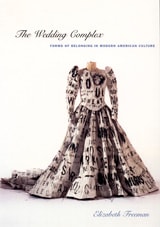
The Wedding Complex
Forms of Belonging in Modern American CultureElizabeth Freeman
Duke University Press, 2002
Freeman draws on queer theory and social history to focus on a range of texts where weddings do not necessarily lead to legal marriage but instead reflect yearnings for intimate arrangements other than long-term, state-sanctioned, domestic couplehood. Beginning with a look at the debates over gay marriage, she proceeds to consider literary works by Nathaniel Hawthorne, William Faulkner, Carson McCullers, Vladimir Nabokov, and Edgar Allan Poe, along with such Hollywood films as Father of the Bride, The Graduate, and The Godfather. She also discusses less well-known texts such as Su Friedrich’s experimental film First Comes Love and the off-Broadway, interactive dinner play Tony ‘n’ Tina’s Wedding.
Offering bold new ways to imagine attachment and belonging, and the public performance and recognition of social intimacy, The Wedding Complex is a major contribution to American studies, queer theory, and cultural studies.
The Weight of a World of Feeling
Reviews and Essays by Elizabeth BowenElizabeth Bowen / Edited and with an introduction by Allan Hepburn
Northwestern University Press, 2017
This fascinating collection of reviews is filled with first impressions of novels, autobiographies, memoirs, illustrated books, biographies of politicians and artists, short story collections, and literary criticism. Books spark statements from Bowen about general principles of fictional technique; she articulates her understanding of the inner workings of fiction incidentally, while providing an opinion about the book at hand. In this volume, Hepburn draws together all the reviews that Bowen left uncollected in her non-fiction collections, as well as several more familiar essays that that she published in The Tatler, in order to make them accessible to a broader audience.
The West Side of Any Mountain
Place, Space, and EcopoetryJ. Scott Bryson
University of Iowa Press, 2005
Informed in general by current thinking in environmental theory and specifically by the work of cultural geographer Yi-Fu Tuan, The West Side of Any Mountain participates in and furthers this scholarly attention by offering an overarching theoretical framework with which to approach the field.
One area that contemporary theorists have found problematic is the dualistic civilization/wilderness binary that focuses on the divisions between culture and nature, thereby increasing the modern sense of alienation. Tuan’s place-space framework offers a succinct vocabulary for describing the attitudes of ecological poets and other nature writers in a way that avoids setting up an adversarial relationship between place and space. Scott Bryson describes the Tuanian framework and employs it to offer fresh readings of the work of four major ecopoets: Wendell Berry, Joy Harjo, Mary Oliver, and W. S. Merwin.
The West Side of Any Mountain will be of great interest to scholars and teachers working in the field of contemporary nature poetry. It is recommended for nature-writing courses as well as classes dealing with 20th-century poetry, contemporary literary criticism, and environmental theory.
The White Negress
Literature, Minstrelsy, and the Black-Jewish ImaginaryHarrison-Kahan, Lori
Rutgers University Press, 2010
Lori Harrison-Kahan examines writings by Edna Ferber, Fannie Hurst, and Zora Neale Hurston, as well as the blackface performances of vaudevillian Sophie Tucker and controversies over the musical and film adaptations of Show Boat and Imitation of Life. Moving between literature and popular culture, she illuminates how the dynamics of interethnic exchange have at once produced and undermined the binary of black and white.
The White Trash Menace and Hemispheric Fiction
Ramón E. Soto-Crespo
The Ohio State University Press, 2020
The Whiteness Between Us
Early Modern Playbooks of Racial TriangulationNoémie Ndiaye
University of Chicago Press, 2026
A theorization of the representational juxtapositions, frictions, and connections between Black people and other non-white people in early modern European theatre.
Over the course of the seventeenth century, European drama was an important tool for whiteness to imagine itself at the top of an aspirational structure of power relations. Indeed, that structure could only be aspirational at a time when Europeans were profoundly divided along easily racializable religious and ethnic lines, and when their sovereignty was threatened by the Ottoman empire. It was to strengthen this emerging consciousness of racial whiteness, Noémie Ndiaye argues, that European drama engaged in a form of racial triangulation, fitting Muslim, Jewish, Indigenous, Romani, and Asian characters into a spurious black/white racial binary.
Focusing on English, Spanish, and French drama from 1580 to 1715, The Whiteness Between Us shows how plays became a crucial tool to position not only black people but any non-white community in the new racial architecture that white supremacy sought to build. Ndiaye reveals the stage of this era as a space for wish fulfillment, enabling participants to imagine and work towards a whiter future.
The early modern playbooks of racial triangulation that Ndiaye brings to light can and have been reactivated for white supremacist purposes in our own day and age. Partly in response to the contemporary threat of white nationalism, scholars and students have sought to unearth the early modern roots of racial whiteness and white supremacy. Ndiaye’s book participates in this wave of interest, offering several innovations, including its capacious transnational claims.
The Wild Girl, Natural Man, and the Monster
Dangerous Experiments in the Age of EnlightenmentJulia V. Douthwaite
University of Chicago Press, 2002
A variety of educational experiments failed to tame these feral children by the standards of the day. After telling their stories, Douthwaite turns to literature that reflects on similar experiments to perfect human subjects. Her examples range from utopian schemes for progressive childrearing to philosophical tales of animated statues, from revolutionary theories of regenerated men to Gothic tales of scientists run amok. Encompassing thinkers such as Rousseau, Sade, Defoe, and Mary Shelley, Douthwaite shows how the Enlightenment conceived of mankind as an infinitely malleable entity, first with optimism, then with apprehension. Exposing the darker side of eighteenth-century thought, she demonstrates how advances in science gave rise to troubling ethical concerns, as parents, scientists, and politicians tried to perfect mankind with disastrous results.
The Wilderness Within
American Women Writers and Spiritual QuestKristina K. Groover
University of Arkansas Press, 1999
Kristina K. Groover, in examining this question, finds that books by American women writers offer alternative patterns for seeking revelation—patterns which emphasize not solitary journeys, but the sacredness of everyday life. Drawing on the work of feminist theorists and theologians, including Carol Gilligan, Naomi Goldenberg, and Rosemary Ruether, Groover explores the spiritual nature and force of domesticity, community, storytelling, and the garden in the works of such writers as Toni Morrison, Katherine Anne Porter, Kaye Gibbons, and Alice Walker. Ordinary, personal experience in these works becomes a source for spiritual revelation. Wisdom is gained, lessons are learned, and lives are healed not in spite of home and communal ties, but because of them.
Thus, American women writers, Groover argues, make alternative literary and spiritual paradigms possible. Similarly, Kristina K. Groover, in this lucid and groundbreaking work, opens up new fields of exploration for any reader interested in women’s spirituality or in the rich, diverse field of American literature.