Results by title
5448 books match the query 'History and criticism' and 1116 start with t
The Williamsburg Avant-Garde
Experimental Music and Sound on the Brooklyn WaterfrontCisco Bradley
Duke University Press, 2023
The Wit of Seventeenth-Century Poetry
Edited by Claude J. Summers & Ted-Larry Pebworth
University of Missouri Press, 1994
As the twelve original essays collected in this volume demonstrate, to study the wit of seventeenth-century poetry is necessarily to address concerns at the very heart of the period's shifting literary culture. It is a topic that raises persistent questions of thematics and authorial intent, even as it interrogates a wide spectrum of cultural practices. These essays by some of the most renowned scholars in seventeenth-century studies illuminate important authors and engage issues of politics and religion, of secular and sacred love, of literary theory and poetic technique, of gender relations and historical consciousness, of literary history and social change, as well as larger concerns of literary production and smaller ones of local effects. Collectively, they illustrate the vitality of the topic, both in its own right and as a means of understanding the complexity and range of seventeenth-century English poetry.

The Woman Detective
GENDER AND GENREViola Klein
University of Illinois Press, 1995
This new edition adds sixty new female private eyes to the roster and includes an afterword that assesses the current state of the genre's new and old novels. A comprehensive bibliography and a character list update the field through mid-1994.
"A highly intelligent analysis." -- Ms.
"Well-researched and well-written. . . . Traces the evolution of sexist boundaries in popular detective fiction from a feminist viewpoint and documents the parallels in social history and the women's rights movement." -- Ronald C. Miller, The Armchair Detective
"Identifies dozens of good novels whose titles are not well known, its promise of good reading extending well beyond its own covers." -- Jane Bakerman, Belles Lettres
The Woman Painter in Victorian Literature
Antonia Losano
The Ohio State University Press, 2008
The nineteenth century saw a marked rise both in the sheer numbers of women active in visual art professions and in the discursive concern for the woman artist in fiction, the periodical press, art history, and politics. The Woman Painter in Victorian Literature argues that Victorian women writers used the controversial figure of the woman painter to intervene in the discourse of aesthetics. These writers were able to assert their own status as artistic producers through the representation of female visual artists.
Women painters posed a threat to the traditional heterosexual erotic art scenarios—a male artist and a male viewer admiring a woman or feminized art object. Antonia Losano traces an actual movement in history in which women writers struggled to rewrite the relations of gender and art to make a space for female artistic production. She examines as well the disruption female artists caused in the socioeconomic sphere. Losano offers close readings of a wide array of Victorian writers, particularly those works classified as noncanonical—by Anne Thackeray Ritchie, Margaret Oliphant, Anne Brontë, and Mrs. Humphrey Ward—and a new look at better-known novels such as Jane Eyre and Daniel Deronda, focusing on the pivotal social and aesthetic meanings of female artistic production in these texts. Each of the novels considered here is viewed as a contained, coherent, and complex aesthetic treatise that coalesces around the figure of the female painter.
The Woman and the Lyre
Women Writers in Classical Greece and RomeJane McIntosh Snyder
Southern Illinois University Press, 1989
Beginning with Sappho in the seventh century B.C.E and ending with Egeria in the fifth century C.E., Snyder profiles ancient Greek and Roman women writers, including lyric and elegiac poets and philosophers and other prose writers. The writers are allowed to speak for themselves, with as much translation from their extant works provided in text as possible. In addition to giving readers biographical and cultural context for the writers and their works, Snyder refutes arguments representing prejudicial attitudes about women’s writing found in the scholarly literature. Covering writers from a wide historical span, this volume provides an engaging and informative introduction to the origins of the tradition of women’s writing in the West.
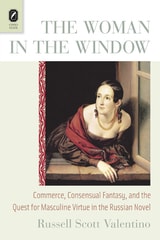
The Woman in the Window
Commerce, Consensual Fantasy, and the Quest for Masculine Virtue in the Russian NovelRussell Scott Valentino
The Ohio State University Press, 2014
With chapters on Gogol, Tolstoy, and Dostoevsky as well as Pasternak and Nabokov, The Woman in the Window argues that Russian authors worked through this question via their depictions of “mixed-up men.” Such characters, according to Valentino, reveal that in a world where social reality and personal identity depend on consensual fantasies, the old masculine figure loses its grounding and can easily drift away. Valentino charts a range of masculine character types thrown off stride by the new commercially inflected world: those who embrace blind confidence, those who are split with doubt or guilt, and those who look for an ideal of steadfastness and purity to keep afloat—a woman in a window.
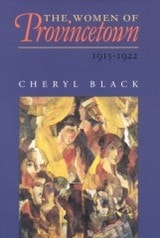
The Women of Provincetown, 1915–1922
Cheryl Black
University of Alabama Press, 2001
In this fascinating work, Cheryl Black reveals that, in addition to its role in developing an American tradition of non-commercial theatre, Provincetown has another, largely unacknowledged claim to fame as one of the first theatre companies in America in which women achieved prominence in every area of operation. At a time when women playwrights were rare, women directors rarer, and women scenic designers unheard of, Provincetown’s female members excelled in all of these roles.
In addition to the well-known playwright Susan Gaspell, the company’s female membership included luminaries such poets Edna St. Vincent Millay, Mina Loy, and Djuna Barnes; journalists Louise Bryant and Mary Heaton Vorce; novelists Neith Boyce and Evelyn Scott; and painter Marguerite Zorach. Illuminating a fascinating chapter in the history of one of the world's most picturesque and beloved artist colonies, The Women of Provincetown is an engaging work of social history, offering new insights into the relationship between gender and theatre. This work includes 40 images of the key artists in the book.
The Word Unheard
Legacies of Anti-Semitism in German Literature and CultureMartha B. Helfer
Northwestern University Press, 2011
The publication of Martha B. Helfer’s The Word Unheard: Legacies of Anti-Semitism in German Literature and Culture marks a stunningly original new direction in the interpretation of canonical works of eighteenth- and nineteenth-century German literature.
Between 1749 and 1850—the formative years of the so-called Jewish Question in Germany—the emancipation debates over granting full civil and political rights to Jews provided the topical background against which all representations of Jewish characters and concerns in literary texts were read. Helfer focuses sharply on these debates and demonstrates through close readings of works by Gotthold Lessing, Friedrich Schiller, Achim von Arnim, Annette von Droste- Hülshoff, Adalbert Stifter, and Franz Grillparzer how disciplinary practices within the field of German studies have led to systematic blind spots in the scholarship on anti-Semitism to date.
While all the authors discussed are well known and justly celebrated, the particular works addressed represent an effective mix of enduring classics and less recognized, indeed often scandalously overlooked, texts whose consideration leads to a reevaluation of the author’s more mainstream oeuvre. Although some of the works and authors chosen have previously been noted for their anti-Semitic proclivities, the majority have not, and some have even been marked by German scholarship as philo-Semitic—a view that The Word Unheard undertakes not so much to refute as to complicate, and in the process to question not only these texts but also the deafness of the German scholarly tradition. With implications that reach into many disciplines, The Word Unheard will be a foundational study for all scholars of modern Germany.
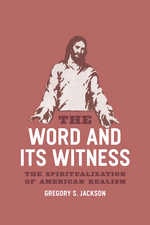
The Word and Its Witness
The Spiritualization of American RealismGregory S. Jackson
University of Chicago Press, 2009
Jackson shows how the homiletic tradition in Protestant sermons provided a foundation for the development of visual and literary realism. Evangelical preachers and writers used vivid language grounded in everyday life to translate abstract concepts like hell into concrete reality—a key influence on realist authors that brought about the more secular forms of the movement we know today. This emphasis on the sensuous also paved the way for Protestantism’s embrace of new media, evident in the photographs of Jacob Riis as well as the video game Left Behind: Eternal Forces.
With its remarkable scope and timely insights into the interplay between religion, secularism, and politics, The Word and Its Witness will transform the way we understand American realism and American religion.
The Word on the Street
Linking the Academy and the Common ReaderHarvey Michael Teres
University of Michigan Press, 2010
"The Word On the Street invites humanities scholars to move beyond the classroom and the monograph to share the pleasures of art in ways that engage the intelligence of the common reader, cultivating the critical imagination so vital to American cultural democracy. Lively and thought-provoking, Teres lays out contemporary debates and wades into them with gusto."
---Nancy Cantor, Syracuse University
"At a moment when questions about the literary, 'bookishness,' and the future of print are being urgently raised, with incessant national attention to the perceived crises of literacy and reading, Teres' thoughtful, broadly democratic, but also tough-minded examination of both 'common readers' and academic readers makes a real contribution to the debate."
---Julie Ellison, University of Michigan
Despite significant changes since the mid-twentieth century in American critical culture---the culture emanating from the serious review of books, ideas, and the arts---it attracts only a small and declining minority of Americans. However productive this culture has been, American society has not approached the realization of Emerson's or Dewey's vision of a highly participatory American cultural democracy. Such a culture requires critics who are read by the average citizen, but the migration of critics and intellectuals from the public to the academy has resulted in fewer efforts to engage with ordinary citizens. The Word on the Street investigates this disjunction between the study of literature in the academy and the interests of the common reader and society at large, arguing the vital importance of publicly engaged scholarship in the humanities. Teres chronicles how the once central function of the humanities professorate---to teach students to appreciate and be inspired by literature---has increasingly been lost to literary and cultural studies in the last thirty years.
The Word on the Street argues for a return to an earlier model of the public intellectual and a literary and cultural criticism that is accessible to ordinary citizens. Along the way, Teres offers an illuminating account of the current problem and potential solutions, with the goal of prompting a future vision of publicly engaged scholarship that resonates with the common reader and promotes an informed citizenry.
Harvey Teres is Associate Professor of English at Syracuse University.
Cover image: Ruth Fremson/The New York Times/Redux
The New Public Scholarship
The Work of Music
Labor and Creativity in Germany's Long Nineteenth CenturyCelia Applegate
University of Wisconsin Press, 2025
The World in a Box
The Story of an Eighteenth-Century Picture EncyclopediaAnke te Heesen
University of Chicago Press, 2002
As Anke te Heesen demonstrates, Stoy and his world in a box epitomized the Enlightenment concern with the creation and maintenance of an appropriate moral, intellectual, and social order. The box, and its images from nature, myth, and biblical history, were intended to teach children how to collect, store, and order knowledge. te Heesen compares the Academy with other aspects of Enlightenment material culture, such as commercial warehouses and natural history cabinets, to show how the kinds of collecting and ordering practices taught by the Academy shaped both the developing middle class in Germany and Enlightenment thought. The World in a Box, illustrated with a multitude of images of and from Stoy's Academy, offers a glimpse into a time when it was believed that knowledge could be contained and controlled.
The World in a Frame
What We See in FilmsLeo Braudy
University of Chicago Press, 1976
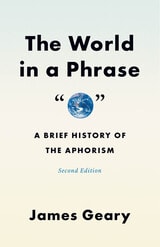
The World in a Phrase
A Brief History of the Aphorism, Second EditionJames Geary
University of Chicago Press, 2025
Aphorisms are literature’s hand luggage. Light and compact, they contain everything you need to get through a rough day at the office or a dark night of the soul. Aphorisms, the oldest written art form on the planet, have been going viral for thousands of years, delivering the short, sharp shock of old forgotten truths. Today, visual artists are mixing pithy language with compelling imagery and using social media to take the form into the future. In a world of disinformation and deepfakes, aphorisms point to the power of fresh debate over tired dogma and inconvenient truths over comfortable lies.
Starting in ancient China and ending with contemporary meme-makers and street artists, The World in A Phrase tells the story of the aphorism through brief biographies of some of its greatest practitioners: sages like Lao-tzu and the Buddha, philosophers like Schopenhauer and Nietzsche, writers like George Eliot and Marie von Ebner-Eschenbach, humorists like Mark Twain and Dorothy Parker, activists like James Baldwin and Audre Lorde, poets like Langston Hughes and Kay Ryan, and artists like Jenny Holzer and David Byrne.
The World in A Phrase is for lovers of words and seekers of wisdom. This new edition of The New York Times bestseller features 26 additional aphorists and explores the aphorism in the age of social media, showing why these short sentences are the ultimate deep dives in an era when TL;DR has become a cultural catchphrase.
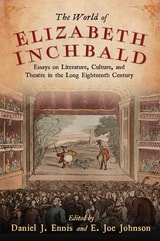
The World of Elizabeth Inchbald
Essays on Literature, Culture, and Theatre in the Long Eighteenth CenturyDaniel J. Ennis
University of Delaware Press, 2022
The Writer as Migrant
Ha Jin
University of Chicago Press, 2008
Consisting of three interconnected essays, The Writer as Migrant sets Ha Jin’s own work and life alongside those of other literary exiles, creating a conversation across cultures and between eras. He employs the cases of Alexander Solzhenitsyn and Chinese novelist Lin Yutang to illustrate the obligation a writer feels to the land of their birth, while Joseph Conrad and Vladimir Nabokov—who, like Ha Jin, adopted English for their writing—are enlisted to explore a migrant author’s conscious choice of a literary language. A final essay draws on V. S. Naipaul and Milan Kundera to consider the ways in which our era of perpetual change forces a migrant writer to reconceptualize the very idea of home. Throughout, Jin brings other celebrated writers into the conversation as well, including W. G. Sebald, C. P. Cavafy, and Salman Rushdie—refracting and refining the very idea of a literature of migration.
Simultaneously a reflection on a crucial theme and a fascinating glimpse at the writers who compose Ha Jin’s mental library, The Writer as Migrant is a work of passionately engaged criticism, one rooted in departures but feeling like a new arrival.
The Writer in Petrograd and the House of Arts
Martha Weitzel Hickey
Northwestern University Press, 2009
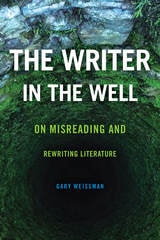
The Writer in the Well
On Misreading and Rewriting LiteratureGary Weissman
The Ohio State University Press, 2016
Rethinking the methods and goals of literary analysis, Weissman’s study redefines the nature of authorial intention and reconceives literary interpretation as a writing-based practice. By integrating writing pedagogy with older and newer schools of thought—from psychoanalytic, reader-response, and poststructuralist theories to rhetorical narrative theory and cognitive literary studies—and bridging the fields of literary studies, composition and rhetoric, and creative writing, The Writer in the Well argues that the richest understanding of a literary work lies in probing how it has been misinterpreted and reconceived and offers a new “writer-response theory.”
This highly accessible and thought-provoking book, which includes the full text of Sher’s “The Man in the Well,” is designed to engage scholars, teachers, students, and avid readers of literature.

The Writing of Melancholy
Modes of Opposition in Early French ModernismRoss Chambers
University of Chicago Press, 1993
After the failed revolution of 1848, the sense of disillusion that swept through France deeply affected the literature of the time. Chambers argues that literary melancholy and disorientation constituted a symptom of historical conditions rather than, as many other critics contend, a willful resistance to them.
Enriched by careful readings of works by Flaubert, Nerval, Baudelaire, Gautier, and Hugo, this book is a subtle meditation on the powers of writing and reading and a suggestive contribution to current debates over the historical status of literary texts. Originally published in French, the book has been revised and expanded to include a new chapter on Gérard de Nerval's "Sylvie."
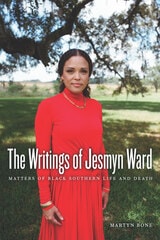
The Writings of Jesmyn Ward
Matters of Black Southern Life and DeathMartyn Bone
University of Iowa Press, 2025
Martyn Bone thoughtfully examines key themes running throughout Ward’s writing: Black life in the U.S. South; the legacies of slavery and segregation; neoliberalism as the contemporary form of capitalism; environmental crisis in the Anthropocene; and human-animal relations. Bone also connects Ward’s work to major figures in the U.S. literary canon, with particular focus on William Faulkner, Zora Neale Hurston, and Toni Morrison.
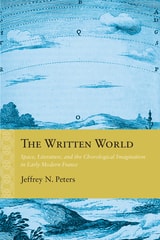
The Written World
Space, Literature, and the Chorological Imagination in Early Modern FranceJeffrey N. Peters
Northwestern University Press, 2018
In analyses of well-known authors such as Corneille, Molière, Racine, and Madame de Lafayette, Peters demonstrates that the apparent absence of physical space in seventeenth-century literary depiction indicates a subtle engagement with, rather than a rejection of, evolving principles of cosmological understanding. Space is not absent in these works so much as transformed in keeping with contemporaneous developments in early modern natural philosophy. The Written World will appeal to philosophers of literature and literary theorists as well as scholars of early modern Europe and historians of science and geography
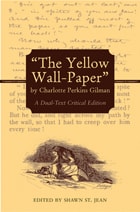
The Yellow Wall-Paper by Charlotte Perkins Gilman
A Dual-Text Critical EditionCharlotte Perkins Gilman
Ohio University Press, 2006
Most editions have been based on the 1892 New England Magazine publication rather than the handwritten manuscript at Radcliffe College. Publication of the unedited manuscript in 1994 sparked controversy over which of the two was definitive. Since then, scholars have discovered half a dozen parent texts for later twentieth-century printings, including William Dean Howells’s version from 1920 and the 1933 Golden Book version.
While traditional critical editions gather evidence and make an argument for adopting one text as preferable to others,“The Yellow Wall-Paper” by Charlotte Perkins Gilman: A Dual-Text Critical Edition, edited by Shawn St. Jean, offers both manuscript and magazine versions, critically edited and printed in parallel for the first time. New significance appears in such facets as the magazine’s accompanying illustrations, its lineation and paragraphing, Gilman’s choice of pronouns, and her original handwritten ending.
This critical edition of “The Yellow Wall-Paper” includes a full and nontraditional apparatus, making it easy for students and scholars to study the more than four hundred variants between the two texts. Four new essays, written especially for this volume, explore the implications of this multitext model.
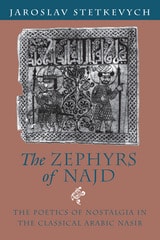
The Zephyrs of Najd
The Poetics of Nostalgia in The Classical Arabic NasibJaroslav Stetkevych
University of Chicago Press, 1993
Stetkevych concentrates on the "places of lost bliss" that furnish the dominant motif in the lyric-elegiac opening section (nasib) of the classic Arab code, or qusidah. In defining the Arabic lyrical genre, he shows how pre-Islamic lamentations over abandoned campsites evolved, in Arabo-Islamic mystical poetry, into expressions of spiritual nostalgia. Stetkevych also draws intriguing parallels between the highlands of Najd in Arabic poetry and Arcadia in the European tradition. He concludes by exploring the degree to which the pastoral-paradisiacal archetype of the nasib pervades Arabic literary perception, from the pre-Islamic ode through the Thousand and One Nights and later texts.
Enhanced by Stetkevych's sensitive translations of all the Arabic texts discussed, The Zephyrs of Najd brings the classical Arabic ode fully into the purview of contemporary literary and critical discourse.
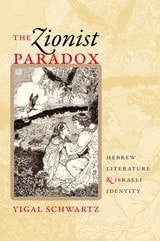
The Zionist Paradox
Hebrew Literature and Israeli IdentityYigal Schwartz
Brandeis University Press, 2014
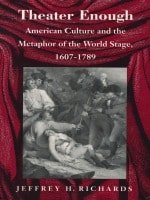
Theater Enough
American Culture and the Metaphor of the World Stage, 1607–1789Jeffrey H. Richards
Duke University Press, 1991
The rhetoric, or discourse, of early American theater emerged out of the figures of speech that permeated the colonists’ lives and literary productions. Jeffrey H. Richards examines a variety of texts—histories, diaries, letters, journals, poems, sermons, political tracts, trial transcripts, orations, and plays—and looks at the writings of such authors as John Winthrop and Mercy Otis Warren. Richards places the American usage of theatrum mundi—the world depicted as a stage—in the context of classical and Renaissance traditions, but shows how the trope functions in American rhetoric as a register for religious, political, and historical attitudes.
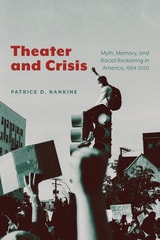
Theater and Crisis
Myth, Memory, and Racial Reckoning in America, 1964-2020Patrice D. Rankine
Lever Press, 2024
Rather than approaching the problem of racial reckoning through history, where periodization and progress are dominant narratives, Theater and Crisis argues that myth and memory allow for better theorization about recurring events from the past, their haunting, and what these apparent ghosts ask of us. Building on the study of myth as active, processual storytelling, Rankine acknowledges that it grounds and orients groups toward significant events. Theater and Crisis aligns narratives about Emmett Till, Trayvon Martin, and George Floyd, among others, with ancient, mythic figures such as Christ, Dionysus, Oedipus, and Moses. As living and verbal visitations, these stories performed on stage encode the past through their epiphanies in the present, urging audiences toward shared meaning.
Rankine traces the cyclical hauntings of race through the refiguring of mythic stories across the past 75 years in the plays of James Baldwin, Ntozake Shange, Antoinette Nwandu, and many more, and in response to flashpoints in US racial history, such as the 1955 lynching of Emmett Till, the upheavals of the 1960s and 1970s, the wars on drugs and crime, and the continued violence against and disenfranchisement of Black people into the twenty-first century. Theater and Crisis explores the appearance of myth on the American stage and showcases the ongoing response by the theatrical establishment to transform the stage into a space for racial reckoning. This timely book is essential reading for scholars of theater studies, classics, and American studies.
Theater and Integrity
Emptying Selves in Drama, Ethics, and ReligionLarry D Bouchard
Northwestern University Press, 2011
It locates ambiguities in our discourse about integrity, and it delves into conceptions of identity, morality, selfhood, and otherness. Its explorations ask if integrity is less a quality we might possess than a contingent gift that may appear, disappear, and perhaps reappear. Not only does he chart anew the ethical and religious dimensions of integrity, but he also reads closely across the history of theater, from Greek and Shakespearean drama to the likes of Seamus Heaney, T. S. Eliot, Caryl Churchill, Wole Soyinka, Tony Kushner, and Suzan-Lori Parks. His is an approach of juxtaposition and reflection, starting from the perennial observation that theater both criticizes and acknowledges dimensions of drama and theatricality in life.
Theater and Martial Arts in West Sumatra
Randai and Silek of the MinangkabauKirstin Pauka
Ohio University Press, 1998
Randai, the popular folk theater tradition of the Minangkabau ethnic group in West Sumatra, has evolved to include influences of martial arts, storytelling, and folk songs. Theater and Martial Arts in West Sumatra describes the origin, development, and cultural background of randai and highlights two recent developments: the emergence of female performers and modern staging techniques.
This book also explores the indigenous martial arts form silek, a vital part of randai today. The strong presence of silek is illustrated in the martial focus of the stories that are told through randai, in its movement repertoire, and even in its costumes and musical accompaniment. As Kirstin Pauka shows, randai, firmly rooted in silek and Minangkabau tradition, is an intriguing mirror of the Minangkabau culture.
Theater and Society in the Classical World
Ruth Scodel, Editor
University of Michigan Press, 1993

Theater in Israel
Linda Ben-Zvi, Editor
University of Michigan Press, 1996
The first volume of its kind in English or Hebrew, Theater in Israel gathers original essays, interviews, and commentaries by leading international theater practitioners and critics. The book explores the rich history and diversity of Israel's theater and illustrates the ways in which this politically committed theater mirrors the historical and cultural forces that have shaped Israeli-Arab relations, the events in the Middle East, and the post-Holocaust Jewish experience. The collection provides a thorough and engaging survey of the playwrights, directors, actors, and productions that comprise this dynamic theater, a theater whose evolution and ideology diverge from Anglo-American models.
The book's early essays trace the development of Hebrew drama from its inception in Moscow in 1918 to the establishment of a national theater and the emergence of a national repertoire. Succeeding essays explore the personalities and themes that have dominated the Israeli stage, featuring interviews with leading Israeli playwrights, actors, directors, and dramaturgs. The book also provides highlights from the first Palestinian and Israeli Arab Theater Symposium, focusing on the history, themes, and future of Arab theater. The contributors include Karen Alkalay-Gut, Shosh Avigal, Linda Ben-Zvi, Erella Brown, Joseph Chaikin, Scott Cummings, Ben-Ami Feingold, Gad Kaynar, Shimon Lev- Ari, Shimon Levy, Gabriella Moscati-Steindler, Freddie Rokem, Eli Rozik, Gershon Shaked, Chaim Shoham, Michael Taub, Dan Urian, Shoshana Weitz, and Nurit Yaari.
Theater of Capital
Modern Drama and Economic LifeAlisa Zhulina
Northwestern University Press, 2024
Emerging amid the turbulent rise of market finance and wider socioeconomic changes, modern drama enacted vital critiques of art and life under capitalism. Alisa Zhulina shows how fin-de-siècle playwrights such as Henrik Ibsen, August Strindberg, Anton Chekhov, George Bernard Shaw, and Gerhart Hauptmann interrogated the meaning of this newly coined economic concept. Acutely aware of their complicity in the system they sought to challenge, these playwrights staged economic questions as moral and political concerns, using their plays to explore the theories of Adam Smith, Karl Marx and Friedrich Engels, Max Weber, and others within the boundaries of bourgeois theater.
Theater of Capital: Modern Drama and Economic Life reveals the prescient and unsettling visions of life in a new financial and societal reality in now-canonical plays such as A Doll’s House, Miss Julie, and The Cherry Orchard, as well as in lesser-known and long-overlooked works. This wide-ranging study prompts us to reevaluate modern drama and its legacy for the urgent economic and political questions that haunt our present moment.
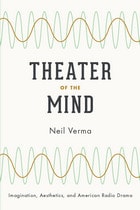
Theater of the Mind
Imagination, Aesthetics, and American Radio DramaNeil Verma
University of Chicago Press, 2012
For generations, fans and critics have characterized classic American radio drama as a “theater of the mind.” This book unpacks that characterization by recasting the radio play as an aesthetic object within its unique historical context. In Theater of the Mind, Neil Verma applies an array of critical methods to more than six thousand recordings to produce a vivid new account of radio drama from the Depression to the Cold War.
In this sweeping exploration of dramatic conventions, Verma investigates legendary dramas by the likes of Norman Corwin, Lucille Fletcher, and Wyllis Cooper on key programs ranging from The Columbia Workshop, The Mercury Theater on the Air, and Cavalcade of America to Lights Out!, Suspense, and Dragnet to reveal how these programs promoted and evolved a series of models of the imagination.
With close readings of individual sound effects and charts of broad trends among formats, Verma not only gives us a new account of the most flourishing form of genre fiction in the mid-twentieth century but also presents a powerful case for the central place of the aesthetics of sound in the history of modern experience.
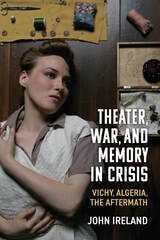
Theater, War, and Memory in Crisis
Vichy, Algeria, the AftermathJohn Ireland
University of Michigan Press, 2025
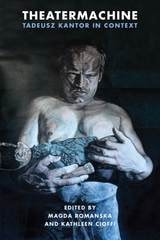
Theatermachine
Tadeusz Kantor in ContextEdited by Magda Romanska and Kathleen Cioffi
Northwestern University Press, 2019
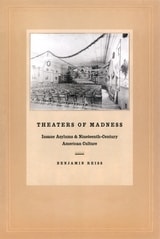
Theaters of Madness
Insane Asylums and Nineteenth-Century American CultureBenjamin Reiss
University of Chicago Press, 2008
Theaters of Translation
Cosmopolitan Vernaculars in Shakespeare's EnglandAndrew S. Keener
University of Alabama Press, 2025
Explores the profound influence of multilingual dictionaries, dialogues, and grammars on English Renaissance playwrights
In Theaters of Translation, Andrew S. Keener offers a fascinating account of the ways that plays by Thomas Kyd, Mary Sidney Herbert, Ben Jonson, and their fellow English contemporaries were shaped by and part of a multilingual Europe where dictionaries, grammars, and language-learning materials circulated widely. He proposes a fresh, multilingual approach to English Renaissance drama that challenges the histories of early modern European languages as sites of national and linguistic cohesion.
Covering the period between 1570 and 1640, when England’s drama and the English language itself were evolving, Keener uses the term “cosmopolitan vernaculars” to examine how nonclassical European languages modeled transnational forms of belonging for playgoers, readers, and authors in Renaissance England. Combining recent contributions to cosmopolitan theory and transnational studies of early modern literature and culture, Keener highlights both the ways in which cosmopolitanism manifests through Europe’s vernacular languages—in print and performance—and the ways languages themselves can exhibit cosmopolitanism for those who encounter them on the page or on the stage.
Theaters of Translation opens up new transnational interpretations of English Renaissance plays and casts fresh light on historical anecdotes, such as Jonson inscribing a copy of Pietro Aretino’s scandalous Italian dialogues or Shakespeare’s First Folio being advertised for sale in Germany before its London publication. It offers much of interest to readers and scholars of Renaissance Europe, early modern drama, and the development of national European languages.
Theaters of the Everyday
Aesthetic Democracy on the American StageJacob Gallagher-Ross
Northwestern University Press, 2018
Offering both fresh reappraisals of canonical figures and movements and new examinations of theatrical innovators, Theaters of the Everyday reveals surprising affinities between artists often considered poles apart, such as John Cage and Lee Strasberg, and Thornton Wilder and the New York experimentalist Nature Theater of Oklahoma. Gallagher-Ross persuasively shows how these creators eschew conventional definitions of dramatic action and focus attention on smaller but no less profound dramas of perception, consciousness, and day-to-day life.
Gallagher-Ross traces some of the intellectual roots of the theater of the everyday to American transcendentalism, with its pragmatic process philosophy as well as its sense of ordinary experience as the wellspring of aesthetic awareness.
Theatre of the Real
Yeats, Beckett, and SondheimGina Masucci MacKenzie
The Ohio State University Press, 2008

Theatre, Time and Temporality
Melting Clocks and Snapped ElasticsDavid Ian Rabey
Intellect Books, 2016
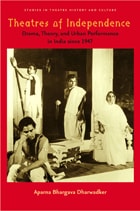
Theatres of Independence
Drama, Theory, and Urban Performance in India since 1947Aparna Bhargava Dharwadker
University of Iowa Press, 2005
The first part of Dharwadker’s study deals with the new dramatic canon that emerged after 1950 and the variety of ways in which plays are written, produced, translated, circulated, and received in a multilingual national culture. The second part traces the formation of significant postcolonial dramatic genres from their origins in myth, history, folk narrative, sociopolitical experience, and the intertextual connections between Indian, European, British, and American drama. The book’s ten appendixes collect extensive documentation of the work of leading playwrights and directors, as well as a record of the contemporary multilingual performance histories of major Indian, Western, and non-Western plays from all periods and genres. Treating drama and theatre as strategically interrelated activities, the study makes post-independence Indian theatre visible as a multifaceted critical subject to scholars of modern drama, comparative theatre, theatre history, and the new national and postcolonial literatures.
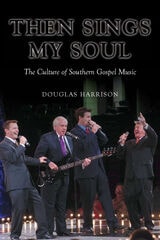
Then Sings My Soul
The Culture of Southern Gospel MusicDouglas Harrison
University of Illinois Press, 2012
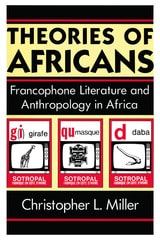
Theories of Africans
Francophone Literature and Anthropology in AfricaChristopher L. Miller
University of Chicago Press, 1990
". . . a superb cross-disciplinary analysis."—Y. Mudimbe
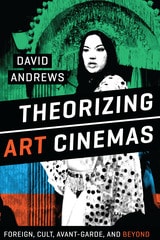
Theorizing Art Cinemas
Foreign, Cult, Avant-Garde, and BeyondBy David Andrews
University of Texas Press, 2013
The term “art cinema” has been applied to many cinematic projects, including the film d’art movement, the postwar avant-gardes, various Asian new waves, the New Hollywood, and American indie films, but until now no one has actually defined what “art cinema” is. Turning the traditional, highbrow notion of art cinema on its head, Theorizing Art Cinemas takes a flexible, inclusive approach that views art cinema as a predictable way of valuing movies as “art” movies—an activity that has occurred across film history and across film subcultures—rather than as a traditional genre in the sense of a distinct set of forms or a closed historical period or movement.
David Andrews opens with a history of the art cinema “super-genre” from the early days of silent movies to the postwar European invasion that brought Italian Neorealism, the French New Wave, and the New German Cinema to the forefront and led to the development of auteur theory. He then discusses the mechanics of art cinema, from art houses, film festivals, and the academic discipline of film studies, to the audiences and distribution systems for art cinema as a whole. This wide-ranging approach allows Andrews to develop a theory that encompasses both the high and low ends of art cinema in all of its different aspects, including world cinema, avant-garde films, experimental films, and cult cinema. All of these art cinemas, according to Andrews, share an emphasis on quality, authorship, and anticommercialism, whether the film in question is film festival favorite or a midnight movie.
Theorizing Scriptures
New Critical Orientations to a Cultural PhenomenonWimbush, Vincent
Rutgers University Press, 2008
Historically, religious scriptures are defined as holy texts that are considered to be beyond the abilities of the layperson to interpret. Their content is most frequently analyzed by clerics who do not question the underlying political or social implications of the text, but use the writing to convey messages to their congregations about how to live a holy existence. In Western society, moreover, what counts as scripture is generally confined to the Judeo-Christian Bible, leaving the voices of minorities, as well as the holy texts of faiths from Africa and Asia, for example, unheard.
In this innovative collection of essays that aims to turn the traditional bible-study definition of scriptures on its head, Vincent L. Wimbush leads an in-depth look at the social, cultural, and racial meanings invested in these texts. Contributors hail from a wide array of academic fields and geographic locations and include such noted academics as Susan Harding, Elisabeth Shüssler Fiorenza, and William L. Andrews.
Purposefully transgressing disciplinary boundaries, this ambitious book opens the door to different interpretations and critical orientations, and in doing so, allows an ultimately humanist definition of scriptures to emerge.
Theory And The Premodern Text
Paul Strohm
University of Minnesota Press, 2000
A major reconsideration of relations between new theories and old texts.
Medieval Studies/Literary Theory
A major reconsideration of relations between new theories and old texts. The work of Paul Strohm allies the most distinguished traditions of medieval study with the most challenging and innovative of theoretical approaches. These features, working together to revise and expand our understanding of both medieval texts and contemporary critical practice, are apparent in full and compelling force in this collection of essays, most now in print for the first time. In a range of theoretical engagements with late medieval texts, dealing with social practice, time, and narrative, this volume proposes a "practical" relation between the text and the theory that illuminates it.Insisting on the imaginative multiplicity of the text, Strohm finds in theory an augmentation of interpretive possibilities-an augmentation that sometimes requires respectful disagreement with what a work says-or seems to want known-about itself. He thus defines theory as "any standpoint from which we might challenge a text’s self-understanding." Coupled with this strategic disrespect is a new and amplified form of respect-for the text as a meaning-making system, for its unruly power and its unpredictable effects in the world.In this spirit, Strohm offers new and illustrative readings of Hoccleve’s "Male Regle" and Regiment of Princes, Ricardian coronation documents, Chaucer’s "Cook’s Tale," Capgrave’s chronicle, the Gesta Henrici Quinti, records of the king’s bench, Malory’s "Knight of the Cart," and other later medieval texts. Throughout, Strohm traverses categories of "literary" and "non-literary" in the service of a more comprehensive understanding of texts and the resourcefulness with which they accomplish their social work.Medieval Cultures Series, volume 26Translation Inquiries: University of Minnesota Press
Theory Aside
Jason Potts and Daniel Stout, eds.
Duke University Press, 2014
Contributors. Ian Balfour, Karen Beckman, Pheng Cheah, Frances Ferguson, William Flesch, Anne-Lise François, Mark B. N. Hansen, Simon Jarvis, Heather Love, Natalie Melas, Jason Potts, Elizabeth A. Povinelli, Eve Kosofsky Sedgwick, Jordan Alexander Stein, Daniel Stout, Irene Tucker
Theory and History of Folklore
Vladimir Propp
University of Minnesota Press, 1984
Theory and Practice of American Literary Naturalism
Selected Essay and ReviewsDonald Pizer
Southern Illinois University Press, 1993
In his first book devoted exclusively to naturalism, Donald Pizer brings together thirteen essays and four reviews written over a thirty-year period that in their entirety constitute a full-scale interpretation of the basic character and historical shape of naturalism in America.
The essays fall into three groups. Some deal with the full range of American naturalism, from the 1590s to the late twentieth century, and some are confined either to the 1890s or to the twentieth century. In addition to the essays, an introduction in which Pizer recounts the development of his interest in American naturalism, reviews of recent studies of naturalism, and a selected bibliography contribute to an understanding of Pizer’s interpretation of the movement.
One of the recurrent themes in the essays is that the interpretation of American naturalism has been hindered by the common view that the movement is characterized by a commitment to Emile Zola’s deterministic beliefs and that naturalistic novels are thus inevitably crude and simplistic both in theme and method. Rather than accept this notion, Pizer insists that naturalistic novels be read closely not for their success or failure in rendering obvious deterministic beliefs but rather for what actually does occur within the dynamic play of theme and form within the work.
Adopting this method, Pizer finds that naturalistic fiction often reveals a complex and suggestive mix of older humanistic faiths and more recent doubts about human volition, and that it renders this vital thematic ambivalence in increasingly sophisticated forms as the movement matures. In addition, Pizer demonstrates that American naturalism cannot be viewed monolithically as a school with a common body of belief and value. Rather, each generation of American naturalists, as well as major figures within each generation, has responded to threads within the naturalistic impulse in strikingly distinctive ways. And it is indeed this absence of a rigid doctrinal core and the openness of the movement to individual variation that are responsible for the remarkable vitality and longevity of the movement.
Because the essays have their origin in efforts to describe the general characteristics of American naturalism rather than in a desire to cover the field fully, some authors and works are discussed several times (though from different angles) and some referred to only briefly or notat all. But the essays as a collection are "complete" in the sense that they comprise an interpretation of American naturalism both in its various phases and as a whole. Those authors whose works receive substantial discussion include Stephen Crane, Frank Norris, Theodore Dreiser, Edith Wharton, James T. Farrell, Norman Mailer, Joyce Carol Oates, and William Kennedy. Of special interest is Pizer’s essay on Ironweed, which appears here for the first time.

Theory as Practice
A Critical Anthology of Early German Romantic WritingsJochen Schulte-Sasse, Haynes Horne, Elizabeth Mittman, Lisa C. Roetzel, Andreas Michel, Assenka Oksiloff, and Mary R. Strand, EditorsTranslated by Jochen Schulte-Sasse
University of Minnesota Press, 1997
Theory as Practice was first published in 1997. Minnesota Archive Editions uses digital technology to make long-unavailable books once again accessible, and are published unaltered from the original University of Minnesota Press editions.
In light of recent, dramatic revisions in criticism of European-particularly German-Romanticism, this anthology brings together key texts of the movement, especially those written in the last quarter of the eighteenth century by a small, influential circle centered at Jena.
In their introductory essays, the editors locate writings by Fichte, Schelling, Novalis, August Wilhelm Schlegel, and Friedrich Schlegel, among others, in this context. The selections include extensive excerpts from the correspondence of the Jena Romantics, their commentaries on each other's work, their most pertinent essays, fragments, and dialogues as well as diary entries and reviews. These works, together with the editors' articulation and elaboration of their significance, provide a new perspective on the provenance of postmodern thought and literary theory.
Jochen Schulte-Sasse is professor of German and comparative literature at the University of Minnesota and coeditor (with Wlad Godzich) of the Theory and History of Literature series at the University of Minnesota Press. Haynes Horne (University of Alabama), Andreas Michel (Indiana University), Assenka Oksiloff (New York University), Elizabeth Mittman (Michigan State University), Lisa C. Roetzel (University of Rochester), and Mary R. Strand each received a Ph.D. from the University of Minnesota.
Theory of African Music, Volume I
Gerhard Kubik
University of Chicago Press, 2010
Taken together, these comprehensive volumes offer an authoritative account of the music of Africa. One of the most prominent experts on the subject, Gerhard Kubik draws on his extensive travels and three decades of study in many parts of the continent to compare and contrast a wealth of musical traditions from a range of cultures.
In the first volume, Kubik describes and examines xylophone playing in southern Uganda and harp music from the Central African Republic; compares multi-part singing from across the continent; and explores movement and sound in eastern Angola. And in the second volume, he turns to the cognitive study of African rhythm, Yoruba chantefables, the musical Kachamba family of Malaŵi, and African conceptions of space and time.
Each volume features an extensive number of photographs and is accompanied by a compact disc of Kubik’s own recordings. Erudite and exhaustive, Theory of African Music will be an invaluable reference for years to come.