Results by title
345 books match the query 'Design' and 79 start with t
The Papers of the Bibliographical Society of America, volume 120 number 3 (September 2026)
The University of Chicago Press
University of Chicago Press Journals, 2026
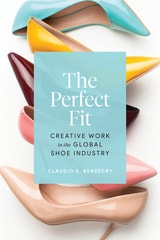
The Perfect Fit
Creative Work in the Global Shoe IndustryClaudio E. Benzecry
University of Chicago Press, 2022
We know a lot about how clothing and shoes are made cheaply, but very little about the process when they are made beautifully. In The Perfect Fit, Claudio E. Benzecry looks at the craft that goes into designing shoes for women in the US market, revealing that this creative process takes place on a global scale. Based on unprecedented behind-the-scenes access, The Perfect Fit offers an ethnographic window into the day-to-day life of designers, fit models, and technicians as they put together samples and prototypes, showing how expert work is a complement to and a necessary condition for factory exploitation.
Benzecry looks at the decisions and constraints behind how shoes are designed and developed, from initial inspiration to the mundane work of making sure a size seven stays constant. In doing so, he also fosters an original understanding of how globalization works from the ground up. Drawing on five years of research in New York, China, and Brazil, The Perfect Fit reveals how creative decisions are made, the kinds of expertise involved, and the almost impossible task of keeping the global supply chain humming.
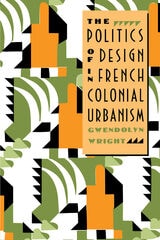
The Politics of Design in French Colonial Urbanism
Gwendolyn Wright
University of Chicago Press, 1991
Gwendolyn Wright focuses on three French colonies—Indochina, Morocco, and Madagascar—that were the most discussed, most often photographed, and most admired showpieces of the French empire in the early twentieth century. She explores how urban policy and design fit into the French colonial policy of "association," a strategy that accepted, even encouraged, cultural differences while it promoted modern urban improvements that would foster economic development for Western investors. Wright shows how these colonial cities evolved, tracing the distinctive nature of each locale under French imperialism. She also relates these cities to the larger category of French architecture and urbanism, showing how consistently the French tried to resolve certain stylistic and policy problems they faced at home and abroad.
With the advice of architects and sociologists, art historians and geographers, colonial administrators sought to exert greater control over such matters as family life and working conditions, industrial growth and cultural memory. The issues Wright confronts—the potent implications of traditional norms, cultural continuity, modernization, and radical urban experiments—still challenge us today.
The Politics of the Artificial
Essays on Design and Design StudiesVictor Margolin
University of Chicago Press, 2002
One of the pioneers of design studies and still one of its most distinguished practitioners, Victor Margolin here offers a timely meditation on design and its study at the turn of the millennium and charts new directions for the future development of both fields. Divided into sections on the practice and study of design, the essays in The Politics of the Artificial cover such topics as design history, design research, design as a political tool, sustainable design, and the problems of design's relation to advanced technologies. Margolin also examines the work of key practitioners such as the matrix designer Ken Isaacs. Throughout the book Margolin demonstrates the underlying connections between the many ways of reflecting on and practicing design. He argues for the creation of an international, interdisciplinary field of design research and proposes a new ethical agenda for designers and researchers that encompasses the responsibility to users, the problems of sustainability, and the complicated questions of how to set boundaries for applying advanced technology to solve the problems of human life.
Opinionated and erudite, Victor Margolin's The Politics of the Artificial breaks fresh ground in its call for a new approach to design research and practice. Designers, engineers, architects, anthropologists, sociologists, and historians will all benefit from its insights.
The Poster
Art, Advertising, Design, and Collecting, 1860s–1900sRuth E. Iskin
Dartmouth College Press, 2014

The Problem of Assessment in Art and Design
Edited by Trevor Rayment
Intellect Books, 2007
The Rent of Form
Architecture and Labor in the Digital AgePedro Fiori Arantes
University of Minnesota Press, 2019
A critique of prominent architects’ approach to digitally driven design and labor practices over the past two decades
With the advent of revolutionary digital design and production technologies, contemporary architects and their clients developed a taste for dramatic, unconventional forms. Seeking to amaze their audiences and promote their global brands, “starchitects” like Herzog & de Meuron and Frank Gehry have reaped substantial rewards through the pursuit of spectacle enabled by these new technologies. This process reached a climax in projects like Gehry’s Guggenheim Bilbao and the “Bilbao effect,” in which spectacular architectural designs became increasingly sought by municipal and institutional clients for their perceived capacity to enhance property values, which author Pedro Fiori Arantes calls the “rent of form.”
Analyzing many major international architectural projects of the past twenty years, Arantes provides an in-depth account of how this “architecture of exception” has come to dominate today’s industry. Articulating an original, compelling critique of the capital and labor practices that enable many contemporary projects, Arantes explains how circulation (via image culture), consumption (particularly through tourism), the division of labor, and the distribution of wealth came to fix a certain notion of starchitecture at the center of the industry.
Significantly, Arantes’s viewpoint is not that of Euro-American capitalism. Writing from the Global South, this Brazilian theorist offers a fresh perspective that advances ideas less commonly circulated in dominant, English-language academic and popular discourse. Asking key questions about the prevailing logics of finance capital, and revealing inconvenient truths about the changing labor of design and the treatment of construction workers around the world, The Rent of Form delivers a much-needed reevaluation of the astonishing buildings that have increasingly come to define world cities.
The Rob Roy Kelly American Wood Type Collection
A History and CatalogDavid Shields
University of Texas Press, 2022
2023 50 Books | 50 Covers Award, The American Institute of Graphic Arts (AIGA)
2024 Honorable Mention, Design Awards, Graphis
2024 Finalist, Typography Competition, Communication Arts Magazine
A beautifully illustrated exploration of the Rob Roy Kelly American Wood Type Collection.
The Rob Roy Kelly Wood Type Collection is a comprehensive collection of wood type manufactured and used for printing in nineteenth-century America. Comprising nearly 150 typefaces of various sizes and styles, it was amassed by noted design educator and historian Rob Roy Kelly starting in 1957 and is now held by the University of Texas. Although Kelly himself published a 1969 book on wood type and nineteenth-century typographic history, there has been little written about the creation of the wood type forms, the collection, or Kelly.
In this book, David Shields rigorously updates and expands upon Kelly’s historical information about the types, clarifying the collection’s exact composition and providing a better understanding of the stylistic development of wood type forms during the nineteenth century. Using rich materials from the period, Shields provides a stunning visual context that complements the textual history of each typeface. He also highlights the non-typographic material in the collection—such as borders, rules, ornaments, and image cuts—that have not been previously examined. Featuring over 300 color illustrations, this written history and catalog is bound to spark renewed interest in the collection and its broader typographic period.
The San Francisco Civic Center
A History of the Design, Controversies, and Realization of a City Beautiful MasterpieceJames Haas
University of Nevada Press, 2019
In The San Francisco Civic Center, James Haas tells the complete story of San Francisco’s Civic Center and how it became one of the most complete developments envisioned by any American city. Originally planned and designed by John Galen Howard in 1912, the San Francisco Civic Center is considered in both design and materials one of the finest achievements of the American reformist City Beautiful movement, an urban design movement that began more than a century ago.
Haas meticulously unravels the Civic Center’s story of perseverance and dysfunction, providing an understanding and appreciation of this local and national treasure. He discusses why the Civic Center was built, how it became central to the urban planning initiatives of San Francisco in the early twentieth century, and how the site held onto its founders’ vision despite heated public debates about its function and achievement. He also delves into the vision for the future and related national trends in city planning and the architectural and art movements that influenced those trends.
Riddled with inspiration and leadership as well as controversy, The San Francisco Civic Center, much like the complex itself, is a stunning manifestation of the confident spirit of one of America’s most dynamic and creative cities.
The Social Object
Apprehending Materiality for Industrial Design PracticeSoumitri Varadarajan
Intellect Books, 2025
Drawing on the methods of design history, material culture studies, and the social construction of technology, this book analyzes the domestic spaces and objects in the homes of the middle class in India, describing how people make meaning of the objects they buy, own, and gift.
Soumitri Varadarajan argues against a simplistic universal account of the way we think about how objects are designed. Instead, he presents a biography of projects and objects, offering a detailed and affectionate account of the lives of objects within the homes of the not-so-rich.
The Switch
An Off and On History of Digital HumansJason Puskar
University of Minnesota Press, 2024
From the telegraph to the touchscreen, how the development of binary switching transformed everyday life and changed the shape of human agency
The Switch traces the sudden rise of a technology that has transformed everyday life for billions of people: the binary switch. By chronicling the rapid growth of binary switching since the mid-nineteenth century, Jason Puskar contends that there is no human activity as common today as pushing a button or flipping a switch—the deceptively simple act of turning something on or off. More than a technical history, The Switch offers a cultural and political analysis of how reducing so much human action to binary alternatives has profoundly reshaped modern society.
Analyzing this history, Puskar charts the rapid shift from analog to digital across a range of devices—keyboards, cameras, guns, light switches, computers, game controls, even the “nuclear button”—to understand how nineteenth-century techniques continue to influence today’s pervasive digital technologies. In contexts that include musical performance, finger counting, machine writing, voting methods, and immersive play, Puskar shows how the switch to switching led to radically new forms of action and thought.
The innovative analysis in The Switch makes clear that binary inputs have altered human agency by making choice instantaneous, effort minimal, and effects more far-reaching than ever. In the process, it concludes, switching also fosters forms of individualism that, though empowering for many, also preserve a legacy of inequality and even domination.
The Texture of Change
Dress, Self-Fashioning, and History in Western Africa, 1700–1850Jody Benjamin
Ohio University Press, 2024
Jody Benjamin analyzes a range of archival, visual, oral, and material sources drawn from three continents to illuminate entanglements between local textile industries and global commerce and between the politics of Islamic reform and encroaching European colonial power. The study highlights the roles of a diverse range of historical actors mentioned only glancingly in core-periphery or Atlantic-centered framings: women indigo dyers, maroon cotton farmers, petty traveling merchants, caravan guides, and African Diaspora settlers. It argues that their combined choices within a set of ecological, political, and economic constraints structured networks connecting the Atlantic and Indian Ocean perimeters.
The Unexpected Dante
Perspectives on the Divine ComedyLucia Alma Wolf
Bucknell University Press, 2021
The Unexpected Dante brings together five leading scholars who offer fresh perspectives on the meanings and reception of The Divine Comedy. Some investigate Dante’s intentions by exploring the poem’s esoteric allusions to topics ranging from musical instruments to Roman law. Others examine the poem’s long afterlife and reception in the United States, with chapters showcasing new discoveries about Nicolaus de Laurentii’s 1481 edition of Commedia and the creative contemporary adaptations that have relocated Dante’s visions of heaven and hell to urban American settings.
This study also includes a guide that showcases selected treasures from the extensive Dante collections at the Library of Congress, illustrating the depth and variety of The Divine Comedy’s global influence. The Unexpected Dante is thus a boon to both Dante scholars and aficionados of this literary masterpiece.
Published by Bucknell University Press in association with the Library of Congress. Distributed worldwide by Rutgers University Press.
The Visual Elements—Abstraction
A Handbook for Communicating Science and EngineeringFelice C. Frankel
University of Chicago Press, 2026
For anyone interested in visual communication, a training guide for evaluating and developing visual representations for the big ideas in science and technology, essential skills for journal submissions, grant applications, and public understanding.
As a scientist, engineer, or other researcher, you may have written an abstract. In a paragraph, you explain the purpose of your research, your approach, the questions you have asked and answered, and your work’s impact. The abstract is a summary and an invitation—to read the paper, attend your talk, and join you in your thinking. You may even have been asked to create a visual abstract—a single image—to achieve the same goals. As a designer or public information officer, you may have had a similar brief—to explain a compelling subject with a visual for a journal cover or press release. And yet, this important skill—devising visual metaphors—isn’t typically taught. With her decades of experience creating compelling images and instructing MIT researchers, award-winning photographer and science communicator Felice C. Frankel helps readers evaluate and create their own visual abstractions.
Like in her other books in the Visual Elements series, on photography and design, Frankel asks readers to evaluate different choices—for example, in conveying the uncertainty of a hurricane’s path or the organization of the Standard Model for elementary particles. But in Abstraction, she offers more. With examples from science, engineering, and beyond, the book helps readers consider and evaluate the visuals around them and determine how they work and when they fail: Is this representation the best for communication? Will these abstractions encourage others to engage with my work? Will they mislead? Will they help my ideas evolve? Frankel invites researchers to think about the many meanings behind their images—and, in turn, to think more deeply about their research.
The Visual Elements—Design
A Handbook for Communicating Science and EngineeringFelice C. Frankel
University of Chicago Press, 2024
In this short handbook, award-winning science communicator Felice C. Frankel offers a quick guide for scientists and engineers who want to share—and better understand—their research by designing compelling graphics for journal submissions, grant applications, presentations, and posters. Like all the books in the Visual Elements series, this handbook is also a training tool for researchers. Distilling her celebrated books and courses to the essentials, Frankel shows scientists and engineers, from students to primary investigators, the importance of thinking visually. This crucial volume in the Visual Elements series offers a wealth of engaging design examples. Case studies and advice from designers at prestigious publications and researchers’ own before-and-after examples show how even the smallest changes—to color, type, composition, and layering—can greatly improve communication. Ideal for researchers who want a foothold for presenting and preparing their work for everything from conferences to publications, the book explains the steps for creating a concise and communicative graphic to highlight the most important aspects of research—and to clarify researchers’ own thinking. The resulting book is an essential element of any scientist’s, engineer’s, or designer’s library.
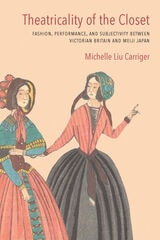
Theatricality of the Closet
Fashion, Performance, and Subjectivity between Victorian Britain and Meiji JapanMichelle Liu Carriger
Northwestern University Press, 2023
Clothing matters. This basic axiom is both common sense and, in another way, radical. It is from this starting point that Michelle Liu Carriger elucidates the interconnected ways in which gender, sexuality, class, and race are created by the everyday act of getting dressed. Theatricality of the Closet: Fashion, Performance, and Subjectivity between Victorian Britain and Meiji Japan examines fashion and clothing controversies of the nineteenth century, drawing on performance theory to reveal how the apparently superficial or frivolous deeply affects the creation of identity.
By interrogating a set of seemingly disparate examples from the same period but widely distant settings—Victorian Britain and Meiji-era Japan—Carriger disentangles how small, local, ordinary practices became enmeshed in a global fabric of cultural and material surfaces following the opening of trade between these nations in 1850. This richly illustrated book presents an array of media, from conservative newspapers and tabloids to ukiyo-e and early photography, that locate dress as a site where the individual and the social are interwoven, whether in the 1860s and 1870s or the twenty-first century.
Their System, Our Game
Homebrew and the Worlds of PathfinderScott DeJong and Marc Lajeunesse
University of Michigan Press, 2026
Our favorite tabletop role-playing games (TTRPGs) provide a chance to act out a fantasy. It might be the desire to wipe out foes with a single strike, the ability to charm even the most curmudgeonly townsfolk, or maybe even just the aspiration to adventure as a potted plant. Since game systems don’t always let players craft the kinds of games they want to experience, this is when they turn to the “homebrew” process to create personal rules and worlds. While Pathfinder has a history of being an underdog to the longtime industry leader Dungeons & Dragons, it has an ethos of open game design that inspires players, indie makers, and third-party content creators to brew up new rules, characters, classes, and game settings.
Their System, Our Game looks at the history of Pathfinder and how it encourages aspiring makers to break into the game design space. Through interviews with player-creators and third party makers, the authors use a range of perspectives to define homebrew for TTRPGs. Taking a closer look at homebrew design, they create two homebrew campaigns (available as free downloads) collaboratively with two different groups of players. Player accounts of gameplay and designer reflections of how their homebrew actually played out at the game table outline some of the challenges and perks of designing on the fly, creating customized settings, and bending or breaking rules. The book concludes by going through the research, interviews, design, and play analysis to show what homebrew and Pathfinder mean together. Ultimately Their System, Our Game is a celebration of how players use homebrew to explore creation and expression in their own TTRPGs.

Theory and Design of Microwave Filters
Ian Hunter
The Institution of Engineering and Technology, 2001

There's a Moose in My Garden
Designing Gardens in Alaska and the Far NorthBrenda C. Adams
University of Alaska Press, 2013
Adams provides helpful tips for Far Northern gardeners on how to design and implement successful landscape environments. The book outlines the entire planning and planting process, covering such aspects as handling low-angled sun, soft light, expansive vistas, and a cool climate.
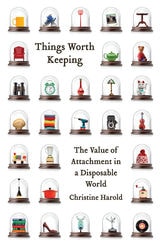
Things Worth Keeping
The Value of Attachment in a Disposable WorldChristine Harold
University of Minnesota Press, 2020
A timely examination of the attachments we form to objects and how they might be used to reduce waste
Rampant consumerism has inundated our planet with pollution and waste. Yet attempts to create environmentally friendly forms of consumption are often co-opted by corporations looking to sell us more stuff. In Things Worth Keeping, Christine Harold investigates the attachments we form to the objects we buy, keep, and discard, and explores how these attachments might be marshaled to create less wasteful practices and balance our consumerist and ecological impulses.
Although all economies produce waste, no system generates as much or has become so adept at hiding its excesses as today’s mode of global capitalism. This book suggests that managing the material excesses of our lives as consumers requires us to build on, rather than reject, our desire for and attraction to objects. Increasing environmental awareness on its own will be ineffective at reversing ecological devastation, Harold argues, unless it is coupled with a more thorough understanding of how and why we love the things that imbue our lives with pleasure, meaning, and utility.
From Marie Kondo’s method for decluttering that asks whether the things in our lives “spark joy” to the advent of emotionally durable design, which seeks to reduce consumption and waste by increasing the meaningfulness of the relationship between user and product, Harold explores how consumer psychology and empathetic design can transform our perception of consumer products from disposable to interconnected. An urgent call for rethinking consumerism, Things Worth Keeping shows that by recognizing our responsibility for the things we produce, we can become better stewards of the planet.
Time, Duration and Change in Contemporary Art
Beyond the ClockKate Bretkelly-Chalmers
Intellect Books, 2018
This book examines alternative frameworks of time, duration, and change in prominent philosophical, scientific, and technological traditions, including physics, psychology, phenomenology, neuroscience, media theory, and selected environmental sciences. It suggests that art makes a crucial contribution to these discourses not by “visualizing” time, but by entangling viewers in different sensory, material, and imaginary temporalities.
Transacting as Art, Design and Architecture
A Non-Commercial MarketEdited by Marsha Bradfield, Cinzia Cremona, Amy McDonnell, and Eva Sajovic
Intellect Books, 2021
The essays in this volume apply an experimental ethos to collaborative cultural production. Expanding the fields of art, design, and architectural research, contributors provide critical reflection on collaborative practice-based research. The volume builds on a pop-up market hosted by the London-based arts cluster Critical Practice that sought to creatively explore existing structures of evaluation and actively produce new ones. Assembled by lead editor Marsha Bradfield, the essays contextualize the event within London’s long history of marketplaces, offer reflections from the stallholders, and celebrate its value system, particularly its critique of econometrics. A glossary rounds off the text and opens up the publication as a resource.
Transformations
Art and the CityEdited by Elizabeth M. Grierson
Intellect Books, 2017
Transglobal Fashion Narratives
Clothing Communication, Style Statements and Brand StorytellingEdited by Anne Peirson-Smith and Joeseph H. Hancock II
Intellect Books, 2018

Trappings
Stories of Women, Power, and ClothingLudwig, Tiffany
Rutgers University Press, 2007
What do you wear that makes you feel powerful? How about the woman next to you at the bank? In line with you at the store? Think about your mother. What would she put on to reveal her power source to the world? These are the questions that inspired Tiffany Ludwig and Renee Piechocki to embark on an interview journey across the United States. Over a period of six years, they talked with more than 500 women and girls, ages four through ninety-two, who ranged from office workers to drag-kings, stay-at-home moms to attorneys, fashion industry executives to elected officials, students to cowgirls.
It is these women’s sensitive, funny, and always revealing thoughts that are at the heart of Trappings—a book that although it begins with a question about clothing is not about fashion at all. Here, clothing is simply a vehicle to access a larger dialogue about a diverse range of issues women face related to power and identity, including what expectations and limitations are placed upon them by their affiliation with a specific gender, culture, race, class, or profession. A complex spectrum of responses include discussions about the importance of clothing’s comfort and practicality, how clothing can facilitate women’s movement through class and social strata, how sex is used strategically in business and social settings, and how clothing can be used to empower women by connecting them with cultural or personal history.
Complimented by 148 color and black-and-white photographs, the visual and written portraits in this book reveal much more than the contents of women’s closets. Through the intimate lens of clothing, Ludwig and Piechocki expose the very personal ways that power is sought, experienced, and projected by women.

Twentieth Century Limited
Industrial Design In America 1925-1939Jeffrey L. Meikle
Temple University Press, 2001
Commercial artists who answered the call of business -- Walter Dorwin Teague, Norman Bel Geddes, Henry Dreyfuss, and Raymond Loewy the best known among them -- were pioneers who envisioned a coherent machine-age environment in which life would be clean, efficient, and harmonious. Working with new materials -- chrome, stainless steel, Bakelite plastic -- they created a streamlined expressionist style which reflected the desire of the Depression-era public for a frictionless, static society.
Appliances such as Loewy's Coldspot refrigerator "set a new standard" (according to the advertisements), and its usefulness extended to the way it improved the middle-class consumer's taste for sleek new products.
Profusely illustrated with 150 photographs, Twentieth Century Limited pays tribute to the industrial designers and the way they transformed American culture; a generation after its initial publication, this book remains the best introduction to the subject. The new edition will fascinate anyone interested in art, architecture, technology, and American culture of the 1930's.
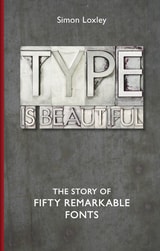
Type is Beautiful
The Story of Fifty Remarkable FontsSimon Loxley
Bodleian Library Publishing, 2016
Type is Beautiful traces the history of fifty remarkable fonts. Thoroughly researched and visually exciting, it takes readers through the story of each font’s creation and distinct characteristics, as well as why it succeeded or failed. Some of the fonts were commissioned for major commercial or cultural projects. Edward Johnston’s iconic Johnston Sans, for instance, was created for the London Underground and remained there exclusively until a redesign in the 1980s. Other fonts became culturally significant unintentionally. The designer of the controversial Comic Sans created the typeface to fill the need for a font to fit the speech bubbles for a Microsoft program, never expecting it to become one of the world’s favorite—and most-maligned—fonts. Along the way, Loxley gives readers an unforgettable cast of characters, including Johannes Gutenberg, William Caslon, Nicolas Jenson, Stanley Morison, William Morris, and Thomas Cobden-Sanderson, the English artist and bookbinder who famously “bequeathed” the unique metal type created for his failed Doves Press to the Thames, casting the type into the river to prevent its future use.
Brimming with fascinating facts, Type is Beautiful is a highly informative and entertaining trip through a lesser-known aspect of history that turns out to have major significance for print and design culture. From Blackletter to Baskerville and Bodoni, you will find yourself looking at fonts with a newfound appreciation.
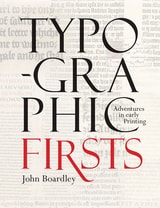
Typographic Firsts
John Boardley
Bodleian Library Publishing, 2018
Many of the standard features of printed books were designed by pioneering typographers and printers in the latter half of the fifteenth century. Johannes Gutenberg is credited with printing the first books in Europe with moveable type in the fifteenth century, but many different European printers and publishers went on to find innovative solutions to replicate the appearance of manuscript books in print and improve on them throughout the Renaissance. The illustrated examples in Typographic Firsts originate in those early decades, bringing into focus the influences and innovations that shaped the printed book and established a Western typographic canon.
From the practical challenges of polychromatic printing and sheet music printing to the techniques for illustrating books with woodcuts and producing books for children to the design of the first fonts, these stories chart the invention of the printed book, the world’s first means of mass communication. Also covering title pages, maps, printing in gold, and printing in color, this book shows how a mixture of happenstance and brilliant technological innovation came together to form the typographic and design conventions of the book.
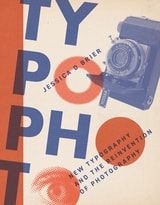
Typophoto
New Typography and the Reinvention of Photographybrier
University of Minnesota Press, 2025
Unveiling the avant-garde fusion of photography and modern graphic design
The concept Typophoto, the synthesis of photography and typography, was coined by renowned Bauhaus artist and theorist László Moholy-Nagy and played a foundational role in the modernist graphic design movement known as the New Typography. Jessica D. Brier examines how Typophoto was embraced by early graphic designers—a group who ultimately reinvented photography as a tool of modern consumerism.
Typophoto embodied designers’ belief in photography as an efficient form of visual communication, merging the material and the visual by abstracting both typographic and photographic form and transmuting photography into graphic material through the halftone process. Uniquely situating 1920s advertising discourse alongside avant-garde theory and significant interwar photographic concepts, Brier positions Typophoto as an analytical framework for considering how photography—as process, image, material, and metaphor—was effectively reconceived through the professionalization of graphic design in Europe and the United States. This was particularly true in Germany, where the capitalist ethos driving the country’s economic recovery bolstered the belief that graphics could create ideal reader-consumers.
Tracing Typophoto from its inception through New Typography’s experiments with the medium, Brier demonstrates how photography was used as a tool for manipulating perception as it became a visual language of modern life.