Results by title
577 books match the query 'Earth Sciences' and 113 start with t
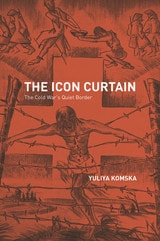
The Icon Curtain
The Cold War's Quiet BorderYuliya Komska
University of Chicago Press, 2015
Yuliya Komska transports readers to the western edge of the Bohemian Forest, one of Europe’s oldest borderlands, where in the 1950s civilians set out to shape the so-called prayer wall. A chain of new and repurposed pilgrimage sites, lookout towers, and monuments, the prayer wall placed two long-standing German obsessions, forest and border, at the heart of the century’s most protracted conflict. Komska illustrates how civilians used the prayer wall to engage with and contribute to the new political and religious landscape. In the process, she relates West Germany’s quiet sylvan periphery to the tragic pitch prevalent along the Iron Curtain’s better-known segments.
Steeped in archival research and rooted in nuanced interpretations of wide-ranging cultural artifacts, from vandalized religious images and tourist snapshots to poems and travelogues, The Icon Curtain pushes disciplinary boundaries and opens new perspectives on the study of borders and the Cold War alike.
The Impact of Global Warming on Texas
Second editionEdited by Jurgen Schmandt, Gerald R. North, and Judith Clarkson
University of Texas Press, 2011
When The Impact of Global Warming on Texas was first published in 1995, it discussed climate change as a likely future phenomenon, predicted by scientific studies. This entirely rewritten second edition presents evidence that early climate change impacts can now be observed and identifies the threats climate change will pose to Texas through the year 2050. It also offers the hopeful message that corrective action, if taken now, can avert unmanageable consequences.
The book begins with a discussion of climate science and modeling and the information that can be derived from these sources for Texas. The authors follow this with an analysis of actual climate trends in the various Texas climate regions, including a predicted rise in temperatures of 5.4 degrees F (plus or minus 1.8 F) by the end of the century. This could lead to less rainfall and higher evaporation, especially in regions that are already dry. Other important effects include possible changes in El Niño (climate variability) patterns and hurricane behaviors. Taking into account projected population growth, subsequent chapters explore likely trends with respect to water availability, coastal impacts, and biodiversity.
The authors then look at the issues from a policy perspective, focusing on Texas's importance to the national economy as an energy producer, particularly of oil and gas. They recommend that Texas develop its own climate change policy to serve the goals of reducing greenhouse gas emissions, increasing energy independence, ensuring regional security, and improving management of water, air, land, and wildlife.
The Imperial Map
Cartography and the Mastery of EmpireEdited by James R. Akerman
University of Chicago Press, 2009
Critically reflecting on elements of mapping and imperialism from the late seventeenth century to the early twentieth century, the essays discuss the nature of the imperial map through a series of case studies of empires, from the Qing dynasty of China, to the Portuguese empire in South America, to American imperial pretensions in the Pacific Ocean, among others. Collectively, the essays reveal that the relationship between mapping and imperialism, as well as the practice of political and economic domination of weak polities by stronger ones, is a rich and complex historical theme that continues to resonate in our modern day.
The Journal of Geology, volume 130 number 4 (July 2022)
The University of Chicago Press
University of Chicago Press Journals, 2022
The Journal of Geology, volume 130 number 5 (September 2022)
The University of Chicago Press
University of Chicago Press Journals, 2022
The Journal of Geology, volume 130 number 6 (November 2022)
The University of Chicago Press
University of Chicago Press Journals, 2022
The Journal of Geology, volume 131 number 1 (January 2023)
The University of Chicago Press
University of Chicago Press Journals, 2023
The Journal of Geology, volume 131 number 2 (March 2023)
The University of Chicago Press
University of Chicago Press Journals, 2023
The Journal of Geology, volume 131 number 3 (May 2023)
The University of Chicago Press
University of Chicago Press Journals, 2023
The Journal of Geology, volume 131 number 4 (July 2023)
The University of Chicago Press
University of Chicago Press Journals, 2023
The Journal of Geology, volume 131 number 5 (September 2023)
The University of Chicago Press
University of Chicago Press Journals, 2023
The Journal of Geology, volume 131 number 6 (November 2023)
The University of Chicago Press
University of Chicago Press Journals, 2023
The Journal of Geology, volume 132 number 1-2 (March 2024)
The University of Chicago Press
University of Chicago Press Journals, 2024
The Journal of Geology, volume 132 number 3-4 (September 2024)
The University of Chicago Press
University of Chicago Press Journals, 2024
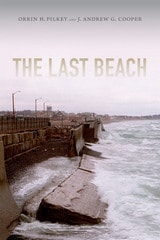
The Last Beach
Orrin H. Pilkey and J. Andrew G. Cooper
Duke University Press, 2014
After explaining beaches as dynamic ecosystems, Pilkey and Cooper assess the harm done by dense oceanfront development accompanied by the construction of massive seawalls to protect new buildings from a shoreline that encroaches as sea levels rise. They discuss the toll taken by sand mining, trash that washes up on beaches, and pollution, which has contaminated not only the water but also, surprisingly, the sand. Acknowledging the challenge of reconciling our actions with our love of beaches, the geologists offer suggestions for reversing course, insisting that given the space, beaches can take care of themselves and provide us with multiple benefits.
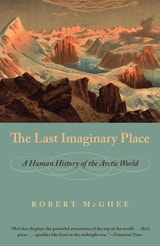
The Last Imaginary Place
A Human History of the Arctic WorldRobert McGhee
University of Chicago Press, 2007
The Arctic of towering icebergs and midnight sun, of flaming auroras and endless winter nights, has long provoked flights of the imagination. Now, in The Last Imaginary Place, renowned archeologist Robert McGhee lifts the veil to reveal the true Arctic world. Based on thirty years of work with native peoples of the Arctic and travel in the region, McGhee’s account dispels notions of the frozen land as an exotic, remote world that exists apart from civilization.
Between the frigid reality and lurid fantasy lies McGhee’s true interest, the people who throughout human history have called the Arctic home. He paints a vivid portrait of Viking farmers, entrepreneurial Inuit, and Western explorers who have been seduced by the natural wealth and haunting beauty of this land. From lively accounts of fur trading, ivory hunting, and whaling to white-knuckle tales of the first, doomed expeditions, McGhee takes the reader on a whirlwind journey across this disorienting, dreamlike terrain that has fascinated mankind for centuries.
“In prose infused by his position as curator of Arctic archaeology at the Canadian Museum of Civilization—which has taken him to sites in several countries—McGhee demolishes some persistent illusions about the white North . . . evocative.”—Times Literary Supplement
“[A] compelling account . . . [McGhee] believes that the Arctic is not so much a region as a dream—what he sees as a dream of a unique, attractive world . . . An archaeologist who has spent thirty years there, the author lets his love for the region shine through on every page.—Booklist
“McGhee displays the powerful attractions of the top of the world . . . [his] prose . . . sparkles like frost in the midnight sun.”—Financial Times
“McGhee has written a sensitive, fascinating and extremely important book.”—Canadian Geographic
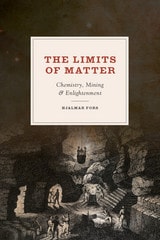
The Limits of Matter
Chemistry, Mining, and EnlightenmentHjalmar Fors
University of Chicago Press, 2014
Fors reveals how, early in the eighteenth century, chemists began to view metals no longer as the ingredients for “chrysopoeia”—or gold making—but as elemental substances, or the basic building blocks of matter. At the center of this emerging idea, argues Fors, was the Bureau of Mines of the Swedish State, which saw the practical and profitable potential of these materials in the economies of mining and smelting.
By studying the chemists at the Swedish Bureau of Mines and their networks, and integrating their practices into the wider European context, Fors illustrates how they and their successors played a significant role in the development of our modern notion of matter and made a significant contribution to the modern European view of reality.
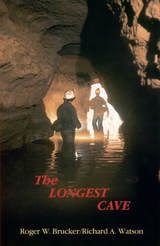
The Longest Cave
Roger W. Brucker and Richard A. Watson
Southern Illinois University Press, 1987
In 1925 the geological connection between Flint Ridge and Mammoth Cave was proved when dye placed in a Flint Ridge spring showed up in Echo River at Mammoth Cave.
That tantalizing swirl of dye confirmed speculations that wereto tempt more than 650cavers over half a century with the thrill of being the first to make human passage of the cave connection. Roger Brucker and Richard Watson tell not only of their own twenty-year effort to complete the link but the stories of many others who worked their way through mud-choked crawlways less than a foot high only to find impenetrable blockages.
Floyd Collins died a grisly death in nearby Sand Cave in1925, after being trapped there for 15 days. The wide press coverage of the rescue efforts stirred the imagination of the public and his body was on macabre display in a glass-topped coffin in Crystal Cave into the 1940s. Agents of a rival cave owner once even stole his corpse, which was recovered and still is in a coffin in the cave. Modern cavers still have a word with Floyd as they start their downward treks.
Brucker and Watson joined the parade of cavers who propelled themselves by wiggling kneecaps, elbows, and toes through quarter-mile long crawlways, clinging by fingertips and boot toes across mud-slick walls, over bottomless pits, into gurgling streams beneath stone ceilings that descend to water level, down crumbling crevices and up mountainous rockfalls, into wondrous domed halls, and straight ahead into a blackness intensified rather than dispelled by the carbide lamps on their helmets.
Over two decades they explored the passages with others who sought the final connection as vigorously as themselves. Pat Crowther, a young mother of two, joined them and because of her thinness became the member of the crew to go first into places no human had ever gone before. In that role, in July 1972, she wiggled her way through the Tight Spot and found the route that would link the Flint Ridge and Mammoth Cave systems into one cave extending 144.4 miles through the Kentucky limestone.
In a new afterword to this edition the authors summarize the subsequent explorations that have more than doubled the established length of the cave system. Based upon geological evidence, the authors predict that new discoveries will add another 200 miles to the length of the world’s longest cave, making it over 500 miles long.
The Lost History of the New Madrid Earthquakes
Conevery Bolton Valencius
University of Chicago Press, 2013
The Mantle of the Earth
Genealogies of a Geographical MetaphorVeronica della Dora
University of Chicago Press, 2021
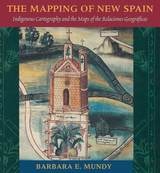
The Mapping of New Spain
Indigenous Cartography and the Maps of the Relaciones GeograficasBarbara E. Mundy
University of Chicago Press, 1996
"Its contribution to its specific field is both significant and original. . . . It is a pure pleasure to read." —Sabine MacCormack, Isis
"Mundy has done a fine job of balancing the artistic interpretation of the maps with the larger historical context within which they were drawn. . . . This is an important work." —John F. Schwaller, Sixteenth Century Journal
"This beautiful book opens a Pandora's box in the most positive sense, for it provokes the reconsideration of several long-held opinions about Spanish colonialism and its effects on Native American culture." —Susan Schroeder, American Historical Review
The Microflora of Lakes and Its Geochemical Activity
By S. I. Kuznetsov
University of Texas Press, 1975
The geochemical processes that take place in water bodies do not stem entirely from the activity of bacteria, but are also determined by the biological activity of higher plants and animals. The Microflora of Lakes and Its Geochemical Activity, the first English translation of the work of S. I. Kuznetsov, renowned Soviet microbiologist, is a detailed description of these processes.
The Microflora of Lakes opens with a complete outline of the ecology and physical and chemical properties of water bodies and a discussion of the entire complex of hydrobionts, since these factors exert tremendous influence on the microbial population. The work then focuses on the principles of the morphology and physiology of the living cell, background knowledge essential to the understanding of the role of microorganisms in the chemical cycle. Having laid the groundwork for the discussion, Kuznetsov follows with chapters on the distribution of bacteria and transformations of organic matter in lakes. He then examines the role of bacteria in the oxygen regime, and the cycles of organic matter, nitrogen, sulfur, iron, manganese and phosphorus. The last chapter describes the role of microorganisms in sediments of calcium carbonate waters.
The Microflora of Lakes and Its Geochemical Activity provides a wealth of information on the microbial limnology of fresh-water lakes throughout the world, particularly in the Soviet Union. As a summary of the geochemical activities as related to the geographic, geological, and physical relationships of fresh-water lakes, it is a monumental study.
The Microflora of Lakes was translated for the National Science Foundation, Washington, D.C., by the Israel Program for Scientific Translations in Jerusalem.
The Middle Path
Avoiding Environmental CatastropheEric Lambin
University of Chicago Press, 2007
In The Middle Path, noted geographer Eric Lambin provides a concise, readable summary of the present state of the environment and considers what must be done if environmental catastrophe is to be avoided. Finding merit in the arguments of both optimists and pessimists, Lambin argues that it is not too late to exploit the inherent tendency toward equilibrium of large-scale systems such as the earth’s environment. By relying upon a combination of remedies as global as international cap-and-trade emission treaties and as local as municipal programs promoting the use of bicycles rather than cars, it may yet be possible to rescue humanity from a potentially fatal crisis of its own making.
Based on rigorous scientific analysis, and strikingly free of ideological prejudice, The Middle Path presents a fresh view of our troubled future, brilliantly balancing tough-minded realism with humanitarian ideals of cooperation and ingenuity.
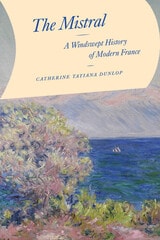
The Mistral
A Windswept History of Modern FranceCatherine Tatiana Dunlop
University of Chicago Press, 2024
Every year, the chilly mistral wind blows through the Rhône valley of southern France, across the Camargue wetlands, and into the Mediterranean Sea. Most forceful when winter turns to spring, the wind knocks over trees, sweeps trains off their tracks, and destroys crops. Yet the mistral turns the sky clear and blue, as it often appears in depictions of Provence. The legendary wind is central to the area’s regional identity and has inspired artists and writers near and far for centuries.
This force of nature is the focus of Catherine Dunlop’s The Mistral, a wonderfully written examination of the power of the mistral wind, and in particular, the ways it challenged central tenets of nineteenth-century European society: order, mastery, and predictability. As Dunlop shows, while the modernizing state sought liberation from environmental realities through scientific advances, land modification, and other technological solutions, the wind blew on, literally crushing attempts at control, and becoming increasingly integral to regional feelings of place and community.
The Mountain
A Political History from the Enlightenment to the PresentBernard Debarbieux and Gilles Rudaz
University of Chicago Press, 2015
In The Mountain, geographers Bernard Debarbieux and Gilles Rudaz trace the origins of the very concept of a mountain, showing how it is not a mere geographic feature but ultimately an idea, one that has evolved over time, influenced by changes in political climates and cultural attitudes. To truly understand mountains, they argue, we must view them not only as material realities but as social constructs, ones that can mean radically different things to different people in different settings.
From the Enlightenment to the present day, and using a variety of case studies from all the continents, the authors show us how our ideas of and about mountains have changed with the times and how a wide range of policies, from border delineation to forestry as well as nature protection and social programs, have been shaped according to them. A rich hybrid analysis of geography, history, culture, and politics, the book promises to forever change the way we look at mountains.
The Mysteries of the Marco Polo Maps
Benjamin B. Olshin
University of Chicago Press, 2014
In The Mysteries of the Marco Polo Maps, historian of cartography Benjamin B. Olshin offers the first credible book-length analysis of these artifacts, charting their course from obscure origins in the private collection of Italian-American immigrant Marcian Rossi in the 1930s; to investigations of their authenticity by the Library of Congress, J. Edgar Hoover, and the FBI; to the work of the late cartographic scholar Leo Bagrow; to Olshin’s own efforts to track down and study the Rossi maps, all but one of which are in the possession of Rossi’s great-grandson Jeffrey Pendergraft. Are the maps forgeries, facsimiles, or modernized copies? Did Marco Polo’s daughters—whose names appear on several of the artifacts—preserve in them geographic information about Asia first recorded by their father? Or did they inherit maps created by him? Did Marco Polo entrust the maps to Admiral Ruggero Sanseverino, who has links to Rossi’s family line? Or, if the maps have no connection to Marco Polo, who made them, when, and why?
Regardless of the maps’ provenance, Olshin’s tale—stretching from the remote reaches of the northern Pacific to early Chinese legends—takes readers on a journey confounding yet fascinating, offering insights into Italian history, the age of exploration, and the wonders of cartography.
The Natures of Maps
Cartographic Constructions of the Natural WorldDenis Wood and John Fels
University of Chicago Press, 2008
To answer that question, the authors turn to a category of maps with a particularly strong reputation for objectivity: maps of nature. From depictions of species habitats and bird migrations to portrayals of the wilds of the Grand Canyon and the reaches of the Milky Way, such maps are usually presumed—even by users who should know better—to be strictly scientific. Yet by drawing our attention to every aspect of these maps’ self-presentation, from place names to titles and legends, the authors reveal the way that each piece of information collaborates in a disguised effort to mount an argument about reality. Without our realizing it, those arguments can then come to define our very relationship to the natural world—determining whether we see ourselves as humble hikers or rampaging despoilers, participants or observers, consumers or stewards.
Richly illustrated, and crafted in vivid and witty prose, The Natures of Maps will enlighten and entertain map aficionados, scholars, and armchair navigators alike. You’ll never be able to look at Google Maps quite the same way again.
The Next New Madrid Earthquake
A Survival Guide for the MidwestWilliam Atkinson
Southern Illinois University Press, 1989
Scientists who specialize in the study of Mississippi Valley earthquakes say that the region is overdue for a powerful tremor that will cause major damage and undoubtedly some casualties.
The inevitability of a future quake and the lack of preparation by both individuals and communities provided the impetus for this book. Atkinson brings together applicable information from many disciplines: history, geology and seismology, engineering, zoology, politics and community planning, economics, environmental science, sociology, and psychology and mental health to provide the most comprehensive perspective to date of the myriad impacts of a major earthquake on the Mississippi Valley.
Atkinson addresses such basic questions as "What, actually, are earthquakes? How do they occur? Where are they likely to occur? Can they be predicted, perhaps even prevented?" He also addresses those steps that individuals can take to improve their chances for survival both during and after an earthquake.
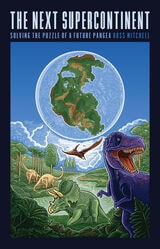
The Next Supercontinent
Solving the Puzzle of a Future PangeaRoss Mitchell
University of Chicago Press, 2023
An internationally recognized scientist shows that Earth’s separate continents, once together in Pangea, are again on a collision course.
You’ve heard of Pangea, the single landmass that broke apart some 175 million years ago to give us our current continents, but what about its predecessors, Rodinia or Columbia? These “supercontinents” from Earth’s past provide evidence that land repeatedly joins and separates. While scientists debate what that next supercontinent will look like—and what to name it—they all agree: one is coming.
In this engaging work, geophysicist Ross Mitchell invites readers to remote (and sometimes treacherous) lands for evidence of past supercontinents, delves into the phenomena that will birth the next, and presents the case for the future supercontinent of Amasia, defined by the merging of North America and Asia. Introducing readers to plate tectonic theory through fieldwork adventures and accessible scientific descriptions, Mitchell considers flows deep in the Earth’s mantle to explain Amasia’s future formation and shows how this developing theory can illuminate other planetary mysteries. He then poses the inevitable question: how can humanity survive the intervening 200 million years necessary to see Amasia?
An expert on the supercontinent cycle, Mitchell offers readers a front-row seat to a slow-motion mystery and an ongoing scientific debate.
The Next Tsunami
Living on a Restless CoastBonnie Henderson
Oregon State University Press, 2014
More than twenty years passed before geologists discovered that it was neither Seaside’s first nor worst tsunami. In fact, massive tsunamis strike the Pacific coast every few hundred years, triggered not by distant temblors but by huge quakes less than one hundred miles off the Northwest coast. Not until the late 1990s would scientists use evidence like tree rings and centuries-old warehouse records from Japan to fix the date, hour, and magnitude of the Pacific Northwest coast’s last megathrust earthquake: 9 p.m., January 26, 1700, magnitude 9.0—one of the largest quakes the world has known. When the next one strikes—this year or hundreds of years from now—the tsunami it generates is likely to be the most devastating natural disaster in the history of the United States.
In The Next Tsunami, Bonnie Henderson shares the stories of scientists like meteorologist Alfred Wegener, who formulated his theory of continental drift while gazing at ice floes calving from Greenland glaciers, and geologist Brian Atwater, who paddled his dented aluminum canoe up coastal streams looking for layers of peat sandwiched among sand and silt. The story begins and ends with Tom Horning, who grew up to become a geologist and return to his family home at the mouth of the river in Seaside—arguably the Northwest community with the most to lose from what scientist Atwater predicts will be an “apocalyptic” disaster. No one in Seaside understands earthquake science—and the politics and complicated psychology of living in a tsunami zone—better than Horning.
Henderson’s compelling story of how scientists came to understand the Cascadia Subduction Zone—a fault line capable of producing earthquakes even larger than the 2011 Tohoku quake in Japan—and how ordinary people cope with that knowledge is essential reading for anyone interested in the charged intersection of science, human nature, and public policy
The Old Barn Book
A Field Guide to North American Barns & Other Farm StructuresNoble, Allen G
Rutgers University Press, 1996
The Pale Blue Data Point
An Earth-Based Perspective on the Search for Alien LifeJon Willis
University of Chicago Press, 2025
“Here is Willis’s fundamental argument: The more we learn about Earth—our one ‘pale blue data point’ for a planet on which life has definitively arisen—the more qualified we will be to recognize signs of life elsewhere. . . . [A] joyful account.”—Steven Poole, The Wall Street Journal
A thrilling tour of Earth that shows the search for extraterrestrial life starts in our own backyard.
Is there life off Earth? Bound by the limitations of spaceflight, a growing number of astrobiologists investigate the question by studying life on our planet. Astronomer and author Jon Willis shows us how it’s done, allowing readers to envision extraterrestrial landscapes by exploring their closest Earth analogs. With Willis, we dive into the Pacific Ocean from the submersible-equipped E/V Nautilus to ponder the uncharted seas of Saturn’s and Jupiter’s moons; search the Australian desert for some of Earth’s oldest fossils and consider the prospects for a Martian fossil hunt; visit mountaintop observatories in Chile to search for the telltale twinkle of extrasolar planets; and eavesdrop on dolphins in the Bahamas to imagine alien minds.
With investigations ranging from meteorite hunting to exoplanet detection, Willis conjures up alien worlds and unthought-of biological possibilities, speculating what life might look like on other planets by extrapolating from what we can see on Earth, our single “pale blue dot”—as Carl Sagan famously called it—or, in Willis’s reframing, scientists’ “pale blue data point.”
The Paleoarchaic Occupation of the Old River Bed Delta
David B. Madsen, Dave N. Schmitt, and David Page
University of Utah Press, 2015
University of Utah Anthropological Paper No. 128
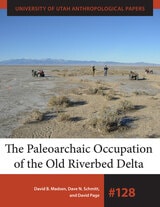
About 12,000 years ago, a major river ran from the Sevier Basin to the Great Salt Lake, feeding a wetland delta system and creating riparian habitat along its length. But after three thousand years the river dried up and the surrounding lands became more like what we see today. Because the Old River Bed Delta experienced less environmental and human disturbance than other areas, many of the Paleoarchaic sites found there have remained relatively intact—a rare find in the Great Basin. This book presents a comprehensive synthesis of a decade of investigations conducted by research teams working in different parts of the delta and explores questions about how the old riverbed was formed, how its distributary system changed through time, and how these changes affected early foragers. It concludes with an integrated summary and interpretation. Additional material from this study will be available online at UofUpress.com.
Supplementary Material for The Paleoarchaic Occupation of the Old River Bed Delta
Chapter 3 - SDM Trench and Locality Descriptions November
Chapter 3 SDM Individual Channel Images November
Chapter 5 - SDM Additional Lithic Artifact Images
Chapter 6 - SDM Results of XRF and PXRF Analysis
Chapter 6 - SDM Source Assignment Tables
The Paleobiological Revolution
Essays on the Growth of Modern PaleontologyEdited by David Sepkoski and Michael Ruse
University of Chicago Press, 2009
The Passage to Cosmos
Alexander von Humboldt and the Shaping of AmericaLaura Dassow Walls
University of Chicago Press, 2009
Explorer, scientist, writer, and humanist, Alexander von Humboldt was the most famous intellectual of the age that began with Napoleon and ended with Darwin. With Cosmos, the book that crowned his career, Humboldt offered to the world his vision of humans and nature as integrated halves of a single whole. In it, Humboldt espoused the idea that, while the universe of nature exists apart from human purpose, its beauty and order, the very idea of the whole it composes, are human achievements: cosmos comes into being in the dance of world and mind, subject and object, science and poetry.
Humboldt’s science laid the foundations for ecology and inspired the theories of his most important scientific disciple, Charles Darwin. In the United States, his ideas shaped the work of Emerson, Thoreau, Poe, and Whitman. They helped spark the American environmental movement through followers like John Muir and George Perkins Marsh. And they even bolstered efforts to free the slaves and honor the rights of Indians.
Laura Dassow Walls here traces Humboldt’s ideas for Cosmos to his 1799 journey to the Americas, where he first experienced the diversity of nature and of the world’s peoples—and envisioned a new cosmopolitanism that would link ideas, disciplines, and nations into a global web of knowledge and cultures. In reclaiming Humboldt’s transcultural and transdisciplinary project, Walls situates America in a lively and contested field of ideas, actions, and interests, and reaches beyond to a new worldview that integrates the natural and social sciences, the arts, and the humanities.
To the end of his life, Humboldt called himself “half an American,” but ironically his legacy has largely faded in the United States. The Passage to Cosmos will reintroduce this seminal thinker to a new audience and return America to its rightful place in the story of his life, work, and enduring legacy.

The Physico-Chemical Properties of Plant Saps in Relation to Phytogeography
Data on Native Vegetation in its Natural EnvironmentJ. Harris
University of Minnesota Press, 1934
The Political Mapping of Cyberspace
Jeremy W. Crampton
University of Chicago Press, 2003
Using concepts and methods derived from the work of Michel Foucault, Crampton outlines a new mapping of cyberspace to help define the role of space in virtual worlds and to provide constructive ways in which humans can exist in another spatial dimension. He delineates the critical role maps play in constructing the medium as an object of knowledge and demonstrates that by processes of mapping we come to understand cyberspace. Maps, he argues, shape political thinking about cyberspace, and he deploys in-depth case studies of crime mapping, security maintenance, and geo-surveillance to show how we map ourselves onto cyberspace, inexorably, and indelibly.
Offering a powerful reinterpretation of technology and contemporary life, this innovative book will be an essential touchstone for the study of cartography and cyberspace in the twenty-first century.
The Political Origins of Inequality
Why a More Equal World Is Better for Us AllSimon Reid-Henry
University of Chicago Press, 2015
The problem of inequality, Reid-Henry argues, is a problem that manifests between places as well as over time. This is one reason why it cannot be resolved by the usual arguments of left versus right, bound as they are to the national scale alone. Most of all, however, it is why the level of inequality that confronts us today is indicative of a more general crisis in political thought. Modern political discourse has no place for public reason or the common good. Equality is yesterday’s dream. Yet the fact that we now accept such a world—a world that values security over freedom, special treatment over universal opportunity, and efficiency over fairness—is ultimately because we have stopped even trying in recent decades to build the political architecture the world actually requires.
Our politics has fallen out of step with the world, then, and at the every moment it is needed more than ever. Yet it is within our power to address this. Doing so involves identifying and then meeting our political responsibilities to others, not just offering them the selective charity of the rich. It means looking beyond issues of economics and outside our national borders. But above all it demands of us that we reinvent the language of equality for a modern, global world: and then institute this. The world is not falling apart. Different worlds, we all can see, are colliding together. It is our capacity to act in concert that is falling apart. It is this that needs restoring most of all.
The Politics of Scale
A History of Rangeland ScienceNathan F. Sayre
University of Chicago Press, 2017
During the late 1880s and early 1890s, a variety of forces—from the Homestead Act of 1862 to the extermination of bison, foreign investment, and lack of government regulation—promoted free-for-all access to and development of the western range, with disastrous environmental consequences. To address the crisis, government agencies turned to scientists, but as Nathan F. Sayre shows, range science grew in a politically fraught landscape. Neither the scientists nor the public agencies could escape the influences of bureaucrats and ranchers who demanded results, and the ideas that became scientific orthodoxy—from fire suppression and predator control to fencing and carrying capacities—contained flaws and blind spots that plague public debates about rangelands to this day. Looking at the global history of rangeland science through the Cold War and beyond, The Politics of Scale identifies the sources of past conflicts and mistakes and helps us to see a more promising path forward, one in which rangeland science is guided less by capital and the state and more by communities working in collaboration with scientists.
The Powers That Be
Global Energy for the Twenty-first Century and BeyondScott L. Montgomery
University of Chicago Press, 2010
Thirty years ago, our global energy landscape did not look remarkably different from what it does today. Three or four decades from now, it certainly will: dwindling oil reserves will clash with skyrocketing demand, as developing nations around the world lead their citizens into the modern energy economy, and all the while, the grave threat of catastrophic climate change looms ever larger. Energy worries are at an all-time high—just how will we power our future?
With The Powers That Be, Scott L. Montgomery cuts through the hype, alarmism, and confusion to give us a straightforward, informed account of where we are now, and a map of where we’re going. Starting with the inescapable fact of our current dependence on fossil fuels—which supply 80% of all our energy needs today—Montgomery clearly and carefully lays out the many alternative energy options available, ranging from the familiar, like water and solar, to such nascent but promising sources as hydrogen and geothermal power. What is crucial, Montgomery explains, is understanding that our future will depend not on some single, wondrous breakthrough; instead, we should focus on developing a more diverse, adaptable energy future, one that draws on a variety of sources—and is thus less vulnerable to disruption or failure.
An admirably evenhanded and always realistic guide, Montgomery enables readers to understand the implications of energy funding, research, and politics at a global scale. At the same time, he doesn’t neglect the ultimate connection between those decisions and the average citizen flipping a light switch or sliding behind the wheel of a car, making The Powers That Be indispensible for our ever-more energy conscious age.
The Pseudoscience Wars
Immanuel Velikovsky and the Birth of the Modern FringeMichael D. Gordin
University of Chicago Press, 2012

The Regional Dynamics of Language Differentiation in Belgium
A Study in Cultural-Political GeographyAlexander B. Murphy
University of Chicago Press, 1988
The Seabed
A Human and Literary HistoryJimmy Packham and Laurence Publicover
University of Chicago Press, 2026
Uncovers human histories, cultures, and politics on the ocean floor.
While often characterized as an alien realm, the seabed has long been fundamental to human life. As new technologies offer ever greater access to this environment, the bottom of the ocean is key to debates about our future—and yet we are poorly equipped to understand our relation to it.
The Seabed plumbs the ocean’s depths to reveal a rich and complex history of human activity at the seafloor, a history that extends from the classical world to the present. Jimmy Packham and Laurence Publicover highlight the literary significance of the seabed, examining works by writers including Aphra Behn, Anton Chekhov, Euripides, Herman Melville, M. NourbeSe Philip, William Shakespeare, Derek Walcott, and H. G. Wells, as well as lesser-known authors who have imagined this dark and mysterious realm. Putting these in dialogue with the science writing of Rachel Carson, Sylvia Earle, and others, and with visual art, politics, and historical case studies, they show how imaginative speculations concerning the ocean floor have influenced, and continue to inform, human activity on the seabed itself. Through chapters that explore sea burial and seafloor memorials, scientific exploration, deep-sea infrastructure, salvage from the seabed, and deep-sea extraction, the book reveals that the ocean floor’s cultural visibility has fluctuated over time. But longstanding visions of the seabed continue to shape our relationship with this place, a site for undersea cables and—in the near future—deep-sea mining.
The bottom of the ocean is closer than we think. Understanding our history there is crucial to assessing the present and imagining our future.
The Silent Deep
The Discovery, Ecology, and Conservation of the Deep SeaTony Koslow
University of Chicago Press, 2007
The Silent Deep tells the story of the exploration and discovery of the deep sea, the ecology of its diverse environments, and the impact of humans, highlighting the importance of global stewardship in keeping this delicate ecosystem alive and well. Written by world renowned deep-sea ecologist Tony Koslow, this book is a comprehensive and authoritative overview of the state of the deep sea today, accessible to anyone interested in ocean science, the story of scientific discovery, and conservation of the earth’s most threatened ecosystems.
“Koslow deals a decisive blow to the notion that the deep sea can ever be immune from unregulated human activities. . . . The historical review of deep-sea biology is the most comprehensive I have ever read.”—Adrian Glover, Times Literary Supplement
“Deeply informed by history and rendered in straightforward, careful prose.”—Anthony Doerr, Boston Globe
“This beautifully produced book tells an urgent story with clarity and grace.”—Choice
“Stands apart from other books about life in the abyss due to Tony Koslow’s thoughtful accounts. . . . [He] succeeds in painting a picture of the deep sea as an environment with inherent and threatened value.”—Science
“Textbook depth on all aspects of deep-sea science and conservation. . . . [An] exhaustively researched and referenced volume with a historical review stretching back to Socrates.”—Mark Schrope, Nature
“An important textbook and viewpoint that is highly recommended for anyone with a professional or personal interest in deep-sea ecosystems.”—Quarterly Review of Biology
The Sinai
A Physical GeographyBy Ned Greenwood
University of Texas Press, 1997
One of the world's oldest crossroads, the Sinai joins the great continental land masses of Africa and Eurasia. Its physical geography of rugged mountain peaks, desert plains, and sea coasts was formed by the collision of the two continental plates, while the human tides that have swept across the region over millennia have left an intricate web of cultures and ethnicities.
In this book, Ned Greenwood offers a complete, up-to-date physical geography of Sinai. After an introductory chapter that situates Sinai within world history and geography, he focuses in detail on the following areas: plate tectonics and geology, geomorphology and drainage, weather and climate, soils, and biogeography.
In the concluding chapter, Greenwood considers the human geography of Sinai, including the pressures currently posed by population growth, political extremism, and environmental constrictions on development. He offers a fully rounded picture of the physical environment of Sinai that will be vital reading for everyone concerned about the future of this strategic yet fragile land.
The Sound of Feathers
Attentive Living in a World Beyond OurselvesKathryn Gillespie
Duke University Press, 2026
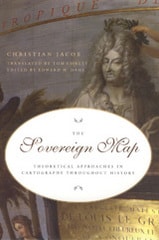
The Sovereign Map
Theoretical Approaches in Cartography throughout HistoryChristian Jacob
University of Chicago Press, 2006
Beginning with a historical overview of maps and their creation—from those traced in the dirt by primitive hands to the monumental Dutch atlases and ornate maps on Italian palace walls—Jacob goes on to consider the visual components of cartography: the decorative periphery, geometric grid, topographical lines, dots, details of iconographic figures, and many other aspects. Considering text on maps—titles, toponyms, legends, and keys—Jacob proposes that writing can both clarify and interfere with a map's visual presentation. Finally Jacob examines the role of the viewer in decoding a map's meaning and the role of society in defining the power of maps as authoritative depictions of space.
Innovative in its philosophical motivation and its interdisciplinary approach to looking at and writing about maps, The Sovereign Map is eagerly awaited by scholars from many different fields.
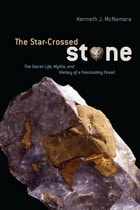
The Star-Crossed Stone
The Secret Life, Myths, and History of a Fascinating FossilKen McNamara
University of Chicago Press, 2010
Throughout the four hundred thousand years that humanity has been collecting fossils, sea urchin fossils, or echinoids, have continually been among the most prized, from the Paleolithic era, when they decorated flint axes, to today, when paleobiologists study them for clues to the earth’s history.
In The Star-Crossed Stone, Kenneth J. McNamara, an expert on fossil echinoids, takes readers on an incredible fossil hunt, with stops in history, paleontology, folklore, mythology, art, religion, and much more. Beginning with prehistoric times, when urchin fossils were used as jewelry, McNamara reveals how the fossil crept into the religious and cultural lives of societies around the world—the roots of the familiar five-pointed star, for example, can be traced to the pattern found on urchins. But McNamara’s vision is even broader than that: using our knowledge of early habits of fossil collecting, he explores the evolution of the human mind itself, drawing striking conclusions about humanity’s earliest appreciation of beauty and the first stirrings of artistic expression. Along the way, the fossil becomes a nexus through which we meet brilliant eccentrics and visionary archaeologists and develop new insights into topics as seemingly disparate as hieroglyphics, Beowulf, and even church organs.
An idiosyncratic celebration of science, nature, and human ingenuity, The Star-Crossed Stone is as charming and unforgettable as the fossil at its heart.
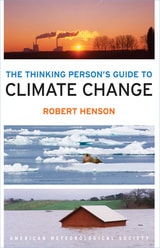
The Thinking Person's Guide to Climate Change
Robert Henson
American Meteorological Society, 2014
Using global research and written with nonscientists in mind, the Guide breaks down the issues into straightforward categories: “Symptoms” covers signs such as melting ice and extreme weather, while “Science” lays out what we know and how we figured it out. “Debates” tackles the controversy and politics, while “Solutions” and “Actions” discuss what we can do as individuals and communities to create the best possible future. Full-color illustrations offer explanations of everything from how the greenhouse effect traps heat to which activities in everyday life emit the most carbon. Special-feature boxes zoom in on locations across the globe already experiencing the effects of a shifting climate.
The Thinking Person's Guide to Climate Change combines years of data with recent research, including conclusions from the Fifth Assessment Report of the Intergovernmental Panel on Climate Change. This reference provides the most comprehensive, yet accessible, overview of where climate science stands today, acknowledging controversies but standing strong in its stance that the climate is changing— and something needs to be done.
The Thinking Person's Guide to Climate Change is a full update and revision of Robert Henson’s The Rough Guide to Climate Change and is now published through the American Meteorological Society, with distribution through University of Chicago Press.
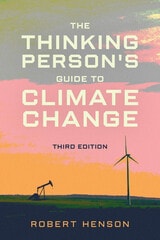
The Thinking Person's Guide to Climate Change, Third Edition
Robert Henson
University of Chicago Press, 2027
Updated throughout, the definitive guide for students, practitioners, and anyone interested in where climate science, politics, and policy stand today.
The physics and chemistry that drive human-caused climate change are surprisingly clear-cut. How we think about, talk about, and respond to the situation is dizzyingly complex. Meteorologist and journalist Robert Henson has spent years making climate science approachable and engaging. His internationally recognized book, The Thinking Person’s Guide to Climate Change, provides both specialists and newcomers with the background, insights, and confidence to engage with the paramount environmental issues of our lives (and beyond).
Drawing on a wealth of studies and assessments, this comprehensive yet lively guide brings a fresh eye to topics often buried in rhetoric. Introductory sections bring to life more than a century of painstaking research that tells us what we know and don’t know about human effects on climate. Henson discusses how and where fossil fuel use has been linked to heat waves, melting ice, wildfires, and other extremes. The guide also explores the high-stakes debates that swirl around climate change—including efforts to deny, downplay, or distract from the crisis—and how political, diplomatic, and legal systems are grappling with it. Color illustrations help explain everything from how the greenhouse effect traps heat to which everyday activities emit the most carbon. Special-feature boxes take readers to locations across the globe: small Pacific islands confronting sea level rise, Africa and its major rainfall shifts, California and year-round wildfire threats, and Florida with hurricanes intensifying ever more rapidly.
Thoroughly updated, this third edition has new coverage of the survivability of extreme heat, the use of global temperature thresholds, the challenge of carbon pricing, and other timely topics. It spotlights the Intergovernmental Panel on Climate Change’s Sixth Assessment Report as well as evolving geopolitics. This book acknowledges controversy, underscores points of agreement, and favors action over apathy and doomism.