Results by title
5448 books match the query 'History and criticism' and 1116 start with t
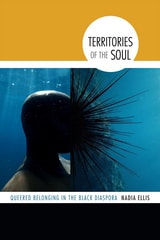
Territories of the Soul
Queered Belonging in the Black DiasporaNadia Ellis
Duke University Press, 2015

Terrorism, Italian Style
Representations of Political Violence in Contemporary Italian CinemaRuth Glynn
University of London Press, 2012
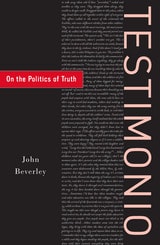
Testimonio
On The Politics Of TruthJohn Beverley
University of Minnesota Press, 2004
A revealing perspective on the controversial literature of witnessing
These four germinal essays by John Beverley sparked the widespread discussion and debate surrounding testimonio—the socially and politically charged Latin American narrative of witnessing—that culminated with David Stoll’s highly publicized attack on Rigoberta Menchú’s celebrated testimonial text. Challenging Hardt and Negri’s Empire, Beverley’s extensive new introduction examines the broader historical, political, and ethical issues that this literature raises, tracing the development of testimonio from its emergence in the Cold War era to the rise of a globalized economy and U.S. political hegemony.
Informed by postcolonial studies and the current debate over multiculturalism and identity politics, Testimonio reaches across disciplinary boundaries to show how this particular literature at once represents and enacts new forms of agency on the part of previously repressed social subjects, as well as its potential as a new form of “alliance politics” between those subjects and artists, scientists, teachers, and intellectuals in a variety of local, national, and international contexts.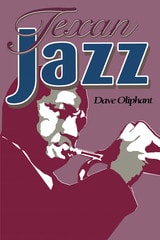
Texan Jazz
By Dave Oliphant
University of Texas Press, 1996
Texas musicians and jazz share a history that goes all the way back to the origins of jazz in ragtime, blues, and boogie-woogie. Texans have left their mark on all of jazz's major movements, including hot jazz, swing, bebop, the birth of the cool, hard bop, and free jazz. Yet these musicians are seldom identified as Texans because their careers often took them to the leading jazz centers in New Orleans, Chicago, New York, Kansas City, and Los Angeles.
In Texan Jazz, Dave Oliphant reclaims these musicians for Texas and explores the vibrant musical culture that brought them forth. Working through the major movements of jazz, he describes the lives, careers, and recordings of such musicians as Scott Joplin, Hersal Thomas, Blind Lemon Jefferson, Sippie Wallace, Jack Teagarden, Buster Smith, Hot Lips Page, Eddie Durham, Herschel Evans, Charlie Christian, Red Garland, Kenny Dorham, Jimmy Giuffre, Ornette Coleman, John Carter, and many others.
The great strength of Texan Jazz is its record of the contributions to jazz made by African-American Texans. The first major book on this topic ever published, it will be fascinating reading for everyone who loves jazz.
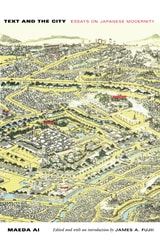
Text and the City
Essays on Japanese ModernityMaeda Ai
Duke University Press, 2004
Maeda remapped the study of modern Japanese literature and culture in the 1970s and 1980s, helping to generate widespread interest in studying mass culture on the one hand and marginalized sectors of modern Japanese society on the other. These essays reveal the broad range of Maeda’s cultural criticism. Among the topics considered are Tokyo; utopias; prisons; visual media technologies including panoramas and film; the popular culture of the Edo, Meiji, and contemporary periods; maps; women’s magazines; and women writers. Integrally related to these discussions are Maeda’s readings of works of Japanese literature including Matsubara Iwagoro’s In Darkest Tokyo, Nagai Kafu’s The Fox, Higuchi Ichiyo’s Growing Up, Kawabata Yasunari’s The Crimson Gang of Asakusa, and Narushima Ryuhoku’s short story “Useless Man.” Illuminating the infinitely rich phenomena of modernity, these essays are full of innovative, unexpected connections between cultural productions and urban life, between the text and the city.

Text/Politics in Island Southeast Asia
Essays in InterpretationD.M. Roskies
Ohio University Press, 1993
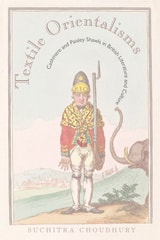
Textile Orientalisms
Cashmere and Paisley Shawls in British Literature and CultureSuchitra Choudhury
Ohio University Press, 2023
Textual Awareness
A Genetic Study of Late Manuscripts by Joyce, Proust, and MannDirk Van Hulle
University of Michigan Press, 2004
A key issue in both textual criticism and the so-called crisis of the novel is the tension between the finished and the unfinished. After a theoretical examination of the relationship between genetic and textual criticism, Dirk Van Hulle uses the three case studies to show how?at each stage in the writing process?the text still had the potential of becoming something entirely different; how and why these geneses proceeded the way they did; how Joyce, Proust, and Mann allowed contingencies to shape their work; how these authors recycled the words of their critics in order to inoculate their works against them; how they shaped an intertextual dimension through the processing of source texts and reading notes; and how text continually generated more text.
Van Hulle's exploration of process sheds new light on the remarkable fact that so many modernist authors protected their manuscripts, implying both the authors' urge to grasp everything and their awareness of the dangers of their encyclopedic projects. Textual Awareness offers new insights into the artificiality of the artifact?the novel?that are relevant to the study of literary modernism in general and the study of James Joyce, Marcel Proust, and Thomas Mann in particular.
Dirk Van Hulle is Assistant Professor of English and German Literature, University of Antwerp.

Textual Confrontations
Comparative Readings in Latin American LiteratureAlfred J. Mac Adam
University of Chicago Press, 1987
Mac Adam describes the changes that have taken place in Latin American literature since the time of Modernismo (roughly 1880-1920), when Spanish American writers tried to update their literary language by imitating foreign, mostly French, literature. Since then, as he demonstrates, Latin American writing has achieved a pioneering status by means of a different kind of imitation—parody—whereby it gives back to the former centers of Western culture their own writing, now distorted and reshaped into something new.
Textual Contraception
Birth Control and Modern American FictionBeth Widmaier Capo
The Ohio State University Press, 2007
Merging cultural analysis and literary scholarship, this compelling work moves from a consideration of how cultural forces shaped literary production and political activism to a close examination of how fictional representations of contraception influenced the terms of public discourse on marriage, motherhood, economics, and eugenics.
By analyzing popular fiction such as Mother by Kathleen Norris, radical periodicals such as The Masses and Birth Control Review, and literature by authors from Theodore Dreiser to William Faulkner, and Nella Larsen to Mary McCarthy, Beth Widmaier Capo reveals the rich cross-influence of contraceptive and literary history.
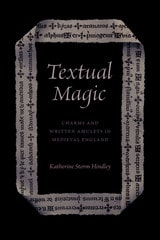
Textual Magic
Charms and Written Amulets in Medieval EnglandKatherine Storm Hindley
University of Chicago Press, 2023
Katherine Storm Hindley explores words at their most powerful: words that people expected would physically change the world. Medieval Europeans often resorted to the use of spoken or written charms to ensure health or fend off danger. Hindley draws on an unprecedented archive of more than a thousand such charms from medieval England—more than twice the number gathered, transcribed, and edited in previous studies and including many texts still unknown to specialists on this topic. Focusing on charms from 1100 to 1350 CE as well as previously unstudied texts in Latin, French, and English, Hindley addresses important questions of how people thought about language, belief, and power. She describes seven hundred years of dynamic, shifting cultural landscapes, where multiple languages, alphabets, and modes of transmission gained and lost their protective and healing power. Where previous scholarship has bemoaned a lack of continuity in the English charms, Hindley finds surprising links between languages and eras, all without losing sight of the extraordinary variety of the medieval charm tradition: a continuous, deeply rooted part of the English Middle Ages.
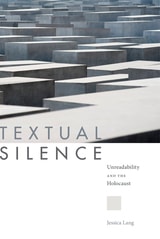
Textual Silence
Unreadability and the HolocaustLang, Jessica
Rutgers University Press, 2017
Holocaust texts, which encompass works as diverse as memoirs, novels, poems, and diaries, are traditionally characterized by silences the authors place throughout the text, both deliberately and unconsciously. While a reader may have the desire and will to comprehend the Holocaust, the presence of “textual silence” is a force that removes the experience of genocide from the reader’s analysis and imaginative recourse. Lang defines silences as omissions that take many forms, including the use of italics and quotation marks, ellipses and blank pages in poetry, and the presence of unreliable narrators in fiction. While this limits the reader’s ability to read in any conventional sense, these silences are not flaws. They are instead a critical presence that forces readers to acknowledge how words and meaning can diverge in the face of events as unimaginable as those of the Holocaust.
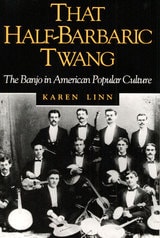
That Half-Barbaric Twang
The Banjo in American Popular CultureKaren Linn
University of Illinois Press, 1991
Long a symbol of American culture, the banjo actually originated in Africa before European-Americans adopted it. Karen Linn shows how the banjo--despite design innovations and several modernizing agendas--has failed to escape its image as a "half-barbaric" instrument symbolic of antimodernism and sentimentalism.
Caught in the morass of American racial attitudes and often used to express ambivalence toward modern industrial society, the banjo stood in opposition to the "official" values of rationalism, modernism, and belief in the beneficence of material progress. Linn uses popular literature, visual arts, advertisements, film, performance practices, instrument construction and decoration, and song lyrics to illustrate how notions about the banjo have changed.
Linn also traces the instrument from its African origins through the 1980s, alternating between themes of urban modernization and rural nostalgia. She examines the banjo fad of bourgeois Northerners during the late nineteenth century; the African-American banjo tradition and the commercially popular cultural image of the southern black banjo player; the banjo's use in ragtime and early jazz; and the image of the white Southerner and mountaineer as banjo player.
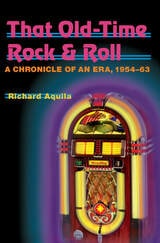
That Old-Time Rock & Roll
A Chronicle of an Era, 1954-63Richard Aquila
University of Illinois Press, 1989
Elvis Presley and Bill Haley. Sam Cooke and the Shirelles. The Crows and the Chords. American Bandstand and Motown. From its first rumblings in the outland alphabet soup of R&B and C&W, rock & roll music promised to change the world--and did it.
Combining social history with a treasure trove of trivia, Richard Aquila unleashes the excitement of rock's first decade and shows how the music reflected American life from the mid-1950s through the dawn of Beatlemania. His year-by-year timelines and a photo essay place the music in historical perspective by linking artists and their hits to the news stories, movies, TV shows, fads, and lifestyles. In addition, he provides a concise biographical dictionary of the performers who made the charts between 1954 and 1963, along with the label and chart position of each of their hit songs.
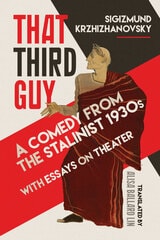
That Third Guy
A Comedy from the Stalinist 1930s with Essays on TheaterSigizmund Krzhizhanovsky, Translated and edited by Alisa Ballard Lin, Foreword by Caryl Emerson
University of Wisconsin Press, 2018
The volume also features selections from Krzhizhanovsky's compelling and idiosyncratic essays on Shakespeare, Pushkin, Shaw, and the philosophy of theater. Professionally, he worked with director Alexander Tairov at the Moscow Kamerny Theater, and his original philosophy of the stage bears comparison with the great theater theorists of the twentieth century. In these writings, he reflects on the space and time of the theater, the resonance of language onstage, the experience of the actor, and the relationship between the theater and the everyday. Commentary by Alisa Ballard Lin and Caryl Emerson contextualizes Krzhizhanovsky's writings.
The "Spirit of Poesy"
Essays on Jewish and German Literature and Thought in Honor of Geza von MolnarRichard Block and Peter Fenves
Northwestern University Press, 2000
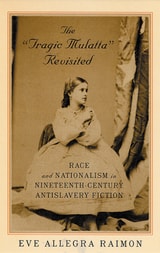
The 'Tragic Mulatta' Revisited
Race and Nationalism in Nineteenth-Century Antislavery FictionEve Allegra Raimon
Rutgers University Press, 2004
Since its inception, the United States has been intensely preoccupied with interracialism. The concept is embedded everywhere in our social and political fabric, including our sense of national identity. And yet, in both its quantitative and symbolic forms, interracialism remains an extremely elusive phenomenon, causing policy makers and census boards to wrangle over how to delineate it and, on an emblematic level, stirring intense emotions from fear to fascination.
In The “Tragic Mulatta” Revisited, Eve Allegra Raimon focuses on the mixed-race female slave in literature, arguing that this figure became a symbolic vehicle for explorations of race and nation—both of which were in crisis in the mid-nineteenth century. At this time, judicial, statutory, social, and scientific debates about the meaning of racial difference (and intermixture) coincided with disputes over frontier expansion, which were never merely about land acquisition but also literally about the “complexion” of that frontier. Embodying both northern and southern ideologies, the “amalgamated” mulatta, the author argues, can be viewed as quintessentially American, a precursor to contemporary motifs of “hybrid” and “mestizo” identities.
Where others have focused on the gendered and racially abject position of the “tragic mulatta,” Raimonreconsiders texts by such central antislavery writers as Lydia Maria Child, William Wells Brown, Harriet Beecher Stowe, and Harriet Wilson to suggest that the figure is more usefully examined as a way of understanding the volatile and shifting interface of race and national identity in the antebellum period.
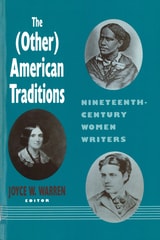
The (Other) American Traditions
Nineteenth-Century Women WritersWarren, Joyce W
Rutgers University Press, 1993
The American literary canon has been the subject of debate and change for at least a decade. As women writers and writers of color are being rediscovered and acclaimed, the question of whether they are worthy of inclusion remains open.
The (Other) American Traditions brings together for the first time in one place, essays on individual writers and traditions that begin to ask the harder questions. How do we talk about these writers once we get beyond the historical issues? How is their work related to their male counterparts? How is it similar: how is it different? Are differences related to gender or race or class? How has the selection of books in the literary canon (Melville, Hawthorne, Emerson, and James) led to a definition of the American tradition that was calculated to exclude women? Do we need a new critical vocabulary to discuss these works? Should we stop talking about a tradition and begin to talk about many traditions? How did black American women writers develop strategies for speaking out when they were doubly in jeopardy of being ignored as blacks and as women? The volume offers irrefutable proof that the writers, the critics who work on their texts, all these questions, and the expansion of the canon matter very much indeed.
Contributors: Nina Baym, Deborah Carlin, Joanne Dobson, Josephine Donovan, Judith Fetterley, Frances Smith Foster, Susan K. Harris, Karla F.C. Holloway, Paul Lauter, Diane Lichtenstein, Carla L. Peterson, Carol J. Singley, Jane Tompkins, Joyce W. Warren and Sandra A. Zagarell.
The Absurd Hero in American Fiction
Updike, Styron, Bellow, SalingerBy David D. Galloway
University of Texas Press, 1981
When The Absurd Hero in American Fiction was first released in 1966, Granville Hicks praised it in a lead article for the Saturday Review as a sensitive and definitive study of a new trend in postwar American literature. In the years that followed, David Galloway’s analysis of the writings of John Updike, William Styron, Saul Bellow, and J. D. Salinger became a standard critical work, an indispensable tool for readers concerned with contemporary American literature. The New York Times described the book as “a seminal study of the modern literary imagination."
David Galloway, himself an established novelist, later extensively revised The Absurd Hero to include authoritative discussions of more than a dozen novels which had appeared since the first revised edition was released in 1970. Among them are John Updike’s Couples, Rabbit Redux, and The Coup; William Styron’s The Confessions of Nat Turner and Sophie’s Choice; and Saul Bellow’s Mr. Sammler’s Planet and Humboldt’s Gift. Through detailed analyses of these works, Galloway demonstrates the continuing relevance of his own provocative concept of the absurd hero and provides important insights into the literary achievements of four of America’s most influential postwar novelists.
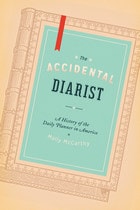
The Accidental Diarist
A History of the Daily Planner in AmericaMolly A. McCarthy
University of Chicago Press, 2013
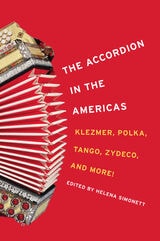
The Accordion in the Americas
Klezmer, Polka, Tango, Zydeco, and More!Edited by Helena Simonett
University of Illinois Press, 2012
This rich collection considers the accordion and its myriad forms, from the concertina, button accordion, and piano accordion familiar in European and North American music to the exotic-sounding South American bandoneon and the sanfoninha. Capturing the instrument's spread and adaptation to many different cultures in North and South America, contributors illuminate how the accordion factored into power struggles over aesthetic values between elites and working-class people who often were members of immigrant and/or marginalized ethnic communities. Specific histories and cultural contexts discussed include the accordion in Brazil, Argentine tango, accordion traditions in Colombia and the Dominican Republic, cross-border accordion culture between Mexico and Texas, Cajun and Creole identity, working-class culture near Lake Superior, the virtuoso Italian-American and Klezmer accordions, Native American dance music, and American avant-garde.
Contributors are María Susana Azzi, Egberto Bermúdez, Mark DeWitt, Joshua Horowitz, Sydney Hutchinson, Marion Jacobson, James P. Leary, Megwen Loveless, Richard March, Cathy Ragland, Helena Simonett, Jared Snyder, Janet L. Sturman, and Christine F. Zinni.
The Acoustic World of Early Modern England
Attending to the O-FactorBruce R. Smith
University of Chicago Press, 1999
In this ear-opening journey into the sound-worlds of Shakespeare's contemporaries, Bruce R. Smith explores both the physical aspects of human speech (ears, lungs, tongue) and the surrounding environment (buildings, landscape, climate), as well as social and political structures. Drawing on a staggeringly wide range of evidence, he crafts a historical phenomenology of sound, from reconstructions of the "soundscapes" of city, country, and court to detailed accounts of the acoustic properties of the Globe and Blackfriars theaters and how scripts designed for the two spaces exploited sound very differently.
Critical for anyone who wants to understand the world of early modern England, Smith's pathbreaking "ecology" of voice and listening also has much to offer musicologists and acoustic ecologists.
The Act and the Place of Poetry
Selected EssaysYves Bonnefoy
University of Chicago Press, 1989
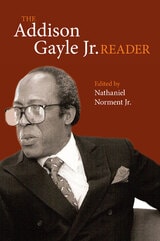
The Addison Gayle Jr. Reader
Edited by Nathaniel Norment Jr.
University of Illinois Press, 2008
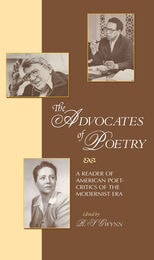
The Advocates of Poetry
A Reader of American Poet-Critics of the Modernist EraR S Gwynn
University of Arkansas Press, 1996
The Aesthetic Border
Colombian Literature in the Face of GlobalizationBrantley Nicholson
Bucknell University Press, 2022
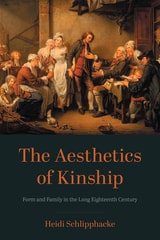
The Aesthetics of Kinship
Form and Family in the Long Eighteenth CenturyHeidi Schlipphacke
Bucknell University Press, 2023
The Aesthetics of Service in Early Modern England
Elizabeth Rivlin
Northwestern University Press, 2011
In The Aesthetics of Service in Early Modern England, Elizabeth Rivlin explores the ways in which servant-master relationships reshaped literature. The early modern servant is enjoined to obey his or her master out of dutiful love, but the servant's duty actually amounts to standing in for the master, a move that opens the possibility of becoming master. Rivlin shows that service is fundamentally a representational practice, in which the servant who acts for a master merges with the servant who acts as a master.
Rivlin argues that in the early modern period, servants found new positions as subjects and authors found new forms of literature. Representations of servants and masters became a site of contact between pressing material concerns and evolving aesthetic ones. Offering readings of dramas by Shakespeare, Jonson, and Thomas Dekker and prose fictions by Thomas Deloney and Thomas Nashe, Rivlin suggests that these authors discovered their own exciting and unstable projects in the servants they created.
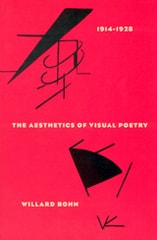
The Aesthetics of Visual Poetry, 1914-1928
Willard Bohn
University of Chicago Press, 1993
"An important contribution. Highly sophisticated, the study tends to raise its reader's impression of visual poetry in the twentieth century from trivial pastime to serious preoccupation."—Eric Sellin, Journal of Modern Literature
"With his definitive analyses full of quotable observations and sharp critical insights, Bohn has provided a model, pioneering study, one from which current and future studies of visual poetry will most certainly benefit."—Gerald J. Janacek, Romance Quarterly
"Bohn substantiates his thesis with thoughtful and often ingenious explications of texts both well known and hard to find. . . . Aesthetics of Visual Poetry is a thoroughly researched, beautifully written and fascinating introduction to an infinitely intriguing genre."—Mechthild Cranston, French Review
The Affinity of the Eye
Writing Nikkei in PeruIgnacio López-Calvo
University of Arizona Press, 2013
In The Affinity of the Eye: Writing Nikkei in Peru, Ignacio López-Calvo rises above the political emergence of the Fujimori phenomenon and uses politics and literature to provide one of the first comprehensive looks at how the Japanese assimilated and inserted themselves into Peruvian culture. Through contemporary writers’ testimonies, essays, fiction, and poetry, López-Calvo constructs an account of the cultural formation of Japanese migrant communities. With deftly sensitive interviews and comments, he portrays the difficulties of being a Japanese Peruvian. Despite a few notable examples, Asian Peruvians have been excluded from a sense of belonging or national identity in Peru, which provides López-Calvo with the opportunity to record what the community says about their own cultural production. In so doing, López-Calvo challenges fixed notions of Japanese Peruvian identity.
The Affinity of the Eye scrutinizes authors such as José Watanabe, Fernando Iwasaki, Augusto Higa, Doris Moromisato, and Carlos Yushimito, discussing their literature and their connections to the past, present, and future. Whether these authors push against or accept what it means to be Japanese Peruvians, they enrich the images and feelings of that experience. Through a close reading of literary and cultural productions, López-Calvo’s analysis challenges and reframes the parameters of being Nikkei in Peru.
Covering both Japanese issues in Peru and Peruvian issues in Japan, the book is more than a compendium of stories, characters, and titles. It proves the fluid, enriching, and ongoing relationship that exists between Peru and Japan.
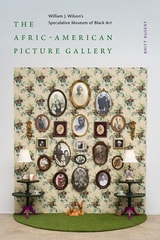
The Afric-American Picture Gallery
William J. Wilson's Speculative Museum of Black ArtBritt Rusert
Duke University Press, 2026
The Afterlife of Sympathy
Reading American Literary Realism in the Wake of "Uncle Tom’s Cabin"Faye Halpern
University of Massachusetts Press, 2024
Literary realism rose to prominence in postbellum America with what the realists heralded as artful and accurate depictions of the world. Realism is thought to have replaced sentimentality—an earlier mode of writing the realists disparaged, which has often been seen as antithetical to realism. Literary scholar Faye Halpern challenges this apparent binary by uncovering how and why William Dean Howells, Mark Twain, Henry James, Constance Fenimore Woolson, and Charles Chesnutt incorporated sentimental elements into their most famous works.
With its distinctively narratological approach, The Afterlife of Sympathy offers a more rhetorical way to understand sentimentality and assess the ethical complexity of sympathy. Halpern demonstrates how sentimentality enables authors to form intimate relationships between their characters and readers to supplement the critical distance that realist writers otherwise celebrate and that has remained a key value in literary studies today. In reassessing American literary realism, Halpern seeks not only to understand why these writers adopted sentimental techniques but to provide insight into contemporary arguments in literary studies about critical distance and sympathetic identification.
The Aftermath of War
Jean-Paul Sartre
Seagull Books, 2008
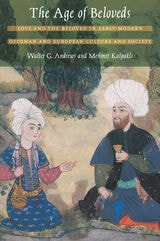
The Age of Beloveds
Love and the Beloved in Early-Modern Ottoman and European Culture and SocietyWalter G. Andrews and Mehmet Kalpakli
Duke University Press, 2005
The authors show that the “age of beloveds” was not just an Ottoman, eastern European, or Islamic phenomenon. It extended into western Europe as well, pervading the cultures of Venice, Florence, Rome, and London during the same period. Andrews and Kalpakli contend that in an age dominated by absolute rulers and troubled by war, cultural change, and religious upheaval, the attachments of dependent courtiers and the longings of anxious commoners aroused an intense interest in love and the beloved. The Age of Beloveds reveals new commonalities in the cultural history of two worlds long seen as radically different.
The Age of Eclecticism
Literature and Culture in Britain, 1815–1885Christine Bolus-Reichert
The Ohio State University Press, 2009
The Age of Nightmare
The Gothic and British Culture, 1750–1900Jeremy Black
St. Augustine's Press, 2022
Black's understanding of the Gothic writer is a remarkable contribution to the legacy of British literature and the novel at large. Once again, in Black thoroughness meets fidelity and the reader is overcome with his own insights into the period on the merit of Black's efforts.
In The Weight of Words Series, Black is devoted to the preservation of the memory of British literary genius, and in so doing he is carving out a niche for himself. As in the Gothic novel where landscapes give quarter to influences that seem to interact with the human fates that freely wander in, reading Black is an experience of suddenly finding oneself in possession of an education, and his allure takes a cue from the horrific Gothic tempt.
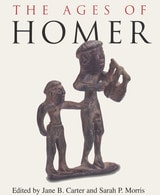
The Ages of Homer
A Tribute to Emily Townsend VermeuleEdited by Jane B. Carter and Sarah P. Morris
University of Texas Press, 1995
Homer’s Iliad and Odyssey have fascinated listeners and readers for over twenty-five centuries. In this volume of original essays, collected to honor the distinguished career of Emily T. Vermeule, thirty-four leading experts in Homeric studies and related fields provide up-to-date, multidisciplinary accounts of the most current issues in the study of Homer.
The book is divided into three sections. The first section treats the Bronze Age setting of the poems (around 1200 B.C.), using archaeological evidence to reveal how poetic memory preserves, distorts, and invents the past. The second section explores the early Iron Age, in which the poems were written (c. 800-500 B.C.), using the strategies of comparative philology and mythology, literary theory, historical linguistics, anthropology, and iconography to determine how the poems took shape. The final section traces the use of Homer for literary and artistic inspiration by classical Greece and Rome.
The Aggada of the Bavli and Its Cultural World
Geoffrey Herman
SBL Press, 2018
Essays that explore the rich engagement of the Talmud with its cultural world
The Babylonian Talmud (Bavli), the great compilation of Jewish law edited in the late Sasanian era (sixth–seventh century CE), also incorporates a great deal of aggada, that is, nonlegal material, including interpretations of the Bible, stories, folk sayings, and prayers. The Talmud’s aggadic traditions often echo conversations with the surrounding cultures of the Persians, Eastern Christians, Manichaeans, Mandaeans, and the ancient Babylonians, and others. The essays in this volume analyze Bavli aggada to reveal this rich engagement of the Talmud with its cultural world.
Features:
- A detailed analysis of the different conceptions of martyrdom in the Talmud as opposed to the Eastern Christian martyr accounts
- Illustration of the complex ways rabbinic Judaism absorbed Christian and Zoroastrian theological ideas
- Demonstration of the presence of Persian-Zoroastrian royal and mythological motifs in talmudic sources
The Air-Line to Seattle
Kenneth S. Lynn
University of Chicago Press, 1984
The Allegorical Epic
Essays in its Rise and DeclineMichael Murrin
University of Chicago Press, 1980
The Ambiguity of Taste
Freedom and Food in European RomanticismJocelyne Kolb
University of Michigan Press, 1995
In The Ambiguity of Taste, Jocelyne Kolb attempts to define changes in genre and metaphorical usage by undertaking close readings of six authors. She looks first at Molière and Fielding, whose culinary allusions herald poetic revolution but whose works do not themselves escape the limits of a neoclassical aesthetic. Byron and Heine, known as renegades, are treated in separate chapters and in the greatest detail. The penultimate chapter joins Goethe and Hugo as champions of poetic freedom, and in the final chapter Kolb briefly considers Thomas Mann and Proust, whose works display the gains of poetic revolution.
This book will be savored by students of comparative literature and European Romanticism. Its accessible style will tempt nonspecialists and food enthusiasts as well.
Jocelyne Kolb is Professor of German Studies, Smith College. This book was the winner of the 1995 American Conference on Romanticism Book Prize.
The American Counterfeit
Authenticity and Identity in American Literature and CultureMary McAleer Balkun
University of Alabama Press, 2006
Focusing on texts written between 1880 and 1930, Mary McAleer Balkun explores the concept of the “counterfeit,” both in terms of material goods and invented identities, and the ways that the acquisition of objects came to define individuals in American culture and literature. Counterfeiting is, in one sense, about the creation of something that appears authentic—an invented self, a museum display, a forged work of art. But the counterfeit can also be a means by which the authentic is measured, thereby creating our conception of the true or real.
When counterfeiting is applied to individual identities, it fosters fluidity in social boundaries and the games of social climbing and passing that have come to be representative of American culture: the Horatio Alger story, the con man or huckster, the social climber, the ethnically ambiguous.
Balkun provides new readings of traditional texts such as The Great Gatsby, Adventures of Huckleberry Finn, and The House of Mirth, as well as readings of less-studied texts, such as Walt Whitman’s Specimen Days and Nella Larsen’s Passing. In each of these texts, Balkun locates the presence of manufactured identities and counterfeit figures, demonstrating that where authenticity and consumerism intersect, the self becomes but another commodity to be promoted, sold, and eventually consumed.
The American Essay in the American Century
Ned Stuckey-French
University of Missouri Press, 2011
The American Girl Goes to War
Women and National Identity in U.S. Silent FilmLiz Clarke
Rutgers University Press, 2022
The American Literature Scholar in the Digital Age
Edited by Amy E. Earhart and Andrew Jewell
University of Michigan Press, 2010
"By casting the collection explicitly as an outreach to the larger community of Americanists---not primarily those who self-identify as 'digital scholars'---Earhart and Jewell have made an important choice, and one that will likely make this a landmark publication."
---Andrew Stauffer, University of Virginia
The American Literature Scholar in the Digital Age, which features a wide range of practitioner-scholars, is the first of its kind: a gathering of people who are expert in American literary studies and in digital technologies, scholars uniquely able to draw from experience with building digital resources and to provide theoretical commentary on how the transformation to new technologies alters the way we think about and articulate scholarship in American literature. The volume collects articles from those who are involved in tool development, usability testing, editing and textual scholarship, digital librarianship, and issues of race and ethnicity in digital humanities, while also situating digital humanities work within the larger literary discipline. In addition, the volume examines the traditional structures of the fields, including tenure and promotion criteria, modes of scholarly production, the skill sets required for scholarship, and the training of new scholars.
The American Literature Scholar in the Digital Age will attract practitioners of digital humanities in multiple fields, Americanists who utilize digital materials, and those who are intellectually curious about the new movement and materials.
Amy E. Earhart is Assistant Professor in the Department of English at Texas A&M University.
Andrew Jewell is Associate Professor of Digital Projects, University Libraries, at the University of Nebraska–Lincoln.
Cover art: Book background ©iStockphoto.com/natashika
digitalculturebooks is an imprint of the University of Michigan Press and the Scholarly Publishing Office of the University of Michigan Library dedicated to publishing innovative and accessible work exploring new media and their impact on society, culture, and scholarly communication. Visit the website at www.digitalculture.org.
The American Open Road
Narrative and Popular ImaginationJeffrey Alan Melton
University of Alabama Press, 2025
WINNER OF THE ELIZABETH AGEE PRIZE IN AMERICAN LITERATURE
The rearview mirror perspective of a road trip across the American “open road.”
The American Open Road: Narrative and Popular Imagination offers a rich exploration of how the mythos of the open road has shaped, and been shaped by, American culture. Beginning with the post–World War II boom that solidified car culture as central to American life, Melton reflects on how roads, automobiles, and landscapes have been represented in literature, film, and other cultural texts, highlighting the interplay between mobility and narrative.
Drawing on a wide range of cultural texts, from traditional classic road novels and cinematic presentations, to advertisements, poetry, and prose, Melton examines how the open road functions as a symbol of autonomy, reinvention, and resistance. He highlights how road narratives have also exposed deeper tensions in American life—especially around race, gender, and power—and how historically marginalized voices have used the road to reclaim space and tell new stories.
From the romanticism of Route 66 to the political edge of modern road films, The American Open Road offers a thoughtful, engaging analysis of the narratives that continue to define American identity and longing. For readers interested in cultural history, travel literature, or the enduring pull of the highway, this book offers a compelling view from the passenger seat of America’s most iconic journeys.
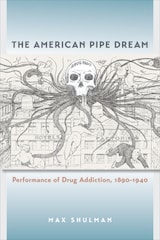
The American Pipe Dream
Performance of Drug Addiction, 1890-1940Max Shulman
University of Iowa Press, 2022
Chapters look at how theatre, film, and popular culture linked the Chinese immigrant and opium smoking; the early attacks on doctors for their part in the creation of addicts; the legislation of addiction as a criminal condition; the comic portrayals of addiction; the intersection of Black, jazz, and drug cultures through cabaret performance; and the linkage between narcotic inebriation and artistic inspiration. The American Pipe Dream creates active connections between these case studies, demonstrating how this history has influenced our contemporary understanding, treatment, and legislation of drug use and addiction.
The American Poet at the Movies
A Critical HistoryLaurence Goldstein
University of Michigan Press, 1995
As an increasingly popular genre of modern poetry, and one that permits a unique view of this century's dominant art form, the movie poem has needed an explanatory book like this one. As cinema and television continue to wield extraordinary influence over the lives of all Americans, the efforts of poets to understand the visual culture will come to be appreciated as central to the task of modern and postmodern literature. This critical history is an important and timely contribution to the study of American literature and American institutions.
"One of the impressive things about the book is that while pursuing the seemingly narrow category of poems-about-movies, Goldstein is able to raise and illuminate virtually all the key issues surrounding the poetry of the period." - Roger Gilbert, Cornell University
". . . a discerning book, combining criticism and social history. It satisfies scholarly standards while appealing to general readers." - Philip French, coeditor of the Faber Book of Movie Verse
"In this work, [Goldstein] provides a new way of looking at American poets, both familiar and neglected. The approach is chronological and thematic, and films are seen from black, gay, Jewish, and feminist as well as middle-class white perspectives." Library Journal
Laurence Goldstein is editor of the Michigan Quarterly Review and Professor of English, University of Michigan.
The American Sonnet
An Anthology of Poems and EssaysDora Malech
University of Iowa Press, 2023
Contributor List: Essayists
Abdul Ali, Baltimore, MD
Anna Lena Phillips Bell, University of North Carolina, Wilmington
Jodie Childers, Queens, New York
Benjamin Crawford, University of Alabama
Meg Day, Franklin and Marshall College
Donna Denizé, St. Albans School
Michael Dumanis, Bennington College
Jordan Finkin, Hebrew Union College
Rebecca Morgan Frank, Northwestern University
Anna Maria Hong, Mount Holyoke College
Gillian Huang-Tiller, University of Virginia, Wise
Walt Hunter, Clemson University
John James, University of California, Berkeley
Matthew Kilbane, University of Notre Dame
Diana Leca, University of Oxford
Ariel Martino, Colgate University
Nate Mickelson, New York University
Lisa L. Moore, University of Texas at Austin
Timo Müller, University of Konstanz, Germany
Carl Phillips, Washington University in St. Louis
Zoë Pollak, Columbia University
Jonathan F.S. Post, UCLA
Stephen Regan, Durham University, UK
Jahan Ramazani, University of Virginia
Hollis Robbins, University of Utah
Nathan Spoon, Joelton, TN
Marlo Starr, Wittenberg University
Yuki Tanaka, Hosei University, Japan
Tess Taylor, Ashland University
Michael Theune, Illinois Wesleyan University
Eleanor Wakefield, University of Oregon
Lesley Wheeler, Washington and Lee University
Jon Woodson, Howard University emeritus
Contributors List: Poets
Elizabeth Alexander, Agha Shahid Ali, Julia Alvarez, Maggie Anderson, Tacey Atsitty, Charles Bernstein, Ted Berrigan, Jen Bervin, Elizabeth Bishop, Louise Bogan, Ruth Muskrat Bronson, Gwendolyn Brooks, Jericho Brown, Lucille Clifton, Henri Cole, Wanda Coleman, Countee Cullen, William Cullen Bryant, E.E. Cummings, Meg Day, Natalie Diaz, Paul Laurence Dunbar, Alice Moore Dunbar-Nelson, Ralph Waldo Emerson, Rhina Espaillat, Tarfia Faizullah, Robert Frost, torrin a. greathouse, Marilyn Hacker, Robert Hayden, Terrance Hayes, Anthony Hecht, Lynn Hejinian, Leslie Pinckney Hill, Anna Maria Hong, Langston Hughes, David Humphreys, Helen Hunt Jackson, Tyehimba Jess, Helene Johnson, James Weldon Johnson, June Jordan, Douglas Kearney, Richard Kenney, Joan Larkin, Emma Lazarus, Mani Levb, Amy Lowell, Robert Lowell, Nate Marshall, Bernadette Mayer, George Marion McClellan, Brandy Nalani McDougall, Claude McKay, Joyelle McSweeney, Lo Kwa Mei-en, James Merrill, Phillip Metres, Edna St. Vincent Millay, Simone Muench, Marilyn Nelson, Craig Santos Perez, Carl Phillips, Sylvia Plath, Alexander Posey, Lizette Woodworth Reese, Adrienne Rich, Lola Ridge, Muriel Rukeyeser, Kay Ryan, Diane Seuss, Fradel Shtok, Aaron Shurin, giovanni singleton, Patricia Smith, Mary Ellen Solt, Nathan Spoon, Gertrude Stein, Adrienne Su, Lorenzo Thomas, Dunstan Thompson, Natasha Tretheway, Fredrick Goddard Tuckerman, Mona Van Duyn, Ellen Bryant Voight, Margaret Walker, Lucian B. Watkins, Phillis Wheatley, John Wheelwright, Jackie K. White, Walt Whitman, James Wright, Elinor Wylie
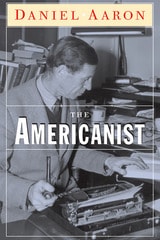
The Americanist
Daniel Aaron
University of Michigan Press, 2009
“I have read all of Daniel Aaron’s books, and admired them, but in The Americanist I believe he has composed an intellectual and social memoir for which he will be remembered. His self-portrait is marked by personal tact and admirable restraint: he is and is not its subject. The Americanist is a vision of otherness: literary and academic friends and acquaintances, here and abroad. Eloquently phrased and free of nostalgia, it catches a lost world that yet engendered much of our own.”
—Harold Bloom
“The Americanist is the absorbing intellectual autobiography of Daniel Aaron, who is the leading proponent and practitioner of American Studies. Written with grace and wit, it skillfully blends Daniel Aaron’s personal story with the history of the field he has done so much to create. This is a first-rate book by a first-rate scholar.”
—David Herbert Donald, Professor Emeritus, Harvard University
The Americanist is author and critic Daniel Aaron’s anthem to nearly a century of public and private life in America and abroad. Aaron, who is widely regarded as one of the founders of American Studies, graduated from the University of Michigan, received his Ph.D. from Harvard, and taught for over three decades each at Smith College and Harvard.
Aaron writes with unsentimental nostalgia about his childhood in Los Angeles and Chicago and his later academic career, which took him around the globe, often in the role of America’s accidental yet impartial critic. When Walt Whitman, whom Aaron frequently cites as a touchstone, wrote, “I am large, I contain multitudes,” he could have been describing Daniel Aaron—the consummate erudite and Renaissance individual whose allegiance to the truth always outweighs mere partisan loyalty.
Not only should Aaron’s book stand as a resplendent and summative work from one of the finest thinkers of the last hundred years, it also succeeds on its own as a first-rate piece of literature, on a par with the writings of any of its subjects. The Americanist is a veritable Who’s Who of twentieth-century writers Aaron interviewed, interacted with, or otherwise encountered throughout his life: Ralph Ellison, Robert Frost, Lillian Hellman, Richard Hofstadter, Alfred Kazin, Sinclair Lewis, Malcolm Muggeridge, John Crowe Ransom, Upton Sinclair, Edmund Wilson, Leonard Woolf, and W. B. Yeats, to name only a few.
Aaron’s frank and personal observations of these literary lights make for lively reading. As well, scattered throughout The Americanist are illuminating portraits of American presidents living and passed—miniature masterworks of astute political observation that offer dazzlingly fresh approaches to well-trod subjects.