Results by title
276 books match the query 'Legal History' and 85 start with t
The Limits of Sovereignty
Property Confiscation in the Union and the Confederacy during the Civil WarDaniel W. Hamilton
University of Chicago Press, 2006
Americans take for granted that government does not have the right to permanently seize private property without just compensation. Yet for much of American history, such a view constituted the weaker side of an ongoing argument about government sovereignty and individual rights. What brought about this drastic shift in legal and political thought?
Daniel W. Hamilton locates that change in the crucible of the Civil War. In the early days of the war, Congress passed the First and Second Confiscation Acts, authorizing the Union to seize private property in the rebellious states of the Confederacy, and the Confederate Congress responded with the broader Sequestration Act. The competing acts fueled a fierce, sustained debate among legislators and lawyers about the principles underlying alternative ideas of private property and state power, a debate which by 1870 was increasingly dominated by today’s view of more limited government power.
Through its exploration of this little-studied consequence of the debates over confiscation during the Civil War, The Limits of Sovereignty will be essential to an understanding of the place of private property in American law and legal history.
The Lost Cause
The Trials of Frank and Jesse JamesJames P. Muehlberger
Westholme Publishing, 2013
On a dreary December 7, 1869, two strangers entered the Daviess County Savings and Loan in Gallatin, Missouri. One of the men asked the cashier for change and then unexpectedly raised a revolver and shot him at point-blank range. Until now, this crime has been considered the first of a string of bank and train robberies committed by Jesse James, his brother Frank, and other gang members. But a story has circulated for more than a century that the case was actually brought to trial by a young Missouri lawyer—and it was through this case that twenty-two-year-old Jesse was first identified as a criminal to the country. But until recently no evidence for such an action could be found. After years of painstaking searches through dusty court archives across Missouri, defense attorney James P. Muehlberger finally discovered the historic documents in 2007. These fascinating and important records reveal that the gunmen were forced to leave behind a magnificent thoroughbred that linked James to the murder and, more intriguing, that the attack was not a bank robbery at all, but a calculated assassination in retribution for a Civil War killing.
The Lost Cause: The Trials of Frank and Jesse James is a thoroughly researched, thrilling account of the rise, pursuit, and prosecution of the legendary outlaw gang. Beginning with the newfound evidence of the Gallatin bank teller murder, the author explains how Jesse James attempted to avenge the death of his Confederate partisan leader, “Bloody Bill” Anderson, but shot the wrong man. Having lost his thoroughbred, Jesse stole another horse. Newly minted lawyer Henry McDougal brashly sued Jesse and Frank James for the loss of property, which would hang the murder on their heads. While Jesse professed his innocence and remained at large, his case was taken up by John Newman Edwards, editor of the Kansas City Times. Through Edwards’s pen, the James brothers were transformed from petty criminals to noble outlaws still fighting for Southern honor—the “Lost Cause.” Not fooled by Edwards’s rhetoric and populist appeal, McDougal and others, including Pinkerton detectives and the governor of Missouri, led a behind-the-scenes fight to bring down the gang. As the author explains, they first prosecuted lesser gang members, and by infiltrating the group, the authorities slowly unraveled the gang, with Jesse being shot by a paid informant in 1882. Frank James gave himself up, and in what was called the “trial of the century,” he was exonerated on all charges and retired to become a notable horse racing official until his death in 1915. Combining true crime, western adventure, and the transformation of America into a modern nation, The Lost Cause is engaging, entertaining history.
The Making of Environmental Law
Richard J. Lazarus
University of Chicago Press, 2022
How did environmental law first emerge in the United States? Why has it evolved in the ways that it has? And what are the unique challenges inherent to environmental lawmaking in general and in the United States in particular?
Since its first edition, The Making of Environmental Law has been foundational to our understanding of these questions. For the second edition, Richard J. Lazarus returns to his landmark book and takes stock of developments over the last two decades. Drawing on many years of experience on the frontlines of legal and policy battles, Lazarus provides a theoretical overview of the challenges that environmental protection poses for lawmaking, related to both the distinctive features of US lawmaking institutions and the spatial and temporal dimensions of ecological change. The book explains why environmental law emerged in the manner and form that it did in the 1970s and traces how it developed over sequent decades through key laws and controversies. New chapters, composing more than half of the second edition, examine a host of recent developments. These include how Congress dropped out of environmental lawmaking in the early twenty-first century; the shifting role of the judiciary; long-overdue efforts to provide environmental justice to disadvantaged communities; and the destabilization of environmental law that has resulted from the election of Presidents with dramatically clashing environmental policies.
As the nation’s partisan divide has grown deeper and the challenge of climate change has dramatically raised the perceived stakes for opposing interests, environmental law is facing its greatest challenges yet. This book is essential reading for understanding where we have been and what challenges and opportunities lie ahead.
The Medieval Origins of the Legal Profession
Canonists, Civilians, and CourtsJames A. Brundage
University of Chicago Press, 2008
By the end of the eleventh century, Brundage argues, renewed interest in Roman law combined with the rise of canon law of the Western church to trigger a series of consolidations in the profession. New legal procedures emerged, and formal training for proctors and advocates became necessary in order to practice law in the reorganized church courts. Brundage demonstrates that many features that characterize legal advocacy today were already in place by 1250, as lawyers trained in Roman and canon law became professionals in every sense of the term. A sweeping examination of the centuries-long power struggle between local courts and the Christian church, secular rule and religious edict, The Medieval Origins of the Legal Profession will be a resource for the professional and the student alike.
The Militia and the Right to Arms, or, How the Second Amendment Fell Silent
H. Richard Uviller and William G. Merkel
Duke University Press, 2002
—Amendment II, United States Constitution
The Second Amendment is regularly invoked by opponents of gun control, but H. Richard Uviller and William G. Merkel argue the amendment has nothing to contribute to debates over private access to firearms. In The Militia and the Right to Arms, or, How the Second Amendment Fell Silent, Uviller and Merkel show how postratification history has sapped the Second Amendment of its meaning. Starting with a detailed examination of the political principles of the founders, the authors build the case that the amendment's second clause (declaring the right to bear arms) depends entirely on the premise set out in the amendment's first clause (stating that a well-regulated militia is necessary to the security of a free state). The authors demonstrate that the militia envisioned by the framers of the Bill of Rights in 1789 has long since disappeared from the American scene, leaving no lineal descendants. The constitutional right to bear arms, Uviller and Merkel conclude, has evaporated along with the universal militia of the eighteenth century.
Using records from the founding era, Uviller and Merkel explain that the Second Amendment was motivated by a deep fear of standing armies. To guard against the debilitating effects of militarism, and against the ultimate danger of a would-be Caesar at the head of a great professional army, the founders sought to guarantee the existence of well-trained, self-armed, locally commanded citizen militia, in which service was compulsory. By its very existence, this militia would obviate the need for a large and dangerous regular army. But as Uviller and Merkel describe the gradual rise of the United States Army and the National Guard over the last two hundred years, they highlight the nation's abandonment of the militia ideal so dear to the framers. The authors discuss issues of constitutional interpretation in light of radically changed social circumstances and contrast their position with the arguments of a diverse group of constitutional scholars including Sanford Levinson, Carl Bogus, William Van Alstyne, and Akhil Reed Amar.
Espousing a centrist position in the polarized arena of Second Amendment interpretation, this book will appeal to those wanting to know more about the amendment's relevance to the issue of gun control, as well as to those interested in the constitutional and political context of America's military history.
The Nature of Legal Interpretation
What Jurists Can Learn about Legal Interpretation from Linguistics and PhilosophyEdited by Brian G. Slocum
University of Chicago Press, 2017
To fully engage and probe these questions of interpretation, this volume draws upon a variety of experts from several fields, who collectively examine the interpretation of legal texts. In The Nature of Legal Interpretation, the contributors argue that the meaning of language is crucial to the interpretation of legal texts, such as statutes, constitutions, and contracts. Accordingly, expert analysis of language from linguists, philosophers, and legal scholars should influence how courts interpret legal texts. Offering insightful new interdisciplinary perspectives on originalism and legal interpretation, these essays put forth a significant and provocative discussion of how best to characterize the nature of language in legal texts.
The Paradox of Protection
The Making of Indirect Rule in Southern Sierra Leone, 1850–1915Trina Leah Hogg
Michigan State University Press, 2025
The Politics of Fiscal Privilege in Provence, 1530s-1830s
Rafe Blaufarb
Catholic University of America Press, 2012
The Politics of Piracy
Crime and Civil Disobedience in Colonial AmericaDouglas R. Burgess
University Press of New England, 2014
The Powers of War and Peace
The Constitution and Foreign Affairs after 9/11John Yoo
University of Chicago Press, 2005
John Yoo, formerly a lawyer in the Department of Justice, here makes the case for a completely new approach to understanding what the Constitution says about foreign affairs, particularly the powers of war and peace. Looking to American history, Yoo points out that from Truman and Korea to Clinton's intervention in Kosovo, American presidents have had to act decisively on the world stage without a declaration of war. They are able to do so, Yoo argues, because the Constitution grants the president, Congress, and the courts very different powers, requiring them to negotiate the country's foreign policy. Yoo roots his controversial analysis in a brilliant reconstruction of the original understanding of the foreign affairs power and supplements it with arguments based on constitutional text, structure, and history.
Accessibly blending historical arguments with current policy debates, The Powers of War and Peace will no doubt be hotly debated. And while the questions it addresses are as old and fundamental as the Constitution itself, America's response to the September 11 attacks has renewed them with even greater force and urgency.
“Yoo’s theory promotes frank discussion of the national interest and makes it harder for politicians to parade policy conflicts as constitutional crises. Most important, Yoo’s approach offers a way to renew our political system’s democratic vigor.”—David B. Rivkin Jr. and Carlos Ramos-Mrosovsky, National Review
The Privilege against Self-Incrimination
Its Origins and DevelopmentR. H. Helmholz, Charles M. Gray, John H. Langbein, Eben Moglen, Henry E. Smith,
University of Chicago Press, 1997
Each chapter of this definitive study uncovers what the privilege meant in practice. The authors trace the privilege from its origins in the medieval period to its first appearance in English common law, and from its translation to the American colonies to its development into an effective protection for criminal defendants in the nineteenth century. The authors show that the modern privilege—the right to remain silent—is far from being a basic civil liberty. Rather, it has evolved through halting and controversial steps. The book also questions how well an expansive notion of the privilege accords with commonly accepted principles of morality.
This book constitutes a major revision of our understanding of an important aspect of both criminal and constitutional law.
The Punitive Imagination
Law, Justice, and ResponsibilityAustin Sarat
University of Alabama Press, 2014
From the Gospel of Matthew to numerous US Supreme Court justices, many literary and legal sources have observed that how a society metes out punishment reveals core truths about its character. The Punitive Imagination is a collection of essays that engages and contributes to debates about the purposes and meanings of punishment in the United States.
The Punitive Imagination examines some of the critical assumptions that frame America's approach to punishment. It explores questions such as:
· What is the place of concern for human dignity in our prevailing ideologies of punishment?
· Can we justly punish the socially disadvantaged?
· What assumptions about persons, social institutions, and the ordering of social space provide the basis for American punitiveness?
· Who, if anyone, can be held responsible for excessively punitive criminal sentences?
· How does punishment depend on prevailing views of free will, responsibility, desert, blameworthiness?
· Where/how are those views subject to challenge in our punitive practices?
As Sarat posits in his introduction, the way a society punishes demonstrates its commitment to standards of judgment and justice, its distinctive views of blame and responsibility, its understandings of mercy and forgiveness, and its particular ways of responding to evil. He goes on to discuss the history of punishment in the United States and what it reveals about assumptions made about persons that “undergird” the American system of punishment.
The five additional contributors to The Punitive Imagination seek to illuminate what American practices of punishment tell us about who we are as a nation. Synthesizing cultural, sociological, philosophical, and legal perspectives, they offer a distinctive take on the meaning of punishment in America.
The Rescue of Joshua Glover
A Fugitive Slave, the Constitution, and the Coming of the Civil WarH. Robert Baker
Ohio University Press, 2006
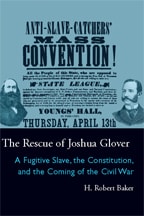
On March 11, 1854, the people of Wisconsin prevented agents of the federal government from carrying away the fugitive slave, Joshua Glover. Assembling in mass outside the Milwaukee courthouse, they demanded that the federal officers respect his civil liberties as they would those of any other citizen of the state. When the officers refused, the crowd took matters into its own hands and rescued Joshua Glover. The federal government brought his rescuers to trial, but the Wisconsin Supreme Court intervened and took the bold step of ruling the Fugitive Slave Act unconstitutional.
The Rescue of Joshua Glover delves into the courtroom trials, political battles, and cultural equivocation precipitated by Joshua Glover’s brief, but enormously important, appearance in Wisconsin on the eve of the Civil War.
H. Robert Baker articulates the many ways in which this case evoked powerful emotions in antebellum America, just as the stage adaptation of Uncle Tom’s Cabin was touring the country and stirring antislavery sentiments. Terribly conflicted about race, Americans struggled mightily with a revolutionary heritage that sanctified liberty but also brooked compromise with slavery. Nevertheless, as The Rescue of Joshua Glover demonstrates, they maintained the principle that the people themselves were the last defenders of constitutional liberty, even as Glover’s rescue raised troubling questions about citizenship and the place of free blacks in America.
The Search for Justice
Lawyers in the Civil Rights Revolution, 1950–1975Peter Charles Hoffer
University of Chicago Press, 2019
The Search for Justice is a look the role of the lawyers throughout the period, focusing on one of the central issues of the time: school segregation. The most notable participants to address this issue were the public interest lawyers of the NAACP’s Legal Defense Fund, whose counselors brought lawsuits and carried out appeals in state and federal courts over the course of twenty years. But also playing a part in the story were members of the bar who defended Jim Crow laws explicitly or implicitly and, in some cases, also served in state or federal government; lawyers who sat on state and federal benches and heard civil rights cases; and, finally, law professors who analyzed the reasoning of the courts in classrooms and public forums removed from the fray. With rich, copiously researched detail, Hoffer takes readers through the interactions of these groups, setting their activities not only in the context of the civil rights movement but also of their full political and legal legacies, including the growth of corporate private legal practice after World War II and the expansion of the role of law professors in public discourse, particularly with the New Deal. Seeing the civil rights era through the lens of law enables us to understand for the first time the many ways in which lawyers affected the course and outcome of the movement.
The Second Amendment on Trial
Critical Essays on District of Columbia v. HellerSaul A. Cornell
University of Massachusetts Press, 2013
On the final day of its 2008 term, a sharply divided U.S. Supreme Court issued a 5-to-4 decision striking down the District of Columbia's stringent gun control laws as a violation of the Second Amendment. Reversing almost seventy years of settled precedent, the high court reinterpreted the meaning of the “right of the people to keep and bear arms” to affirm an individual right to own a gun in the home for purposes of self-defense. The landmark ruling not only opened a new chapter in the contentious history of gun rights and gun control but also revealed both the strengths and problems of originalist constitutional theory and jurisprudence.
This volume brings together some of the best scholarship on the Heller case, with essays by legal scholars and historians representing a range of ideological viewpoints and applying different interpretive frameworks. Following the editors' introduction, which describes the issues involved and the arguments on each side, the essays are organized into four sections. The first includes two of the most important historical briefs filed in the case, while the second offers different views of the role of originalist theory. Section three presents opposing interpretations of the ruling and its relationship to modern constitutional doctrine. The final section explores historical research post-Heller, including new findings on patterns of gun ownership in colonial and Revolutionary America.
In addition to the editors, contributors include Nelson Lund, Joyce Lee Malcolm, Jack Rakove, Reva B. Siegel, Cass R. Sunstein, Kevin M. Sweeney, and J. Harvie Wilkinson III.
The Signature in Law
From the Thirteenth Century to the FacsimileStephen Mason
University of London Press, 2022
Since the thirteenth century, the signature has been used to demonstrate proof of intent. This book puts the concept of the signature into a broad legal context, setting out the purposes and functions of a signature. Drawing on cases from common law jurisdictions across the world, this book demonstrates that judges expanded the meaning of the signature as technologies developed and were used in unanticipated ways.
Following an overview of the historical methods used to demonstrate proof of intent and authentication, the book considers the judicial response to the variations in form that signatures have been subject to over the past two hundred years, from initials, partial signatures, and fingerprints to rubber stamps and typewriting. Past judicial decision-making not only demonstrates the flexibility of the form a signature can take but also confirms that judges had the flexibility of mind to accept the first forms of electronic signature (telex, facsimile transmission) without the aid of special legislation. In this way, the signature is a prime example of the inherent flexibility of the English common law.
The Solemn Sentence of Death
Capital Punishment in ConnecticutLawrence B. Goodheart
University of Massachusetts Press, 2011

The Southern Debate over Slavery
Volume 1: Petitions to Southern Legislatures, 1778-1864Edited by Loren Schweninger
University of Illinois Press, 2001
These petitions, filed by slaveholders and nonslaveholders, slaves and free blacks, women and men, abolitionists and staunch defenders of slavery, constitute a uniquely important primary source. Petitioners were compelled to present the most accurate and fully documented case they could, since their claims would be subject to public scrutiny and legal verification. Unlike the many reminiscences and autobiographies of the period, these petitions record with great immediacy and minute detail the dynamics, common understandings, and legal restrictions and parameters that shaped southern society during this period.
Arranged chronologically, with their original spelling and idiosyncratic phraseology intact, these documents reveal the grim and brutal nature of human bondage, the fears of whites who lived among large concentrations of blacks, and the workings of the complicated legal system designed to control blacks. They tell about the yearning of bondspeople to gain their freedom, the attitudes of freed blacks who were forced to leave the South, and the efforts of African Americans to overcome harsh and restrictive laws. They also underscore the unique situation of free women of color and the reliance of manumitted (formally freed) blacks on their former owners for protection, travel passes, guardianship papers, and reference letters.
Astonishingly intimate and frank,The Southern Debate over Slavery illuminates how slavery penetrated nearly every aspect of southern life and how various groups of southerners responded to the difficulties they confronted as a result of living in a slave society.
The Spanish Element in Texas Water Law
By Betty Eakle Dobkins
University of Texas Press, 1959
The Spanish element in Texas water law is a matter of utmost importance to many landholders whose livelihood is dependent on securing water for irrigation and to many communities particularly concerned about water supply.
Titles to some 280,000 acres of Texas land originated in grants made by the Crown of Spain or by the Republic of Mexico. For these lands, the prevailing law, even today, is the Hispanic American civil law. Thus the question of determining just what water rights were granted by the Spanish Crown in disposing of lands in Texas is more than a matter of historical interest. It is a subject of great practical importance.
Spanish law enters directly into the question of these lands, but its influence is by no means confined to them. Texas water law in general traces its roots primarily to the Spanish law, not to the English common law doctrine of riparian rights or to the Western doctrine of prior appropriation (both of which were, however, eventually incorporated in Texas law). A clear understanding of this background might have saved the state much of the current confusion and chaos regarding its water law.
Dobkins’s book offers an intensive and unusually readable study of the subject. The author has traced water law from its origin in the ancient world to the mid-twentieth century, interpreting the effect of water on the counties concerned, setting forth in detail the development of water law in Spain, and explaining its subsequent adoption in Texas. Copious notes and a complete bibliography make the work especially valuable.
The idea for this book came in the midst of the great seven-year drought in Texas, from 1950 to 1957. The author gave two reasons for her study: “One was my belief that the water problems, crucial to all Texas, can be solved only when Texans become conscious of their imperative needs and only if they become informed and aroused enough to act.
“The second reason came from a realization that water—common, universal, and ordinary as it is—had been overlooked by the historian. It is high time that this oversight be corrected. In American history the significance of land, especially in terms of the frontier, has been spelled out in large letters. The importance of water has been recognized by few.”
The Supreme Court Review, 2015
Edited by Dennis J. Hutchinson, David A. Strauss, and Geoffrey R. Stone
University of Chicago Press Journals, 2016
The Sympathetic State
Disaster Relief and the Origins of the American Welfare StateMichele Landis Dauber
University of Chicago Press, 2012
The Texas Supreme Court
A Narrative History, 1836–1986By James L. Haley
University of Texas Press, 2013
“Few people realize that in the area of law, Texas began its American journey far ahead of most of the rest of the country, far more enlightened on such subjects as women’s rights and the protection of debtors.” Thus James Haley begins this highly readable account of the Texas Supreme Court. The first book-length history of the Court published since 1917, it tells the story of the Texas Supreme Court from its origins in the Republic of Texas to the political and philosophical upheavals of the mid-1980s.
Using a lively narrative style rather than a legalistic approach, Haley describes the twists and turns of an evolving judiciary both empowered and constrained by its dual ties to Spanish civil law and English common law. He focuses on the personalities and judicial philosophies of those who served on the Supreme Court, as well as on the interplay between the Court’s rulings and the state’s unique history in such areas as slavery, women’s rights, land and water rights, the rise of the railroad and oil and gas industries, Prohibition, civil rights, and consumer protection. The book is illustrated with more than fifty historical photos, many from the nineteenth and early twentieth centuries. It concludes with a detailed chronology of milestones in the Supreme Court’s history and a list, with appointment and election dates, of the more than 150 justices who have served on the Court since 1836.
The Tidelands Oil Controversy
A Legal and Historical AnalysisBy Ernest R. Bartley
University of Texas Press, 1953
This study is not written from the narrow perspective of “Who gets the oil?” It is a thoughtful probing of an issue—the ownership and control of the submerged soils of the marginal sea—the outcome of which may go far to determine the division of powers between states and nation under the American federal system.
American constitutional law, international law, theory of federalism, American politics, the machinations of pressure groups, use of propaganda techniques, and issues of social and economic policy—all these features of American government and many more are inherent in the controversy.
In 1947, in a precedent-making decision, the Supreme Court enunciated the principle that the federal government, not the states, has “paramount rights in and power over” the marginal seas which border the coastal states, and has “full dominion over the resources under that water area, including oil.”
For more than 150 years the littoral states had exercised uncontested jurisdiction and ownership over the marginal-sea area, subject only to the powers specifically granted to the national government by the Constitution. The states had regulated the fisheries within the three-mile limit, applying state laws to vessels licensed under federal statutes. Long before oil possibilities were thought of, they had granted or leased areas in the marginal seas to private persons and corporations for purposes of land reclamation and harbor development, dredging for sand and gravel, development of oyster beds, and similar projects. These property rights can far exceed in value the wealth to be derived from petroleum.
A just settlement of the issue, says the author, calls for restoration to the states of control of the marginal sea out to their historical boundaries—three miles in most cases; three leagues, or ten and one-half miles, in the case of Texas and the west coast of Florida.
This study is based upon thorough investigation of all literature on the subject and personal interviews and correspondence with leaders on both sides of the controversy.
The Transformation of Family Law
State, Law, and Family in the United States and Western EuropeMary Ann Glendon
University of Chicago Press, 1989
"Glendon is generally acknowledged to be the premier comparative law scholar in the area of family law. This volume, which offers an analytical survey of the changes in family law over the past twenty-five years, will burnish that reputation. Essential reading for anyone interested in evaluating the major changes that occurred in the law of the family. . . . [And] of serious interest to those in the social sciences as well."—James B. Boskey, Law Books in Review
"Poses important questions and supplies rich detail."—Barbara Bennett Woodhouse, Texas Law Review
"An impressive scholarly documentation of the legal changes that comprise the development of a conjugally-centered family system."—Debra Friedman, Contemporary Sociology
"She has painted a portrait of the family in which we recognize not only ourselves but also unremembered ideological forefathers. . . . It sends our thoughts out into unexpected adventures."—Inga Markovits, Michigan Law Review
The Trial in American Life
Robert A. Ferguson
University of Chicago Press, 2006
The Uses of the Dead
Caroline R. Sherman
Catholic University of America Press, 2017
Posthumous gifts, which required no sacrifice during life, were in fact broadly understood by canon lawyers and medieval donors themselves to have at best a very limited relationship to salvation. As a consequence, for much of the Middle Ages the preferred method for resolving impossible or impractical gifts was to try to reach a consensus among all of the interested parties to the gift, including the donor's heirs and the recipients, with the mediation of the local bishop.
When cy-près emerged in the seventeenth century, it cut a charitable gift o from return to the donor's estate in the event of failure. It also gave the interested parties to the gift (heirs, beneficiaries, or trustees) little authority over resolutions to problematic gifts, which were now considered primarily in relationship to the donor's intent—even as the intent was ultimately honored only in its breach. The Uses of the Dead shows how cy-près developed out of controversies over church property, particularly monastic property, and whether it might be legally turned over to fund education, poor relief, or national defense.
Renaissance humanists hoped to make better, more prudent uses of property; the Reformation sought to correct superstitious abuses of property and ultimately tended to prevent donors' heirs from recovering secularized ecclesiastical gifts; and the early modern state attempted to centralize poor relief and charitable efforts under a more rational, centralized supervision. These three factors combined to replace an older equitable ideal with a new equitable rule—one whose use has rapidly expanded in the modern era to allow assorted approximations and judicial redistributions of property.
The Whole Truth?
A Case of Murder on the Appalachian TrailH. L. Pohlman
University of Massachusetts Press, 1999
On May 13, 1988, Stephen Roy Carr, a so-called mountain man living in Michaux State Forest in south central Pennsylvania, shot two female hikers while they were making love at a campsite near the Appalachian Trail. Rebecca Wight died at the scene. Claudia Brenner, despite five bullet wounds, survived to testify against her attacker.
In this book, H. L. Pohlman reconstructs the dramatic story of this murder case and traces its disposition through the criminal justice system. Drawing on interviews with participants as well as court records, he closely examines competing interpretations of the evidence. Was the attack a hate crime? A sex crime? A class crime? At the same time, he shows how a broad range of substantive and procedural issues—from the rights of the accused to evaluation of potential mitigating circumstances—can influence the assessment of culpability in homicide cases.
This Is Not Civil Rights
Discovering Rights Talk in 1939 AmericaGeorge I. Lovell
University of Chicago Press, 2012
Thomas Goode Jones
Race, Politics, and Justice in the New SouthBrent J. Aucoin
University of Alabama Press, 2016
Thomas Goode Jones of Alabama is the first comprehensive biography of a key Alabama politician and federal jurist whose life and times embody the conflicts and transformations in the Deep South between the Civil War and World War I.
A man who both represented and differed from his class, Thomas Goode Jones offers contemporary readers and scholars an ideal subject of study to understand a period of southern history that still shapes American life today. Often overshadowed by the pharaonic antebellum period, the Civil War, and the luminous heights of the civil rights movement, the deceptively placid decades at the turn of the century were, in fact, a period when southerners fiercely debated the course of the South’s future. In tracing Jones’s career, Brent J. Aucoin offers vivid accounts of the great events and trends of that pivotal period: Reconstruction, the birth of the “Solid South,” the Populist Revolt, and the establishment of racial disenfranchisement and segregation.
Born in 1844, Jones served in the Confederate army and after the war identified as a conservative “Bourbon” Democrat. He served as Alabama's governor from 1890 to 1894 and as a federal judge from 1901 until his death in 1914. As a veteran, politician, and judge, Jones embodied numerous roles in the shifting political landscape of the South.
Jones was not, however, a reflexive conformist and sometimes pursued policies at odds with his party. Jones’s rhetoric and support of African American civil rights were exceptional and earned him truculent criticism from unrepentant racist factions in his party. His support was so fearless that it inspired Booker T. Washington to recommend Jones to Republican president Theodore Roosevelt as a federal judge. On the bench, Jones garnered national attention for his efforts to end peonage and lynching, and yet he also enabled the establishment of legalized segregation in Alabama, confounding attempts easily to categorize him as an odious reactionary or fearless progressive.

Three Bullets Sealed His Lips
Bruce A. Rubenstein
Michigan State University Press, 1987
The gangland style slaying if State Senator Warren G. Hooper on January 11, 1945, three days before he was to testify before a grand jury investigating alleged corruption in the Michigan legislature, forced coverage of Allied war triumphs from the state's newspaper headlines. National media representatives flocked to Michigan to join local reporters in following the efforts of grand jury special prosecutor Kim Sigler and the State Police to apprehend the killers. Because no arrests ever were made, a 1951 journalistic prediction has proven true: "The Hooper case will continue to come back to remind the people and politicians of Michigan of the black days of 1945 when almost every official of the state had his price." For this reason, the Hooper murder has endured as one of the most intriguing unsolved mysteries in the annals of Michigan crime.
Utilizing interviews, trial transcripts, State police files, and a collection of grand jury testimony long thought to have been destroyed, Professors Bruce A. Rubenstein and Lawrence E. Ziewacz set forth the reason for Hooper's assassination. Written in a lively style, using dialogue taken from court records and correspondence, Three Bullets Sealed His Lips demonstrates that historical writing need not be dull.
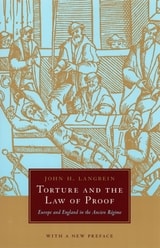
Torture and the Law of Proof
Europe and England in the Ancien RégimeJohn H. Langbein
University of Chicago Press, 2006
The book has recently taken on an eerie relevance as a consequence of controversial American and British interrogation practices in the Iraq and Afghanistan wars. In a new introduction, Langbein contrasts the "new" law of torture with the older European law and offers some pointed lessons about the difficulty of reconciling coercion with accurate investigation. Embellished with fascinating illustrations of torture devices taken from an eighteenth-century criminal code, this crisply written account will engage all those interested in torture's remarkable grip on European legal history.
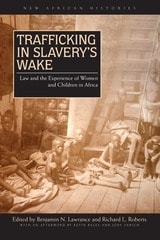
Trafficking in Slavery’s Wake
Law and the Experience of Women and Children in AfricaBenjamin N. Lawrance
Ohio University Press, 2012
Women and children have been bartered, pawned, bought, and sold within and beyond Africa for longer than records have existed. This important collection examines the ways trafficking in women and children has changed from the aftermath of the “end of slavery” in Africa from the late nineteenth century to the present.
The formal abolition of the slave trade and slavery did not end the demand for servile women and children. Contemporary forms of human trafficking are deeply interwoven with their historical precursors, and scholars and activists need to be informed about the long history of trafficking in order to better assess and confront its contemporary forms. This book brings together the perspectives of leading scholars, activists, and other experts, creating a conversation that is essential for understanding the complexity of human trafficking in Africa.
Human trafficking is rapidly emerging as a core human rights issue for the twenty-first century. Trafficking in Slavery’s Wake is excellent reading for the researching, combating, and prosecuting of trafficking in women and children.
Contributors: Margaret Akullo, Jean Allain, Kevin Bales, Liza Stuart Buchbinder, Bernard K. Freamon, Susan Kreston, Benjamin N. Lawrance, Elisabeth McMahon, Carina Ray, Richard L. Roberts, Marie Rodet, Jody Sarich, and Jelmer Vos.
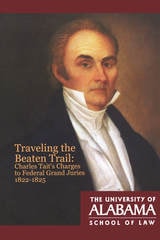
Traveling the Beaten Trail
Charles Tait's Charges to Federal Grand Juries, 1822–1825Paul M. Pruitt Jr., David I. Durham, and Sally E. Hadden
University of Alabama Press, 2013
About Occasional Publications of the Bounds Law Library
This collection offers a series of edited documents that contribute to an understanding of the development of legal history, culture, or doctrine. Series editors Paul M. Pruitt Jr. and David I. Durham have selected a variety of materials—a lecture, diaries, letters, speeches, a ledger, commonplace books, a code of ethics, court reports—to illustrate unique examples of legal life and thought.

Trying Biology
The Scopes Trial, Textbooks, and the Antievolution Movement in American SchoolsAdam R. Shapiro
University of Chicago Press, 2013

Twilight of the American State
Pierre Schlag
University of Michigan Press, 2023
Finalist: 2024 Order of the Coif Book Award | March 3, 2025
The sudden emergence of the Trump nation surprised nearly everyone, including journalists, pundits, political consultants, and academics. When Trump won in 2016, his ascendancy was widely viewed as a fluke. Yet time showed it was instead the rise of a movement—angry, militant, revanchist, and unabashedly authoritarian.
How did this happen? Twilight of the American State offers a sweeping exploration of how law and legal institutions helped prepare the grounds for this rebellious movement. The controversial argument is that, viewed as a legal matter, the American state is not just a liberal democracy, as most Americans believe. Rather, the American state is composed of an uneasy and unstable combination of different versions of the state—liberal democratic, administered, neoliberal, and dissociative. Each of these versions arose through its own law and legal institutions. Each emerged at different times historically. Each was prompted by deficits in the prior versions. Each has survived displacement by succeeding versions. All remain active in the contemporary moment—creating the political-legal dysfunction America confronts today.
Pierre Schlag maps out a big picture view of the tribulations of the American state. The book abjures conventional academic frameworks, sets aside prescriptions for quick fixes, dispenses with lamentations about polarization, and bypasses historical celebrations of the American Spirit.