Results by title
8113 books match the query 'Literary Criticism' and 1818 start with t
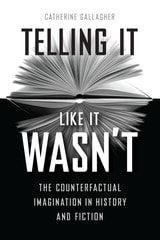
Telling It Like It Wasn’t
The Counterfactual Imagination in History and FictionCatherine Gallagher
University of Chicago Press, 2018
Gallagher locates the origins of contemporary counterfactual history in eighteenth-century Europe, where the idea of other possible historical worlds first took hold in philosophical disputes about Providence before being repurposed by military theorists as a tool for improving the art of war. In the next century, counterfactualism became a legal device for deciding liability, and lengthy alternate-history fictions appeared, illustrating struggles for historical justice. These early motivations—for philosophical understanding, military improvement, and historical justice—are still evident today in our fondness for counterfactual tales. Alternate histories of the Civil War and WWII abound, but here, Gallagher shows how the counterfactual habit of replaying the recent past often shapes our understanding of the actual events themselves. The counterfactual mode lets us continue to envision our future by reconsidering the range of previous alternatives. Throughout this engaging and eye-opening book, Gallagher encourages readers to ask important questions about our obsession with counterfactual history and the roots of our tendency to ask “What if…?”
Telling Narratives
Secrets in African American LiteratureLeslie W. Lewis
University of Illinois Press, 2007
Telling Narratives analyzes key texts from nineteenth- and early twentieth-century African American literature to demonstrate how secrets and their many tellings have become slavery's legacy. By focusing on the ways secrets are told in texts by Jessie Fauset, Charles W. Chesnutt, Pauline Hopkins, Frederick Douglass, and others, Leslie W. Lewis suggests an alternative model to the feminist dichotomy of "breaking silence" in response to sexual violence. This fascinating study also suggests that masculine bias problematically ignores female experience in order to equate slavery with social death. In calling attention to the sexual behavior of slave masters in African American literature, Lewis highlights its importance to slavery’s legacy and offers a new understanding of the origins of self-consciousness within African American experience.
Telling Rhythm
Body and Meaning in PoetryAmittai Aviram
University of Michigan Press, 1994
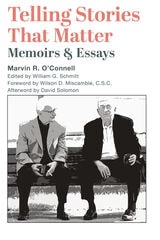
Telling Stories That Matter
Memoirs and EssaysMarvin R. O'Connell
St. Augustine's Press, 2020
In Miscamble’s thorough introduction of O’Connell, he writes that the latter “utilized his striking talents as a historian as an integral part of his fundamental vocation as a priest. [O’Connell] once described the historian as a veritable ‘midwife to our faith,’ who must capture, as best as evidence will allow, the truth of the past.” This position lends itself to the structure of this work. The first part is the sadly incomplete memoirs of Fr. O’Connell, wherein the reader meets the historian and moves with eagerness and confidence into the essays that follow. Highlights of these collected essays include thoughts on Cardinal Newman, Belloc, the Spanish Inquisition, and the historical perspective of evangelization in the United States and modernism at large. What one reads are stories that might have been lost but are here preserved in what can with all moral certainty be called truthfulness. As his friend Ralph McInerny once qualified him, O’Connell combined compassion and judgment such that his histories were always indeed primarily stories and, as the reader well knows, stories have layers and threads and are not told simply for their conclusions.
O’Connell succeeds in showing one how human history is written. Above all, he reveals that history is made by humans, but must also be remembered and deciphered by humans who cannot forego leaving their own marks and prints on everything they encounter (in memory or otherwise). The objectivity we seek can be found in one historical account alone, asserts the priest-storyteller, yet a sharp eye to the past is always consonant with a compassionate desire to understand. Bill Schmitt, Fr. Bill Miscamble and David Solomon do posterity a service by giving us this man and his masterful engagement of history. These friends of O’Connell deem the historian’s passion for truth-in-context to be foundational for shaping stories that matter, including his own.
"This artful combination of memoir and selected essays reawakens our memory of Father O'Connell in all his immense personal charm, intellectual energy, rich erudition, keen wit, and steadfast dedication to his interlocking callings as priest and historian." —J. Philip Gleason, Emeritus Professor, History Department, University of Notre Dame
"The work of a master historian, these memoirs and essays are reliable in recounting what happened, insightful in judging how and why, and eloquent in presenting it all with a flair and wit rarely equaled in historical writing. Moreover, they come forth from a Catholic faith so deep and secure that it need not be imposed on the reader. Rather, they do what good historical writing does, placing the reader into a past that can be seen and felt, recognized and understood. Whether it be his colorful accounts of the tumultuous life and times of Thomas More, or the valiant struggles of Newman and the Oxford Movement, or his own seminary training and teaching in St. Paul, or his fortunes as a graduate student at Notre Dame under the tutelage of the eminent Monsignor Phillip Hughes—whatever the topic, reading O’Connell’s history gives one the gift of being able to say, I remember that happening and I wasn’t even there!"—Michael J. Baxter, Director of Catholic Studies, Regis University in Denver
"O'Connell was a master story teller. He was not, however, just a story teller. He was painstakingly rigorous in what and how he taught. His stories always perfectly illustrated a point, but they were never a substitution for the truth--rather an illustration of it." —Bradley Birzer, Russell Amos Kirk Chair in American Studies, Hillsdale College
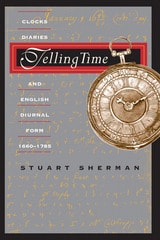
Telling Time
Clocks, Diaries, and English Diurnal Form, 1660-1785Stuart Sherman
University of Chicago Press, 1997
Through brilliant readings of Samuel Pepys's diary, Joseph Addison and Richard Steele's daily Spectator, the travel writings of Samuel Johnson and James Boswell, and the novels of Daniel Defoe and Frances Burney, Sherman traces the development of a new way of counting time in prose—the diurnal structure of consecutively dated installments—within the cultural context of the daily institutions which gave it form and motion. Telling Time is not only a major accomplishment for seventeenth- and eighteenth-century literary studies, but it also makes important contributions to current discourse in cultural studies.
Telling Wonders
Ethnographic and Political Discourse in the Work of HerodotusRosaria Munson
University of Michigan Press, 2001
As he explores the causes of the East-West conflict from its most remote antecedents, Herodotus includes conflicting traditions about different historical periods as well as apparently tangential descriptions of the customs of faraway peoples. What was his aim in combining such diverse material? Rosaria Vignolo Munson argues that Herodotus' aim was two-fold: to use historical narrative to illuminate the present and to describe barbarian customs so that the Greeks might understand themselves.
Herodotus assumes the role of advisor to his audience, acting as a master of metaphor and oracular speech and as an intellectual fully aware of new philosophical and political trends. By comparing, interpreting, and evaluating facts through time and space or simply by pointing them out as objects of "wonder," he teaches that correct political action is linked to an appropriate approach to foreigners and additional "others." Munson relies on traditional scholarship and modern studies in narratology and related critical fields to distinguish between narrative and metanarrative, providing a framework for analyzing the construction of Herodotus' discourse and his presentation of himself through it.
Munson's work will be useful to classicists and ancient historians and will also engage anthropologists interested in cultural interaction and notions of ethnicity and literary critics interested in narrative constructions.
Telling the Little Secrets
American Jewish Writing since the 1980sJanet Handler Burstein
University of Wisconsin Press, 2006
Janet Burstein argues that American Jewish writers since the 1980s have created a significant literature by wrestling with the troubled legacy of trauma, loss, and exile. Their ranks include Cynthia Ozick, Todd Gitlin, Art Spiegelman, Pearl Abraham, Aryeh Lev Stollman, Jonathan Rosen, and Gerda Lerner. Whether confronting the massive losses of the Holocaust, the sense of “home” in exile, or the continuing power of Jewish memory, these Jewish writers search for understanding within “the little secrets” of their dark, complicated, and richly furnished past.
Tempest In The Caribbean
Jonathan Goldberg
University of Minnesota Press, 2003
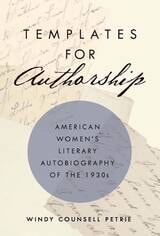
Templates for Authorship
American Women's Literary Autobiography of the 1930sWindy Counsell Petrie
University of Massachusetts Press, 2021
Windy Counsell Petrie considers twelve autobiographies from a diverse group of writers, ranging from highbrow modernists such as Gertrude Stein and Harriet Monroe to popular fiction writers like Edith Wharton and Edna Ferber, and lesser known figures such as Grace King and Carolyn Wells. Since there were few existing examples of women's literary autobiography, these writers found themselves marketed and interpreted within four cultural templates: the artist, the activist, the professional, and the celebrity. As they wrote their life stories, the women adapted these templates to counter unwanted interpretations and resist the sentimental feminine traditions of previous generations with innovative strategies of deferral, elision, comedy, and collaboration. This accessible study contends that writing autobiography offered each of these writers an opportunity to define and defend her own literary legacy.
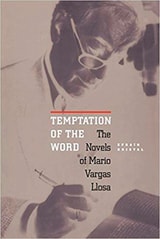
Temptation of the Word
The Novels of Mario Vargas LlosaEfrain Kristal
Vanderbilt University Press, 1998
Temptation of the Word offers an ambitious and careful reading of the creative process--the origin of themes and the development of literary techniques--that Mario Vargas Llosa has brought to each of his novels, published through 1996. To understand the novelist's intellectual environment, Efrain Kristal analyzes the entire corpus of Vargas Llosa's writings, his literary influences in several languages, his intellectual biography, and his political activism, all in the light of the evolving political turbulence of his times and his own changing concept of literature.
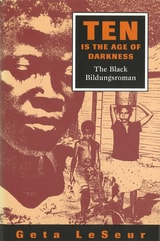
Ten Is the Age of Darkness
The Black BildungsromanGeta LeSeur
University of Missouri Press, 1995
In Ten Is the Age of Darkness, Geta LeSeur explores how black authors of the United States and English- speaking Caribbean have taken a European literary tradition and adapted it to fit their own needs for self-expression. LeSeur begins by defining the structure and models of the European genre of the bildungsroman, then proceeds to show how the circumstances of colonialism, oppression, race, class, and gender make the maturing experiences of selected young black protagonists different from those of their white counterparts.
Examining the parallels and differences in attitudes toward childhood in the West Indies and the United States, as well as the writers' individual perspectives in each work of fiction, LeSeur reaches intriguing conclusions about family life, community participation in the nurturing of children, the timing and severity of the youngsters' confrontation of adult society, and the role played by race in the journey toward adulthood.
LeSeur's readings of African American novels provide new insights into the work of Langston Hughes, James Baldwin, Toni Morrison, Paule Marshall, and Richard Wright, among others. When read as examples of the bildungsroman rather than simply as chronicles of black experiences, these works reveal an even deeper significance and have a more powerful impact. LeSeur convincingly demonstrates that such African American novels as Baldwin's Go Tell It on the Mountain, Wright's Black Boy, and Morrison's The Bluest Eye concentrate to a large extent on protest, while such African West Indian works as George Lamming's In the Castle of My Skin, Austin Clarke's Amongst Thistles and Thorns, Jamaica Kincaid's Annie John, and Erna Brodber's Jane and Louisa Will Soon Come Home reflect a more naive, healthy re-creation of what childhood can and should be, despite economic and physical impoverishment. She also gives a special space within the genre to Paule Marshall's BrownGirl, Brownstones and Ntozake Shange's Betsey Brown and the importance of "woman time," "woman voice," and mothers.
While enlarging our understanding of both the similarities and the differences in the black experiences of the Carribean and American youngsters coming of age, Ten Is the Age of Darkness also suggests that children of color in similar spheres share many common experiences. LeSeur concludes that the bildungsromane by black writers provide uniquely revealing contributions to the Afro-World literary canon and point the way for others to examine literary pieces in Third World communities of color.

Ten Women of Mystery
Edited by Earl F. Bargainnier
University of Wisconsin Press, 1981
This volume, which examines the special contributions of a number of women mystery writers, sheds light on this significant example of common interests in recreational reading among women and men and the reasons behind the early and continuing uncharacteristic near-equality of both sexes in this field of endeavor.
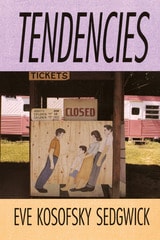
Tendencies
Eve Kosofsky Sedgwick
Duke University Press, 1983
The essays range from Diderot, Oscar Wilde, and Henry James to queer kids and twelve-step programs; from "Jane Austen and the Masturbating Girl" to a performance piece on Divine written with Michael Moon; from political correctness and the poetics of spanking to the experience of breast cancer in a world ravaged and reshaped by AIDS. What unites Tendencies is a vision of a new queer politics and thought that, however demanding and dangerous, can also be intent, inclusive, writerly, physical, and sometimes giddily fun.

Tendentious
Humor as Critique in Postwar and Contemporary PoetryScott Inniss
University of Iowa Press, 2027
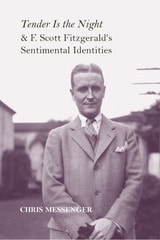
Tender Is the Night and F. Scott Fitzgerald's Sentimental Identities
Chris Messenger
University of Alabama Press, 2015
In “Tender Is the Night” and F. Scott Fitzgerald’s Sentimental Identities, Messenger traces the roots of Fitzgerald’s writing career to the deaths of his two infant sisters a few months before his own birth. It was their loss, Fitzgerald wrote, that made him a writer. Messenger highlights how the loss of Fitzgerald’s siblings powerfully molded his relation to maternal nurturing and sympathy in Tender Is the Night as well as how it shaped the homosocial intimations of its care-giving protagonist, psychiatrist Dick Diver. A concomitant grief and mourning was fueled by Fitzgerald’s intimate and intense creative rivalry with his often-institutionalized wife, Zelda Sayre Fitzgerald.
While sentiment is a discredited strain in high modernism, Fitzgerald nevertheless embraced it in Tender Is the Night to fashion this most poignant and beautiful successor to The Great Gatsby. Fitzgerald’s aesthetic and emotional preoccupations came most vividly to life in this major novel. Messenger describes how Fitzgerald, creating his character Nicole Warren Diver as a victim of paternal incest, finally found the sentimental key to finishing his novel and uniting his vision of the two narratives of “saving” the two sisters and reimagining the agony of his wife and their marriage.
Fitzgerald’s productive quarrel with and through sentiment defines his career, and Messenger convincingly argues that Tender Is the Night should be placed alongside TheGreat Gatsby as a classic exemplar of the modern novel.

Tennysonian Love
The Strange DiagonalGerhard Joseph
University of Minnesota Press, 1969
Tennysonian Love was first published in 1969. Minnesota Archive Editions uses digital technology to make long-unavailable books once again accessible, and are published unaltered from the original University of Minnesota Press editions.
In the century or so since Alfred Tennyson's poetry reached the height of its popularity and critical acclaim, the pendulum of criticism has swung wide in opposite directions. From the earlier idolatry to the later ridicule, that pendulum has now settled into a position of qualified and selective praise from which a more thoughtful consideration of the poet is possible. Consequently, as this critical study suggests, new values and dimensions are recognizable in his work.
Professor Joseph, concentrating on the theme of love but involving in his argument other facets of Tennyson's achievement, demonstrates the thesis that the poet moved as in a "strange diagonal." This phrase used as the subtitle of the book comes from Tennyson's poem The Princess in which the narrator "moved as in a strange diagonal / And maybe neither pleased myself nor them."
As the author shows, Tennyson throughout his work moved between a Platonic conception of love in which the highest kind of spiritual love has disencumbered itself of sense and a Neoplatonic ("Dantesque") one in which sense and soul tend to merge. In coming to terms with the nineteenth-century form of this divided Western heritage, the pietism of the evangelical revival on the one hand and the idealized eroticism of his Romantic predecessors on the other, Tennyson became the exemplary poet of Victorian love. No other Victorian poet, Professor Joseph concludes, exhibits quite his representative and successful blending of these clashing strains. For while moving between the alternate traditions of Western love, Tennyson was able to forge a large body of highly disciplined, beautifully wrought, and far-ranging verse.
Tense and Narrativity
From Medieval Performance to Modern FictionBy Suzanne Fleischman
University of Texas Press, 1990
In this pathfinding study, Suzanne Fleischman brings together theory and methodology from various quarters to shed important new light on the linguistic structure of narrative, a primary and universal device for translating our experiences into language.
Fleischman sees linguistics as laying the foundation for all narratological study, since it offers insight into how narratives are constructed in their most primary context: everyday speech. She uses a linguistic model designed for "natural" narrative to explicate the organizational structure of "artificial" narrative texts, primarily from the Middle Ages and the postmodern period, whose seemingly idiosyncratic use of tenses has long perplexed those who study them. Fleischman develops a functional theory of tense and aspect in narrative that accounts for the wide variety of functions—pragmatic as well as grammatical—that these two categories of grammar are called upon to perform in the linguistic economy of a narration.

Teresa de Avila, Lettered Woman
Barbara Mujica
Vanderbilt University Press, 2009
Teresa's epistolary writing reveals how she used her political acumen to dodge inquisitors and negotiate the thorny issues of the reform, facing off the authorities--albeit with considerable tact--and reprimanding priests and nuns who failed to follow her orders. Her letters bring to light the different strategies she used--code names, secret routing--in order to communicate with nuns and male allies. They show how she manipulated language, varying her tone and rhetoric according to the recipient or slipping into deliberate vagueness in order to avoid divulging secrets. What emerges from her correspondence is a portrait of extraordinary courage, ability, and shrewdness.
In the sixteenth century, the word letrado (lettered) referred to the learned men of the Church. Teresa treated letrados with great respect and always insisted on her own lack of learning. The irony is that although women could not be letradas, Teresa was, as her correspondence shows, "lettered" in more ways than one.

Terminal Identity
The Virtual Subject in Postmodern Science FictionScott Bukatman
Duke University Press, 1993
Drawing on a wide range of contemporary theories of the postmodern—including Fredric Jameson, Donna Haraway, and Jean Baudrillard—Bukatman begins with the proposition that Western culture is suffering a crisis brought on by advanced electronic technologies. Then in a series of chapters richly supported by analyses of literary texts, visual arts, film, video, television, comics, computer games, and graphics, Bukatman takes the reader on an odyssey that traces the postmodern subject from its current crisis, through its close encounters with technology, and finally to new self-recognition. This new "virtual subject," as Bukatman defines it, situates the human and the technological as coexistent, codependent, and mutally defining.
Synthesizing the most provocative theories of postmodern culture with a truly encyclopedic treatment of the relevant media, this volume sets a new standard in the study of science fiction—a category that itself may be redefined in light of this work. Bukatman not only offers the most detailed map to date of the intellectual terrain of postmodern technology studies—he arrives at new frontiers, providing a propitious launching point for further inquiries into the relationship of electronic technology and culture.
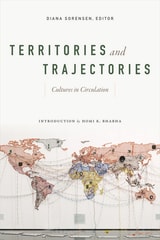
Territories and Trajectories
Cultures in CirculationDiana Sorensen, editor
Duke University Press, 2018
Contributors. Homi Bhabha, Jacqueline Bhabha, Lindsay Bremner, Finbarr Barry Flood, Rosario Hubert, Alina Payne, Kay Kaufman Shelemay, Shu-mei Shih, Diana Sorensen, Karen Thornber, Xiaofei Tian
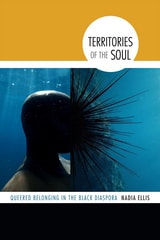
Territories of the Soul
Queered Belonging in the Black DiasporaNadia Ellis
Duke University Press, 2015
Territory of Desire
Representing the Valley of KashmirAnanya Jahanara Kabir
University of Minnesota Press, 2009
Moves beyond traditional analysis to understand the conflict over Kashmir
A result of territorial disputes between India and Pakistan since 1947, exacerbated by armed freedom movements since 1989, the ongoing conflict over Kashmir is consistently in the news. Taking a unique multidisciplinary approach, Territory of Desire asks how, and why, Kashmir came to be so intensely desired within Indian, Pakistani, and Kashmiri nationalistic imaginations. Literary historian Ananya Jahanara Kabir finds an answer to this question in the Valley of Kashmir’s repeated portrayal as a “special” place and the missing piece of Pakistan and India.
Analyzing the conversion of natural beauty into collective desire—through photography, literature, cinema, art, and souvenir production—Kabir exposes the links between colonialism, modernity, and conflict within the postcolonial nation. Representations of Kashmir as a space of desire emerge in contemporary film, colonial “taming” of the valley through nineteenth-century colonialist travelogues, the fetishization of traditional Kashmiri handicrafts like papier maché, and Pandit and Muslim religious revivalisms in the region. Linking a violent modernity to the fantasies of nationhood, Kabir proposes nonmilitaristic ways in which such desire may be overcome. In doing so she offers an innovative approach to complex and protracted conflict and, ultimately, its resolution.
Terror, Theory and the Humanities
Jeffrey R. Di Leo and Uppinder Mehan, editors
Michigan Publishing Services, 2012
Testimony after Catastrophe
Narrating the Traumas of Political ViolenceStevan Weine
Northwestern University Press, 2006
A deeply involving, compassionate, occasionally confrontational blend of practical hands-on experience and dialogic theory, emerging from the author's decade-long work in Europe and Chicago with survivors of the Balkan wars, this book is committed to the proposition that efforts to use testimony to address the consequences of political violence can be strengthened--though by no means guaranteed--if they are based on a fuller acknowledgment of the personal and ethical elements embodied in the narrative essence of testimony. These elements are what Testimony after Catastrophe seeks to reveal.
Tex[t]-Mex
Seductive Hallucinations of the "Mexican" in AmericaBy William Anthony Nericcio
University of Texas Press, 2006
A rogues' gallery of Mexican bandits, bombshells, lotharios, and thieves saturates American popular culture. Remember Speedy Gonzalez? "Mexican Spitfire" Lupe Vélez? The Frito Bandito? Familiar and reassuring—at least to Anglos—these Mexican stereotypes are not a people but a text, a carefully woven, articulated, and consumer-ready commodity. In this original, provocative, and highly entertaining book, William Anthony Nericcio deconstructs Tex[t]-Mexicans in films, television, advertising, comic books, toys, literature, and even critical theory, revealing them to be less flesh-and-blood than "seductive hallucinations," less reality than consumer products, a kind of "digital crack."
Nericcio engages in close readings of rogue/icons Rita Hayworth, Speedy Gonzalez, Lupe Vélez, and Frida Kahlo, as well as Orson Welles' film Touch of Evil and the comic artistry of Gilbert Hernandez. He playfully yet devastatingly discloses how American cultural creators have invented and used these and other Tex[t]-Mexicans since the Mexican Revolution of 1910, thereby exposing the stereotypes, agendas, phobias, and intellectual deceits that drive American popular culture. This sophisticated, innovative history of celebrity Latina/o mannequins in the American marketplace takes a quantum leap toward a constructive and deconstructive next-generation figuration/adoration of Latinos in America.
Text and Culture
The Politics of InterpretationDaniel Cottom
University of Minnesota Press, 1989
Text and Culture was first published in 1989. Minnesota Archive Editions uses digital technology to make long-unavailable books once again accessible, and are published unaltered from the original University of Minnesota Press editions.
In Text & Culture, Daniel Cottom examines the political aspects of contemporary disciplines of interpretation. He pleads against limiting the act of reading by disqualifying some readings as "wrong" or unscholarly, and he argues for the necessity of multiple readings, claiming that a closed-off text glosses over differences that are political in nature. He proceeds, then, from the notion of text to culture. Just as the reading of the text is conditioned by irreducible political differences, so is the reading of culture. Finally, to illustrate and further develop his arguments, Cottom presents an extensive analysis of Great Expectations.
Cottom's materials range from academic jokes to King Lear, and the writers he discusses range from Kant to Derrida, from Freud to Basil Bernstein, from Ludwig Wittgenstein and Bronislaw Malinowski to Erving Goffman, Clifford Geertz, and Stanley Fish. This study is especially concerned with the way "culture" and related terms, such as "context" and "norm," are part of a larger discourse in the contemporary humanities and social sciences - a discourse in which their effect is to repress recognition of important historical differences, conflicts, and possibilities. At the same time that he shows how difficult it is to get "beyond culture," he tries to indicate how interpretation may be turned into a more socially responsible practice.
Daniel Cottom is associate professor of English at the University of Florida. He is the author of Social Figures: George Eliot, Social History, and Literary Representation (Minnesota, 1987) and The Civilized Imagination: A Study of Ann Radcliffe, Jane Austen, and Sir Walter Scott.
Text and Image
Making Meaning in Manga and ComicsDeborah Shamoon
University of Minnesota Press, 2026
How manga and comics reshape storytelling across cultures
Text and Image is a groundbreaking exploration of how Japanese manga and comics from the United States and United Kingdom craft meaning through the combination of words and pictures. Current scholarship often isolates manga in niche genre studies or prioritizes anime instead; in response, Deborah Shamoon proposes a unified framework for understanding paneled visual storytelling across cultures. She reframes comics not as kids’ stuff but as a sophisticated narrative art with its own grammar, rhythm, and visual poetics.
Drawing on narratology, art history, film studies, and media theory, Text and Image examines a vast array of material, from four-panel comic strips to different manga genres, including shōjo (girls’ romance comics), shōnen (teen action), seinen (adult drama), and gekiga (mature realism). Through close visual analysis, Shamoon demonstrates how creators use panel layout, pacing, and the choreography of text and image to shape emotional impact and narrative momentum. She reveals the shared techniques that link works as disparate as Fun Home and Spider-Man while also showing where cultural conventions diverge. Beyond the traditional print realm, Shamoon discusses digital platforms, such as webtoons and vertically scrolling comics, to show how new technologies merge manga’s cinematic sensibility with global innovation.
Making a bold case for a more expansive, inclusive theory of visual narrative that bridges long-standing divides between manga studies and Anglophone comics scholarship, Text and Image is an indispensable guide to understanding how contemporary stories work and why they resonate across borders.
Retail e-book files for this title are screen-reader friendly with images accompanied by short alt text and/or extended descriptions.
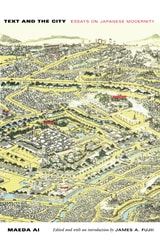
Text and the City
Essays on Japanese ModernityMaeda Ai
Duke University Press, 2004
Maeda remapped the study of modern Japanese literature and culture in the 1970s and 1980s, helping to generate widespread interest in studying mass culture on the one hand and marginalized sectors of modern Japanese society on the other. These essays reveal the broad range of Maeda’s cultural criticism. Among the topics considered are Tokyo; utopias; prisons; visual media technologies including panoramas and film; the popular culture of the Edo, Meiji, and contemporary periods; maps; women’s magazines; and women writers. Integrally related to these discussions are Maeda’s readings of works of Japanese literature including Matsubara Iwagoro’s In Darkest Tokyo, Nagai Kafu’s The Fox, Higuchi Ichiyo’s Growing Up, Kawabata Yasunari’s The Crimson Gang of Asakusa, and Narushima Ryuhoku’s short story “Useless Man.” Illuminating the infinitely rich phenomena of modernity, these essays are full of innovative, unexpected connections between cultural productions and urban life, between the text and the city.
Text as Ride
Electronic Literature and New Media ArtJanez Strehovec
West Virginia University Press, 2016

Text/Politics in Island Southeast Asia
Essays in InterpretationD.M. Roskies
Ohio University Press, 1993

Text
The Genealogy of an Antidisciplinary ObjectJohn Mowitt
Duke University Press, 1992
Beginning with the Tel Quel group in France in the sixties and seventies, Mowitt's study details how a certain interdisciplinary crisis prompted academics to rethink the conditions of cultural interpretation. Concentrating on three disciplinary projects—literary analysis, film studies, and musicology—Mowitt shows how textuality's emergence called into question not merely the relations among these disciplines, but also the cultural logic of disciplinary reason as such.
At once an effort to define "the text" and to explore and extend the theory of textuality, this book illustrates why the notion of interdisciplinary research has recently acquired such urgency. At the same time, by emphasizing the genealogical dimension of the textual object, Mowitt raises the issues of its "antidisciplinary" character, and by extension its immediate pertinence for the current debates over multiculturalism and Eurocentrism.
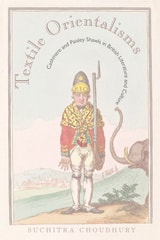
Textile Orientalisms
Cashmere and Paisley Shawls in British Literature and CultureSuchitra Choudhury
Ohio University Press, 2023
Textual Awareness
A Genetic Study of Late Manuscripts by Joyce, Proust, and MannDirk Van Hulle
University of Michigan Press, 2004
A key issue in both textual criticism and the so-called crisis of the novel is the tension between the finished and the unfinished. After a theoretical examination of the relationship between genetic and textual criticism, Dirk Van Hulle uses the three case studies to show how?at each stage in the writing process?the text still had the potential of becoming something entirely different; how and why these geneses proceeded the way they did; how Joyce, Proust, and Mann allowed contingencies to shape their work; how these authors recycled the words of their critics in order to inoculate their works against them; how they shaped an intertextual dimension through the processing of source texts and reading notes; and how text continually generated more text.
Van Hulle's exploration of process sheds new light on the remarkable fact that so many modernist authors protected their manuscripts, implying both the authors' urge to grasp everything and their awareness of the dangers of their encyclopedic projects. Textual Awareness offers new insights into the artificiality of the artifact?the novel?that are relevant to the study of literary modernism in general and the study of James Joyce, Marcel Proust, and Thomas Mann in particular.
Dirk Van Hulle is Assistant Professor of English and German Literature, University of Antwerp.

Textual Confrontations
Comparative Readings in Latin American LiteratureAlfred J. Mac Adam
University of Chicago Press, 1987
Mac Adam describes the changes that have taken place in Latin American literature since the time of Modernismo (roughly 1880-1920), when Spanish American writers tried to update their literary language by imitating foreign, mostly French, literature. Since then, as he demonstrates, Latin American writing has achieved a pioneering status by means of a different kind of imitation—parody—whereby it gives back to the former centers of Western culture their own writing, now distorted and reshaped into something new.
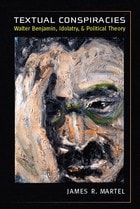
Textual Conspiracies
Walter Benjamin, Idolatry, and Political TheoryJames R. Martel
University of Michigan Press, 2012
“This is a sophisticated and fascinating argument written in a very enjoyably entertaining style. It is hard for me to see how readers initially interested in these texts will not be ‘swept off their feet’ by the core assertions of this author, and the devastatingly comprehensive way in which he demonstrates those arguments.”
—Brent Steele, University of Kansas
In Textual Conspiracies, James R. Martel applies the literary, theological, and philosophical insights of Walter Benjamin to the question of politics and the predicament of the contemporary left. Through the lens of Benjamin’s theories, as influenced by Kafka, of the fetishization of political symbols and signs, Martel looks at the ways in which various political and literary texts “speak” to each other across the gulf of time and space, thereby creating a “textual conspiracy” that destabilizes grand narratives of power and authority and makes the narratives of alternative political communities more apparent.
However, in keeping with Benjamin’s insistence that even he is complicit with the fetishism that he battles, Martel decentralizes Benjamin’s position as the key theorist for this conspiracy and contextualizes Benjamin in what he calls a “constellation” of pairs of thinkers and writers throughout history, including Alexis de Tocqueville and Edgar Allen Poe, Hannah Arendt and Federico García Lorca, and Frantz Fanon and Assia Djebar.
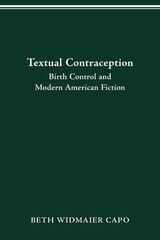
Textual Contraception
Birth Control and Modern American FictionBeth Widmaier Capo
The Ohio State University Press, 2007
Merging cultural analysis and literary scholarship, this compelling work moves from a consideration of how cultural forces shaped literary production and political activism to a close examination of how fictional representations of contraception influenced the terms of public discourse on marriage, motherhood, economics, and eugenics.
By analyzing popular fiction such as Mother by Kathleen Norris, radical periodicals such as The Masses and Birth Control Review, and literature by authors from Theodore Dreiser to William Faulkner, and Nella Larsen to Mary McCarthy, Beth Widmaier Capo reveals the rich cross-influence of contraceptive and literary history.
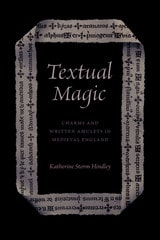
Textual Magic
Charms and Written Amulets in Medieval EnglandKatherine Storm Hindley
University of Chicago Press, 2023
Katherine Storm Hindley explores words at their most powerful: words that people expected would physically change the world. Medieval Europeans often resorted to the use of spoken or written charms to ensure health or fend off danger. Hindley draws on an unprecedented archive of more than a thousand such charms from medieval England—more than twice the number gathered, transcribed, and edited in previous studies and including many texts still unknown to specialists on this topic. Focusing on charms from 1100 to 1350 CE as well as previously unstudied texts in Latin, French, and English, Hindley addresses important questions of how people thought about language, belief, and power. She describes seven hundred years of dynamic, shifting cultural landscapes, where multiple languages, alphabets, and modes of transmission gained and lost their protective and healing power. Where previous scholarship has bemoaned a lack of continuity in the English charms, Hindley finds surprising links between languages and eras, all without losing sight of the extraordinary variety of the medieval charm tradition: a continuous, deeply rooted part of the English Middle Ages.
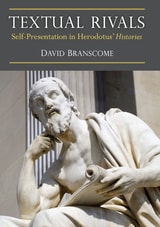
Textual Rivals
Self-Presentation in Herodotus’ HistoriesDavid Branscome
University of Michigan Press, 2013
Textual Rivals studies some of the most debated issues in Herodotean scholarship. One such is Herodotus’ self-presentation: the conspicuousness of his authorial persona is one of the most remarkable features of his Histories. So frequently does he interject first-person comments into the narrative that Herodotus at times almost becomes a character within his own text.
Important issues are tied to Herodotus’ self-presentation. First is the narrator’s relationship to truth: to what extent does he expect readers to trust his narrative? While judgments regarding Herodotus’ overall veracity have often been damning, scholars have begun to concentrate on how Herodotus presents his truthfulness. Second is the precise genre Herodotus means to create with his work. Excluding the anachronistic term historian, exactly what would Herodotus have called himself, as author? Third is the presence of “self-referential” characters, whose actions often mirror Herodotus’ as narrator/researcher, in the Histories.
David Branscome’s investigative text points to the rival inquirers in Herodotus’ Histories as a key to unraveling these interpretive problems. The rival inquirers are self-referential characters Herodotus uses to further his authorial self-presentation. Through the contrast Herodotus draws between his own exacting standards as an inquirer and the often questionable standards of those rivals, Herodotus underlines just how truthful readers should find his own work.
Textual Rivals speaks to those interested in Greek history and historiography, narratology, and ethnography. Those in the growing ranks of Herodotus fans will find much to invite and intrigue.
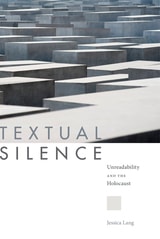
Textual Silence
Unreadability and the HolocaustLang, Jessica
Rutgers University Press, 2017
Holocaust texts, which encompass works as diverse as memoirs, novels, poems, and diaries, are traditionally characterized by silences the authors place throughout the text, both deliberately and unconsciously. While a reader may have the desire and will to comprehend the Holocaust, the presence of “textual silence” is a force that removes the experience of genocide from the reader’s analysis and imaginative recourse. Lang defines silences as omissions that take many forms, including the use of italics and quotation marks, ellipses and blank pages in poetry, and the presence of unreliable narrators in fiction. While this limits the reader’s ability to read in any conventional sense, these silences are not flaws. They are instead a critical presence that forces readers to acknowledge how words and meaning can diverge in the face of events as unimaginable as those of the Holocaust.
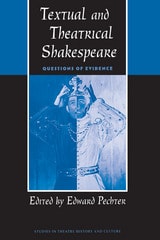
Textual and Theatrical Shakespeare
Questions of EvidenceEdward Pechter
University of Iowa Press, 1996
Bridging the stage-versus-page gap between actors, critics, and scholars, the contributors in this carefully crafted yet energizing book reflect upon the many kinds of evidence available to us from Shakespeare's various incarnations as historical subject and as “our contemporary” as well as from his amphibious occupation of both stage and study. The constraints become arbitrary as each essayist clarifies the sources of this evidence; the seemingly rigid boundaries of scholarly and creative disciplines are crossed and redrawn.
Thackeray
The Sentimental CynicLambert Ennis
Northwestern University Press, 1950
That Self-Forgetful Perfectly Useless Concentration
Alan Shapiro
University of Chicago Press, 2016
In this book, Shapiro brings his characteristic warmth, humor, and many years as both poet and teacher to bear on questions surrounding two preoccupations: the role of conventions—of literary and social norms—in how we fashion our identities on and off the page, and how suffering both requires and resists self-expression. He sketches affectionate portraits of his early teachers, revisits the deaths of his brother and sister, and examines poems that have helped him navigate troubled times. Integrating storytelling and literary analysis so seamlessly that art and life become extensions of each other, Shapiro embodies in his lively prose the very qualities he celebrates in the poems he loves.
Brimming with wit and insight, this is a book for poets, students and scholars of poetry, teachers of literature, and everyone who cares about the literary arts and how they illuminate our personal and public lives.
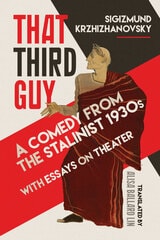
That Third Guy
A Comedy from the Stalinist 1930s with Essays on TheaterSigizmund Krzhizhanovsky, Translated and edited by Alisa Ballard Lin, Foreword by Caryl Emerson
University of Wisconsin Press, 2018
The volume also features selections from Krzhizhanovsky's compelling and idiosyncratic essays on Shakespeare, Pushkin, Shaw, and the philosophy of theater. Professionally, he worked with director Alexander Tairov at the Moscow Kamerny Theater, and his original philosophy of the stage bears comparison with the great theater theorists of the twentieth century. In these writings, he reflects on the space and time of the theater, the resonance of language onstage, the experience of the actor, and the relationship between the theater and the everyday. Commentary by Alisa Ballard Lin and Caryl Emerson contextualizes Krzhizhanovsky's writings.

The "Counterfeit" Man
The True Story of the Boorn-Colvin Murder CaseGerald W. McFarland
University of Massachusetts Press, 1993
The "Spirit of Poesy"
Essays on Jewish and German Literature and Thought in Honor of Geza von MolnarRichard Block and Peter Fenves
Northwestern University Press, 2000
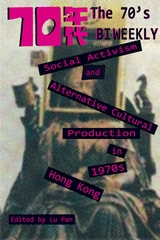
The 70's Biweekly
Social Activism and Alternative Cultural Production in 1970s Hong KongEdited by Lu Pan
Hong Kong University Press, 2023
Taking The 70’s Biweekly—an independent youth publication in 1970s Hong Kong—as the main thread, this edited collection investigates an unexplored trajectory of Hong Kong’s cultural and artistic production in the 1970s. The 70’s Biweekly stands out from many other independent magazines with its unique blending of radical political theories, social activism, avant-garde art, and local literature. By taking the magazine as a node of social and cultural activism from and around which actions, debates, community, and artistic practices are formed, this book fills gaps in the study of how young Hong Kong cultural producers carved out an alternative space to speak out against established authorities.
Split into three parts, The 70’s Biweekly provides readers with a panoramic view of the political and cultural activism in Hong Kong during the 1970s, featuring writings on art and film, and interviews with former founders and contributors that reflect on how their participation led them to engage ideologically with their activism and community.
The ABC of Modern Biography
Nigel Hamilton
Amsterdam University Press, 2018
This book will fascinate general readers interested in how real lives are approached by biographers today in a multitude of media. It will make a much-needed contribution in academia, as well as providing an important text for students of history, language and literature, the arts, science and media. And, not least, for biographers trying to avoid the pitfalls of ignorance or ineptitude.
The Absent Man
The Narrative Craft of Charles W. ChesnuttCharles Duncan
Ohio University Press, 1998
As the first African-American fiction writer to achieve a national reputation, Ohio native Charles W. Chesnutt (1858–1932) in many ways established the terms of the black literary tradition now exemplified by such writers as Toni Morrison, Alice Walker, and Charles Johnson.
Following the highly autobiographical nonfiction produced by Frederick Douglass, Harriet Jacobs, and other slave narrative writers, Chesnutt’s complex, multi-layered short fiction transformed the relationship between African-American writers and their readers. But despite generous praise from W. D. Howells and other important critics of his day, and from such prominent readers as William L. Andrews, Henry Louis Gates, Jr., and Eric Sundquist in ours, Chesnutt occupies a curiously ambiguous place in American literary history.
In The Absent Man, Charles Duncan demonstrates that Chesnutt’s uneasy position in the American literary tradition can be traced to his remarkable narrative subtlety. Profoundly aware of the delicacy of his situation as a black intellectual at the turn of the century, Chesnutt infused his work with an intricate, enigmatic artistic vision that defies monolithic or unambiguously political interpretation, especially with regard to issues of race and identity that preoccupied him throughout his career.
In this first book-length study of the innovative short fiction, Duncan devotes particular attention to elucidating these sophisticated narrative strategies as the grounding for Chesnutt’s inauguration of a tradition of African-American fiction.
The Absent Man
The Narrative Craft of Charles W. ChesnuttCharles Duncan
Ohio University Press, 1998
Following the highly autobiographical nonfiction produced by Frederick Douglass, Harriet Jacobs, and other slave narrative writers, Chesnutt's complex, multi-layered short fiction transformed the relationship between African-American writers and their readers. But despite generous praise from W. D. Howells and other important critics of his day, and from such prominent readers as William L. Andrews, Henry Louis Gates, Jr., and Eric Sundquist in ours, Chesnutt occupies a curiously ambiguous place in American literary history.
In The Absent Man, Charles Duncan demonstrates that Chesnutt's uneasy position in the American literary tradition can be traced to his remarkable narrative subtlety. Profoundly aware of the delicacy of his situation as a black intellectual at the turn of the century, Chesnutt infused his work with an intricate, enigmatic artistic vision that defies monolithic or unambiguously political interpretation, especially with regard to issues of race and identity that preoccupied him throughout his career.
In this first book-length study of the innovative short fiction, Duncan devotes particular attention to elucidating these sophisticated narrative strategies as the grounding for Chesnutt's inauguration of a tradition of African-American fiction.
The Absurd Hero in American Fiction
Updike, Styron, Bellow, SalingerBy David D. Galloway
University of Texas Press, 1981
When The Absurd Hero in American Fiction was first released in 1966, Granville Hicks praised it in a lead article for the Saturday Review as a sensitive and definitive study of a new trend in postwar American literature. In the years that followed, David Galloway’s analysis of the writings of John Updike, William Styron, Saul Bellow, and J. D. Salinger became a standard critical work, an indispensable tool for readers concerned with contemporary American literature. The New York Times described the book as “a seminal study of the modern literary imagination."
David Galloway, himself an established novelist, later extensively revised The Absurd Hero to include authoritative discussions of more than a dozen novels which had appeared since the first revised edition was released in 1970. Among them are John Updike’s Couples, Rabbit Redux, and The Coup; William Styron’s The Confessions of Nat Turner and Sophie’s Choice; and Saul Bellow’s Mr. Sammler’s Planet and Humboldt’s Gift. Through detailed analyses of these works, Galloway demonstrates the continuing relevance of his own provocative concept of the absurd hero and provides important insights into the literary achievements of four of America’s most influential postwar novelists.