Results by title
458 books match the query 'Literature' and 114 start with t

The Monster with a Thousand Faces
Guises of the Vampire in Myth and LiteratureBrian J. Frost
University of Wisconsin Press, 1989
The Novel of the Future
Anaïs Nin
Ohio University Press, 2014
In The Novel of the Future, Anaïs Nin explores the act of creation—in film, art, and dance as well as literature—to chart a new direction for the young artist struggling against what she perceived as the sterility, formlessness, and spiritual bankruptcy afflicting much of mid-twentieth-century fiction. Nin offers, instead, an argument for and synthesis of the poetic novel and discusses her own efforts in this genre as well as its influence on the development of such writers as D. H. Lawrence, Henry Miller, Lawrence Durrell, Marguerite Young, and Djuna Barnes. In chapters devoted to the pursuit of the hidden self, the genesis of fiction, and the relationship between the diary and fiction, she addresses the materials, techniques, and nourishment of the arts, and the functions of art itself.
Originally published in 1968, The Novel of the Future remains a classic among both creative writers and literary scholars. This new Swallow Press edition includes an introduction by Nin biographer Deirdre Bair.
The Nuclear Muse
Literature, Physics, and the First Atomic BombsJohn Canaday
University of Wisconsin Press, 2000
The Outward Mind
Materialist Aesthetics in Victorian Science and LiteratureBenjamin Morgan
University of Chicago Press, 2017
The Papist Represented
Literature and the English Catholic Community, 1688-1791Geremy Carnes
University of Delaware Press, 2017
The Papist Represented reincorporates the history of the English Catholic community into the field of eighteenth-century literary studies. It examines the intersections of literary, religious, and cultural history as they pertain to the slow acceptance by both Protestants and Catholics of the latter group’s permanent minority status. By focusing on the Catholic community’s perspectives and activities, it deepens and complicates our understanding of the cultural processes that contributed to the significant progress of the Catholic emancipation movement over the course of the century. At the same time, it reveals that this community’s anxieties and desires (and the anxieties and desires it provoked in Protestants) fuel some of the most popular and experimental literary works of the century, in forms and modes including closet drama, elegy, the novel, and the Gothic. By returning the Catholic community to eighteenth-century literary history, The Papist Represented challenges the assumption that eighteenth-century literature was a fundamentally Protestant enterprise.
Published by University of Delaware Press. Distributed worldwide by Rutgers University Press.
The Pensive Citadel
Victor Brombert
University of Chicago Press, 2023
In The Pensive Citadel, Victor Brombert looks back on a lifetime of learning within a university world greatly altered since he entered Yale on the GI Bill in the 1940s. Yet for all that has changed, much of Brombert’s long experience as a reader and teacher is richly familiar: the rewards of rereading, the joy of learning from students, and most of all the insight to be found in engaging works of literature. The essays gathered here range from meditations on laughter and jealousy to new appreciations of Brombert’s lifelong companions Shakespeare, Montaigne, Voltaire, and Stendhal.
A veteran of D-day and the Battle of the Bulge who witnessed history’s worst nightmares firsthand, Brombert nevertheless approaches literature with a lightness of spirit, making the case for intellectual mobility and openness to change. The Pensive Citadel is a celebration of a life lived in literary study, and of what can be learned from attending to the works that form one’s cultural heritage.
The Phantom of the Ego
Modernism and the Mimetic UnconsciousNidesh Lawtoo
Michigan State University Press, 2013
The Phantom of the Ego is the first comparative study that shows how the modernist account of the unconscious anticipates contemporary discoveries about the importance of mimesis in the formation of subjectivity. Rather than beginning with Sigmund Freud as the father of modernism, Nidesh Lawtoo starts with Friedrich Nietzsche’s antimetaphysical diagnostic of the ego, his realization that mimetic reflexes—from sympathy to hypnosis, to contagion, to crowd behavior—move the soul, and his insistence that psychology informs philosophical reflection. Through a transdisciplinary, comparative reading of landmark modernist authors like Nietzsche, Joseph Conrad, D. H. Lawrence, and Georges Bataille, Lawtoo shows that, before being a timely empirical discovery, the “mimetic unconscious” emerged from an untimely current in literary and philosophical modernism. This book traces the psychological, ethical, political, and cultural implications of the realization that the modern ego is born out of the spirit of imitation; it is thus, strictly speaking, not an ego, but what Nietzsche calls, “a phantom of the ego.” The Phantom of the Ego opens up a Nietzschean back door to the unconscious that has mimesis rather than dreams as its via regia, and argues that the modernist account of the “mimetic unconscious” makes our understanding of the psyche new.
The Philosopher and the Storyteller
Eric Voegelin and Twentieth-Century LiteratureCharles R. Embry
University of Missouri Press, 2018
Throughout his philosophical career, Eric Voegelin had much to say about literature in both his published work and his private letters. Many of his most trenchant comments regarding the analysis of literature appear in his correspondence with critic Robert Heilman, and, through his familiarity with that exchange, Charles Embry has gained extraordinary insight into Voegelin’s literary views.
The Philosopher and the Storyteller is the first book-length study of the literary dimensions of Voegelin’s philosophy—and the first to use his philosophy to read specific novels. Bringing to bear a thorough familiarity with both Voegelin and great literature, Embry shows that novels—like myths, philosophy, and religious texts—participate in the human search for the truth of existence, and that reading literature within a Voegelinian framework exposes the existential and philosophical dimensions of those works.
Embry focuses on two key elements of Voegelin’s philosophy as important for reading literature: metaxy, the in-between of human consciousness, and metalepsis, human participation in the community of being. He shows how Voegelin’s philosophy in general is rooted in literary-symbolic interpretation and, therefore, provides a foundation for the interpretation of literature. And finally he explores Voegelin’s insistence that the soundness of literary criticism lies in the consciousness of the reader.
Embry then offers Voegelinian readings that vividly illustrate the principles of this approach. First he considers Graham Swift’s Waterland as an example of the human search for meaning in the modern world, then he explores the deformation and recovery of reality in Heimito von Doderer’s long and complex novel The Demons, and finally he examines how Flannery O’Connor’s The Violent Bear It Away mythically expresses the flux of divine presence in what Voegelin calls the Time of the Tale.
The Philosopher and the Storyteller unites fiction and philosophy in the common quest to understand our nature, our world, and our cosmos. A groundbreaking exploration of the connection between Voegelin and twentieth-century literature, this book opens a new window on the philosopher’s thought and will motivate readers to study other novels in light of this approach.
The Popular Press Companion to Popular Literature
Victor E. Neuburg
University of Wisconsin Press, 1983
The Portuguese-Speaking Diaspora
Seven Centuries of Literature and the ArtsBy Darlene J. Sadlier
University of Texas Press, 2016
Long before the concept of “globalization,” the Portuguese constructed a vast empire that extended into Africa, India, Brazil, and mid-Atlantic territories, as well as parts of China, Southeast Asia, and Japan. Using this empire as its starting point and spanning seven centuries and four continents, The Portuguese-Speaking Diaspora examines literary and artistic works about the ensuing diaspora, or the dispersion of people within the Portuguese-speaking world, resulting from colonization, the slave trade, adventure seeking, religious conversion, political exile, forced labor, war, economic migration, and tourism.
Based on a broad array of written and visual materials, including historiography, letters, memoirs, plays, poetry, fiction, cartographic imagery, paintings, photographs, and films, The Portuguese-Speaking Diaspora is the first detailed analysis of the different and sometimes conflicting cultural productions of the imperial diaspora in its heyday and an important context for understanding the more complex and broader-based culture of population travel and displacement from the former colonies to present-day “homelands.” The topics that Darlene J. Sadlier discusses include exploration and settlement by the Portuguese in different parts of the empire; the Black Atlantic slave trade; nineteenth-century travel and Orientalist imaginings; the colonial wars; and the return of populations to Portugal following African independence. A wide-ranging study of the art and literature of these and other diasporic movements, this book is a major contribution to the growing field of Lusophone studies.
The Post Card
From Socrates to Freud and BeyondJacques Derrida
University of Chicago Press, 1987
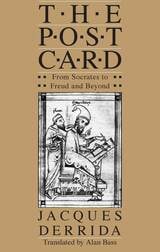
You were reading a somewhat retro loveletter, the last in history. But you have not yet received it. Yes, its lack or excess of address prepares it to fall into all hands: a post card, an open letter in which the secret appears, but indecipherably.
What does a post card want to say to you? On what conditions is it possible? Its destination traverses you, you no longer know who you are. At the very instant when from its address it interpellates, you, uniquely you, instead of reaching you it divides you or sets you aside, occasionally overlooks you. And you love and you do not love, it makes of you what you wish, it takes you, it leaves you, it gives you.
On the other side of the card, look, a proposition is made to you, S and p, Socrates and plato. For once the former seems to write, and with his other hand he is even scratching. But what is Plato doing with his outstretched finger in his back? While you occupy yourself with turning it around in every direction, it is the picture that turns you around like a letter, in advance it deciphers you, it preoccupies space, it procures your words and gestures, all the bodies that you believe you invent in order to determine its outline. You find yourself, you, yourself, on its path.
The thick support of the card, a book heavy and light, is also the specter of this scene, the analysis between Socrates and Plato, on the program of several others. Like the soothsayer, a "fortune-telling book" watches over and speculates on that-which-must-happen, on what it indeed might mean to happen, to arrive, to have to happen or arrive, to let or to make happen or arrive, to destine, to address, to send, to legate, to inherit, etc., if it all still signifies, between here and there, the near and the far, da und fort, the one or the other.
You situate the subject of the book: between the posts and the analytic movement, the pleasure principle and the history of telecommunications, the post card and the purloined letter, in a word the transference from Socrates to Freud, and beyond. This satire of epistolary literature had to be farci, stuffed with addresses, postal codes, crypted missives, anonymous letters, all of it confided to so many modes, genres, and tones. In it I also abuse dates, signatures, titles or references, language itself.
J. D.
"With The Post Card, as with Glas, Derrida appears more as writer than as philosopher. Or we could say that here, in what is in part a mock epistolary novel (the long section is called "Envois," roughly, "dispatches" ), he stages his writing more overtly than in the scholarly works. . . . The Post Card also contains a series of self-reflective essays, largely focused on Freud, in which Derrida is beautifully lucid and direct."—Alexander Gelley, Library Journal
The Price of Literature
The French Novel's Theoretical TurnPatrick M. Bray
Northwestern University Press, 2019
Literary thought, or the theory produced by the text, can only function by exploring what escapes dominant representations. The Price of Literature analyzes how certain iconic texts from the nineteenth century (by Mme de Staël, Hugo, Balzac, Flaubert, and Proust) perform a theoretical turn to claim the freedom to represent anything in the world, but also literature’s ability to transform the world it represents. The conclusion advances a new way of thinking about literary scholarship—one based on how literature redistributes ways of writing by lending form to thought.
The Progress of Romance
Literary Historiography and the Gothic NovelDavid H. Richter
The Ohio State University Press, 1900
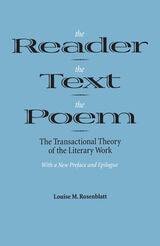
The Reader, the Text, the Poem
The Transactional Theory of the Literary WorkLouise M. Rosenblatt
Southern Illinois University Press, 1994
Louise M. Rosenblatt’s award-winning work continues increasingly to be read in a wide range of academic fields—literary criticism, reading theory, aesthetics, composition, rhetoric, speech communication, and education. Her view of the reading transaction as a unique event involving reader and text at a particular time under particular circumstances rules out the dualistic emphasis of other theories on either the reader or the text as separate and static entities. The transactional concept accounts for the importance of factors such as gender, ethnicity, culture, and socioeconomic context. Essential reading for the specialist, this book is also well suited for courses in criticism, critical theory, rhetoric, and aesthetics.
Starting from the same nonfoundationalist premises, Rosenblatt avoids the extreme relativism of postmodern theories derived mainly from Continental sources. A deep understanding of the pragmatism of Dewey, James, and Peirce and of key issues in the social sciences is the basis for a view of language and the reading process that recognizes the potentialities for alternative interpretations and at the same time provides a rationale for the responsible reading of texts.
The book has been praised for its lucid explanation of the multidimensional character of the reading process—evoking, interpreting, and evaluating the work. The nonliterary (efferent) and the literary (aesthetic) are shown not to be opposites but to represent a continuum of reading behaviors. The author amply illustrates her theoretical points with interpretations of varied texts. The epilogue carries further her critique of rival contemporary theories.
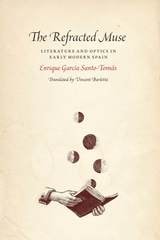
The Refracted Muse
Literature and Optics in Early Modern SpainEnrique Garcia Santo-Tomas
University of Chicago Press, 2017
While Spain is often thought to have taken little notice of the Scientific Revolution, García Santo-Tomás tells a different story, one that reveals Golden Age Spanish literature to be in close dialogue with the New Science. Drawing on the work of writers such as Cervantes, Lope de Vega, Calderón de la Barca, and Quevedo, he helps us trace the influence of science and discovery on the rapidly developing and highly playful genre of the novel. Indeed, García Santo-Tomás makes a strong case that the rise of the novel cannot be fully understood without taking into account its relationship to the scientific discoveries of the period.

The Rhetoric of Interpretation and the Interpretation of Rhetoric
Paul Hernadi, ed.
Duke University Press, 1989
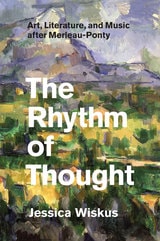
The Rhythm of Thought
Art, Literature, and Music after Merleau-PontyJessica Wiskus
University of Chicago Press, 2013

The Rule of Art
Literature and Painting in the RenaissanceClark Hulse
University of Chicago Press, 1990
These are the questions Clark Hulse takes up in this sophisticated interdisciplinary study of Renaissance aesthetics. Proposing an archeology of artistic knowledge, Hulse examines the theoretical language through which the poets, painters, and patrons of the Renaissance conceived of the relationship between the arts. That language is embedded in what he calls a "rule of art," a specific set of categories, assumptions, and practices that defined the two art forms and the relationship between them. Hulse charts the rise of both forms to the status of liberal arts requiring special intellectual training for artist and patron alike. In the process, he uncovers the history of the practice of theory in the Renaissance, revealing how artistic discourse lived in the world.
The Russian Memoir
History and LiteratureBeth Holmgren
Northwestern University Press, 2007
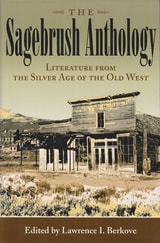
The Sagebrush Anthology
Literature from the Silver Age of the Old WestEdited by Lawrence I. Berkove
University of Missouri Press, 2006
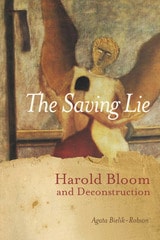
The Saving Lie
Harold Bloom and DeconstructionAgata Bielik-Robson
Northwestern University Press, 2011
Bloom is indeed a party of one, a truly strong poet of his own mode of religious-literary criticism, who, in a typically Emersonian manner, makes his own circumstances and sheds influences by incorporating them into his idiosyncratic theory.In this unprecedented full-length study on Harold Bloom, Agata Bielik-Robson explores the many facets of Bloom’s critical writings and career. In his work, she argues, Bloom draws on a variety of disparate traditions—Judaism, gnosis, Romanticism, American pragmatism, and Freudianism, but also, especially recently, Victorian aestheticism—that comprise a dialectical, difficult whole in a constant quarrel with itself. Yet, this is precisely the image of "life-in-antithesis," which constitutes Bloom’s highest speculative achievement, she observes. The Saving Lie brings all these "Blooms" together and, despite their own tendencies toward dissociation, lets them speak unisono: in one almost harmonious voice that will clearly utter the principles of a new speculative position—Bloom’s antithetical vitalism. This study of Bloom and his contributions will not soon be surpassed.
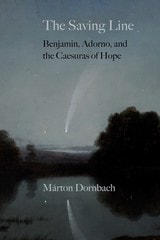
The Saving Line
Benjamin, Adorno, and the Caesuras of HopeMárton Dornbach
Northwestern University Press, 2021
Walter Benjamin and Theodor Adorno both turned to canonical literary narratives to determine why the Enlightenment project was derailed and how this failure might be remedied. The resultant works, Benjamin’s major essay on Goethe’s Elective Affinities and Adorno’s meditation on the Odyssey in Dialectic of Enlightenment, are centrally concerned with the very act of narration. Márton Dornbach’s groundbreaking book reconstructs a hitherto unnoticed, wide-ranging dialogue between these foundational texts of the Frankfurt School.
At the heart of Dornbach’s argument is a critical model that Benjamin built around the concept of caesura, a model Adorno subsequently reworked. Countering an obscurantism that would become complicit in the rise of fascism, the two theorists aligned moments of arrest in narratives mired in unreason. Although this model responded to a specific historical emergency, it can be adapted to identify utopian impulses in a variety of works.
The Saving Line throws fresh light on the intellectual exchange and disagreements between Benjamin and Adorno, the problematic conjunction of secular reason and negative theology in their thinking, and their appropriations of ancient and modern legacies. It will interest scholars of philosophy and literature, critical theory, German Jewish thought, classical reception studies, and narratology.
The Scholar's Art
Literary Studies in a Managed WorldJerome McGann
University of Chicago Press, 2006
Of particular interest to McGann is the demise of public discourse about poetry. That poetry has become recondite is, to his mind, at once a problem for how scholars do their work and a general cultural emergency. The Scholar’s Art asks what could be gained by reimagining the way scholars have codified the literary and cultural history of the past two hundred years and goes on to provide a series of case studies that illustrate how scholarly method can help bring about such reimaginings. McGann closes with a discussion of technology’s ability to harness the reimagination of cultural memory and concludes with exemplary acts of critical reflection.
Astute observation from one of America’s most bracing and original commentators on the place of literature in twenty-first century culture, The Scholar’s Art proposes new ways—cultural, philological, and technological—to reimagine our literary past and future.
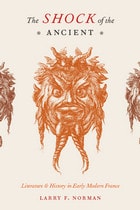
The Shock of the Ancient
Literature and History in Early Modern FranceLarry F. Norman
University of Chicago Press, 2011
The cultural battle known as the Quarrel of the Ancients and Moderns served as a sly cover for more deeply opposed views about the value of literature and the arts. One of the most public controversies of early modern Europe, the Quarrel has most often been depicted as pitting antiquarian conservatives against the insurgent critics of established authority. The Shock of the Ancient turns the canonical vision of those events on its head by demonstrating how the defenders of Greek literature—rather than clinging to an outmoded tradition—celebrated the radically different practices of the ancient world.
At a time when the constraints of decorum and the politics of French absolutism quashed the expression of cultural differences, the ancient world presented a disturbing face of otherness. Larry F. Norman explores how the authoritative status of ancient Greek texts allowed them to justify literary depictions of the scandalous. The Shock of the Ancient surveys the diverse array of aesthetic models presented in these ancient works and considers how they both helped to undermine the rigid codes of neoclassicism and paved the way for the innovative philosophies of the Enlightenment. Broadly appealing to students of European literature, art history, and philosophy, this book is an important contribution to early modern literary and cultural debates.
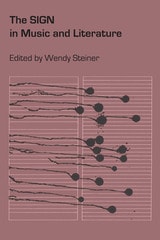
The Sign in Music and Literature
Edited by Wendy Steiner
University of Texas Press, 1981
The notion of semiotics as a universal language that can encompass any object of perception makes it the focus of a revolutionary field of inquiry, the semiotics of art. This volume represents a unique gathering of semiotic approaches to art: from Saussurian linguistics to transformational grammar, from Prague School aesthetics to Peircean pragmatism, from structuralism to poststructuralism.
Though concerned specifically with the semiotics of music and literature, the essays reveal the breadth of semiotics’ interdisciplinary appeal, involving specialists in musicology, ethnomusicology, jazz performance, literary criticism, poetics, aesthetics, rhetoric , linguistics, dance, and film. The diversity of authorial training and approach makes this collection a dramatic demonstration of the on-going debates in the field.
In many ways the semiotics of art is the testing ground of sign theory as a whole, and work in this subject is as vital to the interests of theoretical semioticians as to students of the arts. It is to both these interests that this volume is addressed.
The Significance of Sibling Relationships in Literature
Joanna Stephens Mink
University of Wisconsin Press, 1993
The essays bring together studies in the fields of social and family therapy, psychological research, and literary criticism.
The Skin of Meaning
Collected Literary Essays and TalksAaron Shurin
University of Michigan Press, 2016
The Smell of Books
A Cultural-Historical Study of Olfactory Perception in LiteratureHans J. Rindisbacher
University of Michigan Press, 1993
Rindisbacher examines the works of the German Expressionists and of Baudelaire, Huxley, Rimbaud, Wilde, and Turgenev, as well as Holocaust memoirs and contemporary German books such as Patrick Suskind’s Das Parfum and Christa Wolf’s Storfall. He demonstrates that the sense of smell, which has heretofore occupied a position at the bottom of the sensory hierarchy, plays a consequential role in romantic, modern, and contemporary European and Russian literature.
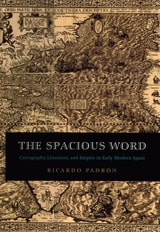
The Spacious Word
Cartography, Literature, and Empire in Early Modern SpainRicardo Padrón
University of Chicago Press, 2004
Padrón contends too that maps and geographic writings heavily influenced the Spanish imperial imagination. During the early modern period, the idea of "America" was still something being invented in the minds of Europeans. Maps of the New World, letters from explorers of indigenous civilizations, and poems dramatizing the conquest of distant lands, then, helped Spain to redefine itself both geographically and imaginatively as an Atlantic and even global empire. In turn, such literature had a profound influence on Spanish ideas of nationhood, most significantly its own.
Elegantly conceived and meticulously researched, The Spacious Word will be of enormous interest to historians of Spain, early modern literature, and cartography.
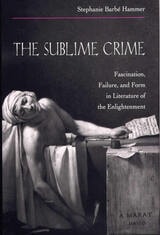
The Sublime Crime
Fascination, Failure, and Form in Literature of the EnlightenmentStephanie Barbe Hammer
Southern Illinois University Press, 1993
In this hermeneutic analysis of seven literary texts, Stephanie Barbé Hammer studies the roles of criminal protagonists in the dramas of George Lillo (The London Merchant) and Friedrich Schiller (The Robbers) and in the narratives of Abbé de Prévost (Manon Lescaut), Henry Fielding (Jonathan Wild), Marquis de Sade (Justine), William Godwin (Caleb Williams), and Heinrich von Kleist (Michael Kohlhaas).
Hammer reflects the current interest in cultural critique by utilizing the social theories of Michel Foucault and the feminist approaches of Hélène Cixous and Eve Sedgwick to redefine the Enlightenment as a movement of thought rather than as a strictly defined period synonymous with the eighteenth century. In addition, through the examination of the works of three post–World War II authors (Jean Genet, Anthony Burgess, and Peter Handke), Hammer suggests that the Enlightenment’s artistic representations of criminality are unparalleled by subsequent modern literature.
Hammer explains that the seven works she focuses on have been dismissed as failures by readers who have misunderstood the texts’ aesthetic elements. While claiming that the form of these works breaks down under the pressure of their criminal protagonists, she asserts that this formal failure actually contributes to the success of the works as art. The works "fail" because, like the criminal characters themselves, they break laws. The criminal protagonist effectively sabotages the official story that the text seeks to tell by deflecting the plot, style, and formal requirements in question, subverting its message—be it moral, sentimental, or libertine— through a kind of structural undermining, forcing the text beyond its own formal boundaries. For example, Hammer maintains that the presence of the criminal figure, Millwood, in Lillo’s bourgeois tragedy actually makes the play covertly antibourgeois.
Hammer insists that the criminal’s subversive presence in these seven works inaugurates new insight, and her analysis thereby challenges late twentieth-century readers to continue the investigation that the works themselves have begun.
This book will prove indispensable to scholars of comparative literature, especially eighteenth-century specialists, as well as to all individuals interested in cultural critique.
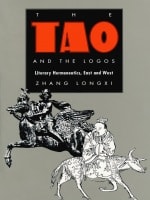
The Tao and the Logos
Literary Hermeneutics, East and WestLongxi Zhang
Duke University Press, 1992
Zhang's book brings together philosophy and literature, theory and practical criticism, the Western and the non-Western in defining common ground on which East and West may come to a mutual understanding. He provides commentary on the rich traditions of poetry and poetics in ancient China; equally illuminating are Zhang's astute analyses of Western poets such as Rilke, Shakespeare, and Mallarmé and his critical engagement with the work of Foucault, Derrida, and de Man, among others.
Wide-ranging and learned, this definitive work in East-West comparative poetics and the hermeneutic tradition will be of interest to specialists in comparative literature, philosophy, literary theory, poetry and poetics, and Chinese literature and history.
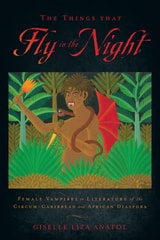
The Things That Fly in the Night
Female Vampires in Literature of the Circum-Caribbean and African DiasporaGiselle Liza Anatol
Rutgers University Press, 2015
This book is available as an audio book (https://www.abantuaudio.com/books/1197052/The-Things-That-Fly-in-the-Night).

The Traditional Theory of Literature
Ray Livingston
University of Minnesota Press, 1962
The Traditional Theory of Literature was first published in 1962. Minnesota Archive Editions uses digital technology to make long-unavailable books once again accessible, and are published unaltered from the original University of Minnesota Press editions.
Through a study of works of the contemporary Indian scholar Ananda K. Coomaraswamy, as well as of other exponents of the ancient doctrine of the Perennial Philosophy, Professor Livingston develops and explicates a traditional theory of literature.
Coomaraswamy, who died in 1947, published widely on a broad range of subjects in art, philosophy, literature, and other fields. Although he is relatively little known, those acquainted with is work acclaim him as one of the great thinkers of our time. His study and writing were devoted primarily to bridging the gap between Oriental and Western cultures.
From the treasury of traditional learning which Coomaraswamy amassed in his profusion of books and articles, Professor Livingston has drawn those elements which contribute to an essential theory of literature. Although he quotes from some of Coomaraswamy's Oriental sources, he delineates the theory in an idiom that is more familiar to the West, as stated or implied in the works of Dante, Milton, and Blake, among others.
The Truth of Uncertainty
Beyond Ideology in Science and LiteratureEdward L. Galligan
University of Missouri Press, 1998
In the last chapter of Walden, Henry David Thoreau proclaims a simple yet profound conviction: "Any truth is better than make- believe." Edward Galligan shares this conviction. In The Truth of Uncertainty: Beyond Ideology in Science and Literature, he argues that contemporary American critics should embrace literary truths with all of their ardent uncertainties rather than cling to the make-believe certainties of ideologies.
Postmodern critics fail to ask the truth-seeker's essential question, What does the evidence prove? and instead trust the generalizations and slogans of ideologies to guide their interpretations. Attempting to be up-to-date and profound, these critics lose sight of the literature they are supposed to explore.
The Truth of Uncertainty celebrates values commonly associated with modern, not postmodern criticism, applying them to contemporary works in a series of fresh and unusual inquiries. Galligan finds important implications for criticism in work from the physical sciences that are rarely touched on by American intellectuals, such as Gerald M. Edelman's Bright Air, Brilliant Fire: On the Matter of the Mind and Roger Penrose's The Emperor's New Mind: Concerning Computers, Minds, and the Laws of Physics. Likewise, he finds illumination in the works of novelists that American critics have largely ignored—Josef Skvorecky, George V. Higgins, Mary Lee Settle, Robertson Davies.
As a consequence of dealing with these "unusual" texts, Galligan presents a refreshing interpretation of a number of important concepts: language is grounded in talk; all literary criticism is subjective and tentative because reading is a highly subjective enterprise; and, most important, the world is real and any truth is indeed better than make-believe. He moves from a rejection of criticism in the service of ideology to an affirmation of criticism in the service of truthfulness.
The ideas celebrated in The Truth of Uncertainty are timeless and valuable. Galligan returns to the text and provides a penetrating critique of the state of contemporary criticism, which has abandoned truth for ideology. The result is an eloquent salute to literature itself.
The Uses of Literary History
Marshall Brown, ed.
Duke University Press, 1995
Concerned with both the theory and practice of literary history, these provocative and sometimes combative pieces examine the writing of literary history, the nature of our interest in tradition, and the ways that literary works act in history. Among the numerous issues discussed are the uses of evidence, anachronism, the dialectic of texts and contexts, particularism and the resistance to reductive understanding, the construction of identities, memory, and the endurance of the past. New historicism, nationalism, and gender studies appear in relation to more traditional issues such as textual editing, taste, and literary pedagogy. Combining new and old perspectives, The Uses of Literary History provides a broad view of the field.
Contributors. Charles Altieri, Jonathan Arac, R. Howard Bloch, Richard Dellamora, Paul H. Fry, Geoffrey Hartman, Denis Hollier, Donna Landry, Lawrence Lipking, Jerome J. McGann, Walter Benn Michaels, Rukmini Bhaya Nair, Virgil Nemoianu, Annabel Patterson, David Perkins, Marjorie Perloff, Meredith Anne Skura, Doris Sommer, Peter Stallybrass, Susan Stewart
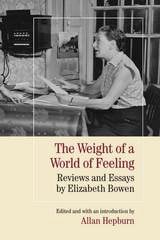
The Weight of a World of Feeling
Reviews and Essays by Elizabeth BowenElizabeth Bowen / Edited and with an introduction by Allan Hepburn
Northwestern University Press, 2017
This fascinating collection of reviews is filled with first impressions of novels, autobiographies, memoirs, illustrated books, biographies of politicians and artists, short story collections, and literary criticism. Books spark statements from Bowen about general principles of fictional technique; she articulates her understanding of the inner workings of fiction incidentally, while providing an opinion about the book at hand. In this volume, Hepburn draws together all the reviews that Bowen left uncollected in her non-fiction collections, as well as several more familiar essays that that she published in The Tatler, in order to make them accessible to a broader audience.
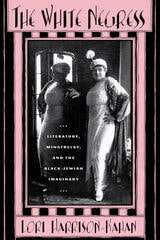
The White Negress
Literature, Minstrelsy, and the Black-Jewish ImaginaryHarrison-Kahan, Lori
Rutgers University Press, 2010
Lori Harrison-Kahan examines writings by Edna Ferber, Fannie Hurst, and Zora Neale Hurston, as well as the blackface performances of vaudevillian Sophie Tucker and controversies over the musical and film adaptations of Show Boat and Imitation of Life. Moving between literature and popular culture, she illuminates how the dynamics of interethnic exchange have at once produced and undermined the binary of black and white.
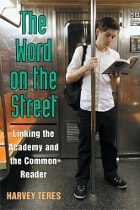
The Word on the Street
Linking the Academy and the Common ReaderHarvey Michael Teres
University of Michigan Press, 2010
"The Word On the Street invites humanities scholars to move beyond the classroom and the monograph to share the pleasures of art in ways that engage the intelligence of the common reader, cultivating the critical imagination so vital to American cultural democracy. Lively and thought-provoking, Teres lays out contemporary debates and wades into them with gusto."
---Nancy Cantor, Syracuse University
"At a moment when questions about the literary, 'bookishness,' and the future of print are being urgently raised, with incessant national attention to the perceived crises of literacy and reading, Teres' thoughtful, broadly democratic, but also tough-minded examination of both 'common readers' and academic readers makes a real contribution to the debate."
---Julie Ellison, University of Michigan
Despite significant changes since the mid-twentieth century in American critical culture---the culture emanating from the serious review of books, ideas, and the arts---it attracts only a small and declining minority of Americans. However productive this culture has been, American society has not approached the realization of Emerson's or Dewey's vision of a highly participatory American cultural democracy. Such a culture requires critics who are read by the average citizen, but the migration of critics and intellectuals from the public to the academy has resulted in fewer efforts to engage with ordinary citizens. The Word on the Street investigates this disjunction between the study of literature in the academy and the interests of the common reader and society at large, arguing the vital importance of publicly engaged scholarship in the humanities. Teres chronicles how the once central function of the humanities professorate---to teach students to appreciate and be inspired by literature---has increasingly been lost to literary and cultural studies in the last thirty years.
The Word on the Street argues for a return to an earlier model of the public intellectual and a literary and cultural criticism that is accessible to ordinary citizens. Along the way, Teres offers an illuminating account of the current problem and potential solutions, with the goal of prompting a future vision of publicly engaged scholarship that resonates with the common reader and promotes an informed citizenry.
Harvey Teres is Associate Professor of English at Syracuse University.
Cover image: Ruth Fremson/The New York Times/Redux
The New Public Scholarship
The World of Early Egyptian Christianity
Language, Literature, and Social Context (CUA Studies in Early Christianity)James E. Goehring
Catholic University of America Press, 2007
The World of Elizabeth Inchbald
Essays on Literature, Culture, and Theatre in the Long Eighteenth CenturyDaniel J. Ennis
University of Delaware Press, 2022
The Writer as Migrant
Ha Jin
University of Chicago Press, 2008
Consisting of three interconnected essays, The Writer as Migrant sets Ha Jin’s own work and life alongside those of other literary exiles, creating a conversation across cultures and between eras. He employs the cases of Alexander Solzhenitsyn and Chinese novelist Lin Yutang to illustrate the obligation a writer feels to the land of their birth, while Joseph Conrad and Vladimir Nabokov—who, like Ha Jin, adopted English for their writing—are enlisted to explore a migrant author’s conscious choice of a literary language. A final essay draws on V. S. Naipaul and Milan Kundera to consider the ways in which our era of perpetual change forces a migrant writer to reconceptualize the very idea of home. Throughout, Jin brings other celebrated writers into the conversation as well, including W. G. Sebald, C. P. Cavafy, and Salman Rushdie—refracting and refining the very idea of a literature of migration.
Simultaneously a reflection on a crucial theme and a fascinating glimpse at the writers who compose Ha Jin’s mental library, The Writer as Migrant is a work of passionately engaged criticism, one rooted in departures but feeling like a new arrival.
The Writer in the Well
On Misreading and Rewriting LiteratureGary Weissman
The Ohio State University Press, 2016
Rethinking the methods and goals of literary analysis, Weissman’s study redefines the nature of authorial intention and reconceives literary interpretation as a writing-based practice. By integrating writing pedagogy with older and newer schools of thought—from psychoanalytic, reader-response, and poststructuralist theories to rhetorical narrative theory and cognitive literary studies—and bridging the fields of literary studies, composition and rhetoric, and creative writing, The Writer in the Well argues that the richest understanding of a literary work lies in probing how it has been misinterpreted and reconceived and offers a new “writer-response theory.”
This highly accessible and thought-provoking book, which includes the full text of Sher’s “The Man in the Well,” is designed to engage scholars, teachers, students, and avid readers of literature.
The Written World
Space, Literature, and the Chorological Imagination in Early Modern FranceJeffrey N. Peters
Northwestern University Press, 2018
In analyses of well-known authors such as Corneille, Molière, Racine, and Madame de Lafayette, Peters demonstrates that the apparent absence of physical space in seventeenth-century literary depiction indicates a subtle engagement with, rather than a rejection of, evolving principles of cosmological understanding. Space is not absent in these works so much as transformed in keeping with contemporaneous developments in early modern natural philosophy. The Written World will appeal to philosophers of literature and literary theorists as well as scholars of early modern Europe and historians of science and geography
Theology and Literature in the Age of Johnson
Resisting SecularismMelvyn New
University of Delaware Press, 2012
Published by University of Delaware Press. Distributed worldwide by Rutgers University Press.
Theory Aside
Jason Potts and Daniel Stout, eds.
Duke University Press, 2014
Contributors. Ian Balfour, Karen Beckman, Pheng Cheah, Frances Ferguson, William Flesch, Anne-Lise François, Mark B. N. Hansen, Simon Jarvis, Heather Love, Natalie Melas, Jason Potts, Elizabeth A. Povinelli, Eve Kosofsky Sedgwick, Jordan Alexander Stein, Daniel Stout, Irene Tucker
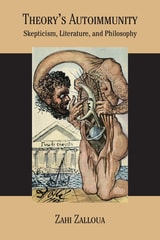
Theory’s Autoimmunity
Skepticism, Literature, and PhilosophyZahi Zalloua
Northwestern University Press, 2018
Openness to change comes with risks, and the self-protective temptation to immunize oneself or one's community against these risks is strong. Yet without such risks, without openness to otherness, no encounter with the new, with difference, can ever take place. Without autoimmunity, theory becomes stagnant and programmatic, unable to receive and respond to the other or the event, to address, revise, and produce new meanings.
Taking up the challenge of thinking theory as skepticism, with and against philosophy, this study turns to literature as an interlocutor, investigating the ways theory, like the literary works of Montaigne, Baudelaire, Stendhal, Morrison, or Duras, declines to put on the interpretive brakes, to stop reading at a point of understanding. Undoing and remaking itself, theory—those critical interpretive practices that revel in the creation and proliferation of meaning—becomes autoimmune.
Thinking Literature across Continents
Ranjan Ghosh and J. Hillis Miller
Duke University Press, 2016
Thinking in Cases
Fiction, Law, and the Case HistoryPeter Brooks
University of Chicago Press, 2027
How the form of the case history became an important way of studying the individual as an exemplary case in medicine, psychoanalysis, law, and the novel.
What does it mean when we address ourselves to a specific problem and treat it as a “case” that needs resolution, a resolution that may in turn offer us more general lessons? The “case history” has become a central form of thought and analysis in our culture, but rarely has it been studied on its own. In Thinking in Cases, the distinguished critic Peter Brooks zeroes in on a kind of thinking that we all know—and often use—without understanding its dimensions and its history.
This book ponders what we do and mean when we think in cases—when we take up specific instances with a view to making them exemplary. Brooks brings to this study decades of reflection on the psychoanalytic case history, on the rhetoric of the legal case, and on novels that unfold as cases seeking solutions. Brooks focuses on the case-history’s emergence in the late nineteenth century: first, he examines how Henry James’s uses of narrative parallel case-study methods in law, medicine, and psychoanalysis. Elsewhere, he traces the case history from Hippocratic medicine through Sir Arthur Conan Doyle’s detective fiction to a startling legal case from Victorian England involving shipwreck and cannibalism. Other chapters discuss a tale of madness by Balzac and Freud’s most speculative works, especially Moses and Monotheism. A final chapter examines recent novels—Duras’s The Ravishing of Lol Stein, Coetzee’s Disgrace, Modiano’s Dora Bruder, and Erpenbeck’s Kairos—as case studies.
Thinking with Tolstoy and Wittgenstein
Expression, Emotion, and ArtHenry W. Pickford
Northwestern University Press, 2015
In this highly original interdisciplinary study incorporating close readings of literary texts and philosophical argumentation, Henry W. Pickford develops a theory of meaning and expression in art intended to counter the meaning skepticism most commonly associated with the theories of Jacques Derrida.
Pickford arrives at his theory by drawing on the writings of Wittgenstein to develop and modify the insights of Tolstoy’s philosophy of art. Pickford shows how Tolstoy’s encounter with Schopenhauer’s thought on the one hand provided support for his ethical views but on the other hand presented a problem, exemplified in the case of music, for his aesthetic theory, a problem that Tolstoy did not successfully resolve. Wittgenstein’s critical appreciation of Tolstoy’s thinking, however, not only recovers its viability but also constructs a formidable position within contemporary debates concerning theories of emotion, ethics, and aesthetic expression.
Thomas De Quincey
British Rhetoric's Romantic TurnLois Peters Agnew
Southern Illinois University Press, 2012
This wide-ranging volume gives proper attention to the views on rhetoric and style set forth by British literary figure Thomas De Quincey (1785–1859), whose contributions to the history of rhetoric are often overlooked. Lois Peters Agnew presents an overview of this theorist’s life and provides cultural context for his time and place, with particular emphasis on the significance of his rhetoric as both an alternative strain of rhetorical history and a previously unrealized example of rhetoric’s transformation in nineteenth-century Britain.
Agnew presents an extensive discussion of De Quincey’s ideas on rhetoric, his theory and practice of conversation, his theory of style and its role in achieving rhetoric’s dialogic potential, and his strategic use of humor and irony in such works as Confessions of an English Opium Eater. Synthesizing previous treatments of De Quincey’s rhetoric and connecting his unusual perspectives on language to the biographical details of his life, Agnew helps readers understand his intellectual development while bringing to light the cultural contexts that prompted radical changes in the ways nineteenth-century British intellectuals conceived of the role of language and the imagination in public and private discourse.
Agnew presents an alternative vision of rhetoric that departs from many common assumptions about rhetoric’s civic purpose and offers insights into the topic of rhetoric and technological change. The result is an accessible and thorough explanation of De Quincey’s complex ideas on rhetoric and the first work to fully show the reach of his ideas across multiple texts written during his lifetime.