Results by title
283 books match the query 'Phenomenology' and 75 start with t
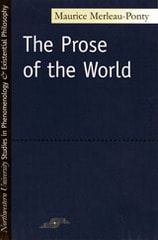
The Prose of the World
Maurice Merleau-Ponty
Northwestern University Press, 1973
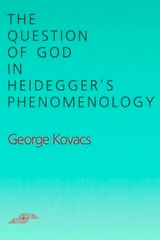
The Question of God in Heidegger's Phenomenology
George Kovacs
Northwestern University Press, 1990
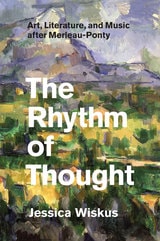
The Rhythm of Thought
Art, Literature, and Music after Merleau-PontyJessica Wiskus
University of Chicago Press, 2013
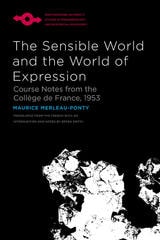
The Sensible World and the World of Expression
Course Notes from the Collège de France, 1953Maurice Merleau-Ponty, Translated from the French with an introduction and notes by Bryan Smyth
Northwestern University Press, 2020
The Sensible World and the World of Expression was a course of lectures that Merleau-Ponty gave at the Collège de France after his election to the chair of philosophy in 1952. The publication and translation of Merleau-Ponty’s notes from this course provide an exceptional view into the evolution of his thought at an important point in his career.
In these notes, we see that Merleau-Ponty’s consideration of the problem of the perception of movement leads him to make a self-critical return to Phenomenology of Perception in order to rethink the perceptual encounter with the sensible world as essentially expressive, and hence to revise his understanding of the body schema accordingly in terms of praxical motor possibilities. Sketching out an embodied dialectic of expressive praxis that would link perception with art, language, and other cultural and intersubjective phenomena, up to and including truth, Merleau-Ponty’s notes for these lectures thus afford an exciting glimpse of how he aspired to overcome the impasse of ontological dualism.
Situated midway between Phenomenology of Perception and The Visible and the Invisible, these notes mark a juncture of crucial importance with regard to Merleau-Ponty’s later efforts to work out the ontological underpinnings of phenomenology in terms of a new dialectical conception of nature and history.
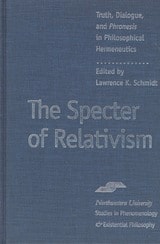
The Specter of Relativism
Truth, Dialogue, and Phronesis in Philosophical HermeneuticsLawrence Schmidt
Northwestern University Press, 1995
The Structures of the Life World
Alfred Schutz and Thomas Luckmann
Northwestern University Press, 1989
The Structures of the Life World
Alfred Schutz and Thomas Luckmann
Northwestern University Press, 1973
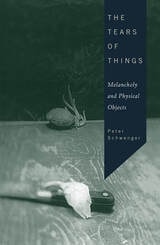
The Tears of Things
Melancholy and Physical ObjectsPeter Schwenger
University of Minnesota Press, 2005
Peter Schwenger deftly weaves together philosophical and psychoanalytical theory with artistic practice. Concerned in part with the act of collecting, The Tears of Things is itself a collection of exemplary art objects—literary and cultural attempts to control and possess things—including paintings by Georgia O’Keeffe and René Magritte; sculpture by Louise Bourgeois and Marcel Duchamp; Joseph Cornell’s boxes; Edward Gorey’s graphic art; fiction by Virginia Woolf, Georges Perec, and Louise Erdrich; the hallucinatory encyclopedias of Jorge Luis Borges and Luigi Serafini; and the corpse photographs of Joel Peter Witkin.
However, these representations of objects perpetually fall short of our aspirations. Schwenger examines what is left over—debris and waste—and asks what art can make of these. What emerges is not an art that reassembles but one that questions what it means to assemble in the first place. Contained in this catalog of waste is that ultimate still life, the cadaver, where the subject-object dichotomy receives its final ironic reconciliation.
Peter Schwenger is professor of English at Mount St. Vincent University in Halifax, Nova Scotia. He is the author of Fantasm and Fiction: On Textual Envisioning, Letter Bomb: Nuclear Holocaust and the Exploding Word, and Phallic Critiques: Masculinity and Twentieth-Century Literature.
The Tenets of Cognitive Existentialism
Dimitri Ginev
Ohio University Press, 2011
In The Tenets of Cognitive Existentialism, Dimitri Ginev draws on developments in hermeneutic phenomenology and other programs in hermeneutic philosophy to inform an interpretative approach to scientific practices. At stake is the question of whether it is possible to integrate forms of reflection upon the ontological difference in the cognitive structure of scientific research. A positive answer would have implied a proof that (pace Heidegger) “science is able to think.” This book is an extended version of such a proof. Against those who claim that modern science is doomed to be exclusively committed to the nexus of objectivism and instrumental rationality, the interpretative theory of scientific practices reveals science’s potentiality of hermeneutic self-reflection. Scientific research that takes into consideration the ontological difference has resources to enter into a dialogue with Nature.
Ginev offers a critique of postmodern tendencies in the philosophy of science, and sets out arguments for a feminist hermeneutics of scientific research.
The Thinking of the Sensible
Merleau-Ponty's A-PhilosophyMauro Carbone
Northwestern University Press, 2004
An original and innovative interpretation of the ontology of Merleau-Ponty--and themselves a significant contribution to the field of Continental thought--these essays constitute a sustained exploration of what Merleau-Ponty detected, and greeted, as a "mutation within the relations of man and Being," which would provide him with the basis for a new idea of philosophy or "a-philosophy." In lucid, often elegant terms, Carbone analyzes key elements of Merleau-Ponty's thought in relation to Proust's Recherche, Hegel's Phenomenology of Spirit, the new biology of Von Uexküll, Rimbaud's Lettre du voyant, and Heidegger's conception of "letting-be." His work clearly demonstrates the vitality of Merleau-Ponty's late revolutionary philosophy by following its most salient, previously unexplored paths. This is essential reading for any scholar with an interest in Merleau-Ponty, in the questions of embodiment, temporality and Nature, or in the possibility of philosophy today.
The Thought of John Sallis
Phenomenology, Plato, ImaginationBernard Freydberg
Northwestern University Press, 2012
Sallis’s work possesses an intrinsic power and originality, as well as deep interpretive insight. This book is a descriptive and critical journey through his thought, providing an overview for readers who wish to gain a sense of its sweep, along with discrete sections on particular philosophical disciplines for readers whose interests are more specific. It grapples with the challenges Sallis’s thought presents, making them explicit and opening them up to further consideration. And it attempts to locate his thought within both contemporary continental philosophy and philosophy as a whole. Essential for any student of continental philosophy, The Thought of John Sallis expounds on his work in a manner that increases access, honors its depth, and opens up unexplored possibilities for philosophy.
The Visible and the Invisible
Maurice Merleau-Ponty
Northwestern University Press, 1968
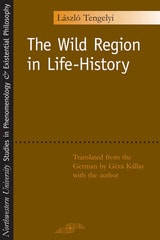
The Wild Region in Life-History
Laszlo Tengelyi
Northwestern University Press, 2004
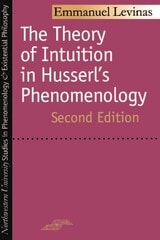
Theory of Intuition in Husserl's Phenomenology
Second EditionEmmanuel Levinas
Northwestern University Press, 1995
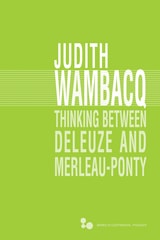
Thinking between Deleuze and Merleau-Ponty
Judith Wambacq
Ohio University Press, 2017
Thinking between Deleuze and Merleau-Ponty is the first book-length examination of the relation between these two major thinkers of the twentieth century. Questioning the dominant view that the two have little of substance in common, Judith Wambacq brings them into a compelling dialogue to reveal a shared, historically grounded concern with the transcendental conditions of thought. Both Merleau-Ponty and Deleuze propose an immanent ontology, differing more in style than in substance. Wambacq’s synthetic treatment is nevertheless critical; she identifies the limitations of each thinker’s approach to immanent transcendental philosophy and traces its implications—through their respective relationships with Bergson, Proust, Cézanne, and Saussure—for ontology, language, artistic expression, and the thinking of difference. Drawing on primary texts alongside current scholarship in both French and English, Thinking between Deleuze and Merleau-Ponty is comprehensive and rigorous while remaining clear, accessible, and lively. It is certain to become the standard text for future scholarly discussion of these two major influences on contemporary thought.
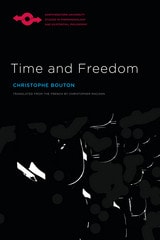
Time and Freedom
Christophe Bouton
Northwestern University Press, 2014
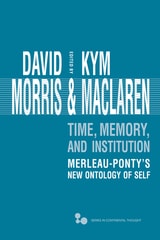
Time, Memory, Institution
Merleau-Ponty's New Ontology of SelfDavid Morris
Ohio University Press, 2015
This collection is the first extended investigation of the relation between time and memory in Maurice Merleau-Ponty’s thought as a whole and the first to explore in depth the significance of his concept of institution. It brings the French phenomenologist’s views on the self and ontology into contemporary focus. Time, Memory, Institution argues that the self is not a self-contained or self-determining identity, as such; it is gathered out of a radical openness to what is not self, and that it gathers itself in a time that is not merely a given dimension, but folds back upon, gathers, and institutes itself.
Access to previously unavailable texts, in particular Merleau-Ponty’s lectures on institution and expression, has presented scholars with new resources for thinking about time, memory, and history. These essays represent the best of this new direction in scholarship; they deepen our understanding of self and world in relation to time and memory; and they give occasion to reexamine Merleau-Ponty’s contribution and relevance to contemporary Continental philosophy.
This volume is essential reading for scholars of phenomenology and French philosophy, as well as for the many readers across the arts, humanities, and social sciences who continue to draw insight and inspiration from Merleau-Ponty.
Contributors: Elizabeth Behnke, Edward Casey, Véronique Fóti, Donald Landes, Kirsten Jacobson, Galen Johnson, Michael Kelly, Scott Marratto, Glen Mazis, Caterina Rea, John Russon, Robert Vallier, and Bernhard Waldenfels
To Act, To Do, To Perform
Drama and the Phenomenology of ActionAlice Rayner
University of Michigan Press, 1994
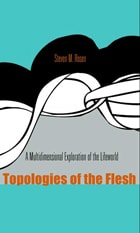
Topologies of the Flesh
A Multidimensional Exploration of the LifeworldSteven M. Rosen
Ohio University Press, 2006
The concept of “flesh” in philosophical terms derives from the writings of Maurice Merleau-Ponty. This was the word he used to name the concrete realm of sentient bodies and life processes that has been eclipsed by the abstractions of science, technology, and modern culture. Topology, to conventional understanding, is the branch of mathematics that concerns itself with the properties of geometric figures that stay the same when the figures are stretched or deformed.
Topologies of the Flesh is an original blend of continental thought and mathematical imagination. Steven M. Rosen opens up a new area of philosophical inquiry: topological phenomenology. Through his unique application of qualitative mathematics, he extends the approaches of Merleau-Ponty and Heidegger so as to offer a detailed exploration of previously uncharted dimensions of human experience and the natural world.
Rosen’s unprecedented marriage of topology and phenomenology is motivated by the desire to help overcome the pervasive dualism of contemporary philosophy and Western culture at large. To carry this to completion, he must address his own dualistic stance as author. Challenging the author’s traditional posture of detachment and anonymity, Rosen makes his presence vividly felt in his final chapter, and his philosophical analysis is transformed into a living reality.
Toward a Phenomenological Rhetoric
Writing, Profession, and AltruismBarbara Couture
Southern Illinois University Press, 1998
Current rhetorical and critical theory for the most part separates writing from consciousness and presumes relative truth to be the only possible expressive goal for rhetoric. These presumptions are reflected in our tradition of persuasive rhetoric, which values writing that successfully argues one person’s belief at the expense of another’s. Barbara Couture presents a case for a phenomenological rhetoric, one that values and respects consciousness and selfhood and that restores to rhetoric the possibility of seeking an all-embracing truth through pacific and cooperative interaction.
Couture discusses the premises on which current interpretive theory has supported relative truth as the philosophical grounding for rhetoric, premises, she argues, that have led to constraints on our notion of truth that divorce it from human experience. She then shows how phenomenological philosophy might guide the theory and practice of rhetoric, reanimating its role in the human enterprise of seeking a shared truth. She proposes profession and altruism as two guiding metaphors for the phenomenological activity of "truth-seeking through interaction."
Among the contemporary rhetoricians and philosophers who influence Couture are Pierre Teilhard de Chardin, Martin Buber, Charles Altieri, Charles Taylor, Alasdair Maclntyre, and Jürgen Habermas.
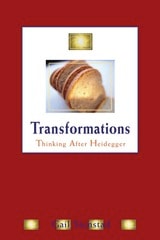
Transformations
Thinking after HeideggerGail Stenstad
University of Wisconsin Press, 2006
How are we to think and act constructively in the face of today’s environmental and political catastrophes? Gail Stenstad finds inspiring answers in the thought of German philosopher Martin Heidegger. Rather than simply describing or explaining Heidegger’s transformative way of thinking, Stenstad’s writing enacts it, bringing new insight into contemporary environmental, political, and personal issues. Readers come to understand some of Heidegger’s most challenging concepts through experiencing them. This is a truly creative scholarly work that invites all readers to carry Heidegger’s transformative thinking into their own areas of deep concern.
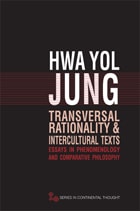
Transversal Rationality and Intercultural Texts
Essays in Phenomenology and Comparative PhilosophyHwa Yol Jung
Ohio University Press, 2011
Transversality is the keyword that permeates the spirit of these thirteen essays spanning almost half a century, from 1965 to 2009. The essays are exploratory and experimental in nature and are meant to be a transversal linkage between phenomenology and East Asian philosophy.
Transversality is the concept that dispels all ethnocentrisms, including Eurocentrism. In the globalizing world of multiculturalism, Eurocentric universalism falls far short of being universal but simply parochial at the expense of the non-Western world. Transversality is intercultural, interspecific, interdisciplinary, and intersensorial. Transversal Rationality and Intercultural Texts means to transform the very way of philosophizing itself by infusing or hybridizing multiple traditions in the history of the world.
Like no other scholar, Jung bridges the gap between Asian and Western cultures. By engaging Western philosophers as diverse as Bacon, Descartes, Heidegger, Hegel, Merleau-Ponty, Derrida, Glissant, Barthes, Fenollosa, McLuhan, and Eastern philosophers such as Wang Yang-ming, Nishida Kitaro, Nishitani Keiji, Watsuji Tetsuro, Nhat Hanh, and Suzuki Daisetz Teitaro, this book marks an unparalleled contribution to comparative philosophy and the study of philosophy itself.
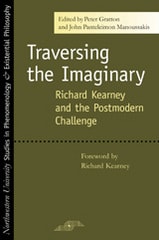
Traversing the Imaginary
Richard Kearney and the Postmodern ChallengeEdited by Peter Gratton and John Panteleimon Manoussakis; Foreword by Richard Kearney
Northwestern University Press, 2007
The book opens with Kearney's own "prelude" in which he traces his intellectual itinerary as it traverses the three imaginaries explored in the volume: the dialogical, the political, and the narrative. The interviews that follow the first section allow readers to listen in on conversations between Kearney and some of the most interesting and respected thinkers of our time—Noam Chomsky, Charles Taylor, Jacques Derrida, Paul Ricouer, and Martha Nussbaum—as they reveal new and unexpected aspects of their thought on stories and mourning, ethics and narrative, terror and religion, intellectuals and ideology. The next section, on the political imaginary, looks at Kearney's distinctive contribution to the political situation in Ireland and in Europe more generally; and in the last, on narrative, writers including David Wood, Terry Eagleton, and Mark Dooley focus on Kearney's novels as instances of narrative theory put into literary practice. Concluding with Kearney's postscript, an essay on "Traversals and Epiphanies in Joyce and Proust," the volume comes full circle, encompassing the full extent of Richard Kearney's engagement and offerings as a philosopher,
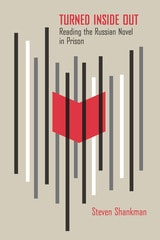
Turned Inside Out
Reading the Russian Novel in PrisonSteven Shankman
Northwestern University Press, 2017
Turned Inside Out will appeal to readers with interests in the classic novels of Russian literature, in prisons and pedagogy, or in Levinas and phenomenology. At a time when the humanities are struggling to justify the centrality of their mission in today’s colleges and universities, Steven Shankman by example makes an undeniably powerful case for the transformative power of reading great texts.
Turning Emotion Inside Out
Affective Life beyond the SubjectEdward S. Casey
Northwestern University Press, 2022
This book begins with a brief critique of internalist views of emotion that hold that feelings are sequestered within a subject. Casey affirms that while certain emotions are felt as resonating within our subjectivity, many others are experienced as occurring outside any such subjectivity. These include intentional or expressive feelings that transpire between ourselves and others, such as an angry exchange between two people, as well as emotions or affects that come to us from beyond ourselves. Casey claims that such far‑out emotions must be recognized in a full picture of affective life. In this way, the book proposes to “turn emotion inside out.”