Results by title
557 books match the query 'Poems' and 128 start with t
The House On Breakaheart Road
PoemsGailmarie Pahmeier
University of Nevada Press, 1998

The Integrated Life
Essays, Sketches and PoemsThomas P. Beyer
University of Minnesota Press, 1948
The Integrated Life was first published in 1948. Minnesota Archive Editions uses digital technology to make long-unavailable books once again accessible, and are published unaltered from the original University of Minnesota Press editions.
This volume of essays and poems is representative of the work and life of their author, a professor of English at Hamline University and for any years chairman of the department.
Of the essays, some are personal, others works of literary appreciation, and still others discuss the profession of teaching, in particular the teaching of English; all reveal the man who wrote them.
At Hamlin Dr. Beyer and reading have been almost synonymous. He proposed the general reading course in 1921 and directed it for twelve years. Students alert to this form of inspiration found existing delight not only in the outside reading but in the discussions with faculty members which followed. Colleagues and off-campus friends also came under provocative influence of Dr. Beyer, and his guidance has been frequently and freely acknowledged.
When Dr. Beyer was honored in 1947 for his long fruitful association with Hamline University, a publication fund was established. It was unanimously agreed that a collection of Dr. Beyer's own essays, poems, and sketches should be the first venture. The Integrated Life is that volume. No attempt has been made to bring the material up to date. The collection appears as it was written—full of the flavor and wisdom of a truly honorable teacher and friend.

The Ladder
PoemsAlan Michael Parker
Tupelo Press, 2016
The Last Incantations
PoemsDavid Mura
Northwestern University Press, 2014
The personal, historical, and artistic are all in dialogue in David Mura’s daring collection, The Last Incantations. In a variety of poetic modes, Mura harmonizes and contrasts multiple voices to form a powerful meditation. Certain poems speak from his experiences as a third-generation Japanese American and his family’s struggles to prove their "Americanness." Others speak from the intersections of our multiracial society—an Asian teenager in love with a Somali Muslim girl, an apostrophe to Richard Pryor, poems about a Palestinian American friend, Abu Ghraib, the hapa sculptor Isamu Noguchi. The result is a sustained multifoliate poetry, bursting with elegance, heartache, and truth.
The Last Nostalgia
Poems, 1982–1990Joe Bolton
University of Arkansas Press, 1999
The Law of Falling Bodies
PoemsElton Glaser
University of Arkansas Press, 2013

The Lighthouse Tattoo
PoemsJose Hernandez Diaz
Acre Books, 2026
In his fourth full-length collection, Jose Hernandez Diaz explores the first-generation Mexican American experience in nuanced linear verse, avant-garde offerings, and deadpan absurdist prose poems.
The Lighthouse Tattoo features plainspoken pieces that reveal the Latinx experience through the lens of a socially conscious contrarian in work that melds the quotidian and the profound. Also included, of course, are experimental prose poems in the signature style and voice that contributed to the meteoric rise of this unique artist. Invoking James Tate, Gabriel García Márquez, Salvador Dalí, Pablo Picasso, Albert Camus, Marosa di Giorgio, and others, Hernandez Diaz cements his place in both the poetic and surrealist traditions.
Even as it unravels mysteries and explores the strange—zebras in a zoo on the moon or English dragons on the Pacific Coast Highway—The Lighthouse Tattoo shines its light on the complex emotions of a seasoned Latinx poet. In this extraordinary volume, the titular tattoo itself becomes evidence of a trauma survived, an apt metaphor for the book as a whole. As one speaker says, “I’m trapped inside of this prose poem, but I don’t want to get out. It's nice and cozy in here. I’m invincible.”
The Listening Chamber
PoemsWilliam Aberg
University of Arkansas Press, 1997
The Long Now Conditions Permit
PoemsJami Macarty
University of Nevada Press, 2025
With ethical attention, Jami Macarty’s collection engages the political, ecological, and personal forces that shape and mark our lives, offering an ecofeminist ethic of care as an antidote to extractive capitalism and patriarchal norms. Each poem meditates on power, insists on articulating what is being lost—and what must be saved and reclaimed.
Amid the exploitation and violence, these poems find moments of grace: the scent of a sea rose, a desert walk in spring, the company of birds, Earth entire. The Long Now Conditions Permit is both tender elegy and urgent call, exhorting readers to grapple with the devastating failings of humanity and the saving possibilities of love.
The Man at Home
PoemsMichael Heffernan
University of Arkansas Press, 1988

The Man on the Tower
PoemsCharles Rafferty
University of Arkansas Press, 1995

The Manageable Cold
PoemsTimothy McBride
Northwestern University Press, 2010
The Manageable Cold showcases McBride’s mastery of a wide range of forms and subjects. Whether his attention is focused on boxing, jazz, or contranyms, McBride breathes new life into the sonnet and the villanelle and handles blank verse with the utmost ease. The combination of traditional techniques and McBride’s thoroughly modern sensibility gives rise to poems that seem simultaneously utterly fresh and immemorially old, calling to mind the rigorously embodied works of Robert Frost, Howard Nemerov, and Mary Oliver. Timothy McBride is a science writer and editor. His poems have appeared in Shenandoah, Seneca Review, and Poetry Northwest, among other publications. The Manageable Cold is his first book of poetry.
The Many Woods of Grief
PoemsLucas Farrell
University of Massachusetts Press, 2011
In this striking debut volume, Lucas Farrell offers a lyrical and illuminating field guide to the flora and fauna of “worlds just out of reach.” With the precision and detail of an Audubon sketch, he turns his naturalist's eye to the vast landscape of human emotion—all the while affirming “how real this world we live in / must be to live in.”
Journeying ever outward, from the achingly ordinary to the mysterious “land where there is no land,” the narrator of this collection, equal parts pastoralist and surrealist, explores the vivid in-betweens—between love and loss, hilarity and despair, wild and domestic, real and imagined. Hungry, expressive, and original, these poems glean light from even the darkest of fields.
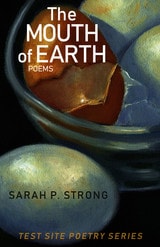
The Mouth of Earth
PoemsSarah P. Strong
University of Nevada Press, 2020
The Mouth of Earth serves as both a survival guide for those seeking connection with our planet and one another as well as a compassionate tribute to what we have lost or are losing—the human consequences of such destruction in a time of climate crisis and lost connectivity. Strong’s powerful poems offer us, if not consolation, at least a way toward comprehension in an age of loss, revealing both our ongoing denial of our planet’s fragility and the compelling urgency of our hunger for connection with all life.
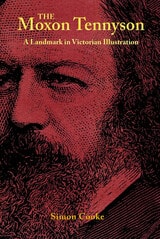
The Moxon Tennyson
A Landmark in Victorian IllustrationSimon Cooke
Ohio University Press, 2021
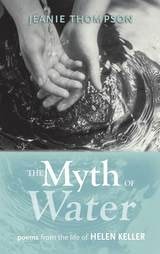
The Myth of Water
Poems from the Life of Helen KellerJeanie Thompson
University of Alabama Press, 2016
Thompson’s artfully concatenated vignettes form a mosaic that maps the insightful mind behind the elegant and enigmatic persona Keller projected. Thompson takes readers on the journey of Keller’s life, from some of the thirty-seven countries she visited, including the British Isles, Europe, and Japan to the wellsprings of her emotional awakening and insight. The poems are paired with fascinating biographical anecdotes from Keller’s life and samplings from her writing, which infuse the work with richly-rewarding biographical detail.
The poems in The Myth of Water reveal the discerning subtlety, resiliency, and complexity of the person Thompson perceives Helen Keller to have been. Through a combination of natural intuition, manual signs, Braille alphabets, and lip reading, Keller came to grasp the revolving tapestry of the seasons and the infinite colors of human relationships.
Not a biography or a fictional retelling, The Myth of Water attempts to unlock what moved Keller to her life of service and self-examination. This is a deeply personal story of coming through—not overcoming—a double disability to a fully realized life in which a woman gives her heart to the world.
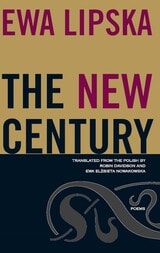
The New Century
PoemsEwa Lipska, translated from the Polisyh by Robin Davidson and Ewa Nowakowska
Northwestern University Press, 2009
Since the publication of her first book in 1967, Ewa Lipska has been among the most acclaimed of contemporary Polish poets. Yet, to date she has not enjoyed the same popularity in the United States as her fellow Poles Wislawa Szymborska, Czeslaw Milosz, and her contemporary Adam Zagajewski. The New Century: Poems, a selection of her recent work, introduces to an American audience the work of an underappreciated master.
Although Lipska’s work displays an acute awareness of history and politics, she’s nonetheless most concerned with individual experience and the most difficult philosophical questions of evil. Lipska is capable of being awed by beauty despite the deep pessimism that flows through her poems, including the failure of language itself to have any ameliorative effect on human experience.
Surreal, skeptical, and laced with wit, Lipska’s poetry, like that of Milosz and Szymborska, seems to effortlessly achieve a kind of hard-won and gracefully wielded authority that tells us something essential about the legacies of the twentieth century’s horrors.
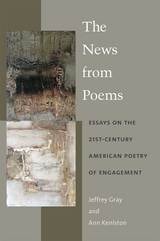
The News from Poems
Essays on the 21st-Century American Poetry of EngagementJeffrey Gray and Ann Keniston
University of Michigan Press, 2016
The News from Poems brings together newly commissioned essays by eminent poets and scholars of poetry and serves as a companion volume to an earlier anthology of engaged poetry compiled by the editors. Essays by Bob Perelman, Steven Gould Axelrod, Tony Hoagland, Eleanor Wilner, and others reveal how recent poetry has redefined our ideas of politics, authorship, identity, and poetics.
The volume showcases the diversity of contemporary American poetry, discussing mainstream and experimental poets, including some whose work has sparked significant controversy. These and other poets of our time, the volume suggests, are engaged not only with public events and topics but also with new ways of imagining subjectivity, otherness, and poetry itself.
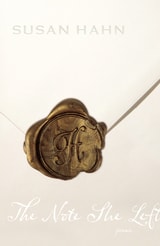
The Note She Left
PoemsSusan Hahn
Northwestern University Press, 2008
Hahn’s new collection wrestles with the elemental and enduring challenges of the human condition: What can we use from our spiritual heritage? How should we find relief? How, after it all, do we live? The poems are presented as a letter to the world from a woman preparing to leave it. In four sections—“The Bells,” “The Crosses,” “Widdershins,” and “Afterwor(l)d”—she contrasts the hope against the dark that is embodied by an amulet or cross with the abased resignation of torture, failed prayers, and witchcraft. Though Hahn’s vision is a dark one, its dramatic emotional depth speaks to a human power that, though damaged, can still engage.
from The Crosses (V)
Cross my fingers, cross my heart,
arms extended, legs together, not apart,
I make of myself a cross.
In my pockets bright blue beads,
small clay gods, scarabs,
four-leaf clovers, bejewelled mezuzahs.
In my hat cockleshells
to exorcize the demons,
to keep hidden the seventh chakra,
the tonsure, the bald compulsion.
Cross my fingers, cross my heart,
arms extended, legs together, not apart.
In my ears little bells of confusion,
to frighten away eyes of the evil.
On my breast a foul sachet
to repel the lick of the Devil.
Cross my fingers, cross my heart.
In my window a glass witch ball
to guard against the shatter
from intruders.
Cross my fingers.
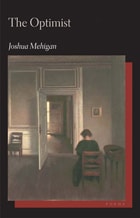
The Optimist
PoemsJoshua Mehigan
Ohio University Press, 2005
In Joshua Mehigan’s award-winning poetry, one encounters a lucid, resolute vision driven by an amazing facility with the metrical line. Most of the poems in The Optimist unapologetically employ traditional poetic technique, and, in each of these, Mehigan stretches the fabric of living language over a framework of regular meter to produce a compelling sonic counterpoint.
The Optimist stares at contemporary darkness visible, a darkly lit tableau that erases the boundary between the world and the perceiving self. Whether narrative or lyric, dramatic or satirical, Mehigan’s poems explore death, desire, and change with a mixture of reason and compassion.
In choosing The Optimist for the Hollis Summers Poetry Prize, final judge James Cummins, wrote:
“The world is given its due in these poems, but its due is the subjective voice making ‘objective’ reality into the reality of art. To do this Mehigan accesses a tradition of voices—the echoes in The Optimist are, to name a few, of Frost, Robinson, Kees, and Justice; and more in terms of point of view, Bishop and Jarrell—to form with great integrity his own. It isn’t that Mehigan is concerned more with what’s outside himself than inside; nor merely that he travels the highway between the two with such humility and grace. It’s also that these voices, this great tradition, infuses his line with what the best verse, metrical or free, must have: wonder.”
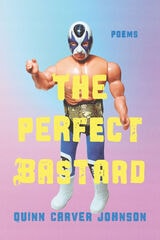
The Perfect Bastard
PoemsQuinn Carver Johnson
Northwestern University Press, 2023
An innovative poetic interrogation of wrestling, queerness, and staying true to oneself
Quinn Carver Johnson’s debut collection, The Perfect Bastard, follows its titular protagonist, a nonbinary and queer professional wrestler, as they travel across Kansas, Oklahoma, Arkansas, and Missouri, working for a booker known as the Puppeteer. Inspired by their idol Adrian Street, the Perfect Bastard strives to positively represent queerness and resist the Puppeteer’s stereotypical and demeaning kayfabe. In the ring, they face off against the likes of champion Jack Holiday and the First Crusher, but their most important battles, against the Puppeteer, take place behind the scenes. They must choose between person and persona, authenticity and humiliating hype, if they want to succeed in the industry.
When offered success on the grandest scale—the championship belt—in exchange for mocking their own queerness, the Perfect Bastard questions their path: Will they betray their identity to achieve their dream, or will they walk away from the world of professional wrestling—a world that refuses to make a genuine, healthy space for them?
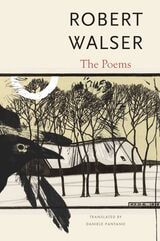
The Poems
Robert Walser
Seagull Books, 2022
Admired by the likes of Kafka, Musil, and Walter Benjamin and acclaimed “unforgettable, heart-rending” by J. M. Coetzee, Swiss writer Robert Walser (1878–1956) remains one of the most influential authors of modern literature. Walser left school at fourteen and led a wandering and precarious existence while producing poems, stories, essays, and novels. In 1933, he abandoned writing and entered a sanatorium, where he remained for the rest of his life. “I am not here to write,” Walser said, “but to be mad.”
This first collection of Walser’s poems in English translation allows English-speaking readers to experience the author as he saw himself at the beginning and the end of his literary career––as a poet. The book also includes notes on dates of composition, draft versions of the printed poems, and brief biographical information on characters and locations that appear in the poems and may not be known to readers. Few writers have ever experienced such a steady rise in their reputation and public profile as Walser has seen in recent years, and this collection of his poems will help readers discover a unique writer whose off-kilter sensibility and innovations in form are perfectly suited to our fragmented, distracted, bewildering era.
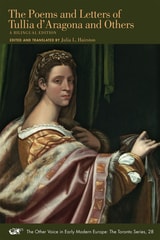
The Poems and Letters of Tullia d'Aragona and Others
A Bilingual EditionTullia d'Aragona and Others, Edited by Julia L. Hairston, Translated by Julia L. Hairston
Iter Press, 2014
Hairston has constructed a full personal, cultural and literary biography for d’Aragona, using newly discovered letters, archival material of other kinds, and contemporary theory about gender in women’s writing. Footnotes establish the intricacy of Tullia’s intellectual networks and her courting of intellectuals in rhyme. Hairston includes poems written to d’Aragona, including Girolamo Muzio’s long pastoral, Tirrhenia. She addresses with tact the question of how sexual Tullia’s relationships were with her various interlocutors. At times, as she says, one just can’t know, but that the issue is much less important than the poems themselves. I agree wholeheartedly. This is the editor Tullia has been waiting for: an indefatigable researcher, a creative biographer, and a precise and appreciative literary critic.
—Ann Rosalind Jones
Esther Cloudman Dunn Professor of Comparative Literature, Smith College
The figure of Tullia d’Aragona has long fascinated readers as the prototype of the “honest courtesan”, a woman who successfully exploited her physical and intellectual charms to win the adoration and respect of the Italian cultural elite. With Julia Hairston’s richly annotated edition of her collected verse, the product of more than a decade of scholarship, d’Aragona finally comes into focus also as poet. She emerges in this volume as one of the most distinctive protagonists in a key transitional moment in Italian literary history, when the aristocratic tradition of Petrarchist lyric began to be reshaped and democratized by its encounter with print.
—Virginia Cox
Professor of Italian, New York University
The Poems of Aimeric de Peguilhan
Aimeric de Peguilhan, edited and translated with introduction and commentary by William P. Shepard and Frank M. Chambers
Northwestern University Press, 1950
The Poems of François Villon
François Villon
Brandeis University Press, 1982
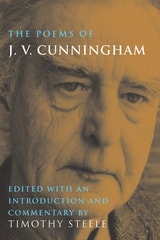
The Poems of J. V. Cunningham
Timothy Steele
Ohio University Press, 1997
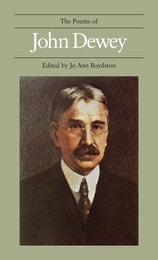
The Poems of John Dewey
Edited by Jo Ann Boydston
Southern Illinois University Press, 1977
A literary discovery of considerable magnitude, these 98 previously unpublished poems by John Dewey, written principally in the 1910–18 period, illuminate an emotive aspect in his intellectual life often not manifest in the prose works.
Rumors of the existence of the poems have circulated among students of Dewey’s life and writings since 1957,when Mrs. Roberta Dewey gained possession of them from the Columbia University Columbiana collection. But except for the few persons who saw copies made by the French scholar Deladelle five years after Dewey’s death, the poems have remained inaccessible until now.
None of the poems has hitherto been published. Mrs. Roberta Dewey and Dewey’s children from his first marriage seem not to have known of Dewey’s experiments in verse during his lifetime. And, as evidence presented here now shows, only two or three acquaintances knew of actual poems written by Dewey, one of them the Polish-American novelist Anzia Yezierska, who had a brief emotional involvement with Dewey in the 1917–18 period. The factual, rather than inferential, evidence of Dewey’s relationship with Anzia Yezierska appears in the poems, which, taken as a whole, provide revealing insights into Dewey’s feelings and illuminate not only aspects of his emotions but of his thought as well.
The fact that Dewey did not publish the poetry himself, together with the circumstances of its discovery and unusual history, has led to the exceptionally careful editorial treatment of the poems given here. Scholars will find all the evidence for the authorship of the manuscripts clearly presented and all the changes and alterations carefully recorded. This edition has received the Modern Language Association of America Center for Editions of American Authors Seal as an “approved text.”
The Poems of Renata Ferreira
Frank X. Gaspar
Tagus Press, 2020
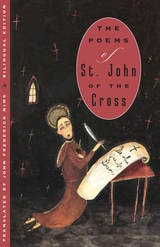
The Poems of St. John of the Cross
St. John of the Cross
University of Chicago Press, 1979
This dual-language edition makes available the original Spanish from the Codex of Sanlúcon de Barrameda with facing English translations. The work concludes with two essays—a critique of the poetry and a short piece on the Spanish text that appears alongside the translation—as well as brief notes on the individual poems.
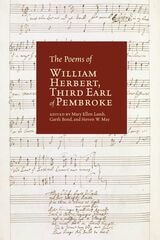
The Poems of William Herbert, Third Earl of Pembroke
William Herbert
Iter Press, 2023
William Herbert, Third Earl of Pembroke, was a pivotal figure in the literary and political cultures of Stuart England. He wrote poetry primarily for social occasions: A debate with a friend, seductions or apologies to beloveds, or support for a deceased political ally. This volume collects his work along with an introduction, detailed notes, and other apparatus that explore the networks in which the poems circulated, the interpretive contexts suggested in miscellanies, and alternative readings revealed through scribal variants. The book also features five contemporary musical settings.
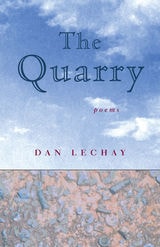
The Quarry
PoemsDan Lechay
Ohio University Press, 2004
Once or twice in a generation a poet comes along who captures the essential spirit of the American Midwest and gives name to the peculiar nature that persists there. Like James Wright, Robert Bly, Ted Kooser, and Jared Carter before him, Dan Lechay reshapes our imagination to include his distinct and profound vision of this undersung region.
The poetry of Dan Lechay, collected in The Quarry, constructs a myth of the Midwest that is at once embodied in the permanence of the landscape, the fleeting nature of the seasons, and the eternal flow of the river. Lechay writes of memory and the mutability of memory, of the change brought on a person by the years lived and lost, and of the stoic attempts made by those around him to elicit an order and rationale to their lives.
The Quarry is the first full-length collection from this seasoned poet. Final judge Alan Shapiro in writing about The Quarry said: “If Dan Lechay’s poems often begin with the ordinary details and circumstances of life in a small Midwestern town or city, they always end by reminding us that no moment of life is ever ordinary, that ‘Nothing is more mysterious than the way things are.’
The Quarry is a marvelous, disquieting, extraordinarily beautiful book that meditates on fundamental questions of time and change in and through a clear-eyed yet loving evocation of everyday existence. Under Lechay’s soulful gaze, the backyards, neighborhoods, animals, and landscapes he describes dramatize the often wrenching connection between beauty and loss, evanescence and memory. The Quarry is a thoroughly mature and accomplished book.”
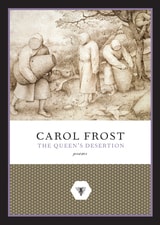
The Queen's Desertion
PoemsCarol Frost
Northwestern University Press, 2006
Pretty to think of the mind at its end
as a metaphysician beekeeping
after the leaves have fallen at autumn's end.
The bee metaphor is handled brilliantly and subtly throughout the collection as a reminder of how often our constant activity, whether it is mental or physical, is taken for granted.
Frost continues her investigation of the mortal plight by entering into a Dantesque descent into the ebb and flow of the seascape. Body consumes body over and over again as fish are caught and killed and the poet observes the flora and fauna as they partake in the darker cycles of nature. A long narrative poem about the Spanish explorer de Baca and his harrowing travels from southern Florida to Mexico powerfully reinforces the certainty of consumption and loss as it comments on the colonizing of the new world. In the final section, Frost returns once more to the need for movement and summons the Greek god Pan, who dances a rite of acceptance through a metaphysical landscape on the verge of seasonal change--the bees are not dead, the dark woods are filled with music.
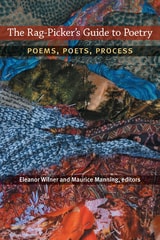
The Rag-Picker's Guide to Poetry
Poems, Poets, ProcessEleanor Wilner and Maurice Manning, editors
University of Michigan Press, 2013
The venture of this inviting collection is to look, from the many vantages that the 35 poets in this eclectic anthology chose to look, at what it was—knowing that a poem can’t be conceived in advance of its creation—that helped their poems to emerge or connected them over time. The Rag-Picker's Guide to Poetry permits an inside view of how poets outwit internal censors and habits of thought, showing how the meticulous and the spontaneous come together in the process of discovery. Within are contained the work and thoughts of:
- Betty Adcock
- Joan Aleshire
- Debra Allbery
- Elizabeth Arnold
- David Baker
- Rick Barot
- Marianne Boruch
- Karen Brennan
- Gabrielle Calvocoressi
- Michael Collier
- Carl Dennis
- Stuart Dischell
- Roger Fanning
- Chris Forhan
- Reginald Gibbons
- Linda Gregerson
- Jennifer Grotz
- Brooks Haxton
- Tony Hoagland
- Mark Jarman
- A. Van Jordan
- Laura Kasischke
- Mary Leader
- Dana Levin
- James Longenbach
- Thomas Lux
- Maurice Manning
- Heather McHugh
- Martha Rhodes
- Alan Shapiro
- Daniel Tobin
- Ellen Bryant Voigt
- Alan Williamson
- Eleanor Wilner
- C. Dale Young
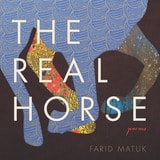
The Real Horse
PoemsFarid Matuk
University of Arizona Press, 2018
Offering a handbook on the possibilities of the verse line, this collection is precise in its figuring, searching in its intellect, and alert in its music. Here lyric energy levitates into constellations that hold their analytic composure, inviting readers into a shared practice of thinking and feeling that interrogates the confounding intersections of gender, race, class, and national status not as abstract concepts but as foundational intimacies.
Matuk’s interrogations of form cut a path through the tangle of a daughter’s position as a natural-born female citizen of the “First World” and of the poet’s position as a once-undocumented immigrant of mixed ethnicity whose paternity is unavoidably implicated in patriarchy. Rejecting nostalgia for homelands, notions of embodied value (self-made or otherwise), and specious ideas of freedom, these luminously multifaceted poem sequences cast their lot with the lyric voice, trusting it to hold a space where we might follow the child’s ongoing revolution against the patrimony of selfhood and citizenship.
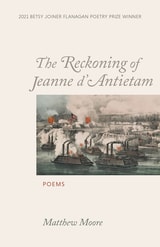
The Reckoning of Jeanne d'Antietam
PoemsMatthew Moore
University of Nevada Press, 2023
The collection of poems in The Reckoning of Jeanne d’Antietam circles the U.S. Civil War and the failed revolution of Reconstruction, and Matthew Moore makes incursions into the histories and beliefs of the era through architectures of sound, but also via ancillary histories and histories stacked upon histories—densely and visibly scrawled—like Anselm Kiefer's sculptures of lead books, melted and dripping with the texts of illegible songs. His poems include the figure of Joan of Arc (Jeanne d'Arc) and her voices; the explosion of the U.S. prison system and racial legal fictions amid the groundswell of mass terror in the wake of the U.S. Civil War; the politically poisoned poetic lineage that moves from Modernism, to New Criticism, and dead-ends in Southern Agrarianism; and the destructive colonial histories of the sugar and cotton industries.
The Reckoning of Jeanne d’Antietam stands imbricated with the spell of language-the-testament; language as hard rhyme and difficult music, evanescence and violence; and the invocation of names and events at their meeting places in history. Moore’s poems stand against sentiment and pity, and against the consolation of that which cannot be consoled.
The Room Within
PoemsMoore Moran
Ohio University Press, 2010
The Room Withinis a retrospective survey of a poetic career dating back to the late fifties. A student of Yvor Winters at Stanford, Moore Moran has deservedly earned a reputation, along with fellow Winters students Turner Cassity and Edgar Bowers, as a “poet’s poet.” He stands, though, not as a disciple, but as a poet who has earned his own voice over the decades, a voice at once familiar and haunting, down-to-earth and carefully wrought—a unique sensibility that emerges not full blown, but rather line by careful line.
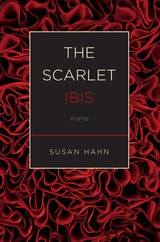
The Scarlet Ibis
PoemsSusan Hahn
Northwestern University Press, 2007
It’s all about disappearance.
About a bird in a cage
with a mirror, a simple twist
on the handle at the side
that makes it come and go
at the magician’s insistence.
It’s all about innocence.
It’s all about acceptance.
It’s all about compliance.
It’s all about deference.
It’s all about silence.
It’s all about disappearance.
The Sea Is a Continual Miracle
Sea Poems and Other Writings by Walt WhitmanWalt Whitman
University Press of New England, 2017
The Shapes of Memory Loss
Stories, Poems and Essays from the University of Michigan Medical School and Health SystemMichigan Publishing Services, 2013
The Shared World
PoemsVievee Francis
Northwestern University Press, 2021
The latest collection from award-winning poet Vievee Francis, The Shared World imagines the ideas and ideals and spaces of the Black woman. The book delves into inherited memories and restrictions between families, lovers, and strangers and the perception and inconvenient truth of Black woman as mother—with or without child. Francis challenges the ways in which Black women are often dismissed while expected to be nurturing. This raw assemblage of poetic narratives stares down the oppressors from within and writes a new language in the art of taking back the body and the memory. These poetic narratives are brutal in their lyrical blows but tender with the bruised history left behind. “You can’t stop this / song,” she writes. “More hands than yours have closed / around my throat.”
Francis’s lyric gifts are on full display as she probes self-discovery, history, intimacy, and violence. Her voice encompasses humor and gravity, enigma and revelation. What emerges is a realm of intertwined experiences. “The secret to knowing the secret is to speak,” she concludes, “but we too often tell / the stories of no matter and avoid the one story that does matter. / In truth, we are bound by one story, so you’d think by now / we’d tell it, at least to each other.”
The Sky Watched
Poems of Ojibwe LivesLinda LeGarde Grover
University of Minnesota Press, 2022
A collective memoir in poetry of an Ojibwe family and tribal community, from creation myth to this day, updated with new poems
Reaching from the moment of creation to the cry of a newborn, The Sky Watched gives poetic voice to Ojibwe family life. In English and Ojibwe, those assembled here—voices of history, of memory and experience, of children and elders, Indian boarding school students, tribal storytellers, and the Manidoog, the unseen beings who surround our lives—come together to create a collective memoir in poetry as expansive and particular as the starry sky.
This world unfolds in the manner of traditional Ojibwe storytelling, shaped by the seasons and the stages of life, marking the significance of the number four in the Ojibwe worldview. Summoning spiritual and natural lore, award-winning poet and scholar Linda LeGarde Grover follows the story of a family, a tribe, and a people through historical ruptures and through intimate troubles and joys—from the sundering of Ojibwe people from their land and culture to singular horrors like the massacre at Wounded Knee to personal trauma suffered at Indian boarding schools. Threaded throughout are the tribal traditions and knowledge that sustain a family and a people through hardship and turmoil, passed from generation to generation, coming together in the manifold power and beauty of the poet’s voice.
The Stars That Fell
PoemsGary Short
University of Nevada Press, 2026
Through his poems, Gary Short illuminates the humanity of the people of Nevada and the American West, specifically the rural communities that often get left out of the narrative. Focusing on family and the relationships between characters, he extends feelings of hope, solace, forgiveness, and even wisdom throughout this collection.
The Story They Told Us of Light
PoemsRodney Jones
University of Alabama Press, 1980
The Surface of the Lit World
PoemsShane Seely
Ohio University Press, 2015
In The Surface of the Lit World, Shane Seely draws on a wide range of sources—from personal memory to biblical narrative—to explore the stories that we tell ourselves about ourselves, the ways in which we make meaning of our lives. Seely delves into the ways in which family and environment shape us. Poems ranging from terse, meditative lyrics to more direct narratives examine the relationship between what lies visible on the lit surface and what lies just beneath.
In addition to first-person autobiographical narratives, there are ekphrastic poems; poems that explore narratives from mythology and religion; and poems based on news reports, radio stories, and audio recordings. Regardless of the approach, the central questions are the same: How do we sense the world we live in? What do the institutions to which we turn for meaning—family, religion, art, literature, science—offer us, and in what ways do they fail us? The answers may depend on where we dare to look.
The Surface
POEMSLaura Mullen
University of Illinois Press, 1991
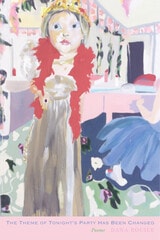
The Theme of Tonight's Party Has Been Changed
PoemsDana Roeser
University of Massachusetts Press, 2014
Sui generis, Dana Roeser's poems are spoken by a stand-up comic having a bad night at the local club. The long extended syntax, spread over her quirky, syncopated short lines, contains (barely) the speaker's anxieties over an aging father with Parkinson's, the maturation of two daughters, friends at twelve-step meetings and their sometimes suicidal urges—acted on or resisted—and her own place in a world that seems about to spin out of control. Bad weather and tiny economy cars speeding down the interstate next to Jurassic semis become the metaphor, or figurative vehicle, for this poet's sense of her own precariousness.
Roeser brings a host of characters into her poems—a Catholic priest raging against the commercialism of Mother's Day, the injured tennis player James Blake, a man struck by lightning, drunk partygoers, an ex-marine, Sylvia Plath's son Nicholas Hughes, a neighbor, travelers encountered in airport terminals, various talk therapists—and lets them speak. She records with high fidelity the nuances of our ordinary exigencies so that the poems become extraordinary arias sung by a husky-voiced diva with coloratura phrasing to die for, “the dark notes” that Lorca famously called the duende. The book is infused with the energy of misfortune, accident, coincidence, luck, grace, panic, hilarity. The characters and narrator, in extremis, speak their truths urgently.
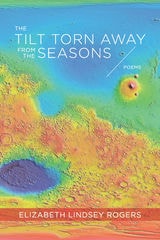
The Tilt Torn Away from the Seasons
PoemsElizabeth Lindsey Rogers
Acre Books, 2020
The Town I Never Told You About
Poems, 2022–2024Ghassan Zaqtan
Seagull Books, 2026
The Town I Never Told You About gathers poems written by celebrated Palestinian poet Ghassan Zaqtan between 2022 and 2024, at a time of intensifying conflict ravaging his homeland. Emerging from both memory and imagination, these poems trace the contours of hillscapes and villages, mapping a Palestine that is both historical and mythic, personal and collective. In Zaqtan’s hands, language threads its way through time—winding across landscapes marked by war, displacement, and enduring beauty. Each poem feels like part of a longer thread: a moment lifted from an ongoing inner epic, stitched into being with dreamlike clarity and haunting precision.
Long meditative pieces drift through shadow and sunlight, while other poems strike with the sharpness of remembered incident. This is poetry as pilgrimage—quiet, persistent, and full of echoes. A book that doesn’t so much end as continue resonating long after the last page is turned.
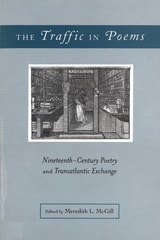
The Traffic In Poems
Nineteenth-Century Poetry and Transatlantic ExchangeMcGill, Meredith L
Rutgers University Press, 2008
Drawing on examples such as Felicia Hemans's elaboration of the foundational American myth of Plymouth Rock, Emma Lazarus's ambivalent welcome of Europe's cast-off populations, black abolitionist Mary Webb's European performances of Hiawatha, and American reprints of Robert Browning and George Meredith, the eleven essays in this book focus on poetic depictions of exile, slavery, immigration, and citizenship and explore the often asymmetrical traffic between British and American poetic cultures.
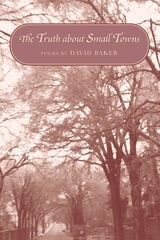
The Truth about Small Towns
PoemsDavid Baker
University of Arkansas Press, 1998
Winner of the 1998 Ohioana Poetry Award
Skilled at both extended narratives and intense, intimate lyrics, David Baker combines his talents in his fifth collection of poems. Working in syllabics, sonnets, couplets, and free verse, Baker can write unflinchingly about love, illness, madness, and perseverance.
His small towns are the burgs of the Midwest, where there is a constant tension between a future that’s coming and a past that may never vanish. The grocer on the corner now carries mango chutney, and the city council must decide—Wendy’s or wetlands.
From these rural towns, Baker evokes lovers, mothers and fathers, highway workmen, hospital patients, and the long dead. He spots the inner struggles of everyday living, as in these lines from “The Women”: “there comes a rubbing of hands, and not as in cleaning. / As when something’s put away, but it won’t stay down.”
Regional in the best sense, Baker’s poems capture the universal human commerce of love and conflict enduring under the water towers and storefronts of America’s heartland.