Results by title
1148 books match the query 'Political Ideologies' and 241 start with t
The End of Czechoslovakia
Jirí Musil
Central European University Press, 1995
Scholars and practitioners from both sides of the divide, Czech and Slovak, as well as international experts, take an in-depth look at the causes of Czechoslovakia's break-up, and explain why a seemingly successful country should disintegrate so quickly after the collapse of the communist regime. Besides exploring the political processes leading to the split, the authors analyse the underlying social, economic and cultural differences between the two nations and examine the historical roots of the problems. Particular attention is paid to changing Czech and Slovak attitudes towards the common state and towards each other, from the heyday of the First Republic to the disillusionment of the post-1989 period.
The End of Kings
A History of Republics and RepublicansWilliam R. Everdell
University of Chicago Press, 2000
"[An] energetic, aphoristic, wide-ranging book."—Marcus Cunliffe, Washington Post Book World
"Ambitious in conception and presented in a clear and sprightly prose. . . . [This] excellent study . . . is the best statement of the republican faith since Alphonse Aulard's essays almost a century ago." —Choice
"A book which ought to be in the hand of every American who agrees with Benjamin Franklin that the Founding Fathers gave us a Republic and hoped that we would be able to keep it."-Sam J. Ervin, Jr.
The End of Liberalism
Chilton Williamson
St. Augustine's Press, 2022
Williamson observes that this liberalism to nevertheless be collapsing, given the obvious opposition to the idea that it is essential to modernity. Liberalism is ironically a kind of unyielding control, "a relativist persuasion that discourages and resists fixed beliefs and certainties and the idea of truth itself." Williamson offers commentary on the present state of liberal ideas and their crimes against better judgment, and vindicates conservatism from being labeled reactionary. Liberalism is exposed as a faith we cannot accept, for it contains nothing to be believed and what it says about the order of things is pure fiction.
The End of Victory Culture
Cold War America and the Disillusioning of a GenerationThomas M. Engelhardt
University of Massachusetts Press, 2007
In a substantial new afterword to his classic account of the collapse of American triumphalism in the wake of World War II, Tom Engelhardt carries that story into the twenty-first century. He explores how, in the aftermath of September 11, 2001, the younger George Bush headed for the Wild West (Osama bin Laden, “Wanted, Dead or Alive”); how his administration brought “victory culture” roaring back as part of its Global War on Terror and its rush to invade Saddam Husseins's Iraq; and how, from its “Mission Accomplished” moment on, its various stories of triumph crashed and burned in that land.
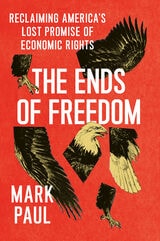
The Ends of Freedom
Reclaiming America's Lost Promise of Economic RightsMark Paul
University of Chicago Press, 2023
Since the Founding, Americans have debated the true meaning of freedom. For some, freedom meant the provision of life’s necessities, those basic conditions for the “pursuit of happiness.” For others, freedom meant the civil and political rights enumerated in the Bill of Rights and unfettered access to the marketplace—nothing more. As Mark Paul explains, the latter interpretation—thanks in large part to a particularly influential cadre of economists—has all but won out among policymakers, with dire repercussions for American society: rampant inequality, endemic poverty, and an economy built to benefit the few at the expense of the many.
In this book, Paul shows how economic rights—rights to necessities like housing, employment, and health care—have been a part of the American conversation since the Revolutionary War and were a cornerstone of both the New Deal and the Civil Rights Movement. Their recuperation, he argues, would at long last make good on the promise of America’s founding documents. By drawing on FDR’s proposed Economic Bill of Rights, Paul outlines a comprehensive policy program to achieve a more capacious and enduring version of American freedom. Among the rights he enumerates are the right to a good job, the right to an education, the right to banking and financial services, and the right to a healthy environment.
Replete with discussions of some of today’s most influential policy ideas—from Medicare for All to a federal job guarantee to the Green New Deal—The Ends of Freedom is a timely and urgent call to reclaim the idea of freedom from its captors on the political right—to ground America’s next era in the country’s progressive history and carve a path toward a more economically dynamic and equitable nation.
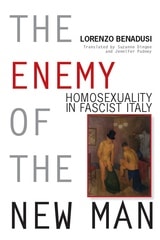
The Enemy of the New Man
Homosexuality in Fascist ItalyLorenzo Benadusi
University of Wisconsin Press, 2012
In this first in-depth historical study of homosexuality in Fascist Italy, Lorenzo Benadusi brings to light immensely important archival documents regarding the sexual politics of the Italian Fascist regime; he adds new insights to the study of the complex relationships of masculinity, sexuality, and Fascism; he explores the connections between new Fascist values and preexisting Italian traditional and Roman Catholic views on morality; he documents both the Fascist regime’s denial of the existence of homosexuality in Italy and its clandestine strategies and motivations for repressing and imprisoning homosexuals; he uncovers the ways that accusations of homosexuality (whether true or false) were used against political and personal enemies; and above all, he shows how homosexuality was deemed the enemy of the Fascist “New Man,” an ideal of a virile warrior and dominating husband vigorously devoted to the “political” function of producing children for the Fascist state.
Benadusi investigates the regulation and regimentation of gender in Fascist Italy, and the extent to which, in uneasy concert with the Catholic Church, the regime engaged in the cultural and legal engineering of masculinity and femininity. He cites a wealth of unpublished documents, official speeches, letters, coerced confessions, private letters and diaries, legal documents, and government memos to reveal and analyze how the orders issued by the regime attempted to protect the “integrity of the Italian race.” For the first time, documents from the Vatican archives illuminate how the Catholic Church dealt with issues related to homosexuality during the Fascist period in Italy.
The Eugenic Fortress
The Transylvanian Saxon Experiment in Interwar RomaniaTudor Georgescu
Central European University Press, 2016
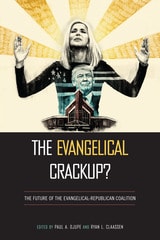
The Evangelical Crackup?
The Future of the Evangelical-Republican CoalitionEdited by Paul Djupe and Ryan L. Claassen
Temple University Press, 2019
Why did Donald Trump attract a record number of white evangelical voters without unified support—and despite nontrivial antipathy from evangelical leaders? The editors and leading scholars that contribute to the timely volume The Evangelical Crackup? answer this question and provide a comprehensive assessment of the status of evangelicals and the Christian Right in the Republican coalition.
The expected “crackup” with the Republican Party never happened. Each chapter in this cogent volume includes analyses of the 2016 election to explain why—and why that is critical. Chapters examine policy priorities, legal advocacy, and evangelical loyalty to the Republican Party; rhetoric, social networks, and evangelical elite influence; and the political implications of movements within evangelicalism, such as young evangelicals, Hispanics, and the Emergent Church movement.
Contributors include: Daniel Bennett, Mark Brockway, Ryan P. Burge, Brian R. Calfano, Jeremy Castle, Kimberly Conger, Daniel A. Cox, Kevin den Dulk, Sarah Allen Gershon, Tobin Grant, Robert P. Jones, Geoffrey Layman, Andrew R. Lewis, Ronald J. McGauvran, Joshua Mitchell, Juhem Navarro-Rivera, Jacob R. Neiheisel, Elizabeth Oldmixon, Adrian D. Pantoja, David Searcy, Anand Edward Sokhey, J. Benjamin Taylor, Robert Wuthnow, and the editors.
The Face of Peace
Government Pedagogy amid Disinformation in ColombiaGwen Burnyeat
University of Chicago Press, 2022
Colombia’s 2016 peace agreement with the FARC guerrillas sought to end fifty years of war and won President Juan Manuel Santos the Nobel Peace Prize. Yet Colombian society rejected it in a polarizing referendum, amid an emotive disinformation campaign. Gwen Burnyeat joined the Office of the High Commissioner for Peace, the government institution responsible for peace negotiations, to observe and participate in an innovative “peace pedagogy” strategy to explain the agreement to Colombian society. Burnyeat’s multi-scale ethnography reveals the challenges government officials experienced communicating with skeptical audiences and translating the peace process for public opinion. She argues that the fatal flaw in the peace process lay in government-society relations, enmeshed in culturally liberal logics and shaped by the politics of international donors. The Face of Peace offers the Colombian case as a mirror to the global crisis of liberalism, shattering the fantasy of rationality that haunts liberal responses to “post-truth” politics.
The Faces of Authoritarianism and Strategies of Dissent in Contemporary Brazil
Edited by Andreza de Souza Santos and Katerina Hatzikidi
University College London, 2025
Faces of Authoritarianism and Strategies of Dissent in Contemporary Brazil dissects the Bolsonaro era as a critical moment in Brazil’s long history of democratic struggle, outlining how authoritarianism took shape and how it was challenged. Rather than viewing Bolsonaro’s presidency as an anomaly, this volume situates it within broader historical and political continuities and highlights the ways state and non-state actors alike engaged in battles over democracy’s meaning.
Interlacing interdisciplinary perspectives, the book explores key arenas of contestation, from institutions under siege to grassroots resistance, providing theoretical depth and rich ethnographic accounts. With a focus on repression and resistance and the shifting boundaries of democratic governance, Faces of Authoritarianism displays a crucial framework for understanding Brazil’s political landscape and its global implications. Required reading for scholars of authoritarianism, democracy, and Latin American politics, this book offers a nuanced view of how democratic backsliding is met with acts of defiance and negotiation.
The Fascist Revolution
Toward a General Theory of FascismGeorge L. Mosse, with a critical introduction by Roger Griffin
University of Wisconsin Press, 2021
The Federalist Frontier
Settler Politics in the Old Northwest, 1783-1840Kristopher Maulden
University of Missouri Press, 2023
Historians of early American politics will have a chance to read about Federalists in the Northwest, and they will see the early American state in action in fighting Indians, shaping settler understandings of space and social advancement, and influencing political ideals among the citizens. For historians of the early American West, Maulden’s work demonstrates that the origins of state-led expansion reach much further back in time than generally understood.
The Federalist Society
How Conservatives Took the Law Back from LiberalsMichael Avery
Vanderbilt University Press, 2013
Today the Society claims that 45,000 conservative lawyers and law students are involved in its activities. Four Supreme Court Justices--Antonin Scalia, Clarence Thomas, John Roberts, and Samuel Alito--are current or former members. Every single federal judge appointed in the two Bush presidencies was either a Society member or approved by members. During the Bush years, young Federalist Society lawyers dominated the legal staffs of the Justice Department and other important government agencies.
The Society has lawyer chapters in every major city in the United States and student chapters in every accredited law school. Its membership includes economic conservatives, social conservatives, Christian conservatives, and libertarians, who differ with each other on significant issues, but who cooperate in advancing a broad conservative agenda.
How did this happen? How did this group of conservatives succeed in moving their theories into the mainstream of legal thought?
What is the range of positions of those associated with the Federalist Society in areas of legal and political controversy? The authors survey these stances in separate chapters on
• regulation of business and private property
• race and gender discrimination and affirmative action
• personal sexual autonomy, including abortion and gay rights
• American exceptionalism and international law
The Fragility of Freedom
Tocqueville on Religion, Democracy, and the American FutureJoshua Mitchell
University of Chicago Press, 1995
Focusing on Democracy in America, The Fragility of Freedom examines Tocqueville's key works and argues that his analysis of democracy is ultimately rooted in an Augustinian view of human psychology. As much a work of political philosophy as of religion, The Fragility of Freedom argues for the importance of a political theology that recognizes moderation.
"An intelligent and sharply drawn portrait of a conservative Toqueville."—Anne C. Rose, Journal of American History
"I recommend this book as one of a very few to approach seriously the sources of Tocqueville's intellectual and moral greatness."—Peter Augustine Lawler, Journal of Politics
"Mitchell ably places Democracy in America in the long conversation of Western political and theological thought."—Wilfred M. McClay, First Things
"Learned and thought-provoking."—Peter Berkowitz, New Republic

The Future of Black Studies
Abdul Alkalimat
Pluto Press, 2022
At a turning point for the growing field of Black Studies, one of its founders looks to its future
'A timely, future-oriented and necessary contribution which provides clarity to the multivalent tendencies in this field' - Carole Boyce Davies
The marginalization of Black voices from the academy is a problem in the Western world. But Black Studies, where it exists, is a powerful, boundary-pushing discipline, grown out of struggle and community action. Here, Abdul Alkalimat, one of the founders of Black Studies in the US, presents a reimagining of the future trends in the study of the Black experience.
Taking Marxism and Black Experientialism, Afro-Futurist and Diaspora frameworks, he projects a radical future for the discipline at this time of social crisis. Choosing cornerstones of culture, such as the music of Sun Ra, the movie Black Panther and the writer Octavia Butler, he looks at the trajectory of Black liberation thought since slavery, including new research on the rise in the comparative study of Black people all over the world.
Turning to look at how digital tools enhance the study of the discipline, this book is a powerful read that will inform and inspire students and activists.
The Future of Totality
Fredric Jameson and the Prospects of Critical TheoryNicholas Brown, Maria Elisa Cevasco, Fabio Akcelrud Durão, and Robert T. Tally Jr., editors
Duke University Press, 2026
The Global Police State
William I Robinson
Pluto Press, 2020
"Karl Marx aspired to a world in which our animal needs would be satisfied and our human needs could be addressed. It is a realistic possibility now, as William Robinson outlines—or the alternative that is taking shape before our eyes: a 'global police state' controlled by narrowly concentrated capital with 'surplus humanity' left to survive somehow on its own. The choice is in our hands."
—Noam Chomsky, author of Who Rules the World?
As the world becomes ever more unequal, people become ever more “disposable.” Today, governments systematically exclude sections of their populations from society through heavy-handed policing. But it doesn't always go to plan.
William I. Robinson exposes the nature and dynamics of this out-of-control system, arguing for the urgency of creating a movement capable of overthrowing it. The global police state uses a variety of ingenious methods of control, including mass incarceration, police violence, US-led wars, the persecution of immigrants and refugees, and the repression of environmental activists.
He writes in his Introduction, “I offer a ‘big picture” of the emerging global police state in a short book that is eminently readable. The pages to follow may startle many readers and make them angry. I trust the work will serve as a warning of the dystopic future that is upon us. More importantly, by exposing the nature and dynamic of this out-of-control system, I hope it will contribute to the struggles to bring about an alternative future based on human freedom and liberation.”
Movements have emerged to combat the increasing militarization, surveillance and social cleansing; however, many of them appeal to a moral sense of social justice rather than addressing its root: global capitalism.
Using shocking data which reveals how far capitalism has become a system of repression, Robinson argues that the emerging megacities of the world are becoming the battlegrounds where the excluded and the oppressed face off against the global police state.
The Government of Mistrust
Illegibility and Bureaucratic Power in Socialist VietnamKen MacLean
University of Wisconsin Press, 2013
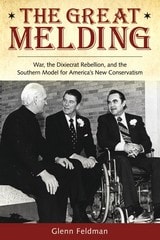
The Great Melding
War, the Dixiecrat Rebellion, and the Southern Model for America's New ConservatismGlenn Feldman
University of Alabama Press, 2015
CHOICE OUTSTANDING ACADEMIC TITLE
Tracing the Southern Origins of Modern American Conservatism.
Audacious in its scope, subtle in its analysis, and persuasive in its arguments, The Great Melding is the second book in Glenn Feldman’s magisterial recounting of the South’s transformation from a Reconstruction-era citadel of Democratic Party inertia to a cauldron of GOP agitation. In this pioneering study, Feldman shows how the transitional years after World War II, the Dixiecrat episode, and the early 1950s formed a pivotal sequence of events that altered America’s political landscape in profound, fundamental, and unexpected ways.
Feldman’s landmark work The Irony of the Solid South dismantled the myth of the New Deal consensus, proving it to be only a fleeting alliance of fissiparous factions; The Great Melding further examines how the South broke away from that consensus. Exploring issues of race and white supremacy, Feldman documents and explains the roles of economics, religion, and emotive appeals to patriotism in southern voting patterns. His probing and original analysis includes a discussion of the limits of southern liberalism and a fresh examination of the Dixiecrat Revolt of 1948.
Feldman convincingly argues that the Dixiecrats—often dismissed as a transitory footnote in American politics—served as a template for the modern conservative movement. Now a predictable Republican stronghold, Alabama at the time was viewed by national political strategists as a battleground and bellwether. Masterfully synthesizing a vast range of sources, Feldman shows that Alabama was then one of the few states where voters made unpredictable choices between the competing ideologies of the Democrats, Republicans, and Dixiecrats.
Writing in his lively and provocative style, Feldman demonstrates that the events he recounts in Alabama between 1942 and Dwight Eisenhower’s 1952 election encapsulate a rare moment of fluidity in American politics, one in which the New Deal consensus shattered and the Democratic and Republican parties fought off a third-party revolt only to find themselves irrevocably altered by their success. The Great Melding will fascinate historians, political scientists, political strategists, and readers of political nonfiction.
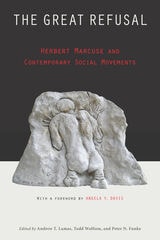
The Great Refusal
Herbert Marcuse and Contemporary Social MovementsAndrew Lamas
Temple University Press, 2016
Herbert Marcuse examined the subjective and material conditions of radical social change and developed the "Great Refusal," a radical concept of "the protest against that which is." The editors and contributors to the exciting new volume The Great Refusal provide an analysis of contemporary social movements around the world with particular reference to Marcuse's revolutionary concept. The book also engages-and puts Marcuse in critical dialogue with-major theorists including Slavoj Žižek and Michel Foucault, among others.
The chapters in this book analyze different elements and locations of the contemporary wave of struggle, drawing on the work and vision of Marcuse in order to reveal, with a historical perspective, the present moment of resistance. Essays seek to understand recent uprisings-such as the Zapatistas in Mexico, the Arab Spring, and the Occupy movement-in the context of Marcuse's powerful conceptual apparatus.
The Great Refusal also charts contemporary social movements against global warming, mass incarceration, police brutality, white supremacy, militarization, technological development, and more, to provide insights that advance our understanding of resistance today.
Contributors include: Kevin B. Anderson, Stanley Aronowitz, Joan Braune, Jenny Chan, Angela Y. Davis, Arnold L. Farr, Andrew Feenberg, Michael Forman, Christian Fuchs, Stefan Gandler, Christian Garland, Toorjo Ghose, Imaculada Kangussu, George Katsiaficas, Douglas Kellner, Sarah Lynn Kleeb, Filip Kovacevic, Lauren Langman, Heather Love, Peter Marcuse, Martin J. Beck Matuštík, Russell Rockwell, AK Thompson, Marcelo Vieta, and the editors.

The Great Separation
The Chinese Cultural Revolution and the Political Origins of OrdoeconomismXiaohong Xu Edited by Roi Livne, Robert Jansen and Yang Zhang
University of Michigan Press, 2026
With a keen attention to how culture and elite conflict shape politics, The Great Separation upends deterministic understandings of the Chinese Cultural Revolution and the market reforms that followed. This ambitious posthumous volume by sociologist Xiaohong Xu turns the existing scholarship on China’s “neoliberalism” on its head by demonstrating that the effort to separate mass politics from economic policy had its origins well before the Reform and Opening-up era.
Over the course of the Cultural Revolution, unfolding factional dynamics and interpretive struggles enabled Chairman Mao and his radical colleagues to mobilize workers to advance their own political goals while neutralizing the masses’ economic demands, symbolically separating the political from the economic. This set the stage for a more thoroughgoing depoliticization of the economy after 1989, when China faced challenges from students and workers whose economic grievances had rapidly morphed into political demands for democracy. The result was what Xu calls ordoeconomism: an ideology that valorizes economic development, rejects mass politics, and views the state as the apolitical guardian of the economy. As Xu demonstrates, while ordoeconomism may share some affinities with neoliberalism, it is a distinctively Chinese approach that must be understood on its own terms.
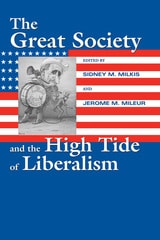
The Great Society and the High Tide of Liberalism
Sidney M. Milkis
University of Massachusetts Press, 2005
In this volume of original essays, a distinguished group of scholars and activists reassess the mixed legacy of this third major reform period of the last century. They examine not only the policies and programs that were part of LBJ's Great Society, but also the underlying ideological and political shifts that changed the nature of liberalism. Some of the essays focus on Lyndon Johnson himself and the institution of the modern presidency, others on specific reform measures, and still others on the impact of these initiatives in the decades that followed. Perspectives, methodologies, and conclusions differ, yet all of the contributors agree that the Great Society represented an important chapter in the story of the American republic and its ongoing struggle to reconcile the power of the state with the rights of individuals—a struggle that has continued into the twenty-first century.
In addition to the editors, contributors include Henry J. Abraham, Brian Balogh, Rosalyn Baxandall, Edward Berkowitz, Eileen Boris, Richard A. Cloward, Hugh Davis Graham, Hugh Heclo, Frederick Hess, William E. Leuchtenburg, Nelson Lichtenstein, Patrick McGuinn, Wilson Carey McWilliams, R. Shep Melnick, Frances Fox Piven, and David M. Shribman.
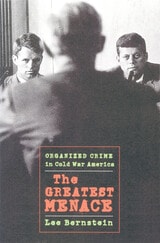
The Greatest Menace
Organized Crime in Cold War AmericaLee Bernstein
University of Massachusetts Press, 2002
The term Cold War has long been associated with the “red menace” of communism at home and abroad. Yet as Lee Bernstein shows in this illuminating study, during the 1950s the threat posed by organized crime preoccupied Americans at least as much as the fear of communist subversion. At the beginning of the decade, the televised hearings of Senator Estes Kefauver's crime committee, focusing on colorful mob figures such as Lucky Luciano and Frank Costello, attracted far more attention than the spy trial of Julius and Ethel Rosenberg. In the years that followed, public concern about gangsters and racketeering continued unabated, even after the anticommunist fever of McCarthyism had begun to subside.
Drawing on a broad range of evidence, from government records to films, television shows, and pulp novels, Bernstein explains how the campaign against organized crime, like the crusade against communism, reflected deep social and political anxieties. Just as the inquisitions of Senator McCarthy fed on popular fears of international conspiracy and alien infiltration, the anticrime investigations of the 1950s raised the specter of a foreign-based criminal cartel—the Sicilian Mafia— preying on a vulnerable American public. In both cases, the association of the foreign-born with criminal or un-American activity led to the creation of state and local citizens committees and to calls for new restrictions on immigration. Labor unions also came under attack, particularly after the McClellan Committee and its chief counsel, Robert F. Kennedy, claimed to have found a link between the International Brotherhood of Teamsters, led by Jimmy Hoffa, and the Mafia.
As Bernstein points out, despite significant changes in the way organized crime actually operated, and despite repeated protests from Italian Americans, the popular image of the sinister gangster persisted, because it served a more profound need. In an era marked by widespread uncertainty and rapid social change, the fight against a common enemy, real or imagined, helped forge a Cold War consensus across shifting lines of race, class, and ethnicity by redefining what it meant to be an American.
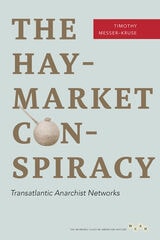
The Haymarket Conspiracy
Transatlantic Anarchist NetworksTimothy Messer-Kruse
University of Illinois Press, 2012
The Hidden Face of Local Power
Appointed Boards and the Limits of DemocracyMirya R. Holman
Temple University Press, 2025
The Hidden Face of Local Power explicates the purpose, role, and consequences of appointed boards in U.S. cities. Mirya Holman finds cities create strong boards that generate policy, consolidate power, and defend the interests of businesses and wealthy and white residents. In contrast, weak boards pacify agitation from marginalized groups to give the appearance of inclusivity, democratic deliberation, and redistributional policymaking. Cities preserve this strong board/weak board dichotomy through policymaking power, institutional design, and by controlling who serves on the boards.
The Hidden Face of Local Power examines the role of boards in the development of urban political institutions, the allocation of power in local politics, and the persistence of inequality. Holman enhances our understanding of how political institutions have contributed to racism and their impact on how people use and live in urban spaces. In her shrewd analysis of the creation and use of boards as political institutions, Holman proves that neither weak or strong boards achieves the goal they are advertised to achieve. In doing so, she provides a new view of the failures of local democracy along with ideas for improvement.
The Historiography of Communism
Michael E. Brown
Temple University Press, 2008
The History of Democracy
A Marxist InterpretationBrian S. Roper
Pluto Press, 2012
Brian Roper refreshes our understanding of democracy using a Marxist theoretical framework. He traces the history of democracy from ancient Athens to the emergence of liberal representative and socialist participatory democracy in Europe and North America, through to the global spread of democracy during the past century.
Roper argues that democracy cannot be understood separately from underlying processes of exploitation and class struggle. He offers an engaging Marxist critique of representative democracy, and raises the possibility of alternative democratic forms. The History of Democracy will be of interest to students and scholars of history and politics and all those concerned about the past, present and future of democracy.
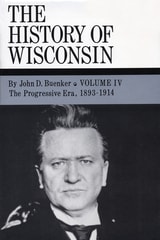
The History of Wisconsin, Volume IV
The Progressive Era, 1893-1914John D. Buenker
Wisconsin Historical Society Press, 1998
Published in Wisconsin's Sesquicentennial year, this fourth volume in The History of Wisconsin series covers the twenty tumultuous years between the World's Columbian Exposition and the First World War when Wisconsin essentially reinvented itself, becoming the nation's "laboratory of democracy."
The period known as the Progressive Era began to emerge in the mid-1890s. A sense of crisis and a widespread clamor for reform arose in reaction to rapid changes in population, technology, work, and society. Wisconsinites responded with action: their advocacy of women's suffrage, labor rights and protections, educational reform, increased social services, and more responsive government led to a veritable flood of reform legislation that established Wisconsin as the most progressive state in the union.
As governor and U.S. Senator from Wisconsin, Robert M. La Follette, Sr., was the most celebrated of the Progressives, but he was surrounded by a host of pragmatic idealists from politics, government, and the state university. Although the Progressives frequently disagreed over priorities and tactics, their values and core beliefs coalesced around broad-based participatory democracy, the application of scientific expertise to governance, and an active concern for the welfare of all members of society-what came to be known as "the Wisconsin Idea."
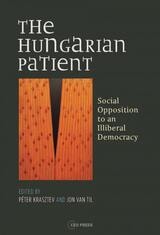
The Hungarian Patient
Social Opposition to an Illiberal DemocracyJon Van Til
Central European University Press, 2015
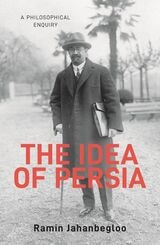
The Idea of Persia
A Philosophical EnquiryRamin Jahanbegloo
Gingko, 2026
This book explores the idea of Persia as a means of investigating the soul of the fascinating nation.
In 1721, the French philosopher Montesquieu posed the question “Comment peut-on être persan?” ("How can one be Persian?") in the title to his famous Persian Letters. After centuries of invasion, murder, destruction, authoritarian rule, decay of political theory, and increasing dissolution in Iran’s politics, this volume is an investigation into what the answer to that question might be today.
The Idea of Persia explores the notion of what it is to be Persian, but not as it has been constituted in the past with reference to the political experience of antiquity, nor as an affirmation of the secular-rational project of modernity. Rather, the book examines the question of what it is to be Persian against the backdrop of centuries in which a common, plural subjectivity of Persian-ness has been continually delayed by those who, with or without ideologies, believed in politics only as a means of ruling or of being ruled without laws or citizenship.
The historical battle for social and political freedoms is still underway in Iran. As the nation wrestles with the possibility of an extended period of political, social, and cultural decline, it is a timely moment to return to the perspective embodied in the enlightened thinking of figures such as the writer and three times prime minister of Iran Mohammed Ali Foroughi (1877–1942) and his vision of a country possessing rational and moral capabilities, and to a possible renaissance of social and political institutions.
The idea of Persia as it is presented here sees hope in the future as the means by which Iranians may liberate themselves from the duality of heroes and saints and remake their political mentality while staying true to an age-old idea of Persia and to freedom as an essential virtue.
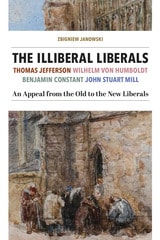
The Illiberal Liberals
An Appeal from the Old to the New LiberalsZbigniew Janowski
St. Augustine's Press, 2026
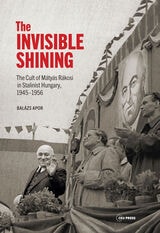
The Invisible Shining
The Cult of Mátyás Rákosi in Stalinist Hungary, 19451956Balazs Apor
Central European University Press, 2018
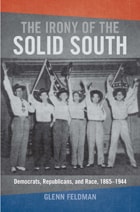
The Irony of the Solid South
Democrats, Republicans, and Race, 1865–1944Glenn Feldman
University of Alabama Press, 2013
Race, Politics, and the Making of the Modern South.
The Irony of the Solid South examines how the south became the “Solid South” for the Democratic Party and how that solidarity began to crack with the advent of American involvement in World War II. Relying on a sophisticated analysis of secondary research—as well as a wealth of deep research in primary sources such as letters, diaries, interviews, court cases, newspapers, and other archival materials—Glenn Feldman argues in The Irony of the Solid South that the history of the solid Democratic south is actually marked by several ironies that involve a concern with the fundamental nature of southern society and culture and the central place that race and allied types of cultural conservatism have played in ensuring regional distinctiveness and continuity across time and various partisan labels. Along the way, this account has much to say about the quality and nature of the New Deal in Dixie, southern liberalism, and its fatal shortcomings.
Feldman focuses primarily on Alabama and race but also considers at length circumstances in the other southern states as well as insights into the uses of emotional issues other than race that have been used time and again to distract whites from their economic and material interests. Feldman explains how conservative political forces (Bourbon Democrats, Dixiecrats, Wallace, independents, and eventually the modern GOP) ingeniously fused white supremacy with economic conservatism based on the common glue of animus to the federal government. A second great melding is exposed, one that joined economic fundamentalism to the religious kind along the shared axis of antidemocratic impulses.
Feldman’s study has much to say about southern and American conservatism, the enduring power of cultural and emotional issues, and the modern south’s path to becoming solidly Republican.
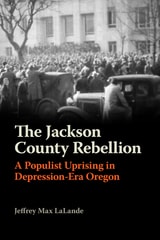
The Jackson County Rebellion
A Populist Uprising in Depression-Era OregonJeffrey Max LaLande
Oregon State University Press, 2023
The Jackson County Rebellion explores a dramatic if little-known populist insurgency in the American West. Author Jeff LaLande takes a deep dive into a tumultuous uprising that captured national attention as it played out in rural Oregon. First tracing its roots back to the area’s tradition of protest, including the Ku Klux Klan of the 1920s, he focuses on Jackson County’s politics of upheaval during the worst days of the Great Depression. The broad strokes of the episode may be familiar to contemporary readers: Demagogues fanning rage — relentlessly accusing an elite of corruption and conspiracy. The strife-torn episode featured nativist and anti-Semitic elements.
The local press played a key role in the events. Two inflammatory newspapers, one owned by wealthy orchardist Llewellyn Banks and the other by politician Earl Fehl, became the vehicles by which these men won the loyalty of rural and working-class residents. Partners in demagoguery, Banks and Fehl created a movement — dubbed the “Good Government Congress” that very nearly took over county government through direct action, ballot theft, and threats of violence. Among those opposing the two men was Harvard-educated Robert Ruhl, owner/editor of the Medford Mail-Tribune, who faced off against Banks and Fehl. Despite boycotts and threats of sabotage. Ruhl ran a resolute editorial campaign against the populist threat in his Mail-Tribune, which won a Pulitzer Prize for its reporting on the uprising.
The rebellion blazed hotly but not for long. Its end was marked by the arrest of its leaders after the fiercely contested 1932 election and by Banks’s murder of the police officer sent to arrest him. Placing the Jackson County Rebellion squarely within America’s long tradition of populist uprisings against the perceived sins of an allegedly corrupt, affluent local elite, LaLande argues that this little-remembered episode is part of a long history of violent conflict in the West that continues today.
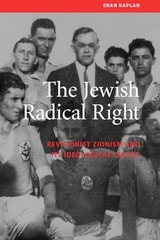
The Jewish Radical Right
Revisionist Zionism and Its Ideological LegacyEran Kaplan
University of Wisconsin Press, 2005
Published with support from the Koret Jewish Studies Program
The Know-Nothing Campaign Against Higher Learning
James Chandler
Prickly Paradigm Press, 2026
Irony and satire in the contemporary American moment.
The second Trump administration has committed itself to upending the knowledge systems and deliberative institutions that have been essential to modern democracy, with the American university—site of scientific research and liberal education—a primary target. In The Know-Nothing Campaign Against Higher Learning, literary and film critic James Chandler spotlights an American tradition of such hostility to intellectual life, especially the nativist movement of the 1850s that persecuted Catholic immigrants from Ireland and Germany. Ironically, Steve Bannon, the self-proclaimed “Know-Nothing vulgarian” who long ago recruited candidate Trump to his anti-intellectual crusade, is himself the great-grandson of an Irish immigrant who would have faced Know-Nothing backlash in that era.
Such dark ironies define our moment, Chandler argues, and they call out not only for intellectual critique but also for satire. Yet in the midst of the MAGA campaign’s calamitous effects on American public discourse, even satire must confront the “kayfabe” practices imported by Trump from professional wrestling, which mix illusion and reality to turn political life into a “spectacle without thought.” Drawing widely on cultural critics from Jonathan Swift and Alexis de Tocqueville to Roland Barthes, Chandler’s pamphlet offers an elegant and bracing account of the MAGA campaign against higher learning and its transformative effects on criticism and democracy itself.
The Labor of Job
The Biblical Text as a Parable of Human LaborAntonio Negri
Duke University Press, 2009
The Labor of Job was first published in Italy in 1990. Negri began writing it in the early 1980s, while he was a political prisoner in Italy, and it was the first book he completed during his exile in France (1983–97). As he writes in the preface, understanding suffering was for him in the early 1980s “an essential element of resistance. . . . It was the problem of liberation, in prison and in exile, from within the absoluteness of Power.” Negri presents a Marxist interpretation of Job’s story. He describes it as a parable of human labor, one that illustrates the impossibility of systems of measure, whether of divine justice (in Job’s case) or the value of labor (in the case of late-twentieth-century Marxism). In the foreword, Michael Hardt elaborates on this interpretation. In his commentary, Roland Boer considers Negri’s reading of the book of Job in relation to the Bible and biblical exegesis. The Labor of Job provides an intriguing and accessible entry into the thought of one of today’s most important political philosophers.
The Last Judgment of Kings / Le Jugement dernier des rois
A Bilingual EditionYann Robert
Bucknell University Press, 2025
Joué pour la première fois le lendemain de l’exécution de Marie-Antoinette, Le Jugement dernier des rois met en scène le procès burlesque des autres rois et reines d’Europe : exhibés et enchaînés tels des animaux, contraints de se battre pour un tonneau de biscuits, et finalement anéantis par l’éruption spectaculaire d’un volcan. Tel est le contexte scandaleux—tragédie et farce à la fois—de la pièce la plus célèbre de la Révolution française, bien connue de tous les spécialistes de cette période. Jusqu’à maintenant, pourtant, il n’existait ni édition critique ni traduction anglaise de cet ouvrage historique. Notre édition bilingue fait revivre la pièce de Maréchal et la replace au centre des plus grands débats chez les historiens de la Révolution, traitant de justice, religion, commémoration, comédie, et propagande. Provocateur, facile à lire, et concis—parfaitement adapté aux étudiants d’un cours de français ou d’histoire—Le Jugement dernier des rois propose ainsi une introduction idéale à la période révolutionnaire et à ses principales controverses.
Published by Bucknell University Press. Distributed worldwide by Rutgers University Press.
The Liberalism of Care
Community, Philosophy, and EthicsShawn C. Fraistat
University of Chicago Press, 2021
To recover that language, Fraistat turns to three prominent philosophers—Plato, Jean-Jacques Rousseau, and William Godwin—who illuminate the varied ways caring language and caring values have structured core debates in the history of Western political thought about the proper role of government, as well as the rights and responsibilities of citizens. The Liberalism of Care presents a distinctive vision for our liberal politics where political communities and citizens can utilize the ethic and practices of care to face practical challenges.

The Limits of Transnationalism
Nancy L. Green
University of Chicago Press, 2019
The Long 1989
Decades of Global RevolutionKyrill Kunakhovich
Central European University Press, 2019
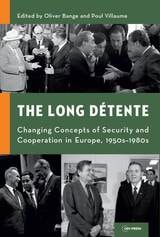
The Long Détente
Changing Concepts of Security and Cooperation in Europe, 1950s–1980sPoul Villaume
Central European University Press, 2017
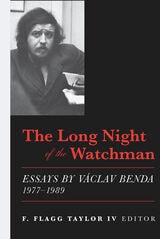
The Long Night of the Watchman
Essays by Vaclav Benda, 1977-1989F. Flagg Taylor
St. Augustine's Press, 2017
The Loss and Recovery of Truth
Selected Writings of Gerhart NiemeyerGerhart Niemeyer
St. Augustine's Press, 2013
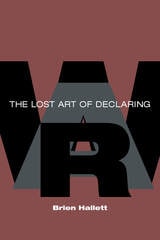
The Lost Art of Declaring War
Brien Hallett
University of Illinois Press, 1998
Historically, it has been assumed that war is violence and declarations of war are simply public announcements that serve to initiate combat. Brien Hallett denies both assumptions and claims that war is policy, not violence.
The Lost Art of Declaring War analyzes the crucial differences between combat and war and convincingly argues that the power to "declare" war is in actuality the power to compose a text, draft a document, write a denunciation. Once written, the declaration then serves three functions: to articulate the political purposes of the war, to guide and direct military operations, and to establish the boundary between justified combat and unjustified devastation.
Hallett sounds a clarion call urging the people and their representatives to take up the challenge and write fully reasoned declarations of war. Then, and only then, can a civilized nation like the United States lay claim to being fully democratic, not only in peacetime, but in wartime as well.
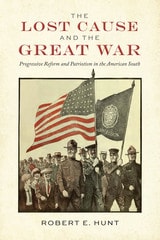
The Lost Cause and the Great War
Progressive Reform and Patriotism in the American SouthRobert E. Hunt
University of Alabama Press, 2025
How Tennessee reformers reconciled Southern heritage with rising nationalism, weaving the Lost Cause into the fabric of American progress and identity.
The Lost Cause and the Great War tells the stories of central Tennessee Progressive-era reformers to illustrate the fascinating broader issue of how Southerners steeped in Lost Cause Civil War mythologies simultaneously developed patriotic American fervor. Focusing on Luke Lea, a prominent politician and American army officer who attempted to capture Kaiser Wilhelm II during World War I, the book reveals the intricate interplay between three competing ideas: attachment to the memory of the Confederacy, intense American nationalism, and advocacy for progressive reforms.
Hunt shows that Lea and his contemporaries sought either to harmonize these competing loyalties or to compartmentalize them to use when needed. Through insightful accounts of Tennessee’s 1928 presidential campaign, the American Legion’s response to cuts to veteran benefits in 1933, and the redefinition of America’s global role post–World War II, Hunt shows how these reformers achieved a balance that held until the Civil Rights movement disrupted this delicate consensus.
Hunt’s rich account reveals how Lea and others like him wove national patriotism and Southern collective memory into a cohesive narrative that supported their broader Progressive goals. The book offers much to readers interested in Southern history, the Gilded Age, Prohibition, World War I, World War II, and the beginnings of the Civil Rights movement. It provides vivid examples of how collective memory and narratives shape social and political movements. General readers will discover how white Southerners who remained devoted to vindicating the Confederacy nonetheless became fervent supporters of America's growing nationalism in the early twentieth century.
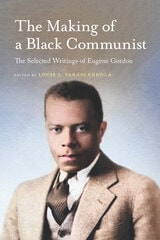
The Making of a Black Communist
The Selected Writings of Eugene GordonLouis J. Parascandola, Editor
University of Massachusetts Press, 2025
Eugene Gordon (1891–1974) was a major writer involved in the development of the burgeoning Black literary scene in Boston in the 1920s, an active player in the Harlem Renaissance, and a longtime member of the Communist Party. Despite his credentials as a reporter, editor, fiction writer, and political activist, he is rarely mentioned in studies of the Harlem Renaissance or Marxist politics. Here, Louis J. Parascandola has pulled together Gordon’s journalism, autobiographical writing, and fiction. This new collection, featuring both previously published pieces from a wide variety of publications as well as material that has never before been published, demonstrates his range and his skill while establishing his importance as a critical voice of his time.
Gordon was born and raised in the South but made his way north at a young age. In Boston, he founded the Saturday Evening Quill Club, an African American literary group that included other notable writers such as Helene Johnson and Dorothy West. He later became editor of and contributor to two major publications coming out of the era: the Messenger and Opportunity: A Journal of Negro Life. As he grew more political, he joined the Communist Party in the 1930s and became editor of and contributor to the New Masses. Scholars looking to research him have struggled to find disparate writings to get a fuller sense of his literary stylings as well as his political commitments. This welcome new volume establishes Gordon as a significant, understudied figure.
The Making of a Nation in the Balkans
Roumen Daskalov
Central European University Press, 2004
The Making of a Socialist Night
Society, Imagination and Everyday Life in Czechoslovakia 1945-1960Lucie Dusková
Central European University Press, 2026