Results by title
1201 books match the query 'Race relations' and 209 start with t
The Colored Aristocracy of St. Louis
Cyprian Clamorgan, Edited & Intro by Julie Winch
University of Missouri Press, 2018
In 1858, Cyprian Clamorgan wrote a brief but immensely readable book entitled The Colored Aristocracy of St. Louis. The grandson of a white voyageur and a mulatto woman, he was himself a member of the "colored aristocracy." In a setting where the vast majority of African Americans were slaves, and where those who were free generally lived in abject poverty, Clamorgan's "aristocrats" were exceptional people. Wealthy, educated, and articulate, these men and women occupied a "middle ground." Their material advantages removed them from the mass of African Americans, but their race barred them from membership in white society.
The Colored Aristocracy of St. Louis is both a serious analysis of the social and legal disabilities under which African Americans of all classes labored and a settling of old scores. Somewhat malicious, Clamorgan enjoyed pointing out the foibles of his friends and enemies, but his book had a serious message as well. "He endeavored to convince white Americans that race was not an absolute, that the black community was not a monolith, that class, education, and especially wealth, should count for something."
Despite its fascinating insights into antebellum St. Louis, Clamorgan's book has been virtually ignored since its initial publication. Using deeds, church records, court cases, and other primary sources, Winch reacquaints readers with this important book and establishes its place in the context of African American history. This annotated edition of The Colored Aristocracy of St. Louis includes an introductory essay on African Americans in St. Louis before the Civil War, as well as an account of the lives of the author and the members of his remarkable family—a family that was truly at the heart of the city's "colored aristocracy" for four generations.
A witty and perceptive commentary on race and class, The Colored Aristocracy of St. Louis is a remarkable story about a largely forgotten segment of nineteenth-century society. Scholars and general readers alike will appreciate Clamorgan's insights into one of antebellum America's most important communities.
The Combat Zone
Murder, Race, and Boston's Struggle for JusticeJan Brogan
University of Massachusetts Press, 2021
At the end of the 1976 football season, more than forty Harvard athletes went to Boston's Combat Zone to celebrate. In the city's adult entertainment district, drugs and prostitution ran rampant, violent crime was commonplace, and corrupt police turned the other way. At the end of the night, Italian American star athlete Andy Puopolo, raised in the city's North End, was murdered in a stabbing. Three African American men were accused of the crime. His murder made national news and led to the eventual demise of the city's red-light district.
Starting with this brutal murder, The Combat Zone tells the story of the Puopolo family's struggle with both a devastating loss and a criminal justice system that produced two trials with opposing verdicts, all within the context of a racially divided Boston. Brogan traces the contentious relationship between Boston’s segregated neighborhoods during the busing crisis; shines a light on a court system that allowed lawyers to strike potential jurors based purely on their racial or ethnic identity; and lays bare the deep-seated corruption within the police department and throughout the Combat Zone. What emerges is a fascinating snapshot of the city at a transitional moment in its recent past.
The Company We Keep
Interracial Friendships and Romantic Relationships from Adolescence to AdulthoodGrace Kao
Russell Sage Foundation, 2019
While research on interracial social ties has often focused on whites and blacks, Hispanics are the largest minority group and Asian Americans are the fastest growing racial group in the United States. The Company We Keep examines friendships and romantic relationships among blacks, whites, Hispanics, and Asian Americans to better understand the full spectrum of contemporary race relations. Using data from the National Longitudinal Study of Adolescent to Adult Health, the authors explore the social ties of more than 15,000 individuals from their first survey responses as middle and high school students in the mid-1990s through young adulthood nearly fifteen years later. They find that while approval for interracial marriages has increased and is nearly universal among young people, interracial friendships and romantic relationships remain relatively rare, especially for whites and blacks. Black women are particularly disadvantaged in forming interracial romantic relationships, while Asian men are disadvantaged in the formation of any romantic relationships, both as adolescents and as young adults. They also find that people in same-sex romantic relationships are more likely to have partners from a different racial group than are people in different-sex relationships. The authors pay close attention to how the formation of interracial friendships and romantic relationships depends on opportunities for interracial contact. They find that the number of students choosing different-race friends and romantic partners is greater in schools that are more racially diverse, indicating that school segregation has a profound impact on young people’s social ties.
Kao, Joyner, and Balistreri analyze the ways school diversity and adolescent interracial contact intersect to lay the groundwork for interracial relationships in young adulthood. The Company We Keep provides compelling insights and hope for the future of living and loving across racial divides.

The Complete Civil War Journal and Selected Letters of Thomas Wentworth Higginson
Thomas Wentworth Higginson
University of Chicago Press, 1999
So wrote Thomas Wentworth Higginson about his role in one of the most compelling and fascinating episodes in the history of the United States. As the colonel of the first regiment of black men in the Union army during the Civil War, Higginson was an early, articulate, and powerful crusader for civil rights, and his journal and letters, collected for the first time in this volume, present some of the most extraordinary documents of the Civil War.
Higginson was a politically engaged intellectual at the forefront of radical antislavery, labor, and feminist causes. Born in 1823 to a formerly wealthy but still prominent Brahmin family, he became one of America's leading social activists and a prominent writer, minister, and reformer. With the publication in 1869 of his classic Army Life in a Black Regiment, which drew on this journal, Higginson became one of the most important chroniclers of the Civil War. The Complete Civil War Journal and Selected Letters of Thomas Wentworth Higginson is the first comprehensive edition of his journal. Sensitively and thoroughly annotated by Christopher Looby and supplemented by a large selection of Higginson's wartime letters, this volume offers the most vivid and intimate picture of the radical interracial solidarity brought about by the transformative experience of the army camp and of Civil War life.
"The immediacy of Higginson's reflections, as well as their sharp insights, make this journal both distinctive and enduringly compelling . . . . Higginson's vivid texts can once again educate, gratify and delight readers."—Publishers Weekly
"This volume will enrich our understanding of the transformations that emancipation and war wrought."—Library Journal
The Coolie Speaks
Chinese Indentured Laborers and African Slaves in CubaLisa Yun
Temple University Press, 2009
Introducing radical counter-visions of race and slavery, and probing the legal and philosophical questions raised by indenture, The Coolie Speaks offers the first critical reading of a massive testimony case from Cuba in 1874. From this case, Yun traces the emergence of a "coolie narrative" that forms a counterpart to the "slave narrative." The written and oral testimonies of nearly 3,000 Chinese laborers in Cuba, who toiled alongside African slaves, offer a rare glimpse into the nature of bondage and the tortuous transition to freedom. Trapped in one of the last standing systems of slavery in the Americas, the Chinese described their hopes and struggles, and their unrelenting quest for freedom.
Yun argues that the testimonies from this case suggest radical critiques of the "contract" institution, the basis for free modern society. The example of Cuba, she suggests, constitutes the early experiment and forerunner of new contract slavery, in which the contract itself, taken to its extreme, was wielded as a most potent form of enslavement and complicity. Yun further considers the communal biography of a next-generation Afro-Chinese Cuban author and raises timely theoretical questions regarding race, diaspora, transnationalism, and globalization.
The Cultivation of Whiteness
Science, Health, and Racial Destiny in AustraliaWarwick Anderson
Duke University Press, 2006
“[Anderson] writes with passion, wit, and panache, and the principal virtues of The Cultivation of Whiteness are the old-fashioned ones of thoroughness, accuracy, and impeccable documentation. . . . [His] sensitive study is a model of how contentious historical issues can be confronted.”—W. F. Bynum, Times Literary Supplement
“One of the virtues of The Cultivation of Whiteness is that it brings together aspects of Australian life and history that are now more often separated—race and environment, blood and soil, medicine and geography, tropical science and urban health, biological thought and national policy, Aboriginality and immigration, the body and the mind. The result is a rich and subtle history of ideas that is both intellectual and organic, and that vividly evokes past states of mind and their lingering, haunting power.”—Tom Griffiths, Sydney Morning Herald
The Cultural Territories of Race
Black and White BoundariesEdited by Michèle Lamont
University of Chicago Press, 1999
These essays examine the cultural territories of race through topics such as blacks' strategies for dealing with racism, public categories for definition of race, and definitions of rules for cultural memberships. Empirically grounded, these studies analyze divisions among blacks according to their relationships with whites or with alternative black culture; differences among whites regarding their attitudes toward blacks; and differences both among blacks and between blacks and whites, in their cultural understandings of various aspects of social life ranging from material success to marital life and to ideas about feminism. The essays teach us about the largely underexamined cultural universes of black executives, upwardly mobile college students, fast-food industry workers, so-called deadbeat dads, and proponents of Afrocentric curricula.
The Cultural Territories of Race makes an important contribution to current policy debates by amplifying muted voices that have too often been ignored by other social scientists.
Contributors are: Elijah Anderson, Amy Binder, Bethany Bryson, Michael C. Dawson, Catherine Ellis, Herbert J. Gans, Jennifer L. Hochschild, Michèle Lamont, Jane J. Mansbridge, Katherine S. Newman, Maureen R. Waller, Pamela Barnhouse Walters, Mary C. Waters, Julia Wrigley, Alford A. Young Jr.
The Cultural Turn in U. S. History
Past, Present, and FutureEdited by James W. Cook, Lawrence B. Glickman, and Michael O'Malley
University of Chicago Press, 2008
The Cunning of Recognition
Indigenous Alterities and the Making of Australian MulticulturalismElizabeth A. Povinelli
Duke University Press, 2002
Povinelli draws on seventeen years of ethnographic research among northwest coast indigenous people and her own experience participating in land claims, as well as on public records, legal debates, and anthropological archives to examine how multicultural forms of recognition work to reinforce liberal regimes rather than to open them up to a true cultural democracy. The Cunning of Recognition argues that the inequity of liberal forms of multiculturalism arises not from its weak ethical commitment to difference but from its strongest vision of a new national cohesion. In the end, Australia is revealed as an exemplary site for studying the social effects of the liberal multicultural imaginary: much earlier than the United States and in response to very different geopolitical conditions, Australian nationalism renounced the ideal of a unitary European tradition and embraced cultural and social diversity.
While addressing larger theoretical debates in critical anthropology, political theory, cultural studies, and liberal theory, The Cunning of Recognition demonstrates that the impact of the globalization of liberal forms of government can only be truly understood by examining its concrete—and not just philosophical—effects on the world.

The Dallas Myth
The Making and Unmaking of an American CityHarvey J. Graff
University of Minnesota Press, 2010
In The Dallas Myth, Harvey J. Graff presents a novel interpretation of a city that has proudly declared its freedom from the past. He scrutinizes the city's origin myth and its governance ideology, known as the "Dallas Way," looking at how these elements have shaped Dallas and served to limit democratic participation and exacerbate inequality. Advancing beyond a traditional historical perspective, Graff proposes an original, integrative understanding of the city's urban fabric and offers an explicit critique of the reactionary political foundations of modern Dallas: its tolerance for right-wing political violence, the endemic racism and xenophobia, and a planning model that privileges growth and monumental architecture at the expense of the environment and social justice.
Revealing the power of myths that have defined the city for so long, Graff presents a new interpretation of Dallas that both deepens our understanding of America's urban landscape and enables its residents to envision a more equitable, humane, and democratic future for all.
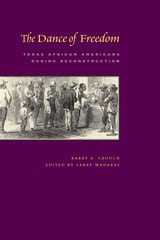
The Dance of Freedom
Texas African Americans during ReconstructionBy Barry Crouch
University of Texas Press, 2007
This anthology brings together the late Barry A. Crouch's most important articles on the African American experience in Texas during Reconstruction. Grouped topically, the essays explore what freedom meant to the newly emancipated, how white Texans reacted to the freed slaves, and how Freedmen's Bureau agents and African American politicians worked to improve the lot of ordinary African American Texans. The volume also contains Crouch's seminal review of Reconstruction historiography, "Unmanacling Texas Reconstruction: A Twenty-Year Perspective." The introductory pieces by Arnoldo De Leon and Larry Madaras recapitulate Barry Crouch's scholarly career and pay tribute to his stature in the field of Reconstruction history.
The Declining Significance of Race
Blacks and Changing American InstitutionsWilliam Julius Wilson
University of Chicago Press, 1980
"Wilson has written a profound and provocative book that is destined to become a classic in the field. He has articulated the issues with which future researchers will have to deal. Truly, he has made a contribution to social science."—Wilson Record, American Journal of Sociology
"The intellectual strength of this book lies in his capacity to integrate disparate findings from historical studies, social theory and research on contemporary trends into a complex and original synthesis that challenges widespread assumptions about the cause of black disadvantage and the way to remove it."—Paul Starr, New York Times Book Review
This is a short but important book. . . . Wilson presents a cogent and convincing interpretation of how the changing political and economic structure of the United States profoundly affected the position of black Americans."—Pierre van den Berghe, Sociology and Social Research
"This publication is easily one of the most erudite and sober diagnoses of the American black situation. Students of race relations and anybody in a policy-making position cannot afford to bypass this study."—Ernest Manheim, Sociology
The Declining Significance of Race
Blacks and Changing American Institutions, Third EditionWilliam Julius Wilson
University of Chicago Press, 2012
When first published in 1980, The Declining Significance of Race immediately sparked controversy with its contentious thesis that race was becoming less of a deciding factor in the life chances of black Americans than class. This new edition of the seminal book includes a new afterword in which William Julius Wilson not only reflects on the debate surrounding the book, but also presents a provocative discussion of race, class, and social policy.
“The intellectual strength of this book lies in his capacity to integrate disparate findings from historical studies, social theory and research on contemporary trends into a complex and original synthesis that challenges widespread assumptions about the cause of black disadvantage and the way to remove it.”—Paul Starr, New York Times Book Review
“This publication is easily one of the most erudite and sober diagnoses of the American black situation. Students of race relations and anybody in a policy-making position cannot afford to bypass this study.”—Ernest Manheim, Sociology
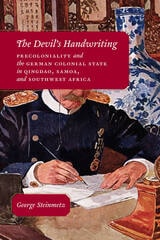
The Devil's Handwriting
Precoloniality and the German Colonial State in Qingdao, Samoa, and Southwest AfricaGeorge Steinmetz
University of Chicago Press, 2007
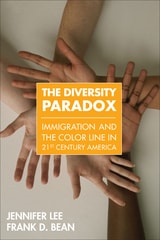
The Diversity Paradox
Immigration and the Color Line in Twenty-First Century AmericaJennifer Lee
Russell Sage Foundation, 2010
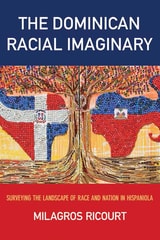
The Dominican Racial Imaginary
Surveying the Landscape of Race and Nation in HispaniolaRicourt, Milagros
Rutgers University Press, 2016
This book begins with a simple question: why do so many Dominicans deny the African components of their DNA, culture, and history?
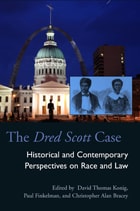
The Dred Scott Case
Historical and Contemporary Perspectives on Race and LawDavid Thomas Konig
Ohio University Press, 2010
In 1846 two slaves, Dred and Harriet Scott, filed petitions for their freedom in the Old Courthouse in St. Louis, Missouri. As the first true civil rights case decided by the U.S. Supreme Court, Dred Scott v. Sandford raised issues that have not been fully resolved despite three amendments to the Constitution and more than a century and a half of litigation.
The Dred Scott Case: Historical and Contemporary Perspectives on Race and Law presents original research and the reflections of the nation’s leading scholars who gathered in St. Louis to mark the 150th anniversary of what was arguably the most infamous decision of the U.S. Supreme Court. The decision, which held that African Americans “had no rights” under the Constitution and that Congress had no authority to alter that, galvanized Americans and thrust the issue of race and law to the center of American politics. This collection of essays revisits the history of the case and its aftermath in American life and law. In a final section, the present-day justices of the Missouri Supreme Court offer their reflections on the process of judging and provide perspective on the misdeeds of their nineteenth-century predecessors who denied the Scotts their freedom.
Contributors: Austin Allen, Adam Arenson, John Baugh, Hon. Duane Benton, Christopher Alan Bracey, Alfred L. Brophy, Paul Finkelman, Louis Gerteis, Mark Graber, Daniel W. Hamilton, Cecil J. Hunt II, David Thomas Konig, Leland Ware, Hon. Michael A. Wolff
The Education of a WASP
Lois M. Stalvey
University of Wisconsin Press, 1989
Brimming with honestly and passion, The Education of a WASP chronicles one white woman's discovery of racism in 1960s America. First published in 1970 and highly acclaimed by reviewers, Lois Stalvey's account is as timely now as it was then. Nearly twenty years later, with ugly racial incidents occurring on college campuses, in neighborhoods, and in workplaces everywhere, her account of personal encounters with racism remains deeply disturbing. Educators and general readers interested in the subtleties of racism will find the story poignant, revealing, and profoundly moving.
“Delightful and horrible, a singular book.” —Choice
“An extraordinarily honest and revealing book that poses the issue: loyalty to one’s ethnic group or loyalty to conscience.” —Publishers Weekly
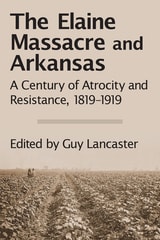
The Elaine Massacre and Arkansas
A Century of Atrocity and Resistance, 1819-1919Guy Lancaster
Butler Center for Arkansas Studies, 2018
We cannot fully understand what happened at Elaine without examining the one hundred years leading up to the massacre. An analysis of the years from 1819, when Arkansas officially became an American territory, to 1919 provides the historical foundation for understanding one of the bloodiest manifestations of racial violence in U.S. history.
During the antebellum years, slaveholders grew paranoid about possible “insurrections,” and after the Civil War and Emancipation, these fears lingered and led to numerous atrocities long before Elaine. At the same time, African Americans—particularly fieldworkers—worked to organize themselves to resist oppression, setting the stage for the farmers’ union that was the target for mob and military wrath during the Elaine Massacre.
These essays provide the larger history necessary for understanding what happened at Elaine in 1919—and thus provide a window into the current state of Arkansas and the nation at large. Contributors include Richard Buckelew, Nancy Snell Griffith, Matthew Hild, Adrienne Jones, Kelly Houston Jones, Cherisse Jones-Branch, Brian K. Mitchell, William H. Pruden III, and Steven Teske.
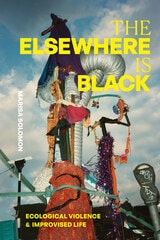
The Elsewhere Is Black
Ecological Violence and Improvised LifeMarisa Solomon
Duke University Press, 2025
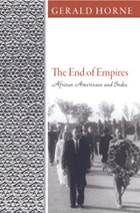
The End of Empires
African Americans and IndiaGerald Horne
Temple University Press, 2009
In the past fifty years, according to Christine So, the narratives of many popular Asian American books have been dominated by economic questions-what money can buy, how money is lost, how money is circulated, and what labor or objects are worth. Focusing on books that have achieved mainstream popularity, Economic Citizens unveils the logic of economic exchange that determined Asian Americans’ transnational migrations and national belonging.
With penetrating insight, So examines literary works that have been successful in the U.S. marketplace but have been read previously by critics largely as narratives of alienation or assimilation, including Fifth Chinese Daughter, Flower Drum Song, Falling Leaves and Turning Japanese. In contrast to other studies that have focused on the marginalization of Asian Americans, Economic Citizens examines how Asian Americans have entered into the public sphere.

The End of Tolerance
Racism in 21st Century BritainArun Kundnani
Pluto Press, 2007
Exacerbated by the attacks of 9/11 and 7/7, Kundnani argues that a new form of racism is emerging that is based on a systematic failure to understand the causes of forced migration, global terrorism and social segregation. The result is a climate of hatred, especially against Muslims and asylum seekers, and the erosion of the human rights of those whose cultures and values are perceived as 'alien'.
Communities are more divided than ever. Yet the government presses ahead with flawed immigration and 'integration' policies and anti-terrorist legislation that creates further resentment, alienation and criminalisation. Behind it all lies a refusal to grasp the ways in which the world has been changed by neoliberal globalisation.
What can be done? This timely and precise analysis is a useful account of why racism is now thriving -- and what can be done to stop it. It will be of interest to anyone who is appalled by the current state of race relations in Britain and it should be required reading for all policy-makers.
The End of White World Supremacy
Black Internationalism and the Problem of the Color LineRoderick Bush
Temple University Press, 2009
The End of White World Supremacy explores a complex issue— integration of Blacks into White America—from multiple perspectives: within the United States, globally, and in the context of movements for social justice. Roderick Bush locates himself within a tradition of African American activism that goes back at least to W.E.B. Du Bois. In so doing, he communicates between two literatures—worldsystems analysis and radical Black social movement history—and sustains the dialogue throughout the book.
Bush explains how racial troubles in the U.S. are symptomatic of the troubled relationship between the white and dark worlds globally. Beginning with an account of white European dominance leading to capitalist dominance by White America, The End of White World Supremacy ultimately wonders whether, as Myrdal argued in the 1940s, the American creed can provide a pathway to break this historical conundrum and give birth to international social justice.
The Enigma of Diversity
The Language of Race and the Limits of Racial JusticeEllen Berrey
University of Chicago Press, 2015
Ellen Berrey digs deep into those questions in The Enigma of Diversity. Drawing on six years of fieldwork and historical sources dating back to the 1950s and making extensive use of three case studies from widely varying arenas—housing redevelopment in Chicago’s Rogers Park neighborhood, affirmative action in the University of Michigan’s admissions program, and the workings of the human resources department at a Fortune 500 company—Berrey explores the complicated, contradictory, and even troubling meanings and uses of diversity as it is invoked by different groups for different, often symbolic ends. In each case, diversity affirms inclusiveness, especially in the most coveted jobs and colleges, yet it resists fundamental change in the practices and cultures that are the foundation of social inequality. Berrey shows how this has led racial progress itself to be reimagined, transformed from a legal fight for fundamental rights to a celebration of the competitive advantages afforded by cultural differences.
Powerfully argued and surprising in its conclusions, The Enigma of Diversity reveals the true cost of the public embrace of diversity: the taming of demands for racial justice.
The Erotic Life of Racism
Sharon Patricia Holland
Duke University Press, 2012
Reemphasizing the black/white binary, Holland reinvigorates critical engagement with race and racism. She argues that only by bringing critical race theory, queer theory, and black feminist thought into conversation with each other can we fully envision the relationship between racism and the personal and political dimensions of our desire. The Erotic Life of Racism provocatively redirects our attention to a desire no longer independent of racism but rather embedded within it.
The Essence of Liberty
Free Black Women During the Slave EraWilma King
University of Missouri Press, 2006
The Essence of Liberty blends social, political, and economic history to analyze black women’s experience in both the North and the South, from the colonial period through emancipation. Focusing on class and familial relationships, King examines the myriad sources of freedom for black women to show the many factors that, along with time spent in slavery before emancipation, shaped the meaning of freedom. Her book also raises questions about whether free women were bound to or liberated from gender conventions of their day.
Drawing on a wealth of untapped primary sources—not only legal documents and newspapers but also the diaries, letters, and autobiographical writings of free women—King opens a new window on the world of black women. She examines how they became free, educated themselves, found jobs, maintained self-esteem, and developed social consciousness—even participating in the abolitionist movement. She considers the stance of southern free women toward their enslaved contemporaries and the interactions between previously free and newly freed women after slavery ended. She also looks closely at women’s spirituality, disclosing the dilemma some women faced when they took a stand against men—even black men—in order to follow their spiritual callings.
Throughout this engaging history, King underscores the pernicious constraints that racism placed on the lives of free blacks in spite of the fact that they were not enslaved. The Essence of Liberty shows the importance of studying these women on their own terms, revealing that the essence of freedom is more complex than the mere absence of shackles.
The Fight for Asian American Civil Rights
Liberal Protestant Activism, 1900-1950Sarah M Griffith
University of Illinois Press, 2018
The First Twenty-Five
An Oral History of the Desegregation of Little Rock’s Public Junior High SchoolsLaVerne Bell-Tolliver
University of Arkansas Press, 2018
“It was one of those periods that you got through, as opposed to enjoyed. It wasn’t an environment that . . . was nurturing, so you shut it out. You just got through it. You just took it a day at a time. You excelled if you could. You did your best. You felt as though the eyes of the community were on you.”—Glenda Wilson, East Side Junior High
Much has been written about the historical desegregation of Little Rock Central High School by nine African American students in 1957. History has been silent, however, about the students who desegregated Little Rock’s five public junior high schools—East Side, Forest Heights, Pulaski Heights, Southwest, and West Side—in 1961 and 1962.
The First Twenty-Five gathers the personal stories of these students some fifty years later. They recall what it was like to break down long-standing racial barriers while in their early teens—a developmental stage that often brings emotional vulnerability. In their own words, these individuals share what they saw, heard, and felt as children on the front lines of the civil rights movement, providing insight about this important time in Little Rock, and how these often painful events from their childhoods affected the rest of their lives.
The Freedmen's Bureau and Black Texans
By Barry A. Crouch
University of Texas Press, 1992

The Geography of Hate
The Great Migration through Small-Town AmericaJennifer Sdunzik
University of Illinois Press, 2023
During the Great Migration, Black Americans sought new lives in midwestern small towns only to confront the pervasive efforts of white residents determined to maintain their area’s preferred cultural and racial identity. Jennifer Sdunzik explores this widespread phenomenon by examining how it played out in one midwestern community. Sdunzik merges state and communal histories, interviews and analyses of population data, and spatial and ethnographic materials to create a rich public history that reclaims Black contributions and history. She also explores the conscious and unconscious white actions that all but erased Black Americans--and the terror and exclusion used against them--from the history of many midwestern communities.
An innovative challenge to myth and perceived wisdom, The Geography of Hate reveals the socioeconomic, political, and cultural forces that prevailed in midwestern towns and helps explain the systemic racism and endemic nativism that remain entrenched in American life.
The Georgia of the North
Black Women and the Civil Rights Movement in New JerseyHettie V. Williams
Rutgers University Press, 2024
The Ghost of Equality
The Public Lives of D. D. T. Jabavu of South Africa, 1885–1959Catherine Higgs
Ohio University Press, 1996
Davidson Don Tengo Jabavu was born in the Cape Colony in British southern Africa on October 20, 1885, when a few African men could vote and the prospects for black equality with the ruling whites seemed promising. He died on August 3, 1959, in the Cape Province of the Union of South Africa, eleven years after the apartheid state had begun stripping blacks of their rights and exorcising the ‘ghost of equality’ with a completeness unparalleled in the country’s history. The ‘ghost of equality was the last vestige of the Cape liberal tradition — itself best summed up by the dictum ’equal rights for all civilized men‘ — finally erased in 1959 with the passage of legislation that would, the following year, remove from parliament the last elected white representatives of Africans.…
If D.D.T. Jabavu’s life reveals anything about South Africa’s political history, it is that this history was not monolithic. It was not simply a lengthly confrontation between a black elite represented by the African National Congress and the white segregationist state. Rather, there was a range of black political opinion and activity, of which Jabavu, an active participant in virtually every government-sponsored and every major extraparliamentary conference between 1920 and the late 1940s, represented one prominent historical strain.
This book, however, is about more than D.D.T. Javavu’s politics; it is about his public life, or perhaps more accurately, his public lives. The book is arranged thematically, divided according to the parts Jabavu played: student, teacher, Methodist, and politician.
— from the introduction by the author

The Good Men Who Won the War
Army of the Cumberland Veterans and Emancipation MemoryRobert E. Hunt
University of Alabama Press, 2010
Robert Hunt examines how Union veterans of the Army of the Cumberland employed the extinction of slavery in the trans-Appalachian South in their memory of the Civil War. Hunt argues that rather than ignoring or belittling emancipation, it became central to veterans’ retrospective understanding of what the war, and their service in it, was all about. The Army of the Cumberland is particularly useful as a subject for this examination because it invaded the South deeply, encountering numerous ex-slaves as fugitives, refugees, laborers on military projects, and new recruits. At the same time, the Cumberlanders were mostly Illinoisans, Ohioans, Indianans, and, significantly, Kentucky Unionists, all from areas suspicious of abolition before the war.
Hunt argues that the collapse of slavery in the trans-Appalachian theater of the Civil War can be usefully understood by exploring the post-war memories of this group of Union veterans. He contends that rather than remembering the war as a crusade against the evils of slavery, the veterans of the Army of the Cumberland saw the end of slavery as a by-product of the necessary defeat of the planter aristocracy that had sundered the Union; a good and necessary outcome, but not necessarily an assertion of equality between the races.
Some of the most provocative discussions about the Civil War in current scholarship are concerned with how memory of the war was used by both the North and the South in Reconstruction, redeemer politics, the imposition of segregation, and the Spanish-American War. This work demonstrates that both the collapse of slavery and the economic and social post-War experience convinced these veterans that they had participated in the construction of the United States as a world power, built on the victory won against corrupt Southern plutocrats who had impeded the rightful development of the country.
The Great Confusion in Indian Affairs
Native Americans and Whites in the Progressive EraBy Tom Holm
University of Texas Press, 2005
The United States government thought it could make Indians "vanish." After the Indian Wars ended in the 1880s, the government gave allotments of land to individual Native Americans in order to turn them into farmers and sent their children to boarding schools for indoctrination into the English language, Christianity, and the ways of white people. Federal officials believed that these policies would assimilate Native Americans into white society within a generation or two. But even after decades of governmental efforts to obliterate Indian culture, Native Americans refused to vanish into the mainstream, and tribal identities remained intact.
This revisionist history reveals how Native Americans' sense of identity and "peoplehood" helped them resist and eventually defeat the U.S. government's attempts to assimilate them into white society during the Progressive Era (1890s-1920s). Tom Holm discusses how Native Americans, though effectively colonial subjects without political power, nonetheless maintained their group identity through their native languages, religious practices, works of art, and sense of homeland and sacred history. He also describes how Euro-Americans became increasingly fascinated by and supportive of Native American culture, spirituality, and environmental consciousness. In the face of such Native resiliency and non-Native advocacy, the government's assimilation policy became irrelevant and inevitably collapsed. The great confusion in Indian affairs during the Progressive Era, Holm concludes, ultimately paved the way for Native American tribes to be recognized as nations with certain sovereign rights.
The Great Melding
War, the Dixiecrat Rebellion, and the Southern Model for America's New ConservatismGlenn Feldman
University of Alabama Press, 2015
CHOICE OUTSTANDING ACADEMIC TITLE
Tracing the Southern Origins of Modern American Conservatism.
Audacious in its scope, subtle in its analysis, and persuasive in its arguments, The Great Melding is the second book in Glenn Feldman’s magisterial recounting of the South’s transformation from a Reconstruction-era citadel of Democratic Party inertia to a cauldron of GOP agitation. In this pioneering study, Feldman shows how the transitional years after World War II, the Dixiecrat episode, and the early 1950s formed a pivotal sequence of events that altered America’s political landscape in profound, fundamental, and unexpected ways.
Feldman’s landmark work The Irony of the Solid South dismantled the myth of the New Deal consensus, proving it to be only a fleeting alliance of fissiparous factions; The Great Melding further examines how the South broke away from that consensus. Exploring issues of race and white supremacy, Feldman documents and explains the roles of economics, religion, and emotive appeals to patriotism in southern voting patterns. His probing and original analysis includes a discussion of the limits of southern liberalism and a fresh examination of the Dixiecrat Revolt of 1948.
Feldman convincingly argues that the Dixiecrats—often dismissed as a transitory footnote in American politics—served as a template for the modern conservative movement. Now a predictable Republican stronghold, Alabama at the time was viewed by national political strategists as a battleground and bellwether. Masterfully synthesizing a vast range of sources, Feldman shows that Alabama was then one of the few states where voters made unpredictable choices between the competing ideologies of the Democrats, Republicans, and Dixiecrats.
Writing in his lively and provocative style, Feldman demonstrates that the events he recounts in Alabama between 1942 and Dwight Eisenhower’s 1952 election encapsulate a rare moment of fluidity in American politics, one in which the New Deal consensus shattered and the Democratic and Republican parties fought off a third-party revolt only to find themselves irrevocably altered by their success. The Great Melding will fascinate historians, political scientists, political strategists, and readers of political nonfiction.
The Greenlining of Staten Island
Environmental Preservation and Racial Segregation, 1945–1995Patrick D. Nugent
University of Chicago Press, 2026
Illuminates how borough residents, urban planners, and politicians used environmental policy to cement a racially restrictive landscape.
Though it was once home to the world’s largest landfill, today Staten Island boasts thousands of acres of parklands, dozens of public-private conservation arrangements, and four ecological zoning districts. In this book, Patrick D. Nugent details the political forces that gave rise to this wealth of greenery in a famously dense city. He demonstrates how postwar economic and political trajectories intersected in the 1960s with the rising consciousness of environmentalism to create a distinctive laboratory in Staten Island, where white communities and politicians heeded the rising call for the preservation of green space—but often as a tool to maintain racial segregation. Ecological zoning, public-private park management, conservation easement, environmental litigation, and other strategies created a lush, discriminatory landscape. Nugent refers to these policies as greenlining.
The Greenlining of Staten Island shows that the political and environmental history of Staten Island is key to understanding how environmentalism has been used to reinforce racial discrimination, not just in New York City, but nationwide. By the mid-1970s, conservationists had embraced urban planning that preserved low-density housing districts and bolstered the sprawling and segregated landscape that took shape in metropolitan America over the coming decades. In exploring the gap between the modern environmental movement’s ambitious goals and its tangible outcomes, Nugent excavates important lessons for contemporary city dwellers debating zoning reform and planning for climate change’s impending effects.
The Harlan Renaissance
Stories of Black Life in Appalachian Coal TownsWilliam H. Turner
West Virginia University Press, 2021
The Harlan Renaissance is an intimate remembrance of kinship and community in eastern Kentucky’s coal towns written by one of the luminaries of Appalachian studies, William Turner. Turner reconstructs Black life in the company towns in and around Harlan County during coal’s final postwar boom years, which built toward an enduring bust as the children of Black miners, like the author, left the region in search of better opportunities.
The Harlan Renaissance invites readers into what might be an unfamiliar Appalachia: one studded by large and vibrant Black communities, where families took the pulse of the nation through magazines like Jet and Ebony and through the news that traveled within Black churches, schools, and restaurants. Difficult choices for the future were made as parents considered the unpredictable nature of Appalachia’s economic realities alongside the unpredictable nature of a national movement toward civil rights.
Unfolding through layers of sociological insight and oral history, The Harlan Renaissance centers the sympathetic perspectives and critical eye of a master narrator of Black life.
The Hindered Hand
Sutton E. Griggs
West Virginia University Press, 2017
Written in response to Thomas Dixon’s recently published race-baiting novel The Leopard’s Spots, Griggs’s book depicts the remnants of the old Southern planter class, the racial crisis threatening the South and the North, the social ferment of the time, the changing roles of women, and the thwarted aspirations of a trio of African American veterans following the war against Spain. This scholarly edition of the novel, providing newly discovered biographical information and copious historical context, makes a significant contribution to African American literary scholarship.
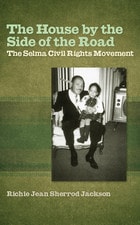
The House by the Side of the Road
The Selma Civil Rights MovementRichie Jean Sherrod Jackson
University of Alabama Press, 2011
King’s informal headquarters in Selma was the home of Dr. Sullivan and Richie Jean Sherrod Jackson and their young daughter, Jawana. The House by the Side of the Road is Richie Jean’s firsthand account of the private meetings King and his lieutenants, including Ralph David Abernathy and John Lewis, held in the haven of the Jackson home.
Sullivan Jackson was an African American dentist in Selma and a prominent supporter of the civil rights movement. Richie Jean was a close childhood friend of King’s wife, Coretta Scott King, a native of nearby Marion, Alabama. Richie Jean’s fascinating account narrates how, in the fraught months of 1965 that preceded the Voting Rights March, King and his inner circle held planning sessions and met with Assistant Attorney General John Doar to negotiate strategies for the event.
Just eight days after Bloody Sunday, President Lyndon Johnson made a televised addressed to a joint session of Congress on Monday, March 15. Jackson relates the intimate scene of King and his lieutenants watching as Johnson called the nation to dedicate itself to equal rights for all and ending his address with the words: “We shall overcome.” Five months later, Congress passed the 1965 Voting Rights Act on August 6.
The major motion picture Selma now commemorates the fiftieth anniversary of Bloody Sunday and the 1965 Voting Rights Act. In it, Niecy Nash and Kent Faulcon star as Sullivan and Richie Jean Jackson among a cast including Oprah Winfrey, Tom Wilkinson, and Cuba Gooding Jr. A gripping primary source, The House by the Side of the Road illuminates the private story whose public outcomes electrified the world and changed the course of American history.
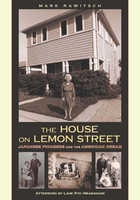
The House on Lemon Street
Japanese Pioneers and the American DreamMark Rawitsch
University Press of Colorado, 2013
Bringing this little-known story to light, The House on Lemon Street details the Haradas' decision to fight for the American dream. Chronicling their experiences from their immigration to the United States through their legal battle over their home, their incarceration during World War II, and their lives after the war, this book tells the story of the family's participation in the struggle for human and civil rights, social justice, property and legal rights, and fair treatment of immigrants in the United States.
The Harada family's quest for acceptance illuminates the deep underpinnings of anti-Asian animus, which set the stage for Executive Order 9066, and recognizes fundamental elements of our nation's anti-immigrant history that continue to shape the American story. It will be worthwhile for anyone interested in the Japanese American experience in the twentieth century, immigration history, public history, and law.
This publication was made possible with the support of Naomi, Kathleen, Ken, and Paul Harada, who donated funds in memory of their father, Harold Shigetaka Harada, honoring his quest for justice and civil rights. Additional support for this publication was also provided, in part, by UCLA's Aratani Endowed Chair as well as Wallace T. Kido, Joel B. Klein, Elizabeth A. Uno, and Rosalind K. Uno.
The Idea of Race in Latin America, 1870-1940
Edited and with an introduction by Richard Graham
University of Texas Press, 1990
From the mid-nineteenth century until the 1930s, many Latin American leaders faced a difficult dilemma regarding the idea of race. On the one hand, they aspired to an ever-closer connection to Europe and North America, where, during much of this period, "scientific" thought condemned nonwhite races to an inferior category. Yet, with the heterogeneous racial makeup of their societies clearly before them and a growing sense of national identity impelling consideration of national futures, Latin American leaders hesitated. What to do? Whom to believe?
Latin American political and intellectual leaders' sometimes anguished responses to these dilemmas form the subject of The Idea of Race in Latin America. Thomas Skidmore, Aline Helg, and Alan Knight have each contributed chapters that succinctly explore various aspects of the story in Brazil, Argentina, Cuba, and Mexico. While keenly alert to the social and economic differences that distinguish one Latin American society from another, each author has also addressed common issues that Richard Graham ably draws together in a brief introduction. Written in a style that will make it accessible to the undergraduate, this book will appeal as well to the sophisticated scholar.
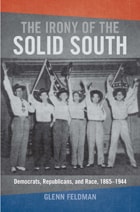
The Irony of the Solid South
Democrats, Republicans, and Race, 1865–1944Glenn Feldman
University of Alabama Press, 2013
Race, Politics, and the Making of the Modern South.
The Irony of the Solid South examines how the south became the “Solid South” for the Democratic Party and how that solidarity began to crack with the advent of American involvement in World War II. Relying on a sophisticated analysis of secondary research—as well as a wealth of deep research in primary sources such as letters, diaries, interviews, court cases, newspapers, and other archival materials—Glenn Feldman argues in The Irony of the Solid South that the history of the solid Democratic south is actually marked by several ironies that involve a concern with the fundamental nature of southern society and culture and the central place that race and allied types of cultural conservatism have played in ensuring regional distinctiveness and continuity across time and various partisan labels. Along the way, this account has much to say about the quality and nature of the New Deal in Dixie, southern liberalism, and its fatal shortcomings.
Feldman focuses primarily on Alabama and race but also considers at length circumstances in the other southern states as well as insights into the uses of emotional issues other than race that have been used time and again to distract whites from their economic and material interests. Feldman explains how conservative political forces (Bourbon Democrats, Dixiecrats, Wallace, independents, and eventually the modern GOP) ingeniously fused white supremacy with economic conservatism based on the common glue of animus to the federal government. A second great melding is exposed, one that joined economic fundamentalism to the religious kind along the shared axis of antidemocratic impulses.
Feldman’s study has much to say about southern and American conservatism, the enduring power of cultural and emotional issues, and the modern south’s path to becoming solidly Republican.
The Law Into Their Own Hands
Immigration and the Politics of ExceptionalismRoxanne Lynn Doty
University of Arizona Press, 2009
Doty examines the social and political contexts that have enabled these civilian groups to flourish and gain legitimacy amongst policy makers and the public. The sentiments underlying the vigilante movement both draw upon and are channeled through a diverse range of organizations whose messages are often reinforced by the media. Taking action when they believe official policy is lacking, groups ranging from elements of the religious right to anti-immigrant groups to white supremacists have created a social movement.
Doty seeks to alert us to the consequences related to this growing movement and to the restructuring of our society. She maintains that with immigrants being considered as enemies and denied basic human rights, it is irresponsible of both citizens and policy makers to treat this complicated issue as a simple black or white reality.
In this solid and theoretically grounded look at contemporary, post-9/11 border vigilantism, the author observes the dangerous and unproductive manner in which private citizens seek to draw firm and uncompromising lines between who is worthy of inclusion in our society and who is not.
The Libertine Colony
Creolization in the Early French CaribbeanDoris Garraway
Duke University Press, 2005
Among the texts Garraway analyzes are missionary histories by Jean-Baptiste Du Tertre, Raymond Breton, and Jean-Baptiste Labat; narratives of adventure and transgression written by pirates and others outside the official civil and religious power structures; travel accounts; treatises on slavery and colonial administration in Saint-Domingue; the first colonial novel written in French; and the earliest linguistic description of the native Carib language. Garraway also analyzes legislation—including the Code noir—that codified slavery and other racialized power relations. The Libertine Colony is both a rich cultural history of creolization as revealed in Francophone colonial literature and an important contribution to theoretical arguments about how literary critics and historians should approach colonial discourse and cultural representations of slave societies.
The Life and Death of Gus Reed
A Story of Race and Justice in Illinois during the Civil War and ReconstructionThomas Bahde
Ohio University Press, 2014
Gus Reed was a freed slave who traveled north as Sherman’s March was sweeping through Georgia in 1864. His journey ended in Springfield, Illinois, a city undergoing fundamental changes as its white citizens struggled to understand the political, legal, and cultural consequences of emancipation and black citizenship. Reed became known as a petty thief, appearing time and again in the records of the state’s courts and prisons. In late 1877, he burglarized the home of a well-known Springfield attorney—and brother of Abraham Lincoln’s former law partner—a crime for which he was convicted and sentenced to the Illinois State Penitentiary.
Reed died at the penitentiary in 1878, shackled to the door of his cell for days with a gag strapped in his mouth. An investigation established that two guards were responsible for the prisoner’s death, but neither they nor the prison warden suffered any penalty. The guards were dismissed, the investigation was closed, and Reed was forgotten.
Gus Reed’s story connects the political and legal cultures of white supremacy, black migration and black communities, the Midwest’s experience with the Civil War and Reconstruction, and the resurgence of nationwide opposition to African American civil rights in the late nineteenth century. These experiences shaped a nation with deep and unresolved misgivings about race, as well as distinctive and conflicting ideas about justice and how to achieve it.
The Limits of Racial Domination
Plebeian Society in Colonial Mexico City, 1660–1720R. Douglas Cope
University of Wisconsin Press, 1994
In this distinguished contribution to Latin American colonial history, Douglas Cope draws upon a wide variety of sources—including Inquisition and court cases, notarial records and parish registers—to challenge the traditional view of castas (members of the caste system created by Spanish overlords) as rootless, alienated, and dominated by a desire to improve their racial status. On the contrary, the castas, Cope shows, were neither passive nor ruled by feelings of racial inferiority; indeed, they often modified or even rejected elite racial ideology. Castas also sought ways to manipulate their social "superiors" through astute use of the legal system. Cope shows that social control by the Spaniards rested less on institutions than on patron-client networks linking individual patricians and plebeians, which enabled the elite class to co-opt the more successful castas.
The book concludes with the most thorough account yet published of the Mexico City riot of 1692. This account illuminates both the shortcomings and strengths of the patron-client system. Spurred by a corn shortage and subsequent famine, a plebeian mob laid waste much of the central city. Cope demonstrates that the political situation was not substantially altered, however; the patronage system continued to control employment and plebeians were largely left to bargain and adapt, as before.
A revealing look at the economic lives of the urban poor in the colonial era, The Limits of Racial Domination examines a period in which critical social changes were occurring. The book should interest historians and ethnohistorians alike.

The Machinery of Whiteness
Studies in the Structure of RacializationAuthored by Steve Martinot
Temple University Press, 2010
In this follow up to his book, The Rule of Racialization—which considered the way class structure is formed in the U.S.—Steve Martinot now examines how the structures of racialization reside at the core of all social, cultural, and political institutions in the U.S. In The Machinery of Whiteness, Martinot examines how race and racism are produced in the United States, analyzing the politics of racialization, and the preponderance of racial segregation and racial deprivation that have kept the U.S. a white dominated society throughout its history. Martinot dedicates this work to expunging white supremacy from the earth.
The Machinery of Whiteness investigates how “whiteness” came to be as foundational to the process that then produced the modern concept of race. Martinot addresses the instrumentalization of women as a necessary step in its formation, furthering the debates regarding the relationships of race and gender. And he addresses U.S. international interventionism, the anti-immigrant movements, and white racist populism to describe the political forms that white supremacy takes.
Martinot puts these together to analyze the underlying cultural structures of racialization that have driven and conditioned the resurgence of white supremacy and white entitlement in the wake of the Civil Rights movements. This book is a call to transform the cultural structures of the U.S. to make justice and democracy, which depend on inclusion and not segregation, possible.
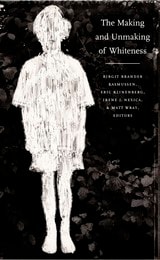
The Making and Unmaking of Whiteness
Birgit Brander Rasmussen, Eric Klinenberg, Irene J. Nexica, and Matt Wray, eds.
Duke University Press, 2001
With essays devoted to theories of racial domination, comparative global racisms, and transnational white identity, the geographical reach of the volume is significant and broad. Dalton Conley writes on “How I Learned to Be White.” Allan Bérubé discusses the intersection of gay identity and whiteness, and Mab Segrest describes the spiritual price white people pay for living in a system of white supremacy. Other pieces examine the utility of whiteness as a critical term for social analysis and contextualize different attempts at antiracist activism. In a razor-sharp introduction, the editors not only raise provocative questions about the intellectual, social, and political goals of those interested in the study of whiteness but assess several of the topic’s major recurrent themes: the visibility of whiteness (or the lack thereof); the “emptiness” of whiteness as a category of identification; and conceptions of whiteness as a structural privilege, a harbinger of violence, or an institutionalization of European imperialism.
Contributors. William Aal, Allan Bérubé, Birgit Brander Rasmussen, Dalton Conley, Troy Duster, Ruth Frankenberg, John Hartigan Jr., Eric Klinenberg, Eric Lott, Irene J. Nexica, Michael Omi, Jasbir Kaur Puar, Mab Segrest, Vron Ware, Howard Winant, Matt Wray
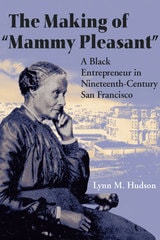
The Making of "Mammy Pleasant"
A Black Entrepreneur in Nineteenth-Century San FranciscoLynn M. Hudson
University of Illinois Press, 2002
Investigating Mary Ellen Pleasant's convoluted legacy
Mary Ellen Pleasant arrived in Gold Rush-era San Francisco a free black woman with abolitionist convictions and a predilection for entrepreneurial success. Behind the convenient and trusted disguise of "Mammy," she transformed domestic labor into enterprise, amassed remarkable real estate, wealth, and power, and gained notoriety for her work in fighting Jim Crow.
Pleasant's legacy is steeped in scandals and lore. Was she a voodoo queen who traded in sexual secrets? A madam? A murderer? In The Making of "Mammy Pleasant," Lynn M. Hudson examines the folklore of Pleasant's real and imagined powers. Emphasizing the significance of her life in the context of how it has been interpreted or ignored in the larger trends of American history, Hudson integrates fact and speculation culled from periodicals, court cases, diaries, letters, Pleasant's interviews with the San Francisco press, and various biographical and fictional accounts.
Addressing the lack of a historical record of black women's lives, the author argues that the silences and mysteries of Pleasant's past, whether never recorded or intentionally omitted, reveal as much about her life as what has been documented. Through Pleasant's life, Hudson also interrogates the constructions of race, gender, and sexuality during the formative years of California's economy and challenges popular mythology about the liberatory sexual culture of the American West.
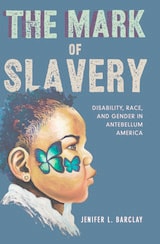
The Mark of Slavery
Disability, Race, and Gender in Antebellum AmericaJenifer L. Barclay
University of Illinois Press, 2021
Time and again, antebellum Americans justified slavery and white supremacy by linking blackness to disability, defectiveness, and dependency. Jenifer L. Barclay examines the ubiquitous narratives that depicted black people with disabilities as pitiable, monstrous, or comical, narratives used not only to defend slavery but argue against it. As she shows, this relationship between ableism and racism impacted racial identities during the antebellum period and played an overlooked role in shaping American history afterward. Barclay also illuminates the everyday lives of the ten percent of enslaved people who lived with disabilities. Devalued by slaveholders as unsound and therefore worthless, these individuals nonetheless carved out an unusual autonomy. Their roles as caregivers, healers, and keepers of memory made them esteemed within their own communities and celebrated figures in song and folklore.
Prescient in its analysis and rich in detail, The Mark of Slavery is a powerful addition to the intertwined histories of disability, slavery, and race.