Results by title
660 books match the query 'Texas' and 189 start with t
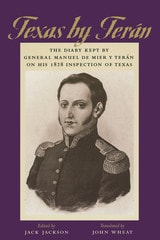
Texas by Terán
The Diary Kept by General Manuel de Mier y Terán on His 1828 Inspection of TexasEdited by Jack Jackson
University of Texas Press, 2000
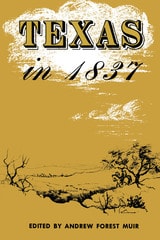
Texas in 1837
An Anonymous, Contemporary NarrativeEdited by Andrew Forest Muir
University of Texas Press, 1958
Written anonymously in 1838–39 by a "Citizen of Ohio," Texas in 1837 is the earliest known account of the first year of the Texas republic. Providing information nowhere else available, the still-unknown author describes a land rich in potential but at the time "a more suitable arena for those who have everything to make and nothing to lose than [for] the man of capital or family."
The author arrived at Galveston Island on March 22, 1837, before the city of Galveston was founded, and spent the next six months in the republic. His travels took him to Houston, then little more than a camp made up of brush shelters and jerry-built houses, and as far west as San Antonio. He observed and was generally unimpressed by governmental and social structures just beginning to take shape. He attended the first anniversary celebration of the Battle of San Jacinto and has left a memorable account of Texas' first Independence Day. His inquiring mind and objective, actue observations of early Texas provide us a way of returning to the past, revisiting landmarks that have vanished forever.

Texas in the Confederacy
An Experiment in Nation BuildingClayton E. Jewett
University of Missouri Press, 2002

Texas on the Table
People, Places, and Recipes Celebrating the Flavors of the Lone Star StateBy Terry Thompson-Anderson, Photos by Sandy Wilson
University of Texas Press, 2014
With a bounty of locally grown meats and produce, artisanal cheeses, and a flourishing wine culture, it’s a luscious time to be cooking in Texas. From restaurant chefs to home cooks, Texans are going to local dairies, orchards, farmers’ markets, ranches, vineyards, and seafood sellers to buy the very freshest ingredients, whether we’re cooking traditional favorites or the latest haute cuisine. We’ve discovered that Texas terroir—our rich variety of climates and soils, as well as our diverse ethnic cultures—creates a unique “taste of place” that gives Texas food a flavor all its own.
Written by one of Texas’s leading cookbook authors, Terry Thompson-Anderson, Texas on the Table presents 150 new and classic recipes, along with stories of the people—farmers, ranchers, shrimpers, cheesemakers, winemakers, and chefs—who inspired so many of them and who are changing the taste of Texas food. The recipes span the full range from finger foods and first courses to soups and breads, salads, seafood, chicken, meat (including wild game), sides and vegetarian dishes, and sweets. Some of the recipes come from the state’s most renowned chefs, and all are user-friendly for home cooks. Finally, the authors and winemakers tell which recipes they turn to when opening their favorite wines.
This delicious compilation of recipes and stories of the people behind them, illustrated with Sandy Wilson’s beautiful photographs, makes Texas on the Table the must-have cookbook for everyone who relishes the flavors of the Lone Star State.
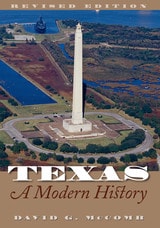
Texas, A Modern History
Revised EditionBy David G. McComb
University of Texas Press, 2010
Since its publication in 1989, Texas, A Modern History has established itself as one of the most readable and reliable general histories of Texas. David McComb paints the panorama of Lone Star history from the earliest Indians to the present day with a vigorous brush that uses fact, anecdote, and humor to present a concise narrative. The book is designed to offer an adult reader the savor of Texan culture, an exploration of the ethos of its people, and a sense of the rhythm of its development. Spanish settlement, the Battle of the Alamo, the Civil War, cattle trails, oil discovery, the growth of cities, changes in politics, the Great Depression, World War II, recreation, economic expansion, and recession are each a part of the picture. Photographs and fascinating sidebars punctuate the text.
In this revised edition, McComb not only incorporates recent scholarship but also tracks the post–World War II rise of the Republican Party in Texas and the evolution of the state from rural to urban, with 88 percent of the people now living in cities. At the same time, he demonstrates that, despite many changes that have made Texas similar to the rest of the United States, much of its unique past remains.
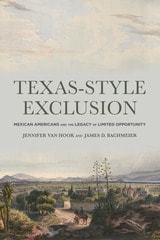
Texas-Style Exclusion
Mexican Americans and the Legacy of Limited OpportunityJennifer Van Hook
Russell Sage Foundation, 2024
Drawing on census and archival data on the quality of public schooling, Van Hook and Bachmeier find that Industrial Era European immigrants, who were primarily located in the northeastern U.S., benefited from programs and policies championed by the Americanization and Progressive movements. The Americanization movement sought to help acclimate new arrivals and transform “foreigners” into “Americans” by providing night school programs to promote civic integration and basic education, as well as other services. The Progressive movement, which aimed to improve education, work, and health conditions, sought to expand investment in public schools and make primary and secondary schooling mandatory, which kept working class children in school as opposed to entering the workforce. This access to education allowed for integration and astonishing intergenerational mobility.
Mexican immigrants in the 1920s and 1930s, the majority of whom resided in Texas, had radically different experiences from their European counterparts. Mexicans in Texas were subjected to racism, segregation, labor exploitation, and intentional school failures. This resulted in tremendous generational disadvantage that persists to the current day. Mexicans from this cohort who left Texas for states with strong Americanization and Progressive movements saw improved educational outcomes and integration. Additionally, Mexicans who immigrated after the Civil Rights Movement saw significantly greater inter-generational mobility and educational attainment than earlier cohorts due to the protections provided by civil rights laws. Van Hook and Bachmeier conclude that whether one is optimistic or pessimistic about the integration of Mexican Americans depends on when and where one looks.
Texas-Style Exclusion is an engaging examination of policies and practices that have been glossed over and forgotten that promoted mobility and integration for certain immigrant groups and impeded them for others.
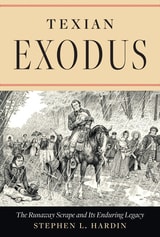
Texian Exodus
The Runaway Scrape and Its Enduring LegacyStephen L. Hardin
University of Texas Press, 2024
2026 Alamo Historical Society Book Award
A narrative account of the evacuation of the Texians in 1836, which was redeemed by the defeat of the Mexican army and the creation of the Republic of Texas.
Two events in Texas history shine so brightly that they can be almost blinding: the stand at the Alamo and the redemption at San Jacinto, where General Sam Houston’s volunteers won the decisive battle of the Texas Revolution. But these milestones came amid a less obviously heroic episode now studiously forgotten—the refugee crisis known as the Runaway Scrape.
Propulsive, lyrical, and richly illustrated, Texian Exodus transports us to the frigid, sodden spring of 1836, when thousands of Texians—Anglo-American settlers—fled eastward for the United States in fear of Antonio López de Santa Anna’s advancing Mexican army. Leading Texas historian Stephen L. Hardin draws on the accounts of the Runaways themselves to relate a tale of high stakes and great sorrow. While Houston tried to build a force that could defeat Santa Anna, the evacuees suffered incalculable pain and suffering. Yet dignity and community were not among the losses. If many of the stories are indeed tragic, the experience as a whole was no tragedy; survivors regarded the Runaway Scrape as their finest hour, an ordeal met with cooperation and courage. For Hardin, such qualities still define the Texas character. That it was forged in retreat as well as in battle makes the Runaway Scrape essential Texas history.

Texian Iliad
A Military History of the Texas Revolution, 1835-1836By Stephen L. Hardin
University of Texas Press, 1996
Winner, T. R. Fehrenbach Book Award, Texas Historical Commission
Summerfield G. Roberts Award, Sons of the Republic of Texas
Honorable Mention, Certificate of Commendation, American Association for State and Local History
Hardly were the last shots fired at the Alamo before the Texas Revolution entered the realm of myth and controversy. French visitor Frederic Gaillardet called it a "Texian Iliad" in 1839, while American Theodore Sedgwick pronounced the war and its resulting legends "almost burlesque."
In this highly readable history, Stephen L. Hardin discovers more than a little truth in both of those views. Drawing on many original Texan and Mexican sources and on-site inspections of almost every battlefield, he offers the first complete military history of the Revolution. From the war's opening in the "Come and Take It" incident at Gonzales to the capture of General Santa Anna at San Jacinto, Hardin clearly describes the strategy and tactics of each side. His research yields new knowledge of the actions of famous Texan and Mexican leaders, as well as fascinating descriptions of battle and camp life from the ordinary soldier's point of view.
This award-winning book belongs on the bookshelf of everyone interested in Texas or military history.
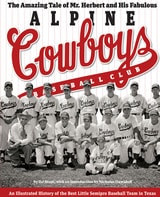
The Amazing Tale of Mr. Herbert and His Fabulous Alpine Cowboys Baseball Club
An Illustrated History of the Best Little Semipro Baseball Team in TexasBy DJ Stout
University of Texas Press, 2010
Back in the 1940s and 1950s, almost every small town in America had a baseball team. Most players were simply local heroes with a local following, but a few teams achieved fame far beyond their region. The Alpine Cowboys—despite being based in Texas's remote, sparsely populated Big Bend country—became a star in the firmament of semi-pro baseball. Lavishly underwritten by a wealthy rancher with a passion not only for baseball but even more for helping young men get a good start in life, the Cowboys played on a "field of dreams" whose facilities rivaled those of professional ballparks. Many Cowboys went on to play in the big leagues, and several pro teams, including the Pittsburgh Pirates, Chicago White Sox, and St. Louis Browns, came to play exhibition games at Kokernot Field.
The story of Herbert Kokernot Jr. and his Alpine Cowboys is a legend among baseball aficionados, but until now it has never been the subject of a book. DJ Stout, son of former Cowboys player Doyle Stout, presents a hall-of-fame-worthy collection of photographs, memorabilia, and reminiscences from Alpine Cowboys players, family members, and fans to capture fifteen years (1946–1961) of baseball at its finest. Nicholas Dawidoff's introduction, originally published in Sports Illustrated, tells the fascinating tale of "Mr. Herbert" and his determination to build a baseball team and ballpark that deserved to carry his ranch's 06 brand.
One of the most heartwarming episodes in the annals of the game, The Amazing Tale of Mr. Herbert and His Fabulous Alpine Cowboys is a fitting tribute to a man, a team, and a ballpark.
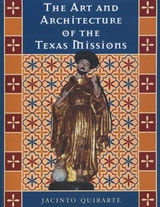
The Art and Architecture of the Texas Missions
By Jacinto Quirarte
University of Texas Press, 2002
Winner, Presidio La Bahia Award, Sons of the Republic of Texas
Built to bring Christianity and European civilization to the northern frontier of New Spain in the seventeenth and eighteenth centuries...secularized and left to decay in the nineteenth century...and restored in the twentieth century, the Spanish missions still standing in Texas are really only shadows of their original selves. The mission churches, once beautifully adorned with carvings and sculptures on their façades and furnished inside with elaborate altarpieces and paintings, today only hint at their colonial-era glory through the vestiges of art and architectural decoration that remain.
To paint a more complete portrait of the missions as they once were, Jacinto Quirarte here draws on decades of on-site and archival research to offer the most comprehensive reconstruction and description of the original art and architecture of the six remaining Texas missions—San Antonio de Valero (the Alamo), San José y San Miguel de Aguayo, Nuestra Señora de la Purísima Concepción, San Juan Capistrano, and San Francisco de la Espada in San Antonio and Nuestra Señora del Espíritu Santo in Goliad. Using church records and other historical accounts, as well as old photographs, drawings, and paintings, Quirarte describes the mission churches and related buildings, their decorated surfaces, and the (now missing) altarpieces, whose iconography he extensively analyzes. He sets his material within the context of the mission era in Texas and the Southwest, so that the book also serves as a general introduction to the Spanish missionary program and to Indian life in Texas.
The Autobiography of the Rev. William Stevenson
Ted A. Campbell
Bridwell Press, 2024

The Behavior of Texas Birds
By Kent Rylander
University of Texas Press, 2002
Whether it's the sudden, plunging dives of Brown Pelicans, the singing and aerial displays of Northern Mockingbirds, or the communal nesting of Purple Martins, innate and learned behaviors are some of the most fascinating things to observe in Texas birds. Even casual birdwatchers eventually ask, "why do they do that?" while serious birders and ornithologists seek to understand all the behaviors involved in feeding, flying, mating, and rearing young. But until now, it has been hard to find this information in one handy source.
In this comprehensive, yet easy-to-use book, Kent Rylander distills data from many sources to provide an authoritative guide to the behavior of Texas birds. He begins by explaining the principles of animal behavior and illustrating how they can be applied to interpreting bird behaviors in the field. The majority of the book is devoted to accounts of more than 400 species of birds that are most likely to be encountered by Texas birdwatchers. Each account describes such behaviors as feeding, courtship, parenting, and other behaviors that are significant for that species. References to interesting and important articles from scientific journals are incorporated in the species accounts where appropriate, and line drawings illustrate some of the behaviors described.

The Bell Ringer
Victor Rodriguez
University of North Texas Press, 2002
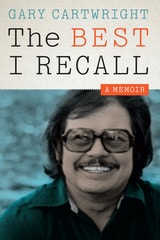
The Best I Recall
A MemoirBy Gary Cartwright
University of Texas Press, 2015
Gary Cartwright is one of Texas’s legendary writers. In a career spanning nearly six decades, he has been a newspaper reporter, Senior Editor of Texas Monthly, and author of several acclaimed books, including Blood Will Tell, Confessions of a Washed-up Sportswriter, and Dirty Dealing. Cartwright was a finalist for a National Magazine Award for reporting excellence, and he has won several awards from the Texas Institute of Letters, including its most prestigious—the Lon Tinkle Award for lifetime achievement. His personal life has been as colorful and occasionally outrageous as any story he reported, and in this vivid, often hilarious, and sometimes deeply moving memoir, Cartwright tells the story of his writing career, tangled like a runaway vine with great friendships, love affairs, four marriages, four or five great dogs . . . looking always to explain, at least to himself, how the pattern probably makes a kind of perverted sense.
Cartwright’s career began at the Fort Worth Star-Telegram and Fort Worth Press, among kindred spirits and fellow pranksters Edwin “Bud” Shrake and Dan Jenkins. He describes how the three rookie writers followed their mentor Blackie Sherrod to the Dallas Times Herald and the Dallas Morning News, becoming the “best staff of sportswriters anywhere, ever” and creating a new kind of sportswriting that “swept the country and became standard.” Cartwright recalls his twenty-five years at Texas Monthly, where he covered everything from true crime to notable Texans to Texas’s cultural oddities. Along the way, he tells lively stories about “rebelling against sobriety” in many forms, with friends and co-conspirators that included Willie Nelson, Ann Richards, Dennis Hopper, Willie Morris, Don Meredith, Jack Ruby, and countless others. A remarkable portrait of the writing life and Austin’s counterculture, The Best I Recall may skirt the line between fact and fiction, but it always tells the truth.
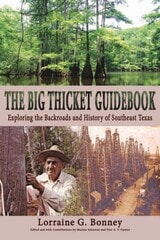
The Big Thicket Guidebook
Exploring the Backroads and History of Southeast TexasLorraine G. Bonney
University of North Texas Press, 2011
The Borderlands of Race
Mexican Segregation in a South Texas TownBy Jennifer R. Nájera
University of Texas Press, 2015
Throughout much of the twentieth century, Mexican Americans experienced segregation in many areas of public life, but the structure of Mexican segregation differed from the strict racial divides of the Jim Crow South. Factors such as higher socioeconomic status, lighter skin color, and Anglo cultural fluency allowed some Mexican Americans to gain limited access to the Anglo power structure. Paradoxically, however, this partial assimilation made full desegregation more difficult for the rest of the Mexican American community, which continued to experience informal segregation long after federal and state laws officially ended the practice.
In this historical ethnography, Jennifer R. Nájera offers a layered rendering and analysis of Mexican segregation in a South Texas community in the first half of the twentieth century. Using oral histories and local archives, she brings to life Mexican origin peoples’ experiences with segregation. Through their stories and supporting documentary evidence, Nájera shows how the ambiguous racial status of Mexican origin people allowed some of them to be exceptions to the rule of Anglo racial dominance. She demonstrates that while such exceptionality might suggest the permeability of the color line, in fact the selective and limited incorporation of Mexicans into Anglo society actually reinforced segregation by creating an illusion that the community had been integrated and no further changes were needed. Nájera also reveals how the actions of everyday people ultimately challenged racial/racist ideologies and created meaningful spaces for Mexicans in spheres historically dominated by Anglos.
The Bullet Meant for Me
By Jan Reid
University of Texas Press, 2005
Jan Reid's powerful, moving account of what being shot during a robbery in Mexico City and the painful road to recovery taught him about manhood, friendship, and marriage.
On April 20, 1998, Jan Reid was shot during a robbery in Mexico City, where he had gone to watch his friend, the boxer Jesus Chavez, fight. In The Bullet Meant for Me, Reid powerfully recounts his ordeal, the long chain of life events that brought him to that fateful attack, and his struggle to regain the ability to walk and to be a full partner in a deeply satisfying marriage. Re-examining the whole trajectory of his life, Reid questions how much the Texan ideal of manhood shaped his identity, including his love for boxing and participation in the sport. He meditates on male friendship as he tells the story of his close relationship with Chavez, whose career and personal travails Reid details with empathy and insight. And he describes his long months in physical therapy, during which he drew on the unwavering love of his wife and daughter, as well as the courage and strength he had learned from boxing, to heal his body and spirit. A moving, intimate portrait of a man, a friendship, and a marriage, The Bullet Meant for Me is Jan Reid's most personal book.
The Chief Executive In Texas
A Study in Gubernatorial LeadershipBy Fred Gantt, Jr.
University of Texas Press, 1964
"A Texas governor has only two happy days: the day he is inaugurated and the day he retires."
So spoke Joseph D. Sayers at the beginning of the twentieth century. Now, in an analysis of the Texas governorship by Fred Gantt, Jr., the reader learns why Governor Sayers' remark remains true many years after it was uttered: the office has come to be so demanding that the reader may ask why anyone would want it. Price Daniel described a typical day: "The governor's job is a night-and-day job; I usually get up in the morning about seven and start answering the telephone, and then look over the mail that has come in late the day before. I sign mail before going over to the office and then have interviews most of the day. . . . In the evening at the Mansion I take calls and messages until late in the night."
The Chief Executive in Texas is much more than a book full of interesting facts: It is a discerning political commentary built on a broad historical foundation that places events and persons in a perspective perhaps not previously considered by the reader.
The office of chief executive in other states also is explored, as well as the decline and rise of executive power as it has been limited in various constitutions in Texas and as it has developed through custom. The account of the governor's relationship with the Legislature is historically valuable. Especially interesting to many readers will be the discussions of the political roles of individual Texas governors, whose ranks include "Ma" and "Pa" Ferguson and "Pappy" O'Daniel. These studies are personally revealing, and they attest that polities in Texas apparently can never be dull.

The Child Who Walks Alone
Case Studies of Rejection in the SchoolsBy Anne and Hart Stilwell
University of Texas Press, 1996
There is an old song that goes, "Look down, look down, that lonesome road, before you travel on." Facing that lonesome road, the adult might travel on. Often, the child can't.
During her twenty-year career as a school social worker, Anne Stilwell worked with two thousand "problem" children. She and her husband, professional writer Hart Stilwell, present here twenty-one factual accounts of children who suffered rejection in the public schools.
Some of the children in these accounts are unusually bright and some are mentally retarded. They are belligerent and destructive or withdrawn. They are from broken homes or happy homes, from the slums or Middle America. They are blacks, Chicanos, and Anglos. There is only one common denominator among these children—tragedy.
Every classroom teacher will gain from this sympathetic evaluation of the problems faced by children in the public schools. No one who reads this book can remain unaware of major areas that call for deep concern on the part of educators and parents. The Stilwells have described school children and their problems and at the same time offered telling portraits of the families of which the youngsters are a part. In the struggle to see that the problem child has a chance to develop and advance within the limits of his or her ability, parents, teachers, administrators, and social workers must work together or all fail. When they fail, the child must walk alone.
The authors' objective in presenting these cases is to show what has happened and does happen, and to encourage others to work for change. A prominent educator describes their account as "an exceptionally worthwhile teaching document—stimulating, touching, well written, and honest."
While this book was originally written in 1972, the issue of rejection in the public schools is, sadly, still timely.
The Chosen Folks
Jews on the Frontiers of TexasBy Bryan Edward Stone
University of Texas Press, 2010
Texas has one of the largest Jewish populations in the South and West, comprising an often-overlooked vestige of the Diaspora. The Chosen Folks brings this rich aspect of the past to light, going beyond single biographies and photographic histories to explore the full evolution of the Jewish experience in Texas.
Drawing on previously unpublished archival materials and synthesizing earlier research, Bryan Edward Stone begins with the crypto-Jews who fled the Spanish Inquisition in the late sixteenth century and then discusses the unique Texas-Jewish communities that flourished far from the acknowledged centers of Jewish history and culture. The effects of this peripheral identity are explored in depth, from the days when geographic distance created physical divides to the redefinitions of "frontier" that marked the twentieth century. The rise of the Ku Klux Klan, the creation of Israel in the wake of the Holocaust, and the civil rights movement are covered as well, raising provocative questions about the attributes that enabled Texas Jews to forge a distinctive identity on the national and world stage. Brimming with memorable narratives, The Chosen Folks brings to life a cast of vibrant pioneers.
The City in Texas
A HistoryBy David McComb
University of Texas Press, 2015
Texans love the idea of wide-open spaces and, before World War II, the majority of the state’s people did live and work on the land. Between 1940 and 1950, however, the balance shifted from rural to urban, and today 88 percent of Texans live in cities and embrace the amenities of urban culture. The rise of Texas cities is a fascinating story that has not been previously told. Yet it is essential for understanding both the state’s history and its contemporary character.
In The City in Texas, acclaimed historian David G. McComb chronicles the evolution of urban Texas from the Spanish Conquest to the present. Writing in lively, sometimes humorous and provocative prose, he describes how commerce and politics were the early engines of city growth, followed by post–Civil War cattle shipping, oil discovery, lumbering, and military needs. McComb emphasizes that the most transformative agent in city development was the railroad. This technology—accompanied by telegraphs that accelerated the spread of information and mechanical clocks that altered concepts of time—revolutionized transportation, enforced corporate organization, dictated town location, organized space and architecture, and influenced thought. McComb also thoroughly explores the post–World War II growth of San Antonio, Dallas, Fort Worth, Austin, and Houston as incubators for businesses, educational and cultural institutions, and health care centers.
The Conservative Frontier
Texas and the Origins of the New RightJeff Roche
University of Texas Press, 2025
2026 Al Lowman Memorial Prize, Texas State Historical Association (TSHA)
2026 Bonney MacDonald Outstanding Book Award Winner, Center for the Study of the American West at West Texas A&M University (CSAW)
How West Texas business and culture molded the rise of conservatism in the United States.
Much of what we understand as modern American political conservatism was born in West Texas, where today it predominates. How did the people of such a vast region—larger than New England and encompassing big cities like Lubbock and Amarillo, as well as tiny towns from Anson to Dalhart—develop such a uniform political culture? And why and how did it go national?
Jeff Roche finds answers in the history of what he calls cowboy conservatism. Political power players matter in this story, but so do football coaches, newspaper editors, and a breakfast cereal tycoon who founded a capitalist utopia. The Conservative Frontier follows these and other figures as they promoted an ideology grounded in the entrepreneurial and proto-libertarian attitudes of nineteenth-century Texas ranchers, including a fierce devotion to both individualism and small-town notions of community responsibility. This political sensibility was in turn popularized by its association with the mythology and iconography of the cowboy as imagined in twentieth-century mass media. By the 1970s and the rise of Ronald Reagan, Roche shows, it was clear that the cowboy conservatism of West Texas had set the stage for the emergence of the New Right—the more professionalized and tech-savvy operation that dominated national conservative politics for the next quarter century.
The Cornett-Whitley Gang
Violence Unleashed in TexasDavid Johnson
University of North Texas Press, 2019

The Courthouse Square in Texas
By Robert E. Veselka
University of Texas Press, 2000
With its dignified courthouse set among shade trees and lawns dotted with monuments to prominent citizens and fallen veterans, the courthouse square remains the civic center in a majority of the county seats of Texas. Yet the squares themselves vary in form and layout, reflecting the different town-planning traditions that settlers brought from Europe, Mexico, and the United States. In fact, one way to trace settlement patterns and ethnic dispersion in Texas is by mapping the different types of courthouse squares.
This book offers the first complete inventory of Texas courthouse squares, drawn from extensive archival research and site visits to 139 of the 254 county seats. Robert Veselka classifies every existing plan by type and origin, including patterns and variants not previously identified. He also explores the social and symbolic functions of these plans as he discusses the historical and modern uses of the squares. He draws interesting new conclusions about why the courthouse square remains the hub of commercial and civic activity in the smaller county seats, when it has lost its prominence in others.

The Courthouses of Central Texas
By Brantley Hightower
University of Texas Press, 2015
The county courthouse has long held a central place on the Texas landscape—literally, as the center of the town in which it is located, and figuratively, as the symbol of governmental authority. As a county’s most important public building, the courthouse makes an architectural statement about a community’s prosperity and aspirations—or the lack of them. Thus, a study of county courthouses tells a compelling story about how society’s relationships with public buildings and government have radically changed over the course of time, as well as how architectural tastes have evolved through the decades.
A first of its kind, The Courthouses of Central Texas offers an in-depth, comparative architectural survey of fifty county courthouses, which serve as a representative sample of larger trends at play throughout the rest of the state. Each courthouse is represented by a description, with information about date(s) of construction and architects, along with a historical photograph, a site plan of its orientation and courthouse square, and two- and sometimes three-dimensional drawings of its facade with modifications over time. Side-by-side drawings and plans also facilitate comparisons between courthouses. These consistently scaled and formatted architectural drawings, which Brantley Hightower spent years creating, allow for direct comparisons in ways never before possible. He also explains the courthouses’ formal development by placing them in their historical and social context, which illuminates the power and importance of these structures in the history of Texas, as well as their enduring relevance today.
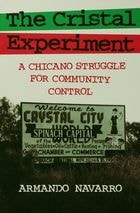
The Cristal Experiment
A Chicano Struggle for Community ControlArmando Navarro
University of Wisconsin Press, 1998
Amidst the turbulence and militancy of the 1960s and early 1970s, the Mexicano population of the dusty agricultural town of Crystal City, Texas (Cristal in Spanish), staged two electoral revolts, each time winning control of the city council and school board. The landmark city council victory in 1963 was a first for Mexican Americans in South Texas, and Cristal—the “spinach capital of the world”—became for a time the political capital of the Chicano Movement.
In The Cristal Experiment, Armando Navarro presents the most comprehensive examination to date of the rise of the Chicano political movement in Cristal, its successes and conflicts (both internal and external), and its eventual decline. He looks particularly at the larger and more successful “Second Revolt” in 1970 and its aftermath up to 1981, examining the political, economic, educational, and social changes for Mexicanos that resulted. Drawing upon nearly 100 interviews, a wealth of secondary materials, and his own experiences as a political organizer in the Chicano Movement, Navarro offers a shrewd and insightful analysis not only of the events in Cristal, but also of the workings of local politics generally, the politics of community control, and the factors inherent in the American political system that lead to the self-destruction of political movements. As both a political scientist and an organizer, he outlines important lessons to be learned from what happened in Cristal and to the Chicano Movement.
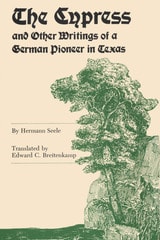
The Cypress and Other Writings of a German Pioneer in Texas
By Hermann Seele
University of Texas Press, 1979
When Hermann Seele anived in New Braunfels in 1845, the raw colony was plagued by poverty, disease, lack of food, and hostile Indians. This personal record of the Germans in Texas shows their evolution from struggling colonists to prosperous citizens.
From his viewpoint of a hardworking yet imaginative pioneer, Seele presents first a history of German immigration and settlement in Texas during the nineteenth century. Next, his autobiographical writings range from a "sentimental recollection" of his first Christmas Eve in Texas to his first day of teaching in New Braunfels, from accounts of the popular singing society to murder and justice along the Comal River. In addition, Seele's romantic novel, The Cypress, is a delightful though improbable tale of a traveling botanist, a chieftain's daughter, and a savage Indian cult.
Hermann Seele—farmer, lawyer, teacher, lay preacher, mayor, state representative, Civil War major, and editor—epitomizes the best of the German immigrants who established their communities as models of respectability and prosperity.

The Dallas Myth
The Making and Unmaking of an American CityHarvey J. Graff
University of Minnesota Press, 2010
In The Dallas Myth, Harvey J. Graff presents a novel interpretation of a city that has proudly declared its freedom from the past. He scrutinizes the city's origin myth and its governance ideology, known as the "Dallas Way," looking at how these elements have shaped Dallas and served to limit democratic participation and exacerbate inequality. Advancing beyond a traditional historical perspective, Graff proposes an original, integrative understanding of the city's urban fabric and offers an explicit critique of the reactionary political foundations of modern Dallas: its tolerance for right-wing political violence, the endemic racism and xenophobia, and a planning model that privileges growth and monumental architecture at the expense of the environment and social justice.
Revealing the power of myths that have defined the city for so long, Graff presents a new interpretation of Dallas that both deepens our understanding of America's urban landscape and enables its residents to envision a more equitable, humane, and democratic future for all.
The Dallas Story
The North American Aviation Plant and Industrial Mobilization during World War IITerrance Furgerson
University of North Texas Press, 2023
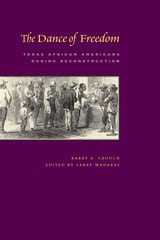
The Dance of Freedom
Texas African Americans during ReconstructionBy Barry Crouch
University of Texas Press, 2007
This anthology brings together the late Barry A. Crouch's most important articles on the African American experience in Texas during Reconstruction. Grouped topically, the essays explore what freedom meant to the newly emancipated, how white Texans reacted to the freed slaves, and how Freedmen's Bureau agents and African American politicians worked to improve the lot of ordinary African American Texans. The volume also contains Crouch's seminal review of Reconstruction historiography, "Unmanacling Texas Reconstruction: A Twenty-Year Perspective." The introductory pieces by Arnoldo De Leon and Larry Madaras recapitulate Barry Crouch's scholarly career and pay tribute to his stature in the field of Reconstruction history.

The Denial of Antiblackness
Multiracial Redemption and Black SufferingJoão H. Costa Vargas
University of Minnesota Press, 2018
An incisive new look at the black diaspora, examining the true roots of antiblackness and its destructive effects on all of society
Thanks to movements like Black Lives Matter, Western society’s chronic discrimination against black individuals has become front-page news. Yet, there is little awareness of the systemic factors that make such a distinct form of dehumanization possible. In both the United States and Brazil—two leading nations of the black diaspora—a very necessary acknowledgment of black suffering is nonetheless undercut by denial of the pervasive antiblackness that still exists throughout these societies.
In The Denial of Antiblackness, João H. Costa Vargas examines how antiblackness affects society as a whole through analyses of recent protests against police killings of black individuals in both the United States and Brazil, as well as the everyday dynamics of incarceration, residential segregation, and poverty. With multisite ethnography ranging from a juvenile prison in Austin, Texas, to grassroots organizing in Los Angeles and Black social movements in Brazil, Vargas finds the common factors that have perpetuated antiblackness, regardless of context. Ultimately, he asks why the denial of antiblackness persists, whom this narrative serves, and what political realities it makes possible.
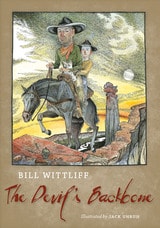
The Devil's Backbone
By Bill Wittliff, illustrated by Jack Unruh
University of Texas Press, 2014
The last the boy Papa saw of his Momma, she was galloping away on her horse Precious in the saddle her father took from a dead Mexican officer after the Battle of San Jacinto, fleeing from his Daddy, Old Karl, a vicious, tight-fisted horse trader. Momma’s flight sets Papa on a relentless quest to find her that thrusts him and his scrappy little dog Fritz into adventures all across the wild and woolly Hill Country of Central Texas, down to Mexico, and even into the realm of the ghostly “Shimmery People.” In The Devil’s Backbone, master storyteller Bill Wittliff takes readers on an exciting journey through a rough 1880s frontier as full of colorful characters and unexpected turns of events as the great American quest novel Adventures of Huckleberry Finn.
Wittliff grew up listening to stories and memories like these in his own family, and in this imaginative novel, they come to vivid life, creating an engrossing story of a Texas Huck Finn that brims with folk wisdom and sly humor. A rogue’s gallery of characters thwart and aid Papa’s path—Old Karl, hell-bent on bringing the boy back to servitude on his farm, and Herman, Papa’s brother who’s got Old Karl’s horse-trading instincts and greed; Calley Pearsall, an enigmatic cowboy with “other Fish to Fry” who might be an outlaw or a trustworthy “o’Amigo”; o’Jeffey, a black seer who talks to the spirits but won’t tell Papa what she has divined about his Momma; Mister Pegleg, a three-legged coyote with whom Papa forms a poignant, nearly tragic friendship; the “Mexkins” Pepe and Peto and their father Old Crecencio, whose longing for his lost family is as strong as Papa’s; and blind Bird, a magical “blue baby” who can’t see with his eyes but who helps other people see what they hold in their hearts. Papa’s adventures draw him ever nearer to a mysterious cave that haunts his dreams—an actual cave that he discovers at last in the canyons of the Devil’s Backbone—but will he find Momma before Old Karl finds him?
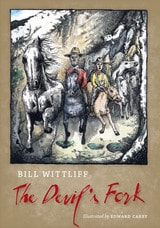
The Devil's Fork
By Bill Wittliff
University of Texas Press, 2018
The Devil’s Fork opens with the boy Papa exclaiming, “They was gonna hang my o’Amigo Calley Pearsall out there in front a’the Alamo down in San Antoneya come Saturday Noon and if I was gonna stop it I better Light a Shuck and Get on with it. And I mean Right Now.” And so Papa and his sweetheart Annie Oster set off to rescue Calley, thereby launching themselves into another series of hair-raising adventures.
The Devil’s Fork concludes the enthralling journey through wild and woolly Central Texas in the 1880s that began in The Devil’s Backbone and The Devil’s Sinkhole. Papa springs Calley from jail, but their troubles are far from over. Framed for murder, the two amigos have to flee for their lives. Joining their flight this time is o’Johnny, the evil Sheriff Pugh’s disabled little brother, who has uncanny abilities. Escaping danger for a while, Papa and Calley try to start a new life as horse traders, only to find themselves branded as horse thieves when o’Johnny and a mysterious white ghost horse begin rescuing abused horses from their masters. Can Papa and Calley escape the noose and save all the horses that Johnny and the White Horse liberate? Or will their own hot tempers send them down the Devil’s Fork, from which no one ever returns?
Proving himself a master storyteller once again, Bill Wittliff spins a yarn as engrossing as the stories his own Papa told him long ago, stories that inspired The Devil’s Backbone, The Devil’s Sinkhole, and The Devil’s Fork.
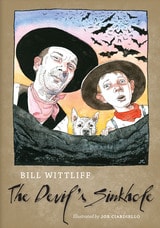
The Devil's Sinkhole
By Bill Wittliff; illustrated by Joe Ciardiello
University of Texas Press, 2016
When last we saw the boy Papa in The Devil’s Backbone, he had finally learned the fate of his missing Momma and his vicious daddy, Old Karl. But hardly has he concluded that quest before another one is upon him. Now a white-haired man with a hangman’s noose around his neck and death in his eye—o’Pelo Blanco—is coming. And he means to hang Papa.
In The Devil’s Sinkhole, the master storyteller Bill Wittliff takes us on another enthralling journey through wild and woolly Central Texas in the 1880s. When Papa and his o’amigo Calley Pearsall confront Pelo Blanco before he can ambush Papa, the encounter sets them on a pursuit with a promise of true love at the end, if only they can stay alive long enough for Calley to win the beautiful Pela Rosa, the captive/companion of Pelo Blanco. But before they can even hope to be united with Pela and Annie Oster, Papa’s plucky sweetheart, Papa and Calley have to defeat not only Pelo Blanco but also the evil, murdering Arlon Clavic and deliver Little Missey, the mysterious Wild Woman a’the Navidad, to the safe haven of the Choat farm. With dangers and emergencies around every bend, it’s a rough ride to the Devil’s Sinkhole, where this world and the next come together, bringing Papa and Calley, Pelo Blanco and Arlon to a climax that will leave readers clamoring for the next adventure.
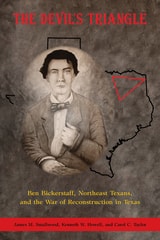
The Devil's Triangle
Ben Bickerstaff, Northeast Texans, and the War of Reconstruction in TexasJames M. Smallwood
University of North Texas Press, 2007
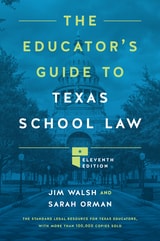
The Educator's Guide to Texas School Law
Eleventh EditionJim Walsh and Sarah Orman
University of Texas Press, 2026
A new edition of the most authoritative guide to Texas school law.
Over the past five years, the US Supreme Court, the White House, and the Texas legislature have collectively been responsible for seismic changes in the landscape of education in the Lone Star State. The eleventh edition of The Educator's Guide to Texas School Law is your up-to-date resource for understanding what the law is and what it means for effective school operations.
Intended for educators, school board members, attorneys, and taxpayers, the eleventh edition offers a comprehensive review of the evolving legal structure of schooling in Texas. Jim Walsh and Sarah Orman highlight pressing issues that educators encounter daily: What are teachers’ and students’ free speech rights? What about due process and religious exercise? Exactly how are teachers hired, and under what circumstances can they be fired? The Educators’ Guide also explains the role of the school board and important dimensions of school district governance, including procurement and compliance with the Open Meetings Act. This latest edition focuses intensively on recent areas of reform, including parents’ rights, special-needs law, and education savings accounts. More essential than ever, the Educator’s Guide provides clarity in uncertain times.
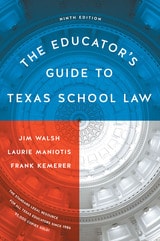
The Educator's Guide to Texas School Law
Ninth EditionBy Jim Walsh, Laurie Maniotis, and Frank Kemerer
University of Texas Press, 2018
Much has changed in the area of school law since the first edition of The Educator’s Guide was published in 1986. This new ninth edition offers an authoritative source on all major dimensions of Texas school law through the 2017 legislative sessions. Intended for educators, school board members, interested attorneys, and taxpayers, the ninth edition explains what the law is and what the implications are for effective school operations. It is designed to help professional educators avoid expensive and time-consuming lawsuits by taking effective preventive action. It is an especially valuable resource for school law courses and staff development sessions.
The ninth edition begins with a review of the legal structure of the Texas school system, incorporating recent innovative features such as charter schools and districts of innovation. Successive chapters address attendance, the instructional program, service to students with special needs, the rights of public school employees, the role of religion, student discipline, governmental transparency, privacy, parent rights, and the parameters of legal liability for schools and school personnel. The book includes discussion of major federal legislation, such as the Individuals with Disabilities Education Act, the Family Educational Rights and Privacy Act, Section 504 of the Rehabilitation Act of 1973, and the Every Student Succeeds Act. On the state level, the book incorporates new laws pertaining to cyberbullying and inappropriate relationships between students and employees. Key points are illustrated through case law, and a complete index of case citations is included.

The Educator's Guide to Texas School Law
Tenth EditionJim Walsh and Sarah Orman
University of Texas Press, 2022
Much has changed in the area of school law since the first edition of The Educator’s Guide to Texas School Law was published in 1986. This new tenth edition of The Educator’s Guide offers an authoritative source on Texas school law through the 2021 legislative sessions. Intended for educators, school board members, attorneys, and taxpayers, it explains what the law is and what the implications are for effective school operations; it helps professional educators avoid expensive and time-consuming lawsuits by taking effective preventive action; and it serves as a highly valuable resource for school law courses and staff development sessions.
The tenth edition begins with a review of the legal structure of the Texas school system, incorporating recent features such as charter schools and districts of innovation, then addresses the instructional program, service to students with special needs, the rights of public school employees, the role of religion, student discipline, governmental transparency, privacy, parental rights, and the parameters of legal liability for schools and school personnel. The book includes discussion of major federal legislation, such as the Individuals with Disabilities Education Act, the Family Educational Rights and Privacy Act, Section 504 of the Rehabilitation Act of 1973, and Title IX. On the state level, the book incorporates laws pertaining to cyberbullying, inappropriate relationships between students and employees, and human sexuality instruction.
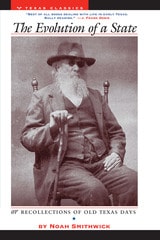
The Evolution of a State, or, Recollections of Old Texas Days
By Noah Smithwick
University of Texas Press, 1983
"I was but a boy in my nineteenth year, and in for adventure when I started out from Hopkinsville, Kentucky, with all my worldly possessions, consisting of a few dollars in money, a change of clothes, and a gun, of course, to seek my fortune in this lazy man's paradise."
Noah Smithwick was an old man, blind and near his ninetieth year, when his daughter recorded these words. He had stayed on in "paradise"—Texas—from 1827 to 1861, when his opposition to secession took him to California. The Evolution of a State is his story of these "old Texas days."
A blacksmith and a tobacco smuggler, Noah Smithwick made weapons for the Battle of Concepción, and he fought in that battle. With Hensley's company, he chased the Mexican army south of the Rio Grande after the Battle of San Jacinto. Twice he served with the Texas Rangers. In quieter times, he was a postmaster and justice of the peace in little Webber's Prairie.
Eyewitness to so much Texas history, Smithwick recounts his life and adventures in a simple, straightforward style, with a wry sense of humor. His keen memory for detail—what the people wore, what they ate, how they worked and played— vividly evokes the sights, sounds, and smells of the frontier.
First published in part by the Dallas Morning News, Smithwick's recollections gained such popularity that they were published in book form, as The Evolution of a State, in 1900. This new edition of a Texas classic makes widely available for the first time in many years this "best of all books dealing with life in early Texas."
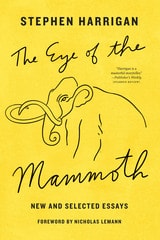
The Eye of the Mammoth
New and Selected EssaysBy Stephen Harrigan; foreword by Nicholas Lemann
University of Texas Press, 2013
History—natural history, human history, and personal history—and place are the cornerstones of The Eye of the Mammoth. Stephen Harrigan's career has taken him from the Alaska Highway to the Chihuahuan Desert, from the casinos of Monaco to his ancestors' village in the Czech Republic. And now, in this new edition, he movingly recounts in "Off Course" a quest to learn all he can about his father, who died in a plane crash six months before he was born.
Harrigan's deceptively straightforward voice belies an intense curiosity about things that, by his own admission, may be "unknowable." Certainly, we are limited in what we can know about the inner life of George Washington, the last days of Davy Crockett, the motives of a caged tiger, or a father we never met, but Harrigan's gift—a gift that has also made him an award-winning novelist—is to bring readers closer to such things, to make them less remote, just as a cave painting in the title essay eerily transmits the living stare of a long-extinct mammoth.
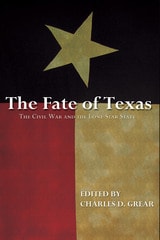
The Fate of Texas
The Civil War and the Lone Star StateCharles D. Grear
University of Arkansas Press, 2018
The Fifty-Year Texas Road Trip
On Assignment from Earth to UncertainRandy Mallory
University of North Texas Press, 2025
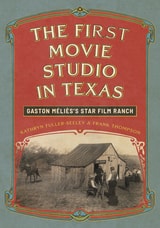
The First Movie Studio in Texas
Gaston Méliès's Star Film RanchKathryn Fuller-Seeley and Frank Thompson
University of Texas Press, 2026
The story of the Star Film Ranch and its pioneering crew, who created the first “authentic” Westerns filmed in Texas.
In 1910, the Méliès Star Film Company of Manhattan set up a moving-picture studio outside San Antonio, the first in Texas. Determined to make the most authentic Westerns possible, the company filmed there for a little over a year. In that brief time, it created more than seventy single-reel films, leaving a lasting mark on moviemaking.
Film historians Kathryn Fuller-Seeley and Frank Thompson return to a moment when on-location filmmaking was emerging as an artform. We meet producer Gaston Méliès, older brother of early-cinema legend Georges Méliès, and his cast and crew of young innovators, old hands, and genuine cowboys—like seventeen-year-old Edith Storey, the tomboy star who helped to ignite modern celebrity culture, and Francis Ford, who learned the art of film directing on the job and mentored his younger brother, Hollywood legend John Ford. The First Movie Studio in Texas traces the company’s trials and accomplishments, its influence on the depiction of race and gender in Western filmmaking, its surviving works, and its crowning achievement: The Immortal Alamo (1911), the earliest cinematic depiction of that famous battle.
Finally recovered from the shadows, the forgotten Méliès brother proves to be one of the key founders of the Western myth on screen.
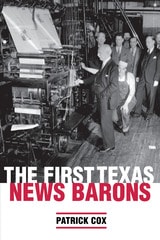
The First Texas News Barons
By Patrick Cox
University of Texas Press, 2005
Newspaper publishers played a crucial role in transforming Texas into a modern state. By promoting expanded industrialization and urbanization, as well as a more modern image of Texas as a southwestern, rather than southern, state, news barons in the early decades of the twentieth century laid the groundwork for the enormous economic growth and social changes that followed World War II. Yet their contribution to the modernization of Texas is largely unrecognized.
This book investigates how newspaper owners such as A. H. Belo and George B. Dealey of the Dallas Morning News, Edwin Kiest of the Dallas Times Herald, William P. Hobby and Oveta Culp Hobby of the Houston Post, Jesse H. Jones and Marcellus Foster of the Houston Chronicle, and Amon G. Carter Sr. of the Fort Worth Star-Telegram paved the way for the modern state of Texas. Patrick Cox explores how these news barons identified the needs of the state and set out to attract the private investors and public funding that would boost the state's civic and military infrastructure, oil and gas industries, real estate market, and agricultural production. He shows how newspaper owners used events such as the Texas Centennial to promote tourism and create a uniquely Texan identity for the state. To balance the record, Cox also demonstrates that the news barons downplayed the interests of significant groups of Texans, including minorities, the poor and underemployed, union members, and a majority of women.

The Flatlanders
Now It's Now AgainBy John T. Davis
University of Texas Press, 2014
A group of three friends who made music in a house in Lubbock, Texas, recorded an album that wasn’t released and went their separate ways into solo careers. That group became a legend and then—twenty years later—a band. The Flatlanders—Joe Ely, Jimmie Dale Gilmore, and Butch Hancock—are icons in American music, with songs blending country, folk, and rock that have influenced a long list of performers, including Robert Earl Keen, the Cowboy Junkies, Ryan Bingham, Terry Allen, John Hiatt, Hayes Carll, Lucinda Williams, Steve Earle, and Lyle Lovett.
In The Flatlanders: Now It’s Now Again, Austin author and music journalist John T. Davis traces the band’s musical journey from the house on 14th Street in Lubbock to their 2013 sold-out concert at Carnegie Hall. He explores why music was, and is, so important in Lubbock and how earlier West Texas musicians such as Buddy Holly and Roy Orbison, as well as a touring Elvis Presley, inspired the young Ely, Gilmore, and Hancock. Davis vividly recreates the Lubbock countercultural scene that brought the Flatlanders together and recounts their first year (1972–1973) as a band, during which they recorded the songs that, decades later, were released as the albums More a Legend Than a Band and The Odessa Tapes. He follows the three musicians through their solo careers and into their first decade as a (re)united band, in which they cowrote songs for the first time on the albums Now Again and Hills and Valleys and recovered their extraordinary original demo tape, lost for forty years. Many roads later, the Flatlanders are finally both a legend and a band.
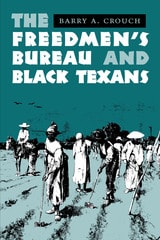
The Freedmen's Bureau and Black Texans
By Barry A. Crouch
University of Texas Press, 1992
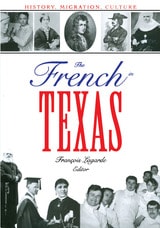
The French in Texas
History, Migration, CultureEdited by François Lagarde
University of Texas Press, 2003
2005 — San Antonio Conservation Society Citation
Original articles that explore the French presence and influence on Texas history, arts, education, religion, and business.
The flag of France is one of the six flags that have flown over Texas, but all that many people know about the French presence in Texas is the ill-fated explorer Cavelier de La Salle, fabled pirate Jean Laffite, or Cajun music and food. Yet the French have made lasting contributions to Texas history and culture that deserve to be widely known and appreciated. In this book, François Lagarde and thirteen other experts present original articles that explore the French presence and influence on Texas history, arts, education, religion, and business from the arrival of La Salle in 1685 to 2002.
Each article covers an important figure or event in the France-Texas story. The historical articles thoroughly investigate early French colonists and explorers, the French pirates and privateers, the Bonapartists of Champ-d'Asile, the French at the Alamo, Dubois de Saligny and French recognition of the Republic of Texas, the nineteenth-century utopists of Icaria and Reunion, and the French Catholic missions. Other articles deal with French immigration in Texas, including the founding of Castroville, Cajuns in Texas, and the French economic presence in Texas today (the first such study ever published). The remaining articles look at painters Théodore and Marie Gentilz, sculptor Raoul Josset, French architecture in Texas, French travelers from Théodore Pavie to Simone de Beauvoir who have written on Texas, and the French heritage in Texas education. More than seventy color and black-and-white illustrations complement the text.

The Future is Mestizo
Life Where Culture Meet, Revised EditionVirgilio Elizondo
University Press of Colorado, 2000

The Gay Place
By Billy Lee Brammer
University of Texas Press, 1995
Set in Texas, The Gay Place consists of three interlocking novels, each with a different protagonist—a member of the state legislature, the state's junior senator, and the governor's press secretary. The governor himself, Arthur Fenstemaker, a master politician, infinitely canny and seductive, remains the dominant figure throughout.
Billy Lee Brammer—who served on Lyndon Johnson's staff—gives us here "the excitement of a political carnival: the sideshows, the freaks, and the ghoulish comedy atmosphere" (Saturday Review).
Originally published in 1961, The Gay Place is at once a cult classic and a major American novel.
The German Texas Frontier
Ferdinand Lindheimer’s Newspaper Accounts of the Environment, Gold, and IndiansDaniel J. Gelo
University of North Texas Press, 2024