Results by title
4917 books match the query 'Philosophy' and 1267 start with t
The Subject of Coexistence
Otherness in International RelationsLouiza Odysseos
University of Minnesota Press, 2007
In this pioneering book, Louiza Odysseos argues that debates about ethnic conflict, human rights, and the viability of multicultural communities all revolve around the question of coexistence. Yet, issues of coexistence have not been adequately addressed by international relations. Instead of being regarded as a question, “coexistence” is a term whose meaning is considered self-evident.
The Subject of Coexistence traces the institutional neglect of coexistence to the ontological commitments of international relations as a modern social science predicated on conceptions of modern subjectivity. This reliance leads to the assumption that coexistence means little more than the social and political copresence of individuals, a premise that occludes the roles of otherness in the constitution of the self. Countering this reliance necessitates the examination of how existence itself is coexistential from the start.
Odysseos opens up the possibility of a coexistential ontology, drawing on Martin Heidegger and his interlocutors, in which selfhood can be rethought beyond subjectivism, reinstating coexistence as a question for global politics—away from the restrictive discursive parameters of the modern subject.
Louiza Odysseos is senior lecturer in international relations at the University of Sussex.
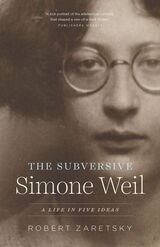
The Subversive Simone Weil
A Life in Five IdeasRobert Zaretsky
University of Chicago Press, 2021
Though Weil published little during her life, after her death, thanks largely to the efforts of Albert Camus, hundreds of pages of her manuscripts were published to critical and popular acclaim. While many seekers have been attracted to Weil’s religious thought, Robert Zaretsky gives us a different Weil, exploring her insights into politics and ethics, and showing us a new side of Weil that balances her contradictions—the rigorous rationalist who also had her own brand of Catholic mysticism; the revolutionary with a soft spot for anarchism yet who believed in the hierarchy of labor; and the humanitarian who emphasized human needs and obligations over human rights. Reflecting on the relationship between thought and action in Weil’s life, The Subversive Simone Weil honors the complexity of Weil’s thought and speaks to why it matters and continues to fascinate readers today.
The Superhumanities
Historical Precedents, Moral Objections, New RealitiesJeffrey J. Kripal
University of Chicago Press, 2022
What would happen if we reimagined the humanities as the superhumanities? If we acknowledged and celebrated the undercurrent of the fantastic within our humanistic disciplines, entirely new cultural worlds and meanings would become possible. That is Jeffrey J. Kripal’s vision for the future—to revive the suppressed dimension of the superhumanities, which consists of rare but real altered states of knowledge that have driven the creative processes of many of our most revered authors, artists, and activists. In Kripal’s telling, the history of the humanities is filled with precognitive dreams, evolving superhumans, and doubled selves. The basic idea of the superhuman, for Kripal, is at the core of who and what the human species has tried to become over millennia and around the planet.
After diagnosing the basic malaise of the humanities—that the truth must be depressing—Kripal shows how it can all be done differently. He argues that we have to decolonize reality itself if we are going to take human diversity seriously. Toward this pluralist end, he engages psychoanalytic, Black critical, feminist, postcolonial, queer, and ecocritical theory. He works through objections to the superhumanities while also recognizing the new realities represented by the contemporary sciences. In doing so, he tries to move beyond naysaying practices of critique toward a future that can embrace those critiques within a more holistic view—a view that recognizes the human being as both a social-political animal as well as an evolved cosmic species that understands and experiences itself as something super.
The Surrealism Reader
An Anthology of IdeasEdited by Dawn Ades, Michael Richardson, and Krzysztof Fijalkowski
University of Chicago Press, 2016
Including essays by leading surrealists and other major writers on the movement, the volume addresses the key themes of identity, otherness, freedom and morality, and poetry. The texts uncover, among other things, the significance of surrealism for the antifascist and anticolonialist movements and the various manifestations of surrealism in the years after World War II. Giving space to the many different voices that made up the movement, and placing them for the first time within a clear and coherent historical framework, The Surrealism Reader radically revises the popular understanding of what, and when, surrealism was—making this book an essential reference for students, scholars, and all those interested in the central place of surrealism within twentieth-century thought and culture.
The Symbolic Construction of Reality
The Legacy of Ernst CassirerEdited by Jeffrey Andrew Barash
University of Chicago Press, 2008

The Symposium of Plato
Suzy Q. Groden
University of Massachusetts Press, 1970
This new translation of Plato’s dialogue on love avoids the cumbersome locutions of Victorian versions and presents Plato’s ancient drinking party in a vigorous contemporary idiom. The character of Socrates emerges with unexpected wit and humor, adding new dimensions to his familiar irony. A poet and philosopher have collaborated to give an English version that is fresh and clear, and accurately renders the ideas of the speakers.
A detailed internal analysis of the structure of the dialogue is given in the introduction. The afterword presents an historical interpretation of the two ways of love, eros and agapé, an a reinterpretation of eros in Plato.
The Tacit Dimension
Michael Polanyi
University of Chicago Press, 2009
A classic work in the philosophy of science that changed how we think about knowledge itself
“I shall reconsider human knowledge by starting from the fact that we can know more than we can tell,” writes Michael Polanyi, whose work paved the way for the likes of Thomas Kuhn and Karl Popper. The Tacit Dimension argues that tacit knowledge—tradition, inherited practices, implied values, and prejudgments—is a crucial part of scientific knowledge. As relevant today as it was when it was first published, this volume challenges the assumption that skepticism, rather than established belief, lies at the heart of scientific discovery.
"The reissuing of this remarkable book give us a new opportunity to see how far-reaching—and foundational—Michael Polanyi's ideas are, on some of the age-old questions in philosophy."—Amartya Sen, from the Foreword
The Tanner Lectures Vol 25
Grethe B Peterson
University of Utah Press, 2005
The Tanner Lectures Vol 26
Peterson, Grethe B
University of Utah Press, 2006
The Tanner Lectures Vol 27
Grethe B Peterson
University of Utah Press, 2007
The Tanner Lectures on Human Values
Volume 32Mark Matheson
University of Utah Press, 2013
John Broome, “The Public and Private Morality of Climate Change”
John Broome is the Whites Professor of Moral Philosophy at the University of Oxford and a fellow of Corpus Christi College in Oxford. He has written six books.
John M. Cooper, “Ancient Philosophies as Ways of Life”
John Cooper is the Henry Putnam University Professor of Philosophy at Princeton University. His books include Pursuits of Wisdom: Six Ways of Ancient Philosophy from Socrates to Plotinus and Panentheism: The Other God of the Philosophers.
Stephen Greenblatt, “Shakespeare and the End of Life History”
Stephen Greenblatt is the John Cogan University Professor of the Humanities at Harvard University. He is the author of several books, including the 2012 Pulitzer Prize–winning The Swerve: How the World Became Modern and Will in the World: How Shakespeare Became Shakespeare.
Lisa Jardine, “The Sorcerer’s Apprentice: C. P. Snow and J. Bronowski” and “Science and Government: C. P. Snow and the Corridors of Power”
Lisa Jardine is a professor of Renaissance studies at University College London, where she is the director of the Interdisciplinary Centre for Research in the Humanities and the Centre for Editing Lives and Letters. She has published more than fifty scholarly articles and seventeen books, including Going Dutch: How England Plundered Holland’s Glory.
Samuel Scheffler, “The Afterlife”
Samuel Scheffler is University Professor and a professor of philosophy and law at New York University. He has published four books in the areas of moral and political philosophy, including Equality and Tradition.
Abraham Verghese, “Two Souls Intertwined”
Abraham Verghese is a professor of medicine and senior associate chair for the Theory and Practice of Medicine at Stanford University. He has published widely across disciplines, including My Own Country: A Doctor’s Story and the novel Cutting for Stone. He is perhaps best known for his deep interest in bedside medicine and work in the medical humanities.
The Tanner Lectures on Human Values
Volume 33Mark Matheson
University of Utah Press, 2014
William G. Bowen, “Costs and Productivity in Higher Education” and “Prospects for an Online Fix: Can We Harness Technology in the Service of Our Aspirations?”
Craig Calhoun, “The Problematic Public: Revisiting Dewey, Arendt, and Habermas”
Michael Ignatieff, “Representation and Responsibility: Ethics and Public Office”
F. M. Kamm, “Who Turned the Trolley?” and “How Was the Trolley Turned?”
Claude Lanzmann, “Resurrection”
Robert Post, “Representative Democracy: The Constitutional Theory of Campaign Finance Reform” and “Campaign Finance Reform and the First Amendment”
Michael J. Sandal, “The Moral Economy of Speculation: Gambling, Finance, and the Common Good”
The Tanner Lectures on Human Values
Volume 34Mark Matheson
University of Utah Press, 2016
The Tanner Lectures on Human Values, founded July 1, 1978, at Clare Hall, Cambridge University, was established by the American scholar, industrialist, and philanthropist Obert Clark Tanner. Lectureships are awarded to outstanding scholars or leaders in broadly defined fields of human values and transcend ethnic, national, religious, or ideological distinctions. Volume 34 features lectures given during the academic year 2013 to 2014 at the University of Oxford; Stanford University; the University of Utah; and Yale University.
Shami Chakrabarti, Liberty Organization (formerly National Council for Civil Liberties)
“Human Rights as Human Values”
Paul Gilroy, King’s College London
“The Black Atlantic and Re-enchantment of Humanism”
Bruno Latour, Institut d’etudes politiques (Sciences Po) Paris “How Better to Register the Agency of Things”
Nicholas Lemann, Columbia University School of Journalism “The Turn Against Institutions” and “What Transactions Can’t Do”
Andrew Solomon, Author
“Love, Acceptance, Celebration: How Parents Make Their Children”
The Tanner Lectures on Human Values
Volume 39Edited by Mark Matheson
University of Utah Press, 2024

The Tao and the Logos
Literary Hermeneutics, East and WestLongxi Zhang
Duke University Press, 1992
Zhang's book brings together philosophy and literature, theory and practical criticism, the Western and the non-Western in defining common ground on which East and West may come to a mutual understanding. He provides commentary on the rich traditions of poetry and poetics in ancient China; equally illuminating are Zhang's astute analyses of Western poets such as Rilke, Shakespeare, and Mallarmé and his critical engagement with the work of Foucault, Derrida, and de Man, among others.
Wide-ranging and learned, this definitive work in East-West comparative poetics and the hermeneutic tradition will be of interest to specialists in comparative literature, philosophy, literary theory, poetry and poetics, and Chinese literature and history.
The Tears of Things
Melancholy and Physical ObjectsPeter Schwenger
University of Minnesota Press, 2005
Peter Schwenger deftly weaves together philosophical and psychoanalytical theory with artistic practice. Concerned in part with the act of collecting, The Tears of Things is itself a collection of exemplary art objects—literary and cultural attempts to control and possess things—including paintings by Georgia O’Keeffe and René Magritte; sculpture by Louise Bourgeois and Marcel Duchamp; Joseph Cornell’s boxes; Edward Gorey’s graphic art; fiction by Virginia Woolf, Georges Perec, and Louise Erdrich; the hallucinatory encyclopedias of Jorge Luis Borges and Luigi Serafini; and the corpse photographs of Joel Peter Witkin.
However, these representations of objects perpetually fall short of our aspirations. Schwenger examines what is left over—debris and waste—and asks what art can make of these. What emerges is not an art that reassembles but one that questions what it means to assemble in the first place. Contained in this catalog of waste is that ultimate still life, the cadaver, where the subject-object dichotomy receives its final ironic reconciliation.
Peter Schwenger is professor of English at Mount St. Vincent University in Halifax, Nova Scotia. He is the author of Fantasm and Fiction: On Textual Envisioning, Letter Bomb: Nuclear Holocaust and the Exploding Word, and Phallic Critiques: Masculinity and Twentieth-Century Literature.
The Technique of Thought
Nancy, Laruelle, Malabou, and Stiegler after NaturalismIan James
University of Minnesota Press, 2019
Interrogating the work of four contemporary French philosophers to rethink philosophy’s relationship to science and science’s relationship to reality
The Technique of Thought explores the relationship between philosophy and science as articulated in the work of four contemporary French thinkers—Jean-Luc Nancy, François Laruelle, Catherine Malabou, and Bernard Stiegler. Situating their writings within both contemporary scientific debates and the philosophy of science, Ian James elaborates a philosophical naturalism that is notably distinct from the Anglo-American tradition. The naturalism James proposes also diverges decisively from the ways in which continental philosophy has previously engaged with the sciences. He explores the technical procedures and discursive methods used by each of the four thinkers as distinct “techniques of thought” that approach scientific understanding and knowledge experimentally.
Moving beyond debates about the constructed nature of scientific knowledge, The Technique of Thought argues for a strong, variably configured, and entirely novel scientific realism. By bringing together post-phenomenological perspectives concerning individual or collective consciousness and first-person qualitative experience with science’s focus on objective and third-person quantitative knowledge, James tracks the emergence of a new image of the sciences and of scientific practice.
Stripped of aspirations toward total mastery of the universe or a “grand theory of everything,” this renewed scientific worldview, along with the simultaneous reconfiguration of philosophy’s relationship to science, opens up new ways of interrogating immanent reality.
The Temptation to Exist
E. M. Cioran
University of Chicago Press, 1998
"A sort of final philosopher of the Western world. His statements have the compression of poetry and the audacity of cosmic clowning."—Washington Post
"An intellectual bombshell that blasts away at all kinds of cant, sham and conventionality. . . . [Cioran's] language is so erotic, his handling of words so seductive, that the act of reading becomes an encounter in the erogenous zone."—Jonah Raskin, L.A. Weekly
The Tenets of Cognitive Existentialism
Dimitri Ginev
Ohio University Press, 2011
In The Tenets of Cognitive Existentialism, Dimitri Ginev draws on developments in hermeneutic phenomenology and other programs in hermeneutic philosophy to inform an interpretative approach to scientific practices. At stake is the question of whether it is possible to integrate forms of reflection upon the ontological difference in the cognitive structure of scientific research. A positive answer would have implied a proof that (pace Heidegger) “science is able to think.” This book is an extended version of such a proof. Against those who claim that modern science is doomed to be exclusively committed to the nexus of objectivism and instrumental rationality, the interpretative theory of scientific practices reveals science’s potentiality of hermeneutic self-reflection. Scientific research that takes into consideration the ontological difference has resources to enter into a dialogue with Nature.
Ginev offers a critique of postmodern tendencies in the philosophy of science, and sets out arguments for a feminist hermeneutics of scientific research.
The Terministic Screen
Rhetorical Perspectives on FilmEdited by David Blakesley
Southern Illinois University Press, 2003
The Terministic Screen: Rhetorical Perspectives on Film examines the importance of rhetoric in the study of film and film theory. Rhetorical approaches to film studies have been widely practiced, but rarely discussed until now. Taking on such issues as Hollywood blacklisting, fascistic aesthetics, and postmodern dialogics, editor David Blakesley presents fifteen critical essays that examine rhetoric’s role in such popular films as The Fifth Element, The Last Temptation of Christ, The Usual Suspects, Deliverance, The English Patient, Pulp Fiction, The Music Man, Copycat, Hoop Dreams,and A Time to Kill.
Aided by sixteen illustrations, these insightful essays consider films rhetorically, as ways of seeing and not seeing, as acts that dramatize how people use language and images to tell stories and foster identification.
Contributors include David Blakesley, Alan Nadel, Ann Chisholm, Martin J. Medhurst, Byron Hawk, Ekaterina V. Haskins, James Roberts, Thomas W. Benson, Philip L. Simpson, Davis W. Houck, Caroline J.S. Picart, Friedemann Weidauer, Bruce Krajewski, Harriet Malinowitz, Granetta L. Richardson, and Kelly Ritter.
The Test Drive
Avital Ronell
University of Illinois Press, 2004
The Texture of Being
Essays in First PhilosophyKenneth L. Schmitz
Catholic University of America Press, 2007
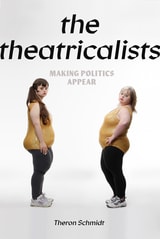
The Theatricalists
Making Politics AppearTheron Schmidt
Northwestern University Press, 2024
Examines how the politics of the theater can illuminate the theatricality of politics
Theatricality is often dismissed as a distraction from “real” politics, as when cynical political gestures are derided as “pure theater” or “only theater.” But the artists and theater companies discussed in this book, including Back to Back Theatre, Tim Crouch, Rabih Mroué, Nature Theater of Oklahoma, and Christoph Schlingensief, take a different approach. Theron Schmidt argues that they represent a “theatricalist turn” that explores and tests the conditions of the theater itself. Across diverse contexts of political engagement, ranging from disability rights to representations of violence, these theatrical conditions are interconnected with political struggles, such as those over who is seen and heard, how labor is valued, and what counts as “political” in the first place. In a so-called post-political era, The Theatricalists argues that an examination of theater’s internal politics can expand our understanding of the theatricality of politics more broadly.
The Theological Basis of Liberal Modernity in Montesquieu's "Spirit of the Laws"
Thomas L. Pangle
University of Chicago Press, 2010
The Spirit of the Laws—Montesquieu’s huge, complex, and enormously influential work—is considered one of the central texts of the Enlightenment, laying the foundation for the liberally democratic political regimes that were to embody its values. In his penetrating analysis, Thomas L. Pangle brilliantly argues that the inherently theological project of Enlightenment liberalism is made more clearly—and more consequentially— in Spirit than in any other work.
In a probing and careful reading, Pangle shows how Montesquieu believed that rationalism, through the influence of liberal institutions and the spread of commercial culture, would secularize human affairs. At the same time, Pangle uncovers Montesquieu’s views about the origins of humanity’s religious impulse and his confidence that political and economic security would make people less likely to sacrifice worldly well-being for otherworldly hopes. With the interest in the theological aspects of political theory and practice showing no signs of diminishing, this book is a timely and insightful contribution to one of the key achievements of Enlightenment thought.
The Theological Metaphors of Marx
Enrique Dussel
Duke University Press, 2024
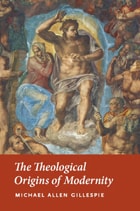
The Theological Origins of Modernity
Michael Allen Gillespie
University of Chicago Press, 2008
Exposing the religious roots of our ostensibly godless age, Michael Allen Gillespie reveals in this landmark study that modernity is much less secular than conventional wisdom suggests. Taking as his starting point the collapse of the medieval world, Gillespie argues that from the very beginning moderns sought not to eliminate religion but to support a new view of religion and its place in human life. He goes on to explore the ideas of such figures as William of Ockham, Petrarch, Erasmus, Luther, Descartes, and Hobbes, showing that modernity is best understood as a series of attempts to formulate a new and coherent metaphysics or theology.
“Bringing the history of political thought up to date and situating it against the backdrop of contemporary events, Gillespie’s analyses provide us a way to begin to have conversations with the Islamic world about what is perhaps the central question within each of the three monotheistic religions: if God is omnipotent, then what is the place of human freedom?”—Joshua Mitchell, Georgetown University
The Theorist's Mother
Andrew Parker
Duke University Press, 2012
The Theory of Ecology
Edited by Samuel M. Scheiner and Michael R. Willig
University of Chicago Press, 2011
Despite claims to the contrary, the science of ecology has a long history of building theories. Many ecological theories are mathematical, computational, or statistical, though, and rarely have attempts been made to organize or extrapolate these models into broader theories. The Theory of Ecology brings together some of the most respected and creative theoretical ecologists of this era to advance a comprehensive, conceptual articulation of ecological theories. The contributors cover a wide range of topics, from ecological niche theory to population dynamic theory to island biogeography theory. Collectively, the chapters ably demonstrate how theory in ecology accounts for observations about the natural world and how models provide predictive understandings. It organizes these models into constitutive domains that highlight the strengths and weaknesses of ecological understanding. This book is a milestone in ecological theory and is certain to motivate future empirical and theoretical work in one of the most exciting and active domains of the life sciences.
The Theory of Morality
Alan Donagan
University of Chicago Press, 1977
"The man value of this book seems to me to be that it shows the force of the Hebrew-Christian moral tradition in the hands of a creative philosopher. Throughout the book, one cannot but feel that a serious philosopher is trying to come to terms with his religious-moral background and to defend it against the prevailing secular utilitarian position which seems to dominate academic philosophy."—Bernard Gert, Journal of Medicine and Philosophy
The Theory of Rules
Karl N. Llewellyn
University of Chicago Press, 2011
Karl N. Llewellyn was one of the founders and major figures of legal realism, and his many keen insights have a central place in American law and legal understanding. Key to Llewellyn’s thinking was his conception of rules, put forward in his numerous writings and most famously in his often mischaracterized declaration that they are “pretty playthings.” Previously unpublished, The Theory of Rules is the most cogent presentation of his profound and insightful thinking about the life of rules.
This book frames the development of Llewellyn’s thinking and describes the difference between what rules literally prescribe and what is actually done, with the gap explained by a complex array of practices, conventions, professional skills, and idiosyncrasies, most of which are devoted to achieving a law’s larger purpose rather than merely following the letter of a particular rule. Edited, annotated, and with an extensive analytic introduction by leading contemporary legal scholar Frederick Schauer, this rediscovered work contains material not found elsewhere in Llewellyn’s writings and will prove a valuable contribution to the existing literature on legal realism.
The Things That Really Matter
Philosophical Conversations on the Cornerstones of LifeMichael Hauskeller
University College London, 2022
While rooted in academic discourse, The Things That Really Matter comprehensively explores the most fundamental aspects of human life in approachable, non-technical language, adding fresh perspectives and new arguments and considerations that are designed to stimulate further debate. It features a series of conversations about the things in our life that we all, in one way or another, wrestle with if we are at all concerned about what kind of world we live in and what our role in it is: things like birth, age, and death, good and evil, the meaning of life, the nature of the self and the role the body plays for our identity, our gendered existence, love and faith, free will, beauty, and our experience of the sacred.
Situating abstract ideas in concrete experience, The Things That Really Matter encourages the reader to participate in an open-ended dialogue involving a variety of thinkers with different backgrounds and orientations. Lively and accessible, it shows thinking as a process and a collaborative endeavor that benefits from our talking to each other rather than against each other, featuring real conversations, where ideas are explored, tested, changed, and occasionally dropped. It is thinking in motion, personal yet universal.

The Thinker As Artist
From Homer To Plato and AristotleGeorge Anastaplo
Ohio University Press, 1997
The Thinking Woman
Julienne van Loon
Rutgers University Press, 2021
While women have struggled to gain recognition in the discipline of philosophy, there is no shortage of brilliant female thinkers. What can these women teach us about ethics, politics, and the nature of existence, and how might we relate these big ideas back to the smaller everyday concerns of domestic life, work, play, love, and relationships?
Australian novelist Julienne van Loon goes on a worldwide quest to answer these questions, by engaging with eight world-renowned thinkers who have deep insights on humanity and society: media scholar Laura Kipnis, novelist Siri Hustvedt, political philosopher Nancy Holmstrom, psychoanalytic theorist Julia Kristeva, domestic violence reformer Rosie Batty, peace activist Helen Caldicott, historian Marina Warner, and feminist philosopher Rosi Braidotti. As she speaks to these women, she reflects on her own experiences. Combining the intimacy of a memoir with the intellectual stimulation of a theoretical text, The Thinking Woman draws novel connections between the philosophical, personal, and political. Giving readers a new appreciation for both the ethical complexities and wonder of everyday life, this book is inspiration to all thinking people.
The Thinking of the Sensible
Merleau-Ponty's A-PhilosophyMauro Carbone
Northwestern University Press, 2004
An original and innovative interpretation of the ontology of Merleau-Ponty--and themselves a significant contribution to the field of Continental thought--these essays constitute a sustained exploration of what Merleau-Ponty detected, and greeted, as a "mutation within the relations of man and Being," which would provide him with the basis for a new idea of philosophy or "a-philosophy." In lucid, often elegant terms, Carbone analyzes key elements of Merleau-Ponty's thought in relation to Proust's Recherche, Hegel's Phenomenology of Spirit, the new biology of Von Uexküll, Rimbaud's Lettre du voyant, and Heidegger's conception of "letting-be." His work clearly demonstrates the vitality of Merleau-Ponty's late revolutionary philosophy by following its most salient, previously unexplored paths. This is essential reading for any scholar with an interest in Merleau-Ponty, in the questions of embodiment, temporality and Nature, or in the possibility of philosophy today.
The Thought and Character of William James
Ralph Barton Perry
Vanderbilt University Press, 1996
This out- of-print classic returns, in a new paperback edition, through the Vanderbilt Library of American Philosophy. Designed to serve as both a systematic account of James's development and a repository of selections from his unpublished writings, the one-volume work (which forms the basis for this new paperback edition) offers a brief and convenient sourcebook of James's thought, set forth in terms that require no previous familiarity with technical problems of philosophy and psychology.
The Thought of Becoming
Gilles Deleuze’s Poetics of LifeKathrin Thiele
Diaphanes, 2008
While this formula might estrange at first, the author, by approaching it through the conceptual figure of becoming, not only manages to carefully develop the Deleuzian thought-universe via its coordinates Spinoza, Bergson, and Nietzsche, but shows in her argument as well that the substitution of becoming for Being is no insignificant matter but rather the preparation for a new thought of ontology as an ontology of becoming and – as such – for a new thought of ethics as a poetics of life.
›Indirection‹ is the movement of becoming into this world, brought forth here as the most compelling dimension of Deleuze’s thought. Such a position dares to conceive of thought as practice without collapsing the gap that always persists between thinking and acting.
The Thought of Death and the Memory of War
Marc Crépon
University of Minnesota Press, 2013
War lays bare death and our relation to it. And in the wars—or more precisely the memories of war—of the twentieth century, images of the deaths of countless faceless or nameless others eclipse the singularity of each victim’s death as well as the end of the world as such that each death signifies.
Marc Crépon’s The Thought of Death and the Memory of War is a call to resist such images in which death is no longer actual death since it happens to anonymous others, and to seek instead a world in which mourning the other whose mortality we always already share points us toward a cosmopolitics. Crépon pursues this path toward a cosmopolitics of mourning through readings of works by Freud, Heidegger, Sartre, Patocka, Levinas, Derrida, and Ricœur, and others. The movement among these writers, Crépon shows, marks a way through—and against—twentieth-century interpretation to argue that no war, genocide, or neglect of people is possible without suspending how one relates to the death of another human being.
A history of a critical strain in contemporary thought, this book is, as Rodolphe Gasché says in the Foreword, “a profound meditation on what constitutes evil and a rigorous and illuminating reflection on death, community, and world.”
The translation of this work received financial support from the French Ministry of Foreign Affairs.
The Thought of John Sallis
Phenomenology, Plato, ImaginationBernard Freydberg
Northwestern University Press, 2012
Sallis’s work possesses an intrinsic power and originality, as well as deep interpretive insight. This book is a descriptive and critical journey through his thought, providing an overview for readers who wish to gain a sense of its sweep, along with discrete sections on particular philosophical disciplines for readers whose interests are more specific. It grapples with the challenges Sallis’s thought presents, making them explicit and opening them up to further consideration. And it attempts to locate his thought within both contemporary continental philosophy and philosophy as a whole. Essential for any student of continental philosophy, The Thought of John Sallis expounds on his work in a manner that increases access, honors its depth, and opens up unexplored possibilities for philosophy.
The Three Axial Ages
Moral, Material, MentalTorpey, John
Rutgers University Press, 2017
Torpey’s argument advances the idea that there are in fact three “Axial Ages,” instead of one original Axial Age and several subsequent, smaller developments. Each of the three ages contributed decisively to how humanity lives, and the difficulties it faces. The earliest, or original, Axial Age was a moral one; the second was material, and revolved around the creation and use of physical objects; and the third is chiefly mental, and focused on the technological. While there are profound risks and challenges, Torpey shows how a worldview that combines the strengths of all three ages has the potential to usher in a period of exceptional human freedom and possibility.
The Three Ethologies
A Positive Vision for Rebuilding Human-Animal RelationshipsMatthew Calarco
University of Chicago Press, 2024
The Three Ethologies offers a fresh, affirmative vision for rebuilding human-animal relations. Venturing beyond the usual scholarly and activist emphasis on restricting harm, Matthew Calarco develops a new philosophy for understanding animal behavior—a practice known as ethology—through three distinct but interrelated lenses: mental ethology, which rebuilds individual subjectivity; social ethology, which rethinks our communal relations; and environmental ethology, which reconfigures our relationship to the land we co-inhabit with our animal kin. Drawing on developments in philosophy, (eco)feminist theory, critical geography, Indigenous studies, and the environmental humanities, Calarco casts an inspiring vision of how ethological living can help us to reimagine our ideas about goodness, truth, and beauty.
The Three Sustainabilities
Energy, Economy, TimeAllan Stoekl
University of Minnesota Press, 2021
Bringing the word sustainability back from the brink of cliché—to a substantive, truly sustainable future
Is sustainability a hopelessly vague word, with meager purpose aside from a feel-good appeal to the consumer? In The Three Sustainabilities, Allan Stoekl seeks to (re)valorize the word, for a simple reason: it is useful. Sustainability designates objects in time, their birth or genesis, their consistency, their survival, their demise. And it raises the question, as no other word does, of the role of humans in the survival of a world that is quickly disappearing—and perhaps in the genesis of another world.
Stoekl considers a range of possibilities for the word, touching upon questions of object ontology, psychoanalysis, urban critique, technocracy, and religion. He argues that there are three varieties of sustainability, seen from philosophical, cultural, and economic perspectives. One involves the self-sustaining world “without us”; another, the world under our control, which can run the political spectrum from corporatism to Marxism to the Green New Deal; and a third that carries a social and communitarian charge, an energy of the “universe” affirmed through, among other things, meditation and gifting. Each of these carves out a different space in the relations between objects, humans, and their survival and degradation. Each is necessary, unavoidable, and intimately bound with, and infinitely distant from, the others.
Along the way, Stoekl cites a wide range of authors, from philosophers to social thinkers, literary theorists to criminologists, anthropologists to novelists. This beautifully written, compelling, and nuanced book is a must for anyone interested in questions of ecology, energy, the environmental humanities, contemporary theories of the object, postmodern and posthuman aesthetics, or religion and the sacred in relation to community.
The Ties That Bind
Julius M. Moravcsik
Central European University Press, 2004
The Time Has Grown Short
René Girard, or the Last LawBenoît Chantre
Michigan State University Press, 2022
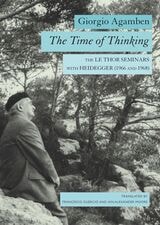
The Time of Thinking
The Le Thor Seminars with Heidegger (1966 and 1968)Giorgio Agamben
Seagull Books, 2026
A glimpse into philosopher Giorgio Agamben's formative encounter with Martin Heidegger, told through his notes from the Le Thor seminars.
What does it mean for thought to have a time of its own? In The Time of Thinking, Italian philosopher Giorgio Agamben presents the notes he took during two seminars with Martin Heidegger at Le Thor, Provence, preserving the compressed, working rhythm of a notebook while clarifying only what might otherwise be opaque. Throughout these pages, vignettes from Agamben's time in Le Thor—walking among pines to a precipitous viewpoint once painted by Paul Cézanne, sitting in quiet recollection—open onto reflections on memory, youth, and the shape of a life not yet “filled in.” Illustrated with archival materials, the book offers a small, carefully composed record of philosophical attention: not a retrospective monument, but a living trace of thought as it happens in time and place.
The Timeliness of George Herbert Mead
Edited by Hans Joas and Daniel R. Huebner
University of Chicago Press, 2016
Edited by well-respected Mead scholars Hans Joas and Daniel R. Huebner, the volume as a whole makes a coherent statement that places Mead in dialogue with current research, pushing these domains of scholarship forward while also revitalizing the growing literature on an author who has an ongoing and major influence on sociology, psychology, and philosophy.
The Totalitarian Experience
Tzvetan Todorov
Seagull Books, 2011
The Tragedy and Comedy of Life
Plato's PhilebusPlato
University of Chicago Press, 1993
In The Tragedy and Comedy of Life, Seth Benardete focuses on the idea of the good in what is widely regarded as one of Plato's most challenging and complex dialogues, the Philebus. Traditionally the Philebus is interpreted as affirming the doctrine that the good resides in thought and mind rather than in pleasure or the body. Benardete challenges this view, arguing that Socrates vindicates the life of the mind over the life of pleasure not by separating the two and advocating a strict asceticism, but by mixing pleasure and pain with mind in such a way that the philosophic life emerges as the only possible human life.
Benardete combines a probing and challenging commentary that subtly mirrors and illuminates the complexities of this dialogue with the finest English translation of the Philebus yet available. The result is a work that will be of great value to classicists, philosophers, and political theorists alike.

The Transformed Library
Jeannette Woodward
American Library Association, 2013
The Treadmill Affect
Marxism, Subjectivity, and the PresentBenjamin Lee
Prickly Paradigm Press, 2025
The Treadmill Affect draws upon the work of three University of Chicago professors, each a former program director at the Center for Transcultural Studies: literary and cultural critic Lauren Berlant, historian and social theorist Moishe Postone, and linguist Michael Silverstein. Through this intellectual synthesis, Benjamin Lee demonstrates the critical possibilities of uniting a revived linguistic turn with Marxist accounts of affect and subjectivity, adding new dimensions to the "treadmill" affective structure of cruel optimism.
The Tribulations of Sophia
Etienne Gilson
St. Augustine's Press, 2021
The heart of the book is entitled, “Three Lectures on Thomism and its Current Situation.” During the Second Vatican Council and its immediate aftermath, the status of Thomism in Catholic intellectual circles and institutions was vigorously challenged. Once again, the problem of Thomism emerges: What is Thomism and where does it belong? Gilson’s devotion to elaborating the nature of Christian philosophy compels him to confront this question head-on. Indeed, because Gilson approaches Thomism as the veritable model for Christian philosophy he cannot ignore the attempts to suppress or supplant it.
And yet this section also contains a fourth lecture on Teilhard de Chardin, whom Gilson knew and held in high esteem. Was Teilhard's thought to become the new Christian philosophy and theology? Was it even appropriate to label his thought as proper philosophy and theology?
The second, somewhat shorter, portion of the book wrestles with the theme of dialogue that was very much in vogue in the 1960s. The central figure here is the French Marxist Roger Garaudy, internationally known for his call to dialogue with Christians. Gilson denies any possibility of such a dialogue, and certainly any usefulness in it. “I regret to say—not having myself any of the virtues of a skilled dialoguer, which are not to listen to what is being said and to take it in a sense that makes it easy to refute. It is a chimerical hope that there should be two people who proceed otherwise.” But specifically on the point of Christian and Marxist dialogue, from the massive ideological, bestial corpus of Marxism Gilson carves out its fundamental need for the world and serves it back to Garaudy, but without garnish, for among Marxists each has his own particular manner of impoverishing the concept of man.
What might be called the postscript of the book, “Wandering Amid the Ruins,” shares some of Gilson's own experiences and unease in the unsettled situation of the Catholic Church at that time. “The Council was the work of truly supernatural courage. For more than three centuries the Church was harshly blamed for not having taken the initiative to make necessary reforms in the sixteenth century.” Yet Gilson laments that perhaps the manner of enacting reform is confused and not in all cases simply intent on reversing the trends of empty churches and the vocations drought. Perhaps we have not understood the Council at all. Gilson’s kind but clear description of the turmoil in Catholic teaching and thought is for the reader essential to any understanding of the tension and transitions of this period of history.