Results by title
4743 books match the query 'Religion' and 1168 start with t
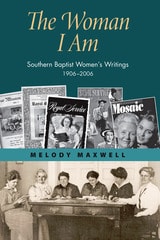
The Woman I Am
Southern Baptist Women's Writings, 1906–2006Melody Maxwell
University of Alabama Press, 2014
The Southern Baptist Convention (SBC) represents the largest Protestant denomination in the United States, yet Southern Baptist women’s voices have been underreported in studies of American religion and culture. In The Woman I Am, Melody Maxwell explores how female Southern Baptist writers and editors in the twentieth century depicted changing roles for women and responded to the tensions that arose as Southern Baptist women assumed leadership positions, especially in the areas of missions and denominational support.
Given access to a century of primary sources and archival documents, Maxwell writes, as did many of her subjects, in a style that deftly combines the dispassionate eye of an observer with the multidimensional grasp of a participant. She examines magazines published by Woman’s Missionary Union (WMU), an auxiliary to the SBC: Our Mission Fields (1906–1914), Royal Service (1914–1995), Contempo (1970–1995), and Missions Mosaic (1995–2006). In them, she traces how WMU writers and editors perceived, constructed, and expanded the lives of southern women.
Showing ingenuity and resiliency, these writers and editors continually, though not always consciously, reshaped their ideal of Christian womanhood to better fit the new paths open to women in American culture and Southern Baptist life. Maxwell’s work demonstrates that Southern Baptists have transformed their views on biblically sanctioned roles for women over a relatively short historical period.
How Southern Baptist women perceive women’s roles in their churches, homes, and the wider world is of central importance to readers interested in religion, society, and gender in the United States. The Woman I Am is a tour de force that makes a lasting contribution to the world’s understanding of Southern Baptists and to their understanding of themselves.
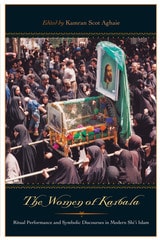
The Women of Karbala
Ritual Performance and Symbolic Discourses in Modern Shi'i IslamEdited by Kamran Scot Aghaie
University of Texas Press, 2005
Commemorating the Battle of Karbala, in which the Prophet Mohammad's grandson Hosayn and seventy-two of his family members and supporters were martyred in 680 CE, is the central religious observance of Shi'i Islam. Though much has been written about the rituals that reenact and venerate Karbala, until now no one has studied women's participation in these observances. This collection of original essays by a multidisciplinary team of scholars analyzes the diverse roles that women have played in the Karbala rituals, as well as the varied ways in which gender-coded symbols have been used within religious and political discourses.
The contributors to this volume consider women as participants in and observers of the Karbala rituals in Iran, Iraq, Lebanon, India, Pakistan, and the United States. They find that women's experiences in the Shi'i rituals vary considerably from one community to another, based on regional customs, personal preferences, religious interpretations, popular culture, and socioeconomic background. The authors also examine the gender symbolism within the rituals, showing how it reinforces distinctions between the genders while it also highlights the centrality of women to the symbolic repertory of Shi'ism. Overall, the authors conclude that while Shi'i rituals and symbols have in some ways been used to restrict women's social roles, in other ways they have served to provide women with a sense of independence and empowerment.
The Word and Its Witness
The Spiritualization of American RealismGregory S. Jackson
University of Chicago Press, 2009
Jackson shows how the homiletic tradition in Protestant sermons provided a foundation for the development of visual and literary realism. Evangelical preachers and writers used vivid language grounded in everyday life to translate abstract concepts like hell into concrete reality—a key influence on realist authors that brought about the more secular forms of the movement we know today. This emphasis on the sensuous also paved the way for Protestantism’s embrace of new media, evident in the photographs of Jacob Riis as well as the video game Left Behind: Eternal Forces.
With its remarkable scope and timely insights into the interplay between religion, secularism, and politics, The Word and Its Witness will transform the way we understand American realism and American religion.

The Word and the Law
Milner S. Ball
University of Chicago Press, 1993
The Word of God
Essays on Mormon ScriptureDan Vogel
Signature Books, 1990
Editor’s Introduction
by Dan Vogel
[p.vii]Belief in continuing revelation and an open canon of scripture distinguishes Mormonism from mainstream Christianity. That the church founded by Joseph Smith would proceed on grounds of continuing revelation was established at the outset. The day the church was organized, 6 April 1830, Joseph Smith dictated a revelation commanding the church to “give heed unto all his words and commandments which he shall give unto you as he receiveth them,… for his words ye shall receive, as if from mine own mouth, in all patience and faith” (LDS D&C 21:4-5; RLDS D&C 19:2). Another revelation declared that the Lord had “given him the keys of the mysteries, and the revelations which are sealed” (LDS D&C 28:7; RLDS D&C 27:12). The principle of continuing revelation insured a gradual unfolding and canonization of various doctrines.
In addition to the Bible, the official canon of the Utah-based Church of Jesus Christ of Latter-day Saints includes the Book of Mormon (first published in Palymra, New York, in 1830), the Doctrine and Covenants (issued in 1833 as A Book of Commandments [incomplete] and in 1835 in Kirtland, Ohio), and the Pearl of Great Price (first published in England in 1851 and republished with changes in Salt Lake City in 1880). This latter volume of scripture contains selections from Joseph Smith’s writings including the Book of Moses (extracted from Smith’s “inspired version” or “translation” of the Bible) and the Book of Abraham (taken from Smith’s interpretation of an ancient Egyptian papyrus). The Reorganized Church of Jesus Christ of Latter Day Saints, headquartered in Independence, [p.viii] Missouri, the second largest institution tracing its origins to Joseph Smith, publishes its own editions of the Book of Mormon and Doctrine and Covenants, as well as Smith’s revision of the Bible, but has not canonized the Book of Abraham.
All but one of the following fifteen essays chosen for inclusion in The Word of God: Essays on Mormon Scripture were written by Mormons from either the LDS or RLDS tradition. (The exception is Susan Curtis.) However, rather than being guided by institutional imperatives, each author has attempted to understand Mormon scripture on its own terms. Additionally, each essay wrestles with the problem of the human and the divine in scripture.
Because one’s belief about revelation affects how one approaches scripture, debate about scriptural interpretation often centers on the nature of revelation. The written “word of God” does not come to us direct but rather through human intermediaries. In the words of J. R. Dummelow, writing in A Commentary on The Holy Bible (New York) in 1908, “It is as sunlight through a painted window—the light must come to us coloured by the medium… It is foolish to ignore the existence of the human medium through which the light has come” (p. cxxxv). Book of Mormon prophets, for instance, repeatedly express anxiety over human limitations to convey in language their spiritual teachings. Nephi prays that “the words which I have written in weakness will be made strong” (LDS 2 Ne. 33:4; RLDS 2 Ne. 15:5), and Moroni writes, “if there are faults they are the mistakes of men; wherefore, condemn not the things of God” (Title Page); A position which does not account for the human in revelation will undoubtedly produce disillusionment or distortion.
To consider the human aspects of prophets, revelation, or scripture does not detract from religion, as some traditionalists fear. On the contrary, what cultural and environmental studies challenge are simplistic assumptions about the nature of revelation. Again, Dummelow notes, “Because of our false theory of Verbal Inspiration we are puzzled when the divine is mingled with the human. We must learn that the divine is mingled with the human” (ibid.). We must seek a definition of revelation which accounts for the spectrum of characteristics we encounter in scripture.
Even when we acknowledge the human in revelation and scripture, what exactly is its role and influence? These are not easy [p.ix] questions to answer. But the more precise our identification of human influence on scripture, the more refined our definition of revelation will become. It is hoped that this collection of essays will contribute to that process of understanding.
An awareness of revelation and scripture is an ongoing process and there are differing positions. Readers should therefore understand that neither the authors nor the editor necessarily agree with the views and conclusions reached in all of the essays that follow.
Appreciation is extended to the following authors and publications for permission to reproduce, sometimes in a different format and/or under a different title, many of the essays appearing here: to Dialogue: A Journal of Mormon Thought for essays by Kevin L. Barney, Lester E. Bush, A. Bruce Lindgren, William D. Russell, and George D. Smith; to Sunstone for essays by Anthony A. Hutchinson, Melodie Moench Charles, and Mark D. Thomas; to the John Whitmer Historical Association Journal for essays by Susan Curtis and James E. Lancaster; to Courage for the essay by Richard P. Howard; and to University Bulletin (RLDS) for the essay by Geoffrey F. Spencer. Three of the essays—”Joseph Smith’s Scriptural Cosmology,” by Dan Vogel and Brent Lee Metcalfe; and “Reducing Dissonance: The Book of Abraham as a Case Study” and “Making the Scriptures ‘Indeed One in Our Hands,'” both by Edward H. Ashment—are published here for the first time.
Throughout the essays standardized parenthetical scriptural references are provided for the most recent editions published by both the LDS and RLDS churches. Thus LDS D&C 76:1 refers to the most recent edition of the Doctrine and Covenants published by the LDS church, section 76, verse 1. RLDS 1 Ne. 2:4 refers to the Book of First Nephi, chapter 2, verse 4, in the most recent edition of the Book of Mormon published by the RLDS church. JST means the Joseph Smith translation of the King James Bible published by the RLDS church; Moses to the Book of Moses and Abr. to the Book of Abraham as found in current editions of the Pearl of Great Price (PGP) published by the LDS church.[p.1]
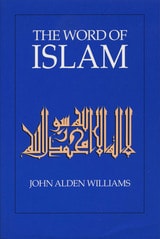
The Word of Islam
Edited by John Alden Williams
University of Texas Press, 1993
Since the 1970s, Islam has been undergoing a tremendous resurgence throughout the world. This resurgence has often been labeled "Islamic fundamentalism" by the media, but it includes believers of every persuasion, from the most conservative to the most liberal.
Given this fact, it is vital for the West to understand the terms in which Islam thinks and to communicate effectively with Muslims. This anthology includes writings central to Islamic thought, some translated earlier but here redone, and others which have never before appeared in any Western language.
The selections include an interpretation of the Qur'an, as well as portions of the Hadith, or sayings and actions of the Prophet; Islamic law; mysticism (Sufism); theology; and sectarian writings. A final essay on Islam today places these writings in their contemporary context and shows the breadth and variety of Islamic belief and practice.
Compiled with the intention of letting Islam describe itself in its own words, the book is an important source for all students of Muslim culture and world religions. This book is similar in scope to Williams' well-known 1961 George Braziller publication, but freshly written and much improved.
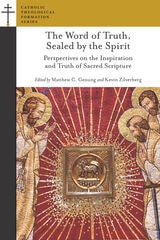
The Word of Truth, Sealed by the Spirit
Perspectives on the Inspiration and Truth of Sacred ScriptureMatthew C. Genung
Saint Paul Seminary Press, 2022
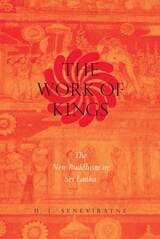
The Work of Kings
H. L. Seneviratne
University of Chicago Press, 2000
Beginning with Anagarika Dharmapala's "rationalization" of Buddhism in the early twentieth century, which called for monks to take on a more activist role in the community, Seneviratne shows how the monks have gradually revised their role to include involvement in political and economic spheres. The altruistic, morally pure monks of Dharamapala's dreams have become, Seneviratne trenchantly argues, self-centered and arrogant, concealing self-aggrandizement behind a façade of "social service."
A compelling call for reform and a forceful analysis, The Work of Kings is essential to anthropologists, historians of religion, and those interested in colonialism, nationalism, and postcolonial politics.
The Works of Saint Cyril of Jerusalem, Volume 1
Saint Cyril of Jerusalem
Catholic University of America Press, 1969
The Works of Saint Cyril of Jerusalem, Volume 2
Saint Cyril of Jerusalem
Catholic University of America Press, 1970
The World of Early Egyptian Christianity
Language, Literature, and Social Context (CUA Studies in Early Christianity)James E. Goehring
Catholic University of America Press, 2007
The Writer and Religion
Edited by William H. Gass and Lorin Cuoco
Southern Illinois University Press, 2000
“Every significant religious system stands upon a sacred text. This text is indeed its temple. Inside, its heroes and their history are enshrined. Although leaders of varying degrees of divinity are always involved in the creation of a new sect, they usually have short lives, often come to bad ends, and their influence, diluted by disciples, soon disappears as water does in sand. What the leader leaves behind is Mein Kampf or its equivalent: his testament. Occasionally, by the indolent, an existent text is chosen, or a compilation selected—a golden treasury. From time to time, other writings may be dubbed divine, as though knighted. This is not a simple social thing, however. It is more important than a nation adding to its territories. Any addition to the divine canon will approve, proscribe, or admit new thoughts, new practices, and in consequence elevate different people to positions of privilege and power.”—William H. Gass
These essays and panel discussions made up The Writer and Religion Conference held at Washington University in St. Louis. The six essays, all by writers of international stature, were followed by panel discussions, with audience participation.
The Writings and Later Wisdom Books
Christl M. Maier
SBL Press, 2014
An international collection of ecumenical, gender-sensitive interpretations
The latest volume in the Bible and Women series seeks to provide an ecumenical, gender-sensitive interpretation and reception history of the Writings and later wisdom traditions including Ben Sira and the Wisdom of Solomon. Articles trace the living conditions of women, examine the presentation of female figures in the Israelite wisdom tradition, discuss women and gender relations in single books, and explore narratives about great female protagonists, such as Ruth, Esther, and Susanna, who prove their wit and strength in situations of conflict.
Features:
- Essays by scholars from five European countries, Israel, and the United States
- An introduction and fourteen essays focused on women and gender relations
- Coverage of power relations and ideologies within the texts and in current interpretations.
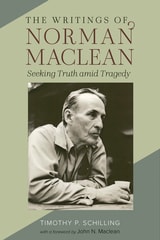
The Writings of Norman Maclean
Seeking Truth amid TragedyTimothy P. Schilling
University of Nevada Press, 2024
The Writings of Norman Maclean: Seeking Truth amid Tragedy provides the first critical reassessment of this celebrated author’s work in more than a decade. In his study, Timothy P. Schilling focuses on Maclean’s attempt, in A River Runs through It and Other Stories and Young Men and Fire, to come to grips with the tragic side of human existence. From the 1938 death of his brother Paul to the 1949 deaths of thirteen firefighters in Montana’s Mann Gulch wildfire, Maclean is driven by a desire to discover ultimate meaning—the truth—in the face of haunting tragedy. Through careful analysis of all of Maclean’s published works, Schilling highlights the audaciousness of Maclean’s quest to wrest free an answer from “the universe.”
Ever open to scientific, literary, philosophical, and theological ways of viewing reality, Maclean found ambiguity, paradoxically, to be an essential tool for probing the truth. Beyond exploring Maclean’s use of this tool, Schilling breaks new ground by considering Maclean’s invocation of the Transcendentals in “A River Runs through It,” noting the sly homage Maclean pays to Izaak Walton, examining Maclean’s often-neglected “Other Stories,” assessing Robert Redford’s film adaptation of “A River Runs through It,” and providing the most thorough exploration of Young Men and Fire yet available.
With this book, Schilling offers a current and complete analysis of Maclean—one of the most iconic figures in Western American literature.
The Writings of Salvian, the Presbyter
The Presbyter Salvian, The Presbyter
Catholic University of America Press, 1947
The Year of Mourning
A Jewish JourneyRabbi Lisa D. Grant, PhD and Cantor Lisa B. Segal
Central Conference of American Rabbis, 2023
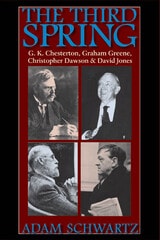
The third spring
G.K. Chesterton, Graham Greene, Christopher Dawson, and David JonesAdam Schwartz
Catholic University of America Press, 2005
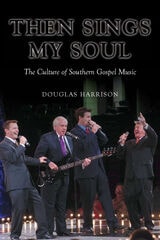
Then Sings My Soul
The Culture of Southern Gospel MusicDouglas Harrison
University of Illinois Press, 2012
Theodoret of Cyrrhus
The Bishop and the Holy ManTheresa Urbainczyk
University of Michigan Press, 2002
With the conversion of Constantine and his subsequent championing of the Christian cause, the Church rapidly began to increase its wealth and status. As coins filled the coffers of God, some Christians came to feel that their religion had become corrupted. They fled to the desert wastes, seeking a purer, holier life. These recluses and ascetics are the subjects of Theodoret's Religious History. The Syrian bishop had known many of them, some for all his life.
Urbainczyk argues that Theodoret's work was not merely written as an act of piety, but was in fact a very political treatise, addressing the theological disputes of his day. The main tensions of the early fifth century lay between the sees of Syrian Antioch and Egyptian Alexandria. One of Theodoret's aims was to show that Syria had produced individuals as pious as those of Egypt, about whom much had already been written. Urbainczyk studies the social background of these Syrian ascetics, describes the relationship between Theodoret's heroes and the Church community, and investigates how Theodoret presents his own personal relationship with the holy men.
This book is the first to examine Theodoret's role in his own work. Urbainczyk argues that the intimate details of Theodoret's life were not let slip accidentally but were inserted deliberately to buttress his own threatened position and to show how these independent men of God deferred to no one but himself.
Theodoret of Cyrrhus is an invaluable study for students of late antiquity, scholars of early Church history, early medieval historiographers and hagiographers.
Theresa Urbainczyk is College Lecturer in Classics, University College, Dublin.
Theodoret of Cyrus
commentary on the Psalms, 73-150Robert C. Theodoret of Cyrus
Catholic University of America Press, 2000
Theological Treatises on the Trinity
Marius Victorinus
Catholic University of America Press, 1981
Theological and Dogmatic Works
Saint Ambrose
Catholic University of America Press, 1963
Theology Needs Philosophy
Matthew L. Lamb
Catholic University of America Press, 2016
Theology and Anthropology in the Book of Sirach
Bonifatia Gesche
SBL Press, 2020
New research on Sirach for scholars and students
The present volume of English and German essays includes the proceedings of an international conference held in Eichstaett, Germany, in 2017. Themes of creation, emotions, life, death, wisdom, knowledge, the individual and society, family, gender, mercy, justice, and freedom are but a few of the topics that contributors explore in this new collection. Essays explore the rich intertextual connections between Sirach and other biblical texts.
Features:
- Attention to theological distinctions presented in the Hebrew, Greek, Syriac, and Latin versions of the book of Sirach
- Examination of the reception of Sirach in the New Testament and the early modern era
- English abstracts for German-language essays and German abstracts for English-language essays
Theology and Literature in the Age of Johnson
Resisting SecularismMelvyn New
University of Delaware Press, 2012
Published by University of Delaware Press. Distributed worldwide by Rutgers University Press.
Theology and the Cartesian Doctrine of Freedom
Etienne Gilson
St. Augustine's Press, 2015
Theology and the Political
The New Debate, sic vCreston Davis, John Milbank and Slavoj Žižek, eds.
Duke University Press, 2005
Contributors. Anthony Baker, Daniel M. Bell Jr., Phillip Blond, Simon Critchley, Conor Cunningham, Creston Davis, William Desmond, Hent de Vries, Terry Eagleton, Rocco Gangle, Philip Goodchild, Karl Hefty, Eleanor Kaufman, Tom McCarthy, John Milbank, Antonio Negri, Catherine Pickstock, Patrick Aaron Riches, Mary-Jane Rubenstein, Regina Mara Schwartz, Kenneth Surin, Graham Ward, Rowan Williams, Slavoj Žižek
Theology as an Ecclesial Discipline
Ressourcement and DialogueJ. Augustine Di Noia
Catholic University of America Press, 2024
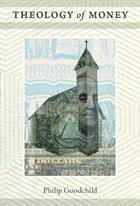
Theology of Money
Philip Goodchild
Duke University Press, 2009
Engaging with Christian theology and the thought of Carl Schmitt, Georg Simmel, Karl Marx, Adam Smith, and many others, Goodchild develops a theology of money based on four contentions, which he elaborates in depth. First, money has no intrinsic value; it is a promise of value, a crystallization of future hopes. Second, money is the supreme value in contemporary society. Third, the value of assets measured by money is always future-oriented, dependent on expectations about how much might be obtained for those assets at a later date. Since this value, when realized, will again depend on future expectations, the future is forever deferred. Financial value is essentially a degree of hope, expectation, trust, or credit. Fourth, money is created as debt, which involves a social obligation to work or make profits to repay the loan. As a system of debts, money imposes an immense and irresistible system of social control on individuals, corporations, and governments, each of whom are threatened by economic failure if they refuse their obligations to the money system. This system of debt has progressively tightened its hold on all sectors and regions of global society. With Theology of Money, Goodchild aims to make conscious our collective faith and its dire implications.
Theology of Peter Damian
Patricia Ranft
Catholic University of America Press, 2012
Theology of the Hebrew Bible, Volume 1
Methodological StudiesMarvin A. Sweeney
SBL Press, 2019
Diverse approaches to biblical theology
This volume presents a collection of studies on the methodology for conceiving the theological interpretation of the Hebrew Bible among Jews and Christians as well as the treatment of key issues such as creation, the land of Israel, and divine absence. Contributors include Georg Fischer, SJ, David Frankel, Benjamin J. M. Johnson, Soo J. Kim, Wonil Kim, Jacqueline E. Lapsley, Julia M. O’Brien, Dalit Rom-Shiloni, Marvin A. Sweeney, and Andrea L. Weiss.
Features:
- Examination of metaphor, repentance, and shame in the presence of God
- Ten essays addressing the nature of biblical theology from a Jewish, Christian, or critical perspective
- Discussion of the changes that have taken place in the field of biblical theology since World War II
Theology of the Hebrew Bible, Volume 2
Texts, Readers, and Their WorldsSoo Kim Sweeney
SBL Press, 2024
This follow-up to Theology of the Hebrew Bible, Volume 1: Methodological Studies, focuses on readers’ engagement with the text and their communities. Part 1 offers fresh interpretations of divine images and theological concepts drawn from various theophanies in the text. Part 2 focuses on how these insights can form new overarching structures, serving as reading strategies or foundations for alternative theologies. Part 3 emphasizes the bond between readers and their communities, highlighting the active participation of both ancient and modern readers through an analysis of past literature. Contributors, each an expert in their field, include Rachel Adelman, Samuel E. Balentine, Shelly L. Birdsong, Ginny Brewer-Boydston, Johanna Etzberger, Frances Flannery, David Frankel, Barry R. Huff, Hyun Chul Paul Kim, Barbara Leung Lai, J. Richard Middleton, Hye Kyung Park, Kris Sonek, Brent A. Strawn, David E. S. Stein, Marvin A. Sweeney, Soo Kim Sweeney, Joseph Sykora, Daniel C. Timmer, and Beat Weber. This collection of essays guides readers, including those well-versed in theology, to explore innovative and unexpected depictions of divine beings and how human characters respond to them.
Theorizing Myth
Narrative, Ideology, and ScholarshipBruce Lincoln
University of Chicago Press, 2000
He begins by showing that mythos yielded to logos not as part of a (mythic) "Greek miracle," but as part of struggles over political, linguistic, and epistemological authority occasioned by expanded use of writing and the practice of Athenian democracy. Lincoln then turns his attention to the period when myth was recuperated as a privileged type of narrative, a process he locates in the political and cultural ferment of the eighteenth and nineteenth centuries. Here, he connects renewed enthusiasm for myth to the nexus of Romanticism, nationalism, and Aryan triumphalism, particularly the quest for a language and set of stories on which nation-states could be founded.
In the final section of this wide-ranging book, Lincoln advocates a fresh approach to the study of myth, providing varied case studies to support his view of myth—and scholarship on myth—as ideology in narrative form.
Theorizing Scriptures
New Critical Orientations to a Cultural PhenomenonWimbush, Vincent
Rutgers University Press, 2008
Historically, religious scriptures are defined as holy texts that are considered to be beyond the abilities of the layperson to interpret. Their content is most frequently analyzed by clerics who do not question the underlying political or social implications of the text, but use the writing to convey messages to their congregations about how to live a holy existence. In Western society, moreover, what counts as scripture is generally confined to the Judeo-Christian Bible, leaving the voices of minorities, as well as the holy texts of faiths from Africa and Asia, for example, unheard.
In this innovative collection of essays that aims to turn the traditional bible-study definition of scriptures on its head, Vincent L. Wimbush leads an in-depth look at the social, cultural, and racial meanings invested in these texts. Contributors hail from a wide array of academic fields and geographic locations and include such noted academics as Susan Harding, Elisabeth Shüssler Fiorenza, and William L. Andrews.
Purposefully transgressing disciplinary boundaries, this ambitious book opens the door to different interpretations and critical orientations, and in doing so, allows an ultimately humanist definition of scriptures to emerge.
Theorizing about Myth
Robert A. Segal
University of Massachusetts Press, 1999
For two hundred years the subject of myth—its origin, function, and significance—has been addressed again and again, first by theologians and philosophers and then by anthropologists, sociologists, and psychologists. From the outset the topic has sparked intense debate, with differing opinions expressed on everything from issues of epistemology and methodology to the meaning of “myth” itself. In this collection of essays, Robert A. Segal surveys the contours of this ongoing discussion, comparing and evaluating the leading theories of myth.
Among the theorists discussed are Edward Tylor, William Robertson Smith, James Frazer, Jane Harrison, S. H. Hooke, Mircea Eliade, Rudolf Bultmann, Hans Jonas, Sigmund Freud, C. G. Jung, Joseph Campbell, Claude Lévi-Strauss, and Hans Blumenberg. Author and editor of numerous books and articles in the fields of theories of myth and theories of religion, Segal has developed a reputation as a preeminent proponent of a social-scientific approach to the study of both. The essays in this book represent some of the best of his writing on myth over the past ten years.
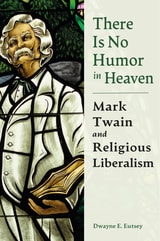
There is No Humor in Heaven
Mark Twain and Religious LiberalismDwayne E. Eutsey
University of Missouri Press, 2025
In There is No Humor in Heaven, Dwayne Eutsey challenges the persistent view of Twain as a hostile critic of religion by placing him within the prevailing liberal religious ethos of his time. From Hannibal to the western frontier and from Hartford to the wider world, Eutsey contends Twain’s vocation as a humorist was rooted in his frustrated youthful ambition to become a preacher of the Gospel. Throughout his life, his friendships with several influential liberal ministers, each of them espousing various forms of the era’s diverse progressive theology, informed not only Twain’s evolving religious worldview but his lecture performances and literary output.
There is No Humor in Heaven traces unconventional theological influences on Twain ranging from African-American spirituality, Freemasonry, and frontier Unitarianism to devout Liberal Christianity, radical Free Religion, and esoteric Hinduism. Drawing from Twain’s writings, documents, personal notes, and more, There is No Humor in Heaven offers readers a radical re-examination of the spiritually creative vitality of a controversial literary giant.
These Saints are Stones
Tullis, Millie
Signature Books, 2026
In Millie Tullis’s new poetry collection, These Saints are Stones, a faithless daughter is haunted by her third-great-grandmother, Martha, a woman who married her stepfather at sixteen and became a sister-wife to her own mother. Tullis cannot stop uncovering details about Martha, who left no written history behind, and her silence permeates this collection, which is rife with gaps and fragments, scraps of memory that blend with dreams. Sparse and spare, these poems echo the red desert landscape where the speaker’s ancestors lived and died, where she hunts for graves among the rocks and confronts a past she can never fully know. After all, like a sampling of lace, the cloth of women’s history is more hole than thread.
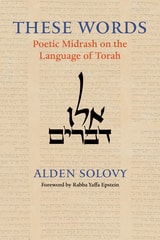
These Words
Poetic Midrash on the Language of TorahAlden Solovy
Central Conference of American Rabbis, 2023
In These Words, liturgist Alden Solovy distills the Torah into its very essence: the individual words it contains. Echoing the midrash that the Torah has seventy faces, Solovy selects seventy of its Hebrew words that are pregnant with meaning. For each word, he delves into the etymology, translation, and usage, providing deeper insights into familiar texts. Then Solovy presents a beautiful poem—what he calls “poetic midrash”—inspired by and interpreting each word. From b’reishit (“in beginning”) to shamayim (“heavens”) to zachor (“remember”), These Words will change the way you look at the language of the Torah.
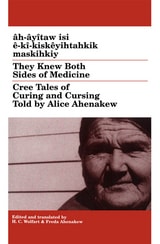
They Knew Both Sides of Medicine
Cree Tales of Curing and Cursing Told by Alice AhenakewH.C. Wolfart
University of Manitoba Press, 2000
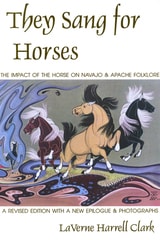
They Sang for Horses
The Impact of the Horse on Navajo and Apache FolkloreLaVerne Harrell Clark
University Press of Colorado, 2001
No Native American groups placed more emphasis on the horse in their lives than did the Navajo and Apache of the Southwest. They Sang for Horses, first published in 1966 and now considered a classic, remains the only comprehensive treatment of the profound mystical influence that the horse has exerted for more than 300 years.
In this completely redesigned and expanded edition, LaVerne Harrell Clark examines how storytellers, singers, medicine men, and painters created the animal's evolving symbolic significance by adapting existing folklore and cultural symbols. Exploring the horse's importance in ceremonies, songs, prayers, customs, and beliefs, she investigates the period of the horse's most pronounced cultural impact on the Navajo and the Apache, starting from the time of its acquisition from the Spanish in the seventeenth century and continuing to the mid-1960s, when the pickup truck began to replace it as the favored means of transportation. In addition, she presents a look at how Navajos and Apaches today continue to redefine the horse's important role in their spiritual as well as material lives.
This classic work is a must for historians, readers interested in Native American folklore and mythology, and anyone who has ever been captivated by the magic and romance of the horse.
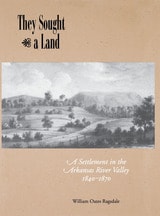
They Sought a Land
A Settlement in the Arkansas River Valley, 1840–1870William Oates Ragsdale
University of Arkansas Press, 1997
Pisgah grew and prospered, developing increasingly successful farming practices, landholding patterns, and trading strategies. But the Civil War took a heavy toll, taking workers away from farms, subjecting those left on the home front to deprivation and violence, and creating division in the community. By 1870, the people of Pisgah had dispersed into Arkansas’s larger developing society.
Absorbing to read and rich with colorful detail, They Sought a Land is an important story of the westward expansion of the United States and the settling of the American South during the nineteenth century.
They Were All Together in One Place? Toward Minority Biblical Criticism
Randall C. Bailey
SBL Press, 2009
Critics from three major racial/ethnic minority communities in the United States—African American, Asian American, and Latino/a American—focus on the problematic of race and ethnicity in the Bible and in contemporary biblical interpretation. With keen eyes on both ancient text and contemporary context, contributors pay close attention to how racial/ethnic dynamics intersect with other differential relations of power such as gender, class, sexuality, and colonialism. In groundbreaking interaction, they also consider their readings alongside those of other racial/ethnic minority communities. The volume includes an introduction pointing out the crucial role of this work within minority criticism by looking at its historical trajectory, critical findings, and future directions. The contributors are Cheryl B. Anderson, Francisco O. García-Treto, Jean-Pierre Ruiz, Frank M. Yamada, Gale A. Yee, Jae-Won Lee, Gay L. Byron, Fernando F. Segovia, Randall C. Bailey, Tat-siong Benny Liew, Demetrius K. Williams, Mayra Rivera Rivera, Evelyn L. Parker, and James Kyung-Jin Lee.
They Were Just People
Stories of Rescue in Poland During the HolocaustBill Tammeus & Rabbi Jacques Cukierkorn
University of Missouri Press, 2009
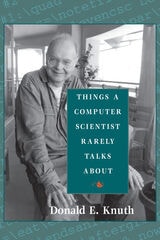
Things a Computer Scientist Rarely Talks About
Donald E. Knuth
CSLI, 2003
Perhaps no one is more qualified to address these questions than Donald E. Knuth, whose massive contributions to computing have led others to nickname him "The Father of Computer Science"—and whose religious faith led him to understand a fascinating analysis of the Bible called the 3:16 project. In this series of six spirited, informal lectures, Knuth explores the relationships between his vocation and his faith, revealing the unique perspective that his work with computing has lent to his understanding of God.
His starting point is the 3:16 project, an application of mathematical "random sampling" to the books of the Bible. The first lectures tell the story of the project's conception and execution, exploring its many dimensions of language translation, aesthetics, and theological history. Along the way, Knuth explains the many insights he gained from such interdisciplinary work. These theological musings culminate in a surprising final lecture tackling the ideas of infinity, free will, and some of the other big questions that lie at the juncture of theology and computation.
Things a Computer Scientist Rarely Talks About, with its charming and user-friendly format—each lecture ends with a question and answer exchange, and the book itself contains more than 100 illustrations—is a readable and intriguing approach to a crucial topic, certain to edify both those who are serious and curious about their faiths and those who look at the science of computation and wonder what it might teach them about their spiritual world.
Includes "Creativity, Spirituality, and Computer Science," a panel discussion featuring Harry Lewis, Guy L. Steele, Jr., Manuela Veloso, Donald E. Knuth, and Mitch Kapor.
Thinking Biblically
Exegetical and Hermeneutical StudiesAndré LaCocque and Paul Ricoeur
University of Chicago Press, 1998
LaCocque's commentaries employ a historical-critical method that takes into account archaeological, philological, and historical research. LaCocque includes in his essays historical information about the dynamic tradition of reading scripture, opening his exegesis to developments and enrichments subsequent to the production of the original literary text. Ricoeur also takes into account the relation between the texts and the historical communities that read and interpreted them, but he broadens his scope to include philosophical speculation. His commentaries highlight the metaphorical structure of the passages and how they have served as catalysts for philosophical thinking from the Greeks to the modern age.
This extraordinary literary and historical venture reads the Bible through two different but complementary lenses, revealing the familiar texts as vibrant, philosophically consequential, and unceasingly absorbing.
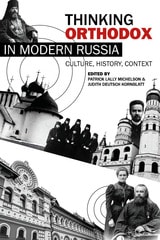
Thinking Orthodox in Modern Russia
Culture, History, ContextEdited by Patrick Lally Michelson and Judith Deutsch Kornblatt
University of Wisconsin Press, 2014
Volume editors Patrick Lally Michelson and Judith Deutsch Kornblatt provide a historical overview of Russian Orthodox thought and a critical essay on the current state of scholarship about religious thought in modern Russia. The contributors explore a wide range of topics, including Orthodox claims to a unique religious Enlightenment, contests over authority within the Russian Church, tensions between faith and reason in academic Orthodoxy, the relationship between sacraments and the self, the religious foundations of philosophical and legal categories, and the effect of Orthodox categories in the formation of Russian literature.
Thinking in Jewish
Jonathan Boyarin
University of Chicago Press, 1996
A fascination with this question prompted Jonathan Boyarin, one of America's most original thinkers in critical theory and Jewish ethnography, to offer the unexpected Jewish perspective on the vexed issue of identity politics presented here. Boyarin's essays explore the ways in which a Jewish—or, more particularly, Yiddish—idiom complicates the question of identity. Ranging from explorations of a Lower East Side synagogue to Fichte's and Derrida's contrasting notions of the relation between the Jews and the idea of Europe, from the Lubavitch Hasidim to accounts of self-making by Judith Butler and Charles Taylor, Thinking in Jewish will be indispensable reading for students of critical theory, cultural studies, and Jewish studies.
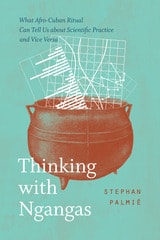
Thinking with Ngangas
What Afro-Cuban Ritual Can Tell Us about Scientific Practice and Vice VersaStephan Palmié
University of Chicago Press, 2023
Inspired by the exercises of Father Lafitau, an eighteenth-century Jesuit priest and protoethnographer who compared the lives of the Iroquois to those of the ancient Greeks, Stephan Palmié embarks on a series of unusual comparative investigations of Afro-Cuban ritual and Western science. What do organ transplants have to do with ngangas, a complex assemblage of mineral, animal, and vegetal materials, including human remains, that serve as the embodiment of the spirits of the dead? How do genomics and “ancestry projects” converge with divination and oracular systems? What does it mean that Black Cubans in the United States took advantage of Edisonian technology to project the disembodied voice of a mystical entity named ecué onto the streets of Philadelphia? Can we consider Afro-Cuban spirit possession as a form of historical knowledge production?
By writing about Afro-Cuban ritual in relation to Western scientific practice, and vice versa, Palmié hopes to challenge the rationality of Western expert practices, revealing the logic that brings together enchantment and experiment.
Thinking with St. John Paul II
JP2 Lectures, 2020/2021Darliusz Karlowicz
Angelicum University Press Fundacja Swietego Mik, 2021

Thinking with St. John Paul II
Vol 2 (2021-2022)Dariusz Karlowicz
Angelicum University Press Fundacja Swietego Mik, 2025