Results by title
4917 books match the query 'Philosophy' and 1267 start with t
The Work of Mourning
Jacques Derrida
University of Chicago Press, 2003
Gathered here are texts—letters of condolence, memorial essays, eulogies, funeral orations—written after the deaths of well-known figures: Roland Barthes, Paul de Man, Michel Foucault, Louis Althusser, Edmond Jabès, Louis Marin, Sarah Kofman, Gilles Deleuze, Emmanuel Levinas, Jean-François Lyotard, Max Loreau, Jean-Marie Benoist, Joseph Riddel, and Michel Servière.
With his words, Derrida bears witness to the singularity of a friendship and to the absolute uniqueness of each relationship. In each case, he is acutely aware of the questions of tact, taste, and ethical responsibility involved in speaking of the dead—the risks of using the occasion for one's own purposes, political calculation, personal vendetta, and the expiation of guilt. More than a collection of memorial addresses, this volume sheds light not only on Derrida's relation to some of the most prominent French thinkers of the past quarter century but also on some of the most important themes of Derrida's entire oeuvre-mourning, the "gift of death," time, memory, and friendship itself.
"In his rapt attention to his subjects' work and their influence upon him, the book also offers a hesitant and tangential retelling of Derrida's own life in French philosophical history. There are illuminating and playful anecdotes—how Lyotard led Derrida to begin using a word-processor; how Paul de Man talked knowledgeably of jazz with Derrida's son. Anyone who still thinks that Derrida is a facetious punster will find such resentful prejudice unable to survive a reading of this beautiful work."—Steven Poole, Guardian
"Strikingly simpa meditations on friendship, on shared vocations and avocations and on philosophy and history."—Publishers Weekly
The Worker
Dominion and FormErnst Jünger, Edited by Laurence Paul Hemming, Translated from the German by Bogdan Costea and Laurence Paul Hemming
Northwestern University Press, 2018
Martin Heidegger considered Jünger “the only genuine follower of Nietzsche,” singularly providing “an interpretation which took shape in the domain of that metaphysics which already determines our epoch, even against our knowledge; this metaphysics is Nietzsche's doctrine of the ‘will to power.’” In The Worker, Jünger examines some of the defining questions of that epoch: the nature of individuality, society, and the state; morality, justice, and law; and the relationships between freedom and power and between technology and nature.
This work, appearing in its entirety in English translation for the first time, is an important contribution to debates on work, technology, and politics by one of the most controversial German intellectuals of the twentieth century. Not merely of historical interest, The Worker carries a vital message for contemporary debates about world economy, political stability, and equality in our own age, one marked by unsettling parallels to the 1930s.
The Works and Days; Theogony; The Shield of Herakles
Hesiod
University of Michigan Press, 1991
The World Computer
Derivative Conditions of Racial CapitalismJonathan Beller
Duke University Press, 2021
The World Is Gone
Philosophy in Light of the PandemicGregg Lambert
University of Minnesota Press, 2021
Part personal memoir, part philosophical reflection and written in the midst of the pandemic in 2021, The World Is Gone employs the Robinson Crusoe fable to launch an existential investigation of the effects of extreme isolation, profound boredom, nightly insomnia, and the fear of madness associated with the loss of a world populated by others.
Forerunners: Ideas First is a thought-in-process series of breakthrough digital publications. Written between fresh ideas and finished books, Forerunners draws on scholarly work initiated in notable blogs, social media, conference plenaries, journal articles, and the synergy of academic exchange. This is gray literature publishing: where intense thinking, change, and speculation take place in scholarship.
The World Unclaimed
A Challenge to Heidegger’s Critique of HusserlLilian Alweiss
Ohio University Press, 2003
The World Unclaimed argues that Heidegger’s critique of modern epistemology in Being and Time is seriously flawed. Heidegger believes he has done away with epistemological problems concerning the external world by showing that the world is an existential structure of Dasein. However, the author argues that Heidegger fails to make good his claim that he has “rescued” the phenomenon of the world, which he believes the tradition of philosophy has bypassed. Heidegger fails not only to reclaim the world but also to acknowledge its loss. Alweiss thus calls into question Heidegger’s claim that ontology is more fundamental than epistemology.
The World Unclaimed develops its powerful critique of Being and Time by arguing for a return to Husserl. It draws on Husserl’s insight that it is the moving and sensing body that discloses how we are already familiar with the world. Kinaesthesia provides a key for understanding our relation to the world. The author thus suggests that thinkers in the vein of Husserl and Kant -who, for Heidegger, epitomize the tradition of modern philosophy by returning to a “worldless subject”- may provide us with the resources to reclaim the phenomenon of the world that Being and Time sets out to salvage.
Alweiss’s fresh and innovative study demonstrates that it is possible to overcome epistemological skepticism without ever losing sight of the phenomenon of the world. Moreover, Alweiss challenges us to reconsider the relation between Husserl and Heidegger by providing a forceful defense of Husserl’s critique of cognition.
The World and the Wild
Expanding Wilderness Conservation Beyond its American RootsEdited by David Rothenberg and Marta Ulvaeus
University of Arizona Press, 2001
Foreword: Whither World Wilderness? / Vance G. Martin
Introduction: Wilderness in the Rest of the World / David Rothenberg
How Can Four Trees Make a Jungle? / Pramod Parajuli
The Unpaintable West / Zeese Papanikolas
Restoring Wilderness or Reclaiming Forests? / Sahotra Sarkar
For Indian Wilderness / Philip Cafaro and Monish Verma
In the Dust of Kilimanjaro / David Western
Why Conservation in the Tropics Is Failing / John Terborgh
"Trouble in Paradise": An Exchange / David Western and John Terborgh
Zulu History / Ian Player
Bruno Manser and the Penan / William W. Bevis
Roads Where There Have Long Been Trails / Kathleen Harrison
Volcano Dreams / Tom Vanderbilt
Recycled Rain Forest Myths / Antonio Carlos Diegues
The Park of Ten Thousand Waterfalls / Dan Imhoff
Mapping the Wild / Edward A. Whitesell
Earth Jazz / Evan Eisenberg
They Trampled on Our Taboos / Damien Arabagali
The World as Abyss
The Caribbean and Critical Thought in the AnthropoceneJonathan Pugh and David Chandler
University of Westminster Press, 2023
This book is about a distinctive ‘abyssal’ approach to the crisis of modernity. In this framing, influenced by contemporary critical Black studies, another understanding of the world of modernity is foregrounded – a world violently forged through the projects of Indigenous dispossession, chattel slavery and colonial world-making. Modern and colonial world-making violently forged the ‘human’ by dividing those with ontological security from those without, and by carving out the ‘world’ in a fixed grid of space and time, delineating a linear temporality of ‘progress’ and ‘development’. The distinctiveness of abyssal thought is that it inverts the stakes of critique and brings indeterminacy into the heart of ontological assumptions of a world of entities, essences, and universal determination. This is an approach that does not focus upon tropes of rescue and salvation but upon the generative power of negation. In doing so, it highlights how Caribbean experiences and writings have been drawn upon to provide an important and distinct perspective for critical thought.
"How is it that ontology has come to be seen as the antidote for modernity? While Foucault denigrated ontology as a mistaken and parochial exercise, contemporary social theory holds out the promise that new modes of planetary knowledge will save us from our own excesses. Drawing together long traditions in Caribbean scholarship with Afro-pessimist thought, Pugh and Chandler illustrate how the search for more emancipatory ontologies - relational ontologies, indigenous ontologies, non-human ontologies, etc. – not only misunderstands the problem of modernity but (more importantly) works to veil the negative force that marks both the limit and cause of all such knowledge practices: what they term the abyss. To engage in abyssal thought – as they lay out – is to inhabit a site of refusal: a determination not to be drawn into the lure of ontological ‘correction’ and to recognise that the practice of world making cannot not bear the imprint of colonial violence. Articulated in passionate declarative prose, these authors powerfully illuminate the trap of the emancipatory instinct and the promise of a deconstructive ethic." — Mitch Rose, Senior Lecturer in Human Geography, Aberystwyth University, UK
“A much-needed intellectual effort in the non-reductionist and non-essentialising style of Pugh and Chandler's previous book. The World as Abyss gives Caribbean thought and culture the place they deserve within critical theory and materialist studies.” — Mónica Fernández Jiménez, Valladolid University, Spain
“For some time now scholars have questioned the overly general assumptions about the ‘anthropos’ of the Anthropocene, but much work needs to be done to flesh out what a decolonized Anthropocene might be. Pugh and Chandler’s The World as Abyss provides an original, intriguing and compelling counterpoint to bland Anthropocene humanism (and posthumanism). This timely work explores the poetics of the Caribbean and provides a way to think about the Anthropocene and the future beyond the managerialism of the present. This book is essential reading for those working in the environmental humanities or Anthropocene studies.” — Claire Colebrook, Professor, Penn State University, USA
“This book names an apocalypse that began long ago. Pugh and Chandler patiently follow the journey of thought as it travels from the Middle Passage to the Caribbean. This brings them face-to-face with the horror of anti-Black violence, not as just another resource to strip-mine, but as an unavoidable abyss that confines all thought. Its reminder: that we have still not yet begun to think a truly Black world.” — Andrew Culp, Professor, California Institute of the Arts, USA
"With the force of a manifesto, the intensity of a polemic, and the nuance of a treatise, thisbook sets out to disavow the disavowal of Colonial violence in the making of thecontemporary world and thought. Learning from Caribbean thinkers, writers, and poets, itsets to work unworking, desedimenting and deconstructing, the violent ontologicalfoundations by which anti-Black worlds maintain and reproduce their innocence andignorance. Replaying and reiterating, extending and multiplying, gestures of refusal –refusals of subjection, of History, of Geography, of meaning, of Being – there is the refusalof the World as it is and of the World as it could be. The World as Abyss artfully combines acritique of the historical forces which make and unmake the contemporary moment withthe suspension of horizons, of ends, of grounds. What emerges in the wake is anintensification of the generative capacity of this refusal; voids, arrhythmia, counter-times,displacements, dislocations, the abyssal. First as threat and then as promise" — PaulHarrison, Associate Professor of Human Geography, Durham University, UK
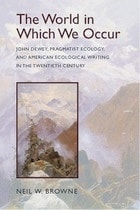
The World in Which We Occur
John Dewey, Pragmatist Ecology, and American Ecological Writing in the Twentieth CenturyNeil W. Browne
University of Alabama Press, 2007
Where nature meets democracy—John Dewey’s vision for a more connected world.
American philosopher John Dewey considered all human endeavors to be one with the natural world. In his writings, particularly Art as Experience (1934), Dewey insists on the primacy of the environment in aesthetic experience. Dewey’s conception of environment includes both the natural and the man-made. The World in Which We Occur highlights this notion in order to define “pragmatist ecology,” a practice rooted in the interface of the cultural and the natural. Neil Browne finds this to be a significant feature of some of the most important ecological writing of the last century.
To fully understand human involvement in the natural world, Browne argues that disciplinary boundaries must be opened, with profound implications for the practice of democracy. The degradation of the physical environment and democratic decay, for Browne, are rooted in the same problem: our persistent belief that humans are somehow separate from their physical environment.
Browne probes the work of a number of major American writers through the lens of Dewey’s philosophy. Among other texts examined are John Muir’s My First Summer in the Sierra (1911); Sea of Cortez (1941) by John Steinbeck and Edward Ricketts; Rachel Carson’s three books about the sea, Under the Sea-Wind (1941), The Sea Around Us (1951), and The Edge of the Sea (1955); John Haines’s The Stars, the Snow, the Fire (1989); Barry Lopez’s Arctic Dreams (1986); and Terry Tempest Williams’s Refuge (1991). Together, these texts—with their combinations of scientific observation and personal meditation—challenge the dichotomies that we have become accustomed and affirm the principles of a pragmatist ecology, one in which ecological and democratic values go hand in hand.
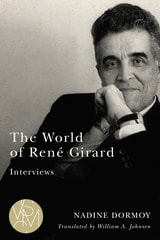
The World of René Girard
InterviewsNadine Dormoy
Michigan State University Press, 2024
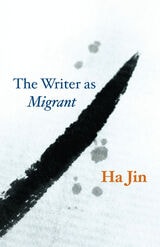
The Writer as Migrant
Ha Jin
University of Chicago Press, 2008
Consisting of three interconnected essays, The Writer as Migrant sets Ha Jin’s own work and life alongside those of other literary exiles, creating a conversation across cultures and between eras. He employs the cases of Alexander Solzhenitsyn and Chinese novelist Lin Yutang to illustrate the obligation a writer feels to the land of their birth, while Joseph Conrad and Vladimir Nabokov—who, like Ha Jin, adopted English for their writing—are enlisted to explore a migrant author’s conscious choice of a literary language. A final essay draws on V. S. Naipaul and Milan Kundera to consider the ways in which our era of perpetual change forces a migrant writer to reconceptualize the very idea of home. Throughout, Jin brings other celebrated writers into the conversation as well, including W. G. Sebald, C. P. Cavafy, and Salman Rushdie—refracting and refining the very idea of a literature of migration.
Simultaneously a reflection on a crucial theme and a fascinating glimpse at the writers who compose Ha Jin’s mental library, The Writer as Migrant is a work of passionately engaged criticism, one rooted in departures but feeling like a new arrival.
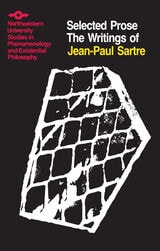
The Writings of Jean-Paul Sartre Volume 2
Selected ProseJean-Paul Sartre
Northwestern University Press, 1974
The Writings of William James
A Comprehensive EditionWilliam James
University of Chicago Press, 1978
The anthology features representive selections from The Principles of Psychology, The Will to Believe, and The Variety of Religious Experience in addition to the complete Essays in Radical Empiricism and A Pluralistic Universe. The original 1907 edition of Pragmatism is included, as well as classic selections from all of James's other major works. Of particular significance for James scholarship is the supplemented version of Ralph Barton Perry's Annotated Bibliography of the Writings of William James, with additions bringing it up to 1976.
The Young Descartes
Nobility, Rumor, and WarHarold J. Cook
University of Chicago Press, 2018
In The Young Descartes, Harold J. Cook tells the story of a man who did not set out to become an author or philosopher—Descartes began publishing only after the age of forty. Rather, for years he traveled throughout Europe in diplomacy and at war. He was present at the opening events of the Thirty Years' War in Central Europe and Northern Italy, and was also later involved in struggles within France. Enduring exile, scandals, and courtly intrigue, on his journeys Descartes associated with many of the most innovative free thinkers and poets of his day, as well as great noblemen, noblewomen, and charismatic religious reformers. In his personal life, he expressed love for men as well as women and was accused of libertinism by his adversaries.
These early years on the move, in touch with powerful people and great events, and his experiences with military engineering and philosophical materialism all shaped the thinker and philosopher Descartes became in exile, where he would begin to write and publish, with purpose. But though it is these writings that made ultimately made him famous, The Young Descartes shows that this story of his early life and the tumultuous times that molded him is sure to spark a reappraisal of his philosophy and legacy.
The modeling of nature
philosophy of science and philosophy of nature in synthesisWilliam A Wallace
Catholic University of America Press, 1996
Theater Of Envy
William ShakespeareRene Girard
St. Augustine's Press, 2004
In this ground-breaking work, one of our foremost literary and cultural critics turns to the major figure in English literature, William Shakespeare, and proposes a dramatic new reading of nearly all his plays and poems. The key to A Theater of Envy is Girard's novel reinterpretation of "mimesis." For Girard, people desire objects not for their intrinsic value, but because they are desired by someone else - we mime or imitate their desires. This envy - or "mimetic desire" - he sees as one of the foundations of the human condition.
Bringing such proocative and iconoclastic insights to bear on Shakespeare, Girard reveals the previously overlooked coherence of problem plays like Troilus and Cressida, and makes a convincing argument for elevating A Midsummer Night's Dream from the status of a chaotic comedy to a masterpiece. The book abounds with novel and provocative interpretations: Shakespeare becomes "a prophet of modern advertising," and the threat of nuclear disaster is read in the light of Hamlet. Most intriguing of all, perhaps, is a brief, but brilliant aside in which an entirely new perspective is brought to the chapter on Joyce's Ulysses in which Stephen Dedalus gives a lecture on Shakespeare. In Girard's view only Joyce, perhaps the greatest of twentieth-century novelists, comes close to understanding the greatest of Renaissance playwrights.
Throughout this impressively sustained reading of Shakespeare, Girard's prose is sophisticated, but contemporary, and accessible to the general reader.

Theater and Social Change, Volume 31
Alisa Solomon, ed.
Duke University Press, 0
Theater and Social Change not only tracks the historical evolution of political theater but also explores the current state and future prospects of different modes, including agit-prop, demonstrations, solo performance, Augusto Boal’s Theater of the Oppressed, and community-based production. With such notable contributors as Anna Deavere Smith, Jonathan Kalb, Holly Hughes, and Tony Kushner, the issue offers a diverse assemblage of personal statements, conversations, photographs, interviews, and performance text.
Contributors include: Reverend Billy, Jan Cohen-Cruz, Arlene Goldbard, Sharon Green, Lani Guinier, Holly Hughes, Jonathan Kalb, Tony Kushner, Judith Malina, Robbie McCauley, John O'Neal, Claudia Orenstein, Bill Rauch, Julie Salverson, Anna Deavere Smith, Alisa Solomon, Roberta Uno
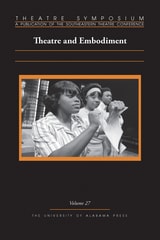
Theatre Symposium, Vol. 27
Theatre and EmbodimentEdited by Sarah McCarroll
University of Alabama Press, 2019
Theatre is inescapably about bodies. By definition, theatre requires the live bodies of performers in the same space and at the same time as the live bodies of an audience. And, yet, it’s hard to talk about bodies. We talk about characters; we talk about actors; we talk about costume and movement. But we often approach these as identities or processes layered onto bodies, rather than as inescapably entwined with them. Bodies on the theatrical stage hold the power of transformation. Theatre practitioners, scholars, and educators must think about what bodies go where onstage and what stories which bodies to tell.
The essays in Theatre Symposium, Volume 27 explore a broad range of issues related to embodiment. The volume begins with Rhonda Blair’s keynote essay, in which she provides an overview of the current cognitive science underpinning our understanding of what it means to be “embodied” and to talk about “embodiment.” She also provides a set of goals and cautions for theatre artists engaging with the available science on embodiment, while issuing a call for the absolute necessity for that engagement, given the primacy of the body to the theatrical act.
The following three essays provide examinations of historical bodies in performance. Timothy Pyles works to shift the common textual focus of Racinian scholarship to a more embodied understanding through his examination of the performances of the young female students of the Saint-Cyr academy in two of Racine’s Biblical plays. Shifting forward in time by three centuries, Travis Stern’s exploration of the auratic celebrity of baseball player Mike Kelly uncovers the ways in which bodies may retain the ghosts of their former selves long after physical ability and wealth are gone. Laurence D. Smith’s investigation of actress Manda Björling’s performances in Miss Julie provides a model for how cognitive science, in this case theories of cognitive blending, can be integrated with archival theatrical research and scholarship.
From scholarship grounded in analysis of historical bodies and embodiment, the volume shifts to pedagogical concerns. Kaja Amado Dunn’s essay on the ways in which careless selection of working texts can inflict embodied harm on students of color issues an imperative call for careful and intentional classroom practice in theatre training programs. Cohen Ambrose’s theorization of pedagogical cognitive ecologies, in which subjects usually taught disparately (acting, theatre history, costume design, for example) could be approached collaboratively and through embodiment, speaks to ways in which this call might be answered.
Tessa Carr’s essay on "The Integration of Tuskegee High School" brings together ideas of historical bodies and embodiment in the academic theatrical context through an examination of the process of creating a documentary theatre production. The final piece in the volume, Bridget Sundin’s exchange with the ghost of Marlene Dietrich, is an imaginative exploration of how it is possible to open the archive, to create new spaces for performance scholarship, via an interaction with the body.

Theatre, Globalization and the Heteroglobal Method
Glenn Odom
Intellect Books, 2026
Theatre, Globalization and the Heteroglobal Method offers a groundbreaking framework for rethinking global theatre studies. Drawing on philosophy and scholarship from major theatre traditions—South Africa, the United States, the United Kingdom, China, Japan, and Nigeria—the volume reimagines how performance circulates and transforms in a global context.
Challenging the dominance of Eurocentric models in postcolonial studies, comparative literature, and world theatre, the book introduces the “heteroglobal” method: an adaptable, equitable approach that begins with local theoretical and philosophical frameworks before bringing them into dialogue. These imagined centers, each with its own rich discursive heritage, become sites of knowledge exchange where fresh understandings of art and globalization emerge.
Through a theoretically pluralistic matrix of comparison and interculturalism, Theatre, Globalization and the Heteroglobal Method documents contemporary scholarly and artistic practices across diverse cultural landscapes, offering a new model for teaching, research, and performance in an interconnected world.
Theatre, Time and Temporality
Melting Clocks and Snapped ElasticsDavid Ian Rabey
Intellect Books, 2016
Theatricality Beyond Disciplines
Amin Erfani
Intellect Books, 2025
In Theatricality Beyond Disciplines, Amin Erfani expands the concept of theatricality beyond the stage, tracing its destabilizing power through literature, psychoanalysis, media, and philosophy. Drawing on Artaud’s vision of theater as an unpredictable, contagious force—what he called “the return of the repressed”—the book rejects the Aristotelian idea of theater as a space of healing. Instead, it frames it as an unsettling intervention into systems of power and meaning.
Through close readings of Artaud, Genet, Novarina, Koltès, and theorists like Freud, Barthes, and Derrida, Erfani reveals how theatricality operates primarily in the aural rather than the visual mode, inciting paranoia, psychic contamination, and ruptures in language. A provocative challenge to disciplinary boundaries, this book suits any student or scholar interested in examining the relationship between theater and theoretical discourse, posing theatricality as a site of radical otherness and transformation.
Themes in Kant's Metaphysics and Ethics
Arthur Melnick
Catholic University of America Press, 2004
Themes in Plato, Aristotle, and Hellenistic Philosophy
Keeling Lectures 2011-18Edited by Fiona Leigh
University of London Press, 2020
Themes out of School
Effects and CausesStanley Cavell
University of Chicago Press, 1988
Fantasies of film and television and literature, flashes across the landscape of literary theory, philosophical discourse, and French historiography give Cavell his starting points in these twelve essays. Here is philosophy in and out of "school," understood as a discipline in itself or thought through the works of Shakespeare, Molière, Kierkegaard, Thoreau, Brecht, Makavejev, Bergman, Hitchcock, Astaire, and Keaton.
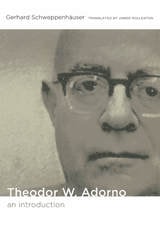
Theodor W. Adorno
An IntroductionGerhard Schweppenhäuser
Duke University Press, 2009
After providing a brief overview of Adorno’s life, Schweppenhäuser turns to the theorist’s core philosophical concepts, including post-Kantian critique, determinate negation, and the primacy of the object, as well as his view of the Enlightenment as a code for world domination, his diagnosis of modern mass culture as a program of social control, and his understanding of modernist aesthetics as a challenge to conceive an alternative politics. Along the way, Schweppenhäuser illuminates the works widely considered Adorno’s most important achievements: Minima Moralia, Dialectic of Enlightenment (co-authored with Horkheimer), and Negative Dialectics. Adorno wrote much of the first two of these during his years in California (1938–49), where he lived near Arnold Schoenberg and Thomas Mann, whom he assisted with the musical aesthetics at the center of Mann’s novel Doctor Faustus.
Theories and Narratives
Reflections on the Philosophy of HistoryAlex Callinicos
Duke University Press, 1995
Pursuing this objective, Alex Callinicos critically confronts a number of leading attempts to reconceptualize the meaning of history, including Francis Fukuyama’s rehabilitation of Hegel’s philosophy of history and the postmodernist efforts of Hayden White and others to deny the existence of a past independent of our representations of it. In these cases philosophical arguments are pursued in tandem with discussions of historical interpretations or, respectively, Stalinism and the Holocaust. Leading theories of history—Marx’s and Weber’s—are then examined in the context of recent work by writers such as Michael Mann, W. G. Runciman, and Robert Brenner
Finally, the politics of historical theory is explored in a discussion of Marxism’s claims to be a universal theory of human progress. Contradicting current fashion, Callinicos rebuts the claims made by many postmodernists that Marxism is inherently Eurocentric in both its conceptual structures and its political practice. Marx’s project of human emancipation, he concludes, still define our political horizons.
Theories and Narratives will interest all readers for whom the role of history in the understanding of contemporary civilizations is an essential issue.
Theories of Art Today
Edited by Noel Carroll
University of Wisconsin Press, 2000
What is art? The contributors to Theories of Art Today address the assertion that the term “art” no longer holds meaning. They explore a variety of issues including: aesthetic and institutional theories of art, feminist perspectives on the philosophy of art, the question of whether art is a cluster concept, and the relevance of tribal art to philosophical aesthetics. Contributors to this book include such distinguished philosophers and historians as Arthur Danto, Joseph Margolis, and George Dickie.
Theories of Translation
An Anthology of Essays from Dryden to DerridaEdited by John Biguenet and Rainer Schulte
University of Chicago Press, 1992
Most of the twenty-one pieces appear in translation, some here in English for the first time and many difficult to find elsewhere. Selections include writings by Scheiermacher, Nietzsche, Ortega, Benjamin, Pound, Jakobson, Paz, Riffaterre, Derrida, and others.
A fine companion to The Craft of Translation, this volume will be a valuable resource for all those who translate, those who teach translation theory and practice, and those interested in questions of language philosophy and literary theory.

Theorizing Social Movements
Joe Foweraker
Pluto Press, 1995
Theory Of The Avant-Garde
Peter Burger
University of Minnesota Press, 1984
Theory and Practice
Jacques Derrida
University of Chicago Press, 2019
Theory and Practice is a series of nine lectures that Jacques Derrida delivered at the École Normale Supérieure in 1976 and 1977. The topic of “theory and practice” was associated above all with Marxist discourse and particularly the influential interpretation of Marx by Louis Althusser. Derrida’s many questions to Althusser and other thinkers aim at unsettling the distinction between thinking and acting.
Derrida’s investigations set out from Marx’s “Theses on Feuerbach,” in particular the eleventh thesis, which has often been taken as a mantra for the “end of philosophy,” to be brought about by Marxist practice. Derrida argues, however, that Althusser has no such end in view and that his discourse remains resolutely philosophical, even as it promotes the theory/practice pair as primary values. This seminar also draws fascinating connections between Marxist thought and Heidegger and features Derrida’s signature reconsideration of the dichotomy between doing and thinking. This text, available for the first time in English, shows that Derrida was doing important work on Marx long before Specters of Marx. As with the other volumes in this series, it gives readers an unparalleled glimpse into Derrida’s thinking at its best—spontaneous, unpredictable, and groundbreaking.
Theory and Reality
An Introduction to the Philosophy of SciencePeter Godfrey-Smith
University of Chicago Press, 2003
Intended for undergraduates and general readers with no prior background in philosophy, Theory and Reality covers logical positivism; the problems of induction and confirmation; Karl Popper's theory of science; Thomas Kuhn and "scientific revolutions"; the views of Imre Lakatos, Larry Laudan, and Paul Feyerabend; and challenges to the field from sociology of science, feminism, and science studies. The book then looks in more detail at some specific problems and theories, including scientific realism, the theory-ladeness of observation, scientific explanation, and Bayesianism. Finally, Godfrey-Smith defends a form of philosophical naturalism as the best way to solve the main problems in the field.
Throughout the text he points out connections between philosophical debates and wider discussions about science in recent decades, such as the infamous "science wars." Examples and asides engage the beginning student; a glossary of terms explains key concepts; and suggestions for further reading are included at the end of each chapter. However, this is a textbook that doesn't feel like a textbook because it captures the historical drama of changes in how science has been conceived over the last one hundred years.
Like no other text in this field, Theory and Reality combines a survey of recent history of the philosophy of science with current key debates in language that any beginning scholar or critical reader can follow.
Theory and Reality
An Introduction to the Philosophy of Science, Second EditionPeter Godfrey-Smith
University of Chicago Press, 2021
Like no other text in this field, Theory and Reality combines a survey of recent history of the philosophy of science with current key debates that any beginning scholar or critical reader can follow. The second edition is thoroughly updated and expanded by the author with a new chapter on truth, simplicity, and models in science.

Theory as Practice
Ethical Inquiry in the RenaissanceNancy S. Struever
University of Chicago Press, 1992
Struever argues that the accomplishment of five major Renaissance figures—Petrarch, Nicolaus Cusanus, Lorenzo Valla, Machiavelli, and Montaigne—was to consider theory as practice and thus engage the ethics of inquiry. She notes three stages of investigation, the first represented by Petrarch, who "relocated" ethical inquiry from a theoretical realm to a familiar practice responsive to daily experience.
Theory for the World to Come
Speculative Fiction and Apocalyptic AnthropologyMatthew J. Wolf-Meyer
University of Minnesota Press, 2019
Can social theories forge new paths into an uncertain future?
The future has become increasingly difficult to imagine. We might be able to predict a few events, but imagining how looming disasters will coincide is simultaneously necessary and impossible. Drawing on speculative fiction and social theory, Theory for the World to Come is the beginning of a conversation about theories that move beyond nihilistic conceptions of the capitalism-caused Anthropocene and toward generative bodies of thought that provoke creative ways of thinking about the world ahead. Matthew J. Wolf-Meyer draws on such authors as Kim Stanley Robinson and Octavia Butler, and engages with afrofuturism, indigenous speculative fiction, and films from the 1970s and ’80s to help think differently about the future and its possibilities.
Forerunners: Ideas First
Short books of thought-in-process scholarship, where intense analysis, questioning, and speculation take the lead
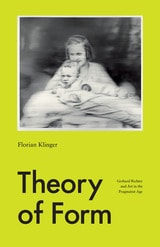
Theory of Form
Gerhard Richter and Art in the Pragmatist AgeFlorian Klinger
University of Chicago Press, 2022
In this study of the practice of contemporary painter Gerhard Richter, Florian Klinger proposes a fundamental change in the way we think about art today. In reaction to the exhaustion of the modernist-postmodernist paradigm’s negotiation of the “essence of art,” he takes Richter to pursue a pragmatist model that understands artistic form as action. Here form is no longer conceived according to what it says—as a vehicle of expression, representation, or realization of something other than itself—but strictly according to what it does.
Through its doing, Klinger argues, artistic form is not only more real but also more shared than non-artistic reality, and thus enables interaction under conditions where it would otherwise not be possible. It is a human practice aimed at testing and transforming the limits of shared reality, urgently needed in situations where such reality breaks down or turns precarious. Drawing on pragmatist thought, philosophical aesthetics, and art history, Klinger’s account of Richter’s practice offers a highly distinctive conceptual alternative for contemporary art in general.
Theory of Governance and Other Miscellaneous Papers, 1921-1938 (CW32)
Eric Voegelin, Edited & Intro by William Petropulos & Gilbert Weiss, & Translated by William Petropulos, Jodi Cockerill, M. J. Hanak, Ingrid Heldt, Elisabeth von Lochner, & Sue Bollans
University of Missouri Press, 2004
This first of two volumes of Voegelin's miscellaneous papers brings together crucial writings, published for the first time, from the early, formative period of this scholar's thought. The book begins with Voegelin's dissertation on sociological method, completed under the direction of Othmar Spann and Hans Kelsen at the University of Vienna in 1922. It reveals an intimate knowledge of the writings of Georg Simmel and a skillful use of insights gained from Edmund Husserl's Logical Investigations and Ideas.
The dissertation, and other smaller pieces written at this time, addresses problems that remained of great importance to Voegelin throughout his life: the relation of insight to language, the structure of the human being, and the human's spiritual center. They disclose both Voegelin's theoretical reference points during these early years, including the thought of Henri Bergson, Othmar Spann, Georg Simmel, and Edmund Husserl, as well the young scholar's remarkably independent approach to theoretical problems.
Moreover, this volume includes a work that is fundamental to an understanding of Voegelin's theoretical development: his extended study on the "theory of governance," written between 1930 and 1932. It follows the issues that confront political society to their roots in the soul and in the soul's relationship to the ground of being.
The Theory of Governance and Other Miscellaneous Papers presents a meditative-exegetic study of texts from Augustine, Descartes, and Husserl, early examples of the meditations that became central to Voegelin's later work. Other essays included in this volume such as "Theory of Law" and "Political Theory as Human Science" develop these theoretical insights and refine Voegelin's methodological tools. This volume will be of interest to all scholars of the work of Eric Voegelin and of the refoundation of political philosophy in the twentieth century in general.
Theory of Intuition in Husserl's Phenomenology
Second EditionEmmanuel Levinas
Northwestern University Press, 1995
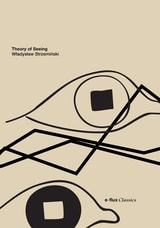
Theory of Seeing
Wladyslaw Strzeminski
University of Minnesota Press, 2025
The first English translation of a radical and influential theory of art by a leader of Poland’s avant-garde
After World War II, socialist realism became the official state doctrine of art in Poland, with abstract works deemed counterrevolutionary and forbidden from public view. Władysław Strzemiński, a leader of the Polish constructivist avant-garde, developed a treatise of visual consciousness as a foundation for progressive art, emphasizing art’s autonomy. His application of Marxist aesthetics to the physiology of seeing is expressed in Theory of Seeing, which was published posthumously in 1958 by his students from notes collected from his lectures.
Preceding the comparable perspectives developed by Jacques Rancière, David Hockney, and John Berger, and even the cinema of Jean-Luc Godard, Strzemiński’s Theory of Seeing introduces the radical and groundbreaking ideas of one of Poland’s most important artists to English-speaking audiences for the first time.
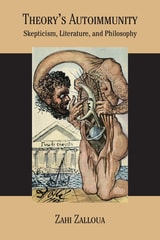
Theory’s Autoimmunity
Skepticism, Literature, and PhilosophyZahi Zalloua
Northwestern University Press, 2018
Openness to change comes with risks, and the self-protective temptation to immunize oneself or one's community against these risks is strong. Yet without such risks, without openness to otherness, no encounter with the new, with difference, can ever take place. Without autoimmunity, theory becomes stagnant and programmatic, unable to receive and respond to the other or the event, to address, revise, and produce new meanings.
Taking up the challenge of thinking theory as skepticism, with and against philosophy, this study turns to literature as an interlocutor, investigating the ways theory, like the literary works of Montaigne, Baudelaire, Stendhal, Morrison, or Duras, declines to put on the interpretive brakes, to stop reading at a point of understanding. Undoing and remaking itself, theory—those critical interpretive practices that revel in the creation and proliferation of meaning—becomes autoimmune.
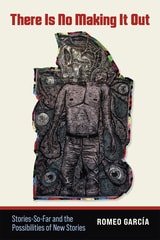
There Is No Making It Out
Stories-So-Far and the Possibilities of New StoriesRomeo García
Utah State University Press, 2025
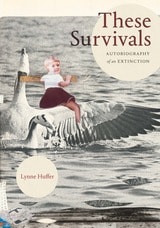
These Survivals
Autobiography of an ExtinctionLynne Huffer
Duke University Press, 2025
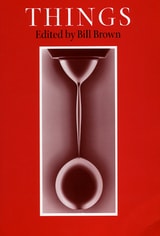
Things
Edited by Bill Brown
University of Chicago Press, 2004
Based on an award-winning special issue of the journal Critical Inquiry, Things features eighteen thought-evoking essays by contributors including Bill Brown, Matthew L. Jones, Bruno Latour, W. J. T. Mitchell, Jessica Riskin, Jeffrey T. Schnapp, Peter Schwenger, Charity Scribner, and Alan Trachtenberg.
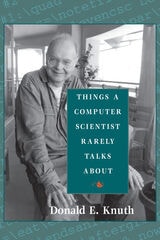
Things a Computer Scientist Rarely Talks About
Donald E. Knuth
CSLI, 2003
Perhaps no one is more qualified to address these questions than Donald E. Knuth, whose massive contributions to computing have led others to nickname him "The Father of Computer Science"—and whose religious faith led him to understand a fascinating analysis of the Bible called the 3:16 project. In this series of six spirited, informal lectures, Knuth explores the relationships between his vocation and his faith, revealing the unique perspective that his work with computing has lent to his understanding of God.
His starting point is the 3:16 project, an application of mathematical "random sampling" to the books of the Bible. The first lectures tell the story of the project's conception and execution, exploring its many dimensions of language translation, aesthetics, and theological history. Along the way, Knuth explains the many insights he gained from such interdisciplinary work. These theological musings culminate in a surprising final lecture tackling the ideas of infinity, free will, and some of the other big questions that lie at the juncture of theology and computation.
Things a Computer Scientist Rarely Talks About, with its charming and user-friendly format—each lecture ends with a question and answer exchange, and the book itself contains more than 100 illustrations—is a readable and intriguing approach to a crucial topic, certain to edify both those who are serious and curious about their faiths and those who look at the science of computation and wonder what it might teach them about their spiritual world.
Includes "Creativity, Spirituality, and Computer Science," a panel discussion featuring Harry Lewis, Guy L. Steele, Jr., Manuela Veloso, Donald E. Knuth, and Mitch Kapor.
Things, Thoughts, Words, and Actions
The Problem of Language in Late Eighteenth-Century British Rhetorical TheoryH. Lewis Ulman
Southern Illinois University Press, 1994
H. Lewis Ulman here examines the roles of language theory in eighteenth-century British rhetorics, linking those roles to philosophical issues informing twentieth-century rhetorical theory. In doing so, Ulman develops a general model of the "problem of language" for rhetorical theory, a model that transcends the impasse between realism and skepticism that marks both eighteenth- and twentieth-century rhetorical theory.
The nature of language was never more central to rhetorical theory than in the second half of the eighteenth century. Yet, until now, the articulation of theories of language and the arts of rhetoric in eighteenth-century Britain has received little attention. Ulman examines the role of grammar and theories of language in the formation of eighteenth-century rhetorical theory, investigating the significance of language theory for such key concerns of eighteenth-century rhetoric as verbal criticism, style, and elocution. His study highlights what he understands as the central motive of late eighteenth-century British rhetoricians—to construct for their particular cultural context philosophically rigorous accounts of verbal communication based on carefully articulated theories of thought and language.
Toward this end, Ulman examines three eighteenth-century British rhetorical treatises: George Campbell’s Philosophy of Rhetoric, Hugh Blair’s Lectures on Rhetoric and Belles Lettres, and Thomas Sheridan’s Course of Lectures on Elocution. He then identifies the continuities and discontinuities between the problem of language for eighteenth- and twentieth-century rhetorical theory and proposes a pluralistic stance toward the problem of language in rhetoric as an alternative to the theoretical standoff that currently characterizes the debate between realist and antirealist rhetorics.
Thinker On Stage
Nietzsche’s MaterialismPeter Sloterdijk
University of Minnesota Press, 1989
Thinking - Resisting - Reading the Political
Current Perspectives on Politics and Communities in the Arts Vol. 2Edited by Anneka Esch-van Kan, Stephan Packard, and Philipp Schulte
Diaphanes, 2013
The essays collected in “Thinking Resistances. Current Perspectives on Politics, Community, and Art“ engage with political phenomena in their interrelations with arts as well as with recent theoretical and philosophical perspectives on the very meaning of politics, the political, and community.
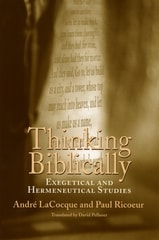
Thinking Biblically
Exegetical and Hermeneutical StudiesAndré LaCocque and Paul Ricoeur
University of Chicago Press, 1998
LaCocque's commentaries employ a historical-critical method that takes into account archaeological, philological, and historical research. LaCocque includes in his essays historical information about the dynamic tradition of reading scripture, opening his exegesis to developments and enrichments subsequent to the production of the original literary text. Ricoeur also takes into account the relation between the texts and the historical communities that read and interpreted them, but he broadens his scope to include philosophical speculation. His commentaries highlight the metaphorical structure of the passages and how they have served as catalysts for philosophical thinking from the Greeks to the modern age.
This extraordinary literary and historical venture reads the Bible through two different but complementary lenses, revealing the familiar texts as vibrant, philosophically consequential, and unceasingly absorbing.
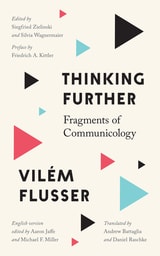
Thinking Further
Fragments of CommunicologyVilém Flusser
University of Minnesota Press, 2026
The first English-language translation of Vilém Flusser’s final series of lectures: the definitive introduction to his methods and ideas in new media theory
In summer 1991, shortly before his death, Vilém Flusser gave a series of lectures as guest professor at Ruhr University Bochum at the invitation of Friedrich Kittler. Flusser intended for these lectures to be the definitive introduction to his “communicology,” the study of human communication and the means by which acquired information is saved, processed, and passed on. In Thinking Further, Aaron Jaffe and Michael F. Miller have curated “fragments” from these lectures—first published in German in 2008—to present the most exciting and timely parts of Flusser’s foundational contributions to what is now known as media studies.
These fragments capture Flusser’s engagements with a wide range of theories, approaches, and interventions, including ecocriticism, posthumanities, game theory, cybernetics, and translinguistic exchanges. Offering sustained engagements with the ideas of Walter Benjamin, Michel Foucault, Michel Serres, and Jean Baudrillard, Thinking Further models possibilities for thinking through and clarifying the most obscure and obdurate implications of technology and modernity.
As they demonstrate Flusser’s contextual positionality and antiuniversalism, the writings presented here also underscore the pleasures and the power of his aphoristic style. Focusing less on Flusser-as-philosopher and more on his role as wry sage at the end of history, Thinking Further is a comprehensive but approachable introduction to his boundary-transcending exploration of the possibilities for communication, writing, and the human condition.
Retail e-book files for this title are screen-reader friendly.
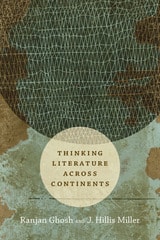
Thinking Literature across Continents
Ranjan Ghosh and J. Hillis Miller
Duke University Press, 2016