Results by title
18284 books match the query 'United States' and 3764 start with t

The First American Women Architects
Sarah Allaback
University of Illinois Press, 2007
Organized alphabetically as a reference guide, this volume provides a biographical sketch of each architect's life, education, and professional career, and a list of known works and sources for further research. Many of these remarkable women have never before appeared in any other history, making The First American Women Architects a unique and invaluable reference for students and scholars interested in women's history and architecture. As an instructive record of the legacy of women in architectural history, this book will also serve as a stimulating indicator of the broadening potential for women and other minorities within the field of architecture.

The First Chouteaus
RIVER BARONS OF EARLY ST. LOUISWilliam E. Foley and C. David Rice
University of Illinois Press, 1983
For more than half a century, Auguste and Pierre Chouteau dominated trade and enterprise in the Mississippi Valley. In their various roles as merchants, Indian traders, bankers, land speculators, governmental advisors, public officials, and community leaders, the Chouteau brothers exerted a tremendous influence on westward expansion. This is the first full account of their lives and illustrious careers.
The First Cold War
The Legacy of Woodrow Wilson in U.S. - Soviet RelationsDonald E. Davis & Eugene P. Trani
University of Missouri Press, 2002
The First Fifteen
How Asian American Women Became Federal JudgesSusan Oki Mollway
Rutgers University Press, 2022
This book tells the stories of the first fifteen. In the process, it recounts remarkable tales of Asian women overcoming adversity and achieving the American dream, despite being the daughters of a Chinese garment worker, Japanese Americans held in internment camps during World War II, Vietnamese refugees, and penniless Indian immigrants. Yet The First Fifteen also explores how far Asian Americans and women still have to go before the federal judiciary reflects America as a whole.
In a candid series of interviews, these judges reflect upon the personal and professional experiences that led them to this distinguished position, as well as the nerve-wracking political process of being nominated and confirmed for an Article III judgeship. By sharing their diverse stories, The First Fifteen paints a nuanced portrait of how Asian American women are beginning to have a voice in determining American justice.
The First Fifty Years
A Jubilee in Prose and Poetry Honoring Women RabbisRabbi Sue Levi Elwell, Jessica Greenbaum, Rabbi Hara E. Person
Central Conference of American Rabbis, 2023
The ordination of Rabbi Sally J. Priesand in 1972 was a watershed moment in Jewish history. In The First Fifty Years, contributors from across the Jewish and gender spectrums reflect on the meaning of this moment and the ensuing decades, both personally and for the Jewish community. In short pieces of new prose, authors—many of them pioneering rabbis—share stories, insights, analysis, and celebrations of women in the rabbinate. These are intertwined with a wealth of poetry that poignantly captures the spirit of this anniversary. The volume is a deep, heartfelt tribute to women rabbis and their indelible impact on all of us.
The First Fleets
Colonial Navies of the British Atlantic World, 1630–1775Benjamin C. Schaffer
University of Alabama Press, 2025
A revealing study on the little-known and misunderstood provincial navies established by North American British colonists.
In The First Fleets, Benjamin C. Schaffer reveals how, contrary to widespread beliefs, the American colonies had a long tradition of independent naval defense decades before the Revolution. He demonstrates that Anglo-American governments established and maintained significant provincial naval forces and that the history of provincial navies illuminates broader aspects of colonial history and the colonies’ ultimate break with the British Crown.
Based on meticulous research, Schaffer recounts the sea-borne threats that American colonies faced from the French, Spanish, pirates, and others. He reviews colonial governance and the relationships between colonial governments and Great Britain. Highlighting Britain’s scant naval power in North America, Schaffer demonstrates how the vulnerable coastal colonies undertook their own self-defense.
Schaffer’s readable study offers many fascinating episodes from colonial history. Establishing a navy was controversial in pacifist-minded, Quaker-dominated Pennsylvania. South Carolina deployed its scout-boat navy to pursue enslaved Africans who fled colonial capture. The first paper money issued in North America was an initiative to pay for a naval expedition against French Quebec in 1690. These and other episodes show the intimate connection between these little-known provincial navies and the major sociopolitical developments of their day.
The First Fleets will be of great interest to historians and readers of early American history, particularly colonial maritime and naval activities. Readers interested in the political and military dynamics of pre-Revolutionary America, as well as enthusiasts of naval history and maritime trade, will find The First Fleets both a valuable resource and an engrossing narrative.
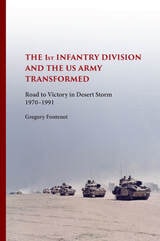
The First Infantry Division and the U.S. Army Transformed
Road to Victory in Desert Storm, 1970-1991Gregory Fontenot
University of Missouri Press, 2017
From the author's introduction:
“My purpose is a narrative history of the 1st Infantry Division from 1970 through the Operation Desert Storm celebration held 4th of July 1991. This story is an account of the revolutionary changes in the late Cold War. The Army that overran Saddam Hussein’s Legions in four days was the product of important changes stimulated both by social changes and institutional reform. The 1st Infantry Division reflected benefits of those changes, despite its low priority for troops and material. The Division was not an elite formation, but rather excelled in the context of the Army as an institution.”
This book begins with a preface by Gordon R. Sullivan, General, USA, Retired. In twelve chapters, author Gregory Fontenot explains the history of the 1st infantry Division from 1970 to 1991. In doing so, his fast-paced narrative includes elements to expand the knowledge of non-military readers. These elements include a glossary, a key to abbreviations, maps, nearly two dozen photographs, and thorough bibliography.
The First infantry Division and the U.S. Army Transformed: Road to Victory in Desert Storm is published with support from the First Division Museum at Cantigny.
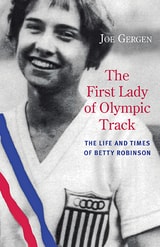
The First Lady of Olympic Track
The Life and Times of Betty RobinsonJoe Gergen
Northwestern University Press, 2014
The 1928 Olympic Games in Amsterdam were the first in which women—over the objections of many, including Pope Pius XI and the founder of the modern Olympics, Baron Pierre de Coubertin—were allowed to run in the marquee track events.
Equally remarkable is the story behind the first female gold medal winner in the 100-meter dash, sixteen-year-old American Betty Robinson. A prodigy running in just her fourth organized meet, Robinson stunned the world, earning special praise from the president of the 1928 American Olympic Committee, General Douglas MacArthur. But Robinson’s triumph soon became tragedy when in 1931 she was involved in a life-threatening plane crash. Unable to assume a sprinter’s crouch, she nevertheless joined fellow pioneer Jesse Owens at the infamous 1936 Berlin Olympics, and achieved further glory on the relay team. Journalist Joe Gergen’s The First Lady of Olympic Track rescues an exceptional figure from obscurity.
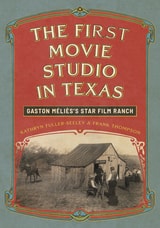
The First Movie Studio in Texas
Gaston Méliès's Star Film RanchKathryn Fuller-Seeley and Frank Thompson
University of Texas Press, 2026
The story of the Star Film Ranch and its pioneering crew, who created the first “authentic” Westerns filmed in Texas.
In 1910, the Méliès Star Film Company of Manhattan set up a moving-picture studio outside San Antonio, the first in Texas. Determined to make the most authentic Westerns possible, the company filmed there for a little over a year. In that brief time, it created more than seventy single-reel films, leaving a lasting mark on moviemaking.
Film historians Kathryn Fuller-Seeley and Frank Thompson return to a moment when on-location filmmaking was emerging as an artform. We meet producer Gaston Méliès, older brother of early-cinema legend Georges Méliès, and his cast and crew of young innovators, old hands, and genuine cowboys—like seventeen-year-old Edith Storey, the tomboy star who helped to ignite modern celebrity culture, and Francis Ford, who learned the art of film directing on the job and mentored his younger brother, Hollywood legend John Ford. The First Movie Studio in Texas traces the company’s trials and accomplishments, its influence on the depiction of race and gender in Western filmmaking, its surviving works, and its crowning achievement: The Immortal Alamo (1911), the earliest cinematic depiction of that famous battle.
Finally recovered from the shadows, the forgotten Méliès brother proves to be one of the key founders of the Western myth on screen.
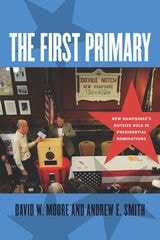
The First Primary
New Hampshire's Outsize Role in Presidential NominationsDavid W. Moore
University of New Hampshire Press, 2015
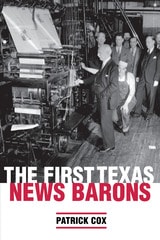
The First Texas News Barons
By Patrick Cox
University of Texas Press, 2005
Newspaper publishers played a crucial role in transforming Texas into a modern state. By promoting expanded industrialization and urbanization, as well as a more modern image of Texas as a southwestern, rather than southern, state, news barons in the early decades of the twentieth century laid the groundwork for the enormous economic growth and social changes that followed World War II. Yet their contribution to the modernization of Texas is largely unrecognized.
This book investigates how newspaper owners such as A. H. Belo and George B. Dealey of the Dallas Morning News, Edwin Kiest of the Dallas Times Herald, William P. Hobby and Oveta Culp Hobby of the Houston Post, Jesse H. Jones and Marcellus Foster of the Houston Chronicle, and Amon G. Carter Sr. of the Fort Worth Star-Telegram paved the way for the modern state of Texas. Patrick Cox explores how these news barons identified the needs of the state and set out to attract the private investors and public funding that would boost the state's civic and military infrastructure, oil and gas industries, real estate market, and agricultural production. He shows how newspaper owners used events such as the Texas Centennial to promote tourism and create a uniquely Texan identity for the state. To balance the record, Cox also demonstrates that the news barons downplayed the interests of significant groups of Texans, including minorities, the poor and underemployed, union members, and a majority of women.
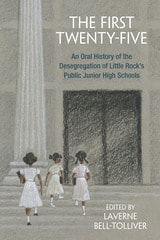
The First Twenty-Five
An Oral History of the Desegregation of Little Rock’s Public Junior High SchoolsLaVerne Bell-Tolliver
University of Arkansas Press, 2018
“It was one of those periods that you got through, as opposed to enjoyed. It wasn’t an environment that . . . was nurturing, so you shut it out. You just got through it. You just took it a day at a time. You excelled if you could. You did your best. You felt as though the eyes of the community were on you.”—Glenda Wilson, East Side Junior High
Much has been written about the historical desegregation of Little Rock Central High School by nine African American students in 1957. History has been silent, however, about the students who desegregated Little Rock’s five public junior high schools—East Side, Forest Heights, Pulaski Heights, Southwest, and West Side—in 1961 and 1962.
The First Twenty-Five gathers the personal stories of these students some fifty years later. They recall what it was like to break down long-standing racial barriers while in their early teens—a developmental stage that often brings emotional vulnerability. In their own words, these individuals share what they saw, heard, and felt as children on the front lines of the civil rights movement, providing insight about this important time in Little Rock, and how these often painful events from their childhoods affected the rest of their lives.
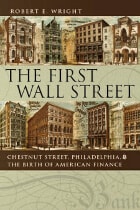
The First Wall Street
Chestnut Street, Philadelphia, and the Birth of American FinanceRobert E. Wright
University of Chicago Press, 2005
The First Wall Street recounts the fascinating history of Chestnut Street and its forgotten role in the birth of American finance. According to Robert E. Wright, Philadelphia, known for its cultivation of liberty and freedom, blossomed into a financial epicenter during the nation's colonial period. The continent's most prodigious minds and talented financiers flocked to Philly in droves, and by the eve of the Revolution, the Quaker City was the most financially sophisticated region in North America. The First Wall Street reveals how the city played a leading role in the financing of the American Revolution and emerged from that titanic struggle with not just the wealth it forged in the crucible of war, but an invaluable amount of human capital as well.
This capital helped make Philadelphia home to the Bank of the United States, the U.S. Mint, an active securities exchange, and several banks and insurance companies—all clustered in or around Chestnut Street. But as the decades passed, financial institutions were lured to New York, and by the late 1820s only the powerful Second Bank of the United States upheld Philadelphia's financial stature. But when Andrew Jackson vetoed its charter, he sealed the fate of Chestnut Street forever—and of Wall Street too.
Finely nuanced and elegantly written, The First Wall Street will appeal to anyone interested in the history of the United States and the origins of its unrivaled economy.
The First Woman in the Republic
A Cultural Biography of Lydia Maria ChildCarolyn L. Karcher
Duke University Press, 1998
The First Year Out
Understanding American Teens after High SchoolTim Clydesdale
University of Chicago Press, 2007
Wild parties, late nights, and lots of sex, drugs, and alcohol. Many assume these are the things that define an American teenager’s first year after high school. But the reality is really quite different. As Tim Clydesdale reports in The First Year Out, teenagers generally manage the increased responsibilities of everyday life immediately after graduation effectively. But, like many good things, this comes at a cost.
Tracking the daily lives of fifty young people making the transition to life after high school, Clydesdale reveals how teens settle into manageable patterns of substance use and sexual activity; how they meet the requirements of postsecondary education; and how they cope with new financial expectations. Most of them, we learn, handle the changes well because they make a priority of everyday life. But Clydesdale finds that teens also stow away their identities—religious, racial, political, or otherwise—during this period in exchange for acceptance into mainstream culture. This results in the absence of a long-range purpose for their lives and imposes limits on their desire to understand national politics and global issues, sometimes even affecting the ability to reconstruct their lives when tragedies occur.
The First Year Out is an invaluable resource for anyone caught up in the storm and stress of working with these young adults.

The First-Year Experience Cookbook
Raymond Pun
Assoc of College & Research Libraries, 2017
The Fishermen, the Horse, and the Sea
Barbara Joosse
Wisconsin Historical Society Press, 2021
This beautifully illustrated children’s book based on a true story recounts a dramatic rescue on Lake Michigan and introduces young readers to Lester Smith and his family, who founded Port Washington’s long-running and beloved Smith Bros. Fish Shanty. Educational materials including definitions, an illustrated map of Lake Michigan, and short biographies of the story’s featured characters supplement this engaging story for elementary-age readers.
The Fishing Creek Confederacy
A Story of Civil War Draft ResistanceRichard A. Sauers and Peter Tomasak
University of Missouri Press, 2012
Governor Andrew Gregg Curtin of Pennsylvania was a staunch supporter of the Lincoln administration. The commonwealth supplied more than 360,000 white soldiers and 9,000 black soldiers during the conflict. However, there was sustained opposition to the war throughout the state, much of it fanned by the pens of Democratic newspaper editors. Though most opposition was disorganized and spontaneous, other aspects of the antiwar sentiment in the state occasionally erupted as major incidents.
In The Fishing Creek Confederacy, Richard A. Sauers and Peter Tomasak address the serious opposition to the draft in Columbia County, Pennsylvania, in 1864. Egged on by the anti-Lincoln newspaper editors, a number of men avoided the draft and formed ad hoc groups to protect themselves from arrest. The shooting of a Union lieutenant confronting draft evaders in July 1864 resulted in military intervention in the northern townships of the county. The troops arrested more than one hundred men, sending about half of them to a prison fort near Philadelphia. Some of these men were subjected to military trials in Harrisburg, the state capital, that fall and winter. The arrests led to bitter feelings that were slow to die. The military intervention eventually impacted a Pennsylvania gubernatorial election and led to a murder trial.
Sauers and Tomasak describe the draft in Pennsylvania and consider how Columbia County fit into the overall draft process. Subsequent chapters take the reader through the events of the summer of 1864, including the interaction of soldiers and civilians in the county, the prison experiences of the men, and the trials. Later chapters cover the August 1865 Democratic rally at Nob Mountain and the effects of the draft episode after the war was over, including its influence on the 1872 election for governor, the 1891 murder trial, and the formation of the official Democratic version of the events, which has been used by historians ever since.
The Fishing Creek Confederacy is the first book to address this episode and its aftermath in their entirety. Sauers and Tomasak present the story and try to disentangle the often contradictory nature of the sources and how both amateur and professional historians have used them.
The Fishing Line
A History of the Grand Rapids & Indiana RailroadGraydon M. Meints
Michigan State University Press, 2018
The Five Life Decisions
How Economic Principles and 18 Million Millennials Can Guide Your ThinkingRobert T. Michael
University of Chicago Press, 2016
Economist Robert T. Michael won’t tell you what to choose. Instead, he’ll show you how to make smarter choices. Michael focuses on five critical decisions we all face about college, career, partners, health, and parenting. He uses these to demonstrate how the science of scarcity and choice—concepts used to guide major business decisions and shape national legislation—can offer a solid foundation for our own lives. Employing comparative advantage can have a big payoff when picking a job. Knowing how to work the marketplace can minimize uncertainty when choosing a partner. And understanding externalities—the ripple of results from our actions—can clarify the if and when of having children.
Michael also brings in data from the National Longitudinal Survey of Youth, a scientific sample of 18 million millennials in the United States that tracks more than a decade of young adult choices and consequences. As the survey’s longtime principal investigator and project director, Michael shows that the aggregate decisions can help us understand what might lie ahead along many possible paths—offering readers insights about how their own choices may turn out.
There’s no singular formula for always making the right choice. But the adaptable framework and rich data at the heart of The Five Life Decisions will help you feel confident in whatever you decide.

The Fixer
Visa Lottery ChroniclesCharles Piot with Kodjo Nicolas Batema
Duke University Press, 2019
The Fixers
Devolution, Development, and Civil Society in Newark, 1960-1990Julia Rabig
University of Chicago Press, 2016
Rabig argues that fixers play dual roles. They support resistance, but also mediation; they fight for reform, but also more radical and far-reaching alternatives; they rally others to a collective cause, but sometimes they broker factions. Fixers reflect longer traditions of organizing while responding to the demands of their times. In so doing, they end up fixing (like a fixative) a new and enduring pattern of activist strategies, reforms, and institutional expectations—a pattern we continue to see today.
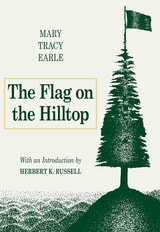
The Flag on the Hilltop
Mary Tracy Earle
Southern Illinois University Press, 1989
Early in the Civil War, two young brothers boldly flew the Union flag from a tree atop a hill between Makanda and Cobden. This was a towering act of courage in an area teeming with Copperheads.
Theodore and Al Thompson, 18 and 20 years old at the time, raised the flag in defiance of the Knights of the Golden Circle, a secessionist group that operated throughout the Midwest. Controlling its membership through terror, this secret society condemned betrayers to death by torture. The Knights, whose goals included capturing a Union prison and liberating the rebels, triggered the Civil War riot in Charleston, instigated anti-draft movements, and aided Northern deserters.
Theodore Thompson, who later owned much of Makanda, Giant City, and the land that became Southern Illinois University describes the tree as a "tall tulip poplar between 3 and 4 feet in diameter at the trunk and some 60 feet to the first limbs. This noted tree could be seen in some directions 15 or 20 miles away."
The Flash Press
Sporting Male Weeklies in 1840s New YorkPatricia Cline Cohen, Timothy J. Gilfoyle, Helen Lefkowitz Horowitz, in association with the American Antiquarian Society
University of Chicago Press, 2008
The Floating University
Experience, Empire, and the Politics of KnowledgeTamson Pietsch
University of Chicago Press, 2023
In 1926, New York University professor James E. Lough—an educational reformer with big dreams—embarked on a bold experiment he called the Floating University. Lough believed that taking five hundred American college students around the globe by ship would not only make them better citizens of the world but would demonstrate a model for responsible and productive education amid the unprecedented dangers, new technologies, and social upheavals of the post–World War I world. But the Floating University’s maiden voyage was also its last: when the ship and its passengers returned home, the project was branded a failure—the antics of students in hotel bars and port city back alleys that received worldwide press coverage were judged incompatible with educational attainment, and Lough was fired and even put under investigation by the State Department.
In her new book, Tamson Pietsch excavates a rich and meaningful picture of Lough’s grand ambition, its origins, and how it reveals an early-twentieth-century America increasingly defined both by its imperialism and the professionalization of its higher education system. As Pietsch argues, this voyage—powered by an internationalist worldview—traced the expanding tentacles of US power, even as it tried to model a new kind of experiential education. She shows that this apparent educational failure actually exposes a much larger contest over what kind of knowledge should underpin university authority, one in which direct personal experience came into conflict with academic expertise. After a journey that included stops at nearly fifty international ports and visits with figures ranging from Mussolini to Gandhi, what the students aboard the Floating University brought home was not so much knowledge of the greater world as a demonstration of their nation’s rapidly growing imperial power.
The Floating University
Experience, Empire, and the Politics of KnowledgeTamson Pietsch
University of Chicago Press, 2023
This is an auto-narrated audiobook edition of this book.
The Floating University sheds light on a story of optimism and imperialist ambition in the 1920s.In 1926, New York University professor James E. Lough—an educational reformer with big dreams—embarked on a bold experiment he called the Floating University. Lough believed that taking five hundred American college students around the globe by ship would not only make them better citizens of the world but would demonstrate a model for responsible and productive education amid the unprecedented dangers, new technologies, and social upheavals of the post–World War I world. But the Floating University’s maiden voyage was also its last: when the ship and its passengers returned home, the project was branded a failure—the antics of students in hotel bars and port city back alleys that received worldwide press coverage were judged incompatible with educational attainment, and Lough was fired and even put under investigation by the State Department.
In her new book, Tamson Pietsch excavates a rich and meaningful picture of Lough’s grand ambition, its origins, and how it reveals an early-twentieth-century America increasingly defined both by its imperialism and the professionalization of its higher education system. As Pietsch argues, this voyage—powered by an internationalist worldview—traced the expanding tentacles of US power, even as it tried to model a new kind of experiential education. She shows that this apparent educational failure actually exposes a much larger contest over what kind of knowledge should underpin university authority, one in which direct personal experience came into conflict with academic expertise. After a journey that included stops at nearly fifty international ports and visits with figures ranging from Mussolini to Gandhi, what the students aboard the Floating University brought home was not so much knowledge of the greater world as a demonstration of their nation’s rapidly growing imperial power.

The Floor in Congressional Life
Andrew J. Taylor
University of Michigan Press, 2013
The House and the Senate floors are the only legislative forums where all members of the U.S. Congress participate and each has a vote. Andrew J. Taylor explores why floor power and floor rights in the House are more restricted than in the Senate and how these restrictions affect the legislative process. After tracing the historical development of floor rules, Taylor assesses how well they facilitate a democratic legislative process---that is, how well they facilitate deliberation, transparency, and widespread participation.
Taylor not only compares floor proceedings between the Senate and the House in recent decades; he also compares recent congressional proceedings with antebellum proceedings. This unique, systematic analysis reveals that the Senate is generally more democratic than the House---a somewhat surprising result, given that the House is usually considered the more representative and responsive of the two. Taylor concludes with recommendations for practical reforms designed to make floor debates more robust and foster representative democracy.

The Fluency of Light
Coming of Age in a Theater of Black and WhiteAisha Sabatini Sloan
University of Iowa Press, 2013
The Fog of Accountability
How Institutions Keep Voters from Holding Their Local Governments AccountableJustin de Benedictis-Kessner
University of Chicago Press, 2026
An astute, data-rich examination of the structural reasons that elections fail to hold US city officials accountable.
In the United States, hundreds of thousands of elected and appointed officials serve more than 50,000 subnational governments, making important decisions about services ranging from education to infrastructure to policing. The provision of critical city services shapes citizens’ everyday lives.
Supposedly, local politicians are the elected representatives closest to the people they serve, but are they actually accountable to their constituents? Justin de Benedictis-Kessner shows that they are not: local elections routinely fail to punish bad politicians or reward strong performers. The Fog of Accountability argues that this is because urban politics is defined by minimally effective competition, complex institutions that confuse voters, and a lack of effective media coverage. These institutional features combine to stymie even well-intentioned voters and make accountability difficult. Fixing these problems is challenging, but, as de Benedictis-Kessner shows, change is possible if we can enable citizens to reclaim and assert their political power.

The Follinglo Dog Book
A Norwegian Pioneer Story from IowaPeder Gustav Tjernagel
University of Iowa Press, 1999
The Follinglo Dog Book both is and is not about dogs. The dogs are certainly here: from Milla to Chip the Third, we encounter a procession of heroic if often unfortunate creatures who, along with their immigrant masters, led a hard life on the nineteenth-century American frontier. However, if you pick up this book thinking it will offer a heartwarming read about canine experiences, you will find yourself reinformed by the way it unfolds.
Instead, these are the stories of a Norwegian pioneer family that came in 1860 to settle the Iowa prairie on a homestead called Follinglo Farm in Story County, Iowa. In the Tjernagels' experience one may read a chronicle of the state, the region, and the nation. Arriving in Iowa in what was still the age of wooden equipment and animal power, the Tjernagels witnessed each successive revolution on the land. They built homes and barns, cultivated the land, and encountered every manner of natural disaster from prairie fires to blizzards. Through all the struggles and setbacks, Peder Gustav Tjernagel's stories sparkle with boyhood pranks and adventures, in which the family dogs frequently play a role.
Readers will discover a wonderful cast of Norwegian relatives and neighbors, including a Herculean uncle, Store Per (Big Pete), who could lift a cow by its horns; a mysterious aunt, Stora Fastero (Big Sister), whose arrival signaled that a baby was soon to be born; and Elling Eilson, the walking Lutheran apostle. And, of course, there are the dogs who shepherd, protect, and even baby-sit the residents of Follinglo Farm.
The Force of Fantasy
Restoring the American DreamErnest G. Borman
Southern Illinois University Press, 2000
In this book, first published in 1985, Ernest G. Bormann explores mass persuasion in America from 1620 to 1860, examining closely four rhetorical communities: the revivals of 1739–1740, the hot gospel of the postrevolutionary period, the evangelical revival and reform of the 1830s, and the Free Soil and Republican parties. Each community varies greatly, but Bormann asserts that each succeeding community shares a rhetorical vision of restoring the “American Dream” that is essentially a modification of the previous visions. Thus, they form a family of rhetorical visions that constitutes a rhetorical tradition of importance in nineteenth-century American popular culture.
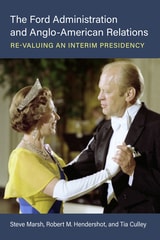
The Ford Administration and Anglo-American Relations
Re-Valuing an Interim PresidencySteve Marsh, Robert M. Hendershot and Tia Culley
University of Michigan Press, 2026
In the shadow of Watergate and the Vietnam War, Gerald Ford’s presidency has long been dismissed as little more than an interim administration. Yet the administration and its British counterparts worked to manage economic crises, Cold War tensions, and international flashpoints, while also harnessing cultural diplomacy to sustain transatlantic partnership. Drawing on newly declassified archival sources and fresh historical analysis, The Ford Administration and Anglo-American Relations shows how Ford’s years in office (1974–77) were pivotal in reshaping the US–UK special relationship at a moment of global turbulence.
Organized thematically rather than chronologically, the authors examine eight dimensions of Anglo-American relations under Ford: the inheritance of transatlantic tensions from the Nixon era; cultural and societal links beyond the state; the significance of Ford’s personal diplomacy; negotiations over defense and security; transformations in international economic relations and the birth of the G6/G7; cooperation through multilateral institutions such as NATO and the UN; joint management of crises in Cyprus and Rhodesia to the sterling currency crisis; and the cultural diplomacy of the 1976 Bicentennial, when Queen Elizabeth II’s state visit symbolized renewed unity between former adversaries. By highlighting both the challenges and the resilience of Anglo-American ties, this book recasts a neglected presidency as a crucial bridge between the crises of the Nixon years and the celebrated Reagan–Thatcher era. Accessible yet deeply researched, it is a work that will appeal to anyone interested in how two nations, facing uncertainty at home and abroad, turned to multilateral cooperation, culture, and public diplomacy to navigate the upheavals of the 1970s.
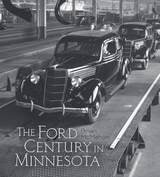
The Ford Century in Minnesota
Brian McMahon
University of Minnesota Press, 2016
In 1903, before the Ford Motor Company was even incorporated, Stephen Tenvoorde signed a contract to sell “Fordmobiles” at his bicycle shop in St. Cloud, Minnesota. Four generations later, the Tenvoorde family still operates what is now the oldest Ford dealership in the world. Brian McMahon chronicles how the fortunes of the company and the state became intertwined during that century.
Ford assembled Model T cars in the world’s tallest automobile plant in Minneapolis and a three-story structure in St. Paul—both still standing. These factories quickly became functionally obsolete after the development of the moveable assembly line. The hunt for a new site to build a modern, single-story plant stirred intense rivalry between Minneapolis and St. Paul. Henry Ford took a rare personal interest in the search and selected a 125-acre parcel in St. Paul overlooking the recently built High Dam on the Mississippi River, which allowed for navigation and hydroelectric power. The Twin Cities Assembly Plant would go on to manufacture millions of cars, trucks, tractors, and military vehicles until its closure in 2011.
Henry Ford’s large-scale experiments with every aspect of the industrial economy sent ripples and shockwaves through the lives of Minnesotans—management and assembly line workers, dealers and customers, families and communities. First-person accounts of more than forty retired auto workers share what it was like to work at Ford—from the early years of the Minneapolis plant to the final hours of the Twin Cities Assembly Plant in St. Paul. McMahon documents the company’s transformation—through the Depression, the rise of the United Auto Workers Union, World War II, women joining the workforce, competition from imported cars, globalization, outsourcing, and the closing of the plant.
This publication was made possible in part by the people of Minnesota through a grant funded by an appropriation to the Minnesota Historical Society from the Minnesota Arts and Cultural Heritage Fund. Any views, findings, opinions, conclusions or recommendations expressed in this publication are those of the authors and do not necessarily represent those of the State of Minnesota, the Minnesota Historical Society, or the Minnesota Historic Resources Advisory Committee.
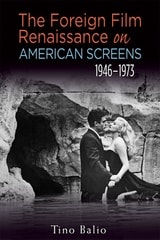
The Foreign Film Renaissance on American Screens, 1946–1973
Tino Balio
University of Wisconsin Press, 2010
Largely shut out of American theaters since the 1920s, foreign films such as Open City, Bicycle Thief, Rashomon, The Seventh Seal, Breathless, La Dolce Vita and L’Avventura played after World War II in a growing number of art houses around the country and created a small but influential art film market devoted to the acquisition, distribution, and exhibition of foreign-language and English-language films produced abroad. Nurtured by successive waves of imports from Italy, Great Britain, France, Sweden, Japan, and the Soviet Bloc, the renaissance was kick-started by independent distributors working out of New York; by the 1960s, however, the market had been subsumed by Hollywood.
From Roberto Rossellini’s Open City in 1946 to Bernardo Bertolucci’s Last Tango in Paris in 1973, Tino Balio tracks the critical reception in the press of such filmmakers as François Truffaut, Jean-Luc Godard, Federico Fellini, Michelangelo Antonioni, Tony Richardson, Ingmar Bergman, Akira Kurosawa, Luis Buñuel, Satyajit Ray, and Milos Forman. Their releases paled in comparison to Hollywood fare at the box office, but their impact on American film culture was enormous. The reception accorded to art house cinema attacked motion picture censorship, promoted the director as auteur, and celebrated film as an international art. Championing the cause was the new “cinephile” generation, which was mostly made up of college students under thirty.
The fashion for foreign films depended in part on their frankness about sex. When Hollywood abolished the Production Code in the late 1960s, American-made films began to treat adult themes with maturity and candor. In this new environment, foreign films lost their cachet and the art film market went into decline.
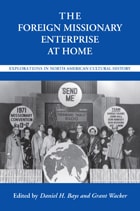
The Foreign Missionary Enterprise at Home
Explorations in North American Cultural HistoryEdited by Daniel H. Bays and Grant Wacker
University of Alabama Press, 2010
This volume is the first to examine at length and in detail the impact of the missionary experience on American cultural, political, and religious history.
This collection of 15 essays provides a fully developed account of the domestic significance of foreign missions from the 19th century through the Vietnam War. U.S. and Canadian missions to China, South America, Africa, and the Middle East have, it shows, transformed the identity and purposes of their mother countries in important ways. Missions provided many Americans with their first significant exposure to non-Western cultures and religions. They helped to establish a variety of new academic disciplines in home universities—linguistics, anthropology, and comparative religion among them. Missionary women helped redefine gender roles in North America, and missions have vitalized tiny local churches as well as entire denominations, causing them to rethink their roles and priorities, both here and abroad. In fact, missionaries have helped define our own national identity by influencing our foreign, trade, military, and immigration policies over the last two centuries.
Topics in the collection range from John Saillant's essay on the missions of free African Americans to Liberia in the 19th century to Grant Wacker's essay on the eventual disillusionment of noted writer Pearl S. Buck. Kathryn T. Long’s essay on the “Auca martyrs” offers a sobering case study of the missionary establishment's power to, in tandem with the evangelical and secular press, create and record the stories of our time. William L. Svelmoe documents the improbable friendship between fundamentalist Bible translator William Cameron Townsend and Mexico’s secular socialist president Lázaro Cárdenas. And Anne Blue Wills details the ways many American groups—black, Protestant, Catholic, and Mormon—sought to convert one another, stead-
fastly envisioning “others” as every bit as “heathen” as those in far-off lands.
The Foreign Missionary Enterprise at Home is an insightful, provocative collection that will stimulate much discussion and debate. It is valuable for academic libraries and seminaries, scholars of religious history and American studies, missionary groups, cultural historians and ethnographers, and political scientists.
The Foreign Policy Disconnect
What Americans Want from Our Leaders but Don't GetBenjamin I. Page with Marshall M. Bouton
University of Chicago Press, 2006
With world affairs so troubled, what kind of foreign policy should the United States pursue? Benjamin Page and Marshall Bouton look for answers in a surprising place: among the American people. Drawing on a series of national surveys conducted between 1974 and 2004, Page and Bouton reveal that—contrary to conventional wisdom—Americans generally hold durable, coherent, and sensible opinions about foreign policy. Nonetheless, their opinions often stand in opposition to those of policymakers, usually because of different interests and values, rather than superior wisdom among the elite. The Foreign Policy Disconnect argues that these gaps between leaders and the public are harmful, and that by using public opinion as a guideline policymakers could craft a more effective, sustainable, and democratic foreign policy.
Page and Bouton support this argument by painting a uniquely comprehensive portrait of the military, diplomatic, and economic foreign policies Americans favor. They show, for example, that protecting American jobs is just as important to the public as security from attack, a goal the current administration seems to pursue single-mindedly. And contrary to some officials’ unilateral tendencies, the public consistently and overwhelmingly favors cooperative multilateral policy and participation in international treaties. Moreover, Americans’ foreign policy opinions are seldom divided along the usual lines: majorities of virtually all social, ideological, and partisan groups seek a policy that pursues the goals of security and justice through cooperative means. Written in a clear and engaging style, The Foreign Policy Disconnect calls, in an original voice, for a more democratic approach to creating such a policy.

The Foreign and Domestic Dimensions of Modern Warfare
Vietnam, Central America, and Nuclear StrategyHoward Mumford Jones
University of Alabama Press, 1988
An exploration of the nuclear arms race and the dangers arising with the advent of “limited warfare”
After the development of the atomic bomb in 1945, Americans became engaged in a "new kind of war" against totalitarianism. Enemies and objectives slipped out of focus, causing political and military aims to mesh as a struggle to contain communism both at home and abroad encompassed civilians as well as soldiers. In matters relating to Vietnam, Central America, and the nuclear arms race, the domestic and foreign dimensions of each issue became inseparable. Policymakers in Washington had to formulate strategies dictated by "limited war" in their search for peace.
Contributors to this volume demonstrate the multifaceted nature of modern warfare. Robert H. Ferrell establishes the importance of studying military history in understanding the post-World War II era. On Vietnam, Colonel Harry G. Summers, Jr., gives an intriguing argument regarding the U. S. Army; George C. Herring examines how America's decisions in 1954 assured deepened involvement; and Captain Mark Clodfelter uncovers new evidence concerning "Linebacker I." On the home front, Robert F. Burk analyzes the impact of the Cold War on the battle for racial justice; Charles DeBenedetti puts forth a challenging interpretation of the antiwar movement; and James C. Schneider provides perspective on the relationship between the Vietnam War and the Great Society. On Central America, two writers downplay communism in explaining the region's troubles. Ralph Lee Woodward, Jr., fits the Nicaraguan revolution in the long span of history, and Thomas M. Leonard shows how the Reagan administration forced Costa Rica to side with the United States's anti-Sandinista policy. Finally, on nuclear strategy, Donald M. Snow offers a thought-provoking assessment of the "star wars" program, and Daniel S. Papp recommends measures to promote understanding among the superpowers.
These essays demonstrate that the making of foreign policy is immensely complicated, not subject to easy solution or to simple explanation. Despite these complexities, the central objective of policymakers remained clear: to safeguard what was perceived as the national interest.

The Forests of Michigan
Donald I. Dickmann and Larry A. Leefers
University of Michigan Press, 2003
No book currently on bookstore shelves explores, as The Forests of Michigan does, the natural history, ecology, management, economic importance, and use of the rich and varied forests that cover about half of the state's 36.3 million acres. The authors look at the forests, where they are, how they got to be, and their present-day usage, using the story of Michigan forests as a backdrop for the state's history, including its archaeology.
The Forests of Michigan explores how the forests came back after the great Wisconsin glacier began to recede over 12,000 years ago, and how they recovered from the onslaught of unrestrained logging and wildfire that, beginning in the mid-1800s, virtually wiped them out. The emphasis of the book is on sustaining for the long term the forests of the state, with a view of sustainability that builds not only upon the lessons learned from native peoples' attitude and use of trees but also on the latest scientific principles of forest ecology and management.
Generously illustrated and written in an engaging style, The Forests of Michigan sees the forest and the trees, offering both education and delight. "As forest scientists," the authors note, "we opted for a hearty serving of meat and potatoes; anyone who reads this book with the intention of learning something will not be disappointed. Nonetheless, we do include some anecdotal desserts, too."
Donald I. Dickmann is Professor of Forestry at Michigan State University and holds a doctorate from the University of Wisconsin. He is the author of The Culture of Poplars. Larry A. Leefers is Associate Professor in the Department of Forestry at Michigan State University. He holds a doctorate from Michigan State University.
The Forge
Thomas S. Stribling
University of Alabama Press, 1985
The first book in T. S. Stribling's award-winning Vaiden Trilogy about life in north Alabama at the onset, during, and after the Civil War
Originally published in 1931, The Forge introduces the Vaiden family, residents of the rural north Alabama of Stribling’s own youth. The Vaidens are a family of white yeoman farmers who scratch out a living in the social and financial shadow of the Lacefields, masters of an opulent plantation nearby.
The novel opens on Alabama’s secession and the onset of the Civil War. It traces the story of Miltiades Vaiden, who enlists in the Confederate army, and explores the ways the Vaidens, Lacefields, and freed slaves attempt to adapt to the collapse of southern society on the home front.
After The Forge, Stribling continued the Vaiden saga in 1932 with The Store, which earned him the Pulitzer Prize. He completed the trilogy in 1934 with The Unfinished Cathedral. Together, the three books paint a portrait of the agrarian South of the mid-nineteenth century, its destruction, and the beginnings of a mercantile future.
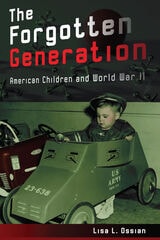
The Forgotten Generation
American Children and World War IILisa L. Ossian
University of Missouri Press, 2021
The Forgotten Memoir of John Knox
A Year in the Life of a Supreme Court Clerk in FDR's WashingtonJohn Knox
University of Chicago Press, 2002
When John Frush Knox (1907-1997) wrote these words, he was in the middle of law school, and his attempt at surpassing Pepys—part scrapbook, part social commentary, and part recollection—had already reached 750 pages. His efforts as a chronicler might have landed in a family attic had he not secured an eminent position after graduation as law clerk to Justice James C. McReynolds—arguably one of the most disagreeable justices to sit on the Supreme Court—during the tumultuous year when President Franklin D. Roosevelt tried to "pack" the Court with justices who would approve his New Deal agenda. Knox's memoir instead emerges as a record of one of the most fascinating periods in American history.
The Forgotten Memoir of John Knox—edited by Dennis J. Hutchinson and David J. Garrow—offers a candid, at times naïve, insider's view of the showdown between Roosevelt and the Court that took place in 1937. At the same time, it marvelously portrays a Washington culture now long gone. Although the new Supreme Court building had been open for a year by the time Knox joined McReynolds' staff, most of the justices continued to work from their homes, each supported by a small staff. Knox, the epitome of the overzealous and officious young man, after landing what he believes to be a dream position, continually fears for his job under the notoriously rude (and nakedly racist) justice. But he soon develops close relationships with the justice's two black servants: Harry Parker, the messenger who does "everything but breathe" for the justice, and Mary Diggs, the maid and cook. Together, they plot and sidestep around their employer's idiosyncrasies to keep the household running while history is made in the Court.
A substantial foreword by Dennis Hutchinson and David Garrow sets the stage, and a gallery of period photos of Knox, McReynolds, and other figures of the time gives life to this engaging account, which like no other recaptures life in Washington, D.C., when it was still a genteel southern town.
The Forgotten Men
Serving a Life without Parole SentenceLeigey, Margaret E
Rutgers University Press, 2015
The Forgotten Network
DuMont and the Birth of American TelevisionDavid Weinstein
Temple University Press, 2006

The Formative Period in Alabama, 1815-1828
Thomas Abernethy, with an introduction by David T. Morgan
University of Alabama Press, 1995
The Formative Period in Alabama, 1815-1828 is a beautifully crafted history of the evolution of the state written by Thomas Perkins Abernethy in 1922. The work shows how Alabama grew out of the Mississippi Territory and discusses the economic and political development during the years just before and just after Alabama became a state.
The Fort Ancient Aspect
James Bennett Griffin
University of Michigan Press, 1943
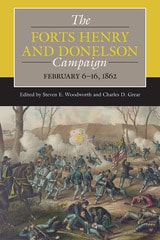
The Forts Henry and Donelson Campaign
February 6–16, 1862Edited by Steven E. Woodworth and Charles D. Grear
Southern Illinois University Press, 2026
New perspectives on the battles that opened the Confederacy to invasion
In early 1862, the Civil War had been raging for almost ten months, and the Confederacy had enjoyed virtually uninterrupted success. From seizing federal property to early battlefield victories, Southern forces had effectively expelled Union authority from nearly all of the Confederacy’s eleven states. The Union suffered repeated setbacks, while modest victories in western Virginia and Kentucky had little strategic impact. By the end of February, however, much had changed.
On February 6, Union gunboats under the joint command of Brigadier General Ulysses S. Grant and Flag Officer Andrew H. Foote captured Fort Henry on the Tennessee River, opening a crucial waterway into the Confederacy. Just days later, Grant moved against Fort Donelson on the Cumberland River. After several days of fighting, the fort surrendered on the 16th, along with more than 13,000 Confederate troops—the largest surrender in US history to that point. These twin victories shattered Confederate control of Kentucky and western Tennessee, allowing Federal soldiers and sailors to use the rivers to threaten the Confederacy’s interior. This first major strategic breakthrough of the war signaled a dramatic shift in momentum and elevated Grant’s national profile.
In this essay collection, leading and emerging scholars provide in-depth analyses of previously overlooked aspects of the Forts Henry and Donelson campaign. Contributors examine how ecological forces influenced the campaign, the effectiveness of the joint command between the Union army and navy, and Union brigadier general Charles F. Smith’s assault that doomed Fort Donelson. They also explore the battle’s impact on the military career of Nathan Bedford Forrest, the effects of surprise during the Confederate breakout attempt from Fort Donelson, Confederate colonel Gabriel Wharton’s memoir, and how the loss of the forts showed Texans that the fight to preserve the enslaved South would cost them more than they had imagined.
In the aftermath of the Forts Henry and Donelson campaign, most of the Civil War still lay ahead. The Confederacy would have many opportunities to regain its momentum and exhaust the Union will to prevail. However, with a few key exceptions, for the rest of the war, the Confederacy fought to defend itself rather than to take new territory. It was in this massive shift of momentum during ten days in 1862 that the war’s military outcome was foreshadowed.
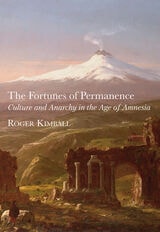
The Fortunes of Permanence
Culture and Anarchy in an Age of AmnesiaRoger Kimball
St. Augustine's Press, 2022
“Cultural instructions.” Everyone who has handled a package of seedlings has encountered that enigmatic advisory. This much water and that much sun, certain tips about fertilizer, soil, and drainage. Planting one sort of flower nearby keeps the bugs away but proximity to another sort makes bad things happen. Young shoots might need stakes, and watch out for beetles, weeds, and unseasonable frosts. It’s a complicated business.
But at least since Cicero introduced the term cultura animi (“cultivation of the mind or spirit”), such “cultural instructions” have applied as much to the realm of civilization as to horticulture. In this wide-ranging investigation into the vicissitudes of culture in the twenty-first century, the distinguished critic Roger Kimball traces the deep filiations between cultivation as a spiritual enterprise and the prerequisites of political freedom. Drawing on figures as various as James Burnham, Richard Weaver, G. K. Chesterton, Rudyard Kipling, John Buchan, Friedrich von Hayek, and Leszek Kolakowski, Kimball traces the interconnections between what he calls the fortunes of permanence and such ambassadors of anarchy as relativism, multiculturalism, and the socialist-utopian imperative.
With his signature blend of wit and erudition, Kimball deftly draws on the resources of art, literature, and political philosophy to illuminate some of the wrong turns and dead ends our culture has recently pursued, while also outlining some of the simple if overlooked alternatives to the various tyrannies masquerading as liberation we have again and again fallen prey to. This rich, rewarding, and intelligent volume bristles with insights into what the nineteenth-century novelist Anthony Trollope called “The Way We Live Now.”
Partly an exercise in cultural pathology, The Fortunes of Permanence is also a forward-looking effort of cultural recuperation. It promises to be essential reading for anyone concerned about the direction of Western culture in an age of anti-Western animus and destructive multicultural fantasy.

The Foundation Administrator
A Study of Those Who Manage America's FoundationsArnold John Zurcher
Russell Sage Foundation, 1972
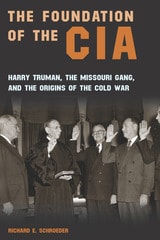
The Foundation of the CIA
Harry Truman, The Missouri Gang, and the Origins of the Cold WarRichard E. Schroeder
University of Missouri Press, 2017
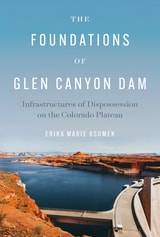
The Foundations of Glen Canyon Dam
Infrastructures of Dispossession on the Colorado PlateauErika Marie Bsumek
University of Texas Press, 2023
2024 Best Indigenous Studies Award, The Mormon History Association
2024 Southwest Book of the Year, Pima County Public Library
A history of how the construction of the Glen Canyon Dam was built and sustained by social inequalities
The second highest concrete-arch dam in the United States, Glen Canyon Dam was built to control the flow of the Colorado River throughout the Western United States. Completed in 1966, the dam continues to serve as a water storage facility for residents, industries, and agricultural use across the American West. The dam also generates hydroelectric power for residents in Colorado, Wyoming, New Mexico, Utah, Nevada, Arizona, and Nebraska. More than a massive piece of physical infrastructure and an engineering feat, the dam exposes the cultural structures and complex regional power relations that relied on Indigenous knowledge and labor while simultaneously dispossessing the Indigenous communities of their land and resources across the Colorado Plateau.
Erika Marie Bsumek reorients the story of the dam to reveal a pattern of Indigenous erasure by weaving together the stories of religious settlers and Indigenous peoples, engineers and biologists, and politicians and spiritual leaders. Infrastructures of dispossession teach us that we cannot tell the stories of religious colonization, scientific exploration, regional engineering, environmental transformation, or political deal-making as disconnected from Indigenous history. This book is a provocative and essential piece of modern history, particularly as water in the West becomes increasingly scarce and fights over access to it continue to unfold.