Results by title
788 books match the query 'Caribbean & Latin American' and 157 start with t
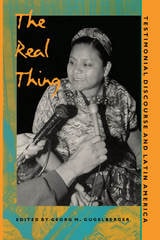
The Real Thing
Testimonial Discourse and Latin AmericaGeorg M. Gugelberger, ed.
Duke University Press, 1996
Although the literature of testimony arose on the margins of institutional power and its ends were in large part political change, the canonization of testimonio by the academic Left has moved it from margin to center, ironically bringing about the institutionalization of its transgressive and counter-hegemonic qualities. Discussing Latin American works ranging from Salvadorian writer Roque Dalton’s Miguel Marmol to I . . . Rigoberta Menchu, a work that earned its author a Nobel Prize, this collection explores how critical writing about testimonio has turned into discourse about the institution of academia, the canon, postmodernism and postcolonialism, and the status of Latin American studies generally.
Contributors. John Beverley, Santiago Colás, Georg M. Gugelberger, Barbara Harlow, Fredric Jameson, Alberto Moreiras, Margaret Randall, Javier Sanjines, Elzbieta Sklodowska, Doris Sommer, Gareth Williams, George Yúdice, Marc Zimmerman
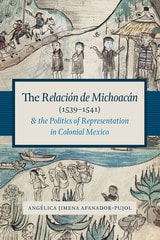
The Relación de Michoacán (1539-1541) and the Politics of Representation in Colonial Mexico
By Angélica Jimena Afanador-Pujol
University of Texas Press, 2015
Through close readings of the painted images in a major sixteenth-century illustrated manuscript, this book demonstrates the critical role that images played in ethnic identity formation and politics in colonial Mexico.
The Relación de Michoacán (1539–1541) is one of the earliest surviving illustrated manuscripts from colonial Mexico. Commissioned by the Spanish viceroy Antonio de Mendoza, the Relación was produced by a Franciscan friar together with indigenous noble informants and anonymous native artists who created its forty-four illustrations. To this day, the Relación remains the primary source for studying the pre-Columbian practices and history of the people known as Tarascans or P’urhépecha. However, much remains to be said about how the Relación’s colonial setting shaped its final form.
By looking at the Relación in its colonial context, this study reveals how it presented the indigenous collaborators a unique opportunity to shape European perceptions of them while settling conflicting agendas, outshining competing ethnic groups, and carving a place for themselves in the new colonial society. Through archival research and careful visual analysis, Angélica Afanador-Pujol provides a new and fascinating account that situates the manuscript’s images within the colonial conflicts that engulfed the indigenous collaborators. These conflicts ranged from disputes over political posts among indigenous factions to labor and land disputes against Spanish newcomers. Afanador-Pujol explores how these tensions are physically expressed in the manuscript’s production and in its many contradictions between text and images, as well as in numerous emendations to the images. By studying representations of justice, landscape, conquest narratives, and genealogy within the Relación, Afanador-Pujol clearly demonstrates the visual construction of identity, its malleability, and its political possibilities.
The Repeating Island
The Caribbean and the Postmodern PerspectiveAntonio Benitez-Rojo
Duke University Press, 1996
The Roof of the Whale Poems
Juan Calzadilla, Translated by Katherine M. Hedeen and Olivia Lott
University of Wisconsin Press, 2023
In 1961 Calzadilla was a founding member of El Techo de la Ballena (The Roof of the Whale), an avant-garde collective that sought to fuse politics and aesthetics. He published three books of poetry under its umbrella—Dictated by the Pack (1962), Bad Manners (1965), and The SupernaturalContradictions (1967)—which are all presented here in an omnibus edition, masterfully translated by Katherine M. Hedeen and Olivia Lott. Decades later, these poems still resonate, profoundly illustrating a sense of entrapment, of societal pressures on the individual, and of steadfast refusal to give in. Suffused with surrealist imagery, exuberant, exciting, and unexpected, The Roof of the Whale Poems is a breathtaking collection.
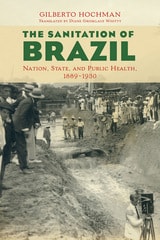
The Sanitation of Brazil
Nation, State, and Public Health, 1889-1930Gilberto Hochman
University of Illinois Press, 2016
The Savage Library of Roberto Bolaño
Radical ReadingsBenjamin Loy
Bucknell University Press, 2026
Visionary Chilean writer Roberto Bolaño was known for his darkly poetic prose and postmodern narratives, exemplified in his novel The Savage Detectives. His work is also deeply infused with references to the Western literary canon—from French and Spanish baroque texts to American and German modernism, as well as postmodern literature from Latin America and France. Taking Bolaño’s notion of “savage” reading as a point of departure, this study explores the key authors and literary traditions that underpin his oeuvre. Blending close textual analysis with insights from the history of literature and ideas, Loy offers fresh perspectives on some of Bolaño’s most significant works, including Distant Star, By Night in Chile, and 2666. The intertextual dialogues Loy traces—with figures such as Blaise Pascal, Sor Juana Inés de la Cruz, Charles Baudelaire, William Carlos Williams, Ernst Jünger, Nicanor Parra, and Georges Perec—illuminate the aesthetic universe of an author now regarded as a central figure in twenty-first-century world literature.
Published by Bucknell University Press. Distributed worldwide by Rutgers University Press.
The Second Conquest of Latin America
Coffee, Henequen, and Oil during the Export Boom, 1850-1930Edited by Steven C. Topik and Allen Wells
University of Texas Press, 1997
Between 1850 and 1930, Latin America's integration into the world economy through the export of raw materials transformed the region. This encounter was nearly as dramatic as the conquistadors' epic confrontation with Native American civilizations centuries before. An emphasis on foreign markets and capital replaced protectionism and self-sufficiency as the hemisphere's guiding principles. In many ways, the means employed during this period to tie Latin America more closely to western Europe and North America resemble strategies currently in vogue. Much can be learned from analyzing the first time that Latin Americans embraced export-led growth.
This book focuses on the impact of three key export commodities: coffee, henequen, and petroleum. The authors concentrate on these rather than on national economies because they illustrate more concretely the interaction between the environment, natural and human resources, and the world economy. By analyzing how different products spun complex webs of relationships with their respective markets, the essays in this book illuminate the tensions and contradictions found in the often conflictive relationship between the local and the global, between agency and the not-so-invisible hand. Ultimately, the contributors argue that the results of the "second conquest" were not one-sided as Latin Americans and foreigners together forged a new economic order—one riddled with contradictions that Latin America is still attempting to resolve today.
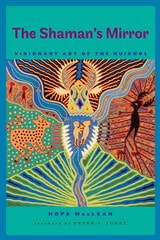
The Shaman’s Mirror
Visionary Art of the HuicholBy Hope MacLean
University of Texas Press, 2011
Huichol Indian yarn paintings are one of the world's great indigenous arts, sold around the world and advertised as authentic records of dreams and visions of the shamans. Using glowing colored yarns, the Huichol Indians of Mexico paint the mystical symbols of their culture—the hallucinogenic peyote cactus, the blue deer-spirit who appears to the shamans as they croon their songs around the fire in all-night ceremonies deep in the Sierra Madre mountains, and the pilgrimages to sacred sites, high in the central Mexican desert of Wirikuta.
Hope MacLean provides the first comprehensive study of Huichol yarn paintings, from their origins as sacred offerings to their transformation into commercial art. Drawing on twenty years of ethnographic fieldwork, she interviews Huichol artists who have innovated important themes and styles. She compares the artists' views with those of art dealers and government officials to show how yarn painters respond to market influences while still keeping their religious beliefs.
Most innovative is her exploration of what it means to say a tourist art is based on dreams and visions of the shamans. She explains what visionary experience means in Huichol culture and discusses the influence of the hallucinogenic peyote cactus on the Huichol's remarkable use of color. She uncovers a deep structure of visionary experience, rooted in Huichol concepts of soul-energy, and shows how this remarkable conception may be linked to visionary experiences as described by other Uto-Aztecan and Meso-American cultures.
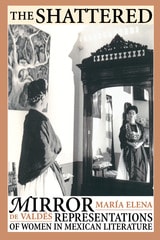
The Shattered Mirror
Representations of Women in Mexican LiteratureBy María Elena de Valdés
University of Texas Press, 1998
Popular images of women in Mexico—conveyed through literature and, more recently, film and television—were long restricted to either the stereotypically submissive wife and mother or the demonized fallen woman. But new representations of women and their roles in Mexican society have shattered the ideological mirrors that reflected these images. This book explores this major change in the literary representation of women in Mexico.
María Elena de Valdés enters into a selective and hard-hitting examination of literary representation in its social context and a contestatory engagement of both the literary text and its place in the social reality of Mexico. Some of the topics she considers are Carlos Fuentes and the subversion of the social codes for women; the poetic ties between Sor Juana Inés de la Cruz and Octavio Paz; questions of female identity in the writings of Rosario Castellanos, Luisa Josefina Hernández, María Luisa Puga, and Elena Poniatowska; the Chicana writing of Sandra Cisneros; and the postmodern celebration—without reprobation—of being a woman in Laura Esquivel's Like Water for Chocolate.
The Siren and the Seashell
And Other Essays on Poets and PoetryBy Octavio Paz
University of Texas Press, 1976
Octavio Paz has long been known for his brilliant essays as well as for his poetry. Through the essays, he has sought to confront the tensions inherent in the conflict between art and society and to achieve a unity of their polarities. The Siren and the Seashell is a collection of Paz’s essays, focusing on individual poets and on poetry in general. The first five poets he treats are Latin American: Sor Juana Inés de la Cruz, Rubén Darío, José Juan Tablada, Ramón López Velarde, and Alfonso Reyes. Then there are essays on Robert Frost, e. e. cummings, Saint-John Perse, Antonio Machado, and Jorge Guillén. Finally, there are Paz’s reflections on the poetry of solitude and communion and the literature of Latin America. Each essay is more than Paz’s impressions of one person or issue; each is the occasion for a wider discussion of cultural, historical, psychological, and philosophical themes. The essays were selected from Paz’s writing between 1942 and 1965 and provide an overview of the development of his thinking and an exploration of the ideas central in his works.
The Social Conscience of Latin American Writing
By Naomi Lindstrom
University of Texas Press, 1998
A CHOICE Outstanding Academic Book
Literature in Latin America has long been a vehicle for debates over the interpretation of social history, cultural identity, and artistic independence. Indeed, Latin American literature has gained international respect for its ability to present social criticism through works of imaginative creation.
In this comprehensive, up-to-the-minute survey of research and opinion by leading Latin American cultural and literary critics, Naomi Lindstrom examines five concepts that are currently the focus of intense debate among Latin American writers and thinkers. Writing in simple, clear terms for both general and specialist readers of Latin American literature, she explores the concepts of autonomy and dependency, postmodernism, literary intellectuals and the mass media, testimonial literature, and gender issues, including gay and lesbian themes. Excerpts (in English) from relevant literary works illustrate each concept, while Lindstrom also traces its passage from the social sciences to literature.
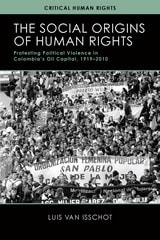
The Social Origins of Human Rights
Protesting Political Violence in Colombia’s Oil Capital, 1919–2010Luis van Isschot
University of Wisconsin Press, 2015
Built by Standard Oil in 1919, and home to the largest petroleum refinery in the country, Barrancabermeja has long been a critical battleground in Colombia’s armed conflict. One of the most militarized urban areas on earth, the city has been a regional base for the Colombian armed forces as well as for leftist guerrillas and a national paramilitary movement. In the midst of a dirty war in which the majority of victims were civilians, urban and rural social movements from Barrancabermeja and the surrounding area came together to establish a human rights movement. These frontline activists called upon the Colombian state to protect basic human rights and denounced the deeper socioeconomic inequalities they saw as sources of conflict. Through close study of the complex dynamics at work in Barrancabermeja, van Isschot shows how the efforts we describe as “human rights” activism derive in large part from these lived experiences of authoritarianism, war, poverty, and social exclusion. Through its social and historical approach, his analysis both complements and challenges the work of scholars who look at rights issues primarily through a legal lens.
The Socialist Party of Argentina, 1890–1930
By Richard J. Walter
University of Texas Press, 1977
In the early part of the twentieth century, Argentina's Socialist Party became the largest and most effective socialist organization in Latin America. Richard J. Walter's interpretive study begins with the party's origins in the 1890s, traces its development through 1912, and then offers a comprehensive analysis of its activities and programs during the almost two decades of civilian, democratic government that ended with the military coup of 1930. His aim has been to provide a detailed case study of a Latin American political party within a specific historical context.
The work gives particular attention to the nature of party leadership, internal party organization, attempts to win the support of the Argentine working class, party activities in national elections and the National Congress, and internal disputes and divisions. In discussing these topics, Walter draws heavily on government documents, including national and municipal censuses, ministerial reports, and the Argentine Congressional Record. He also makes extensive use of national and party newspapers and journals, political memoirs, and collections of essays by party leaders.
Walter concludes that the party enjoyed relative electoral and legislative success because of efficient organization, capable leadership, and specific, well-reasoned programs. On the other hand, it failed to create a firm working-class base or to extend its influence much beyond Buenos Aires, mainly because of its inability to relate adequately to the needs of the proletariat and to the growth of nationalist sentiment. The analysis of these successes and failures also provides an important background for understanding the rise to power of Juan Perón and Peronism.
The Spanish American Novel
A Twentieth-Century SurveyBy John S. Brushwood
University of Texas Press, 1975
In The Spanish American Novel, John S. Brushwood analyzes the twentieth-century Spanish American novel as an artistic expression of social reality. In relating the generic history of the novel to extraliterary events in Spanish America, he shows how twentieth-century fiction sets forth the essence of such phenomena as the first Perón regime, the Mexican Revolution, the Che Guevara legend, indigenismo, and the strongman political type. In essence, he views the novel as art rather than as document, but not as art alienated from society.
The discussion is organized chronologically, opening with the turn of the century and focusing on novels from 1900 to 1915 that exemplify various aspects of the nineteenth-century literary inheritance. Brushwood then highlights the avant-garde fiction (influenced by Proust and Joyce) of the 1920s as a precursory movement to the “new” Latin American novel, a phenomenon that came into its own during the 1940s. He then examines the “boom” in Spanish American fiction, the period of extensive international recognition of certain works, which he dates from 1962 or 1963.
In each era considered, the development of the novel is placed in dual perspective. One view—that of particularly significant novels in light of others published during the same year—is a cross section of the genre at one particular moment. The second view—that of a panorama of novels published in intervals between significant moments in the history of the novel—is more general and selective in the number of books discussed. Combining the historical with the analytical approach, the author proposes that the experience of a novel in which reality has been transformed into art is essential to our understanding of that reality.
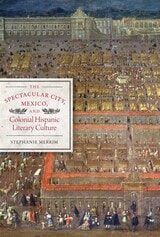
The Spectacular City, Mexico, and Colonial Hispanic Literary Culture
By Stephanie Merrim
University of Texas Press, 2010
Winner, Katherine Singer Kovacs Prize, Modern Language Association, 2010
The Spectacular City, Mexico, and Colonial Hispanic Literary Culture tracks the three spectacular forces of New World literary culture—cities, festivals, and wonder—from the sixteenth to the seventeenth century, from the Old World to the New, and from Mexico to Colombia, Peru, and Bolivia. It treats a multitude of imperialist and anti-imperialist texts in depth, including poetry, drama, protofiction, historiography, and journalism. While several of the landmark authors studied, including Hernán Cortés and Sor Juana Inés de la Cruz, are familiar, others have received remarkably little critical attention. Similarly, in spotlighting creole writers, Merrim reveals an intertextual tradition in Mexico that spans two centuries. Because the spectacular city reaches its peak in the seventeenth century, Merrim's book also theorizes and details the spirited work of the New World Baroque. The result is the rich examination of a trajectory that leads from the Renaissance ordered city to the energetic revolts of the spectacular city and the New World Baroque.
The Struggle of Non-Sovereign Caribbean Territories
Neoliberalism since the French Antillean Uprisings of 2009H. Adlai Murdoch
Rutgers University Press, 2021
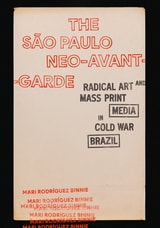
The São Paulo Neo-Avant-Garde
Radical Art and Mass Print Media in Cold War BrazilMari Rodríguez Binnie
University of Texas Press, 2024
How artists challenged a military dictatorship through mass print technologies in 1970s and 1980s São Paulo.
Throughout the 1970s and into the 1980s, during Brazil's military dictatorship, artists shifted their practices to critique the government and its sanitized images of Brazil, its use of torture, and its targeted persecutions. Mari Rodríguez Binnie's The São Paulo Neo-Avant-Garde examines these artworks and their engagement with politics and mainstream art institutions and practices.
As Binnie skillfully shows, artists appropriated processes like photocopy, offset lithography, and thermal and heliographic printing, making newly available technologies of mass production foundational to their work of resistance against both the dictatorship and the established art world. Often working collaboratively, these artists established alternative networks of exchange locally and internationally to circulate their work. As democracy was reestablished in Brazil, and in the decades that followed, their works largely fell out of sight. Here, in the first English-language book to focus entirely on conceptual practices in São Paulo in the 1970s and 1980s, Binnie unearths a scene critical to the development of contemporary Brazilian Art.

The Tension Of Paradox
José Donoso’s the Obscene Bird of Night As Spiritual ExercisesPamela May Finnegan
Ohio University Press, 1992
Pamela Finnegan provides a detailed criticism of a major novel written by one of Chile’s leading literary figures. She analyzes the symbolism and the use of language in The Obscene Bird of Night, showing that the novel’s world becomes an icon characterized by entropy, parody, and materiality. Her study concludes that all linguistic ordering fictionalizes, that the lack of spirituality within the novel’s world is symptomatic of language gone stale, and that blindness to this fact leads to dogma or solipsism, each counter-productive to communication and human endeavor. To revive the linguistic system, she argues, we must revive the creative power of language.
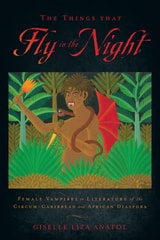
The Things That Fly in the Night
Female Vampires in Literature of the Circum-Caribbean and African DiasporaGiselle Liza Anatol
Rutgers University Press, 2015
This book is available as an audio book (https://www.abantuaudio.com/books/1197052/The-Things-That-Fly-in-the-Night).
The Tragedy of King Christophe
Aimé Césaire
Northwestern University Press, 2015
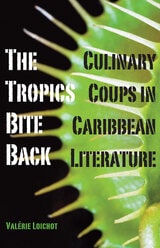
The Tropics Bite Back
Culinary Coups in Caribbean LiteratureValérie Loichot
University of Minnesota Press, 2013
The ubiquitous presence of food and hunger in Caribbean writing—from folktales, fiction, and poetry to political and historical treatises—signals the traumas that have marked the Caribbean from the Middle Passage to the present day. The Tropics Bite Back traces the evolution of the Caribbean response to the colonial gaze (or rather the colonial mouth) from the late nineteenth century to the twenty-first. Unlike previous scholars, Valérie Loichot does not read food simply as a cultural trope. Instead, she is interested in literary cannibalism, which she interprets in parallel with theories of relation and creolization.
For Loichot, “the culinary” is an abstract mode of resistance and cultural production. The Francophone and Anglophone authors whose works she interrogates—including Patrick Chamoiseau, Suzanne Césaire, Aimé Césaire, Maryse Condé, Edwidge Danticat, Édouard Glissant, Lafcadio Hearn, and Dany Laferrière—“bite back” at the controlling images of the cannibal, the starved and starving, the cunning cook, and the sexualized octoroon with the ultimate goal of constructing humanity through structural, literal, or allegorical acts of ingesting, cooking, and eating.
The Tropics Bite Back employs cross-disciplinary methods to rethink notions of race and literary influence by providing a fresh perspective on forms of consumption both metaphorical and material.
The Twentieth-Century Spanish American Novel
By Raymond Leslie Williams
University of Texas Press, 2003
A Choice Magazine Outstanding Academic Book
Spanish American novels of the Boom period (1962-1967) attracted a world readership to Latin American literature, but Latin American writers had already been engaging in the modernist experiments of their North American and European counterparts since the turn of the twentieth century. Indeed, the desire to be "modern" is a constant preoccupation in twentieth-century Spanish American literature and thus a very useful lens through which to view the century's novels.
In this pathfinding study, Raymond L. Williams offers the first complete analytical and critical overview of the Spanish American novel throughout the entire twentieth century. Using the desire to be modern as his organizing principle, he divides the century's novels into five periods and discusses the differing forms that "the modern" took in each era. For each period, Williams begins with a broad overview of many novels, literary contexts, and some cultural debates, followed by new readings of both canonical and significant non-canonical novels. A special feature of this book is its emphasis on women writers and other previously ignored and/or marginalized authors, including experimental and gay writers. Williams also clarifies the legacy of the Boom, the Postboom, and the Postmodern as he introduces new writers and new novelistic trends of the 1990s.

The Untimely Present
Postdictatorial Latin American Fiction and the Task of MourningIdelber Avelar
Duke University Press, 1999
Avelar starts by offering new readings of works produced before the dictatorship era, in what is often considered the boom of Latin American fiction. Distancing himself from previous celebratory interpretations, he understands the boom as a manifestation of mourning for literature’s declining aura. Against this background, Avelar offers a reassessment of testimonial forms, social scientific theories of authoritarianism, current transformations undergone by the university, and an analysis of a number of novels by some of today’s foremost Latin American writers—such as Ricardo Piglia, Silviano Santiago, Diamela Eltit, João Gilberto Noll, and Tununa Mercado. Avelar shows how the ‘untimely’ quality of these narratives is related to the position of literature itself, a mode of expression threatened with obsolescence.
This book will appeal to scholars and students of Latin American literature and politics, cultural studies, and comparative literature, as well as to all those interested in the role of literature in postmodernity.
The Uses of Failure in Mexican Literature and Identity
By John A. Ochoa
University of Texas Press, 2005
While the concept of defeat in the Mexican literary canon is frequently acknowledged, it has rarely been explored in the fullness of the psychological and religious contexts that define this aspect of "mexicanidad." Going beyond the simple narrative of self-defeat, The Uses of Failure in Mexican Literature and Identity presents a model of failure as a source of knowledge and renewed self-awareness.
Studying the relationship between national identity and failure, John Ochoa revisits the foundational texts of Mexican intellectual and literary history, the "national monuments," and offers a new vision of the pivotal events that echo throughout Mexican aesthetics and politics. The Uses of Failure in Mexican Literature and Identity encompasses five centuries of thought, including the works of the Conquistador Bernal Díaz del Castillo, whose sixteenth-century True History of the Conquest of New Spain formed Spanish-speaking Mexico's early self-perceptions; José Vasconcelos, the essayist and politician who helped rebuild the nation after the Revolution of 1910; and the contemporary novelist Carlos Fuentes.
A fascinating study of a nation's volatile journey towards a sense of self, The Uses of Failure elegantly weaves ethical issues, the philosophical implications of language, and a sociocritical examination of Latin American writing for a sparkling addition to the dialogue on global literature.
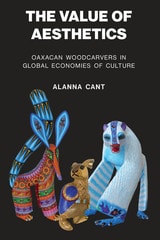
The Value of Aesthetics
Oaxacan Woodcarvers in Global Economies of CultureBy Alanna Cant
University of Texas Press, 2019
Unlike many other handicrafts in the Mexican state of Oaxaca, which have long cultural and historical trajectories, Oaxacan woodcarving began in the second half of the twentieth century and has always been done for the commercial market. In The Value of Aesthetics, Alanna Cant explores how one family’s workshop in the village of San Martín Tilcajete has become the most critically and economically successful, surpassing those of neighbors who use similar materials and techniques. The dominance of this family is tied to their ability to produce a new aesthetic that appeals to three key “economies of culture”: the tourist market for souvenirs, the national market for traditional Mexican artesanías, and the international market for indigenous art.
Offering a new analytical model by which anthropologists can approach visual aesthetics and conceptualize the power of artworks as socially active objects, The Value of Aesthetics shows how aesthetic practices produce and redefine social and political relationships. By investigating the links between aesthetics and issues of production, authorship, ownership, and identity, Cant shows aesthetic change to be a process that ultimately repackages everyday life into commodified objects in Oaxaca.
The Vanishing Frame
Latin American Culture and Theory in the Postdictatorial EraBy Eugenio Claudio Di Stefano
University of Texas Press, 2018
In the postdictatorial era, Latin American cultural production and criticism have been defined by a series of assumptions about politics and art—especially the claim that political freedom can be achieved by promoting a more direct experience between the textual subject (often a victim) and the reader by eliminating the division between art and life. The Vanishing Frame argues against this conception of freedom, demonstrating how it is based on a politics of human rights complicit with economic injustices. Presenting a provocative counternarrative, Eugenio Claudio Di Stefano examines literary, visual, and interdisciplinary artists who insist on the autonomy of the work of art in order to think beyond the politics of human rights and neoliberalism in Latin American theory and culture.
Di Stefano demonstrates that while artists such as Diamela Eltit, Ariel Dorfman, and Albertina Carri develop a concept of justice premised on recognizing victims’ experiences of torture or disappearance, they also ignore the injustice of economic inequality and exploitation. By examining how artists such as Roberto Bolaño, Alejandro Zambra, and Fernando Botero not only reject an aesthetics of experience (and the politics it entails) but also insist on the work of art as a point of departure for an anticapitalist politics, this new reading of Latin American cultural production offers an alternative understanding of recent developments in Latin American aesthetics and politics that puts art at its center and the postdictatorship at its end.
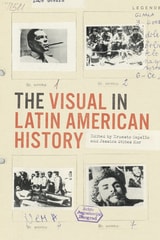
The Visual in Latin American History
Edited by Ernesto Capello and Jessica Stites Mor
University of Texas Press, 2026
A collection of essays examining the role of visual materials in shaping Latin American lives, historical thought, and worldmaking.
Historians have long valued visual media as a source of documentation and illustration. More recently, scholars have also been turning to visual media for another purpose: to directly observe historical processes. Paintings, maps, visual narratives, graffiti, photography—these objects do not simply transmit information about events; they are events. They imbue the historical change we seek to understand.
The Visual in Latin American History is a collection of essays that applies cutting-edge visual-studies methodology to the history of Central and South America and the Caribbean. Contributors focus on the visual production of postcolonial national imaginaries across Latin America—mythologies that purposely omitted Indigenous groups, African diasporic communities, and new migrants from Europe and Asia. The essays range across a vast territory, including erasure in archeology and Afro-Colombian portraiture; image making in domestic spaces and social movements; the visual vocabularies of urban planning and agrarian reform; military “performance” and anti-imperial Cold War exchanges; and humanitarian documentary along the US border.Collectively, the authors show how visual methods can radically transform our understanding of power and culture in Latin America and beyond.
The Voice of the Masters
Writing and Authority in Modern Latin American LiteratureBy Roberto González Echevarría
University of Texas Press, 1985
By one of the most original and learned critical voices in Hispanic studies— a timely and ambitious study of authority as theme and authority as authorial strategy in modern Latin American literature.
An ideology is implicit in modern Latin American literature, argues Roberto González Echevarría, through which both the literature itself and criticism of it define what Latin American literature is and how it ought to be read. In the works themselves this ideology is constantly subjected to a radical critique, and that critique renders the ideology productive and in a sense is what constitutes the work. In literary criticism, however, too frequently the ideology merely serves as support for an authoritative discourse that seriously misrepresents Latin American literature.
In The Voice of the Masters, González Echevarría attempts to uncover the workings of modern Latin American literature by creating a dialogue of texts, a dynamic whole whose parts are seven illuminating essays on seminal texts in the tradition. As he says, "To have written a sustained, expository book ... would have led me to make the same kind of critical error that I attribute to most criticism of Latin American literature.... I would have naively assumed an authoritative voice while attempting a critique of precisely that critical gesture."
Instead, major works by Barnet, Cabrera Infante, Carpentier, Cortázar, Fuentes, Gallegos, García Márquez, Roa Bastos, and Rodó are the object of a set of independent deconstructive (and reconstructive) readings. Writing in the tradition of Derrida and de Man, González Echevarría brings to these readings both the penetrative brilliance of the French master and a profound understanding of historical and cultural context. His insightful annotation of Cabrera Infante's "Meta-End," the full text of which is presented at the close of the study, clearly demonstrates these qualities and exemplifies his particular approach to the text.
The Wandering Signifier
Rhetoric of Jewishness in the Latin American ImaginaryErin Graff Zivin
Duke University Press, 2008
In her readings of Spanish American and Brazilian fiction, Graff Zivin highlights inventions of Jewishness in which the concept is constructed as a rhetorical device. She argues that Jewishness functions as a wandering signifier that while not wholly empty, can be infused with meaning based on the demands of the textual project in question. Just as Jews in Latin America possess distinct histories relative to their European and North American counterparts, they also occupy different symbolic spaces in the cultural landscape. Graff Zivin suggests that in Latin American fiction, anxiety, desire, paranoia, attraction, and repulsion toward Jewishness are always either in tension with or representative of larger attitudes toward otherness, whether racial, sexual, religious, national, economic, or metaphysical. She concludes The Wandering Signifier with an inquiry into whether it is possible to ethically represent the other within the literary text, or whether the act of representation necessarily involves the objectification of the other.
The White Trash Menace and Hemispheric Fiction
Ramón E. Soto-Crespo
The Ohio State University Press, 2020
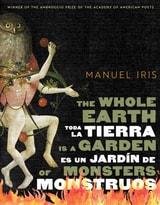
The Whole Earth Is a Garden of Monsters / Toda la tierra es un jardín de monstruos
Manuel Iris; Translated by Manuel Iris and Kevin McHugh
University of Arizona Press, 2026
This award-winning bilingual collection intertwines the lives of a Renaissance painter and a modern migrant worker, offering a fresh perspective on art and migration.
In this highly imaginative work, the lives of the northern Renaissance painter Hieronymus Bosch (1450–1516) and an imagined contemporary migrant worker named Juan Coyoc, later known as Juan Domínguez, run in parallel as they mirror each other across languages, time, and continents.
By comparing and at times intertwining these two poetic narratives, the book explores themes of art, migration, narco-violence, family, spirituality, and the idea that every human being represents all humanity at any moment in history. Both Hieronymus Bosch and Juan Domínguez become relatable and intimate figures, part of our own story.
Written in simple, sharp language, the book employs surprising imagery and a novel structure to blur the boundaries between reality and fiction, while examining the intricacies of the human condition—from the life of Saint Anthony to the violent acts of narcos across Central America and the U.S.-Mexico border. With formal sophistication and philosophical depth, this work enriches the tradition of poetry about both migration and art, contributing to the literary heritage of Mexico and the United States over the past several decades.
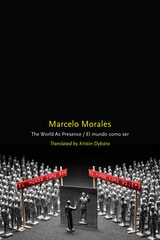
The World as Presence/El mundo como ser
Marcelo Morales, Introduced and Translated by Kristin Dykstra
University of Alabama Press, 2016
Marcelo Morales was born in Cuba in 1977. He is an established, prize-winning writer, yet he is younger in comparison to most of the Cuban poets known internationally, many of whom were born prior to the 1959 revolution. While older generations of Cuban poets have wrestled in their work with social and political critique, those critiques have often been articulated through formal experimentation and abstraction, unsurprising given the censorship and the real threats of punishment that dissident writers have faced. Morales, however, directly interrogates both the Cuban past and present. References to many significant moments, people, and issues in Cuban history and culture can be found throughout his work.
Along with references to the activist group “The White Ladies,” the 1976 bombing of Cuban Airlines Flight 455, and the military aid that Cubans provided to Angola during its fight for independence, Morales’s poetry follows a timeline ranging from Martí to Guevara to the day of the 2014 announcement by Obama and Castro that diplomatic relations between the two nations would finally be restored. As Cuba experiences a series of historically remarkable transitions, Morales emerges from this context to offer an incisive poetic account of this critical moment in Cuban, as well as world, history.
The World as Presence/El mundo como ser is both the debut of this work in any language and the first English translation of a complete Morales collection. Given the bilingual format, this book will be of interest both to English and Spanish readers.
The Writing of Elena Poniatowska
Engaging DialoguesBy Beth E. Jörgensen
University of Texas Press, 1994
Elena Poniatowska is one of Latin America's most distinguished and innovative living writers. Advocacy of women and the poor in their struggle for social and economic justice, denunciation of the repression of that struggle, and a tendency to blur the boundaries between conventional literary forms characterize her writing practice.
Asserting that Poniatowska's writing has been uniquely shaped by her experience as a journalist and interviewer, Beth Jörgensen addresses four important texts: Palabras cruzadas (interviews), Hasta no verte Jesús mío (testimonial novel), La noche de Tlatelolco (oral history), and La "Flor de Lis" (novel of development). She also treats related pieces, including Lilus Kikus (short fiction), De noche vienes (short stories), Fuerte es el silencio (chronicles), and several of Poniatowska's essays. Her readings incorporate a variety of critical approaches within a feminist framework.
The Writings of Carlos Fuentes
By Raymond Leslie Williams
University of Texas Press, 1996
Smitten by the modernity of Cervantes and Borges at an early age, Carlos Fuentes has written extensively on the cultures of the Americas and elsewhere. His work includes over a dozen novels, among them The Death of Artemio Cruz, Christopher Unborn, The Old Gringo, and Terra Nostra, several volumes of short stories, numerous essays on literary, cultural, and political topics, and some theater.
In this book, Raymond Leslie Williams traces the themes of history, culture, and identity in Fuentes' work, particularly in his complex, major novel Terra Nostra. He opens with a biography of Fuentes that links his works to his intellectual life. The heart of the study is Williams' extensive reading of the novel Terra Nostra, in which Fuentes explores the presence of Spanish culture and history in Latin America. Williams concludes with a look at how Fuentes' other fiction relates to Terra Nostra, including Fuentes' own division of his work into fourteen cycles that he calls "La Edad del Tiempo," and with an interview in which Fuentes discusses his concept of this cyclical division.

Theory and Practice of Sociocriticism
Thl Vol 53Edmond CrosTranslated by Jerome SchwartzForeword by Jurgen Link and Ursula Link-Heer
University of Minnesota Press, 1988
Theory and Practice of Sociocriticism was first published in 1988. Minnesota Archive Editions uses digital technology to make long-unavailable books once again accessible, and are published unaltered from the original University of Minnesota Press editions.
Edmond Cros is a leading French Hispanicist whose work is unique in Continental theory because it brings Spanish and Mexican texts into current literary debates, which have so far centered mainly on the French and German traditions. Equally distinctive is the nature of his work, which Cros terms sociocriticism. Unlike most sociological approaches to literature, which leave the structure of texts untouched, sociocriticism aims to prove that the encounter with "ideological traces," and with antagonistic tensions between social classes, is central to any reading of texts. Cros's method distinguishes between the "semiotic and "ideological" elements within a text, and involves the patient, exacting reconstruction of the concrete text from these elements, a process that enables the sociocritic to interpret its fault lines, its internal contradictions - in the end , its irreducibly social nature.
As its title suggests, Theory and Practice of Sociocriticism is structured in two parts. Its opening chapters analyze sociological theories of discourse, including those of Foucault, Bakhtin, and Goldman; in the second part, Cros applies theory to practice in readings of specific works: the film Scarface, contemporary Mexican poetry and prose (Octavio Paz, Carlos Fuentes), and the picaresque novel of the Spanish Golden Age. In their foreword, Jurgen Link and Ursula Link-Heer differentiate sociocriticism from other social approaches to literature and show how Cros's method works in specific textual readings. They emphasize his resistance to the reductive modes and "misreadings" that dominate much of contemporary theory.
Edmond Cros is a professor of literary theory and Hispanic studies at the Universite Paul Valery in Montpellier, France, and Andrew W. Mellon Professor of Hispanic Studies at the University of Pittsburgh. Jurgen Link teaches at the Ruhr-Universitat Bochum and Ursula Link-Heer at the Universitat Siegen, both in West Germany.
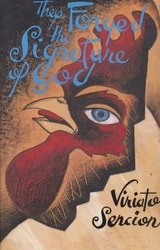
They Forged the Signature of God
A NovelViriato Sención
Northwestern University Press, 1995
Sención's novel follows the lives of three seminary students who suffer from church-state oppression. The book also gives a chilling portrait of Dr. Ramos, a sinister autocrat, who manages to survive six terms as president of his country through manipulation and tyranny. This finely textured novel gives a vivid picture of the internal politics of the Dominican Republic.
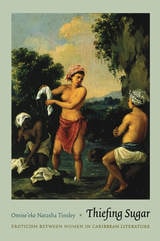
Thiefing Sugar
Eroticism between Women in Caribbean LiteratureOmise eke Natasha Tinsley
Duke University Press, 2010
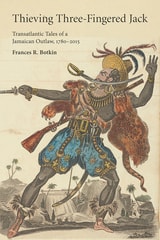
Thieving Three-Fingered Jack
Transatlantic Tales of a Jamaican Outlaw, 1780-2015Botkin, Frances R.
Rutgers University Press, 2018
The fugitive slave known as “Three-Fingered Jack” terrorized colonial Jamaica from 1780 until vanquished by Maroons, self-emancipated Afro-Jamaicans bound by treaty to police the island for runaways and rebels. A thief and a killer, Jack was also a freedom fighter who sabotaged the colonial machine until his grisly death at its behest. Narratives about his exploits shed light on the problems of black rebellion and solutions administered by the colonial state, creating an occasion to consider counter-narratives about its methods of divide and conquer. For more than two centuries, writers, performers, and storytellers in England, Jamaica, and the United States have “thieved" Three Fingered Jack's riveting tale, defining black agency through and against representations of his resistance.
Frances R. Botkin offers a literary and cultural history that explores the persistence of stories about this black rebel, his contributions to constructions of black masculinity in the Atlantic world, and his legacies in Jamaican and United States popular culture.

This America We Dream of
Rodo and "Ariel" One Hundred Years onEdited by Gustavo San Roman
University of London Press, 2001
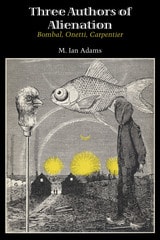
Three Authors of Alienation
Bombal, Onetti, CarpentierBy M. Ian Adams
University of Texas Press, 1975
As a philosophical and social concept, alienation covers a broad range of mental states, both normal and abnormal. Correspondingly, a wide range of literary forms has been employed to deal with this important theme. In Three Authors of Alienation, an exploration of the literary expression of alienation, M. Ian Adams discusses the works of three contemporary Latin American authors.
The fiction of María Luisa Bombal, Juan Carlos Onetti, and Alejo Carpentier reflects alienation, disgust with life, and a feeling of nothingness arising from the conditions of modern society. However, each author treats the theme differently. In La última niebla, María Luisa Bombal uses poetic imagery to create the emotional life of the protagonist. Juan Carlos Onetti portrays the schizoid extreme of alienation with a complex of symbols based on changes of vision caused by the mental states of his characters. In Los pasos perdidos, Alejo Carpentier presents the problem of the modern alienated artist who attempts to rid himself of his social alienation by changing times and cultures.
In his close analysis of the works discussed, Adams considers each literary element in its context and also in terms of its relation to the larger artistic vision of the author. In addition, he places the works of the three authors in the greater perspective of modern social problems by discussing the concepts of social alienation proposed by Erich Fromm and Erich Kahler. His conclusion is that, although disgust with life and feelings of meaninglessness are at the heart of the experiences of the characters of all three authors, only in Alejo Carpentier’s Los pasos perdidos are social conditions the major cause of alienation. In the works of Bombal and Onetti, alienation is a result not of social conditions, but of factors unique to the characters’ personalities and circumstances.
Three Authors of Alienation is a solid contribution to criticism of contemporary Latin American narrative. Adams’s projection of a social problem into the realm of aesthetic experience yields intriguing interpretations of both the problem and the literature.
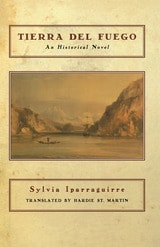
Tierra del Fuego
Sylvia Iparraguirre
Northwestern University Press, 2000
Tierra del Fuego has already won two major awards for the Spanish edition: The Sor Juana Inés de la Cruz Award for the best work of fiction written by a woman and The Best Book of the Year Award at the Buenos Aires Book Fair.
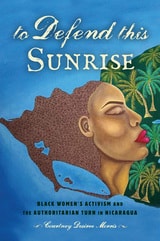
To Defend This Sunrise
Black Women’s Activism and the Authoritarian Turn in NicaraguaCourtney Desiree Morris
Rutgers University Press, 2023
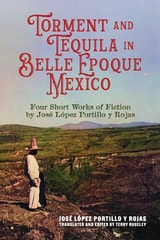
Torment and Tequila in Belle Epoque Mexico
Four Short Works of Fiction by José López Portillo y RojasJosé López Portillo y Rojas, translated and edited by Terry Rugeley
University of Alabama Press, 2025
This captivating collection of translated short works by José López Portillo y Rojas, one of Mexico’s most significant literary figures, explores themes of social frustration, loss, and heartache in late-nineteenth-century Mexico.
Torment and Tequila in Belle Epoque Mexico is the first English-language collection of selected fiction by the influential Mexican author and political figure José López Portillo y Rojas (1850–1923). His distinguished career spanned the late nineteenth century to the tumultuous years of the Mexican Revolution.
López Portillo y Rojas’s prose is characterized by rich vocabulary and fluid progression, offering readers moments of deep reflection. The stories boast finely drawn characters and evocative settings, including that of the author’s native Jalisco. He adeptly addresses the grand issues of Porfirian times, seamlessly blending social and personal themes of suffering, ambition, desire, and betrayal, and anchors his stories in the realities of human experience.
Three masterfully translated short stories and one novella make up the collection, beginning with “The Lottery Ticket,” a critique of social hypocrisy that follows a dreamer whose fortunes slip through his fingers at the hands of his own family. “The Mirror” explores the eerie depths of grief and guilt, echoing the gothic brilliance of Edgar Allan Poe. “Nieves” is a gripping novella of love and power in which a young woman’s fate becomes entangled in a decaying estate and a brewing rebellion. “The Bracelet,” examines the tragic weight of the past, as a locked piece of jewelry seals the fate of an engaged couple. These translations offer an unforgettable glimpse into one of Mexico’s most brilliant minds and restore López Portillo y Rojas to his rightful place in Mexican literary history.
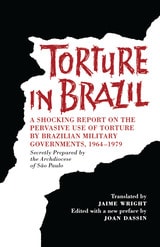
Torture in Brazil
A Shocking Report on the Pervasive Use of Torture by Brazilian Military Governments, 1964-1979, Secretly Prepared by the Archiodese of São PauloArchdiocese of São Paulo, Brazil
University of Texas Press, 1998
Winner, A Choice Outstanding Academic Book
From 1964 until 1985, Brazil was ruled by a military regime that sanctioned the systematic use of torture in dealing with its political opponents. The catalog of what went on during that grim period was originally published in Portuguese as Brasil: Nunca Mais (Brazil: Never Again) in 1985.
The volume was based on the official documentation kept by the very military that perpetrated the horrific acts. These extensive documents include military court proceedings of actual trials, secretly photocopied by lawyers associated with the Catholic Church and analyzed by a team of researchers. Their daring project—known as BNM for Brasil: Nunca Mais—compiled more than 2,700 pages of testimony by political prisoners documenting close to three hundred forms of torture.
The BNM project proves conclusively that torture was an essential part of the military justice system and that judicial authorities were clearly aware of the use of torture to extract confessions. Still, it took more than a decade after the publication of Brasil: Nunca Mais for the armed forces to admit publicly that such torture had ever taken place. Torture in Brazil, the English version of the book re-edited here, serves as a timely reminder of the role of Brazil's military in past repression.
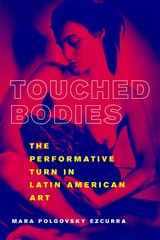
Touched Bodies
The Performative Turn in Latin American ArtMara Polgovsky Ezcurra
Rutgers University Press, 2019
Winner of the 2019 Art Journal Prize from the College Art Association
What is the role of pleasure and pain in the politics of art? In Touched Bodies, Mara Polgovsky Ezcurra approaches this question as she examines the flourishing of live and intermedial performance in Latin America during times of authoritarianism and its significance during transitions to democracy. Based on original documents and innovative readings, her book brings politics and ethics to the discussion of artistic developments during the “long 1980s”. She describes the rise of performance art in the context of feminism, HIV-activism, and human right movements, taking a close look at the work of Diamela Eltit and Raúl Zurita from Chile, León Ferrari and Liliana Maresca from Argentina, and Marcos Kurtycz, the No Grupo art collective, and Proceso Pentágono from Mexico. The comparative study of the work of these artists attests to a performative turn in Latin American art during the 1980s that, like photography and film before, recast the artistic field as a whole, changing the ways in which we perceive art and understand its role in society.
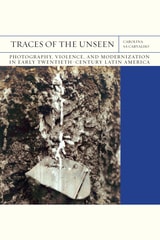
Traces of the Unseen
Photography, Violence, and Modernization in Early Twentieth-Century Latin AmericaCarolina Sá Carvalho
Northwestern University Press, 2023
Winner of the 2024 Roberto Reis Book Award
Winner of the LASA Environment Section Best Book of 2023
Winner of the LASA Amazonian Studies Section Best Book of 2024
Co-Winner of the LASA Book Award for the Visual Culture Studies 2024
A richly illustrated examination of photography as a technology for documenting, creating, and understanding the processes of modernization in turn-of-the-century Brazil and the Amazon
Photography at the turn of the twentieth century was not only a product of modernity but also an increasingly available medium to chronicle the processes of modernization. Traces of the Unseen: Photography, Violence, and Modernization in Early Twentieth-Century Latin America situates photography’s role in documenting the destruction wrought by infrastructure development and extractive capitalist expansion in the Amazon and outside the Brazilian metropole. Combining formal analysis of individual photographs with their inclusion in larger multimedia assemblages, Carolina Sá Carvalho explores how this visual evidence of violence was framed, captioned, cropped, and circulated. As she explains, this photographic creation and circulation generated a pedagogy of the gaze with which increasingly connected urban audiences were taught what and how to see: viewers learned to interpret the traces of violence captured in these images within the larger context of modernization.
Traces of the Unseen draws on works by Flavio de Barros, Euclides da Cunha, Roger Casement, Claude Lévi-Strauss, and Mario de Andrade to situate an unruly photographic body at the center of modernity, in all its disputed meanings. Moreover, Sá Carvalho locates historically specific practices of seeing within the geopolitical peripheries of capitalism. What emerges is a consideration of photography as a technology through which modern aspirations, moral inclinations, imagined futures, and lost pasts were represented, critiqued, and mourned.
Transforming Rural Water Governance
The Road from Resource Management to Political Activism in NicaraguaSarah T. Romano
University of Arizona Press, 2019
In Transforming Rural Water Governance Sarah T. Romano explains the bottom-up development and political impact of community-based water and sanitation committees (CAPS) in Nicaragua. Romano traces the evolution of CAPS from rural resource management associations into a national political force through grassroots organizing and strategic alliances.
Resource management and service provision is inherently political: charging residents fees for service, determining rules for household water shutoffs and reconnections, and negotiating access to water sources with local property owners constitute just a few of the highly political endeavors resource management associations like CAPS undertake as part of their day-to-day work in their communities. Yet, for decades in Nicaragua, this local work did not reflect political activism. In the mid-2000s CAPS’ collective push for social change propelled them onto a national stage and into new roles as they demanded recognition from the government.
Romano argues that the transformation of Nicaragua’s CAPS into political actors is a promising example of the pursuit of sustainable and equitable water governance, particularly in Latin America. Transforming Rural Water Governance demonstrates that when activism informs public policy processes, the outcome is more inclusive governance and the potential for greater social and environmental justice.
Transforming Therapy
Mental Health Practice and Cultural Change in MexicoWhitney L. Duncan
Vanderbilt University Press, 2018
How does one explain the recent growth of Euroamerican-style therapies in the region? Author Whitney L. Duncan analyzes this phenomenon of "psy-globalization" and develops a rich ethnography of its effects on Oaxacans' understandings of themselves and their emotions, ultimately showing how globalizing forms of care are transformative for and transformed by the local context. She also delves into the mental health impacts of migration from Mexico to the United States, both for migrants who return and for the family members they leave behind.
This book is a recipient of the Norman L. and Roselea J. Goldberg Prize from Vanderbilt University Press for the best book in the area of medicine.
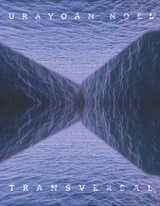
Transversal
PoemsUrayoán Noel
University of Arizona Press, 2021
Featuring Noel’s bilingual playfulness, intellect, and irreverent political imagination, Transversal contains personal reflections on love, desire, and loss filtered through a queer approach to form, expanding upon Noel’s experiments with self-translation in his celebrated collection Buzzing Hemisphere/Rumor Hemisférico. This collection explores walking poems improvised on a smartphone, as well as remixed classical and experimental forms. Poems are presented in interlocking bilingual versions that complicate the relationship between translation and original, and between English and Spanish as languages of empire and popular struggle. The book creatively examines translation and its simultaneous urgency and impossibility in a time of global crisis.
Transversal seeks to disrupt standard English and Spanish, and it celebrates the nonequivalence between languages. Inspired by Caribbean poet and philosopher Édouard Glissant, the collection celebrates Caribbean practices of creolization as maximalist, people-centered, affect-loaded responses to the top-down violence of austerity politics. This groundbreaking, modular approach to poetic translation opens up alternative ways of reading in any language.
Traslados/Translations
Essays on Latin America in Honour of Jason WilsonEdited by Claire Lindsay
University of London Press, 2012