Results by title
425 books match the query 'Ethics' and 116 start with t
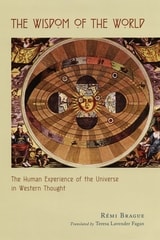
The Wisdom of the World
The Human Experience of the Universe in Western ThoughtRémi Brague
University of Chicago Press, 2003
Before the Greeks, people thought human action was required to maintain the order of the universe and so conducted rituals and sacrifices to renew and restore it. But beginning with the Hellenic Age, the universe came to be seen as existing quite apart from human action and possessing, therefore, a kind of wisdom that humanity did not. Wearing his remarkable erudition lightly, Brague traces the many ways this universal wisdom has been interpreted over the centuries, from the time of ancient Egypt to the modern era. Socratic and Muslim philosophers, Christian theologians and Jewish Kabbalists all believed that questions about the workings of the world and the meaning of life were closely intertwined and that an understanding of cosmology was crucial to making sense of human ethics. Exploring the fate of this concept in the modern day, Brague shows how modernity stripped the universe of its sacred and philosophical wisdom, transforming it into an ethically indifferent entity that no longer serves as a model for human morality.
Encyclopedic and yet intimate, The Wisdom of the World offers the best sort of history: broad, learned, and completely compelling. Brague opens a window onto systems of thought radically different from our own.
The Wounded Storyteller
Body, Illness, and EthicsArthur W. Frank
University of Chicago Press, 1995
Ill people are more than victims of disease or patients of medicine; they are wounded storytellers. People tell stories to make sense of their suffering; when they turn their diseases into stories, they find healing.
Drawing on the work of authors such as Oliver Sacks, Anatole Broyard, Norman Cousins, and Audre Lorde, as well as from people he met during the years he spent among different illness groups, Frank recounts a stirring collection of illness stories, ranging from the well-known—Gilda Radner's battle with ovarian cancer—to the private testimonials of people with cancer, chronic fatigue syndrome, and disabilties. Their stories are more than accounts of personal suffering: they abound with moral choices and point to a social ethic.
Frank identifies three basic narratives of illness in restitution, chaos, and quest. Restitution narratives anticipate getting well again and give prominence to the technology of cure. In chaos narratives, illness seems to stretch on forever, with no respite or redeeming insights. Quest narratives are about finding that insight as illness is transformed into a means for the ill person to become someone new.
The Wounded Storyteller
Body, Illness, and Ethics, Second EditionArthur W. Frank
University of Chicago Press, 1997
Drawing on the work of authors such as Oliver Sacks, Anatole Broyard, Norman Cousins, and Audre Lorde, as well as from people he met during the years he spent among different illness groups, Frank recounts a stirring collection of illness stories, ranging from the well-known—Gilda Radner's battle with ovarian cancer—to the private testimonials of people with cancer, chronic fatigue syndrome, and disabilities. Their stories are more than accounts of personal suffering: they abound with moral choices and point to a social ethic.
In this new edition Frank adds a preface describing the personal and cultural times when the first edition was written. His new afterword extends the book’s argument significantly, writing about storytelling and experience, other modes of illness narration, and a version of hope that is both realistic and aspirational. Reflecting on both his own life during the creation of the first edition and the conclusions of the book itself, Frank reminds us of the power of storytelling as way to understanding our own suffering.
Themes in Kant's Metaphysics and Ethics
Arthur Melnick
Catholic University of America Press, 2004
Thinking About Morality
William K. Frankena
University of Michigan Press, 1980
Thomas Stamford Raffles
Schemer or Reformer?Syed Hussein Alatas
National University of Singapore Press, 2020
This is not a new question—in fact, it was considered at length as far back as 1971, in Syed Hussein Alatas’s slim but devastating volume Thomas Stamford Raffles: Schemer or Reformer?. While the book failed to spark a wide debate on Raffles’s legacy in 1970s Singapore, nearly 50 years after its original publication this powerful work feels wholly fresh and relevant. This edition features a new introduction by Syed Farid Alatas assessing contemporary Singapore’s take on Raffles, and how far we have, or have not, come in thinking through Singapore’s colonial legacy.
Torture and Dignity
An Essay on Moral InjuryJ. M. Bernstein
University of Chicago Press, 2015
Beginning with the attempts to abolish torture in the eighteenth century, and then sensitively examining what is suffered in torture and related transgressions, such as rape, Bernstein elaborates a powerful new conception of moral injury. Crucially, he shows, moral injury always involves an injury to the status of an individual as a person—it is a violent assault against his or her dignity. Elaborating on this critical element of moral injury, he demonstrates that the mutual recognitions of trust form the invisible substance of our moral lives, that dignity is a fragile social possession, and that the perspective of ourselves as potential victims is an ineliminable feature of everyday moral experience.
Toward a Philosophy of the Act
By M. M. Bakhtin
University of Texas Press, 1993
Rescued in 1972 from a storeroom in which rats and seeping water had severely damaged the fifty-year-old manuscript, this text is the earliest major work (1919-1921) of the great Russian philosopher M. M. Bakhtin. Toward a Philosophy of the Act contains the first occurrences of themes that occupied Bakhtin throughout his long career. The topics of authoring, responsibility, self and other, the moral significance of "outsideness," participatory thinking, the implications for the individual subject of having "no-alibi in existence," the difference between the world as experienced in actions and the world as represented in discourse—all are broached here in the heat of discovery. This is the "heart of the heart" of Bakhtin, the center of the dialogue between being and language, the world and mind, "the given" and "the created" that forms the core of Bakhtin's distinctive dialogism.
A special feature of this work is Bakhtin's struggle with the philosophy of Immanuel Kant. Put very simply, this text is an attempt to go beyond Kant's formulation of the ethical imperative. mci will be important for scholars across the humanities as they grapple with the increasingly vexed relationship between aesthetics and ethics.
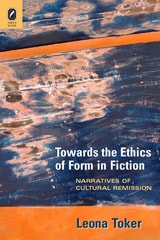
Towards the Ethics of Form in Fiction
Narratives of Cultural RemissionLeona Toker
The Ohio State University Press, 2010
Toker is especially interested in cultural remissions such as the carnivalesque—that is, the inverting of standard cultural hierarchies or the blurring of boundaries between normally separated social groups, actors and audiences, self and other. She argues that cultural remissions have the potential not simply to provide a break from the determinacies of our quotidian existence but also to return us to that existence with some alteration of our perceptions, beliefs, and values. Toker contends that the ethical consequences of reading fiction result from features of its aesthetics, particularly what she calls, following the semiotician Louis Hjemslev, “the form of the content”—the patterns arising from the artistic deployment of narrative details. In addition to addressing the carnivalesque discourse of Bakhtin as well as the theory of oppositionality developed by de Certeau and Chambers, she puts theory into practice through detailed analyses of canonical texts by Fielding, Sterne, Austen, Hawthorne, Dickens, Conrad, Joyce, and other writers.
Trade-Offs
An Introduction to Economic ReasoningHarold Winter
University of Chicago Press, 2023
The highly engaging introduction to thinking like an economist, updated for a new generation of readers.
When economists wrestle with any social issue—be it unemployment, inflation, healthcare, or crime and punishment—they do so impersonally. The big question for them is: what are the costs and benefits, or trade-offs, of the solutions to such matters? These trade-offs constitute the core of how economists see the world—and make the policies that govern it.
Trade-Offs is an introduction to the economic approach of analyzing controversial policy issues. A useful introduction to the various factors that inform public opinion and policymaking, Trade-Offs is composed of case studies on topics drawn from across contemporary law and society.
Intellectually stimulating yet accessible and entertaining, Trade-Offs will be appreciated by students of economics, public policy, health administration, political science, and law, as well as by anyone following current social policy debates.
Trade-Offs
An Introduction to Economic Reasoning and Social IssuesHarold Winter
University of Chicago Press, 2005
Harold Winter provides readers with the analytical tools needed to identify and understand the trade-offs associated with these topics. By considering both the costs and benefits of potential policy solutions, Winter stresses that real-world policy decision making is best served by an explicit recognition of as many trade-offs as possible.
Intellectually stimulating yet accessible and entertaining, Trade-Offs will be appreciated by students of economics, public policy, health administration, political science, and law, as well as by anyone who follows current social policy debates.

Trade-Offs
An Introduction to Economic Reasoning and Social Issues, Second EditionHarold Winter
University of Chicago Press, 2013
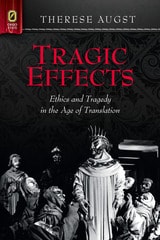
Tragic Effects
Ethics and Tragedy in the Age of TranslationTherese Augst
The Ohio State University Press, 2012
Tragic Effects: Ethics and Tragedy in the Age of Translation confronts the peculiar fascination with Greek tragedy as it shapes the German intellectual tradition, with particular focus on the often controversial practice of translating the Greeks. Whereas the tradition of emulating classical ideals in German intellectual life has generally emerged from the impulse to identify with models, the challenge of translating the Greeks underscores the linguistic and historical discontinuities inherent in the recourse to ancient material and inscribes that experience of disruption as fundamental to modernity.
Friedrich Hölderlin’s translations are a case in point. Regarded in his own time as the work of a madman, his renditions of Sophoclean tragedy intensify dramatic effect with the unsettling experience of familiar language slipping its moorings. His attention to marking the distances between ancient source text and modern translation has granted his Oedipus and Antigone a distinct longevity as objects of discussion, adaptation, and even retranslation. Cited by Walter Benjamin, Martin Heidegger, Bertolt Brecht, and others, Hölderlin’s Sophocles project follows a path both marked by various contexts and tinged by persistent quandaries of untranslatability.
Tragedy has long functioned as a cornerstone for questions about ethical life. By placing emphasis on processes of translation and adaptation, however, Tragic Effects approaches the question of ethics from a perspective informed by recent discourse in translation studies. Reconstructing an ancient text in this context requires negotiating the difficult tension between comprehending the distant past and preserving its radical singularity.
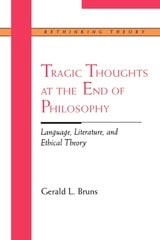
Tragic Thoughts at the End of Philosophy
Language, Literature, and Ethical TheoryGerald L. Bruns
Northwestern University Press, 1999
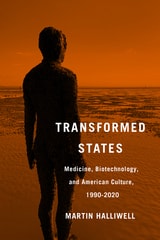
Transformed States
Medicine, Biotechnology, and American Culture, 1990–2020Martin Halliwell
Rutgers University Press, 2025
Transformed States offers a timely history of the politics, ethics, medical applications, and cultural representations of the biotechnological revolution, from the Human Genome Project to the COVID-19 pandemic. In exploring the entanglements of mental and physical health in an age of biotechnology, it views the post–Cold War 1990s as the horizon for understanding the intersection of technoscience and culture in the early twenty-first century.
The book draws on original research spanning the presidencies of George H. W. Bush and Joe Biden to show how the politics of science and technology shape the medical uses of biotechnology. Some of these technologies reveal fierce ideological conflicts in the arenas of cloning, reproduction, artificial intelligence, longevity, gender affirmation, vaccination and environmental health. Interweaving politics and culture, the book illustrates how these health issues are reflected in and challenged by literary and cinematic texts, from Oryx and Crake to Annihilation, and from Gattaca to Avatar.
By assessing the complex relationship between federal politics and the biomedical industry, Transformed States develops an ecological approach to public health that moves beyond tensions between state governance and private enterprise. To that end, Martin Halliwell analyzes thirty years that radically transformed American science, medicine, and policy, positioning biotechnology in dialogue with fears and fantasies about an emerging future in which health is ever more contested.
Along with the two earlier books, Therapeutic Revolutions (2013) and Voices of Mental Health (2017), Transformed States is the final volume of a landmark cultural and intellectual history of mental health in the United States, journeying from the combat zones of World War II to the global emergency of COVID-19.
Troubled Bodies
Critical Perspectives on Postmodernism, Medical Ethics, and the BodyPaul A. Komesaroff
Duke University Press, 1995
These essays examine the ways in which the consideration of ethical questions is shaped by the structures of knowledge and communication at work in clinical practice, by current assumptions regarding the concept of the body, and by the social and political implications of both. Representing various perspectives including medicine, nursing, philosophy, and sociology, these essays look anew at issues of abortion, reproductive technologies, the doctor-patient relationship, the social construction of illness, the cultural assumptions and consequences of medicine, and the theoretical presuppositions underlying modern psychiatry. Diverging from the tenets of mainstream bioethics, Troubled Bodies suggests that, rather than searching for the correct "coherent perspective" from which to draw ethical principles, we must apprehend the complexity and diversity of the discursive systems within which we dwell.