Results by title
2706 books match the query 'European' and 622 start with t

The Complete Works of Robert Browning, Volume IX
With Variant Readings and AnnotationsRobert Browning
Ohio University Press, 1990
The Complete Works of Robert Browning, Volume V
With Variant Readings and AnnotationsRoma A. King Jr.
Ohio University Press, 1981
The Complete Works of Robert Browning, Volume VI
With Variant Readings and AnnotationsRobert Browning
Ohio University Press, 1996
In seventeen volumes, copublished with Baylor University, this acclaimed series features annotated texts of all of Robert Browning’s known writing. The series encompasses autobiography as well as influences bearing on Browning’s life and career and aspects of Victorian thought and culture.
The sixth in the projected seventeen-volume work, this volume covers the second half of Men and Women (1855), perhaps Browning’s most famous collection, and the entirety of Dramatis Personae (1864), the first book Browning produced after the death of Elizabeth Barrett Browning in 1861.
Men and Women II contains several great dramatic poems on which Browning’s reputation still depends, including “Andrea del Sarto,” “Saul,” and “Cleon.” It also includes the more intimate and personal works “The Guardian Angel” and “One Word More,” as well as the mysterious “Women and Roses.” The Brownings‘ shared interests in Renaissance art and nineteenth-century Italian politics inform the challenging “Old Pictures in Florence.”
The publication of Dramatis Personae was a key event in the rapid rise of Browning’s fame in the 1860s, though the collection is marked by a welter of conflicting impulses that arose after the poet left Italy and his married life behind. The classic monologues “Rabbi Ben Ezra” and “Abt Vogler” are here, but beside them Browning placed the nearly surreal “Caliban upon Setebos” and the achingly self-regarding “James Lee’s Wife,” one of the volume’s handful of dramatic lyrics about betrayed or failed relationships. Also included are “A Death in the Desert,” which contributed to the intense Victorian debate about scriptural validity and religious authority; and “Mr Sludge, ’The Medium,‘” Browning’s ferocious, pyrotechnic exposé of a spiritualist fraud.
As always in this acclaimed series, a complete record of textual variants is provided, as well as extensive explanatory notes.
The Complete Works of Robert Browning, Volume VII
With Variant Readings and AnnotationsRobert Browning
Ohio University Press, 1985
The first complete edition of the works of Robert Browning with variant readings and annotations contains: 1. The entire contents of the first editions of Browning’s work; 2. All prefaces and dedications which Browning wrote for his own works and for those of Elizabeth Barrett Browning and others; 3. The two prose essays: The Essay on Chatterton and The Essay on Shelley; 4. The front matter and tables of contents of each of the collected editions (1849, 1863, 1865, 1868, 1888–1889) which Browning himself saw through the press; 5 Poems by Browning published during his lifetime but not collected by him; 9. Poems not published during Browning’s lifetime which have come to light since his death; 7. John Forster’s Thomas Wentworth, Earl of Strafford to which Browning contributed significantly, though to what precise extent has not been determined.
The edition provides a full apparatus, including variant readings and annotations.
The Complete Works of Robert Browning, Volume X
With Variant Readings and AnnotationsRobert Browning
Ohio University Press, 1999
Browning began a poem on Louis Napoleon in 1860, but not until after the fall of the Second Empire in 1870 did he attempt a full-scale portrait of the French emperor. As an exercise in self-justification, Prince Hohenstiel-Schwangau falls into a familiar sub-genre of Browning's dramatic monologues. The most intriguing aspect of the poem lies in its biographical importance: the character and career of Napoleon III was a topic of sustained, sharp disagreement between Robert and Elizabeth Browning.
As always in this acclaimed series, a complete record of textual variants is provided, as well as extensive explanatory notes.
The Complete Works of Robert Browning, Volume XI
With Variant Readings and AnnotationsRobert Browning
Ohio University Press, 2008
In seventeen volumes, copublished with Baylor University, this acclaimed series features annotated texts of all of Robert Browning’s known writing. The series encompasses autobiography as well as influences bearing on Browning’s life and career and aspects of Victorian thought and culture.
Volume XI of The Complete Works of Robert Browning contains two strikingly disparate long poems from the 1870s, Fifine at the Fair and Red Cotton Night-Cap Country. In Fifine at the Fair, Browning creates an idiosyncratic version of the Don Juan figure, a distinctly post-Romantic and intellectual Don Juan who derives little from any literary predecessor. The legendary character is realized in a modern French setting, the village of Pornic, a favorite vacation spot for Browning. The poem is a sustained exercise in self-justification and casuistry, with Don Juan persuading himself that he can reconcile his love of his wife with his carnal love for a gipsy girl.
Though Red Cotton Night-Cap Country is similarly concerned with a struggle between spirit and flesh, the poem is entirely based in contemporary events. Using newspaper accounts and legal documents, Browning tells the strange and shocking tale of a rich and devout Frenchman who throws himself from the roof of his chateau, convinced that heaven will deliver him from death. Upon the question of his sanity hinges the disposition of his considerable estate, and the poet traces the claims and counterclaims to their settlement in court only a few months before he wrote the poem.
As always in this series of critical editions, a complete record of textual variants is provided, as well as extensive explanatory notes.
The Complete Works of Robert Browning, Volume XIII
With Variant Readings and AnnotationsRobert Browning
Ohio University Press, 1995
The Complete Works of Robert Browning, Volume XIV
With Variant Readings and AnnotationsRobert Browning
Ohio University Press, 2003
In seventeen volumes, copublished with Baylor University, this acclaimed series features annotated texts of all of Robert Browning’s known writing. The series encompasses autobiography as well as influences bearing on Browning’s life and career and aspects of Victorian thought and culture.
Volume XIV of The Complete Works of Robert Browning records a transition in the poet’s career. With The Agamemnon of Aeschylus (1877), Browning ended his experiments with classical sources, creating his “transcript” — not quite a translation — of the Greek original and providing an intriguing explanation for his approach. La Saisiaz, the deeply personal expression of Browning’s shock at the sudden death of a dear friend, was published in 1878 with The Two Poets of Croisic, an extended ironic meditation on literary fame. Browning’s collection of six poems under the title Dramatic Idyls (1879) marks the poet’s return to the dramatic forms he perfected in Men and Women and Dramatis Personae, and a revival of his interest in the psychology of motives.
As always in this acclaimed series, a complete record of textual variants is provided, as well as extensive explanatory notes.
The Complete Works of Robert Browning, Volume XV
With Variant Readings and AnnotationsRobert Browning
Ohio University Press, 2007
The Complete Works of Robert Browning, Volume XVI
With Variant Readings and AnnotationsRobert Browning
Ohio University Press, 1998
In seventeen volumes, copublished with Baylor University, this acclaimed series features annotated texts of all of Robert Browning’s known writing. The series encompasses autobiography as well as influences bearing on Browning’s life and career and aspects of Victorian thought and culture.
Robert Browning wrote Parleyings with Certain People of Importance in Their Day in his seventy-third year. The work is a capstone to the poet’s long career, encompassing autobiography as well as influences bearing on the poet’s life and career and on Victorian thought and culture in general. One of Browning’s most complex works, Parleyings is also a work essential to understanding his genius and career as a whole. The Ohio/Baylor Browning edition offers keys to the complexity and interest of Parleyings through a definitive, emended text, full annotations for allusions both explicit and implicit in the text, and variant readings for the manuscript and all editions revised by Browning during his lifetime.
In form and structure, Parleyings is a series of seven poems written in Browning’s own voice and addressed to figures influential in his development. The series is framed by a prologue and an epilogue, the whole amounting to some 3,500 lines. The poems are a formal contrast and a pendant to the great series of linked dramatic monologues in The Ring and the Book. They demonstrate the zest for innovation possessed by the master of the dramatic monologue in his ripe maturity. Interested readers as well as students and scholars of Browning will find a rich field of poetry and a critical mass of resources in Volume XVI of the Ohio/Baylor Browning edition.
As always in this acclaimed series, a complete record of textual variants is provided, as well as extensive explanatory notes.
The Complete and Original Norwegian Folktales of Asbjørnsen and Moe
Peter Christen Asbjørnsen
University of Minnesota Press, 2019
The definitive English translation of the celebrated story collection regarded as a landmark of Norwegian literature and culture—now in paperback
The extraordinary folktales collected by Peter Christen Asbjørnsen and Jørgen Moe began appearing in Norway in 1841. Over the next two decades the publication of subsequent editions under the title Norske folkeeventyr made the names Asbjørnsen and Moe synonymous with Norwegian storytelling traditions. Tiina Nunnally’s vivid translation of their monumental collection is the first new English translation in more than 150 years—and the first ever to include all sixty original tales.
Magic and myth inhabit these pages in figures both familiar and strange. Giant trolls and talking animals are everywhere. The winds take human form. A one-eyed old woman might seem reminiscent of the Norse god Odin. We meet sly aunts, resourceful princesses, and devious robbers. The clever and fearless boy Ash Lad often takes center stage as he ingeniously breaks spells and defeats enemies to win half the kingdom. These stories, set in Norway’s majestic landscape of towering mountains and dense forests, are filled with humor, mischief, and sometimes surprisingly cruel twists of fate. All are rendered in the deceptively simple narrative style perfected by Asbjørnsen and Moe—now translated into an English that is as finely tuned to the modern ear as it is true to the original Norwegian.
Included here—for the very first time in English—are Asbjørnsen and Moe’s Forewords and Introductions to the early Norwegian editions of the tales. Asbjørnsen gives us an intriguing glimpse into the actual collection process and describes how the stories were initially received, both in Norway and abroad. Equally fascinating are Moe’s views on how central characters might be interpreted and his notes on the regions where each story was originally collected. Nunnally’s informative Translator’s Note places the tales in a biographical, historical, and literary context for the twenty-first century.
The Norwegian folktales of Asbjørnsen and Moe are timeless stories that will entertain, startle, and enthrall readers of all ages.
The Conquest of Ruins
The Third Reich and the Fall of RomeJulia Hell
University of Chicago Press, 2019
Hell examines centuries of European empire-building—from Charles V in the sixteenth century and Napoleon’s campaigns of the late seventeenth and early eighteenth centuries to the atrocities of Mussolini and the Third Reich in the 1930s and ’40s—and sees a similar fascination with recreating the Roman past in the contemporary image. In every case—particularly that of the Nazi regime—the ruins of Rome seem to represent a mystery to be solved: how could an empire so powerful be brought so low? Hell argues that this fascination with the ruins of greatness expresses a need on the part of would-be conquerors to find something to ward off a similar demise for their particular empire.
The Context of Ancient Drama
Eric Csapo and William J. Slater
University of Michigan Press, 1995

The Continental Model
Selected French Critical Essays of the Seventeenth Century in English TranslationScott Elledge and Donald Schier, Editors
University of Minnesota Press, 1960
The Continental Model was first published in 1960. Minnesota Archive Editions uses digital technology to make long-unavailable books once again accessible, and are published unaltered from the original University of Minnesota Press editions.
The pervasive influence of seventeenth-century French criticism upon eighteenth-century English criticism makes it important for students of English and comparative literature to be familiar with the most important of the French works. Professors Elledge and Schier bring together here, in translation, some of the best examples of the French essays. They have chosen particularly works that are not otherwise available in translation.
Some of the translations are by contemporaries of the period. These are of works by d'Aubignac, Saint-Evremond, Huet, Rapin, Le Bossu, Bouhours, La Bruyere, and Fontenelle. Other selections have been translated by Professor Schier, and these include works of Chapelain, Sarasin, Scudery, Corneille, Bouhours, and Fontenelle.
The editors provide brief and pertinent comment on each writer and his place in literary history. They have also annotated the essays in order to save time for the reader who encounters references to other literatures not immediately clear to him. The volume as a whole provides a comprehensive and balanced selection of critical texts which were known to, used by, and significant in their influence upon writers such as Dryden, Dennis, Addison, Swift, Pope, and others.
The Converting Imagination
Linguistic Theory and Swift's Satiric ProseMarilyn Francus
Southern Illinois University Press, 1994
By illuminating Jonathan Swift’s fascination with language, Marilyn Francus shows how the linguistic questions posed by his work are at the forefront of twentieth-century literary criticism: What constitutes meaning in language? How do people respond to language? Who has (or should have) authority over language? Is linguistic value synonymous with literary value?
Francus starts with a detailed analysis of Swift’s linguistic education, which straddled a radical transition in linguistic thought, and its effect on his prose. This compelling beginning includes sometimes surprising historical information about the teaching and learning of linguistics and language theory in the seventeenth and eighteenth centuries. Swift’s academic studies reflected the traditional universalist view that seeks an Adamic language to reverse the fragmentation of Babel and achieve epistemological unity. But Swift’s tutor also exposed him to the contemporary linguistics of the scientific societies and of John Locke, who argued that the assignment of linguistic meaning is arbitrary and subjective, capturing an individual’s understanding at a particular instant. These competing theories, Francus maintains, help explain the Irish writer’s conflicting inclinations toward both linguistic order and freewheeling creativity.
To develop a complete vision of Swiftian linguistics, Francus focuses on A Tale of a Tub as the archetypal linguistic text in the Swift canon, but she also includes evidence from his other famous works, including Gulliver’s Travels, A Modest Proposal, Journal to Stella, and The Bickerstaff Papers, as well as from his lesser known religious and political tracts and his correspondence. In addition, Francus draws on the relevant work of contemporary linguists (such as Wilkins, Watts, Dyche, and Stackhouse), philosophers (Hobbes and Locke), and authors (including Temple, Sprat, Dryden, Pope, Addison, and Defoe).
Francus concludes that Swift occupies a pivotal place in literary history: his conscious emphasis on textuality and extended linguistic play anticipates not only the future of satiric prose but the modern novel as well.
The Corporate Commonwealth
Pluralism and Political Fictions in England, 1516-1651Henry S. Turner
University of Chicago Press, 2016
Henry S. Turner uses the resources of economic and political history, literary analysis, and political philosophy to demonstrate how a number of English institutions with corporate associations—including universities, guilds, towns and cities, and religious groups—were gradually narrowed to the commercial, for-profit corporation we know today, and how the joint-stock corporation, in turn, became both a template for the modern state and a political force that the state could no longer contain. Through innovative readings of works by Thomas More, William Shakespeare, Francis Bacon, and Thomas Hobbes, among others, Turner tracks the corporation from the courts to the stage, from commonwealth to colony, and from the object of utopian fiction to the subject of tragic violence. A provocative look at the corporation’s peculiar character as both an institution and a person, The Corporate Commonwealth uses the past to suggest ways in which today’s corporations might be refashioned into a source of progressive and collective public action.
The Correspondence of Johann Amerbach
Early Printing in its Social ContextSelected, Translated, Edited, and with Commentary by Barbara C. Halporn
University of Michigan Press, 2000
Between 1478 and 1513 Amerbach published more than a hundred substantial works. He is best known for his monumental editions of the works of early church fathers. Crucial to his success was the information network he kept through correspondence with scholars, teachers, printers, booksellers, library curators, and other members of the literate community. The letters reveal how books were made, by whom, and for whom. The Correspondence of Johann Amerbach allows us to see the tensions in the new alliance between commerce and the republic of letters. Filling out the scene more fully, letters between the Amerbach children and their parents tell of the daily life, expectations, and aspirations of an intellectual bourgeois family at the end of the fifteenth century.
Barbara C. Halporn is Head of the Collection Development Department, Widener Library, Harvard University.
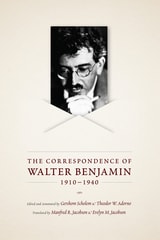
The Correspondence of Walter Benjamin, 1910-1940
Walter Benjamin
University of Chicago Press, 1994
A powerful, mesmerizing collection of letters from one of the most important intellectuals and writers of the twentieth century
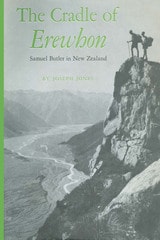
The Cradle of Erewhon
Samuel Butler in New ZealandBy Joseph Jones
University of Texas Press, 1959
In 1859, Samuel Butler, a young Cantabrigian out of joint with his family, with the church, and with the times, left England to hew out his own path in New Zealand. At the end of just five years he returned, with a modest fortune in money and an immense fortune in ideas. For out of this self-imposed exile came Erewhon, one of the world's masterpieces of satire, which contained the germ of Butler's intellectual output for the next twenty years.
The Cradle of Erewhon is an examination and interpretation of the special ways in which these few crucial years affected Butler's life and work, particularly Erewhon and Erewhon Revisited. It shows us Butler the sheep farmer, explorer, and mountain climber, as well as Butler the newcomer to "The Colonies," accepting—and accepted by—his intellectual peers in the unpioneerlike little city of Christchurch, sharpening and disciplining his mind through his controversial contributions to the Christchurch Press. But more importantly, the book suggests the depth to which New Zealand penetrated the man and reveals new facets of influence hitherto unnoticed in Erewhon and Erewhon Revisited. The Southern Alps ("Oh, Wonderful! Wonderful! so lonely and so solemn"), the perilous rivers and passes, the character and customs of the Maoris—all these blend to afford new insights into a complex book. Butler was not the first to create an imaginary world as asylum from the harsh realities of this one (Vergil did the same in the Eclogues), nor was he the first, even in his own time, to protest against the machine as the enslaver of man, but his became the clearest and the freshest voice.
On the biographical side, The Cradle of Erewhon offers new evidence for reappraising the man who for so long has been a psychological and literary puzzle. Why, for instance, did he repudiate his first-born book, A First Year in Canterbury Settlement? And why, once safely away from the entanglements of London, did he voluntarily return to them? Answers to these and other Butlerian riddles are suggested in the engrossing account of the satirist's sojourn in the Antipodes.
The Crime of Jean Genet
Dominique Eddé
Seagull Books, 2016
Dominique Eddé met novelist and playwright Jean Genet in the 1970s. And she never forgot him. “His presence,” she writes, “gave me the sensation of icy fire. Like his words, his gestures were full, calculated, and precise. . . . Genet’s movements mimicked the movement of time, accumulating rather than passing.”
This book is Eddé’s account of that meeting and its ripples through her years of engaging with Genet’s life and work. Rooted in personal reminiscences, it is nonetheless much broader, offering a subtle analysis of Genet’s work and teasing out largely unconsidered themes, like the absence of the father, which becomes a metaphor for Genet’s perpetual attack on the law. Tying Genet to Dostoevsky through their shared fascination with crime, Eddé helps us more clearly understand Genet’s relationship to France and Palestine, Judaism, Christianity, Islam, the theater, and even death. A powerful personal account of the influence of one writer on another, The Crime of Jean Genet is also one of the most penetrating explorations yet of Genet’s work and achievement.

The Crisis of Action in Nineteenth-Century English Literature
Stefanie Markovits
The Ohio State University Press, 2006
The Cultural Milieu of Addison's Literary Criticism
By Lee Andrew Elioseff
University of Texas Press, 1963
The whole history of literary criticism is illuminated by this analysis of one English critic’s work. It is, in effect, a literary case study presented as partial answer to the complicated question: what cultural conditions are conducive to the development of a particular theory of literature?
Initially, Lee Andrew Elioseff defines four difficult responsibilities of the historian of criticism: the interpretation of his material in terms of all the cultural circumstances that produced it; elimination of the purely chance elements, such as private feuds and unimportant personal tastes; consideration of those aspects of criticism that best indicate the dominant critical opinions of the age and the principles that are leading it; and illumination of the present critical situation.
Concentrating upon the first three of these obligations, Elioseff seeks the sources of modern literary criticism in the works of Joseph Addison and his contemporaries, analyzing with great care and accuracy their responses to problems—both literary and nonliterary—in their culture. From the analysis, Addison emerges as a very significant figure: a critic who moved from Renaissance and neoclassical humanism and became one of the most important predecessors of romantic criticism; a formulator of what was to become the “emotive strain” in literary criticism; an essayist who raised many problems shared by the “modern” psychological critic whose immediate concern is the effect of the literature upon its audience.
Drawing abundantly from a wide knowledge of philosophy, literature, and history, and exercising an incisive critical acumen, Elioseff discusses Addison’s criticism in three aspects: “The Critical Milieu,” an interpretation of Addison’s relation to his age as it influenced his views on tragedy, epic poetry, and ballads; “Addison and Eighteenth-Century England,” a consideration of contemporary political thought, morals, and theology; and the “Empirical Tradition,” an analysis of Addison’s critical views as expressed in The Pleasures of the Imagination.
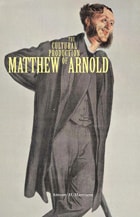
The Cultural Production of Matthew Arnold
Antony H. Harrison
Ohio University Press, 2009
The career of Matthew Arnold as an eminent poet and the preeminent critic of his generation constitutes a remarkable historical spectacle orchestrated by a host of powerful Victorian cultural institutions.
The Cultural Production of Matthew Arnold investigates these constructions by situating Arnold’s poetry in a number of contexts that partially shaped it. Such analysis revises our understanding of the formation of the elite (and elitist) male literary-intellectual subject during the 1840s and 1850s, as Arnold attempts self-definition and strives simultaneously to move toward a position of ideological influence upon intellectual institutions that were contested sites of economic, social, and political power in his era.
Antony H. Harrison reopens discussion of selected works by Arnold in order to make visible some of their crucial sociohistorical, intertextual, and political components. Only by doing so can we ultimately view the cultural work of Arnold “steadily and … whole,” and in a fashion that actually eschews this mystifying premise of all Arnoldian inquiry which, by the early twentieth century, had become wholly naturalized in the academy as ideology.
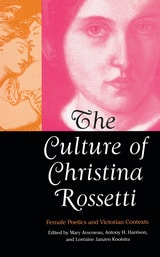
The Culture of Christina Rossetti
Female Poetics and Victorian ContextsMary Arseneau
Ohio University Press, 1999
The Culture of Christina Rossetti explores a “new” Christina Rossetti as she emerges from the scrutiny of the particular historical and cultural context in which she lived and wrote. The essays in this collection demonstrate how the recluse, saint, and renunciatory spinster of former studies was in fact an active participant in her society’s attempt to grapple with new developments in aesthetics, theology, science, economics, and politics.
The volume examines Rossetti’s poetry, fiction, and nonfiction from a variety of theoretical and critical perspectives in order to reevaluate her place in the Victorian world of art, literature, and ideas. The essays offer a radical rethinking of her best-known poems, retrieve neglected works, establish the diversity of her writing, and reposition Rossetti within a canon continually under formation.
Contributing to the ongoing retrieval of the nineteenth-century woman poet, The Culture of Christina Rossetti highlights Rossetti’s responses to both male and female literary traditions and explores her incorporation and revision of literary influences from medieval Italian sources to contemporary writers.
The Culture of Disaster
Marie-Hélène Huet
University of Chicago Press, 2012
The Culture of Neural Networks
Synthetic Literature and Art in (Not Only) the Czech and Slovak ContextZuzana Husárová and Karel Piorecký
Karolinum Press, 2024
The possibilities of generated cultural production have undergone fundamental changes in recent years, leading to a rethinking of existing approaches to the text and the artwork as such. To grasp this process, Zuzana Husárová and Karel Piorecký propose the term “neural network culture,” which captures a wide range of generative practices and reception mechanisms. The Culture of Neural Networks contextualizes the phenomenon of literary texts and other artifacts generated using the latest technological techniques. The generation of literary texts using neural networks is part of a broader cultural process, to which this publication formulates a position through the lens of literary science, media theory, and art theory.
The scholarly debate over this topic has been inconsistent—on the one hand, it underestimates the diachronic connections between generated texts and the tradition of experimental and conceptual literature; on the other hand, it does not sufficiently clarify the new-generation procedures and the contribution of human and technological actors in them. Therefore, Husárová and Piorecký propose the notion of synthetic textual art, which reflects the specific roles of the different actors involved in generative practice and its intermedial nature. In doing so, they approach the topic from both historical and theoretical perspectives, analyzing the current state of generative practice in all three basic literary types and in the intermedial space using selected foreign and Czech-Slovak projects. This state of affairs is often distorted in media discourse and even mythicized in terms of the capabilities of “artificial intelligence”; therefore, a critical analysis of this media discourse is essential. Finally, the authors summarize the implications of this stage in the development of generative practice on creativity theory and literary theory.
The Culture of the Body
Genealogies of ModernityDalia Judovitz
University of Michigan Press, 2001
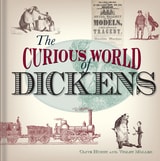
The Curious World of Dickens
Clive Hurst and Violet Moller
Bodleian Library Publishing, 2012
Published to celebrate the twohundredth anniversary of Dickens’s birth, this book brings together quotations from Dickens’s novels and letters with photographs of their original covers and Victorian-era images—among them, prints, posters, and newspaper pieces—that shed light on the topics about which Dickens writes. Ordered by theme, the book covers such topics as schools in Victorian England, domestic entertainment, the introduction of the railroad, and the poor conditions in prisons and workhouses, which loom large in Dickens’s novels—and, indeed, his own childhood. Dickens was also an avid theater enthusiast who arranged productions and public readings of many of his works, and this book explores his role throughout his later years in adroitly adapting his novels for the stage.
The Curious World of Dickens breathes new life on this momentous occasion into the vibrant world inhabited by Dickens and his characters.
The Curved Cliché and the Filtering Net
Keywords in Nineteenth-Century French Print CultureCary Hollinshead-Strick
Northwestern University Press, 2027
Tracing multivalent words of nineteenth-century French print culture
The production of printed text changed radically over the course of the nineteenth century: Everything from the material used to make paper to the gender of the people assembling books shifted. Examining ten key terms as they took on new meanings in the world of print, Cary Hollinshead-Strick shows how the words, borrowed to name technical transformations, reveal the social expectations surrounding the birth of industrial print culture. Through these homonyms she connects papermaking to both Renaissance ceramics and fin-de-siècle japonisme, reveals the politics behind typos and the reasons women went to work in Parisian suburbs, shows how newspaper formats mapped onto rural and urban forms of entertainment and food, and explores the fantasy that information itself could be gathered and distributed in reliable, comprehensive ways.
By lingering over the resonances set in motion when ordinary words like canard and filet became terms for modern media formats, this book situates communication practices in the social, economic, and political environments that gave rise to them. This innovative approach not only elucidates nineteenth-century French print culture’s influence on the literature of the period but also invites us to consider the relationships between contemporary forms of information, media, labor, and language.
The Cut of His Coat
Men, Dress, and Consumer Culture in Britain, 1860–1914Brent Shannon
Ohio University Press, 2006
The English middle class in the late nineteenth century enjoyed an increase in the availability and variety of material goods. With that, the visual markers of class membership and manly behavior underwent a radical change. In The Cut of His Coat: Men, Dress, and Consumer Culture in Britain, 1860–1914, Brent Shannon examines familiar novels by authors such as George Eliot, Anthony Trollope, Thomas Hughes, and H. G. Wells, as well as previously unexamined etiquette manuals, period advertisements, and fashion monthlies, to trace how new ideologies emerged as mass-produced clothes, sartorial markers, and consumer culture began to change.
While Victorian literature traditionally portrayed women as having sole control of class representations through dress and manners, Shannon argues that middle-class men participated vigorously in fashion. Public displays of their newly acquired mannerisms, hairstyles, clothing, and consumer goods redefined masculinity and class status for the Victorian era and beyond.
The Cut of His Coat probes the Victorian disavowal of men’s interest in fashion and shopping to recover men’s significant role in the representation of class through self-presentation and consumer practices.
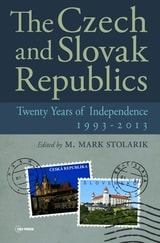
The Czech and Slovak Republics
Twenty years of Independence, 1993–2013M. Mark Stolarik
Central European University Press, 2017
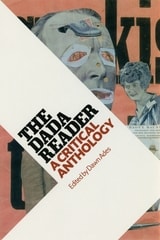
The DADA Reader
A Critical AnthologyEdited by Dawn Ades
University of Chicago Press, 2006
Bringing together key Dada texts, many of them translated into English for the first time, this volume immerses readers in some of the most famous (and infamous) periodicals of the time, from Hugo Ball’s Cabaret Voltaire and Francis Picabia’s 391 to Marcel Duchamp’s The Blind Man and Kurt Schwitters’s Merz. Published in Europe and the United States between 1916 and 1932, these journals constituted the movement’s lifeblood, communicating the desires and aspirations of the artists involved. In addition to providing the first representative selection of these texts, The Dada Reader also includes excerpts from many lesser-known American and Eastern European journals.
Compiled with both students and general readers in mind, this volume is necessary reading for anyone interested in one of the most dynamic and influential movements of the twentieth century.
The Dada Cyborg
Visions of the New Human in Weimar BerlinMatthew Biro
University of Minnesota Press, 2009
Finding the cyborg in early twentieth-century German art
In an era when technology, biology, and culture are becoming ever more closely connected, The Dada Cyborg explains how the cyborg as we know it today actually developed between 1918 and 1933 when German artists gave visual form to their utopian hopes and fantasies in a fearful response to World War I.
In what could be termed a prehistory of the posthuman, Matthew Biro shows the ways in which new forms of human existence were imagined in Germany between the two world wars through depictions of cyborgs. Examining the work of Hannah Höch, Raoul Hausmann, George Grosz, John Heartfield, Otto Dix, and Rudolf Schlichter, he reveals an innovative interpretation of the cyborg as a representative of hybrid identity, as well as a locus of new modes of awareness created by the impact of technology on human perception. Tracing the prevalence of cyborgs in German avant-garde art, Biro demonstrates how vision, hearing, touch, and embodiment were beginning to be reconceived during the Weimar Republic. Biro’s unique and interdisciplinary analysis offers a substantially new account of the Berlin Dada movement, one that integrates the group’s poetic, theoretical, and performative practices with its famous visual strategies of photomontage, assemblage, and mixed-media painting to reveal radical images of a “new human.”
The Daily Charles Dickens
A Year of QuotesCharles Dickens
University of Chicago Press, 2018
A bedside companion to dip into year round, this book introduces each month with a longer seasonal quote, while concise bits of wisdom and whimsy mark each day. Hopping gleefully from Esther Summerson’s abandonment by her mother in Bleak House to a meditation on the difficult posture of letter-writing in The Pickwick Papers, this anthology displays the wide range of Dickens’s stylistic virtuosity—his humor and his deep tragic sense, his ear for repetition, and his genius at all sorts of voices. Even the devotee will find between these pages a mix of old friends and strangers—from Oliver Twist and Ebenezer Scrooge to the likes of Lord Coodle, Sir Thomas Doodle, Mrs. Todgers, and Edwin Drood—as well as a delightful assortment of the some of the novelist’s most famous, peculiar, witty, and incisive passages, tailored to fit the season. To give one particularly apt example: David Copperfield blunders, in a letter of apology to Agnes Wickfield, “I began one note, in a six-syllable line, ‘Oh, do not remember’—but that associated itself with the fifth of November, and became an absurdity.”
Never Pecksniffian or Gradgrindish, this daily dose of Dickens crystallizes the novelist’s agile humor and his reformist zeal alike. This is a book to accompany you through the best of times and the worst of times.
The Daily Jane Austen
A Year of QuotesJane Austen
University of Chicago Press, 2019
Devoney Looser, a.k.a. Stone Cold Jane Austen, has drawn 378 genuine, Austen-authored passages from across the canon, resulting in an anthology that is compulsively readable and repeatable. Whether you approach the collection on a one-a-day model or in a satisfying binge read, you will emerge wiser about Austen, if not about life. The Daily Jane Austen will amuse and inspire skeptical beginners, Janeite experts, and every reader in between by showcasing some of the greatest sentences ever crafted in the history of fiction.
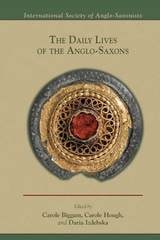
The Daily Lives of the Anglo-Saxons
Carole Biggam
Arizona Center for Medieval and Renaissance Studies, 2017
Insights into the lives of any group of historical people are provided by three main types of evidence: their language, their literature and their material culture. The contributors to this volume draw on all three types of evidence in order to present new research into the lives of the Anglo-Saxons. The particular focus is on daily life – the ordinary rather than the extraordinary, the normal rather than the exceptional. Rather than attempting an overview, the essays address individual scenarios in greater depth, but with an emphasis on shared experience.
The following scholars have contributed essays to this collection:
Martha Bayless
University of Oregon
Carole P. Biggam
University of Glasgow
Paul Cavill
University of Nottingham
Amy W. Clark
University of California, Berkeley
James Graham-Campbell
University College London
Antonina Harbus
Macquarie University, Sydney
Carole Hough
University of Glasgow
Daria Izdebska
Liverpool Hope University
Karen Louise Jolly
University of Hawai‘i at Mānoa
Alexandra Lester-Makin
University of Manchester
Elisabeth Okasha
University College, Cork
Phyllis Portnoy
University of Manitoba
Jane Roberts
University of London
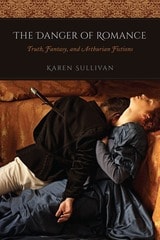
The Danger of Romance
Truth, Fantasy, and Arthurian FictionsKaren Sullivan
University of Chicago Press, 2018
Yet is it possible that romance is expressing a truth—and a truth unrecognized by realist genres? The Arthurian literature of the Middle Ages, Karen Sullivan argues, consistently ventriloquizes in its pages the criticisms that were being made of romance at the time, and implicitly defends itself against those criticisms. The Danger of Romance shows that the conviction that ordinary reality is the only reality is itself an assumption, and one that can blind those who hold it to the extraordinary phenomena that exist around them. It demonstrates that that which is rare, ephemeral, and inexplicable is no less real than that which is commonplace, long-lasting, and easily accounted for. If romance continues to appeal to audiences today, whether in its Arthurian prototype or in its more recent incarnations, it is because it confirms the perception—or even the hope—of a beauty and truth in the world that realist genres deny.
The Dangerous Lover
Gothic Villains, Byronism, and the Nineteenth-Century Seduction NarrativeDeborah Lutz
The Ohio State University Press, 2006
The dangerous lover has haunted our culture for over two hundred years; English, American, and European literature is permeated with his erotic presence. The Dangerous Lover takes seriously the ubiquity of the brooding romantic hero—his dark past, his remorseful and rebellious exile from comfortable everyday living. Deborah Lutz traces the recent history of this figure, through the melancholy iconoclasm of the Romantics, the lost soul redeemed by love of the Brontës, and the tormented individualism of twentieth-century love narratives. Arguing for this character’s central influence not only in literature but also in the history of ideas, this book places the dangerous lover firmly within the philosophy of Martin Heidegger, the Modernism of Georg Lukács, and Roland Barthes’s theories on love and longing. Working with canonical authors such as Ann Radcliffe, Charles Maturin, Lord Byron, Charles Dickens, George Eliot, and Oscar Wilde, and also with non-canonical texts such as contemporary romance, The Dangerous Lover combines a lyrical, essayistic style with a depth of inquiry that raises questions about the mysteries of desire, death, and eroticism.
The Dangerous Lover is the first book-length study of this pervasive literary hero; it also challenges the tendency of sophisticated philosophical readings of popular narratives and culture to focus on male-coded genres. In its conjunction of high and low literary forms, this volume explores new historical and cultural framings for female-coded popular narratives.
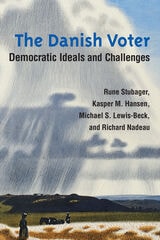
The Danish Voter
Democratic Ideals and ChallengesRune Stubager, Kasper M. Hansen, Michael S. Lewis-Beck, and Richard Nadeau
University of Michigan Press, 2021
The authors of The Danish Voter investigate a series of interesting questions concerning voters’ reactions to these macrosocial challenges and how their reactions affect the foundations for the ideal. Indeed, due to an electoral system open to new influences, the Danish case is an important test case for theories about political development of contemporary Western societies.
The Danton Case and Thermidor
Two PlaysStanislawa Przybyszewska
Northwestern University Press, 1989
The Daughter as Reader
Encounters between Literature and LifePaula Marantz Cohen
University of Michigan Press, 1996
The Dead Ladies Project
Exiles, Expats, and Ex-CountriesJessa Crispin
University of Chicago Press, 2015
The Dead Ladies Project is an account of that journey—but it’s also much, much more. Fascinated by exile, Crispin travels an itinerary of key locations in its literary map, of places that have drawn writers who needed to break free from their origins and start afresh. As she reflects on William James struggling through despair in Berlin, Nora Barnacle dependant on and dependable for James Joyce in Trieste, Maud Gonne fomenting revolution and fostering myth in Dublin, or Igor Stravinsky starting over from nothing in Switzerland, Crispin interweaves biography, incisive literary analysis, and personal experience into a rich meditation on the complicated interactions of place, personality, and society that can make escape and reinvention such an attractive, even intoxicating proposition.
Personal and profane, funny and fervent, The Dead Ladies Project ranges from the nineteenth century to the present, from historical figures to brand-new hangovers, in search, ultimately, of an answer to a bedrock question: How does a person decide how to live their life?
The Deaf Experience
Classics in Language and EducationHarlan Lane
Gallaudet University Press, 2006
The fifth volume in the Gallaudet Classics in Deaf Studies series features works written from 1764 up to1840. Pierre Desloges offers a stirring paean to sign language in an excerpt from his book, the first ever published by a deaf person. Saboureux de Fontenay and Jean Massieu, two prominent leaders, relate their respective experiences in autobiographical accounts. In separate essays, Charles-Michel de l’Epée and Roch-Ambroise Sicard describe systems for teaching manual French, followed by a critique of these methods by Roch-Ambroise Bébian, a well-known hearing friend of Deaf people during that era. Ferdinand Berthier, a renowned Deaf teacher and writer in the 19th century, concludes with a history of Deaf people up to that time.
The Deaf Experience shows clearly how this extraordinary era of French deaf education influenced the adoption of the manual method by the first schools for deaf students in America, in sharp contrast to the oral movement that repressed sign-language-centered education for nearly a century afterward. Deaf studies scholars and students alike will welcome the return of this invaluable resource.
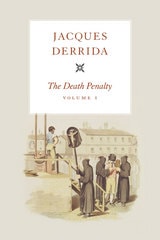
The Death Penalty, Volume I
Jacques Derrida
University of Chicago Press, 2013
With his signature genius and patient yet dazzling readings of an impressive breadth of texts, Derrida examines everything from the Bible to Plato to Camus to Jean Genet, with special attention to Kant and post–World War II juridical texts, to draw the landscape of death penalty discourses. Keeping clearly in view the death rows and execution chambers of the United States, he shows how arguments surrounding cruel and unusual punishment depend on what he calls an “anesthesial logic,” which has also driven the development of death penalty technology from the French guillotine to lethal injection. Confronting a demand for philosophical rigor, he pursues provocative analyses of the shortcomings of abolitionist discourse. Above all, he argues that the death penalty and its attendant technologies are products of a desire to put an end to one of the most fundamental qualities of our finite existence: the radical uncertainty of when we will die.
Arriving at a critical juncture in history—especially in the United States, one of the last Christian-inspired democracies to resist abolition—The Death Penalty is both a timely response to an important ethical debate and a timeless addition to Derrida’s esteemed body of work.
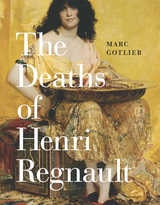
The Deaths of Henri Regnault
Marc Gotlieb
University of Chicago Press, 2016
Gotlieb traces Regnault’s trajectory after he won the prestigious Grand Prix de Rome, a fellowship that provided four years of study in Italy. Arriving in Rome, however, Regnault suffered a profound crisis of originality that led him to flee the city in favor of Spain and Morocco. But the crisis also proved productive: from Rome, Madrid, Tangier, and Paris, Regnault enthralled audiences with a bold suite of strange, seductive, and violent Orientalist paintings inspired by his exotic journey—images that, Gotlieb argues, arose precisely from the crisis that had overtaken Regnault and that in key respects was shared by his more avant-garde counterparts.
Both an in-depth look at Regnault’s violent art and a vibrant essay on historical memory, The Deaths of Henri Regnault lays bare a creative legend who helped shape the collective experience of a generation.
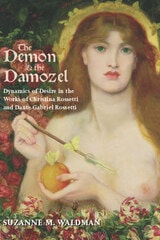
The Demon and the Damozel
Dynamics of Desire in the Works of Christina Rossetti and Dante Gabriel RossettiSuzanne M. Waldman
Ohio University Press, 2008

The Desert Is Alive
Aesthetic Cartographies and the SaharaJill Jarvis
University of Chicago Press, 0
How contemporary writers and filmmakers from across the African Sahara confront the colonial ideology of desert emptiness.
Jill Jarvis’s The Desert Is Alive challenges the image of the Sahara desert as a historical and cultural blank zone through a new “aesthetic cartography” that combines literary and film study with interdisciplinary thinking about space, borders, and infrastructures. In fields that still bear the imprint of a French colonial mindset, the Sahara has long been overlooked as a site of intellectual and cultural vitality. The Desert Is Alive breaks with a longstanding conceptual divide between “North” and “Subsaharan” Africa by resolutely centering the African Sahara and recognizing that the desert is not just full, but “peopled” in unexpected ways.
Jarvis accounts for colonial transformations of Saharan land during the twentieth century, attesting to the tactical and symbolic allure that this desert’s purported “emptiness” has held for French empire-building. Jarvis also considers how such tactics have been repurposed by postcolonial states. She takes up the last manuscript composed by Swiss writer Isabelle Eberhardt, who died in a flood at Aïn Sefra, Algeria in 1904, and examines the first novel published by French writer and aviator Antoine de Saint-Exupéry, composed while he worked as a pilot at Tarfaya, Morocco, in order to build the first trans-Saharan flight line during the 1920s. Jarvis then explores depictions of Timbuktu (Mali) and Nouadhibou (Mauretania) in films by Mauritanian-French director Abderrahmane Sissako. Jarvis concludes with chapters that unfold the unfinished history of French nuclear violence in the Sahara. First, she discusses multimedia and documentary works that reckon with the enduring impact of the seventeen nuclear bombs that France detonated in the Algerian desert in the 1960s. Finally, Jarvis turns to works by Tuareg poet and artist Hawad that confront the ongoing legacy of uranium mining on Indigenous land in northern Niger. The result is a rich contribution to Francophone cultural studies, African studies, postcolonial studies, and ecocriticism.
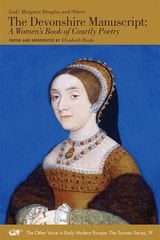
The Devonshire Manuscript
A Women's Book of Courtly PoetryLady Margaret Douglas and Others
Iter Press, 2012
—Jennifer Summit
Professor of English, Stanford University

The Disappearance of God
FIVE NINETEENTH-CENTURY WRITERSJ. Hillis Miller
University of Illinois Press, 1963
interpreters of nineteenth-century England, The Disappearance of God confronts the consciousness of an absent (though perhaps still existent) God in the writings of Thomas De Quincey, Robert Browning, Emily Brontë, Matthew Arnold, and Gerard Manley Hopkins. J. Hillis Miller surveys the intellectual and material developments that conspired to cut man off from God--among other factors the city, developments within Christianity, subjectivism, and the emergence of the modern historical sense--and shows how each writer's body of work reflects a sustained response to the experience of God's disappearance.
The Dismemberment of Orpheus
Toward a Postmodern LiteratureIhab Hassan
University of Wisconsin Press, 1982
In this book, the first edition of which was published in 1971 by Oxford University Press, Ihab Hassan takes Orphic dismemberment and regeneration as his metaphor for a radical crisis in art and language, culture and consciousness, which prefigures postmodern literature. The modern Orpheus, he writes, “sings on a lyre without strings.” Thus, his sensitive critique traces a hypothetical line from Sade through four modern authors—Hemingway, Kafka, Genet, and Beckett—to a literature still to come. But the line also breaks into two Interludes, one concerning ’Pataphysics, Dada, and Surrealism, and the other concerning Existentialism and Aliterature.
Combining literary history, brief biography, and critical analysis, Hassan surrounds these authors with a complement of avant-garde writers whose works also foreshadow the postmodern temper. These include Jarry, Apollinaire, Tzara, Breton, Sartre, Camus, Nathalie Sarraute, Robbe-Grillet, and in America, Cage, Salinger, Ginsberg, Barth, and Burroughs. Hassan takes account also of related contemporary developments in art, music, and philosophy, and of many works of literary theory and criticism.
For this new edition, Hassan has added a new preface and postface on the developing character of postmodernism, a concept which has gained currency since the first edition of this work, and which he himself has done much to theorize.