Results by title
836 books match the query 'France' and 213 start with t
The Land and the Loom
Peasants and Profit in Northern France, 1680–1800Liana Vardi
Duke University Press, 1993
Drawing on evidence culled from parish registers, notarial records, and judicial archives, Liana Vardi outlines the development of the linen weaving trade in Montigny and details the local peasants' participation. The peasants that emerge from her study are not the figures of tradition, driven solely by symbolic attachment to the land and unreasonably devoted to village solidarities. Instead they reveal remarkable flexibility and diversity, not only improving farming methods and raising yields during the eighteenth century, but also using land to finance investments in industry and to develop local business, far-flung commercial networks and complex credit mechanisms. The eighteenth-century French countryside appears as a region and time of capitalist experimentation, cut short by pre-Revolutionary and Revolutionary crises.
Meticulously documented, broadly interpretive, and beautifully written, this fascinating book will permenantly alter conventional perceptions of peasant life and rural industry and, ultimately, the way ordinary people are seen in seemingly distant times and places.
The Land of My Fathers
A Son's Return to the Basque CountryRobert Laxalt
University of Nevada Press, 2024
In 1960, renowned Nevada writer Robert Laxalt moved himself and his family to a small Basque village in the French Pyrenees. The son of Basque emigrants, Laxalt wanted to learn as much as he could about the ancient and mysterious people from which he was descended and about the country from which his parents came. Thanks to his Basque surname and a wide network of family connections, Laxalt was able to penetrate the traditional reserve of the Basques in a way that outsiders rarely can. In the process, he gained rare insight into the nature of the Basques and the isolated, beautiful mountain world where they have lived for uncounted centuries. Based on Laxalt’s personal journals of this and a later sojourn in 1965, The Land of My Fathers is a moving record of a people and their homeland. Through Laxalt’s perceptive eyes and his wife Joyce’s photographs, we observe the Basques’ market days and festivals, join their dove hunts and harvests, share their humor and history, their deep sense of nationalism, their abiding pride in their culture and their homes, and discover the profound sources of the Basques’ strength and their endurance as a people. Photography by Joyce Laxalt.

The Language of Sex
Five Voices from Northern France around 1200John W. Baldwin
University of Chicago Press, 1994
John Baldwin introduces five representative voices from the turn of the twelfth century in northern France: Pierre the Chanter speaks for the theological doctrine of Augustine; the Prose Salernitan Questions, for the medical theories of Galen; Andre the Chaplain, for the Ovidian literature of the schools; Jean Renart, for the contemporary romances; and Jean Bodel, for the emerging voices of the fabliaux. Baldwin juxtaposes their views on a range of essential subjects, including social position, the sexual body, desire and act, and procreation. The result is a fascinating dialogue of how they agreed or disagreed with, ignored, imitated, or responded to each other at a critical moment in the development of European ideas about sexual desire, fulfillment, morality, and gender.
These spokesmen allow us into the discussion of sexuality inside the church and schools of the clergy, in high and popular culture of the leity. This heterogeneous discussion also offers a startling glimpse into the construction of gender specific to this moment, when men and women enjoyed equal status in sexual matters, if nowhere else.
Taken together, these voices extend their reach, encompass their subject, and point to a center where social reality lies. By articulating reality at its varied depths, this study takes its place alongside groundbreaking works by James Brundage, John Boswell, and Leah Otis in extending our understanding of sexuality and sexual behavior in the Middle Ages.
"Superb work. . . . These five kinds of discourse are not often treated together in scholarly writing, let alone compared and contrasted so well."—Edward Collins Vacek, Theological Studies
"[Baldwin] has made the five voices speak to us in a language that is at one and the same time familiar and alien in its resonance and accents. This is a truly exceptional book, interdisciplinary in the real sense of the word, which is surely destined to become a landmark in medieval studies."—Keith Busby, Bryn Mawr Reviews
"[Baldwin's] attempt to 'listen' to these distant voices and translate their language of sex into our own raises challenging methodological questions that will be of great interest to historians and literary scholars alike."—John P. Dalton, Comitatus
The Last Judgment of Kings / Le Jugement dernier des rois
A Bilingual EditionYann Robert
Bucknell University Press, 2025
Joué pour la première fois le lendemain de l’exécution de Marie-Antoinette, Le Jugement dernier des rois met en scène le procès burlesque des autres rois et reines d’Europe : exhibés et enchaînés tels des animaux, contraints de se battre pour un tonneau de biscuits, et finalement anéantis par l’éruption spectaculaire d’un volcan. Tel est le contexte scandaleux—tragédie et farce à la fois—de la pièce la plus célèbre de la Révolution française, bien connue de tous les spécialistes de cette période. Jusqu’à maintenant, pourtant, il n’existait ni édition critique ni traduction anglaise de cet ouvrage historique. Notre édition bilingue fait revivre la pièce de Maréchal et la replace au centre des plus grands débats chez les historiens de la Révolution, traitant de justice, religion, commémoration, comédie, et propagande. Provocateur, facile à lire, et concis—parfaitement adapté aux étudiants d’un cours de français ou d’histoire—Le Jugement dernier des rois propose ainsi une introduction idéale à la période révolutionnaire et à ses principales controverses.
Published by Bucknell University Press. Distributed worldwide by Rutgers University Press.

The Last Shepherd
Martin Etchart
University of Nevada Press, 2012
Matt’s journey to manhood takes place in a vividly depicted landscape populated by lively, memorable characters. This is the powerful story of a young man’s search for an identity that encompasses two cultures and one complex, scattered family.
The Left Bank
Writers, Artists, and Politics from the Popular Front to the Cold WarHerbert Lottman
University of Chicago Press, 1998
"Surprisingly fresh and intense. . . . A retrospective travelogue of the Left Bank in the days when it was the setting for almost all French intellectual activity. . . . Absorbing."—Naomi Bliven, New Yorker
"As an introduction to a period in French history already legendary, The Left Bank is superb."—Michael Dirda, Washington Post Book World
"An intellectual history. A history of the interaction between politics and letters. And a rumination on the limitless credulity of intellectuals."—Christopher Hitchens, New Statesman

The Leopard in the Garden
Animal and Human Lives in Paris at the First Public Zoo of the Modern EraRichard W. Burkhardt, Jr.
University of Chicago Press, 2026
The Paris menagerie at the Paris Museum of Natural History has a special significance in the history of zoos. Founded in 1793–1794 at the height of the French Revolution, it was the model for the other great zoos of the nineteenth century that followed, beginning with London in 1828, Amsterdam in 1838, and Berlin in 1844.
Richard W. Burkhardt Jr. has written the definitive history of the Paris zoo and its early inhabitants, human and nonhuman. The book features narrative or thematic chapters interwoven with chapters focused on particular animals. Combining current scholarship with fresh discoveries gleaned from his immersion in the Paris Zoo’s extensive archive, Burkhardt shares historical treasures that illuminate not only the workings of the menagerie but also various dimensions of the golden age of French zoology (the years of Jean-Baptiste Lamarck, Geoffroy Saint-Hilaire, and Georges Cuvier). His history reconstructs the diverse sources of specimens, the growth of the collection over time, the efforts to make the menagerie scientifically significant, contemporary attitudes toward animals, and the lives of the animals themselves in colonial and diplomatic contexts.
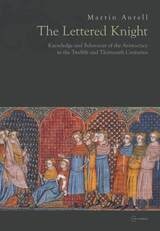
The Lettered Knight
Knowledge and aristocratic behaviour in the twelfth and thirteenth centuriesMartin Aurell
Central European University Press, 2017
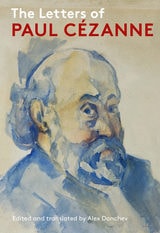
The Letters of Paul Cézanne
Alex Danchev
J. Paul Getty Trust, The, 2013
Revered and misunderstood by his peers and lauded by later generations as the father of modern art, Paul Cézanne (1839-1906) has long been a subject of fascination for artists and art lovers, writers, poets, and philosophers. His life was a ceaseless artistic quest, and he channeled much of his wide-ranging intellect and ferocious wit into his letters. Punctuated by exasperated theorizing and philosophical reflection, outbursts of creative ecstasy and melancholic confession, the artist’s correspondence reveals both the heroic and all-toohuman qualities of a man who is indisputably among the pantheon of all-time greats.
This new translation of Cézanne’s letters includes more than twenty that were previously unpublished and reproduces the sketches and caricatures with which Cézanne occasionally illustrated his words. The letters shed light on some of the key artistic relationships of the modern period—about one third of Cézanne’s more than 250 letters are to his boyhood companion Émile Zola, and he communicated extensively with Camille Pissarro and the dealer Ambroise Vollard. The translation is richly annotated with explanatory notes, and, for the first time, the letters are cross-referenced to the current catalogue raisonné. Numerous inaccuracies and archaisms in the previous English edition of the letters are corrected, and many intriguing passages that were unaccountably omitted have been restored. The result is a publishing landmark that ably conveys Cézanne’s intricacy of expression.
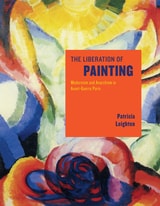
The Liberation of Painting
Modernism and Anarchism in Avant-Guerre ParisPatricia Leighten
University of Chicago Press, 2013
Leighten examines the circle of artists—Pablo Picasso, Juan Gris, František Kupka, Maurice de Vlaminck, Kees Van Dongen, and others—for whom anarchist politics drove the idea of avant-garde art, exploring how their aesthetic choices negotiated the myriad artistic languages operating in the decade before World War I. Whether they worked on large-scale salon paintings, political cartoons, or avant-garde abstractions, these artists, she shows, were preoccupied with social criticism. Each sought an appropriate subject, medium, style, and audience based on different conceptions of how art influences society—and their choices constantly shifted as they responded to the dilemmas posed by contradictory anarchist ideas. According to anarchist theorists, art should expose the follies and iniquities of the present to the masses, but it should also be the untrammeled expression of the emancipated individual and open a path to a new social order. Revealing how these ideas generated some of modernism’s most telling contradictions among the prewar Parisian avant-garde, The Liberation of Painting restores revolutionary activism to the broader history of modern art.
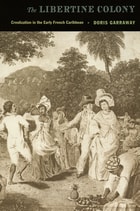
The Libertine Colony
Creolization in the Early French CaribbeanDoris Garraway
Duke University Press, 2005
Among the texts Garraway analyzes are missionary histories by Jean-Baptiste Du Tertre, Raymond Breton, and Jean-Baptiste Labat; narratives of adventure and transgression written by pirates and others outside the official civil and religious power structures; travel accounts; treatises on slavery and colonial administration in Saint-Domingue; the first colonial novel written in French; and the earliest linguistic description of the native Carib language. Garraway also analyzes legislation—including the Code noir—that codified slavery and other racialized power relations. The Libertine Colony is both a rich cultural history of creolization as revealed in Francophone colonial literature and an important contribution to theoretical arguments about how literary critics and historians should approach colonial discourse and cultural representations of slave societies.
The Light-Green Society
Ecology and Technological Modernity in France, 1960-2000Michael Bess
University of Chicago Press, 2003
The Light-Green Society limns sharply these trends over the last fifty years. The rise of environmentalism in the 1960s stemmed from a fervent desire to "save" wild nature-nature conceived as a qualitatively distinct domain, wholly separate from human designs and endeavors. And yet, Bess shows, after forty years of environmentalist agitation, much of it remarkably successful in achieving its aims, the old conception of nature as a "separate sphere" has become largely untenable. In the light-green society, where ecology and technological modernity continually flow together, a new hybrid vision of intermingled nature-culture has increasingly taken its place.

The Likeness of the King
A Prehistory of Portraiture in Late Medieval FranceStephen Perkinson
University of Chicago Press, 2009
Anyone who has strolled through the halls of a museum knows that portraits occupy a central place in the history of art. But did portraits, as such, exist in the medieval era? Stephen Perkinson’s The Likeness of the King challenges the canonical account of the invention of modern portrait practices, offering a case against the tendency of recent scholarship to identify likenesses of historical personages as “the first modern portraits.”
Unwilling to accept the anachronistic nature of these claims, Perkinson both resists and complicates grand narratives of portraiture art that ignore historical context. Focusing on the Valois court of France, he argues that local practice prompted shifts in the late medieval understanding of how images could represent individuals and prompted artists and patrons to deploy likeness in a variety of ways. Through an examination of well-known images of the fourteenth- and early fifteenth-century kings of France, as well as largely overlooked objects such as wax votive figures and royal seals, Perkinson demonstrates that the changes evident in these images do not constitute a revolutionary break with the past, but instead were continuous with late medieval representational traditions.

The Long Affair
Thomas Jefferson and the French Revolution, 1785-1800Conor Cruise O'Brien
University of Chicago Press, 1996
"The book is an attack on America's long affair with Jeffersonian ideology of radical individualism: an ideology that, by confusing Jefferson with a secular prophet, will destroy the United States from within."—David C. Ward, Boston Book Review
"With his background as a politician and a diplomat, O'Brien brings a broad perspective to his effort to define Jefferson's beliefs through the prism of his attitudes toward France. . . . This is an important work that makes an essential contribution to the overall picture of Jefferson."—Booklist
"O'Brien traces the roots of Jefferson's admiration for the revolution in France but notes that Jefferson's enthusiasm for France cooled in the 1790s, when French egalitarian ideals came to threaten the slave-based Southern economy that Jefferson supported."—Library Journal
"In O'Brien's opinion, it's time that Americans face the fact that Jefferson, long seen as a champion of the 'wronged masses,' was a racist who should not be placed on a pedestal in an increasingly multicultural United States."—Boston Phoenix
"O'Brien makes a well-argued revisionist contribution to the literature on Jefferson."—Kirkus Reviews
"O'Brien is right on target . . . determined not to let the evasions and cover-ups continue."—Forrest McDonald, National Review
"The Long Affair should be read by anyone interested in Jefferson—or in a good fight."—Richard Brookhiser, New York Times Book Review
The Man Who Believed He Was King of France
A True Medieval TaleTommaso di Carpegna Falconieri
University of Chicago Press, 2008

The Man Who Flattened the Earth
Maupertuis and the Sciences in the EnlightenmentMary Terrall
University of Chicago Press, 2002
Beginning his scientific career as a mathematician in Paris, Maupertuis entered the public eye with a much-discussed expedition to Lapland, which confirmed Newton's calculation that the earth was flattened at the poles. He also made significant, and often intentionally controversial, contributions to physics, life science, navigation, astronomy, and metaphysics. Called to Berlin by Frederick the Great, Maupertuis moved to Prussia to preside over the Academy of Sciences there. Equally at home in salons, cafés, scientific academies, and royal courts, Maupertuis used his social connections and his printed works to enhance a carefully constructed reputation as both a man of letters and a man of science. His social and institutional affiliations, in turn, affected how Maupertuis formulated his ideas, how he presented them to his contemporaries, and the reactions they provoked.
Terrall not only illuminates the life and work of a colorful and important Enlightenment figure, but also uses his story to delve into many wider issues, including the development of scientific institutions, the impact of print culture on science, and the interactions of science and government. Smart and highly readable, Maupertuis will appeal to anyone interested in eighteenth-century science and culture.
The Man Who Thought He Was Napoleon
Toward a Political History of MadnessLaure Murat
University of Chicago Press, 2014
From those two components, Laure Murat embarks on an exploration of the surprising relationship between history and madness. She uncovers countless stories of patients whose delusions seem to be rooted in the historical or political traumas of their time, like the watchmaker who believed he lived with a new head, his original having been removed at the guillotine. In the troubled wake of the Revolution, meanwhile, French physicians diagnosed a number of mental illnesses tied to current events, from “revolutionary neuroses” and “democratic disease” to the “ambitious monomania” of the Restoration. How, Murat asks, do history and psychiatry, the nation and the individual psyche, interface?
A fascinating history of psychiatry—but of a wholly new sort—The Man Who Thought He Was Napoleon offers the first sustained analysis of the intertwined discourses of madness, psychiatry, history, and political theory.

The Marriage Exchange
Property, Social Place, and Gender in Cities of the Low Countries, 1300-1550Martha C. Howell
University of Chicago Press, 1998
Based on extensive research in this archive, this book reveals how these documents were produced in a centuries-long effort to regulate—and ultimately to redefine—property and gender relations. At the center of the transformation was a shift from a marital property regime based on custom to one based on contract. In the former, a widow typically inherited her husband's property; in the latter, she shared it with or simply held it for his family or offspring. Howell asks why the law changed as it did and assesses the law's effects on both social and gender meanings but she insists that the reform did not originate in general dissatisfaction with custom or a desire to disempower widows. Instead, it was born in a complex economic, social and cultural history during which Douaisiens gradually came to think about both property and gender in new ways.

The Medieval Kitchen
Recipes from France and ItalyOdile Redon, Françoise Sabban, and Silvano Serventi
University of Chicago Press, 1998
"This book is a delight. It is not often that one has the privilege of working from a text this detailed and easy to use. It is living history, able to be practiced by novice and master alike, practical history which can be carried out in our own homes by those of us living in modern times."—Wanda Oram Miles, The Medieval Review
"The Medieval Kitchen, like other classic cookbooks, makes compulsive reading as well as providing a practical collection of recipes."—Heather O'Donoghue, Times Literary Supplement

The Memoire Justificatif of Chevalier Monberaut
Indian Diplomacy in British West Florida, 1763-1765Montault Monberaut
University of Alabama Press, 1965
A rare primary-source account of Indigenous diplomacy and imperial transition in British West Florida, 1763–1765.
Historians of the Gulf Coast have long delighted in the romance of Spanish discovery and French settlement. The period of British occupation was relatively brief, fruitless, and prosaic, if we are to believe the older authorities. Today the availability of materials which were closed to an earlier generation enables us to re-create the story of British West Florida in terms more precise, with details more personal, and with no less dramatic coloration than has long been given-with less accuracy-to the earlier epochs.
In The Memoire Justificatif of Chevalier Monberaut, the translators have undertaken the resurrection of one of those gallant Frenchmen of the ancient regime who remained behind to serve the new Anglo-Saxon masters of West Florida. The Chevalier Montault de Monberaut is not unknown to historians of the colonial scene, but he has never enjoyed a full portrayal of his contribution nor a balanced evaluation of his role. By concentrating our attention upon the man as well as his milieu, we have been able to present in greater detail than before the circumstances and procedure of Indian diplomacy on the Gulf Coast at the beginning of the British period. By placing Monberaut against the backdrop of British colonial government and its problems, we have replaced some of the romantic fallacies with historic realities. The resulting clarity adds to the picture's significance and appeal.

The Militant Hackwriter
French Popular Literature 1800–1848 and Its Influence, Artistic and PoliticalLucian W. Minor
University of Wisconsin Press, 1975
While Louis XVIII, Charles X, and Louis Philippe ruled in France, a vast majority of politically unenfranchised Frenchmen were developing their own subculture. Only recently literate, they fashioned their own literature. It consisted of two important genres: the popular novel and the melodrama. As we trace these genres from the turn of the nineteenth century until that moment of February 25, 1848, when the Second Republic was declared, we are also led to a detailed scrutiny of the injustices which the immense majority of the French suffered and of the political causes they espoused. The succession of heroes and villains in their literature mirrored accurately the fears and hopes they felt.
The Misfit of the Family
Balzac and the Social Forms of SexualityMichael Lucey
Duke University Press, 2003
The Misfit of the Family is a compelling argument that Balzac must be taken seriously as a major inventor and purveyor of new tools for analyzing connections between the sexual and the social. Lucey’s account of the novelist’s deployment of "sexual misfits" to impel a wide range of his most canonical works—Cousin Pons, Cousin Bette, Eugenie Grandet, Lost Illusions, The Girl with the Golden Eyes—demonstrates how even the flexible umbrella term "queer" barely covers the enormous diversity of erotic and social behaviors of his characters. Lucey draws on the thinking of Michel Foucault and Pierre Bourdieu and engages the work of critics of nineteenth-century French fiction, including Naomi Schor, D. A. Miller, Franco Moretti, and others. His reflections on Proust as Balzac’s most cannily attentive reader suggest how the lines of social and erotic force he locates in Balzac’s work continued to manifest themselves in twentieth-century writing and society.
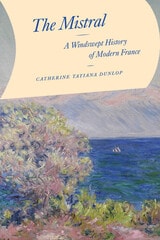
The Mistral
A Windswept History of Modern FranceCatherine Tatiana Dunlop
University of Chicago Press, 2024
Every year, the chilly mistral wind blows through the Rhône valley of southern France, across the Camargue wetlands, and into the Mediterranean Sea. Most forceful when winter turns to spring, the wind knocks over trees, sweeps trains off their tracks, and destroys crops. Yet the mistral turns the sky clear and blue, as it often appears in depictions of Provence. The legendary wind is central to the area’s regional identity and has inspired artists and writers near and far for centuries.
This force of nature is the focus of Catherine Dunlop’s The Mistral, a wonderfully written examination of the power of the mistral wind, and in particular, the ways it challenged central tenets of nineteenth-century European society: order, mastery, and predictability. As Dunlop shows, while the modernizing state sought liberation from environmental realities through scientific advances, land modification, and other technological solutions, the wind blew on, literally crushing attempts at control, and becoming increasingly integral to regional feelings of place and community.
The Misunderstood Mission of Jean Nicolet
Uncovering the Story of the 1634 JourneyPatrick J. Jung
Wisconsin Historical Society Press, 2018
In more recent decades, historians have pieced together a story that is not only more likely but more complicated and interesting. Patrick Jung synthesizes the research about Nicolet and his superior Samuel de Champlain, whose diplomatic goals in the region are crucial to understanding this much misunderstood journey across the Great Lakes. Additionally, historical details about Franco-Indian relations and the search for the Northwest Passage provide a framework for understanding Nicolet’s famed mission.
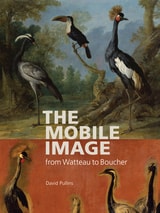
The Mobile Image from Watteau to Boucher
David Pullins
J. Paul Getty Trust, The, 2024
This book provides a new way of thinking about eighteenth-century French art and visual culture by prioritizing production over reception. Abandoning the ideologically driven discourse that distinguished fine from decorative art between the 1690s and 1770s, The Mobile Image reveals how the two have been inextricably bound from the earliest stages of artistic instruction through the daily life of painters’ workshops. In this study, author David Pullins defines artisanal and artistic means of learning, seeing, and making through a system of “mobile images”: motifs that were effectively engineered for mobility and designed never to be definitive, always awaiting replication and circulation. He examines the careers of Antoine Watteau, Jean-Baptiste Oudry, and François Boucher, situating them against a much broader cast of actors—such as printmakers, publishers, anonymous studio assistants, and architects, among others—to place eighteenth-century painting within a wider context of media and making.
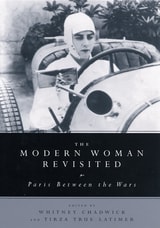
The Modern Woman Revisited
Paris Between the WarsChadwick, Whitney
Rutgers University Press, 2003
The contributions of female artists to the development of literary and artistic modernism in early twentieth century France remain poorly understood. It was during this period that a so-called “modern woman” began occupying urban spaces associated with the development of modern art and modernism’s struggles to define subjectivities and sexualities. Whereas most studies of modernism’s formal innovations and its encouragement of artistic autonomy neglect or omit necessary discussions of gender, race, class, and sexual orientation, the contributors of The Modern Woman Revisited inject these perspectives into the discussion.
Between the two World Wars, Paris served as the setting for unparalleled freedom for expatriate as well as native-born French women, who enjoyed unprecedented access to education and opportunities to participate in public artistic and intellectual life. Many of these women made lasting contributions in art and literature. Some of the artists discussed include Colette, Tamara de Lempicka, Sonia Delaunay, Djuna Barnes, Augusta Savage, and Lee Miller.
Inthis book, an internationally recognized roster of art historians, literary critics, and other scholars offers a nuanced portrait of what it meant to be a modern woman during this decisive period of modernism’s development. Individual essays explore the challenges faced by women in the early decades of the twentieth century, as well as the strategies these women deployed to create their art and to build meaningful lives and careers. The introduction underscores the importance of the contributors’ efforts to engender larger questions about modernity, sexuality, race, and class.

The Mountains of Paris
How Awe and Wonder Rewrote My LifeDavid Oates
Oregon State University Press, 2019
The present tense of the book takes place during the seasons he spends in Paris, sharing an artist’s residency. It is a rare opportunity to consider what it means to be human, through time-stopping moments with music, art, and deep history. The past tense of the book offers memories that intrude into the bustle of Paris life: a Billy Graham crusade at age thirteen, a mountain pass, a love, a loss.
In long years of mountaineering Oates fought the self-loathing which had infused him as the gay kid in the Baptist pew. In The Mountains of Paris, he ascends to a place of wonder through intense, personal narrative encounter with the strangeness of being alive. In his searching, luminous, and inimitable prose, Oates invites readers to share the sense of awe awakened by a Vermeer painting, or the night sky, or the echoing strains of music fading down a Paris street, lifting the curtain on a cosmos filled with a terrifying yet beautiful rightness.

The Music of Django Reinhardt
Benjamin Givan
University of Michigan Press, 2009
"The Music of Django Reinhardt is an impressive contribution to the field of jazz studies. The book offers a penetrating view into the music of one of jazz's most intriguing early figures."
---Keith Waters, coauthor, Jazz: The First Hundred Years
"An important addition to the literature on jazz, Givan's book provides many insights into Reinhardt’s solo building and unorthodox guitar playing; it is richly illustrated with many excellent musical transcriptions."
---Thomas Owens, author of Bebop: The Music and Its Players
"Givan has painstakingly assembled an analytical interpretation of Reinhardt's music that is rigorous, compelling, and illuminating. This book makes a unique contribution to the field of jazz studies and guitar music in general."
---Brian Harker, author of Jazz: An American Journey
When most people think of the great jazz guitarist Django Reinhardt, they conjure up the unusual details of his colorful life: a childhood spent in gypsy encampments outside of Paris; the tragic caravan fire when he was eighteen that rendered his left hand nearly unusable; and his survival during World War II, when gypsies were massacred by the hundreds of thousands. The amazing story of Reinhardt’s life even became the basis for Woody Allen's Sweet and Lowdown.
Yet, it is the music of Django Reinhardt that made him one of the most original guitarists in history. In particular, his partnership with violinist Stéphane Grappelli, in the Quintette du Hot Club de France, brought him international renown and the attention of some of the most important American jazz musicians of the day, including Coleman Hawkins, Benny Carter, and Duke Ellington.
The Music of Django Reinhardt explores the story of the man and his music as never before. Benjamin Givan shows how one of jazz's greatest guitarists created his unparalleled sound. This book is an analytical study of his music, including his process, his improvisational style, and his instrumental technique.
The book features transcriptions from records of the 1920s through the 1950s and includes detailed discussion of selected performances from one of the most important guitarists in history.
Benjamin Givan is Assistant Professor of Music at Skidmore College. His writings on jazz have appeared in scholarly publications such as Current Musicology and the Musical Quarterly, as well as the popular jazz magazine Down Beat. He received his Ph.D. in music theory from Yale University.The National Stage
Theatre and Cultural Legitimation in England, France, and AmericaLoren Kruger
University of Chicago Press, 1992
The National Stage answers this question by tracing the relation between theatre institution and public sphere in the discourses of national identity in Britain, France, and the United States. Exploring the boundaries between history and theory, text and performance, this book speaks to theatre and social historians as well as those interested in the theoretical range of cultural studies.
The Newton Wars and the Beginning of the French Enlightenment
J. B. Shank
University of Chicago Press, 2008
A comprehensive study of public culture, The Newton Wars and the Beginning of the French Enlightenment digsbelow the surface of the commonplace narratives that link Newton with Enlightenment thought to examine the actual historical changes that brought them together in eighteenth-century time and space. Drawing on the full range of early modern scientific sources, from studied scientific treatises and academic papers to book reviews, commentaries, and private correspondence, J. B. Shank challenges the widely accepted claim that Isaac Newton’s solitary genius is the reason for his iconic status as the father of modern physics and the philosophemovement.

The Nights Of Labor
The Workers' Dream in Nineteenth-Century FranceJacques Ranciere
Temple University Press, 1991
The Old Regime and the Revolution, Volume I
The Complete TextAlexis de Tocqueville
University of Chicago Press, 1998

The Old Regime and the Revolution, Volume II
Notes on the French Revolution and NapoleonAlexis de Tocqueville
University of Chicago Press, 2001
With his monumental work The Old Regime and the Revolution, Alexis de Tocqueville (1805–59)—best known for his classic Democracy in America—envisioned a multivolume philosophical study of the origins of modern France that would examine the implications of French history on the nature and development of democratic society. Volume I, which covered the eighteenth-century background to the Revolution, was published to great acclaim in 1856. On the continuation of this project, he wrote: "When this Revolution has finished its work, [this volume] will show what that work really was, and what the new society which has come from that violent labor is, what the Revolution has taken away and what it has preserved from that old regime against which it was directed."
The Orient of Style
Modernist Allegories of ConversionBeryl Schlossman
Duke University Press, 1991
Toward the end of Remembrance of Things Past, the narrator describes the act of creating a work of art as a conversion of sensation into a spiritual equivalent. By means of such allegories of “conversion,” Schlossman shows, the modernist artist disappeared within the work of art and left behind the trace of his sublime vocation, a vocation in which he was transformed, in Schlossman’s words, “into a kind of priest kneeling at the altar of beauty before the masked divinity of representation.”
The author shows how allegory—the representation of the symbolic as something real—was adapted by modernist writers to reflect subjectivity while masking an authorial origin. She reveals how modernist allegory arose, as Walter Benjamin suggests, at the crossroads of history, sociology, economics, urban architecture, and art—providing a kind of map of capitalism—and was produced through the eyes of a melancholic gazing at a “monument of absence.”
The Origins of the Welfare State
Women, Work, and the French RevolutionLisa DiCaprio
University of Illinois Press, 2005
Women workers and the revolutionary origins of the modern welfare state
In May 1790, the French National Assembly created spinning workshops (ateliers de filature) for thousands of unemployed women in Paris. These ateliers disclose new aspects of the process which transformed Old Regime charity into revolutionary welfare initiatives characterized by secularization, centralization, and entitlements based on citizenship. This study is the first to examine women and the welfare state in its formative period at a time when modern concepts of human rights were elaborated.
In The Origins of the Welfare State, Lisa DiCaprio reveals how the women working in the ateliers, municipal welfare officials, and the national government vied to define the meaning of revolutionary welfare throughout the Revolution. Presenting demands for improved wages and working conditions to a wide array of revolutionary officials, the women workers exercised their rights as "passive citizens" capaciously and shaped the meanings of work, welfare, and citizenship. Looking backward to the Old Regime and forward to the nineteenth century, this study explores the interventionist spirit that characterized liberalism in the eighteenth century and serves as a bridge to the history of entitlements in the nineteenth and twentieth centuries.
The Other Americans in Paris
Businessmen, Countesses, Wayward Youth, 1880-1941Nancy L. Green
University of Chicago Press, 2014
Nancy L. Green thus introduces us for the first time to a long-forgotten part of the American overseas population—predecessors to today’s expats—while exploring the politics of citizenship and the business relationships, love lives, and wealth (and poverty for some) of Americans who staked their claim to the City of Light. The Other Americans in Paris shows that elite migration is a part of migration tout court and that debates over “Americanization” have deep roots in the twentieth century.
The Pariahs of Yesterday
Breton Migrants in ParisLeslie Page Moch
Duke University Press, 2012
The Paris Commune
A Brief HistoryCarolyn J. Eichner
Rutgers University Press, 2022
At dawn on March 18, 1871, Parisian women stepped between cannons and French soldiers, using their bodies to block the army from taking the artillery from their working-class neighborhood. When ordered to fire, the troops refused and instead turned and arrested their leaders. Thus began the Paris Commune, France’s revolutionary civil war that rocked the nineteenth century and shaped the twentieth.
Considered a golden moment of hope and potential by the left, and a black hour of terrifying power inversions by the right, the Commune occupies a critical position in understanding modern history and politics. A 72-day conflict that ended with the ferocious slaughter of Parisians, the Commune represents for some the final insurgent burst of the French Revolution’s long wake, for others the first “successful” socialist uprising, and for yet others an archetype for egalitarian socio-economic, feminist, and political change. Militants have referenced and incorporated its ideas into insurrections across the globe, throughout the twentieth and into the twenty-first centuries, keeping alive the revolution’s now-iconic goals and images. Innumerable scholars in countless languages have examined aspects of the 1871 uprising, taking perspectives ranging from glorifying to damning this world-shaking event.
The Commune stands as a critical and pivotal moment in nineteenth-century history, as the linchpin between revolutionary pasts and futures, and as the crucible allowing glimpses of alternate possibilities. Upending hierarchies of class, religion, and gender, the Commune emerged as a touchstone for the subsequent century-and-a-half of revolutionary and radical social movements.

The People
Jules Michelet
University of Illinois Press, 1973
The People is a moving picture of France on the eve of 1848. Michelet saw tensions, divisions, and hatreds tearing France apart, and he sought to provide a new faith that would unite the conflicting groups in the love of country.
This book, Michelet wrote, "is the product of my experience rather than of my studies. I have derived it from my observation and my conversations with friends and neighbors." Because of Michelet's countless discussions with people from all ranks of society and his precise observations, his portrait of France is unsurpassed, and representative of general European problems in a time of rapid social and economic change.
The Photography of Gustave Le Gray
Eugenia Parry Janis
University of Chicago Press, 1987
Drawing on entirely new material Eugenia Parry Janis fully analyzes the life and work of Le Gray and demonstrates the originality of his artistic achievement in the context of discoveries about his personal and professional history. Janis, approaching the photographs of Le Gray with the methods and sensibilities of an art historian, reveals telling connections between Le Gray's choices of subject matter and formal means of presentation and the existing pictorial practice of other media such as painting. This same approach makes her sensitive to Le Gray's departures from such traditional practice, and she skillfully illustrates how he evolved from student painter into master photographer. In doing so she gives us a glimpse of the way in which Le Gray's manipulation of the photographic process was always informed by his pictorial needs and by his developing style.
The Poetics of Indeterminacy
Rimbaud to CageMarjorie Perloff
Northwestern University Press, 1999
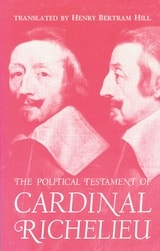
The Political Testament of Cardinal Richelieu
The Significant Chapters and Supporting SelectionsTranslated by Henry Bertram Hill
University of Wisconsin Press, 1964
The Politics of Design in French Colonial Urbanism
Gwendolyn Wright
University of Chicago Press, 1991
Gwendolyn Wright focuses on three French colonies—Indochina, Morocco, and Madagascar—that were the most discussed, most often photographed, and most admired showpieces of the French empire in the early twentieth century. She explores how urban policy and design fit into the French colonial policy of "association," a strategy that accepted, even encouraged, cultural differences while it promoted modern urban improvements that would foster economic development for Western investors. Wright shows how these colonial cities evolved, tracing the distinctive nature of each locale under French imperialism. She also relates these cities to the larger category of French architecture and urbanism, showing how consistently the French tried to resolve certain stylistic and policy problems they faced at home and abroad.
With the advice of architects and sociologists, art historians and geographers, colonial administrators sought to exert greater control over such matters as family life and working conditions, industrial growth and cultural memory. The issues Wright confronts—the potent implications of traditional norms, cultural continuity, modernization, and radical urban experiments—still challenge us today.
The Politics of Fiscal Privilege in Provence, 1530s-1830s
Rafe Blaufarb
Catholic University of America Press, 2012
The Politics of Free Markets
The Rise of Neoliberal Economic Policies in Britain, France, Germany, and the United StatesMonica Prasad
University of Chicago Press, 2006
In The Politics of Free Markets, a comparative-historical analysis of the development of neoliberal policies in these four countries,Monica Prasad argues that neoliberalism was made possible in the United States and Britain not because the Left in these countries was too weak, but because it was in some respects too strong. At the time of the oil crisis in the 1970s, American and British tax policies were more punitive to business and the wealthy than the tax policies of France and West Germany; American and British industrial policies were more adversarial to business in key domains; and while the British welfare state was the most redistributive of the four, the French welfare state was the least redistributive. Prasad shows that these adversarial structures in the United States and Britain created opportunities for politicians to find and mobilize dissatisfaction with the status quo, while the more progrowth policies of France and West Germany prevented politicians of the Right from anchoring neoliberalism in electoral dissatisfaction.

The Politics of Survival
Marc Abélès
Duke University Press, 2010
Abélès examines the new global politics, which assumes many forms and is enacted by diverse figures with varied sympathies: the officials at meetings of the WTO and the demonstrators outside them, celebrity activists, and online contributors to international charities. He makes an impassioned case that our accounts of globalization need to reckon with the preoccupations and affiliations now driving global politics. The Politics of Survival was first published in France in 2006. This English-language edition has been revised and includes a new preface.
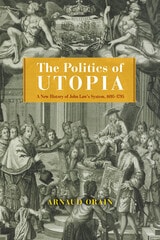
The Politics of Utopia
A New History of John Law's System, 1695–1795Arnaud Orain
University of Chicago Press, 2024
The Scottish economist John Law has been described as the architect of modern central banking. His “System,” established in Regency France between 1716 and 1720, saw the founding of a bank issuing paper money and the establishment of state commercial and colonial enterprises aimed at consolidating public debt. What at first seemed like financial wizardry, however, resulted in rampant speculation and, ultimately, economic collapse. In The Politics of Utopia, historian Arnaud Orain offers a provocative rereading of this well-known episode.
Starting his story in the seventeenth century, Orain reconstructs the figures and ideas, long predating Law, that anticipated and laid the groundwork for the System, which, he argues, is best understood as a failed social utopia aimed at the total transformation of society. Overturning familiar narratives of this seismic event, this book rewrites a stunning chapter in economic history by dealing with the cultural, colonial, religious, and political dimensions of the (in)famous System up to the French Revolution, revealing new lessons for today’s fraught financial landscape.

The Port Royal New Testament
Jansenists and Vernacular Scripture in Seventeenth-Century FranceElizaveta Al-Faradzh
Catholic University of America Press, 2026
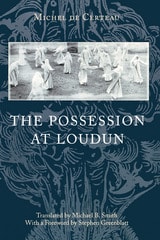
The Possession at Loudun
Michel de Certeau
University of Chicago Press, 2000
Interweaving substantial excerpts from primary historical documents with fascinating commentary, de Certeau shows how the plague of sorceries and possessions in France that climaxed in the events at Loudun both revealed the deepest fears of a society in traumatic flux and accelerated its transformation. In this tour de force of psychological history, de Certeau brings to vivid life a people torn between the decline of centralized religious authority and the rise of science and reason, wracked by violent anxiety over what or whom to believe.
At the time of his death in 1986, Michel de Certeau was a director of studies at the école des hautes études en sciences sociales, Paris. He was author of eighteen books in French, three of which have appeared in English translation as The Practice of Everyday Life,The Writing of History, and The Mystic Fable, Volume 1, the last of which is published by The University of Chicago Press.
"Brilliant and innovative. . . . The Possession at Loudun is [de Certeau's] most accessible book and one of his most wonderful."—Stephen Greenblatt (from the Foreword)
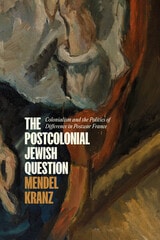
The Postcolonial Jewish Question
Colonialism and the Politics of Difference in Postwar FranceMendel Kranz
University of Chicago Press, 2026
A history of how decolonization shaped Jewish political identity in late-twentieth-century France.
In The Postcolonial Jewish Question, Mendel Kranz shows how France’s colonial history fundamentally shaped contemporary debates among Jews in France about racism, discrimination, and minority politics during the late twentieth century. As the wider country confronted the legacies of the Holocaust and the decline of its colonial empire, Jewish thinkers questioned the boundaries of their own political identity and challenged prevailing paradigms of Western universalism. This book traces how prominent and lesser-known thinkers—including Albert Memmi, Emmanuel Levinas, Alain Finkielkraut, and Wladimir Rabi—as well as organizations like the Colloque des intellectuels juifs de langue française engaged with issues of oppression, nationhood, and communal identity, and the ways that colonialism and its afterlives shaped those discussions. Kranz reveals how the Jewish question itself changed shape through confrontations with postcolonial politics. In doing so, he calls for a reassessment of the parameters of the Jewish question amid colonialism’s enduring legacies in the present.