Results by title
9 books match the query 'Dirt'
Dirt and Desire
Reconstructing Southern Women's Writing, 1930-1990Patricia Yaeger
University of Chicago Press, 2000
For Yaeger, works by black and white southern women writers reveal a shared obsession with monstrosity and the grotesque and with the strange zones of contact between black and white, such as the daily trauma of underpaid labor and the workings of racial and gender politics in the unnoticed yet all too familiar everyday. Yaeger also excavates a southern fascination with dirt—who owns it, who cleans it, and whose bodies are buried in it.
Yaeger's brilliant, theoretically informed readings of Zora Neale Hurston, Harper Lee, Carson McCullers, Toni Morrison, Flannery O'Connor, Alice Walker, and Eudora Welty (among many others) explode the mystifications of southern literary tradition and forge a new path for southern studies.
The book won the Barbara Perkins and George Perkins Award given by the Society for the Study of Narrative Literature.
Dirt and Disease
Polio Before FDRRogers, Naomi
Rutgers University Press, 1992
Dirt and Disease is a social, cultural, and medical history of the polio epidemic in the United States. Naomi Rogers focuses on the early years from 1900 to 1920, and continues the story to the present. She explores how scientists, physicians, patients, and their families explained the appearance and spread of polio and how they tried to cope with it. Rogers frames this study of polio within a set of larger questions about health and disease in twentieth-century American culture.
In the early decades of this century, scientists sought to understand the nature of polio. They found that it was caused by a virus, and that it could often be diagnosed by analyzing spinal fluid. Although scientific information about polio was understood and accepted, it was not always definitive. This knowledge coexisted with traditional notions about disease and medicine.
Polio struck wealthy and middle-class children as well as the poor. But experts and public health officials nonetheless blamed polio on a filthy urban environment, bad hygiene, and poverty. This allowed them to hold slum-dwelling immigrants responsible, and to believe that sanitary education and quarantines could lessen the spread of the disease. Even when experts acknowledged that polio struck the middle-class and native-born as well as immigrants, they tried to explain this away by blaming the fly for the spread of polio. Flies could land indiscriminately on the rich and the poor.
In the 1930s, President Franklin Delano Roosevelt helped to recast the image of polio and to remove its stigma. No one could ignore the cross-spread of the disease. By the 1950s, the public was looking to science for prevention and therapy. But Rogers reminds us that the recent history of polio was more than the history of successful vaccines. She points to competing therapies, research tangents, and people who died from early vaccine trials.
Dirt, Sweat, and Diesel
A Family Farm in the Twenty-first CenturySteven L. Hilty
University of Missouri Press, 2016
With very few people engaged in agriculture today, it is no surprise that most Americans have little understanding of the challenges that modern farmers face. This book provides readers a glimpse into life on a modern Missouri farm where a variety of grains, grass seed, corn, and cattle are produced. All of the conversations, events, and descriptions are drawn from the author’s experience working alongside and observing this father and son family farm operation during the course of a year.
Farming today is technologically complex and requires a broad set of skills that range from soil conservation, animal husbandry, and mechanics to knowledge of financial markets and computer technology. The focus on skills, in addition to the size of the financial risks, and the number of unexpected challenges along the way provides readers with a new perspective and appreciation for modern farm life.
Dirt
A Love StoryEdited by Barbara Richardson
University Press of New England, 2015
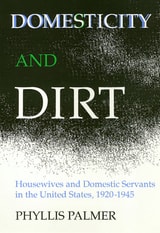
Domesticity And Dirt
Housewives and Domestic Servants in the United States, 1920-1945Phyllis Palmer
Temple University Press, 1991
In the era after Suffrage, white middle-class housewives abandoned moves toward paid work for themselves, embraced domestic life, and felt entitled to servants. In Domesticity and Dirt, Phyllis Palmer examines the cultural norms that led such women to take on the ornamental and emotional elements of the job while relegating the hard physical work and demeaning service tasks to servants—mainly women of color. Using novels, films, magazine articles, home economics texts, and government-funded domestic training course manuals, the author details cultural expectations about middle-class homelife.
Palmer describes how government-funded education programs encouraged the divisions of labor and identity and undercut domestic workers’ organized efforts during the 1930s to win inclusion in New Deal programs regulating labor conditions. Aided by less powerful black civil rights groups, without the assistance of trade unions or women’s clubs, domestics failed to win legal protections and the legal authority and self-respect these brought to covered workers. The author also reveals how middle- class women responded ambivalently to the call to aid women workers when labor reforms threatened their domestic arrangements.
Throughout her study, Palmer questions why white middle-class women looked to new technology and domestic help to deal with cultural demands upon "the perfect housewife" rather than expecting their husbands to help. When the supply of servants declined during the 1950s, middle-class housewives were left isolated with lots of housework. Although they rapidly followed their servants into paid work outside the home, they remain responsible for housework and child care.
In the series Women in the Political Economy, edited by Ronnie J. Steinberg.

Filth
Dirt, Digust, and Modern LifeWilliam A. Cohen
University of Minnesota Press, 2004
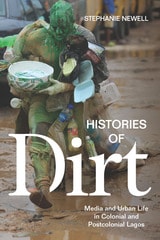
Histories of Dirt
Media and Urban Life in Colonial and Postcolonial LagosStephanie Newell
Duke University Press, 2020
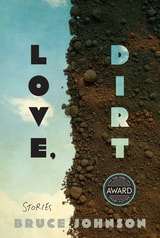
Love, Dirt
Bruce Johnson
University of Iowa Press, 2025
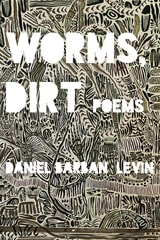
Worms, Dirt
Daniel Barban Levin
Four Way Books, 2026
“The / drugs, the page, none of it is here. That was years ago,” Daniel Barban Levin writes in his debut collection of poems, trying to create an inventory of blank spaces, to describe the persistent presence — the psychological furniture — of what no longer exists. “There was a room. I lived there. / Now, I can’t find it anymore.”
Written in the wake of the media storm surrounding the revelation of the Sarah Lawrence cult, interrogating the constructs of confessionalism and journalistic epistemology after the release of memoirs and viral articles and a Hulu docu-series, Worms, Dirt considers the soil beneath the story playing out aboveground. These poems are a unique telling of two kinds of departure – leaving a cult and exiting a relationship. They weave together fragments and elisions of memory — “Was any of it right? Did any of it happen the way / You remembered?” — reverse engineering a story from the aftermath — “The piece you still can’t find. It must be true. He was // Gentle. Sometimes, he was gentle.” Devastating and open-hearted, these pages transcribe transformation and reconstruction of self, survival, reckoning. They confront the intimate betrayals of belonging to a high-control group or seeking love from the wrong romantic relationships. These lyrics confront horror and a fragile hope in their recognition of this inconceivable thing, the soft flesh smothered by the scar: “The hands’ capacity / For gentleness even as you watched them, in disbelief, dismantle you.”
Traversing New York and New Hampshire and landing in Los Angeles, Levin treats the things we leave behind as the material from which we grow. Most striking about Worms, Dirt is its lyrical metacommentary — as a book about writing a book, it constantly refuses the constraints of the imposed narrative memoir and the parasitic appetite for sensationalism, easily commodified true crime, and flattening characterizations of victims and villains. “For I am at work, writing this / For I have accrued so many reasons to live.”