936 books match the query 'LGBTQ+ Studies' and 156 start with t

cover of The Specter of Materialism: Queer Theory and Marxism in the Age of the Beijing Consensus

The Specter of Materialism

Queer Theory and Marxism in the Age of the Beijing Consensus

Petrus Liu

Duke University Press, 2023

In recent years, queer theory appears to have made a materialist turn away from questions of representation and performativity to those of dispossession, precarity, and the differential distribution of life chances. Despite this shift, queer theory finds itself constantly reabsorbed into the liberal project of diversity management. This theoretical and political weakness, Petrus Liu argues, stems from an incomplete understanding of capitalism’s contemporary transformations, of which China has been at the center. In The Specter of Materialism Liu challenges key premises of classic queer theory and Marxism, turning to an analysis of the Beijing Consensus—global capitalism’s latest mutation—to develop a new theory of the political economy of sexuality. Liu explores how relations of gender and sexuality get reconfigured to meet the needs of capital in new regimes of accumulation and dispossession, demonstrating that evolving US-Asian economic relations shape the emergence of new queer identities and academic theories. In so doing, he offers a new history of collective struggles that provides a transnational framework for understanding the nexus between queerness and material life.
[more]
cover of The Straight Line: How the Fringe Science of Ex-Gay Therapy Reoriented Sexuality

The Straight Line

How the Fringe Science of Ex-Gay Therapy Reoriented Sexuality

Tom Waidzunas

University of Minnesota Press, 2015

To be taken seriously, therapies that claim to “cure” homosexuality wrap themselves in lab coats. Even though the fit is bad, and such therapies and their theorists now inhabit the scientific fringe, the science of sexuality has made some adjustments, too, Tom Waidzunas tells us in this provocative work.

Intervening in the politics of sexuality and science, The Straight Line argues that scientific definitions of sexual orientation do not merely reflect the results of investigations into human nature, but rather emerge through a process of social negotiation between opposing groups. The demedicalization of homosexuality and the discrediting of reparative therapies, ex-gay ministries, and reorientation research have, Waidzunas contends, required scientists to enforce key boundaries around scientific expertise and research methods. Drawing on extensive participant observation at conferences for ex-gays, reorientation therapists, mainstream psychologists, and survivors of ex-gay therapy, as well as interviews with experts and activists, The Straight Line traces reorientation debates in the United States from the 1950s to the present, following homosexuality therapies from the mainstream to the margins. As the ex-gay movement has become increasingly transnational in recent years, Waidzunas turns to Uganda, where ideas about the scientific nature of homosexuality influenced the passage of the Anti-Homosexuality Act of 2014.

While most studies treat the ex-gay movement as a religious phenomenon, this book looks at how the movement, in its attempts to establish legitimacy, has engaged with scientific institutions, shaping virulent anti-gay public policy.

[more]
cover of The Stray Bullet: William S. Burroughs in Mexico

The Stray Bullet

William S. Burroughs in Mexico

Jorge García-Robles

University of Minnesota Press, 2013


William S. Burroughs arrived in Mexico City in 1949, having slipped out of New Orleans while awaiting trial on drug and weapons charges that would almost certainly have resulted in a lengthy prison sentence. Still uncertain about being a writer, he had left behind a series of failed business ventures—including a scheme to grow marijuana in Texas and sell it in New York—and an already long history of drug use and arrests. He would remain in Mexico for three years, a period that culminated in the defining incident of his life: Burroughs shot his common-law wife, Joan Vollmer, while playing William Tell with a loaded pistol. (He would be tried and convicted of murder in absentia after fleeing Mexico.)

First published in 1995 in Mexico, where it received the Malcolm Lowry literary essay award, The Stray Bullet is an imaginative and riveting account of Burroughs’s formative experiences in Mexico, his fascination with Mexico City’s demimonde, his acquaintances and friendships there, and his contradictory attitudes toward the country and its culture. Mexico, Jorge García-Robles makes clear, was the place in which Burroughs embarked on his “fatal vocation as a writer.”

Through meticulous research and interviews with those who knew Burroughs and his circle in Mexico City, García-Robles brilliantly portrays a time in Burroughs’s life that has been overshadowed by the tragedy of Joan Vollmer’s death. He re-creates the bohemian Roma neighborhood where Burroughs resided with Joan and their children, the streets of postwar Mexico City that Burroughs explored, and such infamous figures as Lola la Chata, queen of the city’s drug trade. This compelling book also offers a contribution by Burroughs himself—an evocative sketch of his shady Mexican attorney, Bernabé Jurado.
[more]
cover of The Taylor Mac Book: Ritual, Realness and Radical Performance

The Taylor Mac Book

Ritual, Realness and Radical Performance

David Román and Sean F. Edgecomb, Editors

University of Michigan Press, 2023

This is the first book to dedicate critical attention to the work of influential theater-maker Taylor Mac. Mac is particularly celebrated for the historic performance event A 24-Decade History of Popular Music, in which Mac, in fantastical costumes designed by collaborator Machine Dazzle, sang the history of the United States for 24 straight hours in October 2016. The MacArthur Foundation soon thereafter awarded their “genius” award to a “writer, director, actor, singer, and performance artist whose fearlessly experimental works dramatize the power of theater as a space for building community . . . [and who] interacts with the audience to inspire a reconsideration of assumptions about gender, identity, ethnicity, and performance itself.”
 
Featuring essays, interviews, and commentaries by noted critics and artists, the volume examines the vastness of Mac’s theatrical imagination, the singularity of their voice, the inclusiveness of their cultural insights and critiques, and the creativity they display through stylistic and formal qualities and the unorthodoxies of their personal and professional trajectories. Contributors consider the range of Mac’s career as a playwright, performer, actor, and singer, expanding and enriching the conversation on this much-celebrated and deeply resonant body of work.
 
[more]
cover of The Terrible We: Thinking with Trans Maladjustment

The Terrible We

Thinking with Trans Maladjustment

Cameron Awkward-Rich

Duke University Press, 2022

In The Terrible We Cameron Awkward-Rich thinks with the bad feelings and mad habits of thought that persist in both transphobic discourse and trans cultural production. Observing that trans studies was founded on a split from and disavowal of madness, illness, and disability, Awkward-Rich argues for and models a trans criticism that works against this disavowal. By tracing the coproduction of the categories of disabled and transgender in the United States at the turn of the twentieth century and analyzing transmasculine literature and theory by Eli Clare, Elliott DeLine, Dylan Scholinski, and others, Awkward-Rich suggests that thinking with maladjustment might provide new perspectives on the impasses arising from the conflicted relationships among trans, feminist, and queer. In so doing, he demonstrates that rather than only impeding or confining trans life, thought, and creativity, forms of maladjustment have also been and will continue to be central to their development.

Duke University Press Scholars of Color First Book Award recipient
[more]
cover of The Third Sex

The Third Sex

Willy. Translated and with an Introduction by Lawrence R. Schehr

University of Illinois Press, 2007

A gold mine of information about a hidden queer culture

Thirty-two years before Simone de Beauvoir's classic The Second Sex, popular French novelist Willy published The Third Sex, a vivid description of the world of European homosexuals in France, Italy, and Germany during the late 1920s. Stepping directly into the heart of gay men's culture, Willy follows homosexual nightlife into music halls, nightclubs, casinos, bars, and saunas. While he finds plenty of drug and alcohol abuse, he also discovers homosexual publishers, scientific societies, group rivalries, and opinions--both medical and political--about the nature of homosexuality itself. Lawrence R. Schehr's introduction provides context and translator's notes for this first-ever English edition.

[more]
cover of The Transgender Issue, Volume 4

The Transgender Issue, Volume 4

Susan Stryker

Duke University Press, 0

This special issue of GLQ: A Journal of Lesbian and Gay Studies presents essays that each adopt a methodologically distinctive analysis of a particular concern in transgender studies. Taken together, these pieces demonstrate the wide-ranging and sometimes antagonistic viewpoints of scholars and activists pursuing different political and intellectual goals.

Essays include a documentation of how readers of mass-circulation print media became aware of new medical possibilities for the surgical and hormonal alteration of sex characteristics and began agitating for them; a challenge from feminist theorists to transgender movement activists to avoid repeating the mistakes of previous feminist, gay, and lesbian political mobilizations; a critique of the overreliance on discursive analysis in much current transgender scholarship; and paired essays exploring the so-called Butch/FTM Border Wars from either side of that divide. There are also pieces that focus on intersex activism, the bioethics of gender dysphoria management, and the mobilization of transgender advocacy organizations.
Considering perceptions of queer embodiment past and present, these essays explore the sweeping changes in professional and popular attitudes regarding the transgender community and the issues that affect it. The timeliness of this issue as well as the diversity of its viewpoints makes it a significant contribution to the growing body of transgender literature.

Contributors. Cheryl Chase, Patricia Elliot, Judith Halberstam, C. Jacob Hale, Joanne Meyerowitz, James Lindeman Nelson, Katrina Roen, Henry Rubin, Susan Stryker

[more]
cover of The True Story of Alice B. Toklas: A Study of Three Autobiographies

The True Story of Alice B. Toklas

A Study of Three Autobiographies

Anna Linzie

University of Iowa Press, 2006

In this original and intriguing study, Anna Linzie examines three mid-twentieth-century texts never before treated as interrelated in a book-length work of literary criticism: Gertrude Stein's The Autobiography of Alice B. Toklas (1933) and Alice B. Toklas's The Alice B. Toklas Cook Book (1954) and What Is Remembered (1963). Taking these three texts as intertexts or as an assemblage of the true story of Alice B. Toklas, Linzie challenges assumptions about primary authorship and singular identity that have continued to limit lesbian and feminist rereadings of autobiography as a genre and of Stein and Toklas as writers and historical figures.The True Story of Alice B. Toklas explores how the concept of autobiography as a primarily referential genre is challenged and transformed in relation to autobiographical texts written about the same person, the same life, but differently, by different writers, at different points in time. The concept of one true story is deconstructed in the process as Linzie modifies Homi K. Bhabha's “almost the same but not quite/not white” for the purposes of this particular study as “almost the same but not quite/not straight.” The investigation moves simultaneously on the planes of textuality and sexuality in order to provisionally articulate a “lesbian autobiographical subject” in Linzie's reading of these three texts.Linzie's study fills a gap in literary criticism where Stein's companion and her work have been more or less neglected, conceptualizing the Stein-Toklas sexual/textual relationship as fundamentally reciprocal. The True Story of Alice B. Toklas provides a new critical perspective on Toklas as indispensable to Stein's literary production, a cultural laborer in her own right, and a writer of her own books. Making a significant contribution to recent lesbian/feminist reconceptualizations of the genre of autobiography, this study will fascinate Stein and Toklas scholars as well as those interested in queer and autobiography studies.
[more]
cover of The Truth That Never Hurts 25th anniversary edition: Writings on Race, Gender, and Freedom

The Truth That Never Hurts 25th anniversary edition

Writings on Race, Gender, and Freedom

Barbara Smith

Rutgers University Press, 2024

Read an excerpt "Chicago Firsthand" (click here).

Barbara Smith has been doing groundbreaking work since the early 1970s, describing a Black feminism for Black women. Her work in Black women's literary traditions; in examining the sexual politics of the lives of women of color; in representing the lives of Black lesbians and gay men; and in making connections between race, class, sexuality and gender is gathered in The Truth That Never Hurts. This collection contains some of her major essays on Black women's literature, Black lesbian writing, racism in the women's movement, Black-Jewish relations, and homophobia in the Black community. Her forays into these areas ignited dialogue about topics that few other writers were addressing at the time, and which, sadly, remain pertinent to this day. This twenty-fifth anniversary edition, in a beautiful new package, also contains the essays from the original about the 1968 Chicago convention demonstrations; attacks on the NEA; the Anita Hill-Clarence Thomas Senate hearings; and police brutality against Rodney King and Abner Louima, which, after twenty-five years, still have the urgency they did when they were first written.  

[more]
cover of The Truth That Never Hurts: Writings on Race, Gender, and Freedom

The Truth That Never Hurts

Writings on Race, Gender, and Freedom

Smith, Barbara

Rutgers University Press, 2000

 The Truth That Never Hurts: Writings on Race, Gender, and Freedom brings together more than two decades of literary criticism and political thought about gender, race, sexuality, power, and social change. As one of the first writers in the United States to claim black feminism for black women, Barbara Smith has done groundbreaking work in defining black women’s literary traditions and in making connections between race, class, sexuality, and gender.

Smith’s essay “Toward a Black Feminist Criticism,” is often cited as a major catalyst in opening the field of black women’s literature. Pieces about racism in the women’s movement, black and Jewish relations, and homophobia in the Black community have ignited dialogue about topics that few other writers address. The collection also brings together topical political commentaries on the 1968 Chicago convention demonstrations; attacks on the NEA; the Anita Hill–Clarence Thomas Senate hearings; and police brutality against Rodney King and Abner Louima. It also includes a never-before-published personal essay on racial violence and the bonds between black women that make it possible to survive.

[more]
cover of The Un-Americans: Jews, the Blacklist, and Stoolpigeon Culture

The Un-Americans

Jews, the Blacklist, and Stoolpigeon Culture

Joseph Litvak

Duke University Press, 2009

In a bold rethinking of the Hollywood blacklist and McCarthyite America, Joseph Litvak reveals a political regime that did not end with the 1950s or even with the Cold War: a regime of compulsory sycophancy, in which the good citizen is an informer, ready to denounce anyone who will not play the part of the earnest, patriotic American. While many scholars have noted the anti-Semitism underlying the House Un-American Activities Committee’s (HUAC’s) anti-Communism, Litvak draws on the work of Theodor W. Adorno, Hannah Arendt, Alain Badiou, and Max Horkheimer to show how the committee conflated Jewishness with what he calls “comic cosmopolitanism,” an intolerably seductive happiness, centered in Hollywood and New York, in show business and intellectual circles. He maintains that HUAC took the comic irreverence of the “uncooperative” witnesses as a crime against an American identity based on self-repudiation and the willingness to “name names.” Litvak proposes that sycophancy was (and continues to be) the price exacted for assimilation into mainstream American culture, not just for Jews, but also for homosexuals, immigrants, and other groups deemed threatening to American rectitude.

Litvak traces the outlines of comic cosmopolitanism in a series of performances in film and theater and before HUAC, performances by Jewish artists and intellectuals such as Zero Mostel, Judy Holliday, and Abraham Polonsky. At the same time, through an uncompromising analysis of work by informers including Jerome Robbins, Elia Kazan, and Budd Schulberg, he explains the triumph of a stoolpigeon culture that still thrives in the America of the early twenty-first century.

[more]
cover of The Un-Natural State: Arkansas and the Queer South

The Un-Natural State

Arkansas and the Queer South

Brock Thompson

University of Arkansas Press, 2010
The Un-Natural State is a one-of-a-kind study of gay and lesbian life in Arkansas in the twentieth century, a deft weaving together of Arkansas history, dozens of oral histories, and Brock Thompson's own story. Thompson analyzes the meaning of rural drag shows, including a compelling description of a 1930s seasonal beauty pageant in Wilson, Arkansas, where white men in drag shared the stage with other white men in blackface, a suggestive mingling that went to the core of both racial transgression and sexual disobedience. These small town entertainments put on in churches and schools emerged decades later in gay bars across the state as a lucrative business practice and a larger means of community expression, while in the same period the state's sodomy law was rewritten to condemn sexual acts between those of the same sex in language similar to what was once used to denounce interracial sex. Thompson goes on to describe several lesbian communities established in the Ozark Mountains during the sixties and seventies and offers a substantial account of Eureka Springs's informal status as the "gay capital of the Ozarks." Through this exploration of identity formation, group articulation, political mobilization, and cultural visibility within the context of historical episodes such as the Second World War, the civil rights movement, and the AIDS epidemic, The Un-Natural State contributes not only to our understanding of gay and lesbian history but also to our understanding of the South.
[more]
cover of The Unspeakable Vice: The Catholic Church and Homosexuality in the Twentieth Century

The Unspeakable Vice

The Catholic Church and Homosexuality in the Twentieth Century

Francesco Torchiani, Translated by Johanna Bishop

University of Wisconsin Press, 2026

As gay men and lesbian women increasingly gained recognition and acceptance in twentieth-century literature and film, and subsequently in social and political movements, the Catholic Church reacted by subtly moving away from its overt condemnation of homosexuality as an urgent moral problem and toward tacitly shunning homosexuality as an “unspeakable vice.” In this revealing history, Francesco Torchiani reconstructs the Catholic Church’s shifting attitudes toward homosexuality during this period by drawing on a vast array of internal documents and external accounts. This monograph expands the scholarship on the relationship between Catholicism and homosexuality in terms of both method and content, ultimately concluding that the Catholic Church continues to wholeheartedly condemn homosexuality despite making genuine efforts to reflect on and understand its social and cultural impact. The Unspeakable Vice therefore sheds new light on and places into historical perspective the questions the Catholic Church continues to reckon with regarding its role in contemporary society.
[more]
cover of The War on Sex

The War on Sex

David M. Halperin and Trevor Hoppe, editors

Duke University Press, 2017
The past fifty years are conventionally understood to have witnessed an uninterrupted expansion of sexual rights and liberties in the United States. This state-of-the-art collection tells a different story: while progress has been made in marriage equality, reproductive rights, access to birth control, and other areas, government and civil society are waging a war on stigmatized sex by means of law, surveillance, and social control. The contributors document the history and operation of sex offender registries and the criminalization of HIV, as well as highly punitive measures against sex work that do more to harm women than to combat human trafficking. They reveal that sex crimes are punished more harshly than other crimes, while new legal and administrative regulations drastically restrict who is permitted to have sex. By examining how the ever-intensifying war on sex affects both privileged and marginalized communities, the essays collected here show why sexual liberation is indispensable to social justice and human rights.
 
Contributors. Alexis Agathocleous, Elizabeth Bernstein, J. Wallace Borchert, Mary Anne Case, Owen Daniel-McCarter, Scott De Orio, David M. Halperin, Amber Hollibaugh, Trevor Hoppe, Hans Tao-Ming Huang, Regina Kunzel, Roger N. Lancaster, Judith Levine, Laura Mansnerus, Erica R. Meiners, R. Noll, Melissa Petro, Carol Queen, Penelope Saunders, Sean Strub, Maurice Tomlinson, Gregory Tomso
[more]
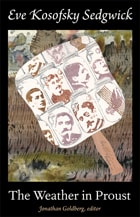
cover of The Weather in Proust

The Weather in Proust

Eve Kosofsky Sedgwick

Duke University Press, 2012

The Weather in Proust gathers pieces written by the eminent critic and theorist Eve Kosofsky Sedgwick in the last decade of her life, as she worked toward a book on Proust. This book takes its title from the first essay, a startlingly original interpretation of Proust. By way of Neoplatonism, Buddhism, and the work of Melanie Klein, Sedgwick establishes the sense of refreshment and surprise that the author of the Recherche affords his readers. Proust also figures in pieces on the poetry of C. P. Cavafy, object relations, affect theory, and Sedgwick’s textile art practices. More explicitly connected to her role as a pioneering queer theorist are an exuberant attack against reactionary refusals of the work of Guy Hocquenghem and talks in which she lays out her central ideas about sexuality and her concerns about the direction of US queer theory. Sedgwick lived for more than a dozen years with a diagnosis of terminal cancer; its implications informed her later writing and thinking, as well as her spiritual and artistic practices. In the book’s final and most personal essay, she reflects on the realization of her impending death. Featuring thirty-seven color images of her art, The Weather in Proust offers a comprehensive view of Sedgwick’s later work, underscoring its diversity and coherence.
[more]
cover of The Wedding Heard 'Round the World: America's First Gay Marriage

The Wedding Heard 'Round the World

America's First Gay Marriage

Michael McConnell

University of Minnesota Press, 2016

On September 3, 1971, Michael McConnell and Jack Baker exchanged vows in the first legal same-sex wedding in the United States. Their remarkable story is told here for the first time—a unique account of the passion and energy of the gay liberation movement in the sixties and seventies. 
 
At the dawn of the modern gay movement (while New York’s Stonewall riots and San Francisco’s emerging political activism bloomed), these two young men insisted on making their commitment a legal reality. They were already crusaders for gay rights: Jack had twice been elected the University of Minnesota’s student president—the first openly gay university student president in the country, an election reported by Walter Cronkite on network TV news. They were featured in Look magazine’s special issue about the American family and received letters of support from around the world.
 
The couple navigated complex procedures to obtain a state-issued marriage license. Their ceremony was conducted by a Methodist minister in a friend’s tiny Minneapolis apartment. Wearing matching white pantsuits, exchanging custom-designed rings, and sharing a tiered wedding cake, Michael and Jack celebrated their historic marriage. After reciting their vows, they sealed their promise to love and honor each other with a kiss and a signed marriage certificate.
 
Repercussions were immediate: Michael’s job offer at the University of Minnesota was rescinded, leading him to wage a battle against job discrimination with the help of the Minnesota Civil Liberties Union. The couple eventually reached the U.S. Supreme Court with two precedent-setting cases. 
 
Michael and Jack have retired from the public spotlight, but after four decades their marriage is still their joy and comfort. Living quietly in a Minneapolis bungalow, they exemplify a contemporary version of the American dream. Only now, with marriage equality in the headlines and the Supreme Court decision to make love the law of the land, are they willing to tell the entire story of their groundbreaking experiences. TIME magazine listed the twenty-five most influential marriages of all time and included Michael and Jack, and they were recently profiled in a cover story in the Sunday New York Times. Their long campaign for marriage equality and insistence on equal rights for all citizens is a model for advocates of social justice and an inspiration for everyone who struggles for acceptance in a less-than-equal world.
[more]
cover of The Work of Friendship: In Memoriam Alan Bray, Volume 10

The Work of Friendship

In Memoriam Alan Bray, Volume 10

Jody Greene , ed.

Duke University Press, 0

The sudden and premature death of Alan Bray deprived gay and lesbian studies of a founding figure. Best known for his 1982 book Homosexuality in Renaissance England, Bray paved the way for subsequent scholars in early modern gay and lesbian studies. This special issue of GLQ collects essays that draw on and expand Bray’s work of the past two decades, as well as offer new work in the emerging field of friendship studies, of which he was a pioneer.

Contributors to the collection include some of the most prominent scholars in the field of early modern sexualities. They think expansively about Bray’s impact on their own work and, most importantly, test the applicability of his theories (that same-sex desire has a history that can be reconstructed and that the actual object of study is difficult to capture, as its expression varies radically across cultures and societies) in areas where they have not been previously employed. Two essays in this collection explore friendships or intimacies between women or between men and women—topics Bray did not pursue extensively. Others deal with locations outside Bray’s heavily English focus, including France, the Netherlands, Belgium, and Luxembourg, or apply his theories to periods beyond the Renaissance. Additionally, the issue includes a review of Bray’s The Friend, published posthumously, and an assessment of his scholarly career from his earliest writings to this final work.

Contributors. George Chauncey, Carla Freccero, Jonathan Goldberg, Jody Greene, George E. Haggerty, Jeffrey Masten, Jeffrey Merrick, Stephen Orgel, Laurie Shannon, Valerie Traub
[more]
cover of The World Turned: Essays on Gay History, Politics, and Culture

The World Turned

Essays on Gay History, Politics, and Culture

John D Emilio

Duke University Press, 2002

Something happened in the 1990s, something dramatic and irreversible. A group of people long considered a moral menace and an issue previously deemed unmentionable in public discourse were transformed into a matter of human rights, discussed in every institution of American society. Marriage, the military, parenting, media and the arts, hate violence, electoral politics, public school curricula, human genetics, religion: Name the issue, and the the role of gays and lesbians was a subject of debate. During the 1990s, the world seemed finally to turn and take notice of the gay people in its midst. In The World Turned, distinguished historian and leading gay-rights activist John D’Emilio shows how gay issues moved from the margins to the center of national consciousness during the critical decade of the 1990s.

In this collection of essays, D’Emilio brings his historian’s eye to bear on these profound changes in American society, culture, and politics. He explores the career of Bayard Rustin, a civil rights leader and pacifist who was openly gay a generation before almost everyone else; the legacy of radical gay and lesbian liberation; the influence of AIDS activist and writer Larry Kramer; the scapegoating of gays and lesbians by the Christian Right; the gay-gene controversy and the debate over whether people are "born gay"; and the explosion of attention focused on queer families. He illuminates the historical roots of contemporary debates over identity politics and explains why the gay community has become, over the last decade, such a visible part of American life.
[more]
cover of Them Goon Rules: Fugitive Essays on Radical Black Feminism

Them Goon Rules

Fugitive Essays on Radical Black Feminism

Marquis Bey

University of Arizona Press, 2019

Marquis Bey’s debut collection, Them Goon Rules, is an un-rulebook, a long-form essayistic sermon that meditates on how Blackness and nonnormative gender impact and remix everything we claim to know.

A series of essays that reads like a critical memoir, this work queries the function and implications of politicized Blackness, Black feminism, and queerness. Bey binds together his personal experiences with social justice work at the New York–based Audre Lorde Project, growing up in Philly, and rigorous explorations of the iconoclasm of theorists of Black studies and Black feminism. Bey’s voice recalibrates itself playfully on a dime, creating a collection that tarries in both academic and nonacademic realms.

Fashioning fugitive Blackness and feminism around a line from Lil’ Wayne’s “A Millie,” Them Goon Rules is a work of “auto-theory” that insists on radical modes of thought and being as a refrain and a hook that is unapologetic, rigorously thoughtful, and uncompromising.
[more]
cover of There's a Disco Ball Between Us: A Theory of Black Gay Life

There's a Disco Ball Between Us

A Theory of Black Gay Life

Jafari S. Allen

Duke University Press, 2021

In There’s a Disco Ball Between Us, Jafari S. Allen offers a sweeping and lively ethnographic and intellectual history of what he calls “Black gay habits of mind.” In conversational and lyrical language, Allen locates this sensibility as it emerged from radical Black lesbian activism and writing during the long 1980s. He traverses multiple temporalities and locations, drawing on research and fieldwork conducted across the globe, from Nairobi, London, and Paris to Toronto, Miami, and Trinidad and Tobago. In these locations and archives, Allen traces the genealogies of Black gay politics and cultures in the visual art, poetry, film, Black feminist theory, historiography, and activism of thinkers and artists such as Audre Lorde, Marsha P. Johnson, Essex Hemphill, Colin Robinson, Marlon Riggs, Pat Parker, and Joseph Beam. Throughout, Allen renarrates Black queer history while cultivating a Black gay method of thinking and writing. In so doing, he speaks to the urgent contemporary struggles for social justice while calling on Black studies to pursue scholarship, art, and policy derived from the lived experience and fantasies of Black people throughout the world.
[more]
cover of These Survivals: Autobiography of an Extinction

These Survivals

Autobiography of an Extinction

Lynne Huffer

Duke University Press, 2025

A collage-style work in fragments, Lynne Huffer’s These Survivals brings together philosophy, memoir, poetry, and original multimedia artworks to articulate an ethics of living on a devastated planet. Focusing on climate change and mass species extinction, Huffer approaches ruination through assemblages rendered in sharp-edged prose, vibrant color images, and experimental features that include black-out poems, weather reports, and abecedarian essays. She considers her struggles with everyday life and confronts the immensity of extinction across the expanse of geological time, recognizing the self’s insignificance in the context of the planet’s 4.5-billion-year existence. As she moves across autobiographical, political, and literary registers, her abiding theme is the repeated phrase: the fragment remains while the whole crumbles. At every turn, Huffer insists on the fragmentary, provisional nature of anything taken to be whole as well as the impartial conditions under which we write, at times experienced as constraint and at others, freedom. Reveling in interruption, obliquity, and layering, Huffer opens space for thought to emerge in unexpected and innovative ways—ways that are grounded in the material practices of writing and living.
[more]
cover of Things No Longer There: A Memoir of Losing Sight and Finding Vision

Things No Longer There

A Memoir of Losing Sight and Finding Vision

Susan Krieger

University of Wisconsin Press, 2005

    Things No Longer There is a lovingly crafted collection of personal stories about the author's struggle toward enlightenment while losing her eyesight. It is also, more broadly, about invisible landscapes—places of the heart that linger long after they have disappeared from the world outside. In these ten brief tales and one novella-length intimate drama, Susan Krieger takes us on a series of adventures in vision, a journey both inward and to various parts of the country. We travel with her as she goes birdwatching before sunrise in the New Mexico desert, learns to walk with a white cane, revisits an old love, returns to a summer camp of her youth, and reflects on the nature of blindness and sight.
    Krieger's touching memoir explores the ways that outer landscapes may change and sight may be lost, but inner visions persist, giving meaning, jarring the senses with a very different picture than what appears before the eyes. This book will reward both the general reader and those interested in disability studies, feminist ethnography, and lesbian studies.
[more]
cover of Thinking Sexuality Transnationally, Volume 5

Thinking Sexuality Transnationally, Volume 5

George and Elizabeth A. Povinelli

Duke University Press, 0

Thinking Sexuality Transnationally examines the emergence of new forms of sexuality and desire from a global perspective. Legal, pop-culture, and academic approaches to these new forms are considered from both national—China, Brazil, Indonesia, and Thailand—and transnational—Puerto Rico, Guatemala, and the United States—standpoints. The contributors approach their subjects with the corollary understanding that these new forms of sexuality and desire arise in borderlands, and what constitutes a borderland has been redefined with the onset of mass media and communication abilities.
Included in this collection are a study of the construction of male gay identities in China; a consideration of sexual pedagogy, the state, and the “new Brazilian homosexuality”; the format of amnesty applications submitted by lesbians in Guatemala; the roles of gender and sexuality in Taiwanese opera; and a review of transgender literature and language. One of the first comprehensive inquiries into the effects of globalization on sexuality and desire, Thinking Sexuality Transnationally brings together essayists from several disciplines to look at how sexuality and global movement are involved and evolving.

Contributors. Tom Boellstorff, George Chauncey, Peter Jackson, Don Kulick, Patrick Larvie, Heather McClure, Frances Negron-Munter, Elizabeth A. Povinelli, Lisa Rofel, Teri Silvio

[more]
cover of Thoughts and Things

Thoughts and Things

Leo Bersani

University of Chicago Press, 2014

Leo Bersani’s career spans more than fifty years and extends across a wide spectrum of fields—including French studies, modernism, realist fiction, psychoanalytic criticism, film studies, and queer theory.  Throughout this new collection of essays that ranges, interestingly and brilliantly, from movies by Claire Denis and Jean-Luc Godard to fiction by Proust and Pierre Bergounioux, Bersani considers various kinds of connectedness.

Thoughts and Things posits what would appear to be an irreducible gap between our thoughts (the human subject) and things (the world). Bersani departs from his psychoanalytic convictions to speculate on the oneness of being—of our intrinsic connectedness to the other that is at once external and internal to us.  He addresses the problem of formulating ways to consider the undivided mind, drawing on various sources, from Descartes to cosmology, Freud, and Genet and succeeds brilliantly in diagramming new forms as well as radical failures of connectedness. Ambitious, original, and eloquent, Thoughts and Things will be of interest to scholars in philosophy, film, literature, and beyond.
[more]
cover of Time Out of Joint: The Queer and the Customary in Africa

Time Out of Joint

The Queer and the Customary in Africa

Kirk Fiereck, Neville Hoad, and Danai Mupotsa, special issue editors

Duke University Press, 0

Contributors to this special issue investigate how queer theory might change when African texts, experiences, and concepts are placed front and center rather than treated as examples or case studies. The authors consider what the concept of customary does to the dialectic of tradition and modernity that is at the heart of much Africanist scholarship. Can queer theoretical texts travel beyond the North Atlantic world that made them without reproducing imperial ways of knowing? Can there be an African queer theory? In posing these questions, the authors encourage readers to consider queerness from and within Africa, exploring what African customary forms of gender and sexuality might do to the anti-normativity of queer theory and how presumptions within Euro-American queer scholarship contribute to Afro-pessimist and/or Afro-optimist scholarship.

Contributors. Cal (Crystal) Biruk, Laura Edmondson, Kirk Fiereck, Neville Hoad, Phoebe Kisubi, Keguro Macharia, Danai Mupotsa, Edgar Nabutanyi, Eddie Ombagi, Ruth Ramsden-Karelse
[more]
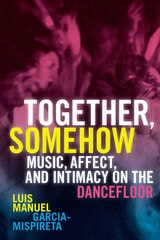
cover of Together, Somehow: Music, Affect, and Intimacy on the Dancefloor

Together, Somehow

Music, Affect, and Intimacy on the Dancefloor

Luis Manuel Garcia-Mispireta

Duke University Press, 2023
In Together, Somehow, Luis Manuel Garcia-Mispireta examines how people find ways to get along and share a dancefloor, a vibe, and a sound. Drawing on time spent in the minimal techno and house music subscenes in Chicago, Paris, and Berlin as the first decade of the new millennium came to a close, Garcia-Mispireta explains this bonding in terms of what he calls stranger-intimacy: the kind of warmth, sharing, and vulnerability between people that happens surprisingly often at popular electronic dance music parties. He shows how affect lubricates the connections between music and the dancers. Intense shared senses of sound and touch help support a feeling of belonging to a larger social world. However, as Garcia-Mispireta points out, this sense of belonging can be vague, fluid, and may hide exclusions and injustices. By showing how sharing a dancefloor involves feeling, touch, sound, sexuality, and subculture, Garcia-Mispireta rethinks intimacy and belonging through dancing crowds and the utopian vision of throbbing dancefloors.
[more]
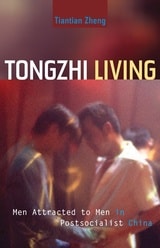
cover of Tongzhi Living: Men Attracted to Men in Postsocialist China

Tongzhi Living

Men Attracted to Men in Postsocialist China

Tiantian Zheng

University of Minnesota Press, 2015

Tongzhi, which translates into English as “same purpose” or “same will,” was once widely used to mean “comrade.” Since the 1990s, the word has been appropriated by the LGBT community in China and now refers to a broad range of people who do not espouse heteronormativity.

Tongzhi Living, the first study of its kind, offers insights into the community of same-sex-attracted men in the metropolitan city of Dalian in northeast China. Based on ethnographic fieldwork by Tiantian Zheng, the book reveals an array of coping mechanisms developed by tongzhi men in response to rapid social, cultural, and political transformations in postsocialist China. According to Zheng, unlike gay men in the West over the past three decades, tongzhi men in China have adopted the prevailing moral ideal of heterosexuality and pursued membership in the dominant culture at the same time they have endeavored to establish a tongzhi culture. They are, therefore, caught in a constant tension of embracing and contesting normality as they try to create a new and legitimate space for themselves.

Tongzhi men’s attempts to practice both conformity and rebellion paradoxically undercut the goals they aspire to reach, Zheng shows, perpetuating social prejudice against them and thwarting the activism they believe they are advocating.


[more]
cover of Torn: Asian/white Life and the Intimacy of Violence

Torn

Asian/white Life and the Intimacy of Violence

Anna M. Moncada Storti

Duke University Press, 2026

In Torn, Anna M. Moncada Storti searches for the ordinary and obscured impressions of the US empire, theorizing the pervasiveness of its violence through the language and patterns of intimacy. Reading for the intimacy of violence, Storti compiles an inventory of quotidian, psychic, and affective tensions that arise within the bodies of empire’s historical subjects. She raises Asian/white life as the representative case study to examine a familiar narrative of inner strife—that being of two distinct racial histories is to be rendered a body in tension, torn between ancestral lineages. Rather than refute this stance, Storti tracks the duress of fragmentation as a sign of war’s permanent mark on racial and sexual subjection. Traversing an archive of aesthetic, literary, and cultural portrayals of Asian/white racial mixture, Storti observes how Asian Americans refuse, rework, or reify the logics of progress and disavowal that have long fueled the US war machine. Tending to tension, she argues for a sustained confrontation with empire’s ordinary life, a prerequisite for anti-imperial solidarity.
[more]
cover of Tortilleras Negotiating Intimacy: Love, Friendship, and Sex in Queer Mexico City

Tortilleras Negotiating Intimacy

Love, Friendship, and Sex in Queer Mexico City

Anahi Russo Garrido

Rutgers University Press, 2020

Tortilleras Negotiating Intimacy: Love, Friendship, and Sex in Queer Mexico City is the first ethnography in English to focus primarily on women’s sexual and intimate cultures in Mexico. The book shows the transformation of intimacy in the lives of three generations of women in queer spaces in contemporary Mexico City, as their sexual citizenship changes, including references to same-sex marriage and anti-discrimination laws. The book shows how these individuals reconfigure relationships through marriage, polyamory, friendship, and sex. Tortilleras Negotiating Intimacy suggests that “new” intimate cartographies are emerging in Mexico City, ultimately redefining relationships, gender, and mexicanidad. Building on ethnographic data collected over the past decade, including forty-five in-depth interviews with women between the ages of twenty-two and sixty-five participating in LGBT spaces, Tortilleras Negotiating Intimacy shows how lesbian women (mainly cis, but some trans) negotiate friendship, same-sex marriage, polyamory, and sexual practices, reinventing love, eroticism, friendship, and ultimately the social organization of Latin American societies.
[more]
cover of Tortilleras: Hispanic & U.S. Latina Lesbian Expression

Tortilleras

Hispanic & U.S. Latina Lesbian Expression

Lourdes Torres

Temple University Press, 2003
The first anthology to focus exclusively on queer readings of Spanish, Latin American, and US Latina lesbian literature and culture, Tortilleras interrogates issues of gender, national identity, race, ethnicity, and class to show the impossibility of projecting a singular Hispanic or Latina Lesbian. Examining carefully the works of a range of lesbian writers and performance artists, including Carmelita Tropicana and Christina Peri Rossi, among others, the contributors create a picture of the complicated and multi-textured contributions of Latina and Hispanic lesbians to literature and culture. More than simply describing this sphere of creativity, the contributors also recover from history the long, veiled existence of this world, exposing its roots, its impact on lesbian culture, and, making the power of lesbian performance and literature visible.
[more]
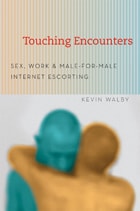
cover of Touching Encounters: Sex, Work, and Male-for-Male Internet Escorting

Touching Encounters

Sex, Work, and Male-for-Male Internet Escorting

Kevin Walby

University of Chicago Press, 2012
Often depicted as deviant or pathological by public health researchers, psychoanalysts, and sexologists, male-with-male sex and sex work is, in fact, an increasingly mainstream pursuit. Based on a qualitative investigation of the practices involved in male-with-male—or m4m—Internet escorting, Touching Encounters is the first book to explicitly address how masculinity and sexuality shape male commercial sex in this era of Internet communications.
 
By looking closely at the sex and work of male escorts, Kevin Walby tries to reconcile the two extremes of m4m sex—the stereotypical idea of a quick cash transaction and the tendency toward friendship and mutuality. In doing so, Walby draws on the work of Foucault to make visible the play of power in these physical and commercial relations between men. At once a revelation to the sociology of work and a much-needed critical engagement with queer theory, Touching Encounters responds to calls from across the social sciences to connect Foucault with sociologies of sex, sexuality, and intimacy. Walby does this and more, retying this sexual practice back to society at large.
[more]
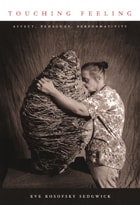
cover of Touching Feeling: Affect, Pedagogy, Performativity

Touching Feeling

Affect, Pedagogy, Performativity

Eve Kosofsky Sedgwick

Duke University Press, 2003

A pioneer in queer theory and literary studies, Eve Kosofsky Sedgwick brings together for the first time in Touching Feeling her most powerful explorations of emotion and expression. In essays that show how her groundbreaking work in queer theory has developed into a deep interest in affect, Sedgwick offers what she calls "tools and techniques for nondualistic thought," in the process touching and transforming such theoretical discourses as psychoanalysis, speech-act theory, Western Buddhism, and the Foucauldian "hermeneutics of suspicion."

In prose sometimes somber, often high-spirited, and always accessible and moving, Touching Feeling interrogates—through virtuoso readings of works by Henry James, J. L. Austin, Judith Butler, the psychologist Silvan Tomkins and others—emotion in many forms. What links the work of teaching to the experience of illness? How can shame become an engine for queer politics, performance, and pleasure? Is sexuality more like an affect or a drive? Is paranoia the only realistic epistemology for modern intellectuals? Ultimately, Sedgwick's unfashionable commitment to the truth of happiness propels a book as open-hearted as it is intellectually daring.
[more]
cover of Tourist Attractions: Performing Race and Masculinity in Brazil's Sexual Economy

Tourist Attractions

Performing Race and Masculinity in Brazil's Sexual Economy

Gregory Mitchell

University of Chicago Press, 2015

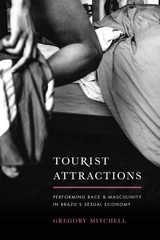
While much attention has been paid in recent years to heterosexual prostitution and sex tourism in Brazil, gay sex tourism has been almost completely overlooked. In Tourist Attractions, Gregory C. Mitchell presents a pioneering ethnography that focuses on the personal lives and identities of male sex workers who occupy a variety of roles in Brazil’s sexual economy.

Mitchell takes us into the bath houses of Rio de Janeiro, where rent boys cruise for clients, and to the beaches of Salvador da Bahia, where African American gay men seek out hustlers while exploring cultural heritage tourist sites. His ethnography stretches into the Amazon, where indigenous fantasies are tinged with the erotic at eco-resorts, and into the homes of “kept men,” who forge long-term, long-distance, transnational relationships that blur the boundaries of what counts as commercial sex. Mitchell asks how tourists perceive sex workers’ performances of Brazilianness, race, and masculinity, and, in turn, how these two groups of men make sense of differing models of racial and sexual identity across cultural boundaries. He proposes that in order to better understand how people experience difference sexually, we reframe prostitution—which Marxist feminists have long conceptualized as sexual labor—as also being a form of performative labor. Tourist Attractions is an exceptional ethnography poised to make an indelible impact in the fields of anthropology, gender, and sexuality, and research on prostitution and tourism.
[more]
cover of Towards a Gay Communism: Elements of a Homosexual Critique

Towards a Gay Communism

Elements of a Homosexual Critique

Mario Mieli

Pluto Press, 2018

First published in Italian in 1977, Mario Mieli's groundbreaking book is an early landmark of revolutionary queer theory - now available for the first time in a complete and unabridged English translation.

Among the most important works ever to address the relationship between homosexuality, homophobia and capitalism, Mieli's essay continues to pose a radical challenge to today's dominant queer theory and politics.

With extraordinary prescience, Mieli exposes the efficiency with which capitalism co-opts 'perversions' which are then 'sold both wholesale and retail'. In his view the liberation of homosexual desire requires the emancipation of sexuality from both patriarchal sex roles and capital.

Drawing heavily upon Marx and psychoanalysis to arrive at a dazzlingly original vision, Towards a Gay Communism is a hitherto neglected classic that will be essential reading for all who seek to understand the true meaning of sexual liberation under capitalism today.
[more]
cover of Tranimalities

Tranimalities

Eva S. Hayward and Jami Weinstein, special issue editors

Duke University Press, 0
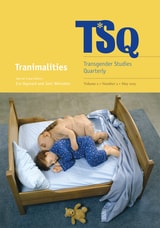
If the critical import of this issue of TSQ, “Tranimalities,” can be narrowed to a single focal point, it is that the human/nonhuman distinction is inextricably tied to questions of gender and sexual difference. Issue editors Eva Hayward and Jami Weinstein, along with the authors whose work they have selected for inclusion, collectively argue that to be human has meant taking a position in relation to sexual difference and becoming gendered (the English& it, for example, has no personhood, as opposed to he and& she), while to be forcibly ungendered or to become transgendered renders one's humanness precarious. It can result in one's status being moved toward the not-quite-human, the inhuman, the “mere” animal, or even toward death, toward a purportedly inanimate “gross materiality.” The editors' exquisite introduction, the feature articles, and much of the content in the journal's recurring sections (including Harlan Weaver's contribution to the New Media section, Paige Johnson's film analysis and Anthony Wagner's artist statement in Arts and Culture, and M. Dale Booth's essay on recent scholarship in the Book Review section) all explore the non/human in relation to transgender at an unprecedented level of detail and theoretical sophistication. They plumb philosophical depths that bring transgender studies into conversation with some of the most fundamental questions we can ask about ourselves and the cosmos we experience, and in doing so they help realize the potential originally envisioned for this journal and for the field.
[more]
cover of Trans Care

Trans Care

Hil Malatino

University of Minnesota Press, 2020

A radical and necessary rethinking of trans care  

What does it mean for trans people to show up for one another, to care deeply for one another? How have failures of care shaped trans lives? What care practices have trans subjects and communities cultivated in the wake of widespread transphobia and systemic forms of trans exclusion? 

Trans Care is a critical intervention in how care labor and care ethics have been thought, arguing that dominant modes of conceiving and critiquing the politics and distribution of care entrench normative and cis-centric familial structures and gendered arrangements. A serious consideration of trans survival and flourishing requires a radical rethinking of how care operates.

Forerunners is a thought-in-process series of breakthrough digital works. Written between fresh ideas and finished books, Forerunners draws on scholarly work initiated in notable blogs, social media, conference plenaries, journal articles, and the synergy of academic exchange. This is gray literature publishing: where intense thinking, change, and speculation take place in scholarship.
[more]
cover of Trans Philosophy

Trans Philosophy

Perry Zurn

University of Minnesota Press, 2024

Establishing trans philosophy as a unique field of inquiry, offering tools for our quest toward a more just and equitable world

Trans Philosophy defines this burgeoning and polymorphous discipline as philosophical work that is accountable to and illuminative of cross-cultural and global trans experiences, histories, and cultural productions. Across language and politics, feminism and phenomenology, and decolonial theory, it addresses trans worldmaking in all its beauty and mundanity.

Critically, the editors center the contributions of trans and gender-nonconforming philosophers from around the globe. Showcasing work from a range of emerging and established voices, Trans Philosophy addresses discrimination, embodiment, identity, language, and law, utilizing diverse philosophical methods to attend to significant intersections between trans experience and class, disability, race, nationality, and sexuality.

At a time when trans-exclusionary views are gaining traction in politics as well as philosophy, this volume urgently redraws the contours of trans discourse, centering the wisdom already generated in trans and other gender-disruptive communities.

Contributors: Megan Burke, Sonoma State U; Robin Dembroff, Yale U; Marie Draz, San Diego State U; Che Gossett, U of Pennsylvania; Ryan Gustafsson, U of Melbourne; Stephanie Kapusta, Dalhousie U; Tamsin Kimoto, Washington U, St. Louis; Hil Malatino, Pennsylvania State U and Rock Ethics Institute; Amy Marvin, Lafayette U; Marlene Wayar.

Retail e-book files for this title are screen-reader friendly.

[more]
cover of Trans Pornography

Trans Pornography

Sophie Pezzutto and Lynn Comella, special issue editors

Duke University Press, 2020

For many people, trans or not, pornography is the first point of contact with trans identities, communities, and subcultures. Always a popular niche, demand for trans pornography has significantly risen in recent years. No longer the domain of a handful of small studios, trans porn is now produced by transnational porn empires and is becoming a staple of commercial pornography production. To date, trans studies has not effectively engaged with the topic of trans porn, while pornography scholarship has largely neglected it as a genre of significance. The contributors to this issue—a mix of scholars and industry insiders—fill that gap and provide an overview of this emerging area of inquiry. Articles include an examination of trans micropornography (user-made remixes shared among fans), a history of two pioneers of mainstream trans pornography, and a photo-essay of portraits by Rae Threat.

Contributors
Skylar Adams, Carolyn Bronstein, Lynn Comella, Korra Del Rio, Sly Fawkes, Aster Gilbert, RL Goldberg, Laura Horak, Valentina Mia, Geoffrey H. Nicholson, Sophie Pezzutto, Matt Richardson, Whitney Strub, Rae Threat
[more]
cover of Trans Studies en las Americas

Trans Studies en las Americas

Claudia Sofia Garriga-López, Cole Rizki, and Juana María Rodríguez, special issue editors

Duke University Press, 0

Shifting the geopolitics of trans studies, travesti theory is a Latinx American body of work with an extensive transregional history. As a particular body politics, travesti identification is not only a sexed, gendered, classed, and racialized form of relation, but a critical mode and an epistemology. Throughout the Américas, trans and travesti studies take a multiplicity of forms: scholarly work that engages identitarian and anti-identitarian analytical frameworks as well as interventions into state practices, cultural production, and strategic activist actions. These multiple critical approaches—both travesti and trans—are regionally inflected by the flows of people, ideas, technologies, and resources that shape the hemisphere, opening up space to explore the productive tensions and expansive possibilities within this body of work.

This special issue of TSQ prompts a conversation between trans and travesti studies scholars working across the Américas to investigate how shifts in cultural practices, aesthetics, geographies, and languages enliven theories of politics, subjectivity, and embodiment. Contributors to this issue offer a hemispheric perspective on trans and travesti issues to the Anglophone academy, expand transgender studies to engage geopolitical connections, and bring interdisciplinary approaches to topics ranging from policy to cultural production. This issue is an unprecedented English-language collection by Latin American and Latinx scholars on trans and travesti issues.

Contributors. Lino Arruda, Daniel Coleman, Cynthia Citlallin Delgado, El Colectivo del Archivo de la Memoria Trans, Juan Carlos Garrido, Claudia Sofía Garriga-López, Bernadine Hernández, Hillary Hiner, Denilson Lopes, Andrés Lopez, Cole Rizki, Juana María Rodríguez, Oli Rodriguez, Marcia Lucia Machuca Rose, Martín de Mauro Rucovsky, Dora Silva Santana, Susy Shock, Sayak Valencia
[more]
cover of Trans Studies: The Challenge to Hetero/Homo Normativities

Trans Studies

The Challenge to Hetero/Homo Normativities

Martínez-San Miguel, Yolanda

Rutgers University Press, 2016

Winner of the 2017 Sylvia Rivera Award in Transgender Studies from the Center for LGBTQ Studies (CLAGS)

From Caitlyn Jenner to Laverne Cox, transgender people have rapidly gained public visibility, contesting many basic assumptions about what gender and embodiment mean. The vibrant discipline of Trans Studies explores such challenges in depth, building on the insights of queer and feminist theory to raise provocative questions about the relationships among gender, sexuality, and accepted social norms.   
 
Trans Studies is an interdisciplinary essay collection, bringing together leading experts in this burgeoning field and offering insights about how transgender activism and scholarship might transform scholarship and public policy. Taking an intersectional approach, this theoretically sophisticated book deeply grounded in real-world concerns bridges the gaps between activism and academia by offering examples of cutting-edge activism, research, and pedagogy.
 
[more]
cover of Trans Studies: The Challenge to Hetero/Homo Normativities

Trans Studies

The Challenge to Hetero/Homo Normativities

Martínez-San Miguel, Yolanda

Rutgers University Press, 2016

Winner of the 2017 Sylvia Rivera Award in Transgender Studies from the Center for LGBTQ Studies (CLAGS)

From Caitlyn Jenner to Laverne Cox, transgender people have rapidly gained public visibility, contesting many basic assumptions about what gender and embodiment mean. The vibrant discipline of Trans Studies explores such challenges in depth, building on the insights of queer and feminist theory to raise provocative questions about the relationships among gender, sexuality, and accepted social norms.   
 
Trans Studies is an interdisciplinary essay collection, bringing together leading experts in this burgeoning field and offering insights about how transgender activism and scholarship might transform scholarship and public policy. Taking an intersectional approach, this theoretically sophisticated book deeply grounded in real-world concerns bridges the gaps between activism and academia by offering examples of cutting-edge activism, research, and pedagogy.
 
[more]
cover of Trans*formational Pedagogies

Trans*formational Pedagogies

Z. Nicolazzo, Susan B. Marine, and Francisco J. Galarte, special issue editors

Duke University Press, 0
With this special issue on “Trans*formational Pedagogies,” guest editors Z Nicolazzo, Susan B. Marine, and Francisco J. Galarte redress such absences and argue that explicit attention to the institutional contexts of formal educational activities should be central to trans studies in the moment of its increasingly rapid institutionalization. The collection of essays they offer here range from an examination of how teachers renaturalize the gender binary in classroom practices, to a study documenting the privileging of masculine norms of embodiment among trans men in college, to a dialogue between two trans teachers in Spain about their approaches to trans* pedagogy in public school classrooms. The articles make visible the reproduction of gender normativity in most educational settings and point to the transformative potential of education for dismantling such unthinking “genderism.”
[more]
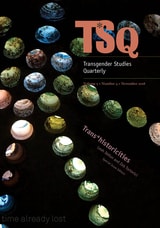
cover of Trans*historicities

Trans*historicities

Leah DeVun and Zeb Tortorici, special issue editors

Duke University Press, 2018

This issue offers a theoretical and methodological imagining of what constitutes trans* before the advent of the terms that scholars generally look to for the formation of modern conceptions of gender, sex, and sexuality. What might we find if we look for trans* before trans*? While some historians have rejected the category of transgender to speak of experiences before the mid-twentieth century, others have laid claim to those living gender-non-conforming lives before our contemporary era. By using the concept of trans*historicity, this volume draws together trans* studies, historical inquiry, and queer temporality while also emphasizing the historical specificity and variability of gendered systems of embodiment in different time periods. Essay topics include a queer analysis of medieval European saints, discussions of a nineteenth-century Russian religious sect, an exploration of a third gender in early modern Japanese art, a reclamation of Ojibwe and Plains Cree Two-Spirit language, and biopolitical genealogies and filmic representations of transsexuality. The issue also features a roundtable discussion on trans*historicities and an interview with the creators of the 2015 film Deseos. Critiquing both progressive teleologies and the idea of sex or gender as a timeless tradition, this issue articulates our own desires for trans history, trans*historicities, and queerly temporal forms of historical narration.

Contributors. Kadji Amin, M. W. Bychowski, Fernanda Carvajal, Howard Chiang, Leah DeVun, Julian Gill-Peterson, Jack Halberstam, Asato Ikeda, Jacob Lau, Kathleen P. Long, Maya Mikdashi, Robert Mills, Carlos Motta, Marcia Ochoa, Kai Pyle, C. Riley Snorton, Zeb Tortorici, Jennifer Louise Wilson
[more]
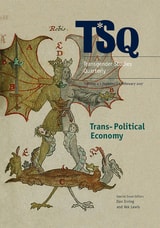
cover of Trans- Political Economy

Trans- Political Economy

Dan Irving and Vek Lewis, special issue editors

Duke University Press, 0

This issue of TSQ: Transgender Studies Quarterly, “Trans-Political Economy,” edited by Dan Irving and Vek Lewis, addresses how capitalism differentially and unequally affects trans and sex/gender-diverse people across the globe. “We all, from our different social and political locations, become implicated in those architectures through our everyday interactions with a variety of coordinated and contradictory institutions and rationalities that order our lives across different local and global geopolitical spaces and scales,” write Lewis and Irving. The editors of and contributors to this issue reveal how the narrowly constructed objects of trans studies and political economy (such as gender, labor, class, and economy) have been complicit in the necropolitical devaluation of trans lives and existing strategies crafted for trans survival. Topics include trans visibility and commodity culture; trans credit reporting; the growing population of T-girls, trans women truckers; trans street-based sex workers; the system of sex/gender identification for trans asylum seekers in South Africa; and waria affective labor in Indonesia. There is also a roundtable deconstructing trans* political economy.

The Arts & Culture section of this issue features a review of season 7 of RuPaul's Drag Race in relation to certain political-economic elements of the drag industry as well as an in-depth look at the representation of transgender lives on film, specifically in Dallas Buyers Club.
[more]
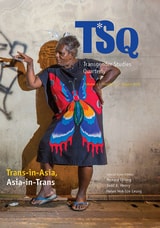
cover of Trans-in-Asia, Asia-in-Trans

Trans-in-Asia, Asia-in-Trans

Howard Chiang, Todd A. Henry, and Helen Hok-Sze Leung, special issue editors

Duke University Press, 0
Since the late twentieth century, scholars and activists have begun to take stock of the deep histories and politically engaged nature of trans* cultures across the diverse societies of “Asia.” Much of this groundbreaking work has cautioned against immediate assumptions about the universality of transgender experiences, while heeding the significant influence of colonial histories, cultural imperialism, Cold War dynamics, economic integration, and migration practices in shaping local categories of queerness, discourses of rights, as well as the political, social, and medical management of gender variance and non-normative sexualities. This growing body of work on Asia joins trans* scholarship and activism across the world that has similarly sought to de-universalize and de-colonize the category of “trans.”
[more]
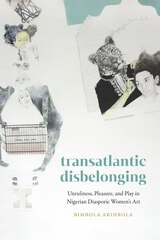
cover of Transatlantic Disbelonging: Unruliness, Pleasure, and Play in Nigerian Diasporic Women's Art

Transatlantic Disbelonging

Unruliness, Pleasure, and Play in Nigerian Diasporic Women's Art

Bimbola Akinbola

Duke University Press, 2025
In Transatlantic Disbelonging, Bimbola Akinbola redirects the focus in diaspora studies from questions of loss and longing to acts of unapologetic self-definition through the study of Nigerian diasporic women artists navigating disparate geographies, allegiances, and identities. Drawing on the work of contemporary visual and performance artists, experimental filmmakers, and writers—including Wura-Natasha Ogunji, Njideka Akunyili Crosby, Zina Saro-Wiwa, ruby onyinyechi amanze, and Nnedi Okorafor—Akinbola articulates how these artists use their experiences as cultural outsiders to redefine home and national belonging on their own terms. Taking a capacious interdisciplinary approach, she explores how these women employ anti-respectability, taboo, the erotic, and play to challenge oppressive colonial legacies and expectations pertaining to gender and morality. For the artists in this book, their artmaking is a form of homemaking that embraces ambivalence and reinvents alienation as possibility. Theorizing these practices as acts of “disbelonging,” Akinbola radically reimagines diasporic identity formation, illustrating how artists use creative practices to enact and embody belonging and community in expansive ways.
[more]
cover of Transformismo: Performing Trans/Queer Cuba

Transformismo

Performing Trans/Queer Cuba

M. Myrta Leslie Santana

University of Michigan Press, 2025
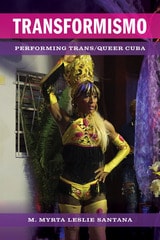
In Transformismo, M. Myrta Leslie Santana draws on years of embedded research within Cuban trans/queer communities to analyze how transformistas, or drag performers, understand their roles in the social transformation of the island. Once banned and censored in Cuba, drag performance is now a state-sponsored event. Transformismo suggests that these performances make critical interventions in Cuban trans/queer life and politics and in doing so, the volume offers critical insight into how Cuba’s postsocialist reform has exacerbated racial, sexual, and economic inequalities. Leslie Santana argues that mainstream trans/queer nightlife in Cuba is entangled with the island’s tourism economy and has shaped the aesthetics and social makeup of transformismo in coastal Havana, which largely caters to foreigners. Leslie Santana considers how Black lesbian and transgender transformistas are expanding understandings of sexual selfhood and politics on the island, particularly questioning the ways that Black women’s creativity is prominently featured in the aesthetics of tourism and trans/queer nightlife, while Black women themselves are denied social and material capital.
[more]
cover of Transgender Cinema

Transgender Cinema

Rebecca Bell-Metereau

Rutgers University Press, 2019

2019 Choice Outstanding Academic Title​

Transgender Cinema gives readers the big picture of how trans people have been depicted on screen. Beginning with a history of trans tropes in classic Hollywood cinema, from comic drag scenes in Chaplin’s The Masquerader to Garbo’s androgynous Queen Christina, and from psycho killer queers to The Rocky Horror Picture Show’s outrageous queen, it examines a plethora of trans portrayals that subsequently emerged from varied media outlets, including documentary films, television serials, and world cinema. Along the way, it analyzes milestones in trans representation, like The Crying Game, Boys Don’t Cry, Hedwig and the Angry Inch,and A Fantastic Woman.
 
As it traces the evolution of trans people onscreen, Transgender Cinema also considers the ongoing controversies sparked by these movies and series both within LGBTQ communities and beyond. Ultimately it reveals how film and television have shaped not only how the general public sees trans people, but also how trans people see themselves.

Selected Filmography:

Adventures of Priscilla, Queen of the Desert, All about My Mother, Anak, Austin Unbound, Becoming Chaz, The Blossoming of Maximo Oliveros, Boy I Am, Boy Meets Girl, Boys Don’t Cry, The Brandon Teena Story, A Busy Day, Call Me Malcolm, Carlotta, Change over Time, The Crying Game, Dallas Buyers Club,  The Danish Gir, The Devil Is a Woman, Drunktown’s Finest, Facing Mirrors, A Fantastic Woman, 52 Tuesdays, Flesh, Girl Inside, A Girl like Me: The Gwen Araujo Story, Hedwig and the Angry Inch, I Was a Male War Bride,Kate Bornstein Is a Queer and Pleasant Danger, Kumu Hina, La Cage aux Folles, Ma Vie en Rose (My Life in Pink) The Masquerader, Myra Breckinridge, Orlando, Paris Is Burning, Playing with Gender, Psycho, Queen Christina, The Rocky Horror Picture Show, The Saga of Anatahan, She’s a Boy I Knew, Silence of the Lambs, Some Like It Hot, Southern Comfort, Still Black: A Portrait of Black Transmen, Stonewall,  The Tenant, Three Generations. Tomboy, Tootsie, Transamerica, Transparent, Trash, Whatever Suits You, A Woman.
 
[more]
cover of Transgender Rights and Politics: Groups, Issue Framing, and Policy Adoption

Transgender Rights and Politics

Groups, Issue Framing, and Policy Adoption

Jami K. Taylor and Donald P. Haider-Markel, Editors

University of Michigan Press, 2015
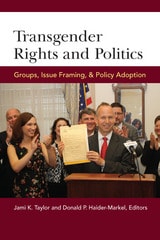
To date, media and scholarly attention to gay politics and policy has focused on the morality debates over sexual orientation and the legal aspects of rights for non-heterosexuals. However, transgender concerns as such have received little attention. With transgender activism becoming more visible, policymakers in the United States and around the world have begun to respond to demands for more equitable treatment.

Jami K. Taylor and Donald P. Haider-Markel bring together new research employing the concepts and tools of political science to explore the politics of transgender rights. Volume contributors address the framing of transgender rights in the U.S. and in Latin America. They discuss transgender interest groups, the inclusion of transgender activists in advocacy coalitions, policy diffusion at the state and local levels, and, importantly, the implementation of transgender public policy. This volume sets the standard for empirical research on transgender politics and demonstrates that the study of this topic can contribute to the understanding of larger questions in the field of political science.
[more]
cover of Translating Transgender

Translating Transgender

David Gramling and Aniruddha Dutta, special issue editors

Duke University Press, 0

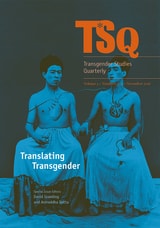
This issue of Transgender Studies Quarterly calls for multilingual and translational critique. Few primary and secondary texts about transgender lives and ideas have been translated from language to language in any formal way over the centuries. This is an important problem for transgender studies in the coming decades because an Anglophone disciplinary and discursive disposition will continue to lead policy makers, public intellectuals, and academics to fall back on ethnocentric and monolingual frameworks and resources.
[more]