Results by title
716 books match the query 'Literary Figures' and 123 start with t

Theodore Roethke - American Writers 30
University of Minnesota Pamphlets on American WritersRalph J. Mills Jr.
University of Minnesota Press, 1963
Theodore Roethke - American Writers 30 was first published in 1963. Minnesota Archive Editions uses digital technology to make long-unavailable books once again accessible, and are published unaltered from the original University of Minnesota Press editions.
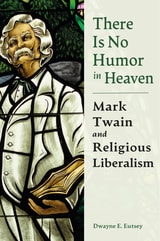
There is No Humor in Heaven
Mark Twain and Religious LiberalismDwayne E. Eutsey
University of Missouri Press, 2025
In There is No Humor in Heaven, Dwayne Eutsey challenges the persistent view of Twain as a hostile critic of religion by placing him within the prevailing liberal religious ethos of his time. From Hannibal to the western frontier and from Hartford to the wider world, Eutsey contends Twain’s vocation as a humorist was rooted in his frustrated youthful ambition to become a preacher of the Gospel. Throughout his life, his friendships with several influential liberal ministers, each of them espousing various forms of the era’s diverse progressive theology, informed not only Twain’s evolving religious worldview but his lecture performances and literary output.
There is No Humor in Heaven traces unconventional theological influences on Twain ranging from African-American spirituality, Freemasonry, and frontier Unitarianism to devout Liberal Christianity, radical Free Religion, and esoteric Hinduism. Drawing from Twain’s writings, documents, personal notes, and more, There is No Humor in Heaven offers readers a radical re-examination of the spiritually creative vitality of a controversial literary giant.
This One Will Hurt You
Paul Crenshaw
The Ohio State University Press, 2019
With eloquence, subtle humor, and an urgent poignancy, Crenshaw delivers a powerful and moving collection of nonfiction essays, tied together by place and the violence of the world in which we live.
Thomas Wolfe - American Writers 6
University of Minnesota Pamphlets on American WritersC. Hugh Holman
University of Minnesota Press, 1960
Thomas Wolfe - American Writers 6 was first published in 1960. Minnesota Archive Editions uses digital technology to make long-unavailable books once again accessible, and are published unaltered from the original University of Minnesota Press editions.
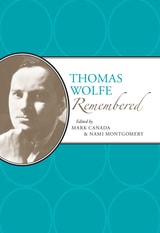
Thomas Wolfe Remembered
Edited by Mark Canada and Nami Montgomery
University of Alabama Press, 2018
A collection of reminiscences captures the private life of a great American writer.
Thomas Wolfe’s life may seem to be an open book. A life that, after all, was the source for his best-known works, including the novels Look Homeward, Angel and Of Time and the River, as well as his numerous short stories and dramas. Since his death in 1938, scholars and admirers of Wolfe have relied largely on these texts to understand the man himself.
Thomas Wolfe Remembered provides something new: a rich, multifaceted portrait painted by those who knew him (casually or intimately), loved him (or didn’t), and saw, heard, and experienced the literary (and literal) giant. This volume gathers in one place for the first time dozens of reminiscences by friends, family members, colleagues, and casual acquaintances, adding color and fine details to the self-portrait the author created in his novels.
Wolfe found plenty to challenge and frustrate him throughout his life, from his boyhood in Asheville, North Carolina, to his education at the University of North Carolina and Harvard University, through his time in New York and Europe, his travels through the American West, and his death in Baltimore. He experienced two distracted parents in a loveless marriage, the premature death of a beloved brother, a minor stutter, and the difficulties of controlling a mercurial temper. Yet Wolfe’s exuberance, perceptiveness, memory, and compulsion to record virtually all that he experienced made for an extravagance of material that sometimes angered the people whose lives he used as source material.
Editors Mark Canada and Nami Montgomery have collected dozens of remembrances, many unpublished or long forgotten, including pieces from Julia Wolfe, Margaret Roberts, Frederick Koch, Maxwell Perkins, Elizabeth Nowell, Edward Aswell, and Martha Dodd. Some are endearing, others are disturbing, and many are comical. All provide glimpses into the vibrant, haunted, boyish, paranoid, disheveled, courteous, captivating, infuriating, and altogether fascinating giant who was Thomas Wolfe.
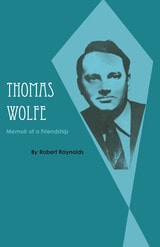
Thomas Wolfe
Memoir of a FriendshipBy Robert Raynolds
University of Texas Press, 1965
Thornton Wilder - American Writers 34
University of Minnesota Pamphlets on American WritersBernard Grebanier
University of Minnesota Press, 1964
Thornton Wilder - American Writers 34 was first published in 1964. Minnesota Archive Editions uses digital technology to make long-unavailable books once again accessible, and are published unaltered from the original University of Minnesota Press editions.
Thornton Wilder and the Puritan Narrative Tradition
Lincoln Konkle
University of Missouri Press, 2005
Thurberville
Bob Hunter
The Ohio State University Press, 2017
Thurber’s Columbus was a wild and crazy place, a city full of fascinating and sometimes peculiar characters, many in his own family. Because of the widespread popularity of his stories, that was also the Columbus that many of his readers around the world came to know.
Thurberville chronicles those characters and explores that world. But it also examines the real city where Thurber struggled and then blossomed as a college student, worked as a newspaper reporter and a press agent, and achieved international fame as a humorist and cartoonist after he left town, in part by writing about the subjects he left behind.
Much of Thurber’s best work was cultivated by experiences Thurber had in Columbus and in his dealings with family, friends, teachers, and acquaintances there. They are worth a revisit and, in some cases, an introduction.
Thus I Lived with Words
Robert Louis Stevenson and the Writer's CraftAnnette R. Federico
University of Iowa Press, 2017
Stevenson belonged to a newly commercial literary world, an era of mass readership, marketing, and celebrity. He had plenty of practical advice for writers who wanted to enter the profession: study the best authors, aim for simplicity, strike a keynote, work on your style. He also held that a writer should adhere to the truth and utter only what seems sincere to his or her heart and experience of the world. Writers have messages to deliver, whether the work is a tale of Highland adventure, a collection of children’s verse, or an essay on umbrellas. Stevenson believed that an author could do no better than to find the appetite for joy, the secret place of delight that is the hidden nucleus of most people’s lives. His remarks on how to write, on style and method, and on pleasure and moral purpose contain everything in literature and life that he cared most about—adventuring, persisting, finding out who you are, and learning to embrace “the romance of destiny.”
Time of Grace
Thoughts on Nature, Family, and the Politics of Crime and PunishmentKen Lamberton
University of Arizona Press, 2007
Time of Grace is a remarkable book, written with great eloquence by a former science teacher who was incarcerated for twelve years for his sexual liaison with a teenage student. Far more than a “prison memoir,” it is an intimate and revealing look at relationships—with fellow humans and with the surprising wildlife of the Sonoran Desert, both inside and beyond prison walls. Throughout, Ken Lamberton reflects on human relations as they mimic and defy those of the natural world, whose rhythms calibrate Lamberton’s days and years behind bars. He writes with candor about his life, while observing desert flora and fauna with the insight and enthusiasm of a professional naturalist.
While he studies a tarantula digging her way out of the packed earth and observes Mexican freetail bats sailing into the evening sky, Lamberton ruminates on his crime and on the wrenching effects it has had on his wife and three daughters. He writes of his connections with his fellow inmates—some of whom he teaches in prison classes—and with the guards who control them, sometimes with inexplicable cruelty. And he unflinchingly describes a prison system that has gone horribly wrong—a system entrapped in a self-created web of secrecy, fear, and lies.
This is the final book of Lamberton’s trilogy about the twelve years he spent in prison. Readers of his earlier books will savor this last volume. Those who are only now discovering Lamberton’s distinctive voice—part poet, part scientist, part teacher, and always deeply, achingly human—will feel as if they are making a new friend.
Gripping, sobering, and beautifully written, Lamberton’s memoir is an unforgettable exploration of crime, punishment, and the power of the human spirit.
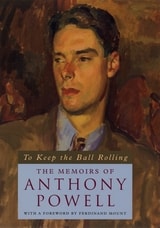
To Keep the Ball Rolling
The Memoirs of Anthony PowellAnthony Powell
University of Chicago Press, 2001
Powell did eventually reveal himself in four volumes of memoirs, published between 1976 and 1982. This edition of Anthony Powell's Memoirs is an abridged and revised version of those volumes, a version that has never before been published in this form in the United States. The result is not only a fascinating view of Powell as a man and an author but also a unique history of British literary society and the social elite Powell lampooned and moved within from the twenties through the eighties. From Eton and Oxford to his life as a novelist and critic, Powell observes all—the obscenity trial sparked by Lady Chatterley's Lover; Shirley Temple's libel suit after Graham Greene reviewed Wee Willie Winkie "with even more than his usual verve"—and paints vivid portraits of Kingsley Amis, V.S. Naipaul, T.S. Eliot, Virginia Woolf, and countless others. Most importantly, Powell's lively memoirs banish all thought of the man as a relic of the British gentry. He was a modernist, a Tory, and more than a little interested in genealogy and peerage, but a man who, according to Ferdinand Mount, "miraculously knew what life was like."
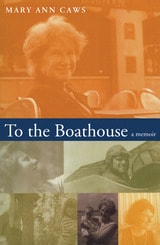
To the Boathouse
A MemoirMary Ann Caws
University of Alabama Press, 2008
From Southern roots to scholarly heights—one woman’s journey to find peace, purpose, and her place in the world.
A neat and lavish, if constricting, childhood in the lush landscapes of North Carolina. Summers at a calm, remote beach house. A proper and religiously influenced prep school in Washington. Years at Bryn Mawr, an impulsive study trip to Paris, further education at Yale, married life, and divorced life. These are the settings for Mary Ann Caws’s passionate memoir, in which she recounts the highs and lows of her journey through life. Marked by complicated relationships and a passion for learning, Caws’s story is one that resonates not only with writers like herself, but with all who have struggled with determining their path within the surrounding world.
Caws writes of her formal, stylish parents, her rebellious and deeply admired sister, and her artistic grandmother, whom she respected and idolized more than anyone else. She describes her marriage and subsequent divorce, her bouts with therapy, her children, and her growth as a student and writer. Throughout the memoir is evidence of her love for writing, teaching, art, and poetry as well as her deep respect for the people in her life that ultimately guided her into her career.
The author describes Southern society and her own life with fondness, nostalgia, and a tinge of honest criticism. The carefully selected details and delicate balance of sentiment and fact bring readers into the fascinating, complicated, and all-too-real world of Caws’s—and our own—past.
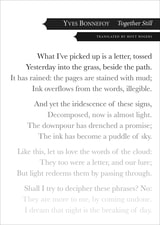
Together Still
Yves Bonnefoy
Seagull Books, 2017
The international community of letters mourned the recent death of Yves Bonnefoy, universally acclaimed as one of France’s greatest poets of the last half-century. A prolific author, he was often considered a candidate for the Nobel Prize and published a dozen major collections of poetry in verse and prose, several books of dream-like tales, and numerous studies of literature and art. His oeuvre has been translated into scores of languages, and he himself was a celebrated translator of Shakespeare, Yeats, Keats, and Leopardi.
Together Still is his final poetic work, composed just months before his death. The book is nothing short of a literary testament, addressed to his wife, his daughter, his friends, and his readers throughout the world. In these pages, he ruminates on his legacy to future generations, his insistence on living in the present, his belief in the triumphant lessons of beauty, and, above all, his courageous identification of poetry with hope.
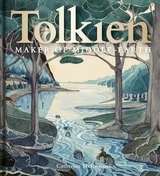
Tolkien
Maker of Middle-earthEdited by Catherine McIlwaine
Bodleian Library Publishing, 2018
Tolkien: Maker of Middle-earth explores the huge creative endeavor behind Tolkien’s enduring popularity. Lavishly illustrated with three hundred images of his manuscripts, drawings, maps, and letters, the book traces the creative process behind his most famous literary works—The Hobbit, The Lord of the Rings, and The Silmarillion—and reproduces personal photographs and private papers, many of which have never been seen before in print.
Six essays introduce the reader to the person of J. R. R. Tolkien and to main themes in his life and work, including the influence of northern languages and legends on the creation of his own legendarium; his concept of “Faërie” as an enchanted literary realm; the central importance of his invented languages in his fantasy writing; his visual imagination and its emergence in his artwork; and the encouragement he derived from his close friend C. S. Lewis and their literary group the Inklings.
The book brings together the largest collection of original Tolkien material ever assembled in a single volume. Drawing on the extensive archives of the Tolkien collections at the Bodleian Libraries, Oxford, which stretch to more than five hundred boxes, and Marquette University, Milwaukee, as well as private collections, this hugely ambitious and exquisitely produced book draws together the worlds of J. R. R. Tolkien – scholarly, literary, creative, and domestic—offering a rich and detailed understanding and appreciation of this extraordinary author.
This landmark publication, produced on the occasion of a major exhibition at the Bodleian Libraries in Oxford in 2018 and at the Morgan Library in New York in 2019, is set to become a standard work in the literature on J. R. R. Tolkien.
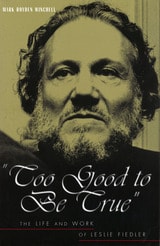
Too Good to Be True
The Life and Work of Leslie FiedlerMark Royden Winchell
University of Missouri Press, 2002
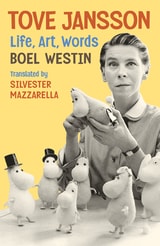
Tove Jansson
Life, Art, WordsBoel Westin
University of Minnesota Press, 2024
An in-depth, perceptive account of the unconventional life of the Moomins’ beloved creator, now available in the United States
Tove Jansson achieved fame as the creator of the Moomins, beloved by generations of readers around the world. Remarkably, the Moomins were only part of the prodigious creative output of this Finnish-Swedish writer and artist. Jansson’s work also includes short stories and five novels for adults, as well as paintings, murals, and book illustrations. In this acclaimed biography, Boel Westin relies on numerous conversations with Jansson and unprecedented access to her journals, letters, and personal archives to present an engrossing and comprehensive review of the life and world of Scandinavia’s best-loved author.
As Westin’s meticulous research makes clear, Jansson’s artistic and literary works reflected what was most important to her: the love of family and nature and the desire to pursue her art. Guided by her personal motto, “Love and work,” Jansson seized both with uncompromising joy. And while her romantic relationships with men proved unfulfilling, she found those with women—especially with her longtime partner, the artist Tuulikki Pietilä—both grounding and inspiring.
Westin weaves together the many threads of Jansson’s rich, complex life: an education interrupted to help her family; the bleak war years and her emergence as a painter; the decades of Moominmania across books, newspaper comic strips, merchandise, and adaptations; her later fictions, including her popular The Summer Book; and her time with Pietilä on the solitary island of Klovharu. Tove Jansson: Life, Art, Words offers fans and admirers around the world the most complete portrait of the writer Philip Pullman described as “a genius, a woman of profound wisdom and great artistry.”
Transatlantic Stowe
Harriet Beecher Stowe and European CultureDenise Kohn
University of Iowa Press, 2006
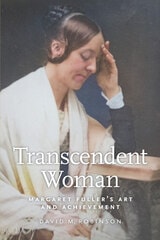
Transcendent Woman
Margaret Fuller’s Art and AchievementDavid M. Robinson
University of Massachusetts Press, 2025
Journalist, editor, critic, translator, and women’s rights advocate, Margaret Fuller was America’s first major female intellectual. Throughout much of the late-19th and 20th centuries, however, critics and scholars largely saw her as a minor figure in the transcendentalist movement with which she is associated, and her work was considered secondary to that of male figures like Emerson and Hawthorne. While her biography—including her marriage to an Italian noble and her dramatic death in a shipwreck—was often the focus, her skill as a writer was generally overlooked, and her intellectual development largely ignored.
In the early 1980s, David M. Robinson was one of the first scholars to publish an article that focused on Fuller’s mind and art. Now Transcendent Woman completes and extends this early work. Outlining the development of her philosophy, which Robinson defines as a “purpose-oriented form of thinking, tailored to the commitment and assets of each individual,” he traces Fuller’s intellectual journey, first in relation to her family and the people around her in New England and later in her travels in the midwestern United States and, more importantly, through Europe and her residency in Italy. He focuses first and foremost on what Fuller was reading (Goethe was key), what she was thinking as revealed in her letters and journals, and what she was writing, including seminal works such as Summer on the Lakes and Woman in the Nineteenth Century as well as lesser-known essays, translations, and short stories. Drawing extensively on primary sources, Robinson charts Fuller’s development and achievement as an original thinker and fearless advocate of democracy.
Travels with My Royal
A Memoir of the Writing LifeRobert Laxalt
University of Nevada Press, 2001
The book opens with a series of vignettes about his youth in Carson City as the second son of an immigrant Basque family and his later experiences as a student at the University of Nevada in Reno.
The second part of the book tells of Laxalt's career as a writer—his early days as a reporter when his assignments included interviews with gangsters and obligatory attendance at executions; his later adventures as a contract writer for National Geographic, and his two stays in the Basque Country. He also recounts his days as director of the University of Nevada's news service and his role in the founding of the University of Nevada Press.
The third section discusses the writing of several of his major books—where the ideas came from, what he tried to accomplish in each book, the challenges he faced, and the ways he chose to resolve them. Foreword by Cheryll Glotfelty.
Truman Capote's Southern Years, 25th Anniversary Edition
Stories from a Monroeville CousinMarianne M. Moates, Foreword by Ralph F. Voss
University of Alabama Press, 2014
Readers are well acquainted with Truman Capote’s meteoric rise to fame and his metamorphosis from literary enfant terrible to literary genius, celebrity author, and dispenser of venomously comic witticisms. It is also well-known that he spent his formative years in the south Alabama hamlet of Monroeville, and that he was abandoned there by his mother to be cared for and then to care for elderly relatives. Yet details of those years have remained sketchy and vague.
In Monroeville young Capote formed significant bonds and played childhood games with his cousin, Jennings Faulk Carter, and next door neighbor, Nelle Harper Lee, author of "To Kill a Mockingbird" and "Go Set a Watchman." Through the tales told by Carter and spun into a fascinating and revealing narrative by Marianne M. Moates readers discover in Truman Capote's Southern Years the lively imagination and the early tragedies of a brilliant child.
A new foreword by Ralph F. Voss underscores the enduring relevance of Truman Capote’s work and the influence his Alabama childhood had on his work.
Trying to Think with Emily Dickinson
Jed Deppman
University of Massachusetts Press, 2008
This book presents Emily Dickinson as one of America's great thinkers and argues that she has even more to say to the twenty-first century than she did to the nineteenth. Jed Deppman weaves together many strands in Dickinson's intellectual culture—philosophy, lexicography, religion, experimental science, the female Bildungsroman—and shows how she developed a lyricized, conversational hermeneutics uniquely suited to rethinking the authoritative discourses of her time.
Through Deppman's original analysis, readers come to see how Dickinson's mind and poetry were informed by two strong but opposing philosophical vocabularies: on the one hand, the Lockean materialism and Scottish Common Sense that dominated her schoolbooks in logic and mental philosophy—Reid, Hedge, Watts, Stewart, Brown, and Upham—and on the other, the neo-Kantian modes of apprehending the supersensible that circulated throughout German idealism and Transcendentalism.
Blending close readings with philosophical and historical approaches, Deppman affirms Dickinson's place in the history of ideas and brings her to the center of postmodern conversations initiated by Jean-François Lyotard, Jean-Luc Nancy, Jacques Derrida, Richard Rorty, and Gianni Vattimo. Trying her out in various postmodern roles—the Nietzschean accomplished nihilist, the Nancian finite thinker, the Vattimian weak thinker, and the Rortian liberal ironist—Deppman adds to the traditional expressive functions of her poetry a valuable, timely, and interpretable layer of philosophical inquiry. Dickinson, it turns out, is an ideal companion for anybody trying to think in the contemporary conditions that Vattimo characterizes as the “weakened experience of truth.”
Turn Here Sweet Corn
Organic Farming WorksAtina Diffley
University of Minnesota Press, 2013
When the hail starts to fall, Atina Diffley doesn’t compare it to golf balls. She’s a farmer. It’s “as big as a B-size potato.” As her bombarded land turns white, she and her husband Martin huddle under a blanket and reminisce: the one-hundred-mile-per-hour winds; the eleven-inch rainfall (“that broccoli turned out gorgeous”); the hail disaster of 1977. The romance of farming washed away a long time ago, but the love? Never. In telling her story of working the land, coaxing good food from the fertile soil, Atina Diffley reminds us of an ultimate truth: we live in relationships—with the earth, plants and animals, families and communities.
A memoir of making these essential relationships work in the face of challenges as natural as weather and as unnatural as corporate politics, her book is a firsthand history of getting in at the “ground level” of organic farming. One of the first certified organic produce farms in the Midwest, the Diffleys’ Gardens of Eagan helped to usher in a new kind of green revolution in the heart of America’s farmland, supplying their roadside stand and a growing number of local food co-ops. This is a story of a world transformed—and reclaimed—one square acre at a time.
And yet, after surviving punishing storms and the devastating loss of fifth-generation Diffley family land to suburban development, the Diffleys faced the ultimate challenge: the threat of eminent domain for a crude oil pipeline proposed by one of the largest privately owned companies in the world, notorious polluters Koch Industries. As Atina Diffley tells her David-versus-Goliath tale, she gives readers everything from expert instruction in organic farming to an entrepreneur’s manual on how to grow a business to a legal thriller about battling corporate arrogance to a love story about a single mother falling for a good, big-hearted man.