Results by title
426 books match the query 'Philosophy & Social Aspects' and 116 start with t
Theory and Reality
An Introduction to the Philosophy of Science, Second EditionPeter Godfrey-Smith
University of Chicago Press, 2021
Like no other text in this field, Theory and Reality combines a survey of recent history of the philosophy of science with current key debates that any beginning scholar or critical reader can follow. The second edition is thoroughly updated and expanded by the author with a new chapter on truth, simplicity, and models in science.
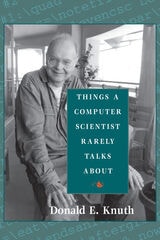
Things a Computer Scientist Rarely Talks About
Donald E. Knuth
CSLI, 2003
Perhaps no one is more qualified to address these questions than Donald E. Knuth, whose massive contributions to computing have led others to nickname him "The Father of Computer Science"—and whose religious faith led him to understand a fascinating analysis of the Bible called the 3:16 project. In this series of six spirited, informal lectures, Knuth explores the relationships between his vocation and his faith, revealing the unique perspective that his work with computing has lent to his understanding of God.
His starting point is the 3:16 project, an application of mathematical "random sampling" to the books of the Bible. The first lectures tell the story of the project's conception and execution, exploring its many dimensions of language translation, aesthetics, and theological history. Along the way, Knuth explains the many insights he gained from such interdisciplinary work. These theological musings culminate in a surprising final lecture tackling the ideas of infinity, free will, and some of the other big questions that lie at the juncture of theology and computation.
Things a Computer Scientist Rarely Talks About, with its charming and user-friendly format—each lecture ends with a question and answer exchange, and the book itself contains more than 100 illustrations—is a readable and intriguing approach to a crucial topic, certain to edify both those who are serious and curious about their faiths and those who look at the science of computation and wonder what it might teach them about their spiritual world.
Includes "Creativity, Spirituality, and Computer Science," a panel discussion featuring Harry Lewis, Guy L. Steele, Jr., Manuela Veloso, Donald E. Knuth, and Mitch Kapor.
Think to New Worlds
The Cultural History of Charles Fort and His FollowersJoshua Blu Buhs
University of Chicago Press, 2024
Flying saucers. Bigfoot. Frogs raining from the sky. Such phenomena fascinated Charles Fort, the maverick writer who scanned newspapers, journals, and magazines for reports of bizarre occurrences: dogs that talked, vampires, strange visions in the sky, and paranormal activity. His books of anomalies advanced a philosophy that saw science as a small part of a larger system in which truth and falsehood continually transformed into one another. His work found a ragged following of skeptics who questioned not only science but the press, medicine, and politics. Though their worldviews varied, they shared compelling questions about genius, reality, and authority. At the center of this community was adman, writer, and enfant terrible Tiffany Thayer, who founded the Fortean Society and ran it for almost three decades, collecting and reporting on every manner of oddity and conspiracy.
In Think to New Worlds, Joshua Blu Buhs argues that the Fortean effect on modern culture is deeper than you think. Fort’s descendants provided tools to expand the imagination, explore the social order, and demonstrate how power is exercised. Science fiction writers put these ideas to work as they sought to uncover the hidden structures undergirding reality. Avant-garde modernists—including the authors William Gaddis, Henry Miller, and Ezra Pound, as well as Surrealist visual artists—were inspired by Fort’s writing about metaphysical and historical forces. And in the years following World War II, flying saucer enthusiasts convinced of alien life raised questions about who controlled the universe.
Buhs’s meticulous and entertaining book takes a respectful look at a cast of oddballs and eccentrics, plucking them from history’s margins and spotlighting their mark on American modernism. Think to New Worlds is a timely consideration of a group united not only by conspiracies and mistrust of science but by their place in an ever-expanding universe rich with unexplained occurrences and visionary possibilities.

Thinking about Music
An Introduction to the Philosophy of MusicLewis E. Rowell
University of Massachusetts Press, 1983
Examines the nature of music and traces the history of music philosophy from ancient Greece to the twentieth century. Lewis Rowell's Thinking about Music is more than an introduction to the connections between music and other arts, and the philosophical underpinnings of aesthetics.
Thinking through Technology
The Path between Engineering and PhilosophyCarl Mitcham
University of Chicago Press, 1994
Tracing the changing meaning of "technology" from ancient times to our own, Mitcham identifies the most important traditions of critical analysis of technology: the engineering approach, which assumes the centrality of technology in human life; and the humanities approach, which is concerned with its moral and cultural boundaries.
Mitcham bridges these two traditions through an analysis of discussions of engineering design, of the distinction between tools and machines, and of engineering science itself. He looks at technology as it is experienced in everyday life—as material objects (from kitchenware to computers), as knowledge ( including recipes, rules, theories, and intuitive "know-how"), as activity (design, construction, and use), and as volition (knowing how to use technology and understanding its consequences). By elucidating these multiple aspects, Mitcham establishes criteria for a more comprehensive analysis of ethical issues in applications of science and technology.
This book will guide anyone wanting to reflect on technology and its moral implications.
Thomas Kuhn
A Philosophical History for Our TimesSteve Fuller
University of Chicago Press, 2000
Steve Fuller argues that Kuhn actually held a profoundly conservative view of science and how one ought to study its history. Early on, Kuhn came under the influence of Harvard President James Bryant Conant (to whom Structure is dedicated), who had developed an educational program intended to help deflect Cold War unease over science's uncertain future by focusing on its illustrious past. Fuller argues that this rhetoric made its way into Structure, which Fuller sees as preserving and reinforcing the old view that science really is just a steady accumulation of truths about the world (once "paradigm shifts" are resolved).
Fuller suggests that Kuhn, deliberately or not, shared the tendency in Western culture to conceal possible negative effects of new knowledge from the general public. Because it insists on a difference between a history of science for scientists and one suited to historians, Fuller charges that Structure created the awkward divide that has led directly to the "Science Wars" and has stifled much innovative research. In conclusion, Fuller offers a way forward that rejects Kuhn's fixation on paradigms in favor of a conception of science as a social movement designed to empower society's traditionally disenfranchised elements.
Certain to be controversial, Thomas Kuhn must be read by anyone who has adopted, challenged, or otherwise engaged with The Structure of Scientific Revolutions.
"Structure will never look quite the same again after Fuller. In that sense, he has achieved one of the main aims of his ambitious and impressively executed project."—Jon Turney, Times Higher Education Supplement
"Philosophies like Kuhn's narrow the possible futures of inquiry by politically methodizing and taming them. More republican philosophies will leave the future open. Mr. Fuller has amply succeeded in his program of distinguishing the one from the other."—William R. Everdell, Washington Times

Tibetan Buddhism and Modern Physics
Toward a Union of Love and KnowledgeVic Mansfield
Templeton Press, 2008
Tibetan Buddhism and Modern Physics: Toward a Union of Love and Knowledge addresses the complex issues of dialogue and collaboration between Buddhism and science, revealing connections and differences between the two. While assuming no technical background in Buddhism or physics, this book strongly responds to the Dalai Lama’s “heartfelt plea” for genuine collaboration between science and Buddhism. The Dalai Lama has written a foreword to the book and the Office of His Holiness will translate it into both Chinese and Tibetan.

To Know a Starry Night
Paul Bogard
University of Nevada Press, 2021
To Save the Phenomena
An Essay on the Idea of Physical Theory from Plato to GalileoPierre Duhem
University of Chicago Press, 1969
Duhem's 1908 essay questions the relation between physical theory and metaphysics and, more specifically, between astronomy and physics–an issue still of importance today. He critiques the answers given by Greek thought, Arabic science, medieval Christian scholasticism, and, finally, the astronomers of the Renaissance.
Topics in the Foundations of General Relativity and Newtonian Gravitation Theory
David B. Malament
University of Chicago Press, 2012

Transforming Science and Engineering
Advancing Academic WomenAbigail J. Stewart, Janet E. Malley, and Danielle LaVaque-Manty, Editors
University of Michigan Press, 2010
"If you have thrown up your hands in despair after trying to retain women science and engineering in the academy, read this book. It offers detailed descriptions of a wide array of tried-and-true programs that have been tested out by the NSF ADVANCE program."
---Joan C. Williams, 1066 Foundation Chair & Distinguished Professor of Law Director, Center for WorkLife Law University of California
"Solid and practical, this volume details the first years of NSF funded institutional change to remake gender dynamics inside U.S. science. What works? What doesn't? And why?"
---Londa Schiebinger, John L. Hinds Professor of History of Science and Barbara D. Finberg Director, Michelle R. Clayman Institute for Gender Research at Stanford University, and author of Has Feminism Changed Science?
"This book's time has come. Transforming Science and Engineering is important, and lots of people can learn from what has happened in the ADVANCE universities."
---Lotte Bailyn, Professor of Management, Behavioral and Policy Sciences Department, Sloan School of Management, MIT; author of Breaking the Mold: Redesigning Work for Productive and Satisfying Lives; and coauthor of Beyond Work-Family Balance: Advancing Gender Equity and Workplace Performance
"This collection profiles 16 NSF ADVANCE grant successes, sandwiched between an interview with Dr. Alice Hogan and Dr. Lee Harle's summary of cost-effective practices from ADVANCE programs, giving so many 'biggest bang for the buck' examples in so few pages that it will easily justify both the cost of the book and the reading time. These accounts do not continue the too-common vague referrals to 'unhealthy environment' or 'chilly climate,' but rather expound the situations before and after the interventions, something necessary in order to transplant the programs, or even to use the programs for idea generation. Transforming Science and Engineering is a model of excellence, and will be extremely useful for those women, men, faculty, or administrators wanting to help their universities move into the 21st century and attract to their campuses qualified women and men who want opportunities to attain their full potentials."
---Donna J. Nelson, Associate Professor of Chemistry, University of Oklahoma
In 2001, the National Science Foundation's ADVANCE Institutional Transformation program began awarding five-year grants to colleges and universities to address a common problem: how to improve the work environment for women faculty in science and engineering. Drawing on the expertise of scientists, engineers, social scientists, specialists in organizational behavior, and university administrators, this collection is the first to describe the variety of innovative efforts academic institutions around the country have undertaken.
Focusing on a wide range of topics, from how to foster women's academic success in small teaching institutions, to how to use interactive theater to promote faculty reflection about departmental culture, to how a particular department created and maintained a healthy climate for women's scientific success, the contributors discuss both the theoretical and empirical aspects of the initiatives, with emphasis on the practical issues involved in creating these approaches. The resulting evidence shows that these initiatives have the desired effects. The cases represented in this collection depict the many issues women faculty in science and engineering face, and the solutions that are presented can be widely accepted at academic institutions around the United States. The essays in Transforming Science and Engineering illustrate that creating work environments that sustain and advance women scientists and engineers benefits women, men, and underrepresented minorities.
Abigail J. Stewart is Sandra Schwartz Tangri Distinguished University Professor of Psychology and Women's Studies at the University of Michigan.
Janet E. Malley is a psychologist and Associate Director of the Institute for Research on Women and Gender at the University of Michigan.
Danielle LaVaque-Manty, former Research Associate at the Institute for Research on Women and Gender at the University of Michigan, teaches composition at U-M's Sweetland Writing Center.
Cover photo: Joanne Leonard
Transhumanism
Evolutionary Futurism and the Human Technologies of UtopiaAndrew Pilsch
University of Minnesota Press, 2017
Transhumanism posits that humanity is on the verge of rapid evolutionary change as a result of emerging technologies and increased global consciousness. However, this insight is dismissed as a naive and controversial reframing of posthumanist thought, having also been vilified as “the most dangerous idea in the world” by Francis Fukuyama. In this book, Andrew Pilsch counters these critiques, arguing instead that transhumanism’s utopian rhetoric actively imagines radical new futures for the species and its habitat.
Pilsch situates contemporary transhumanism within the longer history of a rhetorical mode he calls “evolutionary futurism” that unifies diverse texts, philosophies, and theories of science and technology that anticipate a radical explosion in humanity’s cognitive, physical, and cultural potentialities. By conceptualizing transhumanism as a rhetoric, as opposed to an obscure group of fringe figures, he explores the intersection of three major paradigms shaping contemporary Western intellectual life: cybernetics, evolutionary biology, and spiritualism. In analyzing this collision, his work traces the belief in a digital, evolutionary, and collective future through a broad range of texts written by theologians and mystics, biologists and computer scientists, political philosophers and economic thinkers, conceptual artists and Golden Age science fiction writers. Unearthing the long history of evolutionary futurism, Pilsch concludes, allows us to more clearly see the novel contributions that transhumanism offers for escaping our current geopolitical bind by inspiring radical utopian thought.

Trespassing Natures
Species Migration and the Right to SpaceDonnie Johnson Sackey
The Ohio State University Press, 2024
As old worlds become hostile and new spaces become hospitable, many species are shifting their ranges to live in locations where they have never previously existed. Biological and sociocultural realms collide and boundaries blur, making it increasingly difficult to mark definitively who belongs and who is a trespasser. In Trespassing Natures, Donnie Johnson Sackey troubles the idea of biological “invasion,” turning our attention away from scientific considerations and toward the discursive and rhetorical dimensions of this term—offering a new paradigm that recasts this issue as a question of what it means to live in multi-species communities. Presenting case studies on bed bugs, bighead carp, feral cats, and mackerel, Sackey argues that the identification of a species as an invader is not merely a scientific act, but a cultural and political one. By questioning issues around space, identity, and the institutions that make human participation apparent, Sackey redirects focus away from the belief that a single species threatens space. Ultimately, Trespassing Natures asks us to expand our idea of community and question who has the right to space.
Truth and Beauty
Aesthetics and Motivations in ScienceS. Chandrasekhar
University of Chicago Press, 1987
The late S. Chandrasekhar was best known for his discovery of the upper
limit to the mass of a white dwarf star, for which he received the Nobel
Prize in Physics in 1983. He was the author of many books, including
The Mathematical Theory of Black Holes and, most recently,
Newton's Principia for the Common Reader.
Tunguska, or the End of Nature
A Philosophical DialogueMichael Hampe
University of Chicago Press, 2015
Tunguska, Or the End of Nature uses its four-man setup to tackle some of today’s burning issues—such as climate change, environmental destruction, and resource management—from a diverse range of perspectives. With a kind of foreboding, it asks what the world was like, and will be like, without us, whether we are negligible and the universe random, whether nature can truly be explained, whether it is good or evil, or whether nature is simply a thought we think. This is a profoundly unique work, a thrillingly interdisciplinary piece of scholarly literature that probes the mysteries of nature and humans alike.
Tuning the World
The Rise of 440 Hertz in Music, Science, and Politics, 1859–1955Fanny Gribenski
University of Chicago Press, 2023
Tuning the World tells the unknown story of how the musical pitch A 440 became the global norm.
Now commonly accepted as the point of reference for musicians in the Western world, A 440 hertz only became the standard pitch during an international conference held in 1939. The adoption of this norm was the result of decades of negotiations between countries, involving a diverse group of performers, composers, diplomats, physicists, and sound engineers. Although there is widespread awareness of the variability of musical pitches over time, as attested by the use of lower frequencies to perform early music repertoires, no study has fully explained the invention of our current concert pitch. In this book, Fanny Gribenski draws on a rich variety of previously unexplored archival sources and a unique combination of musicological perspectives, transnational history, and science studies to tell the unknown story of how A 440 became the global norm. Tuning the World demonstrates the aesthetic, scientific, industrial, and political contingencies underlying the construction of one of the most “natural” objects of contemporary musical performance and shows how this century-old effort was ultimately determined by the influence of a few powerful nations.