Results by title
584 books match the query 'Short Stories (single author)' and 172 start with t
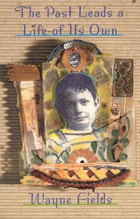
The Past Leads a Life of Its Own
Wayne Fields
University of Chicago Press, 1997
"Going through these pages quickly would be like chug-a-lugging a jar of honey fresh from the comb, or wolfing down a slow-cured, hickory-smoked country ham. It is a rich and complexly flavored work of fiction, a book to be savored."—Harper Barnes, St. Louis Post-Dispatch
"Set against the rhythms of nature, Fields's 16 luminous, interrelated stories celebrate a boy's coming-of-age. . . . The beauty of these deeply felt stories lies in their spare, ear-perfect language and in quiet epiphanies."—Publishers Weekly
"[A] beautifully subtle work. . . . Here are a series of vignettes, each capturing some moment in nature, poetic and ethereal. . . . [They] are like stones skipping on water, capturing the struggles of a family leaving one way of life behind for another, Fields remembers the feeling of a time and a place gone forever."—Library Journal

The Perp Walk
Jim Ray Daniels
Michigan State University Press, 2019
The Piazza Tales and Other Prose Pieces, 1839-1860
Volume Nine, Scholarly EditionHerman Melville
Northwestern University Press, 1987
This scholarly edition presents texts as close to the author's intentions as surviving evidence permits. Based on surviving manuscripts, on original newspaper and magazine printings, and on collations of magazine printings with the book of editions of The Piazza Tales, the text incorporates over 800 emendations by the editors and over 200 from later printings during Melville's lifetime.
This edition is an Approved Text of the Center for Editions of American Authors (Modern Language Association of America).
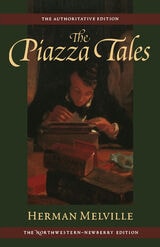
The Piazza Tales
Volume NineHerman Melville
Northwestern University Press, 1996
This scholarly edition presents texts as close to the author's intentions as surviving evidence permits. Based on surviving manuscripts, on original newspaper and magazine printings, and on collations of magazine printings with the book of editions of The Piazza Tales, the text incorporates over 800 emendations by the editors and over 200 from later printings during Melville's lifetime.
This edition is an Approved Text of the Center for Editions of American Authors (Modern Language Association of America).
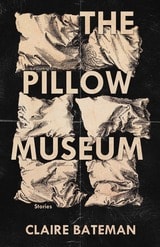
The Pillow Museum
StoriesClaire Bateman
University of Alabama Press, 2025
A collection of 56 flash fictions, micro-essays, and contemporary fables about the burden on women and families.
The Pillow Museum is a collection of 56 flash fictions, micro-essays, and contemporary fables set in various simulacra of our world. Claire Bateman’s gorgeous prose captures the imagination with closely observed details of people and places that are startlingly familiar yet unreal, where nothing can be taken for granted, including narrative logic: "It was snowing the night they had the fight about the glass piano whose music provided all the light in the house."
In an authoritative voice that offers no apologies or justifications, The Pillow Museum evokes a closely observed slipstream strangeness that refuses to take any moment or detail for granted—a fruitful, delirious disruption.
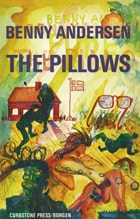
The Pillows
Benny Andersen
Northwestern University Press, 1995
A collection of 16 uniquely funny short stories by acclaimed Danish poet Benny Andersen.
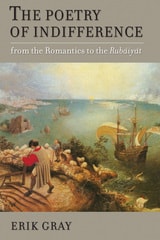
The Poetry of Indifference
From the Romantics to the RubaiyatErik Irving Gray
University of Massachusetts Press, 2005
of poetic indifference began to emerge.
The Poetry of Indifference analyzes nineteenth-century works by Wordsworth, Keats, Byron, Tennyson, Robert Browning, and Edward FitzGerald, among others—works that do not merely declare themselves to be indifferent but formally enact the indifference they describe. Each poem consciously disregards some aspect of poetry that is usually considered to be crucial or definitive, even at the risk of seeming "indifferent" in the sense of "mediocre." Such gestures discourage critical attention, since the poetry of indifference refuses to make claims for itself.
This is particularly true of FitzGerald's Rubáiyát, one of the most popular poems of the nineteenth century, but one that recent critics have almost entirely ignored. In concentrating on this underexplored mode of poetry, Gray not only traces a major shift in recent literary history, from a Romantic poetics of sympathy to a Modernist poetics of alienation, but also considers how this literature can help us understand the sometimes embarrassing but unavoidable presence of indifference in our lives.
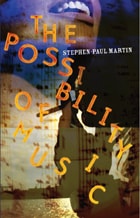
The Possibility of Music
Stephen-Paul Martin
University of Alabama Press, 2007
The Possibility of Music is an imaginative reconstruction of America in the early 21st century. What would our post-9/11 society look like if it were viewed through a series of funhouse mirrors?
Each of Stephen-Paul Martin’s stories is a response to this question, a prose exploration that redefines what it means to write fiction in a world in which the Sistein Chapel has become the Mall of America. Nightmarish at times, playfully amusing at others, Martin’s prose is relentlessly inventive and challenging, relocating the experimental tradition of Joyce, Kafka, Borges, and Marquez in a contemporary context in which intelligent communication has become both impossible and increasingly necessary.
"I’d always told myself that if I ever wrote my own music," the narrator of one story says, "every composition would become its own distinct struggle with aesthetic questions that emerged as the process unfolded." In good part, that’s what animates The Possibility of Music, a book in which John Coltrane’s "Love Supreme" moves through characters and stories like a soundtrack.

The Postal Confessions
Max Garland
University of Massachusetts Press, 1995
These poems wrestle with the inherited myths of their particular time and place. Often set in a small corner of western Kentucky, they explore moments when an individual life becomes implicated in a larger scheme—the realm of Cold War politics, the mysteries of religious faith, the codes and rituals of romantic love. Max Garland shows a lyrical determination to deal with history through the lives, minds, and emotions of ordinary people “stricken with time.”
In poems about baptism, bowling, Greek goddesses, and the hydrogen bomb, Garland seems to say that knowledge and even revelation might come from anywhere. The book ends with the image of the empty space Michelangelo left between the hands of Adam and God on the ceiling of the Sistine Chapel; that tension between what lasts and what passes away, comprises the territory of these poems.
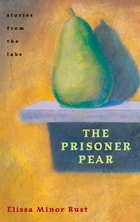
The Prisoner Pear
Stories from the LakeElissa Minor Rust
Ohio University Press, 2005
The twelve stories in The Prisoner Pear: Stories from the Lake take place in an affluent suburb of Portland, Oregon, but they could be taken from any number of similar enclaves across the United States. These stories infuse stark reality with occasional hints of magical realism to explore what the American dream means to twenty-first-century suburbanites. In a city where the homecoming queen still makes the front page of the weekly newspaper, ducks caught in storm drains and stolen campaign signs make up the bulk of the paper’s crime reports. The community’s hidden complexities, however, rival those of Sherwood Anderson’s Winesburg, Ohio.
Each of the stories begins with an entry from the newspaper’s police blotter. Elissa Minor Rust fills in the background to these small, odd events-a headless parakeet found in a mailbox, a nude jogger, an alarmingly deathlike discarded teddy bear. Her stories, both humorous and disturbing, probe beneath the clear, hard surface of a community into the murky depths beneath.
The lake at the center of town is a constant in the lives of this town’s people, and it reappears throughout the book as a symbol of wealth and power, of love and loss. The Prisoner Pear offers a rare look inside the heart of suburban America. Reading these stories is, as one character observes, “like seeing the town from the inside out, as if the lake was its heart and the rest merely its bones and skin.”
The Prophecy and Other Stories
Drago Jancar
Northwestern University Press, 2009
These newly collected short stories reveal a master at the top of his game. Drago Jancar possesses an acute understanding of the human psyche, enabling his stories to resonate beyond their particular milieu. This collection features seven pieces, drawn from four different collections, that together present the struggle of individuals against powerful forces. The characters try to make sense of a world of shifting borders and changing names that make the idea of a "homeland"—either literal or figurative—a dream rather than a reality.
The Prose of the Mountains
Three Tales of the CaucasusAleksandre Qazbegi
Central European University Press, 2015
The Prose of the Mountains contains three tales of the Caucasus by Aleksandre Qazbegi, one of the most prescient and gifted chroniclers of the Georgian encounter with colonial modernity. His stories offer an invaluable counterpoint to the predominantly Russian narratives that have hitherto shaped scholarly accounts of the nineteenth-century Caucasus. “Memoirs of a Shepherd” poignantly chronicles the young author’s decision to pass seven years of his life as a shepherd with Georgian mountaineers. “Eliso” (the name of a Chechen girl) offers one of the most searing accounts on record of the forced migration of this people from their homeland to Ottoman lands. Set in the sixteenth century, “Khevis Beri Gocha” (the name of a Georgian village chief) classically chronicles a tragic misunderstanding between a severe father and his loving son.
The Quaker City, or The Monks of Monk Hall
A Romance of Philadelphia Life, Mystery, and CrimeGeorge Lippard
University of Massachusetts Press, 1995
The Questionable Ones
Judith Keller
Seagull Books, 2023
With quirky humor and wry insight, Swiss author Judith Keller’s micro-fictions unravel the fabric of daily life. She delves into the aporia of language by taking idiomatic expressions literally, unpacking the multiple meanings of words, and confounding expectations. Seven Zurich tram stops provide the framework for these familiar yet absurd portraits of passers-by, fellow passengers on the tram, the unemployed and the overemployed, the innocent and the suspicious, young mothers and confused elderly. The reader is taken on a journey through the city and offered glimpses of people going more or less successfully about their lives. These deceptively banal glimpses, however, show us more than we expect—they turn the lens back on us, puncture our complacency and ask, "Who are you to judge?"
The characters are hapless and far-fetched, trying to find their footing on shifting ground and grateful for what happiness they can find. In just a sentence or two, Keller unlocks metaphysical trapdoors. The Questionable Ones offers a collection of snapshots that reveal the extraordinary lurking inside the ordinary and the ordinary at the core of the extraordinary.
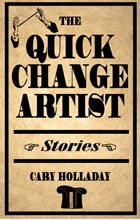
The Quick-Change Artist
StoriesCary Holladay
Ohio University Press, 2006
In these stories of magic and memory, clustered around a resort hotel in a small Virginia community, Cary Holladay takes the reader on an excursion through the changes wrought by time on the community and its visitors. From the quiet of a rural forest to the rhythms of rock and roll, The Quick-Change Artist is at once whimsical and hard-edged, dizzying in its matter-of-fact delivery of the fantastic.
Romance, a sense of place and belonging, and the supernatural—especially in the lives of children coming of age—offer windows into worlds beyond the ordinary throughout The Quick-Change Artist. In the title story, a young chambermaid is in love with a foreign magician who performs at the hotel where she works. In “Heaven,” set during the 1918 flu epidemic, a struggling mother and son rely on the support of their fortune-telling plow horse. The narrator of “Jane’s Hat” recalls a childhood enlivened by an unusual school principal and a friend who starts finding beauty everywhere.
Horses and the people who love them, wanderers and those who feed them, creatures that disappear and those who search for them: these are stories with a constant heart.

The Rebel's Silhouette
Selected PoemsFaiz Ahmed Faiz, translated and edited by Agha Shalid Ali
University of Massachusetts Press, 1995
The Registry of Forgotten Objects
StoriesMiles Harvey
The Ohio State University Press, 2024

The Rest Is Slander
Five StoriesThomas Bernhard
Seagull Books, 2022
“The cold increases with the clarity,” said Thomas Bernhard while accepting a major literary prize in 1965. That clarity was the postwar realization that the West’s last remaining cultural reference points were being swept away by the ever-greater commodification of humankind. Collecting five stylistically transitional tales by Bernhard, all of which take place in sites of extreme cold, this volume extends that bleak vision of the master Austrian storyteller.
In “Ungenach,” the reluctant heir of an enormous estate chooses to give away his legacy to an assortment of oddballs as he discovers the past of his older brother, who was murdered during a career in futile colonialist philanthropy. In “The Weatherproof Cape,” a lawyer tries to maintain a sense of familial solidarity with a now-dead client with the help of an unremarkable piece of clothing. “Midland in Stilfs” casts a jaundiced eye on the laughable efforts of a cosmopolitan foreigner to attain local authenticity on a moribund Alpine farmstead. In “At the Ortler,” two middle-aged brothers—one a scientist, the other an acrobat—meditate on their unusual career paths while they climb a mountain to reclaim a long-abandoned family property. And in “At the Timberline,” the unexpected arrival of a young couple in a mountain village leads to the discovery of a scandalous crime that casts a shadow on the personal life of the policeman investigating it.
The River of Lost Voices
Stories from GuatemalaMark Brazaitis
University of Iowa Press, 1998
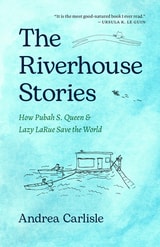
The Riverhouse Stories
How Pubah S. Queen and Lazy LaRue Save the WorldAndrea Carlisle
Oregon State University Press, 1986
40th anniversary edition of a rediscovered classic
When Pubah and Lazy LaRue move to a houseboat on an Oregon river, they find themselves immersed in a life filled with whimsical adventures. Even though their dwelling is ancient, tippy, and in need of endless repairs, their affection for it, for river life, and for one another does not wane. These linked stories teem with life and with love for their friends and for new neighbors—other houseboat people, ducks, beavers, muskrats, and all else the river has to offer. Lazy LaRue writes stories; Pubah is an apprentice electrician. Their world encompasses the mundane and the fanciful—from lassoing logs and rewiring a houseboat to dreaming of new inventions and traveling in a hot air balloon.
Filled with humor, optimism, and playful exploration, the stories in these pages bring warmth and inspiration. Illustrations by Mary Narkiewicz capture the quirky quality of the tales with splendid charm and add to the dreamlike quality of the storytelling. A new afterword by the author reflects on writing The Riverhouse Stories and on the cultural climate of the time, showing how much the world has changed over four decades.
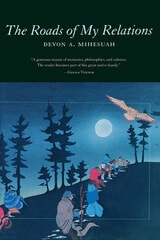
The Roads of My Relations
Devon A. Mihesuah
University of Arizona Press, 2001
"I've traveled a lot of roads, but never alone. My relations are with me," says Billie McKenney, one of the matriarchs of the complex family of Choctaws searching for peace as the white world rapidly encroaches on their tribal land, politics, and values. In her first collection of stories, Native American writer Devon A. Mihesuah chronicles the lives of several generations of a close-knit Choctaw family as they are forced from their traditional homeland in nineteenth-century Mississippi and endure unspeakable sorrows during their journey before settling in southeastern Oklahoma.
Blending family lore, stark realism, and vivid imagination, The Roads of My Relations relays a strong sense of Choctaw culture and world view in absorbing tales of history and legend. Unfolding through the voices and actions of family members, confused half-bloods, and unlikely heroes—not all of them living or even human—the stories tell of the horrors of forced removal, the turbulence of post Civil War Indian Territory, the terrifying violence suffered at the hands of immortal Crow witches, and the family's ultimate survival against forces of evil. Time-traveling ghosts, mysterious medicine men, and eerie shape-shifters share the pages with proud matriarchs, mischievous schoolgirls, and loving siblings.
Together, these interwoven stories express the strength and persistence of a tribe whose identity and pride have survived the disruptions of colonialism. With The Roads of My Relations, Devon A. Mihesuah has created a universal and timeless exploration of heritage, spirituality, and the importance of preserving and passing on tradition.
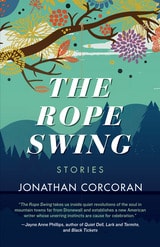
The Rope Swing
StoriesJonathan Corcoran
West Virginia University Press, 2016
A once-booming West Virginia rail town no longer has a working train. The residents left behind in this tiny hamlet look to the mountains that surround them on all sides: The outside world encroaches, and the buildings of the gilded past seem to crumble more every day.
These are the stories of outsiders—the down and out. What happens to the young boy whose burgeoning sexuality pushes him to the edge of the forest to explore what might be love with another boy? What happens when one lost soul finally makes it to New York City, yet the reminders of his past life are omnipresent? What happens when an old woman struggles to find a purpose and reinvent herself after decades of living in the shadow of her platonic life partner? What happens to those who dare to live their lives outside of the strict confines of the town’s traditional and regimented ways?
The characters in The Rope Swing—gay and straight alike—yearn for that which seems so close but impossibly far, the world over the jagged peaks of the mountains.
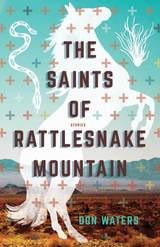
The Saints of Rattlesnake Mountain
StoriesDon Waters
University of Nevada Press, 2017
Soldiers, seekers, priests, prisoners, and surfers pursue their fate amid bizarre, sometimes overwhelming circumstances. In “La Luz de Jesús,” a gutless Los Angeles screenwriter, a believer in nothing but the god of Hollywood, must reorient after he encounters a group of penitents in New Mexico’s Sangre de Cristo Mountains. The decorated soldier in “Española” faces more chaos back home than he did during his tour in Iraq. And “The Saints of Rattlesnake Mountain” pairs a “trustee” prison inmate and a wild mustang horse, both wards of the state of Nevada, as they fumble toward a spiritual truth.
These stories capture the spirit of a region and its people. Once again Waters assembles an unconventional cast of characters, capturing their foibles and imperfections, and always rendering them with compassion as these modern-day martyrs and spiritually haunted survivors strive for some kind of redemption.
Ingenious, sometimes forbidding, often absurd, and altogether original, The Saints of Rattlesnake Mountain is a stirring tribute to the lives, loves, and hopes of the faithful and the dispossessed.

The Science Fiction of Kris Neville
Barry N. Malzberg
Southern Illinois University Press, 1984
Other stories in this anthology are “Old Man Henderson,” “The Hunter,” “Underground Movement,” “The Forest of Zil,” and “From the Government Printing Office.”
In most of the stories Neville writes of loneliness, isolation, alienation, intolerance of anything or anyone different, and of insanity created by the pressures of living. Along with madness of various kinds, his stories explore the essence of human nature and individuals interacting with one another as well as with society. As Malzberg notes, Neville, unlike many science fiction writers, was a serious author interested in “Big ideas.”

The Selected Stories of Ann Scott-Moncrief
Ann Scott-Moncrief
Catholic University of America Press, 2026
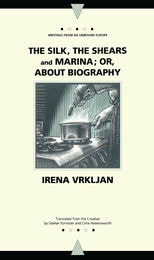
The Silk, the Shears and Marina; or, About Biography
Irena Vrkljan
Northwestern University Press, 1999
These are the first two volumes of the Croatian poet and novelist Irena Vrkljan's lyrical autobiography. Although each novel illuminates the other, they also stand alone as original and independent works of art. In The Silk, the Shears, Vrkljan traces the symbolic and moral significance of her life, and her vision of the fate of women in her mother's time and in her own. Marina continues the intense analysis of the poetic self, using the life of Marina Tsvetaeva to meditate on the processes behind biography.
The Sins of Childhood and Other Stories
Boleslav Prus
Northwestern University Press, 1996
The Spirit Papers
Elizabeth Metzger
University of Massachusetts Press, 2017
All right, I'm a little afraid.
It's the zeroing in of All That Could
Possibly Go Wrong vs. Myself.
—"Small Talk with an Imagined Son"
The Spirit Papers explores the magical thinking that precedes impending and inevitable loss, the taboo fantasia that occurs in the crippling timelessness of anticipation. Grieving for the future with a spiritual clarity characterized by ritual and doubt, Metzger's lines are chameleons to every feeling. In the interminable window of expecting the unexpected, the poems ultimately materialize the very events they wish to ward off. The Spirit Papers chases mortality with equal parts disbelief and love.
The Stars, The Earth, The River
Short Stories by Le Minh KhueLe Minh Khue
Northwestern University Press, 1997
The Stars, the Earth, the River contains an excellent introduction by the translators, grounding the stories in Le Minh Khue's personal history. You simultaneously feel the rage of the author and the narrator when Khue disparagingly notes that the conversations around her center on luxuries, motor scooters, and business deals. Of what use, these stories ask, is such suffering? How can a culture honor the losses of war?
The Stone Child
StoriesStories by Gary Fincke
University of Missouri Press, 2003

The Stories of Hans Christian Andersen
A New Translation from the DanishHans Christian Andersen
Duke University Press, 2005
In this collection are twenty-two tales that best represent Andersen’s literary legacy, including such classics as “The Little Mermaid,” “The Ugly Duckling,” “Thumbelisa,” and “The Emperor’s New Clothes,” as well as largely unfamiliar stories like “By the Outermost Sea.” Illuminating notes clarify references in the tales. And in an introductory essay, the Franks explore the writer and his times, placing the enigmatic and often bizarre figure of Andersen among his literary contemporaries, such as Charles Dickens and Søren Kierkegaard, with whom he crossed paths; and they bring to life Andersen’s fascinating relationship with the United States. Illustrated with the delicate and beautiful drawings that accompanied the original Danish publication, The Stories of Hans Christian Andersen will delight readers of all ages.
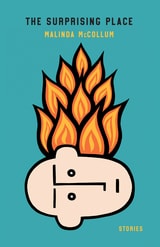
The Surprising Place
StoriesMalinda McCollum
University of Massachusetts Press, 2018
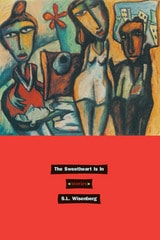
The Sweetheart Is In
S.L. Wisenberg
Northwestern University Press, 2001
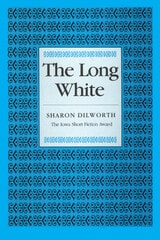
The The Long White
Sharon Dilworth
University of Iowa Press, 1988
In the sparsely settled hills of Michigan's Upper Peninsula, winter's toughness is matched only by the animosity and affection of its inhabitants for each other and for the land that unnerves them. In The Long White, Sharon Dilworth evokes a place dominated by two great lakes whose power and ferocity influence the lives of every inhabitant. The particularities of place and character come together with the clarity and exactitude of a fresh snowfall that both veils and illuminates a landscape.
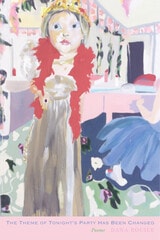
The Theme of Tonight's Party Has Been Changed
PoemsDana Roeser
University of Massachusetts Press, 2014
Sui generis, Dana Roeser's poems are spoken by a stand-up comic having a bad night at the local club. The long extended syntax, spread over her quirky, syncopated short lines, contains (barely) the speaker's anxieties over an aging father with Parkinson's, the maturation of two daughters, friends at twelve-step meetings and their sometimes suicidal urges—acted on or resisted—and her own place in a world that seems about to spin out of control. Bad weather and tiny economy cars speeding down the interstate next to Jurassic semis become the metaphor, or figurative vehicle, for this poet's sense of her own precariousness.
Roeser brings a host of characters into her poems—a Catholic priest raging against the commercialism of Mother's Day, the injured tennis player James Blake, a man struck by lightning, drunk partygoers, an ex-marine, Sylvia Plath's son Nicholas Hughes, a neighbor, travelers encountered in airport terminals, various talk therapists—and lets them speak. She records with high fidelity the nuances of our ordinary exigencies so that the poems become extraordinary arias sung by a husky-voiced diva with coloratura phrasing to die for, “the dark notes” that Lorca famously called the duende. The book is infused with the energy of misfortune, accident, coincidence, luck, grace, panic, hilarity. The characters and narrator, in extremis, speak their truths urgently.
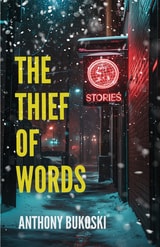
The Thief of Words
Anthony Bukoski
University of Wisconsin Press, 2025
The lightly interconnected stories in this riveting collection are split between the Polish American communities of northern Wisconsin and Louisiana, where refugees from World War II were resettled. Exploring themes of dislocation and assimilation, love and loneliness, and generational conflict, Anthony Bukoski admirably paints portraits of people doing their best, despite the odds and their sometimes-thwarted attempts to follow the urgings of their better angels.
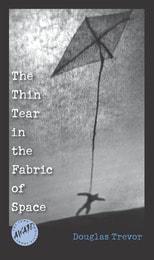
The Thin Tear In The Fabric Of Space
Douglas Trevor
University of Iowa Press, 2005
The Thin Tear in the Fabric of Space gathers stories about coping with grief, trying to love people who have died, and—more broadly—leaving old versions of the self behind, sometimes by choice and sometimes out of necessity. In each of the nine stories, Douglas Trevor’s characters are forced to face uncomfortable realities. For Elena Gavrushnekov in the title story, that means admitting after the death of her beloved that she still longs for contact with other human bodies. For Peter in “Central Square,” it is realizing that, like his deceased father before him, he is drinking himself to death. Unable to confront his incapacitated mother and the memory of the plane crash that killed his father, Edwin Morris in “Saint Francis in Flint” is compelled to acknowledge that his saintly aspirations are not what they appear to be, while Sharon Mackaney in “The Surprising Weight of the Body's Organs” struggles with uncontrollable outbursts of rage in the wake of her young son’s death.
In moments of great pain and loss, when self-expression seems impossible and terribly useless, the characters in these stories nonetheless discover the tenderness of others. In “The River,” the narrator finds that the friendship he has forged with a French girl with whom he can only just communicate has bred intense, almost intuitive compassion, while in “Fellowship of the Bereaved,” the disconsolate brother of the deceased sister who occupies the empty center of the story uncovers not only anger in his parents but also empathy and humor. As these characters persevere in their own lives, they do so mindful of, and humanized by, the experiences of having seen people they know and love slip unexpectedly into the thin tear in the fabric of space: that quiet chasm that so resolutely separates the living from the dead.
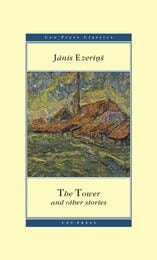
The Tower
and other storiesJanis Ezerins
Central European University Press, 2012
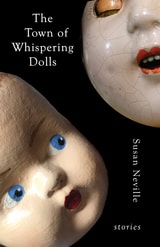
The Town of Whispering Dolls
StoriesSusan Neville, Foreword by Shelley Jackson
University of Alabama Press, 2020
WINNER OF FC2’S CATHERINE DOCTOROW INNOVATIVE FICTION PRIZE
Stories haunted by the remains of the industrial Midwest, the opioid epidemic, and the technology of war
Located somewhere in the rust belt in the early twenty-first century, residents of the town of Whispering Dolls dream of a fabled and illusory past, even as new technologies reshape their world into something different and deeply strange. Dolls walk down the streets, cradling their empty heads and letting the wind turn them into flutes. A politician heads to Washington, DC, and leaves a toxic underground plume in his wake. A woman eats car parts instead of confronting the children who have forgotten her. A young woman falls in love with the robot who took her job at the candy factory.
In The Town of Whispering Dolls, it is usually the grandmothers and the children who grieve. Feeling invisible, in the story “Here,” a woman who has buried her children looks up at the sky where commercial and military jets fly overhead and tries to express her rage to the rich and powerful: “Keep flying above us in your planes. From one coast to the other, keep right on flying over us! We test your bombs and your beloved warriors. Here. Right here. Look down.”
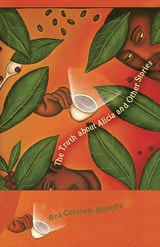
The Truth about Alicia
and Other StoriesAna Consuela Matiella
University of Arizona Press, 2002
Alicia is not the only woman with problems. In these stories about contemporary and traditional Latinas, Ana Consuelo Matiella uses sensitivity and wit to address issues faced by women of color and women everywhere—issues largely having to do with love: between men and women, mothers and daughters, women and friends. In engaging stories about family myths, gossip, and lies, comadres converse over afternoon café con leche. "I'm sure that I was the only wife whose husband was teaching their daughter to do Cheech Marin imitations," remarks one of Matiella's characters. Another sings the praises of the chocolate milkshake diet: "That’s one advantage of living on the border. You get to try all the latest gringo inventions as soon as they hit the streets." Through encounters with angels, conversations with dogs, and relationships with men overly concerned with the dimensions of their manhood, Matiella offers a new exploration of the human condition—one showing us that if we cannot laugh at life, no matter how tragic the circumstances, we are surely doomed.
With humor and insight that come only through close observation of her fellow human beings, this gifted writer brings new twists to familiar scenes. The Truth about Alicia and Other Stories is an authentic portrayal of the world of contemporary Chicanas that will delight everyone who enters it.
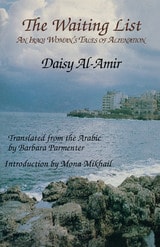
The Waiting List
An Iraqi Woman's Tales of AlienationBy Daisy Al-Amir
University of Texas Press, 1994
Daisy Al-Amir is one of the more visible figures in women's fiction in the Arab world today. This collection of stories, originally published in Lebanon as Ala La'ihat al-Intizar, is the most recent of her five publications. Her stories intimately reflect women's experiences in the chaotic worlds of the Lebanese civil war and the rise of Saadam Hussain as Iraq's leader. Set in Iraq, Cyprus, and Lebanon, the stories shed light on an unusual Middle East refugee experience—that of a cultural refugee, a divorced woman who is educated, affluent, and alone.
Al-Amir is also a poet and novelist, whose sensual prose grows out of a long tradition of Iraqi poetry. But one also finds existential themes in her works, as Al-Amir tries to balance what seems fated and what seems arbitrary in the turbulent world she inhabits. She deals with time and space in a minimalist, surreal style, while studying the disappointments of life through the subjective lens of memory. Honestly facing the absence of family and the instability of place, Al-Amir gives lifelike qualities to the inanimate objects of her rapidly changing world.
In addition to the stories, two examples of the author's experimental poems are included. In her introduction, Mona Mikhail places these stories and poems in the context of contemporary Islamic literature and gender studies.

The War of the Fatties and Other Stories from Aztec History
By Salvador Novo
University of Texas Press, 1993
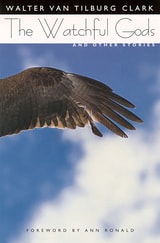
The Watchful Gods And Other Stories
Walter Van Tilburg Clark
University of Nevada Press, 2004
Critic John R. Milton once said that Walter Van Tilburg Clark "did perhaps more than anyone else to define (in his fiction) the mode of perception, the acquisition of knowledge, and the style which we tend to call Western." In 1950, Walter Van Tilburg Clark, author of the acclaimed novel The Ox-Bow Incident, published a collection of short stories that had already won distinction in various national magazines. The collection was well received by reviewers, and subsequent critics have noted that these stories reflect both Clark’s literary power and the major concerns of his novels: the interior and intuitive complexities of good and evil, and the fragile, intricate web that connects humankind to the rest of the natural world.
A foreword by Ann Ronald, one of the West’s most astute literary critics, sets the stories into the context of Clark’s oeuvre and illuminates the way they reveal crucial characteristics of this writer’s imagination.
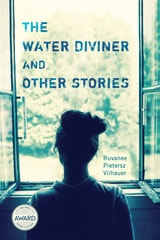
The Water Diviner and Other Stories
Ruvanee Pietersz Vilhauer
University of Iowa Press, 2018
In this thought-provoking collection, Sri Lankan immigrants grapple with events that challenge perspectives and alter lives. A volunteer faces memories of wartime violence when she meets a cantankerous old lady on a Meals on Wheels route. A lonely widow obsessed with an impending apocalypse meets an oddly inspiring man. A maidservant challenges class divisions when she becomes an American professor’s wife. An angry tenant fights suspicion when her landlord is burgled. Hardened inmates challenge a young jail psychiatrist’s competence. A father wonders whether to expose his young son’s bully at a basketball game. A student facing poverty courts a benefactor. And in the depths of an isolated Wyoming winter, a woman tries to resist a con artist. These and other tales explore the immigrant experience with a piercing authenticity.
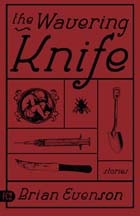
The Wavering Knife
StoriesBrian Evenson
University of Alabama Press, 2004
Where reality fractures and darkness takes shape.
Replete with the brutality, primordial waste, and savage blankness familiar to readers of his earlier works, Evenson's Kafkaesque allegories entice the mind while stubbornly disordering it. In the title story an obsessive consciousness folds back on itself, creating a vertiginous mélange of Poe and Borges, both horrific and metaphysical. Here, as in "Moran's Mexico," and "Greenhouse," the solitary nature of reading and writing leads characters beyond human limits, making the act of putting words to paper a monstrous violation opening onto madness. In "White Square" the representation of humans by dimly colored shapes confirms our feeling that something lies behind these words, while seeming to mock us with the futility of seeking it. Evenson's enigmatic names-Thurm, Bein, Hatcher, Burlun-placeable landscapes, and barren rooms all combine to create a semblance of conceptual abstraction, as though the material universe had come to exist inside someone's head.
Small wonder that Evenson's work has attracted so much attention among philosophers, literary critics, and other speculative intelligences, for it continuously projects a tantalizing absence, as though there were some key or code that, if only we knew it, would illuminate everything. However, the blade of discernment wavers, and we are left to our own groping interpretations.
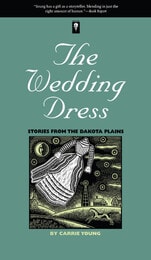
The Wedding Dress
Stories From The Dakota PlainsCarrie Young
University of Iowa Press, 1992
These finely wrought stories unfold in the Dakotas during the struggling pioneer days and bone-dry landscape of the thirties as well as the verdant years that followed, where the nighttime plains are bathed by softly radiant harvest moons shining down from dazzling northern skies. Young's absorbing narratives begin with the pleasant sense of “Once upon a time…” anticipation, but the firmly sketched details, warm humor, and vivid characterizations reveal an unanticipated and satisfying realism.
The haunting title story is about a beautiful and tragic pioneer woman and her wedding dress; her gown takes on a life of its own and turns into an enduring symbol for the grace and compassion of homesteading women on the plains. In “Bank Night,” a hired hand working during the midst of the Depression wins $250 at the movies, careening him into a single night of notoriety that becomes a legend in its time. “The Nights of Ragna Rundhaug” tells the tale of a woman who wants only to be left alone with her white dog, Vittehund, and her crocheting but instead is propelled into a life of midwifery “because there was no one else to do it.” The babies have predilection for arriving during blizzards and always at night, when she must be transported across the dark plains by frantic husbands who have fortified themselves with strong drink and headstrong horses.
All the stories in The Wedding Dress are linked by the enigmatic Nordic characters who people them and by the skill with which Young draws them. Emotions run so deep that they are seldom able to surface; when they do the interaction is extraordinarily luminous, both for the characters themselves and for the fortunate reader. The Wedding Dress is for all readers, young and old.
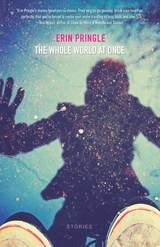
The Whole World at Once
StoriesErin Pringle
West Virginia University Press, 2017
Dark, strange beauties, all of the stories in The Whole World at Once follow the lives of people grappling with what it means to live in a world with death.

The Women Carry River Water
PoemsNguyen Quang Thieu
University of Massachusetts Press, 1997
This landmark collection represents the first English translation of poetry by Nguyen Quang Thieu, a significant Vietnamese writer of the post-1975 generation. Translated collaboratively by acclaimed poet Martha Collins and the author himself, this bilingual volume presents verses rooted deeply in Vietnamese cultural traditions that honor the dignity of daily labor, the resilience of ordinary people, and the spiritual dimensions of human experience in contemporary Vietnam.
Thieu's work draws upon a rich Vietnamese poetic tradition while addressing themes of displacement, reconstruction, memory, and the search for meaning in the aftermath of conflict. The poems capture the essence of Vietnamese life—its rhythms, relationships, and philosophical underpinnings—through images drawn from nature, labor, family, and community. The bilingual format stands as a bridge between Vietnamese and American literary traditions, and honors the linguistic and cultural dimensions of Thieu groundbreaking collection.
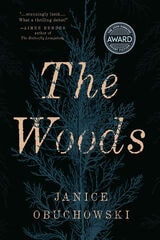
The Woods
StoriesJanice Obuchowski
University of Iowa Press, 2022
What do we find in the woods? An uplifting of spirit or a quieting of sorrow. A sense of being haunted by the past. Sometimes rougher, more violent things: abandoned quarries and feral cats, black bears, brothers caught up in an escalating war, a ghost who wishes to pass on her despair, monsters who boom with hollow ecstatic laughter. But also songbirds: the hermit thrush and the winter wren. Rushing rivers glossy with froth. A nineteenth-century inn that’s somehow gotten by all these years. And far within, a vegetal twilight and constant dusk that feels outside of time. This remarkable debut illuminates the ways we all carry within ourselves aspects stark, beautiful, wild, and unknowable.
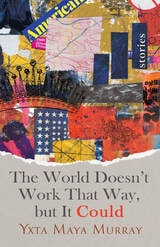
The World Doesn't Work That Way, but It Could
StoriesYxta Maya Murray
University of Nevada Press, 2025
The Millions' Most Anticipated: The Great Second-Half of 2020 Book Preview
The gripping, thought-provoking stories in Yxta Maya Murray’s latest collection find their inspiration in the headlines. Here, ordinary people negotiate tentative paths through wildfire, mass shootings, bureaucratic incompetence, and heedless government policies with vicious impacts on the innocent and helpless. A nurse volunteers to serve in catastrophe-stricken Puerto Rico after Hurricane Maria and discovers that her skill and compassion are useless in the face of stubborn governmental inertia. An Environmental Protection Agency employee, whose agricultural-worker parents died after long exposure to a deadly pesticide, finds herself forced to find justifications for reversing regulations that had earlier banned the chemical. A Department of Education employee in a dystopic future America visits a highly praised charter school and discovers the horrific consequences of academic failure. A transgender trainer of beauty pageant contestants takes on a beautiful Latina for the Miss USA pageant and brings her to perfection and the brink of victory, only to discover that she has a fatal secret.
The characters in these stories grapple with the consequences of frightening attitudes and policies pervasive in the United States today. The stories explore not only our distressing human capacity for moral numbness in the face of evil, but also reveal our surprising stores of compassion and forgiveness. These brilliantly conceived and beautifully written stories are troubling yet irresistible mirrors of our time.